Tag Archives: ephemera

March On

The first of March: a notable historical day from my own geographical perspective, as it marks the anniversaries of both the incorporation of the first English “city” in North America, my hometown of York, Maine (in 1642), and the commencement of the most dominant event (unfortunately) in the history of my adopted hometown of Salem, Massachusetts: the Witch Trials of 1692. March is also one of my favorite months, so I always wake up happy on its first day. I am sure that this is a minority opinion among my fellow New Englanders, for whom March is generally perceived as the muddiest month. It certainly can be muddy here, and cold, snowy, rainy, dark, windy, and raw. But it can also be bright (like today) with a brilliant sun that seems to highlight the material world in stark detail. It is the month of all weather, and also a month of transition. That’s what I like about it:  you are heading somewhere in March (towards spring); you are not already there (like winter or summer). I like to be en route, in transition, looking forward, in the process—and March feels like that to me, all month long. If you look at magazine covers from their turn-of-the-last-century Golden Age, advertising artistry rather than celebrity, many seem to convey that movement, if only to depict the wind. At least those that don’t feature rabbits.

M27740-26 001

March Harpers 1895

March 1896 2

March Inland Printer 1896

March Black Cat

March 1897

M33739-10 001

March Scribners 1905

M33739-1 001

March covers from 1895 (2); 1896 (3);1897; 1900; 1905 & 1907; Swann Auction Galleries, Boston Public Library, and Library of Congress.


Home, Hearth & History

I’m really looking forward to an upcoming exhibition at the Concord Museum: Fresh Goods: Shopping for Goods in a New England Town, 1750-1900, offered as part of a state-wide MASS Fashion collaborative project which will include a fall exhibition at the Massachusetts Historical Society guest-curated by my Salem State colleague Kimberly Alexander: Fashioning the New England Family. I thought I had fashion fatigue, because there have been so many clothing-based exhibitions over the past few years, but these exhibitions look a bit different to me—there’s something more active and engaging about the words shopping and furnishing. Instead of just being wowed by the artifacts, we can learn how and why they came to be created and acquired, processes that involved not just cultural considerations, but also economic and social factors. If I were a curator, I think I would like to create a similar exhibition focusing on home furnishings, because that could offer up insights into so many crafts, industries, and distributors—especially over the nineteenth century as households were affected increasingly by market forces. Recapturing and representing colonial “hearths and homes” and “daily life” were Colonial Revival preoccupations over a century ago; I think we could do with a refresh–and an expanded chronological focus.

Home Furnishings BA 1869

373 Essex Street Joseph Ropes©Boston Athenaeum and Phillips Library, Timothy Ropes Papers (MSS 365).

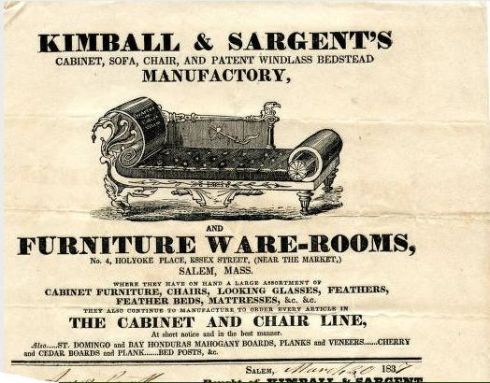
I imagine there are two approaches to researching the history of household furnishing: presume by utilizing prescriptive materials like trade catalogs and books on contemporary home decoration, or establish through receipts, diaries, and accounts. There are certainly lots of collections of the former, at the Smithsonian, here, and the Winterthur Library, to name just a few sources. Individual household accounts are more decentralized, of course, and for Salem we would be quite dependant on the collections of the Phillips Library: the marvelous hand-drawn sketch by Joseph Ropes of his bedroom at 373 Essex Street above was included in a blog post published by the library which is no longer available, but I was so taken with it I snipped it right up, fortunately. Imagine researching the furnishing of just this one room: that odd stove, so many chairs, the textiles on the bedspread and chair? Wherever they end up, and hopefully digitized, all those family papers in the Phillips have such a wealth of information within—capable of tracing the history of decades of the China Trade and a single year in the material life of one Salem household. But until they see the light of day, we have some other sources: the Winterthur Library’s digital collection of ephemera will not enable me to source Joseph Ropes’ room, but it can give us a few glimpses into Salem’s material past.

Home Furnishings 1801

Liverpool War NA 2

Home Furnishing Waters

Waters

Home Furnishings 4

Home Furnishings 2

Printed_bill 1862

Home Furnishings 3

Home Funishings

A crate of Liverpool Ware for Mr. Nathaniel Burnham (?), 1801; perhaps a pattern such as this (Northeast Auctions)? Andirons and a Kettle for Captain John Waters and the Captain himself (Northeast Auctions); furniture for another Mr. Waters, 1861; 14 yards of black silk for Mr. Goodhue; pillow and furniture manufacturers in the 1880s, Winterthur Library.


Curtain Lectures

It was Burns Night at Hamilton Hall last night, and my husband and I were charged with giving the Toast to the Lassies and Reply. After a week steeped in the Ploughman Poet, both of us were a bit uncomfortable with the very bawdy Burns in this year of #metoo, so he went with the more inspiring Rights of Woman as the basis of his toast, which meant I had to go for the uplifting too. But I kind of wish he had gone with one of my favorite Burns poems, The Henpecked Husband. I don’t like it for its overall sentiment, of course, but because of just one phrase, curtain lecture, an idiom which I’ve used in class time and time again, because it always provokes a conversation!

The Henpecked Husband

Curs’d be the man, the poorest wretch in life, The crouching vassal to a tyrant wife!  Who has no will but by her high permission, What has not sixpence but in her possession; Who must to he, his dear friend’s secrets tell, Who dreads a curtain lecture worse than hell. Were such the wife had fallen to my part, I’d break her spirit or I’d break her heart; I’d charm her with the magic of a switch. I’d kiss her maids, and kick the perverse bitch.

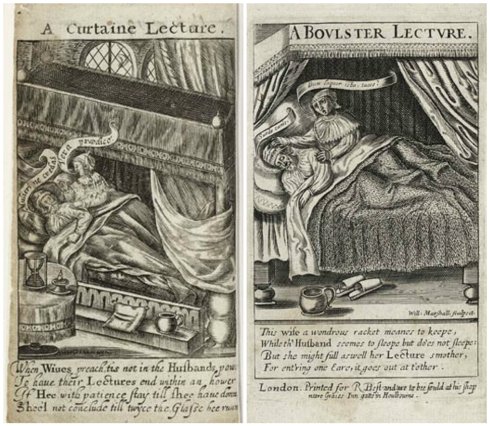
Burns certainly didn’t coin this phrase; it had been around for quite a while. In my courses, I use the frontispieces from Thomas Heywood’s Curtaine Lecture (1637) and Richard Brathwaite’s Art Asleep, Husband? (1640) but I think the expression predates these works as well. It seems very Shakespearian to me, but the heavily-curtained seventeenth-century bed provides the perfect “frame” for wifely “advice”.

Curtain Lecture collage

If you pop these images up before a class of 19-year-olds you are immediately rewarded with their focused engagement in the history of women, marriage, gender relationships, satirical discourse, and material culture (inevitably their attention strays to the “alarm clock” on the table in the Heywood illustration). Lots of comments, lots of questions, all of which can be contextualized and connected to other timely trends. Obviously the notion had a wide appeal—or recognition–in the seventeenth century and after, which is why it survived up until Burns’ time. In an earlier post, I showed the Richard Newton caricature that dates from around the time of The Henpecked Husband, and it is one of many variations on the theme published in this era, give or take a few decades. As the era of curtained-beds closed, the curtain lecture continued, and was revived quite dramatically by the publication of Mrs. Caudle’s Curtain Lectures by Douglas Jerrold in Punch in 1845. These 37 illustrated lectures were published in book form that same year, and reissued frequently thereafter, inspiring a wave of  variant visual expressions in all sorts of mediums: stereoviews, postcards, even a board game. Now it is a general rule of mine that once animals (or birds) take the place of people a concept has jumped the shark (with a few exceptions), and it’s hard to conceive the curtain lecture could have lasted through the twentieth century in any case, but nevertheless it survives as an effective teaching tool.

Curtain Lecture J. Lewis Marks 1824

Caudle2

Caudle 3 John Leech

mrs-caudle-s-curtain-lecture-victorian-card-from-punch-lecture-3-modelled-faces-and-real-hair_a-l-1585476-8880731

Curtain Lecture 1907 LOC

Curtain Lectures PC 1905

Curtain Lectures Chickens

Curtain DucksA Curtain Lecture pub. by J. Lewis Marks, 1824, British Museum; illustrations by John Leech for the first edition of Mrs. Caudle’s Curtain Lectures, 1845; Mrs. Caudle Card (with real hair!), Victoria & Albert Museum; 1907 stereoview from the Library of Congress; postcards, c. 1900-1910.


Caretaking and Curating

As frustrating as this past month has been with the prospect of Salem’s history being extracted by the relocation of the Phillips Library it has also been interesting, as I dove into the depths of its catalog so that I could develop a full appreciation of what we will be losing. I’m not an American historian so it was never an essential repository for me, and the life of this blog roughly corresponds with its closure. When I first moved to Salem I would research house histories and a few other things at the Phillips, but I was never truly aware of how rich and vast its collections were until just this past month: now I am awed. And as I discover and rediscover these holdings, I keep coming up with questions about their utility and accessibility: the slow process of digitization at the PEM remains confounding, but now I’m wondering if there is even an institutional interest in these materials. There is no question in my mind that the PEM is a responsible caretaker of its Phillips collections, but is there, or will there ever be, any enthusiasm for their interpretation? Historical records are not preserved merely for the sake of mothballing: they need to come alive through ongoing interpretation and curation. According to their messaging, the PEM hopes to attract scholars to its “state-of-the-art Collections Center” in Rowley via its digitized catalog, but does it have any interest in curating its own collections?  We all thought that the last library exhibition, 2011’s Unbound: Highlights from the Phillips Library at PEM, was meant to tide us over until the reopening of the Phillips in 2013, but perhaps it was indeed the last library exhibition.

Libraries comparable to the Phillips, as well as those with far less resources, have presented wonderful exhibitions over the past few years, both online and in their reading rooms. In lieu of the lists of books which I usually produce at this time of the year, I thought I’d list some library exhibitions from the recent past and present, set forth for the purposes of comparison and perhaps inspiration.

John Carter Brown Library, Global Americana: The Wider Worlds of a Singular Collection (2017). Given the PEM’s global interests and the nature of their collections, a similar exhibition would be easily within reach, really popular, and a great teaching resource. We’re applying for an NEH grant on the trade between Salem and Spain at SSU, so this particular exhibit item, in which a very young nation assesses its trade, caught my eye—but it’s probably the least colorful item in the exhibition.

Curatorian Global Americana JCB

Secretary of State’s Report on the Cod and Whale Fisheries, 1791, John Carter Brown Library, Brown University.


American Antiquarian Society, Louis Prang and Chromolithography. Artist, Innovator, and Collaborator (2015). This exhibition–archived online–features several works by Salem-born artist Fidelia Bridges. The PEM has some great lithographic images, including an amazing Prang process proof that was featured in Unbound—it was really the highlight of the highlights.

Curatorial Prang

L. Prang & Co., “Dipper missing,” Louis Prang: Innovator, Collaborator, Educator. American Antiquarian Society.


Harvard University Map Collection, Pusey Library, Look but Don’t Touch: Tactile Illusions in Maps. Everyone loves maps, and the PEM has a great collection, especially of local maps. A chorographical exhibition would be very interesting, but perhaps a bit too local for the cosmopolitan PEM.

birds-eye-eastern-railroad

“Bird’s-eye View of the Eastern Railroad Line to the White Mountains and Mt. Desert.” Boston: Rand Avery Supply Co., 1890. Harvard University Library.


Delaware Art Museum, The Cover Sells the Book: Transformations in Commercial Book Publishing, 1860-1920 (2017). A wonderful exhibition of notable bookbindings in the collection of the Museum’s Helen Sloan Farr Library & Archives. Thanks to the Phillips librarians’ tweets, pins, and instagram posts, we know that they preside over a treasure chest of beautiful bookbindings, and could easily mount a similar exhibition (or three or four).

Curatorial Del

Helen Farr Sloan Library & Archives, Delaware Art Museum.


Baker Library, Harvard University Business School, The Art of American Advertising, 1865-1910 (ongoing). This digital exhibition of American advertising ephemera is an amazing resource that I visit often. Given the Essex Institute’s all-encompassing policy of collecting old bills, letters, and account books, books, pamphlets, newspapers, magazines, directories, etc…in fact, all articles which now or in the future may throw light on our history, or manners and customs”, there is no shortage of similar materials in the Phillips Library.

Curatorial Baker

Famous (or infamous) “Antikamnia” Skeleton Calendar for 1901, by Louis Crusius, a St. Louis pharmacist and physician. Baker Library, Harvard University.

Phillips Ephemera

Merrill & Mackintire Calendar for 1884, Phillips Library, Peabody Essex Museum.


And finally, photography, and a plea. The Phillips collections include the photographs and papers of two local photographers who established national reputations over their careers: Frank Cousins (1851-1925) and Samuel V. Chamberlain (1895-1975). While many of their photographs were published over their lifetimes and after, others remain entombed in the Phillips. Photography lends itself to digital exhibition particularly, so I’m really hoping that the PEM can release some of these images in that (or any!) form, forever.

Chamberlain collage

Samuel V. Chamberlain at work in France and New England, Phillips Library MSS 369, Peabody Essex Museum.



Severed from Salem

Reading through the Phillips Library catalog is an activity that is simultaneously enticing and frustrating: one can glean the scope of the collections but not access them, provenances are presented but not deeds of gift or deposit (which is standard). Given the missions of its two founding institutions, the Essex Institute and the Peabody Museum, the Phillips’ collections are both regional and global in nature, but one cannot fail to notice the prominence of Salem materials, consequences of content and/or bequest. To supplement that perception, just browse through the century-old Essex Institute Bulletins digitized by the Internet Archive, where you can easily access long lists of donations and deposits from descendants of scores of old Salem families and every type of organization: public, civic, commercial, religious, fraternal and sororal (a word I had to look up!). As is always the case in the Witch City, there’s too much focus on witch trial records: the tragedy of the removal of the Phillips Library by the Peabody Essex Museum is the vast amount of personal and institutional history–a cumulative cultural memory– that will be severed from Salem. Let me offer up just one collection of papers as an illustration: the Almy, Butler, and Robson Family Papers, which encompass the activities and associations of three intertwined Salem families from 1804 to 1982. Through these records, we can (or could) examine the rise and fall of one of Salem’s most prominent department stores, Almy’s, Bigelow and Washburn (1858-1985), a particular phase in the history of the Wesley Methodist Episcopal Church (now the Wesley United Methodist Church on North Street, which donated its archives to the Phillips as well), an edited manuscript of Katherine Butler Hathaway’s famous memoir The Little Locksmith (!!!!!), and considerable correspondence and materials relative to her niece Elizabeth “Libby” Reardon Frothingham’s energetic advocacy for historic preservation both during and after Salem’s battle with urban renewal in the 1960s and 1970s. Personal perspectives on Salem’s history.

Almys PC

Salem-Wesley-ME-Churchx

Phillips PC Just two Salem institutions whose records are preserved in the Phillips Library, and the Essex Institute in its heyday.

The personal nature of historical materials works both ways: the people of Salem should be enabled to engage with their history in a personal way. When I read the detailed catalog entry and finding aid for the Almy, Butler, and Robson family papers, I think of the Almy’s clock that still stands on Essex Street, the first time I read The Little Locksmith, just a few years ago, and Elizabeth Reardon’s house histories for Historic Salem, Inc., which I used as a model for my own reports way back when I first moved to Salem and wanted to learn about my new city house by house. I’ve read about her exciting “discovery” of two Salem first-period houses hiding in (somewhat) plain sight, and just last year, I visited the ongoing restoration of her former house, and saw the cupboards where her records–memorials of decades of service to Salem– were stored. And now they’re off to Rowley?

Reardon 4

Gedney House

Severed 3

Severed 4The Gedney House on High Street, soon after its discovery by Elizabeth Reardon and restoration by Historic New England, and an excerpt from Julie Arrison-Bishop’s article “A Witness to Four Centuries in Salem”, Historic New England Summer 2015; 1965 Boston Globe article on Elizabeth’s discovery of the Samuel Pickman House (hiding under a mansard roof), and the Pickman House today, with the Peabody Essex Museum in the background.


Thanksgiving Menus

If there is one genre of history that has benefitted particularly and immensely from digitization, it is culinary history: cookbooks from all ages are readily available and I easily mined two collections of restaurant menus to come up with a portfolio of Thanksgiving feasts past, from 1883 to the 1950s. The New York Public Library’s Buttolph Collection includes nearly 19,000 menus, and the University of Nevada at Las Vegas’s Digital Collections include a range of menus under the heading “The Art of Dining”. There are many more places to find menus online: a great list is here. I’m not really a foodie, so I was more interested in the evolving cover art than the food, but I have included several bills of fare below: you can find more by going to the sources. These are primarily menus from large hotel restaurants which seem to be concerned with offering their guests multiple choices and courses: turkey is always featured prominently but not exclusively! Last year’s little investigation of the holiday drink “Tom and Jerry” made me very excited to see frozen Tom and Jerry on the 1899 menu of Boston’s Quincy House, and it seems very clear that English plum pudding was a staple on fancy feasts for this most American of holidays until at least World War I.

Thanksgiving 1883 Briggs_House_menu_page_1

Thanksgiving Picture1

Thanksgiving 1898 nypl.digitalcollections.510d47db-3321-a3d9-e040-e00a18064a99.001.q

Thanksgiving nypl.digitalcollections.510d47db-3325-a3d9-e040-e00a18064a99.001.q 1899

Thanksgiving collage

Thanksgiving 1905 nypl.digitalcollections.510d47db-765f-a3d9-e040-e00a18064a99.001.q

Thanksgiving collage 4

Thanksgiving collage2

Thanksgiving collage 3

Hotel_Roosevelt_Thanksgiving_dinner_menu_cover

Thanksgiving 1955 nypl.digitalcollections.a6dbdb16-2467-df3a-e040-e00a18064c6f.001.w

Thanksgiving The_Sands_menu_pages_23 (1) 1957

Thanksgiving 1958 Sands_Hotel_and_Casino_menu_page_1Thanksgiving menus from all over the country and 1883 to 1958 (1883, 1898, 1898, 1999, 1905, 1905, 1906, 1914, 1929, 1955, 1957, 1958), from the Buttolph Collection of the New York Public Library and UNLV’s “Art of Dining” Collection.


Salem Tokens, and my appreciation

Periodically, but continually, I get tokens from readers of my blog—scanned pictures or stories from old magazines, little pamphlets, scraps of Salem history—which I place in a file for safekeeping with the intent that I will devote one post to each item at some point. This file has grown pretty full, so I wanted to expose some of these items to the light of day. I’ve reserved some pieces for their own special posts, but I’m not sure I can contextualize all of these treasures so better just to get them out there as maybe someone else can! I’m so appreciative of all these gifts, and will be donating them to a public repository in due time, but for now I’m holding on to them, because I never know when inspiration will strike, or some other little piece of paper will come along to amplify something I already have. So here we go, perhaps the first of what may become a series of “tales from the files” posts, beginning with a lovely fundraising pamphlet issued by the Essex Institute in 1929, when its directors were seeking to raise the grand amount of $400,000. The focus is on preservation, accessibility, and “remembrance of things past” throughout the pamphlet, which features silhouettes of famous Salemites in the margins and highlights of the collections on every other page. I sense some emerging sentimentality around the old Essex Institute these days, with the prolonged absence of the Phillips Library: I’ve received several items in just the past few months.

Tokens first

Tokens Collage 2

Tokens Nurse

I have quite a collection of little books, souvenirs I suppose, including several of Fred Gannon’s compilations from the 1940s published by Salem Books Co., guidebooks such as the Streets & Homes in Old Salem, published from 1930 to 1953, and leather industry newsletters: I love the photograph of the old tanneries (on Goodhue Street???) which is in the Leather in Salem and Peabody newsletter below, sourced (of course) from the Essex Institute.

Tokens 5

Tokens 4

Tokens9

Salem Tokens

Tokens Leather Collage

Token Tannery

My own postcard collection has been supplemented by gifts from readers, encompassing cards from all eras, undivided and divided backs, dignified black-and-white and cheerful chromes, depicting mostly Salem buildings—people don’t send me witches, except for very close friends! Last but far from least, I have been privileged to receive quite a few family photographs–scans of course–including one of my very favorites below: some lovely ladies and the bride at a Ropes Family wedding in 1898.

Tokens 6

Salem Tokens Lucia Ropes Wedding Day 1890s


Pope Night in Salem

The colonial American equivalent of Bonfire Night, which has been celebrated in Britain ever since the foiling of Guy Fawkes’ and his fellow Catholic conspirators’ attempt to blow up King James I and Parliament on November 5, 1605, seems to have flourished in eighteenth-century New England as “Pope-Night” or “Pope-Day”. We have a pretty good idea of how Pope Night was observed, at least in Boston, thanks to the survival of a remarkable 1768 broadside: South End Forever. North End Forever. Extraordinary Verses on Pope-Night, Or a Commemoration of the Fifth of November, giving a History of the Attempt, made by the Papistes, to blow up King and Parliament, A.D. 1588……..[interesting that the author has confused the Gunpowder Plot of 1605 with that other big triumph over militant Catholicism, the defeat of the Spanish Armada in 1588].

Pope Night Broadside LC

The “extraordinary verses” above can be supplemented with more narrative accounts in the Boston and Massachusetts Gazettes from around the same time. They describe elaborate “pageants” and processions in which effigies representing the Pope, the Devil, the Stuart Pretender, and other representations of “tyranny, oppression, and slavery” were paraded about before enthusiastic spectators before their consignment to the flames of majestic bonfires. While some accounts stress the “order” of the event: Boston Pope Nights in particular seem to have been characterized by considerable disorder, including brawling between the North End and South End gangs, extortion, destruction, and all sorts of mischief. They seem divisive, but also representative of the agitated environment of pre-Revolutionary Boston. One would think that this most British of holidays would have been dispensed with once the American Revolution began, but George Washington’s order of November 5, 1775 indicates that this was not the case:  As the Commander in Chief has been apprized of a design form’d for the observance of that ridiculous and childish custom of burning the Effigy of the pope–He cannot help expressing his surprise that there should be Officers and Soldiers in this army so void of common sense, as not to see the impropriety of such a step at this Juncture; at a Time when we are solliciting, and have really obtain’d, the friendship and alliance of the people of Canada, whom we ought to consider as Brethren embarked in the same Cause. The defence of the general Liberty of America: At such a juncture, and in such Circumstances, to be insulting their Religion, is so monstrous, as not to be suffered or excused; indeed instead of offering the most remote insult, it is our duty to address public thanks to these our Brethren, as to them we are so much indebted for every late happy Success over the common Enemy in Canada.

482px-Washington_Before_Yorktown_Rembrandt_Peale_1823Washington and Lafayette in Rembrandt Peale’s Washington Before Yorktown, 1824, National Gallery of Art—Washington would not meet Lafayette for some time after his Pope Night order, but I imagine he was also thinking about France as well as Canada at that time.

And it is to our second President that we owe the first reference to Pope Night in Salem, long before he became our second President. When he was attending court in Salem he made the following note in his diary for November 5, 1766: Spent the evening at Mr. Pynchon’s [on Summer Street–a house that is still with us but much changed], with Farnham, Sewall, Sargeant, Col. Saltonstall &ct. very agreeably. Punch, wine, bread and cheese, apples, pipes and tobacco. Popes and bonfires, this evening at Salem, and a swarm of tumultuous people attending. I don’t know if people in Salem abstained from following General Washington’s order, but Pope Night certainly continued on after the Revolution: I can find references up to 1819 in the Reverend William Bentley’s famous diary. His entry for the 5th of November, 1792 reads: Not all the revolutions which have passed over our Country can efface the remembrance of this anniversary. The boys must have their bonfire. But the light of it is going out. We have little concern in powder plots of Kings at this day. The Town of Boston have determined not to disturb any ground in the antient Burying places. For a long time these grounds have been crowded & it was impossible to observe decency in the opening of graves. The Charge is just in a great degree against the old ground in this Town, but the objections have not yet become serious. I’m not exactly sure what he is referencing here: the Boston festivities did occur at Copp’s Hill Burying Ground in the North End, but I can’t find any references to Pope Night events occurring in Salem cemeteries: the bonfires were always lit at Salem Neck. He sounds like me complaining about the toll of Halloween on the Old Burying Ground! Every other year or so the Reverend makes a Pope Night entry, all of which express his increasing irritation, until his final words on the matter in 1819: We have had this evening the full proof of the obstinate power of superstition & habit. The 5 of Nov. was celebrated by the ritual & rubric of the English Church for political purposes. The history of the plot against all fact most pertinaciously insisted upon rea, & the popular celebration, by the carrying about the Pope & the Devil, most zealously encouraged. Tho we have lost all connection with Great Britain & have detected the fraud & the purpose, yet our common people still keep the 5 of Nov. and we had a roaring fire on the Neck on this occasion. We had not the old fashion transportation through the streets, nor the riots & quarrels, but we had enough to shew us that old habits are invincible against all the light which can be offered them.

Pope Night Dr. Bentley's Rock at Salem Neck SSU “Dr. Bentley’s Rock at Salem Neck”—the site of the Pope Night bonfires?—many decades later, Nelson Dionne Collection, Salem State Archives & Special Collections.

And after 1820 or so, no other Salem references, save Nathaniel Hawthorne’s short story “Old Times” where Pope Night is something distinctly past. The “holiday” seems to survive over the nineteenth century in a few other places, namely Marblehead, Newburyport, and Portsmouth, where it became known as Pork Night. I think the boys of Salem transferred all of their mischief and mayhem and bonfire-building energies to two other more American holidays: Halloween and the Fourth of July.

gunpowderplot21

GunpowderSome exciting news!  BBC One’s Gunpowder miniseries, starring Kit Harrington of Game of Thrones (a descendant of conspirator Robert Catesby), will be coming to the US next month on HBO.


Female Fancy-Dress, 1609-1980

I am so looking forward to Halloween night next Tuesday, not only because our long municipal nightmare will be over here in Salem for another year, but also because I actually do enjoy creative Halloween costumes, and they do appear on this night, glittering like stars in a sky of more generic garb. If an entire family is going to make the trek to Salem to trick-or-treat on Chestnut Street, they will often go all out, and in years past I’ve seen the Swiss Family Robinson, The Jacksons, the Addams Family (actually I think these three were all just last year), the Coneheads, the Jetsons, and a variety of historical characters, en masse and individually. I wish there were more conceptual costumes and less inspired by popular culture but that’s probably asking for too much for a holiday that is supposed to be for and about children. The most creative (and conceptual) costumes I have ever seen were made (or proposed) for masquerades or fancy-dress parties prior to 1920 or so, after which Halloween began to emerge as a major American holiday and the witches and the pumpkin-heads pushed out the nymphs and the sprites and the various ethereal forest creatures. Costumes begin with Queens, who were entitled to prance about in court masques long before actresses were, so I’m going to begin my portfolio with the Queen of the Amazons, one of many costumes designed by Inigo Jones for Ben Jonson’s Jacobean masques, which were commissioned by King James I’s (and VI’s) Queen Anne, my vote for best–dressed Queen of all time. Jonson’s The Masque of the Queens was presented at Whitehall Palace in February of 1609, the third masque written for Anne and the first to include an “anti-masque” featuring witches, of course, the opposite of the virtuous ladies played by the Queen and her ladies. Penthesilea, the Amazonian Queen, enters first (after the witches).

Costume Masques

Costume rowlandson500

Costume collage 3Inigo Jones’ Penthesilea costume for the Masque of Queens, 1609, British Library; Thomas Rowland’s Dressing for a Masquerade, British Museum;  Léon Sault’s designs for the House of Worth, 1860s: Eve with a snake and a Sorceress, Victoria & Albert Museum. 


A bit less custom, and a bit more commercialized, costuming commences in the later nineteenth century: more for fancy-dress parties than for Halloween. All sort of costumes can be found in pattern books from this era, such as Jennie Taylor Wandle’s Masquerade and Carnival. Their Customs and Costumes, published by the Butterick Publishing Company in 1892. As you can see, the Halloween archetypes (devil, witch, sorceress, little and big bat) are already popular. Women’s magazine also offer up lots of fancy-dress inspiration: below are some very……naturalistic costumes from the Ladies Home Journal in 1914 and a few more conventional examples from 1920.

Costume collage

Costume masqueradecarniv00wand_0053

Costume masqueradecarniv00wand_0114

Fancy Party Costumes LHJ Nov 1914

Costume collage 2

The transition from fancy-dress to Halloween costumes comes just around this time, 1920: I am marking it with an aptly-titled commercial publication,  Dennison’s Bogie Book, issued by the Dennison Manufacturing Company of Framingham, Massachusetts in 1920. This “book of suggestions for decorating and entertaining at Hallowe’en, Harvest Time, and Thanksgiving” contains lots of instructions, indicating that we’re at a moment where traditions are being invented. Of course all you need to have the perfect Halloween are Dennison products, which all seem to be made of orange and black crepe paper. It seems like full-blown commercial Halloween is right around the corner, but yet when I look at the photograph of Batgirl, St. Ann (wow, she’s the outlier here!), and Wonder Woman from New York city photographer Larry Racciopo’s Halloween (1980), it doesn’t seem like we’ve come that far at all.

Costumes 1920

Halloween Costumes 1980 Bat Girl, St. Ann, and Wonder Woman photographed by Larry Racioppo, New York Public Library Digital Gallery.


The Hanged Man

Is it just me (here in Salem) or is Tarot experiencing a major resurgence? If so, I would point to our own anxieties and its flexibility, which encourages and drives myriad interpretations and paths: the Economist kicked off the year with its annual predictions issue featuring a spread of Tarot cards suggesting a dystopian future for “Planet Trump”. Regardless of their meaning, I love visual metaphors that are enduring and flexible, or so flexible that they are enduring: reflective of a particular era’s beliefs and values time and time again. One Tarot card that seems to represent this genre well is trump XII, The Hanged Man, which can represent a state of suspension, punishment, suffering, self-sacrifice, and also a critical crossroads at which one has the opportunity to change course. In the first Tarot decks, produced in fifteenth-century Italy and France, he was simply the traitor, perhaps reflecting contemporary “shame paintings” of conspirators and criminals, who were hanged by one leg for all to see.

Hanged Man collage

Shame Paintings collageHanged Men from the Visconti-Sforza deck, c. 1428-50, Cary Collection of Playing Cards, Beinecke Rare Book and Manuscript Library, Yale University and Morgan Library & Museum ; Samuel Y. Edgerton’s CLASSIC book on pittura infamante, with one of  Andrea del Sarto’s drawings (Galleria degli Uffizi, Florence) on the cover and inside.

The hanged man crosses the alps and is presented as Le Pendu in Tarot decks produced in early modern France and Flanders in the characteristic hanging-by-one-leg pose, (sometimes with bags of coins weighing him down in reference to the ultimate traitor, Judas). It’s important to note that before the end of the eighteenth century and the publication of French occultist Antoine Court de Gébelin’s The Primitive World Analyzed and Compared with the Modern World (1773-1782), Tarot cards were merely for play. The Primitive World asserted an ancient Egyptian lineage and ascribed much more power to all of the cards, and replaced the Hanged Man dangling from a rope to Prudence in the presence of a snake. A few years after the publication of de Gébelin’s tome, Jean-Baptiste Alliette reinforced and popularized his claims and offered up a more practical approach to Tarot practice in How to Entertain Yourself with the Deck of Cards called Tarot (1785), completing its transition to an occult art. The Hanged Man reappears in the nineteenth century, looking much the same as his pre-modern form but with enhanced powers and meaning.

Tarot Pack BM

Tarot Worth BMThe Hanged Man in a Flemish Tarot deck from the eighteenth century, and Oscar Wirth’s 1889 deck, British Museum.

The troubled twentieth century was a golden age for Tarot, beginning with the deck that popularized and standardized its “divinatory meanings”: the Rider-Waite Deck, with illustrations by Pamela Coleman Smith, which was first published in 1909 and reissued in a major way in 1970. In A.E. Waite’s accompanying Pictorial Key to the Tarot, the Hanged Man is described as “a card of profound significance, but all the significance is veiled…..the face expresses deep entrancement (represented by the saintly halo), not suffering…the figure, as a whole, suggests life in suspension, but life and not death”. While Tarot meanings were widely disseminated and standardized by Rider-Waite, the archetypal images were subjected to a range of modern interpretations over the next century. Perhaps the second most influential deck of the twentieth century was the “Thoth Tarot”, a collaboration between Aleister Crowley and Lady Frieda Harris which was published in 1969, well after both artists’ deaths. Much more multidisciplinary, the Thoth Deck broke the mold and inspired decades of creative interpretations–“traditional” (whatever that means when referencing Tarot), commercial, allegorical and abstract. Several Crowley-Harris paintings, the Hanged Men among them, were exhibited at the Venice Biennale in 2013, which I think began this current preoccupation with Tarot. There have been several Tarot exhibitions over the past few years, encompassing everything from emblematic installations to hooked rugs, as the Tarot cards are “reimagined” over and over again. Right here in Salem, photographs from Jim Bostick’s  “Salem Arcanum” Tarot series, featuring a Hanged Man who seems both traditional and modern and definitely illustrates “life in suspension”, are currently on view in the October exhibition at the Mercy Tavern.

Hanged Man 1909

Hanged Man Crowley-Harris

Hanged Men collage2

HWT collage

Hanged Man Woodcut

Minimalist Tarot

SONY DSC

A century of Hanged Men: Pamela Coleman Smith, from the Rider-Waite deck, 1909; Aleister Crowley and Lady Frieda Harris, 1969; Dürer & Bruegel Hanged Men by Giocinto Gaudenzi, 1989, and Pietro Alligo & Guido Zibordi Marchesi, 2003 accessed from this amazing site which showcases Tarot through the ages; the Housewives Tarot by Jude Buffum and Paul Kepple for Quirk Books, 2003; Woodcut @ HorseAndHair, 2013; photographs by Ayla El-Moussa for 25th Century, 2016; and Jim Bostick of Salem, 2017.