Tag Archives: Cathedrals

Three Irish Takeaways

How to summarize a long trip all around Ireland? I’ve got lots of photos—and thoughts—but I always think it’s better to focus when presenting anything, any way, so I’ve narrowed much of it down to three takeaways covering three topics that I feature on this blog consistently: architecture, gardens, and public history. So here I go with: more Pugin please, highlights from the Wild Atlantic Way, and bifurcated Belfast. If you’ve been following the blog for a while you know that I’m not really one who goes on and on about the glories of nature, but the coast of Ireland is so beautiful that I couldn’t top myself from taking lots of photos on the trip or sharing them now, so this is a bit of a dump, I’m afraid!

More Pugin please. 

I’ve always loved the Gothic Revival style which is so associated with the English architect Augustus Welby Pugin in nineteenth-century England as well as Ireland, where he designed around 18 buildings, mostly ecclesiatical commissions, between 1837 and 1850. Under British rule, the building of Catholic Churches in Ireland was restricted until the 18th century, but Catholic emancipation in 1829 initiated a building boom consisting of over 3000 churches. I was always looking for these “new” churches in every town and city we visited, right from the beginning of our trip when I became entranced by a Dublin church designed not by Augustus Pugin, but rather by his son and successor, Edward Welby Pugin: St. Augustine and St. John the Baptist Church (generally referred to as John’s Lane Church). I had made my way through the (crowded) Anglican St. Patrick’s and Christ Church Cathedrals when I saw the spire of Pugin’s church soaring in the near distance and went right there, where I was wowed. The pictures are not going to do the interior justice: there was something about the medieval motifs and smaller scale (than an actual medieval church) that was stirring.

I WAS wowed by the Pugin (Jr.) church, and it influenced me to search out more Pugin and more mid-19th century Gothic structures in Ireland, like St. Mary’s Cathedral in Killarney and these gatehouses. But I shouldn’t diminish St. Patrick’s (last picture above),  or Christ Church, which are both epic, of course, and I want to shout out the 

Along the Wild Atlantic Way:

The “Wild Atlantic Way” proceeds along the western coast from Cork to Donegal, which we did as well, but we couldn’t drive around ALL those peninsulas and we took some other shortcuts. Next time, I think I will follow it more precisely because it is a stunning coastline, interspersed with cliffs, beaches, colorful towns, island views and lots and lots of sheep. We used the inland town of Killarney as a base, went all around the Dingle peninsula, and then took the ferry over the river Shannon so did not go to Limerick. Then it was up to Galway, via the Cliffs of Moher in County Clare. Galway seemed like the New Orleans of Ireland to me on this particular trip, but I loved its very new (1965) cathedral, the last great stone cathedral built in Europe. It seemed very Romanesque revival to me, but I have to say I was less impressed by the Normanesque Kylemore Abbey up the coast (weird AI interpretation) but I did love its walled garden and cute little Gothic Revival cottage. Three medieval revivals in quick succession! Then it was on to Donegal Town and Northern Ireland.

In Kenmare, and Ross Castle in Killarney. Inch Beach on the Dingle peninsula and more Dingle coastline. The one llama on this Dingle sheep farm cracked me up; he was watching the herding from above as we watched below. Cliffs of Moher and Galway City. Kylemore Abbey and its Victorian walled garden. Classibawn Castle in County Sligo, and the parish church of Donegal Town.

Bifurcated Belfast:

I have not been in Northern Ireland for twenty years, and its major cities, (London)Derry and Belfast, struck me as thriving compared to my last visit, although Derry was a little quiet as we walked along its walls on a Bank Holiday Monday. Belfast was bustling, and of course it’s much bigger. I’m using the word “bifurcated” to describe it in this post because I was so struck by the two stories it presents to visitors: the Troubles and the Titanic. Two very different stories, but the city seems to embrace them both! Its massive City Hall seemed to me to occupy a central space between the West Belfast murals and the rising Titanic Quarter but I was very centered on downtown with the exception of a foray out to Queen’s University. I wasn’t really looking forward to going to the City’s biggest attraction, Titanic Belfast, because I thought it would just be a Disney experience, and it is essentially was (complete with a ride inside), but its interpretation also drew in the more comprehensive recent history of the city, for “Linenopolis” to the near-present. I just didn’t have enought time in Belfast; I need to go back, which is exactly how you want to feel when you leave a place.


A Scottish Photo Feast for St. Andrew’s Day

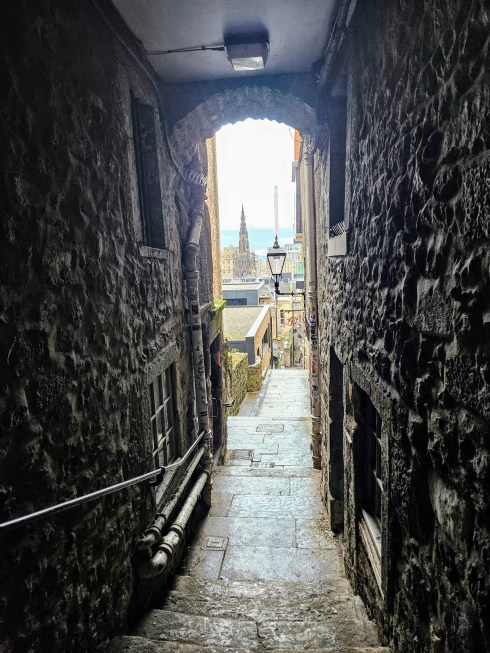
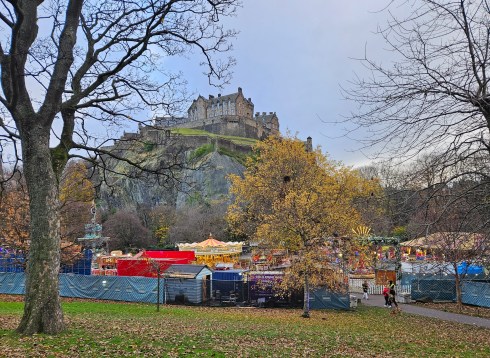
I’m just returned from a long trip to Scotland, during which I took hundreds of photographs, and today marks the feast of the Scottish patron Saint Andrew, so that’s the post! I promise more substantive essays in the future, but I have re-entered at the busiest time of the semester and my Salem’s Centuries manuscript is due in just over a month, so these photos will have to suffice for now. We spent most of our time in Edinburgh, but also covered a wide swath of south central Scotland, including Glasgow, Oban and Fort William in the west, and St. Andrews in the east. I spent my junior year abroad at that city’s university, and while I’ve been back several times since, it’s always great to go back. I really explored Edinburgh on this trip, both Old Town and New and some adjoining neighborhoods, so it was hard to pick my favorite photos of the capital, but I think I’ll favor the light. All the cities and towns we visited were aglow with Christmas trim, and every other day the sun bathed the land-and street-scapes for several intermittent hours: with moody mornings and darkness descending at 4pm, the light is very precious.

In Edinburgh:

Interior shots are of two National Trust properties: Gladstone’s Land in the Old Town and the Georgian House in the new. Of course the modern embellished building is the relatively new Scottish Parliament, about which I learned a lot. Christmas markets and fairs in every available green space!


Glasgow:

Glasgow Cathedral and Council Chambers are quite something, as are the Hunterian Museum and Art Gallery at Glasgow University. Charles Rennie McIntosh immersion is possible.


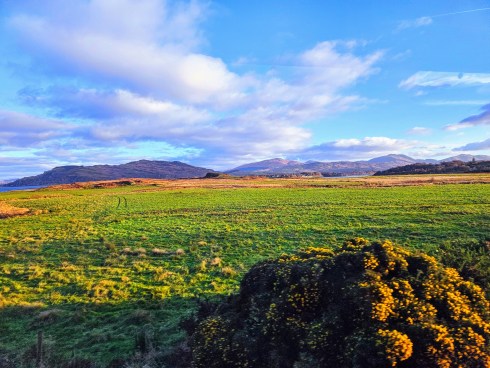
Western Coast from Oban to Fort William and through the Highlands:


Fife villages on the East Coast, and St. Andrews:

So, lots more to write about, including whiskey, GIN, Jacobites, McIntosh, Princes Street, old and new architecture, the power of Outlander, closes, courts and corridors, and hedgehogs, but this postcard post will have to do for now: Happy Feast of St. Andrew day!


Red Roofs

Patriots Day 2019 was not a very enjoyable day. It was certainly not as dreadful as Patriots Day 2013, but still a frightful day. I woke up to thunder, looked out at the dreary rain, made the decision not to drive to Lexington so I could walk the Battle Road as is my custom, did some errands, and then turned on the radio to hear the Marathon results and instead heard “Notre Dame is burning”.  And that was the story for the rest of the day: listening, watching (big mistake but I could not look away), and (towards the end of the day) drinking. I admire all historical architecture, but Gothic cathedrals are more than mere buildings: they symbolize the aspirations and abilities of an era and a civilization. Very early in my teaching career, I essentially turned my medieval survey into an “Age of Cathedrals” course, and I still teach through and around and with these monuments. At first reference that might sound like an approach that is simplistic and old-fashioned, but for me the cathedral has always been both a symbol and a conduit, connecting one to all the layers of medieval history, not just religious, but social, economic, political, cultural, and of course technological. Cathedrals can open up minds too: especially the minds of college students who are predisposed to think of the Middle Ages as merely “dark”,  and “backward”. It’s impossible to look at a cathedral and not be impressed by its creators, or maintain a presentist perspective.

aptopix-france-notre-dame-fire-20190415155934-12400800AP Photo by Thibault Camus

As the day wore on, I realized I was getting upset as much by the commentary and coverage as by the incessant fire. There was a lot of speculation, and little confirmation, and of course we could see the fire burning and burning and burning. So I turned everything off and went to bed. The next day, the fire had finally been stopped and Notre Dame was still standing: its roof and spire were gone but the bulk of its early Gothic expanse and vaulting, its bell towers, and even its trio of rose windows had been saved. I welcome the full report on the fire’s causes and damage because there is still a lot of contradictory information out there, but I learned a lot from a few select Twitter threads that found their way into my feed, mostly through architectural historians: about the protocol followed by the Parisian firefighters, put in place after the last time Notre Dame was ravaged during the French Revolution and sustained through two world wars, about the oak trees planted at Versailles after the last restoration of Notre Dame’s roof 160 years ago, and about the human chain created to rescue its treasures, with a fire-fighting chaplain serving as the essential link.  The combination of a still-standing Notre Dame, human heroism, and the resolute statement of President Macron reassured me quite a bit (French cathedrals have been owned by the state since 1905), but more than anything I am hopeful because of history: cathedrals were built over generations, in fits and starts, many sustained fire damage as well as human assaults but survived and were rebuilt. There are several precedents for the restoration of Notre Dame, but I think the most inspirational examples must be Reims Cathedral, which sustained devastating damage during World War I, and the Cathedral of St. Peter and St. Paul in Nantes, which was bombed heavily during World War II and severely damaged by a fire in 1972.

Cathedral CollageThe Cathedrals of Reims and Nantes in their present glorious condition. Photographs by Nicolas Janberg for Structurae.

The restoration of Reims, the most royal of French cathedrals, was an epic achievement. It sustained intense shelling by German forces outside of the city in September of 1914, setting fire to the wood scaffolding that was in place, and then the cathedral’s oak roof, which caved into the nave below. Reims lay in a state of semi-ruin for the rest of the war, and was bombed again in 1917 and 1918, thus attaining its status as a “martyred cathedral”. I inherited a book from my great aunt by the American illustrator George Wharton Edwards titled Vanished Halls & Cathedrals of France which was published at the height of the war. Reims is on the cover and inside, looking beautiful in his pre-war paintings, but the text reads like a eulogy: the catastrophe is so unbelievable that one cannot realize it…….Reims can never be restored to what it was before the bombardment. Let it rest thus….a sacred ruin—the scarred, pierced heart of France. He goes on a bit later: Let it remain….the living, standing record of an infamous crime. Consumed by fire, soaked in blood, Reims, which crowned and sheltered a hundred kings, has passed. Deleta est Carthago.

Vanished Halls

Edwards Collage

Vanished Halls Reims_Cathedral_burning_during_World_War_I

Vanished Halls Reims PC

The burning of Reims Cathedral after the severe bombardment by the Germans, 17-24 September 1914Edwards’ book and paintings; two 1914 postcards; Charles W. Wyllie, The Burning of Reims Cathedral after the Severe Bombardment of the Germans, 17-24 September 1914. From The Sphere, 7 December 1914.

Edwards would not get his wish. Reims would be restored after the war (with a good deal of American money) and it served as the site of the signing of the peace treaty which ended the second World War in Europe in May of 1945. Only a year before, and more than 300 miles to the east, the city and cathedral of Nantes sustained significant damage from Allied bombing in June of 1944, but the more serious threat to the latter was the fire that broke out in January of 1972 related to ongoing restoration on the roof. Indeed, the post-war restoration was barely completed by that time according to most accounts, but the “resuscitation” following the fire was shorter, and detailed in a wonderful short video you can view here. President Macron’s five-year plan is perhaps ambitious, but not impossible: it’s been done before.

1211872-musee-des-sapeurs-pompiers-de-loire-atlantique-fonds-hervio

[The Angel of the Resurrection on the Roof of Notre-Dame, Paris]Nantes Cathedral in flames on the night of January 28, 1972, Museum of firefighters Loire-Atlantique. Hervio Fund; Charles Nègre, Angel of Resurrection at Notre Dame, 1853, Getty Museum.