Tag Archives: ephemera

Hallowed House

There have been several Salem houses—houses that are no longer standing—that have haunted me; I get almost desperate to find out as much as I possibly can about them and if and when I do I’m done. If they remain inscrutable, they remain with me. There is one house that I’ve been thinking about for years: I’ve learned quite a bit about it but not enough: I’m not sure I’ll ever learn everything I want to know (at least not now, while I can’t get into the Phillips Library!). I’m posting on this house today just so I can stop thinking about it for a while.

The house in question is (was) the Colonel Benjamin Pickman house, built in either 1740 or 1750 or sometime in the decade between depending on the source, right on Essex Street, adjacent to where the Peabody Essex Museum’s East India Marine Hall now stands. Its former site was the Museum’s Japanese garden, recently transformed into a construction site–which is why I’ve been thinking about the Pickman House: have the workers found any material remains? Or does it just survive on paper–and in pieces? This is a house that was famous in its day, and well after. It was designed by an English architect–previously unknown but possibly identified as Peter Harrison, who also possibly designed the Cabot-Low-Endicott House further along Essex Street and the “King” Hooper Mansion in Marblehead. Whoever the architect or builder was, all agree that it was the client, the Colonel himself, who had carved and gilded codfish affixed to every riser of the house’s central stairway in acknowledgement of the source of his wealth and position, thus inspiring that perfect phrase, “Codfish Aristocracy”. Its elegant furnishing were much commented upon by contemporary observers and diarists, as was its rusticated wooden siding, meant to mimic stone. There’s a long list of prominent diners at the house, including Alexander Hamilton: on June 20, 1800. The house was successively celebrated, lithographed, photographed, obscured, picked-apart, measured and drawn, and ultimately demolished in 1940 or 1941.

Pickman Lithograph Boston Athenaeum

Pickman collage

Pickman Cod

Benjamin Pickman Doorway Cousins

All representations of the Pickman House are based on the c. 1830 lithograph published by Pendleton’s Lithography which shows the house in its pristine eighteenth-century state (courtesy Boston Athenaeum); an amped-up Pickman codfish from Mark Kurlansky’s Cod: a Biography of the Fish that Changed the World; A Frank Cousins photograph of the enclosed doorway which Samuel McIntire added to the house c. 1800. 

We can’t see this famous house for most of its life, which only adds to its air of mystery (and vulnerability). Charles Webber and Winfield Nevins, the authors of Old Naumkeag: An Historical Sketch of the City of Salem and the Towns of  Marblehead, Peabody, Beverly, Danvers, Wenham, Manchester, Topsfield and Middleton (1877) inform us that a certain “Mrs. LeMasters” constructed several low shop buildings in front of the house in the 1870s, and so we only see dormer windows peaking out from above in all the late nineteenth and early twentieth-century views of Essex Street and the East India Marine Hall.  The Pickman family had moved west–into the residential McIntire District–away from the increasingly-busy downtown. A correspondent from the Philadelphia Inquirer who visited Salem in September of 1918 to see all the old storied mansions noted that the charming old house next to to the Peabody Museum has been all but obliterated by the shop front built out over its first and second stories…the gambrel roof, with its picturesque dormer windows, may still be seen overlooking the horrid shops, but all the inside fixtures have been destroyed. Progress is painful!

Pickman 1912

Pickman PEM PC

Pickman 1920s

20170924_180714

You can see the Pickman House dormer windows peaking out from above the storefront on the right of the two postcards and just above the P&Q shop, c. 1920s. These images were sourced for me from the Salem State Archives and Special Collections by Jen Ratliff–thanks! The house is completely invisible in the street- view photograph above from the late 1800s and the Phillips Library–it’s just behind the shops on the left, beginning with the “Importers of Crockery” storefront.

We do get to see the the unobstructed house (or what’s left of it), as a team of architects and photographers from the Historic American Building Survey went in to document it on the eve of its demolition–no doubt inspired by a succession of architects who had made the pilgrimage to Salem to measure and sketch this house, beginning with Arthur Little in 1877. As you can see, the storefronts didn’t just obstruct the house, they cut into it on the first and second stories. From that point on it must have been open season for house parts: an archway and a golden cod went to the Essex Institute, and all the other codfish went to a Pickman descendant’s Newport mansion: I think this one (where there is also a reproduction McIntire summer house) but I’m not certain.

pickman-house-parlor-arthur-little-early-new-england-interiors

Pickman House

Pickman HABS 1

Pickman HABS 2

Pickman HABS 3

Pickman HABS 4

Arthur Little sketch of the Pickman House parlor, Early New England Interiors (1878); William Martin Aiken sketch of Pickman architectural elements, 1883, Lowcountry Digital Archive; HABS MA-332 photographs and drawing, Library of Congress.

I’m not just interested in wood or architecture; I’m also interested in Colonel Pickman–but he remains pretty inscrutable too. Ultimately the only way to get to know him is through material remnants (like the silver he left to the First Church) or his family: his son Benjamin Pickman Jr. (whom I’ve written about here and here), was a Loyalist who left Salem during the Revolution but managed to easily assimilate into its social and political society upon his return–hence the dinner with Hamilton at the house! The more patriotic Colonel had died in 1773, so he doesn’t figure very prominently in the edited volume of his son’s diary and letters published in 1928. There is a beautiful portrait of the elder Benjamin by John Greenwood in the collection of the Peabody Essex Museum, but I’ve never seen it on display–nor the fluted archway and golden cod that is all that is left in Salem of the beautiful house that was once next door.

Benjamin PIckman collage

Colonel Benjamin Pickman of Salem, 1708-73.


Busy Bees

I know that bees are experiencing some serious challenges at the moment, but it seems to me that there are much more of them out there than in previous summers—at least in our region. I’ve encountered mini-swarms on rural walks in both New Hampshire and Massachusetts over the past month, it seems like individual bees have been buzzing around my garden constantly since July, and just the other day I saw hundreds of bees affixed to the sunflowers in the large patch at Colby Farm up in Newbury: neither bees nor people can resist this flagrant perennial display!

Bee Sunflowers Best

Bee Sunflowers Closeup

I went into my clip file—comprised of very random digital images which I find interesting or attractive and store away for whenever or whatever (other people seem to use Pinterest this way but I just don’t)–and found several bee images there that I had clipped or snipped over the last few months: books, ephemera, creations. So clearly I’ve had bees on the brain: maybe because I decided to forego sugar over the summer and thus became more intensely focused on honey. In any case, this seems like a good time to get these images out there–Thomas Tusser suggests that the ongoing process of “preserving” bees demands a bit more human attention in September in his classic agricultural manual Five Hundred Points of Good Husbandry (1573):  Place hive in good air, set southly and warm, and take in due season wax, honey, and swarm. Set hive on a plank (not too low by the ground) where herbs and flowers may compass it round: and boards to defend it from north and northeast, from showers and rubbish, from vermin and beast. Tusser is one of many British and continental authors writing about bees and beekeeping in the sixteenth century, and over the succeeding centuries this sub-genre continued to flourish, right up to the wildly-popular Beekeeper’s Bible. I’ve written about bee books before, but my favorite recent discovery is Samuel Bagster’s Management of Bees, with a description of the Ladies’ Safety Hive (1834). Bagster has a very entrepreneurial attitude towards bees, and is striving to transform their keeping into a feminine avocation with his promotion of the “Ladies Safety Hive”: they can be built at home or delivered by Bagster, fully-equipped.

bee collage

Bees Bagster

My apian ephemera is focused less on the bees than their hives: which of course serve as an accessible symbol of industry and by extension, achievement. The most prominent uses of beehive symbolism on Salem ephemera that I have found were issued by the Salem Charitable Mechanic Association (which it clearly borrowed from the Massachusetts Charitable Mechanic Association, or vice-versa) and Frank Cousins’ many trade cards advertising his Bee-Hive store but there is also an early trade card for the Salem goldsmith and jeweler Robert Brookhouse which features the very Salemesque combination of hive and ship. I discovered a completely new type of ephemera this summer–watch papers–of which there is an interesting collection at the American Antiquarian Society, including several embellished with beehives.

Bee Certificate

Bee Hive MA Charitable HNE

Trade Card beehive

Bee Brookhouse

Bee Hive Watch Paper AAS

Ephemeral beehives: Phillips Library (printed in EIHC Volume 113); Historic New England; and courtesy American Antiquarian Society.

Another discovery of this fading summer are the amazing textile creations of Mister Finch, which you must see for yourself. His bee is among the more realistic of his species–check out his website for more surrealistic creatures. And then there is Tamworth Distilling, to which I returned several times, which manufactures several varieties of botanical gins, including the Apiary Gin pictured below. To be honest, this was a bit too honey-based for me: gin is my favorite spirit and I tend to be a London Dry traditionalist. But I love the bottle, of course (and their cordials).

bee

Bee Gin

Mister Finch Bee and Tamworth Distilling Apiary Gin.


Posters (and More) @ the PEM

In my recent post on the Phillips Library, I deliberately excluded any commentary on the Peabody Essex Museum, but most of the commenters did not. Any large expansive institution inserting and asserting itself in the midst of a small city like Salem is going to incur a lot of commentary, and the Peabody Essex Museum is not an exception. I wanted my post to focus on Salem’s material heritage, so I excluded its enveloping institution, but in fact my feelings towards the Peabody Essex are mixed. I understand that in order to be successful, the 1992 merger of the former Essex Institute and the Peabody Museum of Salem had to result in a completely new museum, rather than a Frankenstein-esque amalgamation of the two former institutions. That has happened: the Peabody Essex is new, and dynamic, and thriving. I do miss the dusty Essex Institute a bit, just because I like those sorts of institutions, and I think Salem needs a historical society/museum run by professionals for passion and preservation, rather than profit. But I know it is never coming back. However, its archive, the Phillips Museum, must come back. And meanwhile, the Peabody Essex is here, and expanding like a force of nature: one must embrace it. I appreciate many things about the PEM: its collections, its community programming, even its shop. It is a constant resource for me as both a curious individual and a teacher. But just as I want to see more of its historical records, I want to see more of its collections–and it seems to me that the showcase, display, and interpretation of the PEM’s permanent collections are deemed secondary to the mounting of blockbuster exhibitions time and time again: DRESSES, HATS, SHOES. The first great expansion of the relatively new PEM over a decade ago was explained in terms of the need to have more exhibition space to display the Museum’s collections, as is its current project, but in the interim we have seen lots of DRESSES, HATS and SHOES (and several months of McIntire and Gould, to be fair).

At present, the PEM has two blockbuster exhibitions on view coincidentally: the summer-long exhibition Ocean Liners: Glamour, Speed and Style and It’s Alive, a showcase of classic horror and science fiction movie posters from the collection of Kirk Hammett. When I first heard about both, I thought, oh no, posters and posters taking up precious gallery space (away from the permanent collections): ephemera. But I have visited Ocean Liners several times over the summer and I think it comes very close to the “glocal” vision first expressed at the time of the merger of the Essex Institute and Peabody Museum: local history with an enhanced global context. It is maritime history ramped up several notches, encompassing art, history, culture, and style. There are posters, of course, but wow, several of them speak volumes in terms of their impact and message. It’s Alive just seems like a collection of movie posters to me, not really an exhibition, but if I were a curator at the PEM with October hordes passing by my door, I wouldn’t have turned them down either!

PEM ExhibitionsPortholes and eyes at the PEM.

PEM Exhibitions 3

PEM Exhibitions 4

PEM Clyde

PEM Exhibition LinersPEM Exhibitions 7

PEM Exhibitions 5

PEM Murals

PEM Fashion

PEM Luggage

PEM Exhibitions 6

PEM Exhibitions 2

PEM Enlist

PEM Enlist LOCJust a few items from Ocean Liners, which also includes some amazing ship models of which I don’t seem to be able to take a good photograph. Stanley Spencer’s Shipbuilders on the Clyde: Riveters (1941) is amazing! The panel from the Titanic’s sister ship Olympic is displayed in full majesty, altar-style, in the midst of renderings from other pre-World War I ships–this was an era in which the interiors were certainly not streamlined. I never knew there was Titanic “recreation diorama” for tourists just a couple of years after the disaster! This Fred Spear Enlist poster from 1915, showing victims of the Lusitania sinking, really stopped me in my tracks–the last image is from the Library of Congress. 

PEM EX CATS

PEM EX Wallpaper

PEM Exhibitions KarloffMy favorite posters from It’s Alive, on either side of some very atmospheric wallpaper.


Au Courant Classrooms

For my annual back-to-school post, I want to focus on two very distinct phases of school reform, both of which focused on the aesthetics of the classroom. This will not be the case everywhere, obviously, but when I look around Salem and its environs, I see a lot of school buildings built in the later 19th century–World War I era, and an equal number built after World War II. Rather than thinking about demographics, my mind immediately wanders to the design elements of these structures. The exteriors are pretty obvious (solid civic Classical Revival for the former era, International-style boxes for the latter), but what about the interiors? It happens that the celebrated Salem artist Ross Turner was very active and influential in a movement dedicated to embellishing classrooms in the 1890s and after, a movement dedicated to “vitalizing the dormant sense of the artistic” among Americans, “which by false and ugly environment, has been so repressed as to be of little actual value to the community”.  Arts education and the decoration of the classroom went hand in hand for Turner, and he believed that students should be exposed to both as early as possible, in the (relatively-new)) kindergartens and primary schools. He had an effective partner in the Prang Educational Company, which published his works and produced artistic products for the classroom.

Stylish Schools Art for the Eye

Prang Educational Company AAS Courtesy, American Antiquarian Society.

Here are Turner’s design recommendations for classrooms: they should be quiet, harmonious in color and arrangement [with] the color of the walls selected according to the light…the use of dull colors–brown or slate colors–should be usually avoided. The color effect should be responsive and light, never dull, heavy or cold. Remember we have under present conditions to struggle against a hideous dulled surface known as the blackboard, too large and ugly…A comprehensive group or series of art subjects…beginning with primitive work, Egyptian and Assyrian, early Greek and Etruscan, and proceeding up through the Renaissance [not after] is essential, in plaster or pictorial forms. He recommends that statues and “solar prints’ be spread liberally around the classroom, as well as architectural fragments, and decorative designs in plaster. And one last thing: every schoolroom should have a bust or portrait of some eminent American citizen or patriot placed immediately above the desk of the teacher; above and around this the colors of our common country. Here should be the shrine of American patriotism. We should display the flag above patriotic busts, or portraits, inside as well as outside the schoolroom. Art for the Eye was first published in 1895: let’s look at some Salem classrooms from about a decade later to see if it had any impact. These photographs are all from the very accessible digital collections of Salem State University Archives and Special Collections.

Stylish Schools SSU Horace Man

Stylish Classroom SSU Horace Mann3

Stylish Schools SSU HOrace Man 2

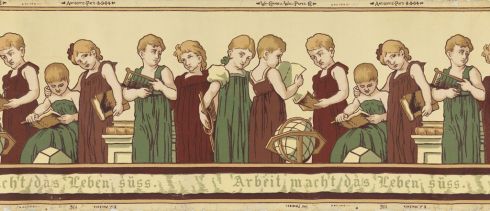
The photographs are from a series taken by Salem photographer E.G. Merrill of the Salem Normal School’s Training School, later known as Horace Mann, for the School’s 50th anniversary in 1904. It looks like the hideous chalkboard is still in the classroom (though utilized for artistic purposes via the elaborate blackboard sketching that was a speciality at Salem Normal School), but there are certainly a lot of other Turner-approved embellishments! It’s so perfect, I envision this wallpaper frieze from 1910, named after the inventor of kindergarten, in all Turner-approved classrooms!

Stylish Schools WallpaperWallpaper “Froebel” frieze, 1905, E.J. Walenta for Wm. Campbell Wall Paper Company, Machine-printed on paper, Hackensack, New Jersey, USA, Cooper-Hewitt Museum, gift of Paul F. Franco, 1938-50-15.

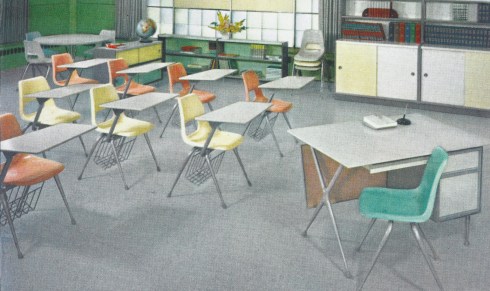
The second wave of educational aesthetic reform followed World War II, and seems largely focused on clearing out all of the elements that Turner advocated for, as well as letting in, or creating, even more light vis-à-vis the new fluorescent lighting. A model classroom was installed at Salem’s Bowditch School (then on Flint Street) by the Salem-based Sylvania factory, and promoted nationally by a serialized newspaper article in alliance with the National Education Association. I can’t get the photographs any clearer, but the description is helpful: blackboards replaced by tackboards (that won’t last), wooden floors replaced by tile, and “posture-improving desks” installed. In the permanent collection of the Museum of Modern Art there is a prototype desk designed for the Bowditch School by the architectural/engineering firm Markus & Nocka in 1946–ostensibly for this remodeling–but I can’t tell if these are the desks in the photograph (if they are, I wonder where they all went when the Bowditch was converted into condominiums!)  More likely something more conventional was chosen, like the colorful Brunswick desks in the advertisement below. These are what I grew up with, and I think there’s still more than a few in the old SSU Sullivan Building where I teach today.

Stylish Schools 1946

Stylish Schools MOMA

Stylish schoolchairs BrunswickBrunswick chairs c. 1958 from the VS Schulmuseum site. 

♣ Heads up: exhibition of Ross Turner’s works at the Kensington-Stobart Gallery at the Hawthorne Hotel opens this Friday September 8!


The Great New England Eclipse of 1932

In my ongoing preoccupation with turning the universal into the parochial, it wasn’t difficult to determine which historical eclipse had the biggest impact on Salem, which was just on the southwest border of the total blackout zone of the eclipse of August 31, 1932. This eclipse cut a diagonal swath through New England from Montreal to Provincetown, and people converged in the White Mountains, Cape Ann and Cape Cod for viewing: there were special eclipse “packages” and special eclipse trains, and more than one observer pointed out that the frenzy was serving as a distraction from the Depression. In Salem, the shops closed at 1:00 in the afternoon on the 31st (which was a Wednesday), as everyone departed for Gloucester–apparently not content to be in the 99% zone! The headlines leading up to the 1932 eclipse were not too different than those today: watch out for your eyes, watch out for your chickens (perhaps there was more emphasis on chickens then), the best viewing places, why the scientists are so excited. I do think there was more “eclipse ephemera” produced then, but it was a period of paper.

Eclipse 1932 NE Map

eclipse collage

Eclipse 1932 Williams

Eclipse 1932 Williams 2

Eclipse glasses 1932

August 1932 headlines from the Boston Daily Globe: eclipse ephemera from the Cole Collection at the Hopkins Observatory at Williams College.

The viewing experience seems to have been uneven across New England on August 31, 1932: clouds and rain prevailed in some places, inspiring my favorite September 1 headlines: Long Awaited Eclipse is Partially Eclipsed (or some variation thereof). I have no doubt that people had fun on the New Haven Railroad’s special Eclipse Train, however, on which they could see night-time when it’s day in New England as you play. Strange things were reported for days afterwards: chickens (very sensitive to eclipses, apparently) laid eggs that bore an imprint of the corona, which appeared on several glass windows around the region as well. In my hometown of York Harbor, Maine, the artist Henry Russell Butler, who had traveled across the country in order to capture the previous three eclipses on canvas, was thrilled to see one appear in his backyard. Photography had long been able to capture eclipses, but paint still worked too.

Eclipse 1932 eclipsed

Eclipse NYT

M25823-28 001

Eclipse 1932 Henry Russell Butler

North Adams Transcript and New York Times headlines, September 1, 1932; New Haven Railroad Eclipse Train poster by John Held Jr., Swann’s Auctions; Henry Russell Butler, Solar Eclipse, 1932, Princeton University Art Museum, gift of David H. McAlpin, Class of 1920.


Give me Mrs. Miniver

My husband, myself, and my stepson can rarely find a movie we all want to see together: the latter is 16 so of course all summer movies are made for him, but I can’t stand the bombastic computer-generated imagery and violence and the predictable scripts. When Christopher Nolan’s Dunkirk came out, we all wanted to see it and so went together last week: a rare occasion. We did not return home together, however, as I had to run out less than halfway through! It wasn’t that it was bad–it was actually riveting–but also just too painful for me to watch all those men on the beach, so exposed and so vulnerable. I knew the Armada was coming but I couldn’t wait for it.

Dunkirk film

Dunkirk real The film and the reality, June 1, 1940 ©Imperial War Museum, London

It’s ridiculous I know, but I think I prefer the Mrs. Miniver version of Dunkirk, in which the gentleman-architect Mr Miniver takes his pleasure craft (conveniently docked in front of his Hollywood-perfect expansive English cottage) out into the Channel and returns only slightly battered (and bearded) a few days later. During his absence, Mrs. Miniver battles a downed Nazi in their kitchen. She wins, of course, but the Director William Wyler gives him a speech intended to bolster the Allied effort (by the time the film was released in 1942, the United States had already entered the war, but during its production Wyler was concerned about American isolationism): We will bomb your cities…Rotterdam we destroy in two hours. Thirty thousand in two hours. And we will do the same here! Combined with all other “inspirational” details in the film, including the bombing of the Miniver house, the heartbreaking death of their new daughter-in-law, and the village vicar’s closing sermon, it’s no wonder that Joseph Goebbels was afraid of it.

Mrs. Miniver 2

Mrs Miniver

It was acceptable to make propaganda films in the 1940s: today things must be as real as (technically) possible and sometimes that is unrelenting, at least for me: I fear my stepson is inured due to a steady diet of video games. I would like to see the Dunkirk miracle play out so I think I’ll have to steel myself to go back and see this film again, but in the meantime I’ll occupy myself with more distant records of this epic event, in paper and a paint. The Imperial War Museum in London has many photographs (including several of the Germans moving in after the evacuation), oral histories, and paintings of Dunkirk among its collections, although after I spent some (digital) time with these memorials I realized they weren’t that distant after all.

Dunkirk collage

Dunkirk 1940 IWM jpeg

Dunkirk painting 1940

Dunkirk Drawing IVW

Dunkirk abstractJune 3 headlines from the Sydney Morning Herald and the Los Angeles Times; a small fraction of the 200,000 British Expeditionary Forces who were evacuated (+140,000 French troops), ©IWM; Charles Ernest Cundall, The Withdrawal from Dunkirk, 1940, © IWM (Art.IWM ART LD 305); “little ships” in Muirhead Bone’s The Return from Dunkirk; Arrival at Dover, 1940, © IWM (Art.IWM ART LD 251); Rudolf A. Haywood, The London Fire-Boat ‘Massey Shaw’ approaching Dunkirk at 11 pm on the 2nd June 1940, © IWM (Art.IWM ART LD 248).


Battle of the Bonfires

Salem’s traditional Independence Day eve bonfires were epic, receiving considerable regional and national attention up until the 1950s, peaking with a portfolio of images taken by Life magazine photographer Yale Joel in 1949. I’ve written about these spectacles before, but there is more to say. I have a much better understanding of their chronology now, but I still can’t find evidence of the very first one, which early 20th-century references point to happening in 1814. I do not doubt this date, or even an earlier one, as bonfires go way back in Anglo-American history, through the Armada and Gunpowder Plot commemorations on one side of the Atlantic and Pope’s Day and Revolutionary War festivities on the other, but I wish I could find some confirmation. Actually, I don’t have much information about Salem’s bonfires prior to 1890, but after that year they clearly took off, escalating in size and notoriety over the next decades. There was a decade-long dry spell from 1910, which I assumed (very logically) was due to the Great Salem Fire of 1914, but actually predated that catastrophic event by several years. Things start heating up again in 1921, and in the 1920s there were bigger bonfires and crowds with every passing year. There are sporadic bonfires in the 1930s and 1940s, and then after the war the tradition continued into the 1960s (I think!) but it’s a bit hazy.

Bonfires Cabinet Card 1907

A.C. MacKintire cabinet card, c. 1906: these bonfires were BIG.

So here’s a bit more national, regional, and local context for Salem’s Independence Day bonfires, gleaned from a variety of sources, including a local facebook group focused on Salem’s history. Unfortunately no member is old enough to remember the pre-1930 glory days, but the earlier history is surprisingly (or perhaps unsurprisingly) well-documented.

1. It’s all about the 1890s. I’ve noticed this about other aspects of Salem’s history, particularly anything related to tourism: everything intensifies in the 1890s. There are random brief references to Salem’s bonfires before 1890, but in that year the Boston Daily Globe ran a long story under the headline “Old Salem Ablaze. Bonfires on Gallows Hill Lighted the Home of the Witches” which described a frenzied celebration in the streets of Salem on July 3:  from sunset until midnight the principle streets were crowded with men, women, boys and girls, who passed the time in firing crackers, throwing torpedoes and blowing horns. In many ways it was the most noisy demonstration ever made in Salem. At midnight the immense crowd assembled in the vicinity of the highlands to watch the bonfires. On Gallows Hill a pile consisting of over 1000 barrels and boxes, to say nothing of old straw beds and witch hazel crammed into the intersections of the stack was set on fire, making a very handsome sight. The pile was 50 feet high and the flames towered as many feet higher. From 11-1 there was a concert on the hill by the Salem Brass Band. The Broad Street Social Club also had its annual jubilee on the Lookout and its adjacent pasture in the at the head of Broad Street (now the site of Salem Hospital). The 8th Regiment Band gave a concert from 8 to 12:00, interspersed with a exhibition of dissolving views, thrown upon an immense screen (what in the world was this????). At midnight upwards of 1000 barrels were set on fire, making a mountain of flame, which could be seen for miles.

Bonfire 1898 collage

2. Battle of the Bonfires: as the Philadelphia Record article above illustrates, there was a fierce competition in Salem over bonfire blazes, between the Gallows Hill Association which built their pyre on Gallows Hill and the Broad Street Club, which claimed Lookout Hill: this competition led to bigger and bigger bonfires with each passing year. In addition to this internal Salem competition, there was also competition between Salem and other Boston-area cities and towns, particularly in the first decade of the twentieth century. Salem clearly won the Boston battle, and the Gallows Hill guys (succeeded by the Ward Four Social Club and the Ancient Order of Hibernians) took the Salem prize.

Bonfires 1903

Bonfire 1905collage

3. Independence Day was the “most dangerous day of the year”. I’m quoting from an 1865 editorial and a 1935 Department of Agriculture pamphlet, both referencing the death, maiming and disablement associated with the festivities of July 4. During that long period there were repeated attempts by federal and state officials to cut down on the fiery July 4th celebrations, to no avail. On several occasions violence broke out in Salem, most notably in 1909, when a shooting occurred at the Lookout bonfire. Note the description of the scene in the Boston Daily Globe article from the next day: upwards of 75,000 persons witnessed the burning of the stack of railroad sleepers and barrels. Hundreds of boys and men were firing guns and revolvers. There’s a sense that things were getting a bit out of control, which may explain why the bonfires ceased for about a decade at this point.

Bonfire BDG 1909

4. Logistics. I’m amazed that things didn’t get even more out of control, given the composition of the bonfires: barrels of course, which were provided by local businesses, including tanneries, so supposedly they had remnants of combustible materials. Casks, old straw beds, hogsheads, railroad ties and sleepers, wired together and lit afire by torches before 1905, and then: ELECTRICITY. Salem made big news in 1905:  never before in the history of this country was a bonfire started by wireless electricity claimed the Boston Daily Globe, thanks to 18-year-old John J. Brophy, pictured below. Even though the days of the Lookout bonfires were numbered at this point, this was a great victory for the Broad Street Club. One of the few acknowledgements of any potential danger in producing these spectacles concerns ignition: twenty years later there will be a brief attempt to ignite by “radio”.

Bonfire electricity collage

5. 1920s revival. After a break during the nineteen-teens, during which the Great Salem Fire devastated the city and the new Salem Hospital was built on Lookout Hill, the Gallows Hill bonfires resumed under the auspices of the Ward Four Social Club and Ancient Order of Hibernians. The 1922 bonfire was ignited just after midnight ‘the night before’ by the old-fashioned torch method, and not by electricity as one or two of the former fires were started. There is a very conspicuous emphasis on “tradition” and “revival” in all of the coverage of these 1920s bonfires, and this is when you see references to the first bonfire: the organizers of the 1928 bonfire referred to it as the “114th Bonfire”. There was a tremendous response: with crowds reported at 80,000 for Salem’s tercentenary year and nearly as many in 1927. There are a few regional competitors in this decade, but Salem’s bonfire was repeatedly claimed to be “New England’s Biggest”.

Bonfires 1922

Bonfire 1927 collage

Bonfire 1928 Lowell Sun

6. Decline and dispersal. From 1931 to 1951, the Gallows Hill bonfires ebbed and flowed and ebbed again. The Boston Globe coverage of July Fourth festivities in the region shows what happened at the beginning of the era very clearly. In 1931, there was another “huge Salem bonfire stack”, so momentous that it required round-the-clock guards before the big night, while in 1932, both Boston and Salem abandoned their “bonfires of yore” at the onset of the Depression: for the first time in many years, there will be no mammoth stack in Salem. Several places have taken the money to buy railroad ties and cut them into stove lengths to give to the needy when the cold weather arrives. This strikes me as a pretty straightforward illustration of just one little consequence of the decade’s economic crisis! The bonfires resumed from 1937 to 1940, but they were much smaller and Salem was just briefly mentioned along with other communities in a Fourth of July roundup by the local papers. After World War II, everyone wanted to build a big celebratory bonfire, and Salem’s attracted a crowd of 60,000 in 1946, but in the next year (gasp) neighboring Danvers had a bigger stack and a bigger crowd. The Life photographs look a bit memorialistic in this context, but Salem natives tell me that the bonfires continued into the 1950s and early 1960s. What is clear from personal reminiscences is that Gallows Hill was no longer alone from this point on: there were smaller bonfires built in other parts of town: Collins Cove, Dead Horse Beach in the Willows, along the river in North Salem. So the bonfires (and the competition?) continued as an expression of neighborhood and community spirit, tapped down but still very traditional.

Bonfire Depression collage

7. Appendix: is there an (unfortunate) connection between Salem’s famous bonfires and that OTHER big Salem event, resulting in the common misconception—still very much alive today—that the accused witches of 1692 were burned on Gallows Hill?  I can’t tell you how many national headlines I read like the one below!

Bonfire 1928 Text Box


The Lost Bungalows of Great Misery Island

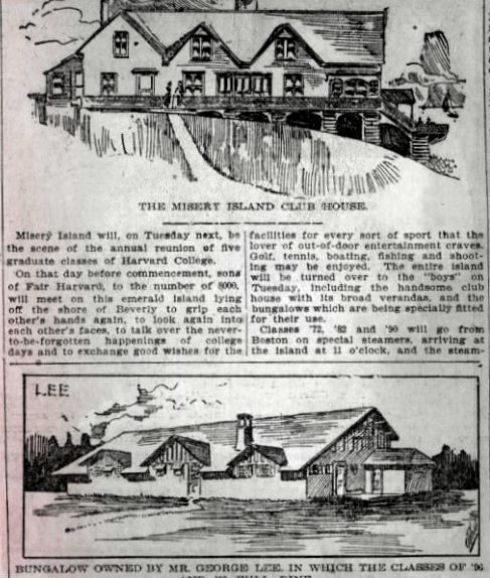
Out on Salem Sound the other day, sailing in a beautiful boat, I looked over at one of the several islands that mark the entrance to Salem Harbor and tried to imagine what once was. Off Great Misery Island there is a calm maritime meeting place referred to as “Cocktail Cove”: while one imbibes off-island now a century ago drinks were served on the island, first at the Misery Island Club, which became the Casino Hotel in 1904, and also in private cottages: 26 in all. Most of the structures on Great Misery were swept away by a fire in May of 1926 (just before the season), and both it and its adjacent island, Little Misery, reverted to nature under the stewardship of the Trustees of Reservations. But for a quarter of a century or so, Great Misery was quite a happening place, and its cottages attracted the attention of contemporary shelter magazines. House & Garden and The House Beautiful featured several Misery Island summer houses on their pages in their “aughts” heyday,  all bungalows, and all the work of Salem architect Ernest M.A. Machado, an extremely enterprising young architect who died far too soon.

Sailing to the Misery Islands, passing the Fame along the way–off Great Misery.

Misery Sailing

Misery Fame

Misery Today 2

Ernest Machado’s buildings on Great Misery: the Clubhouse/Casino (MIT Archives); the bungalow of Mrs. Charles Steadman Hanks (Mary Harrod Northend, “Some Seacoast Bungalows”, House and Garden, June 1905), “Ye Court of Hearts” (The House Beautiful, June 1905), the bungalow of Mr. George Lee, “The Anchorage” of Mr. George Towle (The House Beautiful, June 1909) , and “The Bunker” of Mr. Jacob C. Rogers (The House Beautiful, June 1906).

Misery Island Club

Misery Hanks collage

Misery Island Lee Bungalow

Misery Bungalow 2

Misery Bungalow 3

Misery Bungalow Bunker

Misery Bungalow Bunker 2

All of these Misery Island bungalow-owners lived on the mainland, either down in Boston or somewhere on the North Shore (Rogers was the last private owner of Samuel McIntire’s majestic Oak Hill, where the Northshore Mall now stands, or should I say sprawls), but they also owned summer houses along the Gold Coast: these cottages were for the weekend! The magazine articles accompanying these images emphasize the simplicity of the island bungalows, but it was a very deliberate, and very occasional, ethic. For about a quarter century, Misery was a Gilded Age playground, complete with shooting range and golf course, perfect for Harvard senior “Robinson Crusoe” picnics and reunions. Its moment might have been even shorter: social register references seem to appear with much less frequency in the teens and twenties, and then this very social chapter in the island’s history closes much more abruptly with the 1926 fire.

Misery club Bonston Post June 25 1902

Misery Reunion 2

Misery Fire collage May 8-10 1926 Boston Daily Globe

Misery Today

Misery Salem Harbor 2Newspaper reports of the 1902 Harvard reunions (Boston Post, June 22-25, 1902 ) and 1926 fire (Boston Daily Globe, May 8-10, 1926); Great Misery today, and home in Salem Harbor on a glorious early evening!


Scorched Earth/A Lost Salem Garden

Since I went in deep for the centennial anniversary of Great Salem Fire of 1914 a few years ago I have this date imprinted in my mind: I woke up this morning and my first thought was oh no. So much was lost that day—houses, factories, civic buildings, churches–as the fire devoured several wards of Salem. The recovery effort, which seems remarkably swift and efficient to me, focused primarily and rightfully on rebuilding, but there was an implicit concern for the loss of landscape as well, and so parks were planned and trees replanted. There was one notable Lafayette Street landscape that was lost on forever on that day, however: the garden of George B. Chase. There was no effort to reconstitute this creation; instead the large lot became the site of the new Saltonstall School, which rose from the ashes of the fire pretty quickly. The Chase Garden was indeed fleeting, but fortunately we have two great sources to remember it by: the wonderful 1947 guide book Old Salem Gardens, published by the Salem Garden Club, and several photographs in the American Garden Club’s Archives of American Gardens at the Smithsonian.

Chase Old Salem Gardens

Chase Old Salem Gardens 2

Chase Garden collageJust one of my many copies of the invaluable Old Salem Gardens (1947) with the Chase garden entry; the location of the Chase garden on the 1874 and 1891 Salem Atlases.

The Salem Garden Club ladies who produced Old Salem Gardens, chief among them Club President Mable Pollock, took great care to include historical information and personal reminiscences whenever possible, greatly enhancing the research value of their compilation:  this is no little pamphlet! We hear all about the Chase Garden from the “discussive and chatty” Miss Chase, who grew up on the property, as her memories are transcribed onto the page. She tells us about the beds of ostrich ferns and rhododendrons in the immediate proximity of her family house, above which swayed purple beech and weeping birch trees, and a “large bed containing 72 plants of Azalea mollis bought from Lewis Van Houtte of Belgium”. In the spring there was white narcissus poeticus, followed by red salvia. Laburnum and althaea screened the large vegetable garden, which included salsify, rhubarb, asparagus, peas, beans, carrots, summer squash, tomatoes, onions and corn: the seed of the latter [came from] a cousin, Benjamin Fabens, and was called “Darling’s Early”. It was most satisfactory in every way, for the ears were not too long, and they had deep kernels and a small cob; the husk was quite red, as were the blades….it was the sweetest corn ever eaten at that time. Continuing along towards Salem Harbor along a box-bordered path, we “see” fruit trees and more exotic trees and shrubs, including a very notable varieties of magnolia and viburnum which particularly impressed repeat visitors from the Massachusetts Horticultural Society. Near the back of the garden were beds of roses, and a cutting garden of annuals and perennials, encircled by yet another row of shrubs and trees, including the oldest growth on the property, a locust grove, which nature had planted. All swept away on one day: June 25, 1914.

Chase Garden

Chase Garden AAG 1904 Smithsonian

Chase Garden After

Chase Garden After 2Views of the front and back of the Chase Garden (including Mr. Chase himself on the bench), 1904, Archives of American Gardens, Smithsonian Institution; Ten years later on Lafayette Street: postcard views of the Fire’s immediate aftermath from the (commemorative???) Views of Salem after the Great Fire of June 25, 1914 brochure issued by the New England Stationery Company.


Cultivating American History

The Smithsonian Libraries have produced a summer-long digital and actual exhibition on the history of American gardening titled Cultivating America’s Gardens and it features a Salem garden! I’m not surprised; I’ve consulted the Smithsonian’s Archives of American Gardens on more than one occasion and it has several wonderful slides of Salem gardens, most unidentified. The “old-fashioned” garden of the Misses Laight on Chestnut Street in the 1920s opens up one section of the exhibition, “Gardening as a Link to the Past”, which doesn’t surprise me either: Salem’s Colonial Revival ethic and aesthetic certainly extended to horticulture. Besides “the Past”, Cultivating America’s Gardens has six additional sections/themes: “Gardening for Science” (“botanizing” in the eighteenth and nineteenth centuries), “Rolling out the Lawn” (the emergence of the Great American Lawn from the Victorian era through World War II), “Gardening to Impress” (Gilded Age gardens and World Fairs), “Gardening for the Common Good” (Victory gardens and school gardens), “Gardening as Enterprise” (selling seeds), “Gardening for the Environment” (sustainable gardening), as well as a concluding section on the Smithsonian’s role in preserving America’s garden heritage. My discoveries from the online exhibition? The word “botanizing”, which I never knew was a verb, the “tastemaker” Mariana Griswold Van Rensselaer (1851-1934), author of more than 300 articles for Garden and Forest as well as the influential Art Out–of–Doors: Hints on Good Taste Gardening, and the Lowthorpe School of Landscape Architecture, Gardening, and Horticulture for Women, founded in Massachusetts in 1901, the first of its kind open to women. I definitely want to learn more about that!

Curated Gardens Laight

Curated Gardens Victorian Lawns

Curated Gardens Gilded

Curated Gardens War

Curated Garden collage

Curated Seeds

PA624001

The Laight Garden in Salem, 1920s; Catalog for Ross Bro’s. Co., Farm & Garden Supplies (Worcester, Massachusetts, 1909); The Blue Garden at Beacon Hill, Newport, Rhode Island, 1920s; Editorial cartoon: “War Garden to Do Its Duty”, drawing after J.N. Darling in the New York Tribune, about 1917 (LOVE THIS); the gardens of Alexander Hamilton and Dolly Madison as envisioned in 1920 by Peter Henderson & Co.’s Everything for the Garden catalogs; Burpee’s Seeds Contest entry, 1925; The Concrete Jungle, Philadelphia, Pennsylvania, 2002, Lawrie Harris, photographer, all Smithsonian Institution Libraries.