
Tag Archives: Preservation Month

Preservation by the People

I always like to have a preservation post for preservation month so here it is: a little populist spin on Salem’s experience of urban renewal in the 1960s and 1970s. This is a long and rather complicated story that I’ve written about here before, several times, and in Salem’s Centuries, so I’m going to streamline it considerably, I promise. I’ve been wanting to do a post like this for a while, because I’m a bit troubled by a trend I see in Salem today, one which has been emerged for several years, maybe even over a decade. It’s the tendency for anyone who is opposed to any policy coming out of City Hall to be denigrated and dismissed, in words spoken at public meetings by officials, and on social media. There’s no question in my mind that the latter is the culprit: social media has enabled us all to be so dismissive, and so unaccountable, I think. Nevertheless, I don’t like the trend, because sometimes you have to fight City Hall, and when City Hall doubled down on a very agressive, one might say radically so, policy of urban renewal in the 1960s, the people of Salem resisted it—and ultimately won a battle (this is a word used by contemporaries again and again) for preservation.

The story you generally hear today in Salem is that Ada Louise Huxtable, the notable architectural critic for the New York Times, set her sights on Salem and transformed the process of renewal through demolition into one of rehabilitation almost single-handedly, or how Samuel Zoll, elected Mayor of Salem in 1969, brought about the same transformation with a resolute will. Huxtable and Zoll were indeed very important players in saving Salem from near-annihilation, and their efforts should not be under-estimated but neither should those of many more anonymous Salem people who really showed up, setting the scene for Zoll’s election and everything that followed. I certainly don’t have all their names but I have some of them, but first let’s look at some headlines from the 1960s.

“Bulldozer job”: this is not an accusation by Salem preservationists but rather the term that the head of the agency charged with implementing urban renewal, the Salem Redevelopment Authory (SRA), used to describe what was coming in 1965! The Executive Director of the SRA, John W. Barrett (who was appointed by Salem’s mayor Francis X. Collins), responded to an “overflow throng” of Salem residents in the summer of 1965 with the admission that in the beginning we did say we would not use the bulldozer approach to Salem in our planning. However, we no longer say that and went on to admit that “from 80% to 90% of structures in the central business district” would be demolished under the present plan. This meeting was sponsored by Historic Salem, Inc., (HSI) which would go on to lead a feisty opposition to the bulldozers over the next eight years. Elizabeth Reardon, President of HSI, moderated regular meetings like this at the same time she was serving on the city’s Historic District committee following the passage of the National Historic Preservation Act in 1966. Her successor, Donald Koleman, sued the SRA for not complying with Salem’s original urban renewal plan, which stressed rehabilitation as well as demolition. Prominent architect James Ballou gave an impassioned speech before the Salem Chamber of Commerce urging business leaders to advocate for preservation over demolition. Elizabeth Hunt, Bill Burns, Bob Murray, Deirdre Henderson, and others pressed for preservation consistently in myriad ways, ultimately winning several concessions, first the creation of a consulting blue ribbon panel of professionals chosen by the brand new National Trust for Historic Preservation, and later the formation of the Design Review Board for the SRA, consisting of architectural and preservation professionals appointed by local organizations like Historic Salem, the Peabody Museum and the Essex Institute.

Lynn Daily Item, 4.12.1966

This GREAT poster is among the Salem Redevelopment Authority records at the Phillips Library of the Peabody Essex Museum, in Rowley, Massachusetts. We used some of these records for our chapter on the 20th century development of Salem, but not all—they could form the foundation of a great thesis, dissertation, or book!

I’d really like to say that all these efforts, including the very personal protest of Bessie Munroe, the elderly resident of an elegant Ash Street home who refused to vacate her home when the bulldozers were really busy in 1969, turned the tide, but the fact is I think it was the destruction itself, especially when no developers popped up to rebuild. Over 60 buildings swept away, but not 147, Barrett’s greatest goal. After Samuel Zoll became mayor in 1970, he made new appointments to the Salem Redevelopment Authority, and new ideas like facade easements for the rehabilitation of buildings rather than their automatic demolition came with these new appointees. The end result was a “workable urban renewal” in Zoll’s words, facilitated in collaboration with Salem’s residences rather than in opposition to them.

“Old Salem” and “restored”:  this phrase and this word were not goals in the 1960s, but a decade later, they were! A big victory for Salem preservationists.

Blog notes: I’m off to Ireland for the rest of May so no blog posts until June. I’m thinking about some changes to the blog after so many (15!) years, some serious Salem fatigue, and several new projects. Would love to hear your thoughts, so please comment below or feel free to email me if you have any about topics and directions at dseger@salemstate.edu. Enjoy the month–it’s my favorite.


My Top Ten Books on Salem’s Architectural History

I thought I would combine my traditional spring book list with the Preservation Month of May and put together a list of my top ten books on Salem architecture in historical context. I’m a rank amateur admirer of New England architecture up to about 1840 or 1850 but a bit more focused on the later eighteenth and early nineteenth centuries when it comes to Salem structures. While I am offended by every new Salem building which is erected there’s enough inventory from this golden era to keep me enthralled—for now: I’m not at all convinced that our city’s self-professed preservation ethic still holds. These are the books about Salem houses from which I have learned the most and to which I return the most often: some are just picture books but I find myself going back to them again and again for some reason. But this first book, Fiske Kimball’s study of Samuel McIntire, defined architectural history for me. I love Dean Lahikainen’s more recent Samuel McIntire: Woodcarver of Salem too, but Kimball is always near. I’m a big fan of Frank Cousins, of course, but I share the view of his contemporaries at the Essex Institute that his McIntire book was a bit slight—and so they commissioned Kimball. I do rely on Cousins’ (and Phil M. Riley’s) Colonial Architecture in Salem quite a bit though, so it’s number two. I’ll read anything by Frank Chouteau Brown, and the compilation Colonial architecture in Massachusetts : from material originally published as the White pine series of architectural monographs, edited by Russell F. Whitehead and Frank Chouteau Brown (1977) includes one of his classic Salem articles. Likewise, I will read anything by his fellow architect Frank E. Wallis, who came up from Boston to measure and draw Salem exteriors and interiors often in his early career. Wallis was a big contributor to a succession of portfolios of measured drawings published as The Georgian Period and edited by William Rotch Ware which were first published in The American Architect and Building News. These portfolios are GORGEOUS—my former neighbors had one and let me peruse it for a bit: I have no idea why I don’t have at least one myself!

I carry Edwin Whitefield’s books with me in the car everywhere, just because they are so charming. You never know when I will find myself in a town with one of his houses!  Albert MacDonald’s Old Colonial Brick Houses of New England, which has the long subtitle edited and published with the purpose of furthering a wider knowledge of the beautiful forms of domestic architecture developed during the time of the colonies and the early days of the republic is pretty much a picture book too, as is Halliday’s Collection of Photographs of Colonial and Provincial Houses 1628-1775. Early American Architecture by Hugh Morrison is rather old-fashioned but also very practical—it’s the only book on this list that has anything to say about construction. And finally, this is BORING I know, but if you’re interested in Salem architecture you must realize that it was written about quite a bit in early architectural periodicals, so I felt that I should include this classic bibliography.


Seven Women of Salem: the Preservationists

I’ve been rather depressed about the state of historic preservation in Salem: after a strong commitment in response to full scale urban renewal in the 1960s and early 1970s we seem to be awash in a sea of vinyl siding and shed dormers. I’m not sure what happened exactly, although rising property values and the corresponding desire of developers to cram as many units as possible into old structures, thereby transforming their architectural profile beyond all recognition, likely has something to do with it. But history always brings perspective, and in recognition of both this Centennial anniversary of women’s suffrage, my own #SalemSuffrageSaturday series, and the Preservation Month of May, I am focusing on seven women who really made an impact on the recognition, and preservation, of Salem’s material heritage. These women faced far greater obstacles than I am seeing now, and they should be celebrated. This post is partly repetitive, as I’ve featured several of these women before, but there are some new heroines as well, at least new to me.

In chronological order:

Caroline Emmerton (1866-1942): the founder of the House of the Seven Gables Settlement Association, and a founding member of the Society for the Preservation of New England Antiquities (now Historic New England). Much has been written about Caroline Emmerton (especially as she was a rather mysterious woman), so I don’t have too much to add here, but she deserves recognition not only for reconstructing and creating the House of the Seven Gables and its campus, but also reorienting Salem’s—and the nation’s—appreciation of its first-period past. The House of the Seven Gables, and Emmerton’s vision of her native city, remains a strong counterweight to the commercial cacophony of Witch City. Emmerton seems like a rather “creative” preservationist to me, but certainly an influential one!

Emmerton Collage (2)Caroline O. Emmerton, The Chronicles of Three Old Houses, 1935

Louise du Pont Crowninshield (1877-1958): As a du Pont, Mrs. Crowninshield was not from Salem, nor did she ever live here (although she summered in Marblehead), but she has to be included on any list of preservationists for her key efforts towards the preservation and interpretation of several Salem sites, including the Derby House of the Salem Maritime National Historic Site and the Peabody Essex Museum’s Crowninshield-Bentley and Peirce-Nichols houses. She was also a board member of SPNEA, as well as of the Essex Institute and Peabody Museum in Salem, and a founding trustee of the National Trust for Historic Preservation. You can read more about Louise in this post, in which I appeal to a potential successor to to emerge in contemporary Salem!

louise-du-pont-crowninshield1Louise duPont Crowninshield (center) surrounded by the ladies of the Kenmore Association in Virginia, one of her first preservation projects, Hagley Museum & Library.
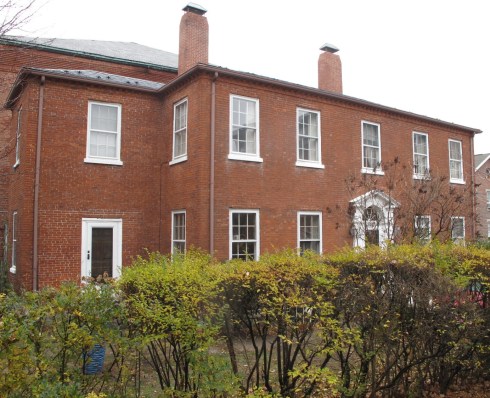
Bessie E. Munroe (?-1975): Mrs. Munroe waited out urban renewal in Salem in her lovely Federal home on Ash Street, with demolition ongoing all around her. She was a widow in her 80s when the Salem Development Authority began implementing its 1965 urban renewal plan, which called for the demolition of 145 out of 177 buildings downtown, including her house! She was compelled to sell to the SRA in 1970, but fortunately the agency agreed to her life tenancy because of her age and health. And then a new Salem Redevelopment Authority emerged, more intent on preservation than demolition: at the time of Bessie’s death in 1975, her house—the last historic residence standing, facing a parking lot—was saved and sold to a preservation architect. It is now on the National Register.

IMG_20200518_091858_799

SAL_2431 (2)Seeing red (demolition) in 1965; 7 Ash Street, the Bessie Munroe House, today.

Ada Louise Huxtable (1921-2013): Another woman who never lived in Salem (but long summered in nearby Marblehead like Louise duPont Crowninshield) yet had a tremendous effect on the city’s material heritage largely through her passionate indictments of the 1965 urban renewal plan (see above) published in the New York Times from 1965. Sometimes I think crediting her exclusively for the demise of this plan minimized all the efforts towards that aim by preservationists here in Salem, but still, there’s no denying her powerful impact, as she occupied a strong position of power as the architectural critic for the Times. Ms. Huxtable was not a strict preservationist, but she believed that it could be a useful tool against generic, thoughtless development with no historical or aesthetic merit: sterilized nonplaces. She kept watch on Salem through its new redevelopment and credited its mix of old and new in later articles and her 1986 anthology Goodbye History, Hello Hamburger. In praising Salem for “renewing it right” she also asserted that “Salem’s results promise to be a stunning rebuke to every community that has ever thought the only way to revitalization lay through….mutilation of what was often a unique identity for shoddy-slick, newly jerrybuilt anonymity.” Every day I wonder what Ms. Huxtable would think of Salem’s newest buildings.

Ada 1965 NYTAda Louise Huxtable’s condemnation of Salem’s 1965 Urban Renewal Plan in October of that year, the first of several pieces published in the New York Times.

Elizabeth K. Reardon Frothingham (1923-1983): A Salem native descended from several notable Salem families, “Libby” Reardon was a passionate afficionado and student of early American architecture who went on to become a professional preservationist, shepherding Historic Salem Inc. though its most turbulent era and writing several detailed inventories for the City of Salem. All of her records, unfortunately, were donated to the PEM’s Phillips Library and therefore moved from the city to which she was so dedicated: you can read more about that here. Given the pandemic, I haven’t been able to access her records or reports up there, but newspaper accounts testify both to her discovery (as a mere “housewife”) of two camouflaged Salem first-period houses, the Gedney and Samuel Pickman (pictured in the Huxtable article above, as well as below) Houses, as well as to her steadfast defense of Salem’s material heritage in the 1960s and 1970s. She was a real preservation heroine, gone too soon: I can only imagine what she might have achieved in the 1980s or 1990s—or now!

Reardon Collage1965! What a year that must have been—-Salem’s preservationists had to have been functioning 24/7.

And speaking of gone too soon, I wanted to take this opportunity to recognize two women who were clearly effective administrators of their respective institutions as well as contributors to the preservation of Salem’s material heritage: Anne Farnam (1940-91) of the Essex Institute and Cynthia Pollack (1932-1992) of the Salem Maritime National Historic Site. Ms. Farnam served as Curator at the Institute from 1975 to 1983 and as its President from 1984 until 1991, while Ms. Pollack served as Superintendent of SMNHS from 1983 to 1992. I have no idea what their personal relationship was like, but they were clearly colleagues not only in advancing the missions of their institutions but also the stature of Salem as a heritage destination. Both were active in the Salem Project, the forerunner of the Essex National Heritage Area, and both worked towards a more layered and contextual interpretation of Salem’s history. When you study their careers, you can see how interpretation and preservation are integrated and complementary: as the chief administrator of an institution charged with the stewardship of eight historic houses, Ms. Farnam was by necessity a preservationist, but she also initiated the 1977 exhibition on “Dr. Bentley’s Salem: Diary of a Town” which seemed to have seamlessly merged textual and material history (I never saw it, but I do have the companion volume of the Essex Institute Historical Collections). Likewise, Ms. Pollack deserves high praise for her dedication to the restoration of Salem’s historic wharves, but at the same time worked to enhance Salem Maritime’s interpretive reach: as the tribute sign at the Visitors Center’s Cynthia Pollack Theater reads: There were stories to be told, and she wanted visitors to see, touch, smell, and feel the maritime spirit that the site embodies. We all have a lot to live up to, I think.

Women Preservationists CollageA Boston Globe (glowing) review for Ms. Farnam’s exhibition, Dr. Bentley’s Salem. Diary of a Town in 1977 and 1992 photograph of Ms. Pollack.


Preservation Awards 2017

Every May (which is Preservation Month in case you didn’t know it), Salem’s venerable preservation organization, Historic Salem, Inc., holds its annual meeting at which a slate of officers are elected and a slate of preservation awards announced–with the latter taking up considerably more time than the former. The awards are culled from nominations by HSI’s membership and the community, and generally include a variety of projects: private residences meticulously restored, adaptive re-use projects, large public projects that privilege preservation. I look forward to these awards every year, but for some reason I haven’t “covered” them in my blog:  I think it’s because annual meeting nights have fallen on teaching nights in years past and so I haven’t been able to attend, but that’s a poor excuse as I certainly could and should have featured the list in years past. These awards go to individuals (owners, developers, architects) but represent material and aesthetic contributions to the entire community as preservation is a public good. In any case, this year the HSI annual meeting fell on a Friday, but I would have attended regardless as (shameless full disclosure here) my husband’s firm received not one but two awards: for the Howard and Derby Street condominium projects through which a 1960s convent and the former Settlement House of the House of the Seven Gables were transformed into residential buildings. These projects were in good company: the newly-restored (and expanded) Essex Probate and Family Court (now the Thaddeus Buczko Building) the Notch Brewery & Tap Room, the Pickering House, the Baker’s Island Light Station, Old Town Hall, the former Klondike Building–turned-offices for the North Shore Community Development Corporation, and a beautifully-refurbished Victorian house in North Salem were also recognized on this past Friday night. Together, they represent the sheer variety of preservation work going on in Salem by individuals and institutions, efforts that are more important than ever in this era of bland new building.

Preservatio Overview

Preservation Old Town Hall

Preservations Awards Nursery

Preservation Awards Lafayette Street

Preservation Awards Howard Street

Preservation Derby

Preservation Awards Federal Street

The 2017 HSI Preservation Award winners: Old Town Hall was recognized for the rehabilitation of its historic windows, and the Pickering House for its fence and balustrade. The Nursery Street Victorian sets the standard for meticulous restoration, inside and out. The second-floor North Shore CDC offices on Lafayette Street, also stunning. Seven Howard Street is a mid-century modern convent turned condominiums, and the former Settlement House of the House of the Seven Gables led many lives before its recent transformation into residences.

Looking forward to 2018: The Salem Maritime National Historic Site is in the process of restoring the windows of the Derby House, the old “Grimshawe House” on Charter Street (where Nathaniel Hawthorne courted his wife Sophia) is in the midst of a thorough rehabilitation, and I’m really hoping that my employer, Salem State University, not only saves but restores this historic bungalow on Loring Avenue.

Preservation Derby 2

Preservation Charter

Loring Bungalow

