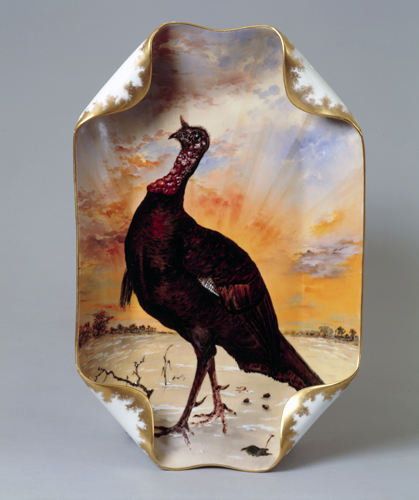
Tag Archives: Pottery

New Year’s Day

New Year’s Day is generally and literally about dismantling for me: taking down the elaborate holiday displays I assembled only weeks before on my eight fireplace mantels and all of the other decorations around the house. The tree is relatively easy compared to everything else, frankly, and as I write it’s out on the sidewalk awaiting its transport to Dead Horse Beach for the annual Christmas Tree bonfire this weekend. I’m an habitual seasonal decorator but now I’m wondering if I should reign in this instinct a bit….that’s certainly an attainable New Year’s resolution! In between bouts of dismantling I wasted copious amounts of time browsing the web for the perfect 2014 datebook because the one I bought at Target the other day is so devoid of any aesthetic whimsy that I fear I will not use it, and I need to: this is another area where my life has changed since becoming chair of my department–I now need to keep track of everyone’s dates and not just my own. As usual, I had Turner Classic Movies on in the background, and several movies distracted me from my dismantling mission as well, most notably the original (1968) Thomas Crown Affair. I had to figure out exactly where Steve McQueen lived on Beacon Hill in Boston (85 Mount Vernon Street–the 2nd Harrison Gray Otis house!!!) and examine each one of Faye Dunaway’s amazing outfits. And then, of course, I had to keep checking the weather reports as we have a big snowstorm bearing down on us: it looks like I will have several days inside to come up with some new displays for my mantels.

A day in the life: outside my bedroom window, the calm before the storm; a Christmas mantel before its dismantling; I love these little fabric trees from Quietude Quilts so I’m going to keep them up for a while; great Christmas presents: Wanderlust plates made in Rhode Island; Jessica Hische pocket planner; 85 Mount Vernon Street, Boston.

New Year 038

New Year 066

New Year 031

New Year 032

New Year 054

today-is-the-day-pocket-planner-570

OLYMPUS DIGITAL CAMERA


What I want for Christmas

Well, it’s a bit too late to put in this request, but if I had been able to make a Christmas list of wants rather than chores and things to buy at the grocery store, these amazing “Christmas Pudding” dishes designed by Eric Ravilious would be on the top. I’ve never really appreciated either holiday china or twentieth-century china, but these dishes are just so striking, as are most of the pieces made by Ravilious in his short life (1903-1942). My favorite is the first plate with what looks like a flaming (steaming) Christmas pudding, which was accentuated by the Victoria & Albert Museum in the form of a Christmas card. I was looking for a traditional Christmas pudding recipe when I found this plate, and then my search was over–I put in an order with our new bakery because I was so distracted by these decidedly cooler (in more ways than one) versions. Happy Christmas, everyone.

Christmas Pudding Plate

Christmas Pudding Plate Card

Christmas Pudding Plate 2

Christmas Pudding Sauce

Christmas pudding Bowl

Wedgwood “Christmas Pudding” dishes designed by Eric Ravilious, 1938, collection of the Victoria & Albert Museum, London.


Fox and Geese

The pictures from my last post on the Coolidge Reservation do not convey one of its major features:  what remains of  the many geese that obviously enjoy the Ocean Lawn as much as other visitors. I remarked upon this to the ranger who was stationed there, and he laughed and told us that they brought in a fox to keep the geese away, but after a while he gave up and left……the geese won. The parable of the fox and the geese and their adversarial relationship is an old one, even older than the fox in the hen-house I think, and it has inspired centuries of illustrations, decorative objects, and games, all featuring the hunter and the hunted or the geese somehow outfoxing the fox; in either case, the two parties are inevitably intertwined, in one way or another.

Fox and Geese Harley BL

Fox and geese

British Library MS Harley 4751, English Bestiary, 1230-40; Fox and Geese in the Tudor Pattern Book, Bodleian Library MS Ashmole 1504, 1520-30.

It looks like the fox is winning in these two pre-modern images, and he definitely has the upper hand in most representations of the relationship, at least until the creation of a succession of satirical views from the later eighteenth century onwards.

Fox Goose and Gander

Fox and Geese BM

Johann Heinrich Tischbein, A Goose and a Gander Honking in Alarm as Foxes Approach, mid-18th century, Metropolitan Museum of Art; The Goose Lost (a caricature of British politician Charles James Fox), published by J. Barrow, 1784, British Museum.

Porcelain and pottery with fox-and-goose motifs were also produced around this time, including rather elaborate pieces for extensive table services and the popular ABC and proverbial plates for children. Talk about intertwined: look at the gravy (sauce) boat below!

AMICO_CLARK_1039413730

Fox and Goose Gravy Boat

Fox Plate V and A

Fox and Goose plate Cooper Hewitt

Fox and Goose plate detail

Meissen Porcelain Cup and Saucer, c. 1760, Sterling and Francine Clark Institute; AMAZING Staffordshire Fox and Goose Sauce Boat, c. 1780-1790, and Transferware Plate, 1790, Victoria & Albert Museum, London; Creamware Fox and Goose ABC Plate by Elsmore & Son, England, late nineteenth century.

Children’s books published in the nineteenth and twentieth centuries, whether fables, nursery rhymes, or bedtime stories, feature a variety of illustrations of foxes and geese, generally on friendlier, or at least less predatory, terms. And then there were the fox-and-goose games of strategic pursuit, played on a board, in the parlor or even outside, which date back to the seventeenth century at the very least. Textile designs in the past and present  feature fox and geese continuously, in abstracted patterns for quilting and knitting, and more literal prints for fabrics and wallpapers.

Fox and Geese Game 1883

FoxGeesePieces

Fox Fabric

Fox and Geese board game, Gloucester, Massachusetts, 1993, Smithsonian Institution, and pieces from a modern version of the game; Westfalenstoffe fox and geese fabric.

My favorite images of these two natural enemies are a bit more basic and elemental, in line with the medieval and Tudor images above. The realistic, rather than romantic relationship was captured completely by John James Audubon in the nineteenth century and The National Geographic more recently: these are elemental and eternal images.

audubon

04-feisty-fox-drives-snow-goose-670

John James Audubon, Fox and Goose, c. 1835, Butler Art; An arctic fox and a snow goose face off in Sergy Gorshkov’s photograph for National Geographic,


Patriotic Patterns

Given my armchair observance of Patriots’ Day, and then everything that happened on that sad day (and is still happening), I thought I’d retreat into a safe material world and examine some of the patriotic products that were produced in the decades after the American Revolution, some in the new country and some for the new country. It seems appropriate to continue exploring expressions of patriotism; after all, the real anniversary of Lexington and Concord is today. Right after the Revolution (literally) home furnishings which reflected the revolutionary spirit were produced both in this country and oddly enough, in Britain. Maybe it’s not odd:  Britain was in the midst of the Industrial Revolution which was initiated by what I’ve always considered a uniquely pragmatic entrepreneurial attitude. I wish I could see the imagery more clearly in this first woodblock-printed wallpaper, but obviously it has deteriorated with time. Here is the catalog description from the Cooper Hewitt Museum: perhaps it will help you make out the Lexington Minuteman and his associates: Beside an Indian maiden, representing America, a patriot tramples British laws underfoot and extends the declarations of July 4, 1776, to Britannia, who weeps over a pedestal containing an urn, or a tomb. The whole is contained within a curtained arch. Printed in black, white and gray on a light colorless ground.

Patriotic pattern Minuteman

This paper was produced in America in the last quarter of the eighteenth century, the same time as the textiles below, which are obviously in much better condition: The Apotheosis of Benjamin Franklin and George Washington  is a copperplate-printed toile fabric produced in several colorways in Britain between 1785-1800, right after the first big defeat of the British Empire. I love George Washington’s leopard-driven carriage!

Patriotic pattern Apotheosis Winterthur 2

Patriotic Pattern Apotheosis

Patriotic Pattern Apotheosis Bed Valence Dumbarton

Apotheosis of  Benjamin Franklin and George Washington fabrics in black and red colorways, collections of the Winterthur Museum and the Society of the Cincinnati; bed valence at Dumbarton House/National Society of the Colonial Dames of America.

British pottery manufacturers were also quick to take advantage of the newly-independent emerging American market. Even if you’re just a casual picker, I’m sure that you have run into some of the blue-and-white transferware of the Clews Brothers, James and Ralph, decorated with American scenes and symbols at their factory in Cobridge, England in the 1820s and 1830s. You see it everywhere, in all sorts of forms.

Patriotic Patterns  Clews at Skinner Auctions

Patriotic Patterns Clews Platter Skinner

“American” transferware, including a “States Design” platter below,  made by James and Ralph Clews in England,c. 1819-36, Skinner Auctioneers Archives.

And how many gilt mirrors emblazoned with eagles were produced in the Federal era (or reproduced afterwards)? So many, and again, produced in all shapes and sizes in both America and England. Below is a particularly nice eglomise (reverse-painted) example featuring the USS Constitution made in Providence by Peter Grinnell & Son right after the War of 1812. And from the next decade, a beautiful “patriotic overmantle painting” from a Rockport, Massachusetts home. It is tempera on plaster (I’m wondering how they took it off the wall???), and sold for $61,ooo at a Christie’s auction in 2008.

Federal Mirror Eglomise Providence

Patriotic Overmantle painting Rockport MA

This last painting does not really qualify as a commercially-produced product or a pattern, but it is so beautiful I wanted to include it. My last item–a handmade woven wool and linen coverlet with patriotic themes and symbols–dates from the mid-nineteenth century (1851 to be precise), just before patriotism becomes divided and divisive with the coming of the Civil War. Actually, even before 1850 the Abolitionist and Temperance movements produced their own patriotic/promotional objects. This lovely coverlet expresses a more personal patriotism, but also one in keeping with the functions of these other objects:  Americans wanted the symbols and imagery of their new nation on their walls, on their tables, and on their beds.

Patriotic Woven Wool and Linen Coverlet 1851 Skinnersp

Addendum:  Last night on Salem Common: thousands walking, running, praying in support of Boston.

Salem News David Le Staff Photo

Salem News:  David Le/Staff Photo.


Reynard the Fox

That fox pulling the papal tiara off Celestine V’s head in my last post reminded me of Reynard the Fox, a very popular medieval fable which developed in the later twelfth and thirteen centuries in France and Germany, from where it spread throughout western Europe:  the many “branches” of Reynard verse are generally grouped together as the Roman de Renart cycle. Reynard is an anthropomorphic fox who is always up to no good, a cunning trickster whose escapades are both entertaining and illuminating. He is the animal representative of the medieval outlaw, far less benevolent than Robin Hood, and utilized by medieval scribes (who were of course, monks) as a form of satirical and whimsical criticism.  But Reynard is also a fox, and like all sly foxes, quite capable of feigning vulnerability (and piety) in order to elude capture and capture his next meal. One of the most common images in medieval manuscripts is of Reynard preaching, to an audience of birds whom he intends to eat.

Royal 10 E.IV, f.49v

Fox Preaching Stowe

British Library MS  Royal 10 E IV, late 13th/early 14th century, and MS Stowe 17, “The Maastricht Hours”, early 14th century.

In every Reynard tale, the fox is summoned before a court of his animal peers, headed by a lion, of course, and called to task for his bad behavior. He always manages to outfox his judges by his cunning. He feigns remorse, confesses his sins, and sets off on a holy pilgrimage of atonement, only to get into more trouble. A death sentence leads to more displays of cunning, exploits and opportunities, and consequently he becomes the sympathetic “hero”, the one for whom we root.

Reynard the Fox Bod MS Douce 360

Reynard Bod Ms Douce Reynard Dead

Reynard as a “pious” pilgrim and on the cart of a fishmonger who has presumed him dead–meanwhile, the fox is working his way through the stock of fish:  Bodleian MS Douce 360, “The Romance of Reynard and Isengrin”, 1339.

I definitely think Reynard’s popularity increased in the late medieval era along with anticlericalism and lay piety, and he makes it into print relatively early. In England, William Caxton published his own translation in 1481, and the “history” was reprinted regularly in the sixteenth and seventeenth centuries. There followed all sorts of literary adaptations, as Reynard, like any outlaw, is readily adaptable. The most famous modern adaptation is Reneike Fuchs, an epic poem produced by Johann Wolfgang von Geothe in 1794, supposedly influenced by the events of the French Revolution. The editions of this text issued from the mid-nineteenth century, illustrated by Wilhelm von Kaulbach and Joseph Wolfe, must have been extremely popular as they were constantly in print. There were also a succession of children’s versions of the fable issued in the nineteenth century, and really beautiful artistic editions published by William Morris’s Kelmscott Press in 1892 (a reprint of Caxton) and the Insel Verlag Press in 1913.

V0023068EL A fox in a monk's habit is apparently deeply engrossed in pr

Reynard the Pilgrim

Reynard Kelmscott Press 1892

Reinke Voss 1913

Reynard posing as a monk in order to access the chicken coop of a monastery, and as a pilgrim being blessed by a ram-priest, Wolfe and von Klaubach illustrations from 1853 & 1846; first page of the Kelmscott Press Caxton edition, 1892; Cover of first edition of Reinke Voss, 1913.

Reynard lives on in a variety of forms and formats in the twentieth century, and today can be found on everything from pillows to china to chess sets. He seems to have shed a lot of the satirical and moralistic messages of his medieval origins, but he was never that moral a character to begin with so I guess it doesn’t matter!

Reynard the Fox Coffee Service

Reynard the Fox Etsy

Two Reynards that I covet:  a Royal Doulton coffee service from 1935, and pencil illustration of Reynard the Fox Detective.


Presidential Plates

Because I dislike Presidents Day so much (because of its ahistorical morphing of all the presidents together, thus denying their individual achievements, as well as the fact that it never seems to occur on the actual date of either Washington’s or Lincoln’s birthdays, the particular presidents it claims to commemorate), I’m going to downplay the historical and emphasize the material today with a very brief examination of Presidential china. The morphing of presidents is a very popular pastime today (see this viral video), but I prefer not to morph.

I spent (another) snowy afternoon looking through two books (Official White House China by Margaret Brown Klapthor and Susan Gray Detweiler’s American Presidential China. The Robert L. McNeil, Jr., Collection at the Philadelphia Museum of Art) and accessing two online sources (the White House Historical Association’s “Picturing the President’s House” digital series (so well done!) and the McNeil Americana Collection at the Philadelphia Museum of Art) and quickly formed an impression of presidential plates:  those from the first century of the presidency are far more aesthetically pleasing and interesting than those from the second.  Twentieth-century presidential china is, for the most part, boring.

Here are some of the early presidential plates, starting with that of the Washingtons, a gift to Martha from Dutch East India trader Andreas Everardus van Braam Houckgeest, who commissioned the design in Canton, China. I love the chain of 15 states, the state of the union in 1796. The service commissioned by James and Elizabeth Monroe from the French firm of Dagoty-Honoré is considered the first official White House china because of its patriotic motif:  surrounding the eagle are five vignettes depicting Strength, Agriculture, Commerce, Art, and Science, the foundations of the new nation. Successive presidents apparently used the large Monroe service (400+ pieces) for big state dinners but also brought their own china into the White House for daily use:  Mr. and Mrs. John Quincy Adams used this neoclassical service (with seahorse motifs), likely manufactured by the La Courtille Factory in Paris and purchased during Mr. Adams’ earlier diplomatic service in Europe, during their time in office.

Presidential China Plate

Presidential China Monroe

Presidential China Adams

Porcelain plates used during the Washington, Monroe, and Adams administrations, McNeil Americana Collection, Philadelphia Museum of Art.

There is no doubt that the star of early presidential china was the set purchased by James and Dolley Madison from the Nast Factory in Paris:  an absolutely stunning (and modern!) design featuring wheels, of all motifs. It seems to be very sought after; at first I thought this was because of its relative rarity, given the fact that the Madison White House was burned down by the British in 1814.  But it seems like most of the service survived (did Dolley sneak it out in the last hours, along with that great portrait of George Washington?), so I think its value must be based on the unusual design. I love it, and am even tempted to buy a copy–nearly every presidential library’s shop, including the JFK Library here in Massachusetts, seems to offer reproduction presidential china produced by Woodmere.

Presidential China Madison

Presidential China Madison 2

Presidential China Madison Nast Dessert Cooler 1804

The Madison China, purchased c. 1806 from the Nast Factory in Paris.  Plate and sauce boat, Philadelphia Museum of Art; dessert cooler, White House Historical Association.

The Lincoln “Royal Purple” china, pictured below on the cover of Detweiler’s book, was certainly expensive, like most of Mary Todd Lincoln’s White House “improvements”, but it seems to have stood the test of time and was supplemented and complemented by later sets. The scalloped shape set it apart from its predecessors, and like all White House china commissioned before 1918, it was made in France, by Haviland.

American Presidential China

In terms of their china choices, the two most innovative, or nationalistic (as well as naturalistic), first ladies were Lucy Webb Hayes and Caroline Harrison. Quite by chance, Mrs. Hayes met an artist and reporter for Harper’s Weekly named Theodore R. Davis who convinced her to use native American flora and fauna in the design of a new White House service in 1880; the end result, designed by Davis in collaboration with the Haviland Factory in Limoges, France, was a rather dramatic departure from the traditional styles of the mid-nineteenth century.  A decade later, Mrs. Harrison incorporated the naturalistic theme in her own design, but also paid tribute to tradition with the eagle and stars, and to Mrs. Lincoln’s plates with the  scalloped edge.

Presidential China Hayes Soup Plate 1880

Presidential China Rutherford B Hayes 1880 Haviland

Presidential China Harrison

Soup plate and serving platter from the administration of Rutherford B. Hayes, designed by Theodore R. Davis in collaboration with the Haviland Factory, Limoges France, 1880, Philadelphia Museum of Art and White House Historical Association; A soup plate designed by Mrs. Benjamin Harrison (Caroline Lavinia Scott) and manufactured by Tressemanes and Vogt, Limoges, France, 1891.

With the arrival of the twentieth century we come to the era of domestic production (mostly by Lenox) and rather boring bands: lots of gold, along with blue (Roosevelt), green (Truman and Bush), red (Reagan), and yellow (Clinton). The only departure from these restrained designs seems to be the Johnson wildflowers. I’m not sure what the Obama plans are regarding china, but in the mean time, we do have the “Abraham Obama” tea set by Ron English ( I suppose I am engaging in a little bit of presidential morphing after all) and you can also custom order your own flowered presidential plate here; I might go for Teddy Roosevelt myself.

Presidential China

President Plate Rothshank


Wassail and Shrub

I’m making two traditional drinks for the holidays this year:  wassail for a gathering and shrub for gifts. Both drinks go way back, how far no one really knows. Wassail was both a drink and an activity, first referenced in the cider-producing parts of England where harvest revelers would dance about sprinkling the trees with a particularly potent vintage so that the next year’s harvest would be abundant: Robert Herrick wrote Wassaile the trees that they may beare / You many a plum and many a peare/For more or lesse fruits they will bring / As you do give them Wassailing in the seventeenth century. At some point, Wassail and Wassailing also came to refer to a more general custom of a drink/drinking to one’s health (the Middle English waes hael roughly translates to “be hale” or “be well”), and more specifically to Christmas cheer and well-wishing:  wassailing seems to merge with caroling to create a custom of extending celebratory hospitality to one’s friends and neighbors during the holiday season. The great revival (or creation?) of Christmas traditions in the Victorian era brought forth not only trees but also wassailing; the “traditional” Here We Come a-Wassailing carol that we are all so familiar with actually dates from the mid-nineteenth century.

wassail bowl V and A

Christmas Spirits

An English wassail bowl from the later seventeenth century, Victoria & Albert Museum, and a “Merry Christmas” image from the major illustrator of Dickens’ works, Hablot Knight Brown (also know as “Phiz”). Father Christmas holds the wassail cup among other Christmas traditions of “merrie olde England”:  plum pudding, roast beef, mistletoe. I’m not sure why so many spirits (“bogies” and the snapdragon) are in the picture, nor do I know what “twelfth cake” is–yet!) British Museum, c. 1860.

It was a bit difficult to narrow down the variant recipes for the wassail drink; they seem to fall into spiced ale, spiced cider, and spiced wine categories with rum even appearing in a few.  The most traditional recipes feature stewed and mottled apples and/or eggs to create a thick  frothiness that makes the drink resemble “lambswool”, its early designation. I’m not going that route, as I find that texture (and eggs in general) rather repellant. I think I’m going to go for a simple wine and fruit juice recipe from the Williamsburg Cookbook.  And sadly, I do not have one of those multi-handled wassail bowls like the one from the V & A above; a simple punchbowl will have to do.

Shrub is probably even more ancient than wassail drinks; it derives from the necessity of preserving fruit long after the harvest over. Fruit is combined first with sugar and then with vinegar to create a syrup that can last indefinitely and mix with anything.  My hunch is that shrub was one of those things discovered (or rediscovered) by Europeans as a result of their encounters during and after the Crusades, as its name derives from the Arabic sharab (syrup; drink) and sugar was introduced into the European diet (and consciousness!) at that time too. Refrigeration did away with shrub, but I think it is currently experiencing a revival: there are several commercial manufacturers, including Tait Farm, from which I bought my first bottle.  But it’s easy enough to make, and there are 2 major processes:  hot and cold.  Using heat, you macerate whatever fruit you prefer (berries are best), add sugar and a bit of water, and boil up a syrup.  Once it has cooled, you add vinegar–whatever kind you like (I generally use apple cider or some type of flavored vinegar rather than white).  Leave it for a while, then strain, and then you have a fermented concoction which you can add to seltzer, lemonade, or alcohol (gin,vodka, and rum all work well with shrub). Without heat, the fruit and sugar combine to create a syrup-like mixture anyway, which you then add to the cider. Shrub is both tart and sweet, and you can keep it in the refrigerator for quite a while. A very pleasant way to drink your vinegar!

Tait-Shrub-Group-PS-Fullsized-2

Shrub Bottle Ticket Elizabeth Morley V and A

Shrub Bottle Ticket Enameled Copper 1770 V and A

Tait Farm shrubs, and two shrub bottle tickets from the Victoria & Albert Museum, London: the silver ticket was made by Elizabeth Morley in London around 1794-95, and the enameled copper ticket dates from 1770.


Arctic Animals

I had an arctic weekend. It wasn’t particularly cold here in Salem (rather the opposite), but since I was in a Santa Claus frame of mind, I thought I’d follow up my St. Nicholas post with a historical look at the North Pole, and that led to full immersion in the Arctic. This northern orientation (and two great books: Robert McGhee’s Imagining the Arctic:  the Human History of the Arctic World; Francis Spufford’s I May Be Some Time:  Ice and the English Imagination) gave me new insights into lots of things, but for the sake of imagery, I’m going to go for arctic animals:  great white beasts of the frozen north.

Before they set out to explore all the unknown corners of the world in the fifteenth and sixteenth centuries, Europeans had lots of ideas about the North which had been passed down from ancient geographical writers like Pytheas, Strabo and Pliny the Elder. The typical Renaissance endeavor involved the engagement, verification and/or dismissal of classical knowledge and for the Arctic, nothing was more influential than the posthumous publication of Gerhard Mercator’s world map, which portrayed the North Pole as a magnetic black rock surrounded by a clearly-marked Northwest Passage. In England, this inspired the erection of “arctic poles” all over the country and Martin Frobisher’s three voyages, from 1576-78, to Meta Incognito (the “unknown limits”; really southern Baffin Island, though Frobisher claimed the entire Arctic for England).

arctic1595

Gerhard Mercator, “Septentrionalium Terrarum descriptio”, from his posthumously published atlas, Atlantis pars altera. Enlarged fascimile, Historic Collection, Princeton University: part of a Princeton digital exhibition, Of Maps and Men.  In Pursuit of a Northwest Passage.

Imagine the surprise (or perhaps the expectation) when Frobisher’s men found a unicorn washed up on a Baffin Island beach, or rather a “Sea Unicorn”, as they referred to the creature. This fabled creature seemed to confirm that they were somewhere special, and previously elusive. From this first discovery, northern fish and fauna were always described and depicted as especially monstrous, especially large, especially white.  From narwhals to polar bears, from foxes to hares, these were almost-otherworldly creatures.  The Frobisher “Sea Unicorn” is pictured below, from George Best’s account of the second voyage, followed by two relatively modern caricatures of really large Arctic creatures.

Arctic Sea Unicorn

Arctic Hare 1890s Smithsonian

AMICO_PHILADELPHIA_103883058

Anonymous drawing of a BIG arctic hare, c. 1890, Smithsonian Institution, and Charles Sidney Raleigh, “Chilly Observation”, 1889, Philadelphia Museum of Art

The Arctic Hare (Lepus articus) is the largest North American rabbit, but it’s not that big! And of course it’s the same for the polar bear:  these images convey a sense of the (literal) diminution of man in the vast, frozen Arctic.  I’m quite taken with the hare, so much so that I even “adopted” one through the World Wildlife Fund (I figured that polar bears have more advocates). They are grey in the summer, but apparently turn into white fuzzy balls in the arctic winter.

Arctic Hare

Arctic Hair Greenpeace Ad

Arctic hares in their natural habitat; South African Greenpeace “white is the new green” ad, 2010.

For an Arctic animal in scale, there is no better image than William Bradford’s An Arctic Summer:  Boring through the Pack in Melville Bay (1871) with what looks like an arctic fox walking along the ice undisturbed or unaware of the nearby ship. Yet man is still humbled–isn’t that a piece of a wreck on the shore?  Bradford was a Massachusetts artist whose work, based on his own observations while on an 1869 polar expedition, figured heavily in the Peabody Essex exhibit Journey to the Ends of the Earth:  Painting the Polar Landscape a couple of years ago. More of Bradford’s paintings, as well as amazing photographs from his illustrated book, The Arctic Region:  Illustrated with Photographs taken on an Expedition to Greenland can be found at the Clark Art Institute.

Arctic Bradford

Arctic Fox

William Bradford, An Arctic Summer:  Boring through the Pack in Melville Bay, 1871, Metropolitan Museum of Art; cast earthenware Arctic fox, Hornsea Pottery Co., 1956, Victoria & Albert Museum, London.


Flawed by Design

Several years ago I sold my rather large collection of red transferware, and cleansed the house of most of the odd bits of toile:  it was pretty clear that my husband hated these romantic patterns–particularly in red.  I think most men share his opinion. I miss the dishes more than the textiles, and have been looking for ways to sneak a few transfer pieces back into our home.  Two versions of modern transferware on the market right now might be just creative enough to overcome their toileness:

Target Too by Blu Dot dinnerware and Anthropologie “Dipped Toile” desert plates.

The first set of dishes–the result of a rather stealth collaboration between Target and the modernist manufacturers Blu Dot–are so subtle I think they could make it into my cupboards unnoticed.  Both of these collections are charming, I think, because they are flawed by design, achieving difference (and whimsy) through apparent “defects”.  It occurred to me that only in our modern industrial age could you possibly have such a design concept as deliberately imperfect:  the standards of pre-industrial craftsmanship would simply not allow it. Then I thought (and read) about the traditional Japanese philosophy and aesthetic of wabi-sabi, which embraces the incomplete and imperfect as a way to grasp simple beauty and transience:  yet another cultural distinction between east and west. In the first half of the twentieth century, similar values were embraced by artisans of the Arts & Crafts movement, who were trying not only to revive craftsmanship but also differentiate their products from those that were mass-produced.  Skip forward a century or so, and differentiation through mass production seems to be the aim of some industrial designers.

Porcelain Tray by Bernard Leach, 1931, Victoria & Albert Museum, London.

While exploring the art of imperfection a bit further, I came across this perfectly-matched (at least to me!) pair of objects of flawed beauty, one the result of the passage of time, the other deliberately modern.  Bear in mind that as I am writing this, I am staring at a large crack on my bedroom wall, a flaw that always reappears no matter how many times we reapply plaster.  I’m searching for an empty gilt frame–and trying to have an optimistic outlook!

Highworth Roman milk pot in unrestored state, via The History Blog; crack “painting” via A Lovely Escape.


Variations on Blue and White

I’ve never been a blue person; there is no blue in my house except for my turquoise dining room which I think of as green.  When I went through my transferware phase, I collected red (pink) and white rather than the more attainable blue and white, and in the summer time, when it seems like all of my favorite shelter magazines feature blue and white portfolios, I leaf quickly through.  That said, I have been quite taken by the latest installation of the Peabody Essex Museum”s ongoing “FreePort” exhibitions, through which contemporary artists engage with and respond to the museum’s collections, creating completely new works in the process.  FreePort [No.005]:  Michael Lin takes the traditional blue and white of Chinese export ware and runs with it, as Mr. Lin has emblazoned the armorial and heraldic crests of porcelain produced in China for the European market on the staircase walls and floors of the Museum’s Asian Export galleries.  The effect is modern and baroque at the same time.

And then, as  if these vibrant blue-and white walls and floors were not enough to make us look at plates in a completely different way, Lin also produces a mass of “Mr. Nobodys”, the first Chinese representations of Europeans, with their anonymity enhanced by the massing, and their commercial qualities (we are talking about the Chinese export trade here) enhanced by the fact that you can buy one in the PEM Museum Shop.

For comparison’s sake, another Mr. Nobody from the collection of the Victoria & Albert Museum, London.  This one, however, was produced in England in the later seventeenth century.

The motifs and the figurines are interesting examples of cross-cultural exchange, an important dynamic in world history.  I can’t imagine a better way to (literally) illustrate it.  The Lin installation reminds me of another artistic expression, Blue and White by the Silk Road Ensemble, a multimedia performance that traces the migration of blue-and-white porcelain around the world.

This is a big task, because there are a lot of varieties of Asian-influenced blue and white porcelain and pottery:  delftware, fritware, transferware, just to name a few. Blue and white earthenware is everywhere, crafted in very diverse forms, over many centuries.  Here are two particularly disparate examples:  Iranian rasps in the form of shoes from the eighteenth century, and an image of omnipresent “oriental” planters from Victorian England.  Because I was so inspired by Lin, I tried my hand at my own blue and white Salem fabric design via Spoonflower with limited success:  Samuel McIntire’s sheaths of wheat look a bit too tropical in blue!  Obviously Christopher Dresser’s stenciled ceiling (a nice counterpart for Lin’s walls and floors) is much better.

Fritware and late 19th century songsheet, Victoria & Albert Museum, London; design for a stenciled ceiling, Christopher Dresser, Studies in Design, 1876.