Tag Archives: Pottery

A Swarm of Bees in July

According to the old English nursery rhyme: A swarm in May is worth a load of hay; a swarm in June is worth a silver spoon; but a swarm in July is not worth a fly. Even if we could muster enough bees in these days of ever-dwindling bee populations, apparently it’s too late in the season for a regenerating swarm. Nevertheless, there still seem to be bees around, in my garden, on the streets of Salem, and in my bookmark folder labeled interesting insects. So it’s a good time to showcase most of the above.

For the past few years, the city of Salem has been initiating public art projects, and this year the goal is all about transforming mundane surfaces into works of art.  All the utility boxes around town have been painted, and my favorite is the “bee box” near the intersection of Essex and Summer Streets: here we have a real swarm, or at least a utilitarian representation of one.

I think bees are on everyone’s minds now that their numbers are in decline, but in fact representations of them go way back: the royal associations, their industrious and organizational nature, and the fact that they were the source of Europe’s native sweetener made them very conspicuous insects in western culture.  Sometimes they even seem to transcend insect-hood, or at the very least represent all of insect-hood, as in God made the birds and the bees.

Some medieval bees:  pollinating, confronting a bear, and making honey:

British Library MSS Harley 3244 (after 1236), Harley 3448 (15th century) and Sloane 4016 (c. 1440).

Bees were big in the early modern era, as their role in pollination was universally known and expensive imported sugar could not fulfill the demand for sweet treats. They also became, very notably, the subjects of the first publication of empirical observations made with one of the revolutionary instruments of the era, the microscope, in Federico Cesi’s and Francesco Stelluti’s Apiarium (1625; detail below).  In England, all of the practical gardening manuals from the sixteenth and seventeenth century contain sections on bee-keeping; it seems to be a natural component of cultivation, not a specialization by any means. Sometimes women are the designated bee-keepers, sometimes men.  There were also books focused particularly on bee cultivation and bee culture, like John Levett’s classic Ordering of Bees (1634, below) as well as satirical allegories like John Day’s Parliament of Bees (perhaps 1607, but not printed until 1641). Given that bees live in a matriarchy as well as their general nature and attributes, I’ve always wondered why Elizabeth never made more iconographical use of them; perhaps it was too patently obvious.

Centuries later, Napoleon had no such subtlety: he used bee motifs to project legitimacy for his very new regime.  The bee enabled him to project royalty–as it was associated with France’s very first royal dynasty, the Merovingians, and with France’s early medieval emperor, Charlemagne–while disassociating himself with the fleur-de-lys-bearing Bourbons whom he displaced.

Bonaparte among the Bees:  portraits of Napoleon by Anne-Louis Girodet de Roucy-Trioson  (after 1804) and Jacques-Louis David (1812; National Gallery of Art, Washington).

Bees were too universal and essential to be stigmatized by their association with Napoleon, and after his fall they became an important decorative motif in the nineteenth and early twentieth centuries, appearing on textiles, ceramics, and jewelry, and in many illustrations and lithographs. At the same time, this very industrious era produced several key innovations in bee-keeping, most notably Langstroth’s movable frame hive, bringing about a revolution in the management of bees. Art, science, and industry were inextricably connected when it came to bees, and I haven’t even touched on advertising.

Wedgwood Sugar Caster, early 19th century, and French bonnet veil, c. 1860, Victoria & Albert Museum, London; illustration from Brockhaus Konversations-Lexicon : allgemeine deutsche Real-Encyklopädie. (Leipzig : F.A. Brockhaus, 1883-1887), New York Public Library Digital Gallery.

Of course bees continue to be inspirational for artists, designers, and crafters.  Given that the bee population is declining at an alarming rate (30%!!!), I hope that their ongoing popularity is not merely a sentimental urge.  There are too many items emblazoned with bees to showcase here, but I am drawn to British ceramicist Fenella Smith‘s bee mugs and jugs, which you don’t see everywhere (yet).


Whistle Belly Vengeance

Flipping through one of a stack of old books I seem to be collecting on “ye olde” customs of New England, I found not only a recipe for a popular drink called “Flip”, but also one very much linked to my adopted city:  “A terrible drink is said to have been made popular in Salem – a drink with a terrible name – whistle-belly-vengeance. It consisted of sour household beer simmered in a kettle, sweetened with molasses, filled with brown-bread crumbs and drunk piping hot” (Alice Morse Earle, Customs and Fashions of Old New England, 1893).  I had seen that phrase before–in Old England–where it generally seemed to convey a truly awful drink, so it is odd to see it used as a name of a popular one:  the link must be the sour (spoiled) beer.  Our colonial forebears lived in an ever-perishable world which disdained waste of all kinds, so spoiled beer was turned into something sweet and hot to cover up its taste, and I suppose that the bread crumbs even added a bit of sustenance.  Many of the drinks referenced by Earle are similar in their combination of sweet and hot–and a few have proteins mixed in as well;  sillabub (hard cider, mixed with sugar, nutmeg and cream)and the afore-mentioned flip (strong beer, mixed with sugar, nutmeg, pumpkin and molasses, a shot of rum and a beaten egg, stirred with a hot fire poker) seem to have been the most substantive.  In general, possets were drinks which featured cream or milk, and fustians contained eggs.

Staffordshire posset pot, early 18th century, courtesy of Victoria & Albert Museum, London.

Beverige was a lighter, non-alcoholic drink generally made of water mixed with ginger and molasses, but when served to sailors it was strengthened by the addition of rum and vinegar, and became switchel. There were countless rum drinks, served hot and cold:  beer was mixed with rum (bogus), cider was mixed with rum (stone-wall), molasses was mixed with rum (black-strap).  New England was indeed awash in rum, perhaps fueled by rum, and therein, unfortunately, lies its major connection to slavery. My own house was built by a wealthy rum distiller, so I think about this connection quite a bit.

Eighteenth-century caricature from the George Arents Collection of Tobacciana in the New York Public Library (where there is smoking there is usually drinking); the Buckman Tavern in Lexington, Massachusetts, from A Revolutionary Pilgrimage (1917) by Ernest Clifford Peixotto.

Apparently a British brewery has revived Whistle Belly Vengeance:  a “ malty reddish ale”  produced by Summerskills Brewery of Devon is clearly not based on the original recipe, but it does seem to have attained the “frothiness” that was often aspired to way back when.


Silver Substitute

I spent the latter part of the long July Fourth week with family in southern Maine, engaging in some leisurely antiquing along Route One.  Our first stop was one of my long-time favorite shops, R. Jorgensen Antiques in Wells, which is always a lovely place to visit:  amazing furniture, beautiful grounds, friendly owners.  Usually I’m exclusively focused on the big pieces at Jorgensens, particularly tables:  I really can’t imagine a better place to buy an antique dining table.  But while I was gazing longingly at a pedestal table that seats eight but could be magically transformed into a Pembroke table that you could push against the wall, my eye fell on several smaller items: a “silver” tea set that was really pottery in disguise.

I thought I was familiar with lustreware but apparently not.  Many of my pearlware pieces have copper lustre bands, and you see the pink lustreware everywhere, but I had never seen pieces completely dipped in silver or platinum glaze, in such an alchemical and egalitarian way.  Silver for everyone!  This particular tea set is Edwardian, but looking around I found items from the early nineteenth century onwards.  Here are some of my favorites, all dating from the decades immediately following the invention of the glazing process in Staffordshire around 1805:  two lead-glazed earthenware coffeepots with platinum lustre decoration from about 1810-1820, and a two-handed cup, two decorated jugs, and an urn from the same period and region.  I also checked out auction results for similar items over the past few years and found that they are surprising affordable: could there be a new collection in my future?

Silver lustreware from the collection of the Victoria & Albert Museum, London, with the exception of the last two pieces:  decorated jug at Appleby Antiques and urn at the Metropolitan Museum of Art, New York.


Playing with Fire

Francis Bacon heralded the compass, printing, and gunpowder as the three European (really Chinese) inventions that changed the world, but he also had words of praise for another Renaissance (Chinese) innovation:  fireworks. Like gunpowder, fireworks represented the Promethean feat of his age:  stealing fire from heaven, and in both his Essays (1612; “On Masques”) and The New Atlantis (1627) he references the achievement:  we represent also ordinance and instruments of war, and engines of all kinds: and likewise new mixtures and compositions of gunpowder, wildfires burning in water, and unquenchable. Also fireworks of all variety both for pleasure and use.

I’m not sure what the recommended use of fireworks was besides pleasure, but I thought I’d indulge in a brief (and very Eurocentric) illustrated history of fireworks for the beginning of our July 4th week.  As always, when I compare the past and present, I’m struck by the artfulness of the former:  fireworks displays from the Renaissance through the nineteenth century seem to have been as much focused on a flagrant display of machines on the ground as light in the sky. As evidence, look at the elaborate seventeenth-century (Italian, of course) creation below, and an illustration from John Babington’s Pyrotechnia.

Engraving by Lodovico Ottavio Burnacini (1636-1707), courtesy Victoria & Albert Museum, London; John Babington, Pyrotechnia (1635), courtesy Folger Shakespeare Library.

Fireworks demonstrations in Europe are first recorded in the fifteenth century, so two centuries later they are not quite the marvel they once were and the “pyrotechnists” had to stage ever-more elaborate displays in order to impress at every royal and national event:  weddings, coronation, victories in battles and wars. Views of London fireworks celebrating the English victory at the Battle of Boyne in Ireland in 1690 and the Peace of Aix-la-Chapelle in April of 1749 are below;  the latter celebration definitely had its highs and lows. The high was the first performance of Handel’s Music for the Royal Fireworks, while the “low” was a firework-sparked fire which burned the central pavilion to the ground, accompanied by a swordfight between the pyrotechnist-architect of the performance, Giovanni Niccolo Servandoni, and the organizer of the event, the Duke of Montagu.

Night-time fireworks celebrating William III’s victory at the Battle of Boyne, 1690, British Museum; two views of the fireworks and fireworks pavilion celebrating the Peace of Aix-la-Chapelle, April 27, 1749, British Library and Victoria & Albert Museum.

In the nineteenth century, fireworks celebrations look a bit more recognizable (boring), so I’m going to shift to ephemera and fireworks-related items.  From either end of the century, some great British trade cards and a beautiful cover of Lippincott’s Magazine by Will Carqueville.

Trade cards from the British Museum and British Library; Lippincott’s cover from July 1895, Victoria & Albert Museum, London.

Back to the art of fireworks for the last century:  Eric Revilious’ amazing fireworks design for Wedgwood, commemorating the 1937 coronation of King George VI on a coffee cup, and a recent photograph by Sarah Anne Johnson.

Eric Revilious mug for Wedgwood, 1937, Victoria & Albert Museum, London; Chromogenic print with applied photospotting ink, acrylic ink, gouache, and india ink by Sarah Anne Johnson, New York Public Library Digital Gallery.


Blue Lobsters

The rare discovery of a blue lobster by several Rockport lobstermen was all over the Boston news late last week, prompting a search to discover just how rare these crustaceans are.  I kept coming up with the odds of 1 in 2 million, which would indeed make them pretty rare, but I also found bright blue lobsters pulled out of the waters off Ocean City, Maryland last week, two from Canadian waters over the past year, and another off Scotland last year.  Before that, not much news; in fact, the last mention of a blue lobster in Boston was in 1926!  So I am wondering if something is up in the lobster world? Here is the very bright blue–quite aptly referred to as cobalt–Scottish lobster, and an even more rare (1 in 30 million) mutant calico lobster, in the New England Aquarium.

Natural History Museum/Solent

I wish I could blow up this little negative of the 1926 lobster on exhibit in a Boston hotel from the Smithsonian, because it looks like a great picture.  The caption reads:  Boston, Mass.: Rare lobster exhibited at hotel exposition. Ann Donnelly, an attendant at the exposition in the Mechanics Building, holds a blue lobster, one of the very few which has been taken out of New England waters in many years. 5/20/26.

Out of the water, there are lots of blue lobsters, on pottery and paper, fabric and canvas (besides lots of restaurants and Nike sneakers). I particularly liked this platter from Apartment 48, a repurposed nineteenth-century image from Etsy seller Ephemera Press, and an original watercolor called A Lobster Tale by Sarah Storm.


Slippers and Slipware

It’s perhaps a bit early–though not too early considering our warm spring– but the lady’s slippers have arrived in my garden.  Late last week I took a walk through the woods and encountered the pink variety (sorry, no camera!) and this weekend out popped my yellow variety ( Cypripedium parviflorum or Cypripedium calceolus, there seems to be an ongoing debate about classification):  they always take my breath away the first time I turn the corner and see them.

I must say I do prefer the yellow variety; the pink ones look a little fleshy close up, with the flower resembling a lung more than a slipper!  Thanks to the journal function of writing a blog, I checked in on my lady’s slippers last year to find that I had seven slippers, while this year I have eleven, including one stem that has two flowers on it!  Words fail to contain my excitement.  Here is a shot from early this morning, after last night’s thunderstorm (during which I had to restrain myself from going outside to put an umbrella over them):  they survived, but are looking a bit put upon.

I was looking around to see how artists have been inspired by the Lady’s Slipper in the past and the present and found that ceramics seem to be the preferred medium for depicting this particular flower, which was once so common, and now relatively rare. My favorite discoveries were a beautiful piece of Staffordshire creamware from the late eighteenth century in the collection of the Victoria & Albert Museum, a Whately jug from the mid-nineteenth century, and a lovely little vase by Michael Stanley Pottery.


Stag Party

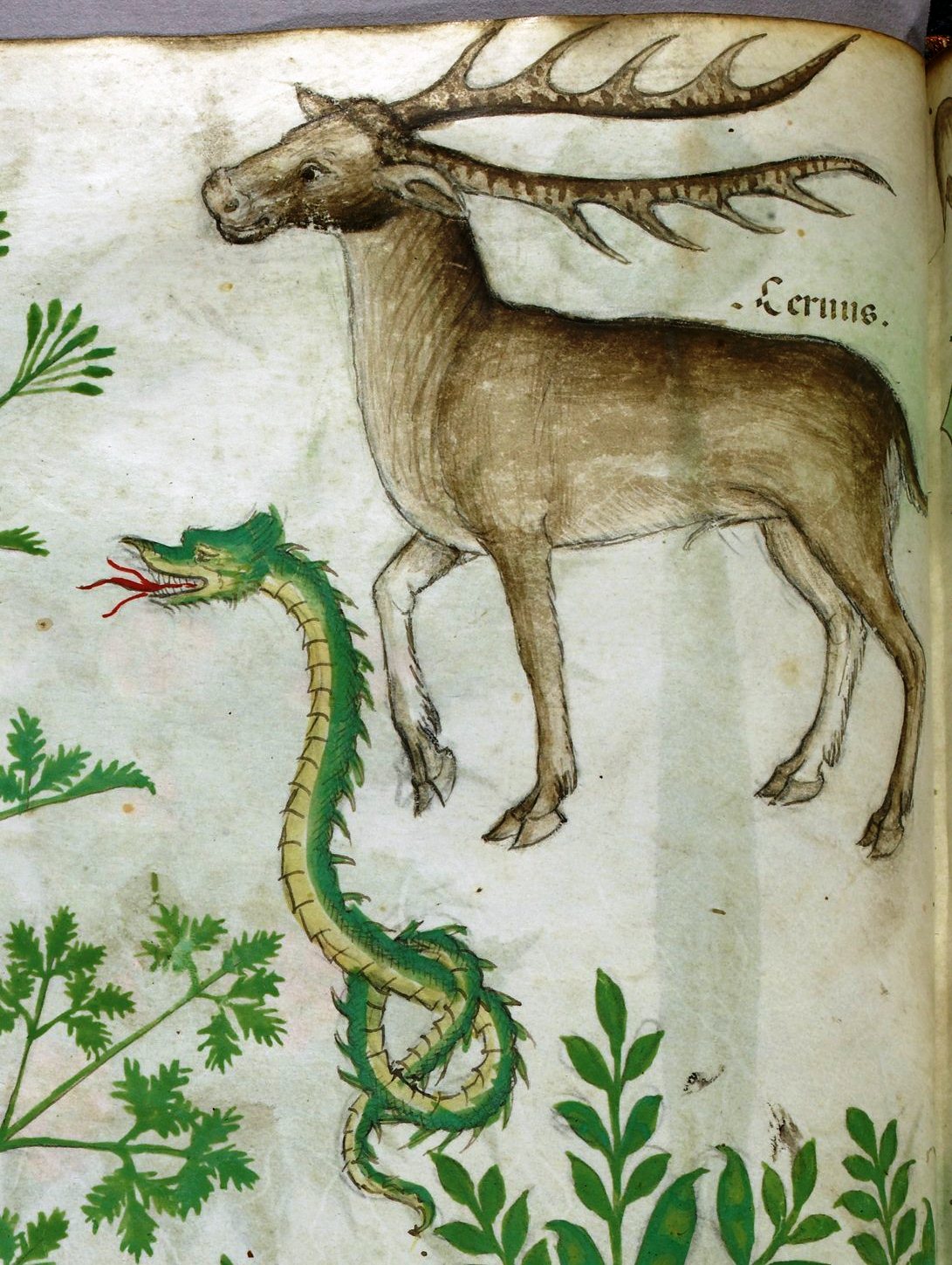
In addition to my chair duties, I am teaching one course this semester, a survey of English history from the Roman era through the Tudors.  This is a long period, and in order to add more depth to a course that is more characterized by breadth I’m going to bring quite a few illuminated manuscripts (digitally) into the classroom for my students to view and analyze.  While I was reacquainting myself with some of my favorites this past weekend (via the extraordinary resource that is the British Library’s digital catalog of illuminated manuscripts), I seemed to be seeing lots of deer in the margins, and stags in particular:  stags alone, stags as prey, stags with satyrs, stags with serpents (which they can apparently drive out of the ground) and stags parading with other animals. Stags appear not only in medieval bestiaries (encyclopedias of animals) but also in herbals (encyclopedias of plants) because the hardened cartilage of their hearts–os de cor de cervi–was used in medical preparations.

A selection of stags from the British Library Department of Manuscripts:  Arundel, Egerton, and Royal Mss., circa 1280-1490.

The image of the stag persists into the modern era in visual and material culture more as a symbol of majesty and the (receding) forest than a feature of everyday life.  There is the statuesque, noble stag, the leaping stag, and of course, the stag head–a hunting motif that has gained a more general popularity in the last decade or so.  I prefer my deer with their bodies attached, so here are a few favorite images from the collection of the Victoria & Albert Museum:  leaping deer on a  Meissen plate from the late 18th century, and Foxton furnishing fabric and a Susie Cooper figurine, both from the 1930s.  Cooper (1902-1995), the dominant ceramics designer of the twentieth century, loved the leaping deer motif so much that she used it as her company logo and trademark.

I use a lot of deer for my Christmas decorating, and as I’ve had neither the time or the inclination to do my typical January purge, there’s still quite a few stags around the house.  And I’ve had my eye on the Nico Masemula stag at Anthropologie for the last couple of months, now fortunately (for my wallet) sold out.


Robinson Crusoe Style

I love little plates.  I have stacks and stacks of old and new desert plates, salad plates, appetizer plates, saucers, and plates which seem to have absolutely no purpose beyond decoration.  I hang them on the wall, I display them on mantels and bookcases, and then they go back into the stacks when I realize that there are just too many plates around. One of the few categories–or actually sub-categories–of plates that remain constantly on view are my Staffordshire “Robinson Crusoe” children’s plates, dating from the mid-nineteenth century.  Somehow they just manage to keep looking good to me, or maybe it’s because I don’t go into the third-floor bedroom in which they are displayed very often.

Children’s plates were produced in large numbers in the nineteenth and early twentieth centuries and are consequently a relatively easy thing to collect (Best Books:  Noel Riley’s 2-volume Gifts for Good Children. A History of Children’s China, 1790-1890). I have some which feature Benjamin Franklin maxims, domestic scenes, free trade slogans, animals, and the alphabet,but the Robinson Crusoe plates are my favorite even though they are in far from perfect condition:  they are octagonal, transfer-printed (rather sloppily), and then “painted” with rather abstract strokes, as if the children themselves “colored” them, and most of them have a hairline fracture or two.

Daniel Defoe mined several true tales, most prominently that of Alexander Selkirk, a Scottish sailor who was marooned on a remote island off Chile (now called Robinson Crusoe Island) from 1704 to 1709  to come up with his elemental castaway story, Robinson Crusoe, in 1719, and the flood of texts, prints, plates and plays thereafter testify to its continuing popularity well into the twentieth century.  According to the digital exhibition at the Lilly Library of Indiana University, the book has never been out of print.  The title page from the Lilly collection is below, with my favorite edition, published in 1900 with illustrations by Louis and Frederick Rhead.

Editions of Robinson Crusoe published specifically for children seem to have the best illustrations.  To make the story more accessible, sometimes Crusoe is transformed into a boy, and there was even a “little Miss Robinson Crusoe” in the 1920s.  From the vast collection of historical children’s literature at the University of Florida, here’s a few of my favorite images:  a rather ominous empty Robinson Crusoe suit from the title page of an 1845 English edition, the cover of an 1896 American edition illustrated by Walter Paget, and several pages from a Willy Pogany 1914 edition.

Robinson Crusoe shows up not only in books but also on all sorts of prints:  he’s an early cartoon-strip character, an advertising device, and the subject of all sorts of dramatic presentations.  He even shows up on wallpaper, back in the nineteenth century, and more recently on a Christopher Moore design for Lee Jofa.

1809 print by B. Tabart & Company and 1894 program for Robinson Crusoe play at the Drury Lane Theater, London, Victoria & Albert Museum; Advertisement for Fancy Dress Costumes, including the “Miss Robinson Crusoe”, New York Public Library Digital Gallery; Robinson Crusoe wallpapers from the Victoria & Albert Museum (circa 1875) and Christopher Moore/Lee Jofa.

And for the final touch (and also from the Victoria & Albert), a pair of “Robinson Crusoe” sunglasses manufactured by Oliver Goldsmith Eyewear in 1962, and apparently quite popular for a time.  So there you are; certainly very few characters can make the leap from plates to sunglasses.


Wrapped in Wool

Getting all the Christmas stuff out of the house (which you should never do on New Year’s Day according to custom but always want to) leaves mantles and bookcases and other household surfaces looking bare.  I like the look of austerity after so much abundance in December, but still need to inject some warmth into my big old house.  I think I can get both with a few pieces of “cable knit ceramics”: pottery that looks like a sweater!  I’m late to this design trend (as usual) but it really appeals to me right now, in my post-Christmas, January mood. I can wrap myself in wool and my house too.

Here are some examples of what I’m looking at/for:

Cable-knit sweater bowls from Etsy seller reshapestudio.

“Knitware” collection tumblers and vases from Brooklyn potter Alyssa Ettinger.

“Knit Vases” from British artist Annette Bugansky.

“Wave” sweater vases from IlluStration.

If you want a soft sweater texture for your accessories rather than a faux surface one, you can buy wool-wrapped vases like the ones from Ferm Living pictured below, or easily make your own by wrapping, gluing, and/or sewing an old sweater sleeve around a cylindrical glass vase.  Pinterest can direct you to many sites with examples and instructions; I liked the ones below.

“Sweater vases” by Ferm Living at Velocity Art & Design; upcycled sweater-covered mason jars from DIY Crafts.

Now that we’re in the realm of textile arts, let’s move on from pedestrian vases into more exotic fare:  look at these amazing sweater-wrapped “domestic trophies” by Rachel Denny:

Red cable-knit deer head and blue cashmere “Clover” bunny at racheldenny.com

And finally, if you just want to sink into a cozy sweater yourself , how about this custom-made cable-knit slipcover?

Hand-knitted armchair slipcover by Etsy seller BiscuitScout.


House Plates

I picked up a desert plate at a flea market last week with an image of the Richard Derby House of Salem on it,  part of a series of 13 “Colonial Heritage” plates produced in 1976 by the Ridgewood Fine China Company in association with the Early America Society.  The artist Robert Franke was commissioned to paint a historic house for each of the 13 colonies in that bicentennial year, and the Derby House represented Massachusetts.  I have cabinets full of plates, even after selling off the transferware of my early collecting days, but this plate was cute, $7, and associated with Salem, so I did not hesitate very long.  Now that I have it, I’m thinking I need two more, as I always like to have three of everything, if possible.  I like Connecticut’s Webb House (center), and the Moffatt-Ladd House in Portsmouth, New Hampshire was quite important to me growing up nearby, so maybe I should have that too.

But then again, what would I do with these plates?  They are a bit cutesy/ye oldey; I better refrain and just stick with my one Salem plate.  Of course, this big decision got me thinking about houses on plates in general, and in history, as I remembered that most of my “romantic” transferware plates had houses on them, generally famous or fantasy houses, in bucolic settings, similar (but not nearly as nice) as these two examples from the collection of the Metropolitan Museum of Art.

Both plates were produced around 1830 by Job and John Jackson in the English Midlands for the American market:  nineteenth-century Americans loved  their house plates, if survivals are any indication.  I guess the English did too.  Below is a delftware plate made in Bristol in the 1760s and an early nineteenth-century French plate made for the British market, both clearly presenting houses, simple and grand.

Bristol delftware plate produced by Richard Frank and Creil pottery factory plate, both from the Victoria & Albert Museum.

Back to the present, some “modern toile” plates with houses by the great Scottish design firm Timorous Beasties, who make amazing wallpaper and fabrics, but also china.  Their “London Toile” pattern, while not exactly centered on a single house, certainly focuses on structures.  Somehow it reminds me more of the eighteenth-century delftware than the nineteenth-century toile-like transferware, as does the Juliska “Country Estate” charger below.

And here’s one last merging of architecture and ceramics, by Esther Coombs, a British illustrator who often uses vintage tableware for her canvases, always with charming results.