
This weekend will bring the (38th) annual Christmas in Salem house tour, centered on the “City Sidewalks” of downtown Salem, with decorated homes on Central, Crombie and Chestnut Streets open, along with a house on Hamilton Street. I love this tour: for me it highlights Salem at its best, showcasing the creative continuity of the city rather than exploiting one dark time, in stark contrast to that other big Salem event (yes, I’m referencing Haunted Happening, which I still can’t get out of my system). I’m not exactly sure what the “City Sidewalks” theme means, but for me it conjures up a streetscape of diverse buildings—large and small, residential, commercial and institutional–closely aligned together so to form a community characterized by the integration of all the activities of daily life: a city, and to be more precise, a small historic city like Salem. Maintaining the balance between all of these diverse structures is challenging: the materials, scale, and infrastructure of modern construction can be a constant threat. Consequently preservation and planning advocacy is absolutely paramount, and the proceeds from the annual Christmas in Salem tour go towards these efforts on the part of Historic Salem, Incorporated.


 Central, Crombie & Chestnut Streets, Salem
I am certain that the tour committee also wanted to emphasize the diversity of residential structures in downtown Salem, as everything from an above-the-shop flat (in a Bulfinch building no less) to a sea captain’s mansion (designed by McIntire of course) will be on view. They are all townhouses in the general sense of the word, but the more specific designation—a multi-level, semi-detached structure–will be represented on the tour as well. The two 1906 covers of The House Beautiful below illustrate my vision of winter/Christmas in an urban village of townhouses–and the one on the right features the Chestnut Street mansion of Pickering Dodge, who commenced the construction of one of the tour’s featured townhouses–just next door– for his daughter and son-in-law in 1828. Since I acquired my own townhouse, which was built just the year before on the same street, I’ve bookmarked images of townhouses—semi-detached and freestanding, exteriors and interiors—that have enhanced my appreciation of their functionality and design: first and foremost the two “party” paintings of Boston artist Henry Sargent in the collection of the Museum of Fine Arts. The Dinner Party (1821) and The Tea Party (1824). It might not be Christmastime, but it feels like it in these festive parlors. Another great townhouse interior painting is Robert Scott Tait’s A Chelsea Interior (1857-58) featuring the author Thomas Carlyle, along with his wife and dog in the parlor of their London townhouse: again, likely not Christmastime, but the “shotgun” perspective is classic townhouse. The taller townhouses of the 1850s are featured in the wintry A Street in Winter: Evening by an anonymous artist, who casts light on the city sidewalks from a shop window: in the next century all of those windows will be lit up, especially at Christmas time.


 Henry Sargent, The Dinner Party & The Tea Party, 1820s, collection of the Museum of Fine Arts, Boston; Robert Scott Tait, A Chelsea Interior, collections of the National Trust; A Street in Winter: Evening, collection of the Museum of Fine Arts, Boston; I am very enamored of this townhouse wallpaper from the new Hearth & Hand/Magnolia collection at Target.
Christmas in Salem “City Sidewalks” Tour, December 1,2 & 3, 2017—more information and additional events here: http://salem.org/event/37th-annual-christmas-salem-house-tour-2/2017-12-02/.


 The evil Marquis Don Luis (Claude Rains) places little Anthony Adverse in the foundling wheel.


 Piranesi print of the church and hospital of Santo Spirito, Rome from the ‘Varie vedute di Roma antica e moderna‘, Rome, 1741-8, British Museum; the Foundling Wheel at Santo Spirito, Expositus illuminations from James le Palmer’s Omne Bonum, England (London), c. 1360-c. 1375, British Library MS Royal MS 6 E VI/2; “Madonna of the Foundlings” (also very wound up!) by Domenico di Michelino c. 1446, Ospedale degli Innocenti di Firenze; The London Foundling Hospital in the 18th Century, Wellcome Collection.

 Washington and Lafayette in Rembrandt Peale’s Washington Before Yorktown, 1824, National Gallery of Art—Washington would not meet Lafayette for some time after his Pope Night order, but I imagine he was also thinking about France as well as Canada at that time.
 “Dr. Bentley’s Rock at Salem Neck”—the site of the Pope Night bonfires?—many decades later, Nelson Dionne Collection, Salem State Archives & Special Collections.
 Some exciting news! BBC One’s


 Inigo Jones’ Penthesilea costume for the Masque of Queens, 1609, British Library; Thomas Rowland’s Dressing for a Masquerade, British Museum; Léon Sault’s designs for the House of Worth, 1860s: Eve with a snake and a Sorceress, Victoria & Albert Museum.


 Bat Girl, St. Ann, and Wonder Woman photographed by Larry Racioppo, New York Public Library Digital Gallery.

 Hanged Men from the Visconti-Sforza deck, c. 1428-50, Cary Collection of Playing Cards, Beinecke Rare Book and Manuscript Library, Yale University and Morgan Library & Museum ; Samuel Y. Edgerton’s CLASSIC book on pittura infamante, with one of Andrea del Sarto’s drawings (Galleria degli Uffizi, Florence) on the cover and inside.
 The Hanged Man in a Flemish Tarot deck from the eighteenth century, and Oscar Wirth’s 1889 deck, British Museum.


 Fernlea, early morning: designed by Russell Sturgis for Miss Mary Amory Greene, 1882-1883.
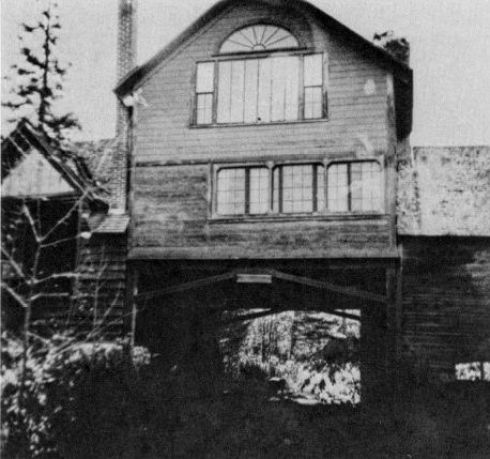
 The Thayer cottage complex and studio, and Gladys Thayer (Abbott’s daughter) in her sleeping hut, circa 1900. Nancy Douglas Bowditch and Brush Family papers, circa 1860-1985, Archives of American Art, Smithsonian Institution: cited in Susan Hobbs, “Nature into Art: the Landscapes of Abbott Handerson Thayer”, The Journal of American Art 14 (Summer 1982): 4-55.

 Abbott Handerson Thayer, Dublin Pond, New Hampshire, 1894, Smithsonian American Art Museum (painted as a gift for Stanford White); my early-morning view across from Fernlea; An Angel, 1903, Museum of Fine Arts, Boston.


 The two memorials: Proctor’s Ledge this summer; downtown in October 2015.






