Category Archives: History

Fossil Factories

For me, the most haunted place in Salem is not a cemetery or anything to do with the Witch Trials (though it is quite near Harmony Grove Cemetery and Gallows Hill): it is Blubber Hollow, a site of intensive manufacturing and industrial activities from the seventeenth century until the later twentieth. The center of Salem’s bustling leather industry in the later nineteenth century, this was where the Great Salem Fire started in June of 1914, in a factory producing patent leather shows on the site of the present-day Walgreens on Boston Street (behind which is is Proctor’s Ledge, now confirmed as the execution site of the victims of 1692). Its name indicates that it was also associated with the production of whale oil, but for me it always conjures up an image of frenzied commercial activity, candles burning at both ends or oil lamps burning all night. No longer: those factories that survived the 1914 fire, or were built after, are empty for the most part, and coming down soon, as Blubber Hollow transitions from ghost town into residential neighborhood: one large apartment building has already been built and there are more to come. As you walk down Grove Street towards Goodhue, past the still-busy Moose Lodge and marijuana dispensary, the sense of imminent transformation is palpable but ghosts are still present.

Urban Archaeology 3

Urban Archaeology 2

Urban Archaeology 5

Relic smokestack.

Urban Archaeology 7

Urban Archaeology 8

Urban Archaeology 9

North River Canal

Texture at one of the former Salem Oil and Grease buildings, and the North River Canal.

Urban Archaeology 14

No one will be sorry to see Flynntan go.

salem_historic_preservation_plan_update_2015_-_final_draft_for_public_review

Blubber Hollow Hose House

Urban Archaeology 13

Past and Future: Blubber Hollow in its heyday and “Hose House” No. 4 in its midst, from Fred A. Gannon’s Old Salem Scrapbook, #6 (1900); North River Luxury Apartmentst @ 28 Goodhue Street.


A Pair of Pears

I had a pear-oriented day yesterday. I was trying to work on the syllabus for my upcoming graduate course on Elizabethan England as well as the three-semester schedule for our department’s course offerings. Both are rather tedious tasks so I was taking regular breaks and roaming (both digitally and literally) away for bouts of time. I always like to have an “inspirational image” on my syllabi, and under the pretense of looking for one I spent hours examining Elizabethan portraits. Hours. Who is this, where are they, what are they holding, why are they dressed that way? Then I would feel guilty and go back to the syllabus and the schedule. Then I would take another break and go outside and see what’s popped up in my garden, ride my bike, play with my cats, and come inside and scope out lots in upcoming auctions, between loads of laundry and stabs at my syllabus and schedule. So you see the rhythm of my day, and by the end of this day of searching for Elizabethan images and secreting away from my schedule I ended up fixated on a pair of pears (or two pairs of pears really).

800px-Three_Young_Girls_by_Follower_of_William_Larkin

Pears by Sultan Skinner Auctions

Anonymous follow of William Larkin, Three Young Girls, c. 1620, Berger Collection, Denver Art Museum; Donald Sultan, Pears screenprint from Fruit, Flowers and a Fish, 1989-91, published by Parasol Press, Ltd., New York, Skinner Auctions.

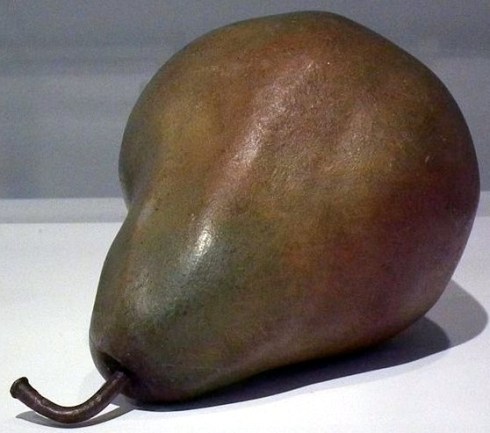
The painting of the three girls is not even Elizabethan–it dates from a bit later. But look at these girls, so beautiful and so ready, but for what? To greet an eminent visitor? To assume command of the household upon the death of their mother? The ripe fruit held by the older two might represent their maturity (and fecundity) while the younger girl is still “playing” with dolls–is this one a representation of Queen Elizabeth? I’m quite preoccupied with this painting: apparently lots of research remains to be done on both its projection(s) and its painter. Sultan’s pears appeal to me aesthetically, though I don’t have any questions about them (such is my reaction to much modern art). In their craftsmanship and detail they do, however, remind me of a very famous Salem pear: Samuel McIntire’s carving of an exemplar pear grown in Ipswich first captured by his contemporary, artist Michele Felice Corné.
Pear Carving McIntire PEM

Pear model by Samuel McIntire, 1802-1811, after a painting by Michele Felice Corné, Peabody Essex Museum, Salem.

I don’t feel like I have to draw Salem connections to every topic I write about here, but sometimes I can’t help it! Salem actually plays a very big role in pomological history as it prospered at a time when pears were much, much, much more important than mere apples, or any other tree fruit. More generally, Salem’s horticultural history is another example of its heritage that gets completely overshadowed by the giant Witch Trials. From Governor Endecott’s pear tree, planted around 1630 and still standing in nearby Danvers (then Salem–read a very complete history here), to the nearly as old and much commented-upon orange pear tree on the Hardy Street property of Captain William Allen, to the popular colonial pear cider, or “perry” made from Salem fruit, to Nathaniel Hawthorne’s grandfather Robert Manning’s vast “Pomological Garden” in North Salem, it is very evident that pears were popular, and perceived as representative of both Salem’s productivity and longevity. In a report on the Horticultural Exhibition held at the Essex Institute in 1850, the Horticultural Review and Botantical Magazine noted that this Salem must be a wonderful place for longevity. While we are boasting of our pears that begin to bear on bushes, three or four years old, these Salemites claim nearly as many centuries for some of theirs.

Pear Tree Danvers PC

Pears Buffum 1877

1910 postcard of the Endecott Pear Tree, Danvers; a pair of Buffum pears, one of the hundreds of varieties grown at Robert Manning’s “Pomological Garden” on Dearborn Street in the mid-19th century, from D.M. Dewey’s The nurseryman’s pocket specimen book : colored from nature : fruits, flowers, ornamental trees, shrubs, roses, &c (1872).

P.S. I did finish the syllabus, but not the schedule.


What to do with my Stereoviews?

I’ve been a collector of sorts for much of my life but I never collected historic photographic images until I started this blog: I quickly realized their power to tell stories and provide context in this, our digital age. So I started buying some Salem images, mostly stereoviews, which were produced in vast quantities in the later nineteenth century. There were about six or seven major publishers of stereoviews here in Salem at that time, but I’ve focused almost all my collecting efforts on images associated with Frank Cousins, as either photographer or publisher. I just completed my collection of his sentimental “Salem in 1876” views, encompassing nearly every corner of central Salem. Now I’ve got a (shoe) box of stereoviews and I’m not quite sure what to do with them.

Stereoviews

Stereoviews 2

Steroview Chestnut Street Cousins

Frank Cousins published views taken both up and down Chestnut Street and all over the city, documenting “Salem in 1876”.

Stereoviews are relatively easy to acquire, especially of a city like Salem which has been selling its image, in one way or another, for quite some time. They turn up online very frequently and I always find them at the larger flea markets and paper shows. My collection is pretty focused on Cousins, but it also has a few views that I have never seen anywhere else, including a great (though completely unattributed and undated) view of Front Street from Washington Street and a rather unusual (forested!) view of the South Church that stood across Chestnut Street from my house for nearly a century. This McIntire masterpiece burned down in 1803: I’m trying to gather as many images of it so I can glean its impact from every possible perspective. My verdant view is contrasted with a more typical image of the church, from the best source for digitized stereoviews: the Robert N. Dennis Collection of Stereoscopic Views at the New York Public Library (where you can make “stereogranimators”).

Stereoview Front Street Salem

Stereoview Second Church Tilton

Stereo South Church Salem NYPL

(Stereo)view of Front Street, ?date, ?photographer); the South Church on Chestnut by Peabody & Tilton, c. 1875 and Guy & Brothers, c. 1884, Dennis Collection, New York Public Library.

Obviously I have a predilection for streetscapes but I like some (not all; some are creepy) of the more intimate, “up close and personal” stereoviews too. I’ve seen quite a few of people just standing outside their houses, being captured for posterity. A double dose of daily life. I love this image of a Salem Willows summer cottage with its residents, all ready for summer. This is not mine, unfortunately, but from another great source of stereoviews: the Center for Lowell History at the University of Massachusetts at Lowell Libraries.

Stereoview Juniper Point UMASS Lowell SP

“View at Juniper Point, Salem Neck, Mass.”, n.d., Center for Lowell History at the University of Massachusetts Lowell Libraries (the original Willows cottages were built for Lowell residents who wanted to summer on the coast).

So again, what to do with those stereoviews that I do possess? Ultimately I will leave them all to the Salem State University Library’s Archives and Special Collections, because what Salem needs is a Center for Salem History there, as the Peabody Essex Museum ceased its historical-society function long ago. But in the meantime, I’d like to find a more clever and creative way to preserve and display them. I’d like to get them out of the box! I guess I could frame them in some interesting combinations and create a gallery wall, but that’s about the extent of my creativity. Brass floating frames? Display them with a special “twinscope” at hand like this cool exhibit from just last year, Syracuse in 3-D (1860-1910)? I’m open to suggestions, because I do think there is something very engaging–both aesthetically and historically– about images in multiples. As evidence, I give you this beautiful invitation to the Pickering House’s annual garden party by Salem artist Racket Shreve, paired with Cousins’ stereoview, of course.

OLYMPUS DIGITAL CAMERA

Stereo Pickering

Stereoview Pickering House Cousins 1876

Scene from the interactive “Syracuse in 3-D” exhibit by Colleen Woolpert (+ more here); Racket Shreve’s quatre-Pickering House invitation; Frank Cousins’ “Salem in 1876” stereoview of the Pickering House.


Trees for Lafayette

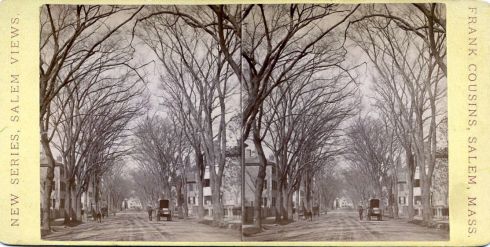
This is not to complain–I know lots of good Salem people are working on this–but rather to offer some perspective: Salem’s grand boulevard Lafayette Street needs some trees (and some love). This is the route on which I walk to work nearly every day, and I crave the protective canopy it once had. I’m also tired of picking up trash, and hoping that the commitment to the future that tree plantings represent would also instill a bit more stewardship for this once-grand street. Lafayette Street was laid out a bit later than the rest of Salem: over the course of the nineteenth century following the erection of a bridge to Marblehead and the partition of the vast farm of Ezekiel Hersey Derby. The earliest photographs I have seen are from the 1870s: they show a boulevard of mansions, and trees: elms of course, but also other varieties. We have very precise dating for the planting of the elms of upper Lafayette Street from a wonderful book, John Robinson’s Our Trees. A Popular Account of the Trees in the Streets and Gardens of Salem, and of the Native Trees of Essex County, Massachusetts, with the Locations of Trees, and Historical and Botanical Notes (1891):  It has been said that the trees on the upper portion of Lafayette Street were planted within the line of the Derby estate, on account of some opposition to placing them in the street itself. The street was laid out in its present magnificent width at the suggestion of Mr. E. Hersey Derby in 1808. Mr. David Waters informs me that his father, but a short time before his death, while passing these trees, said that when a boy he was called by Mr. Derby to assist at planting them, holding the samplings while the workers filled the earth in about them. Mr. Waters, Senior, was born in 1796 and would have been twelve years of age when the street was laid out. The date of the planting of these elms, thus corroborated, may, therefore, safely be placed at 1808. In addition to a few images of the entire tree-lined street, we also have several photographs of the “wooded estates and pleasure gardens” (a phrase from an 1873 guidebook to greater Boston) of Lafayette Street before the Great Salem Fire of 1914. When you compare these lush images with those taken in the days after the Fire, it’s painful.

Lafayette_Street,_Salem,_MA 1910

Lafayette Street Cousins cropped 1891

Lafayette Street Cousins Derby Mansion 1891

Lafayette Houses Collage

Lafayette Church 1880s

Shades of pre-fire Lafayette Street: a very popular postcard c. 1910; Frank Cousins’ photographs of the very verdant street (1876) and the Old Derby Mansion (1891), demolished in 1898, Duke University Library; Gothic Revival and Victorian houses on upper Lafayette, still standing, while the McIntire-designed Josiah Dow House (built 1809) in the lower-right hand corner is gone (Smithsonian Institution collections and Cornell University Library); rendering for the Lafayette Street Methodist Church, American Architecture and Building News, 1884.

The Fire laid waste to half of the street (from Derby to Holly and Leach Streets), and later on many of the surviving mansions of the other half–rather massive Victorians, Queen Annes, and Italianates–became subdivided and commercialized. After the replacement of some of these structures by some truly terrible mid-century apartment buildings, the Lafayette Street Historic District was created in 1985. Trees will really help Lafayette Street, but other challenges remain: chiefly the constant traffic which seems to grow worse and worse with every passing year and the incremental though persistent expansion of Salem State University (my employer) at its upper end. Students and staff have turned this end of Lafayette into one big parking lot, a trend that has not been mediated by the construction of a large campus parking lot in my estimation. I think a new South Salem train stop would help with the parking, but I’m not sure about the traffic: I watch it every day on my way to and from work and the majority of it does not seem to be university-related: this is also the only route to Marblehead, after all.

Traffic is tough, but more trees will shield and shade Lafayette Streets residents…and walkers. And as I said at the top, there are plans for more trees, and better maintenance of existing trees, throughout Salem. Just last week the City Council formed the Leaf-oriented Resiliency and Arboricultural Expansion Taskforce with its associated acronym, LORAX, for just that purpose (yes, you read that correctly: LORAX). The plans for the major new development at the corner of Lafayette and Loring Streets also have lots of provisions for trees. I’m not really a fan of the new building (which will totally dominate the view from my office) but I’m really happy to see plans for all these new trees, including some disease-resistant elms (there is one Elm still alive on Lafayette–I think? See below!)

Lafayette Street 1908 Final

Lafayette today

Lafayette after the Fire pc

Lafayette 1917 SRCR Final

Lafayette Tree

Upper Lafayette in 1908 and today; the 1914 fire was so devastating, in so many ways, and all of the reports reference the lost trees almost as much as the lost buildings: the Rebuilding Commission Report specified many trees–some of which are visible in the 1917 photograph above: if trees were a priority then, they should be a priority now! Lafayette’s surviving Elm, near the corner of Fairfield Street.


Scent of a Queen

While I was looking for spring wine concoctions in A Queen’s Delight the other day I came across a recipe for “Queen Elizabeths Perfume”: Take eight spoonfuls of Compound water, the weight of two pence in fine powder of Sugar, and boil it on hot Embers and Coals, softly, and half an ounce of sweet Marjoram dried in the Sun, the weight of two pence of the powder of Benjamin to make a sweet, long-lasting perfume. As you can see, other delights are in there, including a rose and cypress perfume supposedly utilized by her brother Edward, and a toothpaste made of Mother of Pearl.

Queens Delight 4

This herbal scent seems a bit more complex (and long-lasting) than Elizabeth’s other perfume, recorded in C.J.S. Thompson’s Mystery and Lure of Perfume (1927) and the inspiration for the “perfume garden” designed by Laurie Chetwood and Patrick Collins which won a Gold Medal and the title of “Most Creative” at the 2009 Chelsea Flower Show. I wish I had seen this garden–which presented the evolution of Elizabeth’s perfume from plant to bottle in a “polysensorial” way–but we can all buy a bottle of the finished product at the Historic Royal Palaces gift shop (oh no, they only ship to the U.K). I think I might prefer the marjoram-based scent anyway; rose damask is a bit cloying.

Scent of a Queenp

PerfumeGarden2009

Perfume Garden Sketch ChettwoodArchitects

Elizabeth Perfume HRP

Sketch and photograph of the award-winning Perfume Garden, 2009, from a portfolio here; Elizabeth’s inspirational rose damask eau de toilette, available (in the U.K.) here.

Speaking of cloying: neither of these perfumes contains the exotic ingredient found in so many recipes for scented sachets, pomanders, and waters in the sixteenth and seventeenth century: musky secretions from the anal glands of the civet cat (not a cat at all), which could mask all unpleasant odors and serve as an aphrodisiac. Shakespeare gave King Lear a civet reference–Give me an ounce of civet, good apothecary, to sweeten my imagination–but a century later it was fortunately out of fashion if Samuel Cowper’s rhyme is any indication: I cannot talk with civet in the room, a fine puss-gentleman that’s all perfume.

Elizabethan Perfume Collage

Barbier Elizabethans 1928

Another perfume recipe from A Queen’s Delight and an Elizabethan perfume bottle from the “Cheapside Hoard” and the Museum of London; the Elizabethan pouchoir print by Georges Barbier from Richard Le Gallienne’s Romance of Perfume (1928).


Lincoln’s Laboratory

I’ve been digging around in bins and folders for scraps of paper for as long as I can remember, and I do recall one item that caught my attention years ago: it was an envelope with a still-bright print of Abraham Lincoln depicted as some sort of wizardly chemist, an alchemist, I also recall thinking, in the midst of a rather wordy laboratory. It had a sticker marked $5 on it which struck me as quite steep at that time. Now I see that this same envelope fetched $2600 at a recent auction! The envelope, produced by the Salem stationery and publishing firm of G.M. Whipple and A.A. Smith (1860-1875), has become a highly-coveted example of Civil War propaganda, and I clearly missed out.

Union Alchemist

Whipple and Smith were not only showing their colors; they were marketing a relatively new product: the envelope itself. Before 1851 U.S. postage was charged by the sheet, so people simply folded their letters with sealing wax and mailed them off. In that year a flat postage rate was introduced for mail under a half-ounce and traveling less than 3,000 miles, so protective “covers” were introduced, which became patriotic covers a decade later. More than 10,000 embellished envelopes were produced in the North during the Civil War, much less in the South. They became collectible items even during that time, as many survive unaddressed—like the one I saw some time ago and those below. I can see why the “Union Alchemist” envelope is coveted today: its image and message is a bit more intricate than the majority of pro-Union covers I have seen–many featuring Jefferson Davis swinging from a rope (actually he is there, in the upper left-hand corner, in a specimen jar, next to General Beauregard).

Union Alchemist 3

Lincoln is writing prescriptions in a laboratory full of his distillations, including pure refined national elixir of liberty and metallic soap for erasing stains..for the southern market; he is not only the Great Emancipator (and the Great Distiller) but also the renowned rebel exterminator. It’s such a great image and item: what was I thinking years ago when I passed it by? I’ve found quite a few more in auction and historical archives, but none available, for $5 or $500: this is definitely one that got away, but I did catch a Salem octopus!

Lincoln Envelope Hakes Auctions

Lincoln's Laboratory PMA

Union Alchemist 2

Union Alchemist 5 Cowans

Union Alchemist 8

Union Alchemist Bangor

Civil War Cover

Whipple & Smith’s “Lincoln’s Laboratory or the Union Alchemist” covers, from Hake’s Americana & Collectibles, The Helfand Collection at the Philadelphia Museum of Art, The John A. McAllister Collection at the Library Company of Philadelphia, Cowan’s Auctions, PBA Galleries, and the Bangor Historical Society.


Bridge Street Neck

Salem is a city of extremities in terms of its physical shape: two “necks” jut out into the Atlantic Ocean from a central peninsula. You can easily see that this was a settlement oriented towards the water rather than the land. Once transportation shifted towards the latter, traffic problems emerged for Salem, and they still present a major challenge to the city. One interesting Salem neighborhood which seems to represent the shifting impact of transportation very well is Bridge Street Neck, the first area to be settled by Europeans and the main gateway to the north. Its central corridor or “spine”, Bridge Street, first led to a ferry, and by the end of the eighteenth century the first bridge to Beverly was completed. From that time the area developed in typical mixed-use fashion, with commercial structures and residences rising up on Bridge Street, smaller houses on the side streets leading down to the water on both sides, and manufacturing sites interspersed: first maritime-related uses, later lead and gas works. There are all sorts of references (though I can never find images) to horticultural uses as well, from the first fields of the early “old Planters” to nineteenth-century greenhouses and pleasure gardens to today’s parks. In a few months Salem’s newest park will open at the very end of the Neck, dedicated to the work and memory of the Abolitionist Remond family.

Salem Map 1970 Osher Romantic Boston Bay Text

Salem Map 1903 cropped The North Shore coastline from Edwin Rowe Snow’s The Romance of Boston Bay, 1970; 1903 Map of Salem and surrounding places, Henry M. Meek Publishing Co., Leventhal Map Library, Boston Public Library.

Carriages, trains, trolleys, CARS: for too long Bridge Street Neck has simply been a place to get through.It’s never been a destination, unlike Salem’s other neck, home to the Willows. But over the past decade, a series of infrastructural changes have (perhaps) transformed this Neck’s functional status: a new bridge attached to a new bypass road which skirts the neighborhood rather than running through it, and a “revitalization plan” implemented by the city to address its aesthetic and economic challenges. I think this is a Salem neighborhood that is really primed for change, but in what direction? Its diverse building inventory–ranging from late eighteenth-century Georgians to post-war Capes–is protected by the recent designation as a National Register Historic District but not the more stringent review of a local historic district. And there is much to protect: there are some great old houses interspersed among the streets of Bridge Street Neck, better appreciated if you get out of your car and walk.

Bridge Street 4

Bridge Street 2

Bridge Street 1

LOVE this Gothic Revival cottage and its mansard-roofed neighbors on Arbella Street, named for the ship that brought John Winthrop to Salem in 1630.

Bridge Street 5

Bridge Street 6

Bridge Street Gwimm House

Bridge Street Thaddeus Gwinn House MACRIS

Bridge Street Neck Collage

Very pretty Victorian two-family; two early nineteenth-century houses: a Georgian (behind the addition) and the stunning c. 1805 Thaddeus Gwinn House, an unusual Salem two-story Federal (today and in the 1980s, courtesy MACRIS); two cute cottages on the North River side of Bridge Street.

Bridge Street 12

Bridge Street 8

Bridge Street 9

Bridge Street Neck Planters

The old and the new on Bridge Street including the Thomas Woodbridge House on the corner of March, and across from it: the future?


Salem 1912

I stumbled across the “first annual” Report of the Salem Plans Commission the other day, and read it with rapt attention. This was issued at the end of 1912, a time when the city’s population had experienced rapid growth and housing was in short supply, the waterfront was “decayed”, and downtown (trolley) traffic was at a standstill. There were startling parallels to Salem 2016 in the Report, starting with its opening assertion that Salem is known quite literally with a single tolerable entrance or exit and (possibly excepting Loring Avenue) we must admit that this is quite literally true, whether we travel by foot, carriage, automobile, trolley, train or boat. While the Commission asserts that Salem’s entrance corridors, called “gateways” in the report (a timely term now) all needed work, they are clearly advocating for more immediate attention to the city’s key transportation network: the combination of trains and trolleys that drove external and internal traffic. Salem’s main gateway was identified as the Boston & Maine Depot, and the arteries that commenced from there were apparently in dire need of widening and expansion in the forms of a”ring road”, a “shore drive”, and a street system. The entire report calls for a more systematic Salem in every conceivable way: roads, parks, housing, zoning.

Salem Train Depot 1912Salem’s Gateway, 1912

The commissioners write with a very strong voice, one voice, and express stark opinions throughout their report: the congested wooden housing in The Point is a “fire menace” (a prescient observation, given it would be leveled by the Great Salem Fire in two years) which evolved through “selfish gain driven by public indifference”, the waterfront must be “redeemed”, the North River is a “stinking open sewer”. They are so assertive that what one would think would be a rather dry text makes for riveting reading!

Salem 1912 North River

Salem 1912 Billboards on Bridge Street The “Stinking” North River and “Billboard Adornment” on Bridge Street.

In order to achieve their vision for Salem, the Commissioners include lots of detailed recommendations which are both utilitarian and aesthetic. They are aware of the significance of Salem’s material heritage but I would not call them preservationists: if an old building is interfering with trolley traffic on a narrow street it’s got to go! They seem particularly focused on Central and Lynde streets as problematic for traffic flow, and their recommendations seem to be the inspiration for the consolidation of the former Elm and Walnut Streets into a widened Hawthorne Boulevard.

Salem 1912 Central Street to Essex St

Salem 1912 Washington and Lynde Streets

Salem 1912 North and Lynde Streets

Salem 1912 Lynde Street from North St

Salem 1912 North and Federal Streets

Salem 1912 Elm and Walnut From above: Central Street looking towards Essex; the intersection of Washington and Lynde Streets; two views of the intersection of North and Lynde Streets; a trolley turning onto Federal Street; Elm and Walnut Streets.

I think Commissioner Harlan P. Kelsey was the author of the report, but I can’t confirm this as it was simply published by the “Plans Commission”. Kelsey was a really prolific landscape architect who lived in Salem (at One Pickering Street–this was the house that distracted me from Kelsey’s story to that of its architect, Ernest Machado) and, in addition to his landscape and planning practices, also maintained two profitable nurseries in his native North Carolina and adopted city. I’ve read his writing on plans and parks elsewhere, and it sounds familiar, and the last part of the Report is devoted to the shoddy condition of Salem’s shade trees—another timely topic!

Salem 1912 Broad ST

Salem 1912 Lafayette Two Salem streets which the Commissioners actually LIKED for both their width and their trees: Broad and Lafayette. Both would be half-leveled by the Great Salem Fire in 1914.

All photographs from:  City Plans Commission, First Annual Report to the Mayor and City Council, December 26, 1912.  Salem: Newcomb & Gauss, 1913.


A Tale of Two Salem Patriots

Timothy Pickering (1745-1829), who rose to serve successively as Colonel of the Essex County Militia to Washington’s Adjutant General, Quartermaster General, and Secretary of War and President Adams’ Secretary of State is probably Salem’s best-known “Patriot”, but during the Battles of Lexington and Concord (commemorated in Massachusetts and Maine as Patriots’ Day on the third Monday of April) he was, shall we say unengaged, while another Salem man died in the bloodiest skirmish of the day. This was Benjamin Peirce, a baker by profession, 37 years old, who fought alongside men from Danvers, Beverly, Lynn and several other communities in their effort to halt (or at least hinder) the British retreat back to Boston. As far as I can tell, he died in the violent “Battle of Menotomy”(Arlington) in and around the still bullet-riddled Jason Russell House with Pickering yet to arrive on the scene (having stopped at not one but two taverns for refreshments). And when the Colonel with his 300+ Essex County militiamen finally arrived in the area, another decision was made to disengage, enabling the British to reach Boston. I know Pickering’s actions (or lack thereof) on April 19, 1775 have been debated almost from that very date, but from a parochial perspective he clearly pales in comparison with Peirce, the only Salem militiaman to die on that fateful day. Peirce’s heroism was recognized at the time by the entrepreneurial Salem printer Ezekiel Russell, who published Bloody Butchery, by the British Troops; of the Runaway Fight of the Regulars just a few days later.

Bloody Butcheryp

Russell House Whitefield

BLOODY BUTCHERY, BY THE BRITISH TROOPS; OR THE RUNAWAY FIGHT OF THE REGULARS, with Peirce’s identified coffin in the second row, second from right, published in The Salem Gazette, from E. RUSSELL’S Salem Gazette, or Newbury and Marblehead Advertiser, Friday, April 21, 1775; the Russell House–where Peirce died–from Edwin Whitefields’s
Homes of our Forefathers (1879).

There was also an individual elegy for Peirce penned by Russell:  We sore regret poor Peirce’s death,  A stroke to Salem known, Where tears did flow from every brow, When the sad tidings come. There was, however, no coffin: Peirce was buried in a mass grave in Arlington along with some of his compatriots, excepting the Danvers martyrs who were returned to that town. No one from Salem came for Benjamin, so he is still there, in the Old Burying Ground behind the First Parish Unitarian Church on Massachusetts Avenue. I cannot find any reference (or sign) of a monument to this native son in Salem until the erection of a bicentennial plaque (under a liberty tree which appears to have not survived) by Historic Salem, Inc., in a rather odd spot–adjacent to a parking lot on Church Street.

Peirce 6

Peirce 2

Peirce 8

Peirce 10

Peirce 7

Three plaques for Peirce in Arlington–one in Salem, below,  adjacent to parking lot: while fictional Samantha gets an entire (very visible) square to herself!

Peirce 3

Peirce 5


Political Poplars?

I suspect that most of my colleagues who teach American history dislike Thomas Jefferson. I don’t really get into it with them; I prefer to play naive and impressionistic when it comes to American history (because I am), but I have heard and seen disparaging words and glances on more than one occasion. Their opinion was shared by Salem’s Federalists over two centuries ago, who cast Jefferson as a licentious Jacobin even before the disastrous Embargo Act of 1807. But there was one Jeffersonian “policy” that was popular in Salem, at least for a while: the planting of (Lombardy) Poplar trees on the Common and along several streets. Jefferson loved these stately trees, and had them planted not only at Monticello but also in Washington, along Pennsylvania Avenue from the Capitol to the White House. His poplar advocacy spread north, and in one of my favorite Salem paintings (actually it’s everyone’s favorite Salem painting), George Ropes’ Salem Common on Training Day, the newly-planted poplars are very prominent. Apparently they were also planted along the Newburyport “turnpike”, now Highland Avenue, and a few other new streets.

Washington 1800 LC

Poplars Washington

Poplars Porter MFA

SALEMCOMMONTRAININGA

Poplars lining Pennsylvania Avenue, Washington, D.C., early nineteenth century, Library of Congress; Poplars in Rufus Porter’s “Boston Harbor” wall mural from the Prescott Tavern in Jaffrey, New Hampshire, Museum of Fine Arts, Boston; George Ropes, Jr., Salem Common on Training Day, 1808, Peabody Essex Museum. 

As attractive as they were (or as Ropes made them), the Common poplars would soon be gone, replaced by maples and elms and more pedestrian trees. Was their disappearance due to nature (the “Great September Gale” of 1815 or their unsuitability to Salem’s climate and/or soil) or politics? I ask this question because of a provocative little passage in one of Sidney Perley’s early articles in the Essex Antiquarian (1911): Political feeling was so strong in the old Jeffersonian days that these poplars were condemned by the Federalists on account of Jefferson having been instrumental in producing them. Some of the Republicans planted these trees in front of their residences to show their allegiance to Jeffersonian principles, and the enraged Federalists were guilty of injuring and destroying them. This was true in Salem in 1801 in several instances, the mischief being of course done under cover of darkness. Captain Samuel Very, who lived at Buffum’s Corner, offered a reward of twenty dollars for the conviction of the person or persons who injured the trees before his house. Very interesting! It sounds like poplars were conspicuous targets, and the grove on the Common must have been offensive to Salem’s Federalists: did they mount an attack? To answer this question, I turned to one of Perley’s contemporaries and the authority on horticultural Salem a century ago, John Robinson, who wrote a great little book on Salem’s trees titled Our trees : a popular account of the trees in the streets and gardens of Salem, and of the native trees of Essex County, Massachusetts : with the location of trees, and historical and botanical notes (1891). A man of science, Robinson discounts political explanations for the disappearance of Salem’s poplars in favor of botanical ones: The stiff Lombardy Poplar (Populus dilatata) once grown everywhere, is now but rarely seen except in a state of decay. Our Common was originally planted with these trees in 1802 from nurseries on the northern side, in the vicinity of Winter Street. But, fifteen years later, the trees were found to be of little value for ornament and they were replaced by elms. There are wrecks of Lombardy poplars on Loring Avenue, beyond the Marblehead branch railroad crossing, near the Willows, and on the Newburyport turnpike in various places……….it turns out that Lombardy Poplars just didn’t “take” in Salem’s soil. There are certainly no Poplar “wrecks” on the Common today, but I think I found a few relics in the Howard Street cemetery, still standing guard.

20160415_160607_HDR~2[1]

20160415_160600_HDR~2[1]

20160415_165155_HDR~3[1]

Apparently NOT a poplar, but an upright English oak!