Category Archives: History

Anatomy of a Restoration

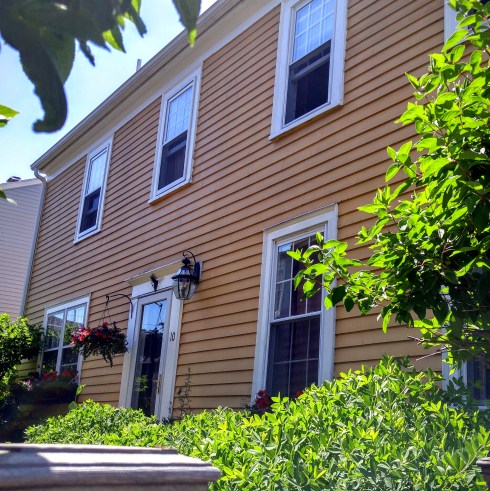
The new owners of a beautiful Chestnut Street townhouse, part of the street’s only triple house which also happens to be its tallest structure, very kindly allowed me to come in and take some pictures of their restoration process, which has begun in earnest. I’m so grateful, because this was the perfect time: the bones of the house were exposed in all of their beauty–and strength. Even with ceilings torn out and dust everywhere, the building still looked elegant–and solid–from top to bottom (well maybe the basement isn’t beautiful, but it sure is interesting, as you can see below). This is a very notable house not only because it is a “triplet”, but also because it was home to three Salem mayors, including the Reverend Charles Wentworth Upham, who was also President of the Massachusetts Senate, a U.S. representative, and author of Salem Witchcraft; with an account of Salem Village, a history of opinions on witchcraft and kindred subjects (1867). The entire house was commissioned by Salem shipowner Pickering Dodge, who lived next door, in 1828, ostensibly for several of his five daughters. A son-in-law, John Fiske Allen, oversaw the completion of the project after Dodge’s death in 1833 and his widow lived in the westernmost townhouse—our townhouse–until her death in 1851, followed by all those mayors in the nineteenth century and one of Salem’s most prominent preservationists in the twentieth. The restoration philosophy is conservative: reveal and burnish what is already there, and alter the systems and utilitarian rooms of the house (kitchen and bathrooms) so that they can “be useful to the daily lives of today” in the words of project architect Helen Sides: “Kitchens are no longer for servants and it’s nice not to share the bathroom if there are spaces to put new ones!  It is the responsible thing to update these houses so that they can stand for another 200 years”.

Restoration Cousins 1916

Chestnut Street Salem 2016

Looking up Chestnut Street towards the triple house, 1916 (Frank Cousins) and 2016.

Restoration 5

Restoration 6

Restoration 7

Entrance hall and front and back stairs. This house has a lovely scale and great light (even though it has a firewall on one side) because it is two rooms deep–so you have windows both in the front and the back. Because it also has both front and back stairs I imagine it has great flow too…and the basement is a virtual museum.

Restoration 10

Restoration 12

Restoration Collage Slatted Cupboards

Original basement kitchen, coal bin, and pantry with “slatted cupboards”—I’m not sure that’s what they are called, but I have the EXACT same ones in my house, built roughly at the same time (on the left with reindeer, swan, and pinecones: this is my seasonal decoration room). Back upstairs…..

Restoration 15

Restoration 21

Restoration 3rd floor

Restoration 4th floor

Bedrooms on the second, third, and fourth floors. The windows have their own dedicated restorer, Window Woman of New England, who have developed quite a reputation here in Salem. A very conspicuous aspect of this house is its built-in cupboards, cases, cabinets and closets–very evident in the second-floor study but also all throughout the house.

Restoration 16

Restoration Collage Cupboards

Restoration 8

A collage of cupboards between the bookcases of the second floor study and the first floor butler’s pantry (?) cabinets, which are PERFECT. I always notice COLOR in older houses—tones you don’t normally see–but in this house (in this state) it was really more about the color of wood, briefly exposed before new ceilings are installed.

Restoration Collage

Restoration Ceiling

Restoration boards

Restoration boards 2

Restoration Tim

Love the red stairway (down to the basement) and green doors…various exposed ceilings…Tim of Peter Strout Construction building a new bathroom in this old house……out back: another house!

Restoration 22

Restoration Sink.jpg

Restoration 24

Set in the midst of the long garden out back is a carriage house  (according to Bryant Tolles’ Architecture in Salem) which was converted to a residence c. 1912 utilizing materials from the demolished Chase house at 21 Federal Street. Obviously there was a deep appreciation for Salem craftsmanship then, which is very much in evidence here and now.

Restoration Team Collage


Rededicating Derby Square

Salem has quite a few intersections named “squares” but very few square squares. Its most conspicuous one is Derby Square, which was carved out of the growing city 200 years ago. This month’s Derby Square FLEA Salvage ART Market, coming up tomorrow, is marking the Square’s Bicentennial with a special theme and ribbon-cutting, and so I thought I’d examine this early example of urban planning in Salem. The basic background is well-known: John Derby III and Benjamin Pickman, Jr., scions of wealthy Salem families, business partners and brothers-in-law, offered the land on which the majestic and short-lived Derby Mansion formerly stood to the town of Salem in 1816 with the provision that a suitable civic building be built–civic in this context clearly implying both public and commercial functions. The city accepted the offer, and so the new Derby Square was developed over 1816-1817 with the new Town Hall/Market House at its center. It is clearly visible on Jonathan Saunders’ 1820 Plan of the town of Salem in the commonwealth of Massachusetts, from actual surveys, made in the years 1796 & 1804; with the improvements and alterations since that period as surveyed, marked as the #1 improvement and/or alteration to the town.

1820 Map of Salem BPL

Jonathan Peel Saunders, Plan of the town of Salem in the commonwealth of Massachusetts, from actual surveys, made in the years 1796 & 1804; with improvements and alterations since that period surveyed, 1820. Leventhal Map Center, Boston Public Library.

In the tradition of both European cities from the late medieval period onward and urban centers in colonial America, the centerpiece of Derby Square was designed to be a combination town hall and market, with an open arcade on the ground floor and meeting space on the second. Boston’s Faneuil Hall and Old State House had similar dual–even multiple–functions, as had Salem’s first town hall, built in 1636. There does not seem to be agreement on just who was the architect of the new town hall, although Bulfinch is mentioned in some sources, but Joshua Upham built the structure at a cost of $12,000. The lower story opened in late fall of 1816 and the second story was “christened” by visiting President James Monroe on July 8, 1817. The new Town Hall served in that capacity for only 20 years, and became the Old Town Hall with the construction of the Greek Revival structure on Washington Street in 1837-38; thereafter it was principally known as the “Market House”. Derby and Pickman had a vision that extended beyond just one building however, however: they determined the structure, scale, and composition of Derby Square by building several buildings surrounding Old Town Hall themselves and selling adjacent lots with deed restrictions specifying brick or stone construction. This was waterfront property in the early eighteenth century, and Derby and Pickman also donated a way to the water to the town of Salem with the condition that it remain a fish market in perpetuity: the “Derby Deed” lost some of its restrictive strength over the years, resulting in a Salem Marketplace that offers more than fish.

There are a lot of images of Derby Square out there, so I went to the Salem State University Archives and Special Collections to see if I could find some views that were a bit more fresh. Among the stereoviews, ephemera, and pamphlets of the Dionne collection I was able to find quite a few Derby Square-related materials–if I had more time to spend in the victualler records, I doubtless could have found much more. Clearly Market Square/Derby Square operated as a seasonal and regional food market over much of the nineteenth and twentieth centuries, just as it does now on the summer Thursdays of the Salem Farmers’ Market.

Derby Square Stereo Procter Crop

Derby Square Winter Procter

Derby Square Stereo Moulton

Derby Square Stereoview Moulton crop

Two G.K Procter stereoviews of Derby or Market Square, summer and winter (cropped in half), c. 1861-1882; and two stereoviews of the Square by J.W. and J.S. Moulton Photographers of Salem, who operated from 1873-1881, all from Nelson Dionne Collection of Salem Images at Salem State University Archives and Special Collections. Below: a few billheads, also from the Dionne collection, which represent the dominance of the victualling trade in the Market and the inconsistent use of “Derby Square” and “Market Square”.

Derby Square Billhead

Derby Square billhead 1885

And from a private collection, here is an undated photograph of the Square which is quite unusual in its relative emptiness–it was among some Frank Cousins photographs so it could be one of his, but I just don’t know. In any case, I love it!

Derby Square nd

How has Derby Square fared in the age of the automobile? The visual evidence indicates that its integrity was challenged in the third quarter of the twentieth century, given its location in the center of the urban renewal storm. Yet this same (central) location, combined with its classical design and steadfast (central) function, determined that it would not only survive but also stand as a symbol of Salem’s revived prosperity.

Derby Square 1960s SSU

Derby Square Salem Marketplace SSU

Derby Square and Salem Marketplace in the 1960s and 1970s: how horrified John Derby III and Benjamin Pickman Jr., would have been by the Budweiser sign! Below: more sentimental views from early and late twentieth-century postcards.

Derby Square PC SSU2

Derby Square PC 1913 SSU

Derby Square PC Higginson SSU

Save

Save

Save


Marked by a Witch

I have featured maps on this blog many times: maps allegorical, anthropomorphic, and antique, maps featuring octopuses, spiders, relationships and myriad places and perspectives. An ongoing exhibition of pictorial maps at the University of Southern Maine’s Osher Map Library has inspired me to examine this particular cartographical creation yet again–along with a recent ebay score of one of my favorite local pictorial maps, Alva Scott Garfield’s “Scott-Map of Salem, Massachusetts”. Maps with pictographic elements go way back, but the Osher exhibition is focused on the mid-twentieth century, identified as “The Golden Age of American Pictorial Maps”. I wanted to confirm this chronology in my own mind, so I began perusing the larger collection of pictorial maps at the David Rumsey Map Collection: casual browsing led me down the virtual rabbit hole, of course!  Clearly you can map anything in a pictorial way: plants, animals, commodities, imaginary places, infrastructure and material culture, the past and the present: one of the major reasons the Osher exhibition identifies the mid-twentieth century as a golden age for these maps is the production of so many maps related to the campaigns of World War II, and these are among the most striking maps of this genre. I love global and national pictorial maps (a particular favorite is pictorial-map pioneer MacDonald Gill’s “Tea Revives the World”, produced in the darkest days of Britain’s World War II experience and pictured below), but the more I looked at the Osher and Rumsey maps and my newly-acquired ScottMap of Salem the more parochial my perspective became. Since the golden age of pictorial maps was roughly coincidental with the Salem’s increasing identification as the Witch City, I wondered if this would be apparent on regional and local maps. How often did a witch mark Salem’s place on the map?

Tea-Revives-the-World-Gill

Pictorial Map America 1940 Osher

Two Patriotic Maps from 1940: “Tea Revives the World” by MacDonald Gill and “America–A Nation of One People from Many Countries”, published by the Council Against Intolerance in America, Rumsey Map Collection and Osher Map Library.

Quite often, it seems, though the struggle between Salem’s divergent commercial and cultural identities is also evident on local pictorial maps from the mid-twentieth century. Situated between the big shoe representing Lynn’s characteristic industry to the south and the fishermen of Cape Ann to the north, Salem is represented alternatively by either the House of the Seven Gables or a broom-mounted witch, and sometimes both. Coulton Waugh’s beautiful map of “Cape Ann and the North Shore” (1927) identifies Salem with the Gables and the famous ship Hazard, but over the next several years the witch appears on Griswold Tyng’s illustrated Map of the Eastern United States (1929), Harold Haven Brown’s Picture Map of Massachusetts (1930) and Elizabeth Shurtleff’s very detailed map of Massachusetts, “the Old Bay State” (1930). One of my very favorite pictorial maps, Raymond Lufkin’s “Old Massachusetts” produced for The House Beautiful in 1930, is focused on the state’s architectural heritage, so witchcraft is literally marginalized (along with another notable event in Salem’s history, the landing of the first elephant in North America). Surprisingly there is no witch on Paul Spener Johst’s 1931 picture map of Massachusetts (just a BIG pilgrim), but the increasingly-familiar figure returns on Elmer and Berta Hader’s cartoon map of Massachusetts published in 1932, from their Picture Book of the States. From that point on, the flying witch marks the spot of Salem on most pictorial maps. By the time we get to the end of the “golden era”, Salem is firmly established as the Witch City on Ernest Dudley Chase’s official travel map of Historic Massachusetts, and the “Scott-Map of Salem” can make the rather whimsical claim that “aviation started in Salem”.

Pictorial Map North Shore 1927 Osher

Pictorial Map US Tyng 1929 Rumsey Map Collection

Pictorial Map Massachusetts Brown 1930

Pictorial Map Shutleff 1930

Pictorial Maps House Beautiful 1930

Pictorial Maps House Beautiful detail Salem 1930

Pictorial Map Massachusetts Johst 1931

Pictorial Map Haders 1932 Rumsey Map Collection

How Salem is marked on the map, 1920s-1960s: ABOVE: Coulton Waugh’s map, 1927; details of Tyng US Pictorial map, 1929, Brown “Picture Map“, 1930, and Shurtleff map, 1930; “Old Massachusetts” published by The House Beautiful, 1930; Johst map of Massachusetts, 1931; Hader pictorial map of Massachusetts, 1932; BELOW:  Ernest Dudley Chase’s Historic Massachusetts, “A Travel Map to help you feel at home in the Bay State”, 1957 (published by the Massachusetts Department of Commerce) and Alva Scott-Garfield’s “Scott-Map of Salem, Masschusetts”, 1960.

Pictorial Map Mass 1957 Chase

Pictorial Map Scott-Salem 1960

Save

Save

Save

Save

Save


Salem in the 1770s

For this year’s July Fourth commemoration, I have gathered some Salem structures built in the 1770s so we can see some semblance of the city during that revolutionary decade. Salem has quite a few extant colonial structures, but not as many as you would imagine: it has long been a city, and also a relatively prosperous place, and economic development is a major impediment to historic preservation. I try to qualify every statement that I make about Salem’s history with the caveat I am not an American historian, but my constant consideration of the city’s built landscape has convinced me that the narrative that Salem entered a prolonged period of economic decline following the War of 1812 is mythology: many, many structures were built after 1820, after 1850, after 1870. Salem is more of a later nineteenth-century city than a Federal one, though its Federal architecture remains conspicuous. As for its colonial architecture, it seems to me that there are more structures from the mid-eighteenth century rather than the later part of the century, though there was definitely a mini-boom in the 1790s. Colonial houses are found on Salem’s side streets rather than its main thoroughfares, though Essex Street, Salem’s original “highway”, features several: it is definitely the most historically diverse street in the city. There are many colonial houses in the streets around Derby Street, a neighborhood that does not have the status or the protection of an historic district, consequently debacles like this can and will happen. I found quite a few houses from the decade of the 1770s thought nothing that was built in 1773 or 1778, and no structure survives from that very busy year of 1776 either, though there was definitely one big construction project that year: Fort Lee.

1770: Federal and Turner Streets.

1770 River Street

1770 Hardy Street

1771: Federal, Summer & Turner Streets.

1771 Federal Street

1771 Summer

Turner Street

1771 Turner Street

1772: Derby Street

1772 Derby Street

1772 Derby Street 2

1774: Broad Street

1774 Broad Street

1775: Cambridge Street

1775 Cambridge

1776: Fort Lee on Salem Neck

Fort Lee

1777: Essex and River Streets

1777 Essex

1777 River

1779: Turner and Beckford Streets

1779 Turner Street

1779 Beckford

By no means an exhaustive list!


Misplaced McIntire Pieces?

My title is a bit provocative: I am sure art historians know where the various extant pieces of Samuel McIntire’s urns, swags, mantles, etc.. wound up after they were removed from structures that were burning or razed or mistakenly modernized. But I don’t. A case in point is the previous embellishment of the former stable of the John Robinson House on Summer Street. Just this past week I had a coincidental “happening” with this structure. I happened to run across an article in the March 1912 edition of Country Life in America about John Robinson’s garden (he was a famous horticulturist, author, and garden designer) entitled “A Little Garden in Old Salem” which features several photographs, including one of his stable, embellished with McIntire panels and urns taken from a Derby coach house and the South Church which had burned down nine years before. Then two days later, I happened to meet the charming artist who presently lives in the stable, which was converted to a residence many years ago (and separated from the Robinson House). As her house is no longer embellished with swags and urns, I asked her where they went. According to her sources (the stable’s previous owners, and the man who moved her into it), there was a fire, during which people in the neighborhood “saved” the McIntire pieces, but no one is quite sure where they all ended up. I confirmed the fire–which happened in 1950, just one year after the stable had been converted into a garage–but my photographic evidence dates from before this time, and after: obviously we have a present-day building which is quite transformed, as well as swag-less and urn-less.

McIntire Embellished Stable in Salem 1912

Robinson Stable HABS 2 LC

McIntire Collage

Robinson Stable HABS 3 West Elevation LC

Robinson Stable HABS LC

Summer Street Stable Salem

Photographs of the Robinson Stable/House over the years: from “A Little Garden in Old Salem” by Wilhelm Miller (photograph by Arthur G. Eldredge), Country Life in America volume 21 (1911-12): all outfitted with McIntire panels and urns; from the HABS inventory at the Library of Congress, 1940, with panels and no urns but drawings of all ornamentation; today–rebuilt after the 1950 fire with no ornamentation.

Regardless of the whereabouts of the McIntire elements, the 1912 and 1940 examinations of the Robinson stable are interesting comparisons of relative appreciation for the famed architect and woodcarver of Salem: the earlier article scarcely mentions him while the HABS report is all about him! But ultimately one wonders how all that ornamentation got on the stable and off it: I am imagining frenzied pilfering/saving, both on the night of the burning of the South Church next door and the stable 47 years later. And where are all these elements now? I’m just not sure. The Peabody Essex Museum has urns from the William Orne House (demolished 1882) in their collection, and The Visitor’s Guide (s) to Salem published by its predecessor, the Essex Institute, in 1908 and 1916 indicate that urns from the South Church as well as other architectural elements are among its collection. South Church elements are also featured in Volume 13 of the pictorial Pageant of America series, published for the nation’s sesquicentennial. Are these the same urns taken off the stable for the photo shoot–or others rescued on that terrible night in 1903? And where are all those swag and rosette panels that we see affixed to the stable in 1912 and 1940? What is missing and what is accounted for? As I write this I’m looking down Chestnut Street and thinking about all those basements–but sadly, there are only Victorian doors and shutters in my own, as well as lots of late twentieth-century junk.

McIntire Doorhead South Church

McIntire Urns South Church NYPL

South Church Details PEM

 McIntire doorhead and urns from the South Church, destroyed by fire in 1903, from Volume 13 of the Pageant of America Series: The American Spirit of Architecture by Talbot Faulkner Hamlin (1926), New York Public Library Digital Collections. Details of the South Church spire from the Peabody Essex Museum’s archived microsite for its exhibition Samuel McIntire: Carving an American Style.

Save

Save

Save

Save

Save


A Breech-less Brute

The students in my Elizabethan class had quite a lot to say about Marcus Gheerhaerts’ 1594 portrait of Captain Thomas Lee yesterday: it is indeed a provocative portrait and he was indeed a provocative man. A poor relation of Sir Henry Lee, the Queen’s Champion and Master of the Armouries, Thomas’s career is characterized by his long “service” in Ireland, from the mid 1570s until the late 1590s, after which he was implicated in the Essex Rebellion of 1601 and executed for treason. In his pursuit of the conquest of Ireland and his own personal gain, Captain Lee murdered, blinded, stole, and conspired. When he was not “serving”, he engaged in highway robbery and was imprisoned for debt. He was not a happy outlaw, however, and the Gheerhaerts portrait, along with his two essays, A brief declaration of the government of Ireland  (1594) and The discovery and recovery of Ireland with the author’s apology (1599), are attempts to repair his reputation. Too little too late–though his arrest and execution at Tyburn in February of 1601 were consequences of his involvement in the Essex plot rather than any of his actions in Ireland, which were supposedly on behalf of the Queen.

Captain_Thomas_Lee_by_Marcus_Gheeraerts Portrait of Captain Thomas Lee by Marcus Gheeraerts II, 1594, Tate Britain.

Well of course this personal history does not explain why Captain Lee is not wearing pants (or breeches, or hose). Clearly that is the defining feature of this portrait, commonly known as “the man with the bare legs”. There’s something vaguely classical about the painting, with its pastoral background and Latin inscription on the right: Facere et pati Fortia, “To act and suffer bravely”, a quotation from Livy’s history of the Roman commander Caius Mucius Scaevola, who defeated Etruscan rebels by penetrating their camp and living among them, so he could know the enemy. He was recognized for his bravery and rewarded handsomely by the Roman government for his efforts and thus represented a useful example for Lee, who perhaps saw himself as performing a similar service for the Queen among the “wild” Irish. Despite its fanciful fabric, Lee’s outfit is actually a bit more pragmatic: he is fully-armed and wears some semblance of the “uniform” of an Irish foot-soldier, or “wood-kerne”, bare-legged to better accommodate the boggy terrain of the Emerald Isle. So Lee is presenting himself as Irish: he has “gone native” in the (sacrificial) service of the Queen. The true measure of his claimed “sacrifice” can only be grasped through a realization of just how “wilde”, barbaric, and brutal the English perceived and presented the Irish to be: John Derrick’s Image of Irelande (1581) is a good source for this, as is a book by another man who was constantly currying favor with the Queen, Edmund Spenser’s thoroughly racist View of the Present State of Ireland (c. 1596).

Lee Discovery Folger

1024px-The_Image_of_Irelande_-_plate01

Lee’s discoverye and recoverye of Ireland with the authors apologie, ca. 1600. Folger Shakespeare Library: John Derrick, The Image of Irelande, with a Discoverie of Woodkarne, 1581, Edinburgh University Library.

Save

Save

Save

Save

Save


Silken Skirts and Open Houses

On at least five occasions over the last century, residents of Chestnut Street opened their wardrobes and their houses, donning period clothing while giving house tours on a succession of “Chestnut Street Days” celebrating the apparel, architecture, and culture of Salem’s golden age. The first Chestnut Street was in 1926, organized to recognize Salem’s Tercentenary, and the last was sometime in the 1970s: I’m not sure precisely when but I’m assuming it must have been around the Bicentennial? I’ve posted on these occasions before, but just the other day a very nice man sent me a photograph of the first Chestnut Street Day which I’d never seen before, so I thought I would do so again: we have lots of new residents on the street who are probably completely unaware of these happenings. I also delved into the press coverage a bit and was amazed by the number of headlines the 1939 and 1947 Chestnut Street Days generated: my title is derived from my favorite, “Heavy Silken Skirts Rustle Again at Salem’s Chestnut St.Day Preview”, from the May 27, 1947 edition of the Boston Globe.

Chestnut Street Day 1947 Boston Globep

This preview was followed up by no less than seven articles in the Globe over the next month, covering every little detail of the organization and occasion of the 1947 Chestnut Street Day:  Luncheon Waitresses Chosen for Chestnut Street Day in Salem (all Misses, for the luncheon at Hamilton Hall, the beneficiary of this particular Chestnut Street Day), Salem’s Beautiful Old Houses to be Open for Chestnut Street Day (30 that year!), It Took Two Months to Ripen the 4th of July Rum Punch in Salem (no aspect of the life of “Old-Time Sea Captains” was left uncovered by either the organizers of the Day or the press), and finally, on the eve of the big day:

Chestnut Street Day June 24 1947 Boston Globe Headline

There was definitely a big emphasis on the “garb”, for both men and women, some of which still resides on the street in storage at Hamilton Hall but most of which was sold a few years ago, as I recall. Historic New England also has some clothing in their collection–and films of Chestnut Street days–from the Phillips family. Every piece of evidence indicates that no detail was spared: clothing, food, furnishings carriages, games, house flags, flowers. These days were huge undertakings, apparently involving everyone of every age on the street: a real community effort and display of pride of place. Here are some images from a succession of Chestnut Street Days, beginning with the great family photo I just received and proceeding up to 1952. I don’t have any 1970s images: I wish someone would fill me in on that particular occasion and send photos!

Chestnut Street Days 1926 Trumball

Chestnut Street Day 1626 Tom Sanders

howell-painting-1926-chestnut-street-christies-2006-7200

Chestnut Street Day 1926: Family photograph courtesy of Jim Trumball;  Tom Sanders and his horses and carriage courtesy Martha Sanders; Felicie Ward Howell, “Salem’s 300th Anniversary, Chestnut Street, June, 1926”, Christie’s.

chestnut-street-days

Chestnut Streets Days 1939 carriage SSU

Chestnut Street Day 1939 Gibralter Lady SSU

1939: Flyer featuring Samuel Chamberlain’s “Springtime in Salem”; another carriage and team of horses; two ladies buying Salem’s famous Gibralters from Mrs. Mary E. Barker in period dress, Dionne Collections, Salem State University Archives and Special Collections.

Chestnut Street Day 1947 Press Coverage

Chestnut Street Day 1952 Ticket

1947 and 1952: One of MANY photographs and stories about the “famous” Chestnut Street Day in the Boston (and even New York) press, and a ticket to the 1952 Day, which featured 25 open houses.

Save

Save


They were what they Wore

This past week we were examining some social trends in my Elizabethan course, and I used several watercolor illustrations by the Flemish refugee artist Lucas de Heere to “color” some of my presentations and our discussions. De Heere (1534-1584) was a Ghent-born painter and poet, the son of well-established artists, who converted to Protestantism upon his marriage and therefore was inclined to flee the war-torn Low Countries with the onset of the Dutch Revolt. He came to England in the later 1560s, worked steadily, and apparently became very rich. One of de Heere’s English works, The Family of Henry VIII: an Allegory of the Tudor Succession, is justly famous, but his first important commission (and connection) came from Edward Lord Clinton, the High Admiral of England, who desired a series of murals of “national costumes” to adorn the walls of his London house. The murals do not survive, but a couple of illustrated manuscripts in which de Heere engages in an anthropological/materialistic narrative of Europe in general and Britain in particular fortunately do: Théâtre de tous les peuples et nations de la terre avec leurs habits et ornemens divers, tant anciens que modernes, diligemment depeints au naturel par Luc Dheere peintre et sculpteur Gantois (available here) and Corte Beschryvinghe van Engheland, Schotland, ende Irland (British Library MS Additional 28330). This examination of national character through costume is nothing new in the sixteenth century, but de Heere includes some interesting comparative commentary in his manuscripts, and while the Description’s opening illustration is a rather conventional image of Queen Elizabeth, the Théâtre‘s most distinctive image is of a naked (almost–and also very hairy and/or dirty) Englishman, holding a shred of cloth and scissors, apparently wondering what to wear!

Add. 28330 f.4

Lucas de Heere

Quite a contrast of de Heere images: Queen Elizabeth from the Beschryvinghe, and the “naked Englishman” from the Théâtre.

Karel van Mander, a former student of de Heere’s apparently asked his mentor about this latter image a few years later, as he included the following passage in his collective biography of the most eminent Netherlandish and German artists, Het Schilderboeck (1604):

It once happened that when de Heere was in England he obtained a commission to paint in a gallery for the Admiral in London in which he had to paint all the costumes or clothing of the nations. When all but the Englishman were done, he painted him naked and set beside him all manner of cloth and silk materials, and next to them tailor’s scissors and chalk. When the Admiral saw this figure he asked Lucas what he meant by it. He answered that he had done that with the Englishman because he did not know what appearance or kind of clothing he should give him because they varied so much from day to day; for if he had done it one way today the next day it would have to be another–be it French or Italian, Spanish or Dutch– and I have therefore painted the material and tools to hand so that one can always make of it what one wishes.

This is so interesting, but to what can we ascribe the Englishman’s sartorial flexibility? In class, I went with the relative “openess” of the English elite and social mobility in the merchant and gentry orders of Tudor society. The peerage are depicted in their ceremonial robes by de Heere in the Beschryvinghe, but gentlemen, gentle ladies, and “bourgeois” ladies testify to shifting fashions: he also distinguishes between “a London merchant’s wife” and a rich London merchant’s wife” and between city and country dwellers. As is so often the case, it often takes an outsider view to see things clearly, or at least comparatively.

800px-Two_Lords_and_a_Halberdier

Lucas de Heere Gentry

Heere Aldermen of London

Heere Women 1570s

1570LucasDeHeere

Lucas de Heere’s Englishmen and Women: peers, gentlemen and ladies, London aldermen, bourgeois and merchant’s wives, city women and country woman, Ghent University MS BHSL. HS. 2466 and British Library MS Additional 28330. See also de Heere’s interesting triple portrait here.

Save

Save

Save

Save

Save

Save


A Soldier of the Massachusetts Line

I don’t think Revolutionary War soldiers get the attention they deserve in terms of commemoration–on Memorial Day and every day. There is insufficient or nonexistent appreciation of their suffering and their sacrifice, certainly here in Salem, where our most prominent statues pay tribute to a “planter”, a diplomat, a temperance leader, Hawthorne, and a fictional television witch. There are monuments to those who served in the Civil War and World War I and II, but I’ve always wondered why the Salem men who served in the Revolutionary War have received so little recognition–beyond their individual graves, most of which do not even reference their service. Maybe that’s why. These were men who served and then came back home with little fanfare and recognition: quiet, anonymous men for the most part, with the exception of the perplexing Timothy Pickering and dashing privateers like Jonathan Haraden. Both Pickering and Haraden are buried in the Broad Street Cemetery behind my house, and I walked over there very early this morning to look upon their graves, as well as those of their comrades. By all accounts, there are nine veterans of the Revolutionary War buried in the Broad Street Cemetery, but only Pickering’s and Haraden’s graves are marked with flags.

Memorial Day 4

Memorial Day 7

Memorial Day 11

Memorial Day 10

Memorial Day 9

Memorial Day 6

Not far from the Pickering graves is a single dark stone marking the grave of Joshua Cross, a veteran of the Revolutionary War, and his wife Lydia Derby Cross, both of whom died on May 24: he in 1829 and she in 1837. I have long appreciated this marker: it stands alone, in excellent condition, and it does refer to his service (but still no flag: I have planted one in past years and will this year too). According to his pension application, Cross served in the “Massachusetts Line” for only one year–from January 1776 until January 1777–and did not rise above the rank of Private, but the details of his service indicate that he might have seen some action! Here is his story, in his own words:

I, Joshua Cross of Salem in the County of Essex and Commonwealth of Massachusetts on solemn oath declare that I enlisted into the service of the late United Colonies, in the Revolutionary War, on the Continental establishment, in the month of January in the year of our Lord one thousand seven hundred and seventy six as a private soldier in the Company then under the command of Ensign Gould and called General Lee’s life guard, said company belonging to the____ Regiment of the Massachusetts line, under the command of Col. Little that I continued in the service of the said United Colonies until the month of January in the year seventeen hundred and seventy seven, when my term of service expired, and returned home–I have no recollection of having received my discharge in writing, and believe it was not usual at that time to give such discharges–and further declare aforesaid that from reduced circumstances I need the assistance of my country for support.

This statement gives us enough information to place Cross in Colonel Moses Little’s 12th Continental Regiment, which saw action in the Siege of Boston, on Long Island,  and at the Battles of Trenton and Princeton during his service. It’s a bit confusing, because I think our Joshua has been confused with a “Joseph Cross” in Volume 4 of Massachusetts Soldiers and Sailors of the Revolutionary War. A Compilation from the Archives (1898), and I know that this particular “life guard” of  General [Charles] Lee under the command of Ensign [Benjamin] Gould made it to New York but I’m not quite sure about New Jersey. But it’s quite possible that our humble Salem housewright, with no flag by his grave, served at Trenton and Princeton alongside General Washington. But you think he would have mentioned that!

Memorial Day 13

Memorial Day 5

Memorial Day 12

Broad Street Cemetery, Salem, Memorial Day Weekend 2016


Elizabethan Caterpillars

Oddly enough, I was thinking about caterpillars before the big Tudor revelation of last week: the confirmation that a lavishly embroidered cloth-of-silver altar cloth in a small church in Herefordshire was fashioned from a dress which might have belonged to Elizabeth I. The cloth was discovered by Historic Royal Palaces Joint Chief Curator Tracy Borman, who has included it in her newly-released book, The Private Lives of the Tudors. Uncovering the Secrets of Britain’s Greatest Dynasty. Apparently Elizabeth had a reputation for casting-off her clothing to favorites, and her faithful servant Blanche Parry hailed from Bracton, the small village where this luxurious cloth has been hanging for over 400 years. The photographs of the cloth, particularly close-ups, show familiar Elizabethan flora and fauna (in a pattern that does indeed look very familiar to that of the dress which Elizabeth wears in the famous “Rainbow” portrait), including a rather conspicuous caterpillar hovering over a bear.

Caterpillar Cloth HRP

Jacobean Jacket METThe Herefordshire altar cloth (@Historic Royal Palaces) and a fitted jacked from a bit later (c. 1616) featuring a caterpillar among a world of flora and fauna, Metropolitan Museum of Art.

So why was I thinking about caterpillars in general and Elizabethan caterpillars in particular? For the usual mix of scholarly/materialistic reasons. I am prepping for my summer graduate course on Elizabethan England, while at the same time spring cleaning the house and indulging in a bit of seasonal decoration, which for me means swapping out Spring rabbits for Summer bugs and snails: I had just replaced a John Derian glass tray featuring a card-dealing rabbit with one bearing a colorful caterpillar when I read the news about the Herefordshire discovery. And I’m rereading one of my favorite books, Deborah Harkness’s The Jewel House: Elizabethan London and the Scientific Revolution which captures perfectly the dynamic world of fledgling naturalists and “scientists” in later-sixteenth century London. Harkness is probably better known for her fictional bestsellers of the past few years but for me, this is her jewel. I really had a hard time conveying to my students just how focused Elizabethans were on the natural world before it was published; certainly you can see–they can see– this preoccupation in Tudor decorative arts, and most particularly textiles, but I’m hoping that Harkness will really bring it home to them.

Caterpillar Tray John Derian

Jewel House Cover HarknessJohn Derian’s caterpillar tray & Deborah Harkness’s The Jewel House.

So back to the caterpillar, which is such a distinctive creature in terms of both appearance and activity: it transforms and consumes, dramatically. Which quality determined their metaphorical characterization in Elizabethan England? Definitely the latter: when Shakespeare writes of a commonwealth of caterpillars in Richard II, he is referring to devouring parasites whom Bolingbroke has sworn “to weed and pluck away”. Another Shakespearian reference is to false caterpillars in Henry IV, Part 2: a rebellious group of “scholars, lawyers, courtiers, gentleman” who (once again) are preying on the people: prey, “pill”, pillage: the caterpillar is hardly the wondrous creature of the first British entomologists Thomas Penny and Thomas Moffett, who maintained a more empirical perspective. The latter’s great work (which is largely based on the former!), Insectorum sive Minimorum animalium theatrum (posthumously published in 1634), is more focused on metamorphosis than munching.

Moffett collage

Thomas Moffett’s Insectorum sive Minimorum animalium theatrium (1634–but largely based on Thomas Penny’s 500-page manuscript from the 1590s).