Category Archives: History

Searching for Castle Hill

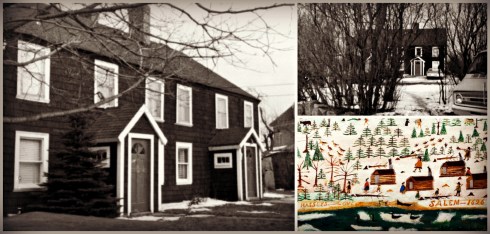
When I do not walk to work down Lafayette Street, I drive down Jefferson Avenue through a neighborhood called Castle Hill, which has neither a castle or a hill. I’m not sure it ever had a castle–nineteenth-century antiquarians assert that the great Nanapashemet, majestic leader of the Pawtucket confederation of tribes before the arrival of the Old Planters, maintained some sort of “castle” in this area, but I don’t know if this can ever be verified or if it is the source of the place-name. Much later, this land was owned by the (almost) equally royal Derby family of Salem, who maintained a vast farm to sustain and complement their city properties.The great diarist (and gossip) the Reverend William Bentley tells us about a walk in early June of 1809 in which he passed to Castle Hill upon which Mr. E. H. Derby has erected a small summer house of two small square stories, the upper of smaller dimensions, in the Italian style. It wants the grandeur of the former house which occupied this space [was this the castle? It didn’t last long in any case–destroyed in the “Great September Gale” of 1815]. He has shut up the old road by Forest river road & opened a new road, over a New Bridge finished last year, leading to the Mansion House upon the road to Marblehead. The Garden is extensive and well arranged, without any unnatural or useless ornaments. The old Farm House at the foot of Castle Hill is in a state of decay. At this season the hill & fields are alive…….So castle or not, there was certainly a hill, surrounded by Derby farmland and pastures, including the “Great Pasture”, bounded by Mill Pond, over which one could look north to Salem the town, almost a separate town altogether. This perspective is illustrated by two great steroeviews from the 1870s and 1880s, both taken from Castle Hill.

Castle Hill Collage

Castle Hill Farms

Stereoviews by Moulton and Fogg from the 1870s and 1880s; paintings of Pickman and Derby farms (Corné) from the early 19th century; Northeast Auctions and Historic New England.

Castle Hill is referred alternatively to the “Great Pasture” or the “Salem Pastures” all the way up to the turn of the twentieth century (and even after) but changes are coming, ushered in by the Boston and Maine Railroad, the filling-in of Mill Pond, and the leveling of the hill by the Massachusetts Broken Stone Company, which also maintained a quarry in this pastoral realm for a while. In his 1894 article entitled “Some Localities around Salem” Henry Mason Brooks of the Essex Institute opined that I dislike to see these old localities disappear, but change will come and we must make the best of it. If you compare the Salem Atlases of 1874, 1897, and 1911 you do see a changing landscape and streetscape in Castle Hill, as members of the growing French Canadian population of Salem moved into the area with the foundation of Sainte-Anne Parish in 1901: this church, which burned down in 1982 and was rebuilt over the next few years, remains the center of Castle Hill. A decade later, the 1912 annual report of Salem’s first planning commission identified Castle Hill as the future of Salem: The great area comprising the Salem Pastures may be made into splendid home sites with magnificent views, and winding roads with good grade can readily be built when the proper time comes. It is here that Salem must develop if it is to have the future which we believe its traditions justify, and the business demands. Much more housing did indeed follow, but large parts of the pasture and woodland were preserved later in the form of Highland Park/ Salem Woods and Olde Salem Greens. And if you drive off Jefferson Avenue just a few feet, you can see the rocky remains of the hill anywhere and everywhere.

Castle Hill Map 1897

Castle Hill 4

Castle Hill 1

Castle Hill 3

Castle Hill 5


Artistic Nationalism

I started this blog to indulge in the discovery (and rediscovery) of Salem’s history, but also American history, which I haven’t really studied in any depth since high school. And I’ve completely forgotten what I learned then, or before, because it was the same old narrative, year after year, Plymouth to Ford’s Theater again and again and again. Past politics. So boring–I hated history by the time I went away to college and was determined to avoid it by majoring in something that was almost completely contrary to my interests and talents: economics. But my time abroad, along with the few history courses I allowed myself to take, convinced me that it was only American history that was boring, so I went on to get my Ph.D. in European history and become a history professor, which is quite simply the best job ever. Of course now I know that American history is not boring (though it is short), because I’ve uncovered more of its layers, including that which is most interesting to me: its culture. My American history curriculum starts with creativity and ends with events, and so I tend to fall down a rabbit hole when I encounter an amazing database like the Index of American Design, a project that commissioned Depression-era artists to produce nearly 18,000 watercolor renderings of traditional American arts and crafts made before 1900 under the auspices of the Federal Arts Project (FAP) of the Works Progress Administration (WPA). The project encompassed 34 states, regional exhibitions of the renderings, and the creation of a permanent inventory of reference materials with which one can rediscover American material culture again and again and again–as accessed today through the portal of the National Gallery of Art.

IAD-20140326-0018.jpg

Robert Pohle, “Sheaf of Wheat” Shop Sign, American, active c. 1935, 1935/1942, watercolor, graphite, and pen and ink on paper, Index of American Design

Index renderings are photographic in their simplicity and detail: the artists are documenting and creating at the same time. Like all WPA initiatives, the Index was first and foremost a way to put unemployed people, in this case artists, to work, but like several FAP projects, the goal of archiving all forms of American culture seems to be just as important. The artists of the Index of American Design, just like the architects of the Historic American Buildings Survey (HABS), used their own artistry to capture and preserve American artistry, as a form and expression of artistic nationalism. Their meticulous drawings of shop signs, andirons, cabinets, dolls and dresses, showcased in a series of national exhibitions, enabled an anxious American audience to discover (or rediscover) its own cultural identity, through very familiar forms.

IAD-20140409-0035.jpg

Margaret Knapp, Silver Teapot, American, active c. 1935, 1934, graphite on paper, Index of American Design

IAD-20140513-0019.jpg

Lillian Causey, Quilt, applique, American, active c. 1935, Index of American Design

IAD-20130711-0008.jpg

Bessie Forman, Dress, American, active c. 1935, 1935/1942, watercolor and graphite on paper, Index of American Design

IAD-20130828-0006.jpg

Bessie Forman, Man’s Hat, American, active c. 1935, 1935/1942, watercolor and graphite on paperboard, Index of American Design

There are several Salem items in the Index (of course), including some very primitive wooden dolls, a cartouche, and a very characteristic chair. I’m biased, I know, but I think more Salem items should have been included–and wondering if the democratization goals of the Index worked against seats of “high” culture?

IAD-20140630-0035.jpg

Beverly Chichester, Salem Dolls, American, active c. 1935, 1935/1942, watercolor, graphite, and gouache on paperboard, Index of American Design

IAD-20130624-0008.jpg

Alfred H. Smith, Cartouche from Salem Gate, American, active c. 1935, c. 1939, watercolor, graphite, and pen and ink on paperboard, Index of American Design

William Kieckhofel, Salem Chair, American, active c. 1935, c. 1937, watercolor and colored pencil on paper, Index of American Design

William Kieckhofel, Salem Chair, American, active c. 1935, c. 1937, watercolor and colored pencil on paper, Index of American Design


A few posters of WPA/FAP/IAD exhibitions held in 1937-38:

IAD Collage


Considering Caroline

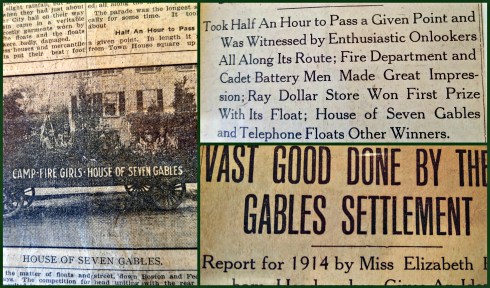
The House of the Seven Gables is featuring a new exhibit on its founder, Caroline O. Emmerton (1866-1942) in commemoration of the sesquicentennial of her birth and as the rather mysterious Caroline has long intrigued me I took advantage of a preview invitation to check it out even before the official opening. Despite her fortunate birth into one of Salem’s wealthiest and most philanthropic families, her connections, and her achievements, Caroline is a bit enigmatic, and I was hoping that Caroline Emmerton. An Unbounded Vision would shed new light on her for me. It did, but my suspicion that Caroline can only really be known in context rather than strictly on her own was confirmed. The exhibit actually presents Caroline in several contexts and it is through these perspectives that we come to know her: the wealth, privileges, and sense of civic duty that came to her through her family, her interest in the emerging Settlement Movement, with its aims of aiding and assimilating (or “Americanizing”) the country’s expanding immigrant communities, and the corresponding Preservation Movement, which aimed to preserve the pre-industrial past in an era of dynamic change. You can definitely perceive how Salem shaped her. The exhibit appropriately emphasizes Caroline’s settlement activities over her preservation goals but you certainly get the sense that they are going to merge with the formation of the House of the Seven Gables Settlement Association in 1910.

Gables Exhibition

Gables 2

Gables 4.jpg

Gables Panels 2

Gables Panels

Gables 10

Caroline Emmerton: an Unbounded Vision, at the House of the Seven Gables through August 31: A young Caroline and a very famous photograph of her with children at the Settlement House c. 1920; Exhibition panels, which were also produced in Spanish (a 21st-century update on Caroline’s settlement goals).

Gables 13

Gables 3Gables Scrap Collage

Context, context: the Gables in the Community. Great photograph of a Derby Street factory and worker, instructing neighborhood girls in the Settlement House kitchen; newspaper clippings from a Gables scrapbook.

So the context was definitely there but what about the personal Caroline? There was a sense of her in the exhibit, actually: a photograph of her home on Essex Street (with a wallpaper sample and a few household possessions), a range of photographs of her at different stages in her life, an original notepaper version of her (very ye Olde) tour for the Gables, and my favorite, the hand-written manuscript of her book Chronicle of Three Old Houses, which she published in 1935 for the 25th anniversary of the Gables. It was lovely to see these things, and also to talk with Irene Axelrod, the former Research Librarian of the Phillips Library of the Peabody Essex Museum, who knows more about Caroline than anyone else. I asked Irene where Caroline went to school, because in my experience institutions often offer up lots of evidence, and she said that Caroline was tutored at home and then probably went on the Grand Tour. So there goes that source. Irene told me that her research forayed into oral history, and she was able to interview some (quite old) people that actually knew Caroline. So that’s about as close as I’m going to get, I think: four degrees of separation?

Gables 12

Gables Emmerton Handwriting

LOVE this handwritten manuscript of Caroline’s Chronicles of Three Old Houses complete with little intextual illustrations! The companion book to the exhibition by David Moffat features a full-page view, along with lots of other illustrations from the Gables archives, sources, and more context.


Ernest M.A. Machado, Salem Architect

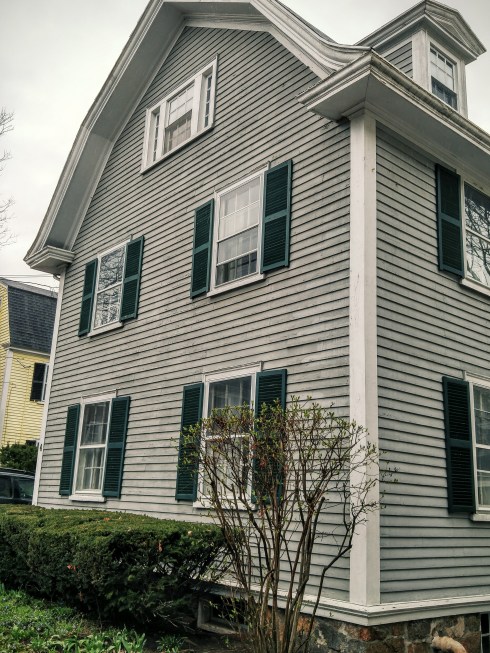
I tend to romanticize architects and the practice of architecture. When I first went to the house of my now-husband, who is an architect, I expected it to be Monticello-like, with a study in which a drafting table took center stage, surrounded by lovely hand-drawn renderings on whitewashed walls. My vision was not realized, and of course he is generally bent over a computer rather than a drafting table. It’s impossible to romanticize his work now that I know much more about it, so while I maintain a wifely interest in his business and projects, I also tend to drift away, back, towards architects who lived in ages past, who can easily engage and distract me. Just yesterday I walked over to take a picture of a Salem house which was built and occupied by a very prominent horticulturist and landscape architect, Harlan P. Kelsey, about whom I wanted to write a post (it is spring after all, even if it is a frigid spring, and so time to turn to gardening). But the more time I spent looking at the house, the less I was interested in its occupant and the more I was interested in its architect. And so I forgot Kelsey (for now–I’ll come back to him because he is pretty amazing), and began to focus on Ernest M. A. Machado, the likely architect of One Pickering Street and a man who is very easy to romanticize because he died relatively young, very tragically, and with much apparent promise.

Fortunately Machado’s life his well-documented: he seems to come from a family that wanted him (and all of its members) to be remembered: there is a nice genealogy and some pictures here, and the family donated his own photographs of completed projects to his alma mater, MIT. Ernest Machado was born just up the coast in Manchester-by-the-Sea to a Cuban émigré father and a North Shore mother who was orphaned but nevertheless connected. Juan Francisco Machado and Elizabeth Frances Jones met and married in Massachusetts, returned to Cuba for a decade, and then settled in Massachusetts permanently to raise their large family, first in Manchester and later in Salem. The Machado house is one of my favorite in Salem: a stunning brick Federal on Carpenter Street. Ernest attended Salem schools and then the Massachusetts Institute of Technology, graduating from its pioneering architecture program in 1890. After working for at least two prestigious Boston architectural firms, he established his own practice in partnership with his future brother-in-law Ambrose Walker, with offices in Salem (on Church Street), Boston and Ottawa (where his brother was an established banker). In the later 1890s he seems to be working feverishly, with commissions in several Boston suburbs, Salem, and all along the North Shore. This pace continued in the new century, all the way up to his death by drowning in Lake Ossipee in New Hampshire in September of 1907: he was 39 years old and had just completed his most challenging commission: the 14,000 square foot brick mansion of Governor Charles B. Clarke on Portland’s Western Promenade.

Machado Kelsey House One Pickering Street Salem

Machado Carpenter Street Salem

The Kelsey House on Pickering Street & Machado family home at 5 Carpenter Street.

Machado’s mark on Salem is not hard to find. Besides the Kelsey house and a few other residences in the McIntire Historic District and the Phippen house on the Common, he supervised substantial renovations to the Salem Club and the Bulfinch Bank on Central Street. He rebuilt the Salem Lyceum on Church Street, and as a testament to his versatility, designed both a commercial building on Washington Street for the dry goods retailer Charles W. Webber and the Blake Memorial Chapel in Harmony Grove Cemetery. Yesterday I trudged over through driving rain to contemplate the chapel, and then walked up the hill to his grave, part of a family plot of elegant markers which apparently he also designed (and unfortunately very wet by the time I got there).

Machado 16 Beckford

Machado 4 Carpenter

_258185, 4/5/15, 9:41 AM,  8C, 4358x3223 (7538+1035), 150%, Custom, 1/160 s, R89.4, G34.6, B41.3

Machado Harmony Grove

Machado Chapel

Machado Graves

Machado Grave

Machado in Salem: 16 Beckford Street and Four Carpenter Street; his own photograph of the Webber store on Washington Street, from the MIT Machado Archive; The Blake Memorial Chapel at Harmony Grove Cemetery and the (very wet) Machado grave(s) at Harmony Grove.

Looking at his Salem work as well as the portfolio of North Shore commissions (lots of residences and clubhouses for both the Salem Country Club and the Manchester Yacht Club) in the digital archive at MIT, it’s hard to discern a distinct Machado style: there are Colonial Revival houses in both the classical and Tudor traditions as well as lots of Shingle residences reflecting contemporary trends. But remember, he was a young architect, just establishing his practice and business and no doubt catering to the desires of his clients. Who knows what he would have achieved over the next thirty or so years of his working life? He could have maintained and expanded his practice as a Gold Coast residential architect, or he could have rebuilt Salem after the Great Salem Fire of 1914. Or both.

Machado Agge House MIT

Machado C.F. Allen House MIT Dome

Machado R. Wheatland House MIT

Machado Sanden House MIT

Machado House MIT Dome

Machado House MIT

Machado Lynn House AABN

Machado’s photographs of his own work at the Machado Archive at MIT: the Agge, Allen, R. Wheatland, and Sanden houses, and two unidentified houses (one of which looks just like a house in my hometown, York Harbor, Maine); a Tudor house in Lynn, from American Architect and Building News, 1906.

Appendix: you can stay in Machado’s recently-restored Clarke “Manor” (below) in Portland via airbnb; My Machado-obsessed day ended appropriately with a birthday party at one of his buildings: the Salem Lyceum, now Turner’s Seafood.

Machado Clark House Portland Zillow

Machado Lyceum.jpg


Massey’s Cove

Sometimes I feel sorry for the so-called “Old Planters”, the very first European settlers of Salem (which they called Naumkeag), who arrived in 1626 from the failed colony further north on Cape Ann. They are a rather overlooked lot. For two years they maintained their own isolated settlement until John Endecott arrived with more settlers and authority and transformed the rather loose Naumkeag into the rather staunch Salem, under the aegis of the Massachusetts Bay Company. And thus the Old Planters gave way to the New. Salem recognizes the Old Planters with a prominent statue of its leader, Roger Conant (who had made his way from Plymouth to Cape Ann to Salem), which is unfortunately located in close proximity to the Salem Witch Museum, thus he is often misidentified and/or overlooked: I shudder to remember all the ridiculous things I have heard tourists say about Conant as I have passed by. The other site associated with these men (and their families) is unmarked and removed: this is their landing place on the north side of the Salem peninsula and the North River: most often called “Massey’s Cove” in the sources. Salem’s great antiquarian/historian from a century ago, Sidney Perley, places this location at the foot of Skerry Street, but the train tracks and Route 1A bypass road that was built a couple of years ago have rendered it relatively inaccessible. Even though it is a very idealistic perspective, probably the best way to ponder Massey’s Cove is by looking Marblehead folk artist J.O.J. Frost’s naïve painting, The Hardships + Sacrifice Masseys Cove Salem 1626 The First Winter. A mighty nation was born God leading these noble men and women, painted in the 1920s.

Massey's Cove Frost

Massey's Cove crop

John Orne Johnson Frost, The Hardships and Sacrifice, Massey’s Cove, Salem 1626, Collection of Historic New England.

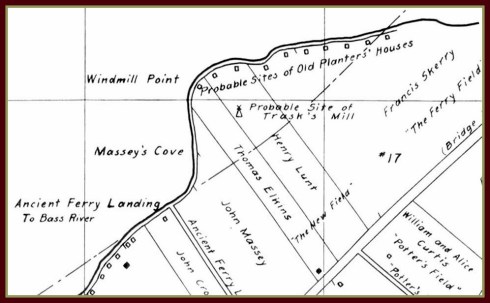
And then of course we also have Perley’s seventeenth-century maps from the Essex Antiquarian–not very embellished but most likely pretty accurate. Perley believed that the Old Planters erected 19 cottages along the shore, all of which had disappeared by 1661. The oldest house in this first-settled section of Salem to survive well into the twentieth century was the Ephraim Skerry House on Conant Street, a late First Period house built in the early eighteenth century. It was demolished in 1990, to make way for the bypass road. I tried to conjure up some sort of historical feeling for the Old Planters by accessing some photographs (from MACRIS, dated 1985) of the Old Skerry House, but it didn’t work, as it was just too new.

Massey's Cove map Perley

Massey's cove map Perley detail

Massey's Cove

Massey's Cove Collage.jpg

The Ephraim Skerry House on Conant Street, built between 1710-1724, demolished 1990.


Salem on Screen: East meets West

There is quite a long list of films set in Salem, but the list of films that were actually filmed here is impressive as well–and much more impactful. David O. Russell apparently loves Salem, as he filmed scenes from two movies here (American Hustle, Joy) even though their plots did not necessitate this location, tours of Hocus Pocus locations remain ridiculously popular, and though not a film, we’ve decided to dedicate a very prominent city square to Samantha from Bewitched (and TV Land), just because a few episodes were filmed here. The very first production filmed in Salem, however, traded on its commercial reputation rather than its connection to witchcraft: this was the 1923 silent film Java Head, which shot scenes on Derby Wharf, Salem Common, and Chestnut Street.

Filmed in Salem Java Head Lobby Poster

Java Head was based on the novel of the same name by Joseph Hergesheimer, about the scion of an old Salem family who meets a “Manchu princess” in China, marries her to prevent her imminent death, and brings her home to his Yankee family and the girl he left behind. Apparently this love triangle drives the movie, along with lots of cross-cultural conflicts, but I’m basing my plot summary on the novel (and the 1934 “talkie” remake, which replaced Salem with Bristol, England) as the film has not made it to You Tube (and may indeed be lost, along with 75% of all silent films that were produced–the Library of Congress has catalogued the film but there are “no holdings” in its archive). The interior and “Chinese” scenes of Java Head were filmed at a studio in New York, but Derby Wharf (or a nearby stand-in) and several Salem structures were used as locations. In his 1989 memoir Highlight and Shadows, cameraman Charles Galloway Clarke recalls that We loved the good people of Salem for they were friendly and helpful and did everything to make our stay there pleasurable. After finishing the scenes around the recreated dock, for this was a film about the China Trade during the sailing days of Salem, we returned to Astoria for the interior scenes. The title “character” of the film is actually a Federal mansion, exemplifying the fortunes to be made in the China trade. Contemporary sources hint that the Forrester-Peabody Mansion (later the Salem Club and later still the Bertram Home) “played” Java Head, but I think a far more likely suspect is the Devereux-Hoffman-Simpson House on Chestnut Street.There are a few more details and images here, but what I’d really like to see is the film!.

Filmed in Salem Java Head Poster

Filmed in Salem Java Head article

Filmed in Salem Leatrice Joy

Filmed in Salem Java Head 1923

Filmed in Salem Bertram Home

Filmed in Salem Devereux Hoffman Simpson House Chestnut Street

Lobby Card for Java Head (1923) and article from Picture Play from the same year, showing lead actress Leatrice Joy’s transition “from occidental to oriental”; after the transition-a Swedish poster for the film; a still from the film showing the Salem mansion “Java Head” which some sources identify as the Bertram House at 29 Washington Square (with flag, above), but I think it was definitely 26 Chestnut Street (just above).


A Witch Cake for Early April

Those who are familiar with the established narrative of the Salem Witch Trials will recognize the reference to a “witch cake”, in that case concocted of the urine of the afflicted mixed with rye meal and ashes, baked in cake form and fed to a dog with the hope that the beast would somehow reveal the name of the malevolent witch. In 1692 Tituba assisted Mary Sibley in the preparation of a witch cake in order to identify the person(s) responsible for bewitching the young girls in Samuel Parris’s household, an act that would later be used to condemn her. In Salem the witch cake was clearly used as a form of counter-magical test; while in Britain it was more commonly used as a defensive amulet against the bewitchment of a person or household. There are many surviving examples of anti-witchcraft charms and amulets in British collections, everything from pierced “hag-stones” to very familiar horseshoes, but more perishable cakes are hard to find. But here is one, which doesn’t look very perishable at all!

Witch cakes in April Card

This witch cake, which dates not from the seventeenth but rather the twentieth century, is part of the large (around 1400 items) collection of charms, amulets and talismans accumulated by British folklorist Edward Lovett (1852-1933), who seems to have been more interested in the magical artifacts and beliefs of his own time than those of the past. Lovett was an amateur folklorist in a time when that pursuit was being professionalized: he worked as a bank cashier by day and walked the streets of London by night, listening to the stories and purchasing the personal charms of street hawkers, sailors, and washerwomen, or whoever came upon his path armed with “protection”. (You can follow his steps here). This research formed the basis of his fascinating book Magic in Modern London (1925), and his collection can now be found chiefly in three institutions: the Pitt Rivers Museum at Oxford University, the Cuming Museum on South London (which has been closed due to a fire, but many of its collections have been preserved and digitized), and the Wellcome Museum. The items below, including a cow’s heart stuck with pins and nails (upper right-hand corner, used by a dairyman as a talisman against a man he believed had put a curse on his cows), and the two anti-witchcraft charms, the ram’s horn with attached key and hag-stone below, all come from the Cuming collection, along with the more familiar charms. Acorns abound, to guard against lightning, and the wishbone wrapped in blue and red ribbon is almost a work of art!

Charm Collage Lovett

Lovett Acorn Charm

Lovett Wishbone

And below are some Lovett amulets purchased from British soldiers who fought in the First World War: hand votives guard against the “evil eye”, geological charms protect the wearer from a host of evils, and black cats were actually lucky in some parts of Britain, unlike the rest of the world.

L0057378 Amulet brooch in the shape of a black cat, England, 1914-191

Back to the Witch Cake, about which I don’t have too much information. There is Lovett’s own description: around about Flamborough Head [in Yorkshire], “witch cakes are to be met with in almost every cottage. These are circular-shaped, with a hole in the middle and with spikes projecting on all sides. If you hang one up in your cottage and once a year burn it and replace it with another [presumably during Holy Week, or the first week of April], you will have good luck. But no recipe!


Salem Lots

Several years ago, Bonhams Auctions held an auction of items from the Caren Archive, the largest private collection of American documents from the colonial era to the present. It was an extremely profitable event for all concerned, and so now there is a second sale coming up, and this one features several notable Salem items. The April 11 “Treasures from the Caren Archives II: How History Unfolds” auction comprises a wide variety of paper lots, among them one of the earliest English reports on the Salem Witch Trials, a 1777 financial document in which the Widow Sarah Putnam agreed to finance the Salem privateer Pluto during the American Revolution,  the “preliminaries of peace” negotiations that brought the Revolution to a close as reported by the Salem Gazette, Andrew Jackson’s 1834 State of the Union address, also reported in the Gazette, and a list of the Salem donors who contributed to William Henry Harrison’s successful presidential campaign in 1840.There’s also a great mezzotint image of Major-General Israel “Old Put” Putnam made in 1775 by Salem printer Joseph Hiller, based on a painting by Benjamin Blyth–very similar to the portrait of John Hancock this very pair produced in that same year.

Selling Salem 1693

Selling Salem Putnam 1795

Salem Gazette 1783 Preliminaries of Peace

Salem Gazette 1834

Selling Salem 1840

Salem Lots from the upcoming Bonhams Auction of items from the Caren Archive: Memoirs of the Present State of Europe, or the Monthly Account of Occurrences Ecclesiastical, Civil and Military. Vol II. No 1 [-12]. London: printed for Robert Clavel and Jonathan Robinson and Samuel Crouch, 1692-93;  BLYTH, BENJAMIN. 1746-1786. The Honble Israel Putnam Esqr. Major General of the United Forces of America. Salem, [MA]: printed by Joseph Hiller, [1775]; Salem Gazettes from 1783 and 1834; A handwritten list of 47 Whig subscribers offering to contribute funds to the campaign of William Henry Harrison, Salem, June 1840.

The two items that interest me the most are the 1693 London periodical and (oddly enough), the list of William Henry Harrison campaign donors. 1693 is very late in the history of the European Witch Hunt, and you would expect English reactions to the Salem trials to run along the lines of those backward, superstitious colonials, but this correspondent is not quite so condemnatory. He does however express the emerging enlightened mentality : In my opinion a Rational person, who is not Convinced of the Matter by his own Eyes, ought to suspend his judgment and to remain in a kind of Skepticism, until Experience shall receive farther illustrations from Experience. The Harrison document is interesting not because of the 47 names of Salem men listed (familiar prominent names) but because it sheds light on campaign finances in the mid-nineteenth century: the money went not to the production of hand-bills or newspaper advertising, but to defray the expenses of the Whig celebrations of the Fourth of July ensuing in addition to the cost of the collations…..” . Firecrackers and food (and drink), no doubt.


Ghostly Courtiers

I’ve just got a few more English posts before I get back to the actual streets of Salem: I just took so many great pictures over there if I do say so myself! I’m going back to Hampton Court today–the other side of Hampton Court, which if of course a bilateral palace, with a Tudor side and a Baroque/Georgian one, the cumulative work of Sir Christopher Wren and Sir John Vanbrugh who were commissioned by the last Stuarts and the first Georgians to remodel the entire castle in a more modern (and presumably comfortable) style. If completed, this modernization plan would have resulted in the complete demolition of the Tudor palace but lack of funds and the shifting preferences of monarchs determined that it was (fortunately) not. I far prefer the Tudor palace, inside and out, but I really enjoyed the furnishings, paintings, and overall interpretation of the “Secrets of the Royal Bedchamber” exhibit in the royal apartments on the other side, populated by courtiers all draped in white Tyvek.  Like any old place touched by tragedy, there are rumors of ghosts at Hampton Court Palace, and it as if you are walking among them in these rooms.

20160315_111841_Burst01~2[1]

London 735.jpg

London 724

London 726

London 728

London 727

London 725

London 731

London 730

London 732

Baroque facades–with the Tudor roofline peaking out behind, dining rooms and courtiers; Below, the “Grey Lady” ghost, Sybil Penn, wandering through the palace.

Grey-Lady-low-res


Hooked on Hawksmoor

Well, I am very late to this party but I became absolutely obsessed with the works of British Baroque architect Nicholas Hawksmoor (1661-1736) on my recent trip to London. Hawksmoor’s professional reputation was overshadowed in his own time–and long afterwards–by his association with two more prominent “gentlemen” architects, Christopher Wren and John Vanbrugh, but in the last few decades he seems to have emerged from their shadow. His oeuvre is impressive: under Wren he worked on St. Paul’s Cathedral, the naval buildings at Greenwich, several buildings at Oxford University, Hampton Court and Kensington Palaces and Westminster Abbey, the west towers of which were constructed according to his own design during his tenure as Surveyor General, and he collaborated with Vanbrugh on both Castle Howard and Blenheim Palace. I’ve been to all of these places, but I never associated any of them with Hawksmoor, or thought about Hawksmoor at all, until I saw his Christ Church, Spitalfields, early last week. From that point on the week belonged to Hawksmoor: I scouted out his six surviving London “Queen Anne” churches commissioned by the New Churches in London and Westminster Act of 1710, really looked at the Abbey’s west towers for the first time, and looked on the stately buildings of the Royal Naval College at Greenwich with a new appreciation.

Christ Church Spitalfields

Hawksmoor 1

Christ Church Spitalfields 1950s

Christ Church Spitalfields 1909

21. Christ Church, Spitalfields, London: by Nicholas Hawksmoor 1964 by John Piper 1903-1992

Christ Church, Spitalfields, shining like a beacon at the end of very busy Brushfield Street, afternoon and early evening (after its long restoration, completed in 2004), and in the 1950s and 1909; John Piper, Christ Church, Spitalfields, London: by Nicholas Hawksmoor, 1964, Presented by Curwen Studio through the Institute of Contemporary Prints, Tate Britain.

I just can’t stop looking at Christ Church! And I’m not alone: it has inspired scores of artists and photographers, and authors such as Iain Sinclair, Peter Ackroyd, and Alan Moore. In the poem Lud Heat (1975), which inspired Ackroyd’s (crime? suspense? mystery? not sure how to categorize it) novel Hawksmoor (1985), Sinclair envisions a “psychogeographical” alignment between all of the Hawksmoor churches, and later calls them “eternal” as opposed to the “shimmering trash” of the Docklands (in this great video). Sinclair is absolutely right; these churches do stand out, all of them, not just because of their stature and their distinctive spires but also because they present a rather odd combination of classical austerity and weight.You also have the sense that Hawksmoor was building temples rather than churches: these houses of worship don’t look precisely Christian! One of his six surviving London churches, St. George’s, Bloomsbury, is essentially a classical temple with a steeple on the side rather than the center, at the top of which is not Saint George but King George (I–in Roman dress, presumably he is the Saint), accompanied by a lion and a unicorn. It’s no wonder that our modern secular age admires Hawksmoor, the architect and the Freemason.

Hawksmoor St. Georges

Hawksmoor St. Georges 2.jpg

Hawksmoor St. Georges 3

Hawksmoor’s St. George’s Bloomsbury, completed in 1730; restoration completed in 2006.

Well, I do believe St. George’s was Hawksmoor’s last London church; his earlier ones do appear a bit more traditional/ecclesiastical but still display that distinctive Hawksmoor edge of composition and detail. Here are the rest of his churches, plus two more that he collaborated on with John James: St. Luke’s Old Street in Islington (which features an obelisk steeple!) and St. John’s Horsleydown in Bermondsey, which was demolished after sustaining bomb damage during World War II.

Hawksmoor St Alfrege

Hawksmoor St. Alfrege

Hawksmoor St. Alfrege 3

St. Annes Limehouse

St George in the East

St George in the East rendering BL

Hawksmoor St Mary Woolnoth City

450px-St_Lukes_Islington Hawksmoor

Hawksmoors lost church Bermondsey

St. Alfege Church, Greenwich, 1712-1714 (with window details); St. Anne’s Limehouse, 1714-27 (on the grounds of which there is a pyramid); St. George in the East, Wapping, 1714-1729 (I did not have time to make it out to Wapping, so I have “borrowed” a picture from here and a drawing of the facade from the George III topographical collection at the British Library. Next time!); St. Mary Woolnoth, 1716-27, right in the center of the City of London (very wide and narrow steeple); Two collaborations with John James, 1727-33: St. Luke’s, Old Street and St. John’s Horsleydown, demolished after World War II (from the Collections of the Metropolitan Archives of London). Similar fluted spires, but St. John’s had a comet on top!

So we have all sorts of classical elements, combined with more whimsical ones: columns, pyramids, obelisks, unicorns, comets. Mathematical precision and clocks. I don’t think this adds up to anything particularly pagan, much less sinister (somehow Hawksmoor acquired the moniker “the Devil’s Architect”–I’m not sure if this is a creation of his time or ours): I just think he was a man of his time, which was of course the Enlightenment. Quite a modern man, who ascended to the heights of a gentleman’s profession on his merits alone and worked primarily for institutions rather than patrons. He was impressive and his work remains impressive. I’m not precisely sure what his creative contributions were relative to those of his mentor, Christopher Wren, but I really felt Hawksmoor’s presence at Greenwich, almost as much as Christ Church, Spitalfields: maybe I’m getting a bit “psychogeographical” myself! Unfortunately we don’t seem to have this particular field of inquiry in the States: we’re just not that attached to our built environment to get that introspective about it.

Hawksmoor Greenwich

Hawksmoor Greenwich 2

So now I’m home, with only a few Hawksmoor books to sustain me. I need more: so now I’m going about collecting more texts, and some images that rival, or at least capture, the magnificence of Hawkmoor’s buildings. I really like the work of Andrew Ingamells, who has rendered several of Hawksmoor’s churches in aquatint etchings, and I would almost kill for Pablo Bronstein’s Four Alternate Designs for a Lighthouse in the Style of Nicholas Hawksmoor (Bronstein also designed and commissioned the construction of an actual Hawksmoor beach hut in the form of a lighthouse at  Folkestone, which you can see here).

Ingamells Hawksmoor Collage

Hawksmoor Collage2

Hawksmoor Pablo Bronstein

Hawksmoor books

Trinity and Hawksmoor

Aquatint etchings of Hawksmoor churches by Andrew Ingamells, from a selection here; Pablo Bronstein’s “Four Alternate Designs”, Herald Street Gallery;  Architectural and historical analysis from Owen Hopkins and Mohsen Mostafavi and beautiful black and white photographs by Hélène Binet; just finishing up Ackroyd’s engaging Hawksmoor this morning!