Last night we went to see Six at the American Repertory Theater in Cambridge; I bought the tickets, but my husband accompanied me willingly. I simply could not resist a musical about the six wives of Henry VIII and it did not disappoint in its fluffy, fun feminism. The performance was certainly not a deep (or long) dive, but it was interesting in its distillation of the essential character of each woman, whether based on fact or fiction. Each queen had her say (or song), but the entire performance was a collective concert; midstream my husband said it reminded him of Josie and the Pussycats! The musical’s writers, Toby Marlow and Lucy Moss, are younger than us so they were inspired by different pop princesses: Beyonce, Avril Lavigne, Adele, Rhianna, Ariana Grande, Alicia Keys.


 Beard Collection, Victoria and Albert Museum.
Henry and his six wives have been the focus of many popular culture expressions for decades, even centuries: none of them will ever die. What’s interesting to me about re-envisioning is how it reflects on the society which is doing the re-envisioning and what gets distilled down as the universal “truth” of whatever or whomever is being recalled. In the case of the former, the King is nowhere to be seen on the Six stage: obviously he is the elephant in the room but he’s not there in this #metoo moment, this “her-story” (I hate that word; I almost lost the job I now hold because I told the hiring committee I would not teach a course on the books titled “Herstory” as history was about people). It’s all about the women and even though they look and sound very contemporary their characterizations are pretty traditional: Catherine of Aragon is the steadfast queen who says “no way” to Henry, Jane Seymour is “the only one he really loved”, Anne of Cleves is the one who got away, with a very nice annulment settlement, Katherine Howard is the precocious teenager with very poor judgement owing to an abusive past, and Katherine Parr is the grown-up survivor. I’ve heard this all before many times, and there’s a nice spotlight on the court painter Hans Holbein, including the old yarn in which he is sent to Germany to paint the miniature portrait of Anne of Cleves before her betrothal to Henry, and falling in love with her, made her more beautiful than she really was and so raised the King’s expectations to an extent that she could not meet, as well as entire song, “Haus of Holbein,” right in the middle of the performance. The one Queen I did not recognize was Anne Boleyn: she’s a plucky party girl in Six, with many, many references to her unfortunate death, including her showcase song, “Don’t Lose Ur Head”. She does get one of the best lines of the night when narrating her long road to royal marriage, when “the Pope said nope” to the annulment of Henry’s first marriage. But there’s no conviction in Anne, or any of the wives really: it’s hard to inject religion into a pop concert. The conceit of the show was that these women would compete—through their stories–for the title of who suffered the most at Henry’s hands, but near the end they decided they were all in it together, so we didn’t get to clap for our favorite Queen. I was relieved, as I was torn: I know Henry’s first queen suffered the most, but my very favorite, forever, is his last.


 All the wives, plucky Anne, personal Tudor history from the last century, and Hans Holbein re-envisioned by Alys Jones.


 Cornelis Verbeeck, A Dutch Pinnace in Rough Seas, National Maritime Museum of the Netherlands; Armada cards from the later 17th century, Royal Museums Greenwich, Wenceslaus Hollar, view of the Tower with pinnace-rigged ships, 1637, British Museum.


 The John P. Felt House on Federal Court past and present: despite a rough last half-century or so, the house is still standing in good form, lacking only its widow’s walk and shutters.
 Barton Square has been pretty much annihilated.
 Change and continuity on Bott’s Court: old house on the left, newer (both 1890s) houses on the right. Cousins is showing us the demolition of the former house on the right with his preservationist eye.
 Kimball Court present and past: Cousins is showing us the birthplace of Nathaniel Bowditch below: this house is in the top right corner above. In front of it today is a house that was brought over from Church Street during urban renewal in the 1960s when that street was wiped out.
 18 Lynde Street: this appears to be the same house, with major doorway changes.
 The house on Mall Street where Nathaniel Hawthorne wrote the Scarlet Letter: there was an addition attached to the house at some point in the 1980s or thereabouts.
 134 Bridge Street: As a major entrance corridor–then and now—Bridge Street has impacted by car traffic pretty dramatically over the twentieth century; Cousins portrays a sleepier street with some great houses, many of which are still standing—hopefully the progressive sweep of vinyl along this street will stop soon.
 17 Pickman Street seems to have acquired a more distinguished entrance; this was the former Mack Industrial School (Cousins’ caption reads “Hack” incorrectly).
 Great view of lower Daniels Street–leading down to Salem Harbor–and the house built for Captain Nathaniel Silsbee (Senior) in 1783. You can’t tell because of the trees, but the roofline of this house has been much altered, along with its entrance.
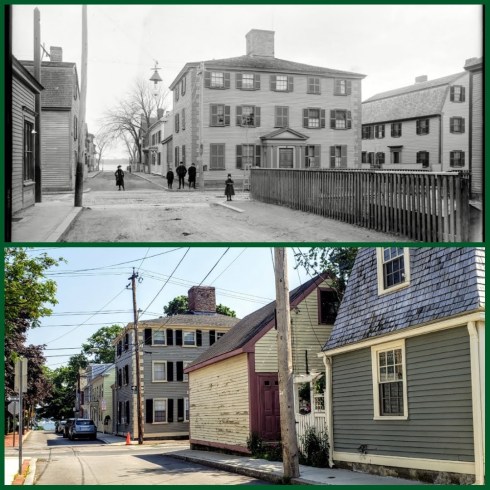 Hardy Street, 1890s and today: with the “mansion house” of Captain Edward Allen still standing proudly on Derby Street though somewhat obstructed by this particular view. You can read a very comprehensive history of this house

 The Frank Cousins “Team”/ Employees’


 Signs everywhere in Raleigh, which has held on to its state heritage markers (even for sites that no longer exist) and added lots more.
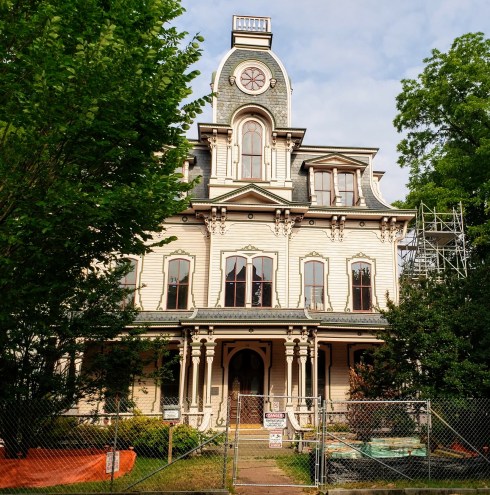


 The Heck-Andrews House (under renovation), Polk House, and Executive Mansion in the city center, and Oakwood beyond—and beyond Oakwood.


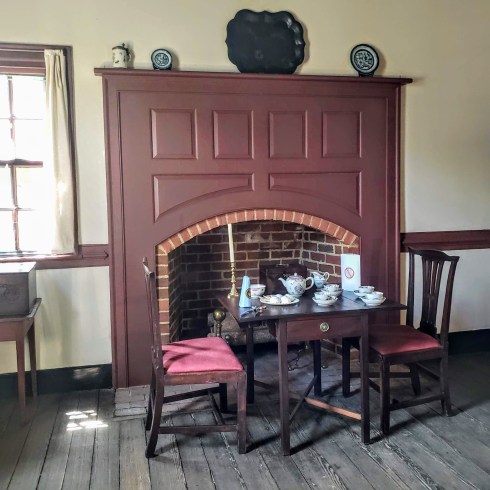


 Exteriors and Interiors of the Lane and Mordecai Houses + their gardens and the Andrew Johnson birthplace, adjacent to Mordecai.


 The City of Raleigh (COR) Museum: a must-visit spot; this last question is existential!


 There is a facsimile edition, but how amazing to see the original 1693 maritime atlas of Pierre Mortier, the “most expensive sea-atlas ever published in Amsterdam in the seventeenth century” according to the eminent Dutch cartographical historian Cornelis Koeman. Stunning plates of beautiful European ships: here is a “Tartane de Pesche”.
 Mr. Monroe at the 1/11/18 public forum at PEM.


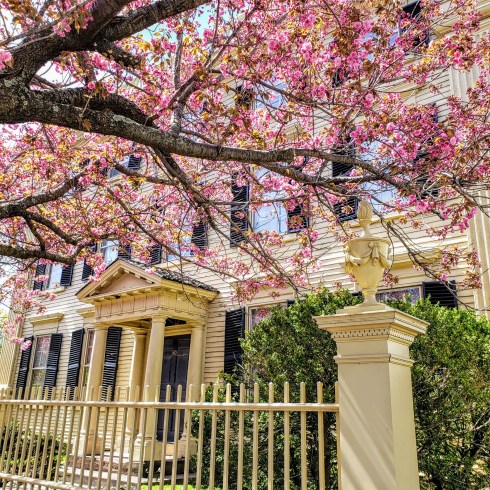 Is the Red Line going to take us across North Street to the beautiful Peirce-Nichols House? Of course not, sharp left to the Witch House, after we’ve just been to the Witch Dungeon Museum.
 Two empty courthouses downtown: can’t ONE play a key public role?

 Thank goodness for Wicked Good Books and the Hotel Salem, otherwise there’s not a lot going on on the Essex Street pedestrian mall, day or night.


 Bridge Street Neck was not “home to a large population of African Americans” in the 19th century: just check the city directories!


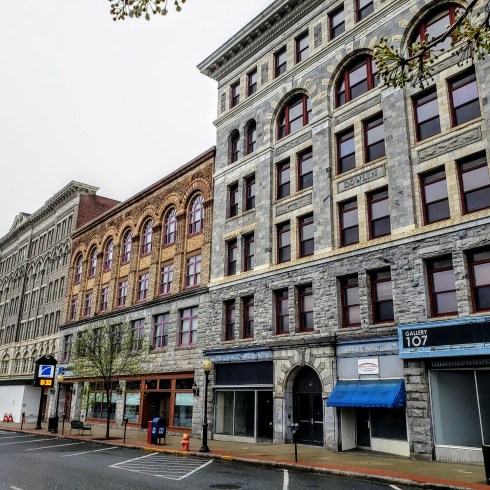


 Some of the larger Victorians on Church Street (just above) need some help, but just up the hill is a lovely neighborhood of mostly-restored structures. Below: the Arnold Print Works produced a full line of textiles over their long history, but one of their popular products in the 1890s were these stuffed animal templates (examples below from the collections of the Rhode Island School of Design Museum & Cooper Hewitt): the finished products are very collectible and you can buy reproductions too (here are some Etsy