Tag Archives: Photography

Salem Women’s Lives in the Phillips Library

As they are now, Salem women were really, really busy in the near and more-distant past, and the records in the Phillips Library are a testament to both the range and intensity of their activities. At this moment, the PEM is highlighting all of the powerful women whose work and lives are featured in their 2018 slate of exhibitions, including Georgia O’Keeffe, artist and facilitator Angela Washco, photographer Sally Mann, and a succession of Qing Dynasty empresses of China. In her post, Lydia Gordon writes about “multiple feminisms” and observes that to operate in feminist modes is not just advocating for women’s issues, but rather to take on the human issues within social, cultural, economic and political arenas of our lives. To be a feminist is to be human. I couldn’t agree more, and while it is wonderful to have all these exhibitions on view here in Salem, once again I am struck by the burying of the local past by an institution which is focused primarily on the more global present. For the collections of the PEM’s Phillips Library are full of women tak[ing]on the human issues within [the] social, cultural, economic, and political arenas of [their] lives, and I’m afraid we’re never going to hear their stories–or see their faces.

Woman Pierce PEMThe lovely Catherine Johnson Pierce, who we do get to see in Salem: anonymous American artist, c. 1828-29, Peabody Essex Museum.

So many activist “Republican Mothers” in nineteenth-century Salem! Here’s just a sampling of women’s association papers in the Phillips Library: the Salem Female Charitable Society Records (1801-2001; MSS 359—still active today!), the Dorcas Society of Salem (1811-1875; MSS 113), The Seamen’s Widow and Orphan Association (1833-1960; Acc. 2011.008); the Salem Female Anti-Slavery Records, 1834-1866; MSS 34—fortunately digitized by the Congregational Library and Archives), the Salem Female Employment Society (1861-1875; MSS 113) and the Salem Thought and Work Club (1891-1974), headed by the famed author and activist Kate Tannatt Woods, who deserves her own archive. In her 1977 article in the Essex Institute Historical Collections, then-curator Anne Farnam outlined the workings of the Salem Female Charitable Society early in the nineteenth century, and also reads between the lines to illustrate what can be gleaned from the more opaque entries, such as the vote of the SFCS on September 2, 1801 from the first published list of subscribers of the society. Mrs. West was in the process of a bitter divorce, and one would like to have heard that discussion. As the century progresses, Salem women’s organizations continue to serve as charity stewards, and widen their social scope to include abolition, temperance, education and immigration.

Women PEM SFCS

WOMEN PEM collage A published sermon for the Salem Female Charitable Society, 1815; and records of the Salem Female Anti-Slavery Society as digitized by the Congregational Library & Archives.

And then there are so many stories of individual women in the Phillips: far too many to include an exhaustive list here. One could: follow a Salem sea captain’s wife along as she accompanies her husband around the world in 1837-38 (Log 405), reconstruct several long-distance marriages by delving into the correspondence between captain’s wives who stayed in Salem and their roving husbands, perceive how several Salem women, from different stations in life, assessed the world around them and their own lives during short and long stretches of time in the nineteenth and early twentieth centuries through their diaries; appreciate the contributions of the extraordinary women of the Remond family (MSS 271), assess the interesting lives and careers of the “Misses Williams” of Salem, two spinster sisters who made, taught, collected and sold art in Salem, and traveled to Italy and elsewhere recording their observations and purchasing items for resale back in their Salem studio/gallery (MSS 253); read cookbooks annotated with notes and suggested variations (MSS 483); examine the unsuccessful restoration of the Qing Dynasty in China from the perspective of three missionaries present at the time (MSS 0.650), learn so much more about the lives and work of so many accomplished Salem women, including Sophia and Rose Hawthorne (MSS 69), educator Elizabeth Palmer Peabody (MSS 474), author, illustrator and educator Lydia Very (MSS 83), authors Kate Tannatt Woods and Mary Harrod Northend (Fam. Mss 1119 and MSS 0.016) and artist and entrepreneur Sarah Symonds (MSS 0.016).

Women PEM Collage 3

Photograph of Waters family members, undated, MSS 92 Volume 4

Women PEM Williams Sisters Studio

Women PEM Very


Women PEM Woods

Cookbook

Synchronicity Sarah Symonds

Studies of the intersection of maritime and gender histories have been trending for some time–but where do the rich collections of the Phillips Library fit in? Women of the Waters Family–all dressed up and ready to go where? (Phillips MH 12); The Studio of the Misses Williams of Salem (Phillips Library photograph from Jacqueline Marie Musacchio’s “The Misses Williams in Salem and Rome: Women Making and Marketing Art and Antiquities.” In The Art of the Deal: Dealers and the Art Market on Both Sides of the Atlantic, 18601940, ed. Lynn Catterson, 59-8 (2017)An illustration by Lydia Very, who bequeathed her Federal Street house to the Essex Institute (MSS 83); Kate Tannatt Woods, Out and About (1882); What Salem Dames Coked, the cookbook published by the Esther C. Mack (another amazing woman) Industrial School in 1910, 1920, and 1933 and reprinted by Applewood Books; The “Colonial Studio” of Sarah Symonds on Brown Street, in a building now owned by the Peabody Essex Museum.

As I think about these Salem women on this particular day, in the midst of this particular Women’s History Month, I am dismayed and disheartened when I should be inspired. The sources for women’s history in the Phillips Library are so rich that I have no doubt that they will be discovered and dispersed by a succession of scholars, as many have already (and the digitized catalog and finding aids will facilitate that process), but the prospects for public presentation and engagement seem bleak. As the Phillips collections take up residence in an inaccessible factory, with no obvious digitization plan in place or apparent institutional interest in historical interpretation, it is difficult to see how the people of Salem—or visitors to our “historic city”– will be able to face its history in any meaningful way, like the little girl below.

CurryPhotoTwo-year-old Parker Curry facing Michelle Obama’s portrait by Amy Sherald: a photograph taken by museum visitor Ben Hines which went viral last week, Washington Post.


Unobstructed Views

My self-education in historical architectural photography is now quite stalled in the realm of the photogravure, and I just can’t see enough tonal prints of old buildings, preferably but not necessarily of the New England variety. There is a slim volume titled Under Colonial Roofs by Alvin Lincoln Jones with forty stunning photogravures from negatives by Charles Webster that I keep by my bedside but I like the Internet Archive copy even better because it is annotated by a snarky little anonymous note facing the title page: the first good photographic study of New England’s historic houses was Alvin Lincoln Jones’ Under Colonial Roofs which appeared in 1894. The pictures, which are of a high quality, show us many buildings that have since disappeared. The picture of the Paul Revere House, when compared to a modern view, gives us some idea of how drastic the 1907 restoration must have been. Jones’ picture leads me to conclude that it is very easy to over-restore a building. I wonder what he/she thought of the coincidental restoration of the House of the Seven Gables! The 1894 version of the Paul Revere house is in fact very revealing, as is that of the Wells-Adams House, also in the North End, which would come down in the very same year that Under Colonial Roofs was published.

undercolonial roofs

undercolonialroo00jone_0081

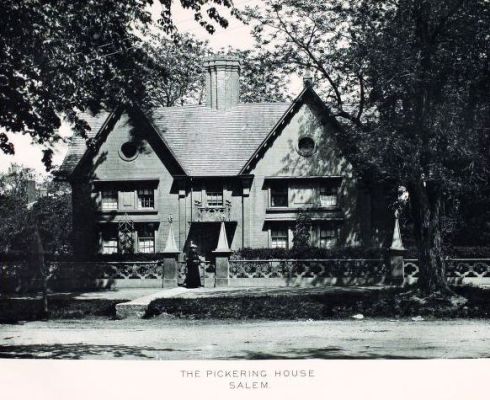
Jones showcases only two Salem houses, a very un-restored Corwin/Witch House, which he calls the Roger William House as it is several years before Sidney Perley disproved that connection, and the Pickering House, which looks then pretty much like it looks now. There are so many more I wish he had included! But images of Salem’s “ancient” houses were being dispersed far and wide by Frank Cousins in the 1890s, so I can understand his sparing coverage. There are lots of Essex County houses in the volume: I was particularly drawn to the Cobbett House on East Street in Ipswich, which appears to be no longer with us, the striking image of the Whipple House (again–in its un-Colonial-revivalized state) and the Peaslee Garrison House up in Haverhill, which looks like it could have been built in East Anglia.

undercolonialroo00jone_0106 (1)

undercolonialroo00jone_0111

undercolonialroo00jone_0146

undercolonialroo00jone_0201

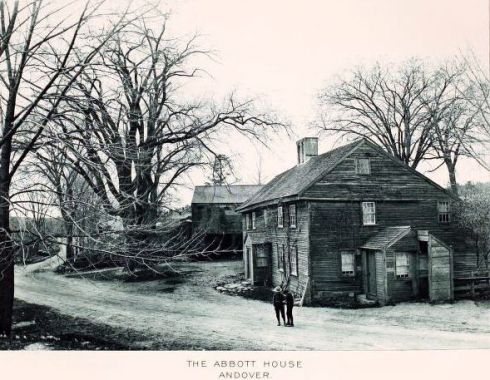
Jones takes us to all of the usual houses in Lexington, Concord and Duxbury, but does not venture onto the Cape or “out west”. Perhaps the anonymous note-inserter is correct: there is something about the untouched, organic images of two houses that I am familiar with—the Abbot house in Andover and the Peter Tufts House in Medford (which Jones calls the “Cradock House”) that are so very revealing, even more than the photographic technique. These houses would survive the twentieth century: not so the Barker House in Pembroke, then boarded-up, overgrown and abandoned.

undercolonialroo00jone_0216

undercolonialroo00jone_0223 Cradock House

undercolonialroo00jone_0343 Barker House Pembroke


Samuel Chamberlain’s Salem I: Winter

Two notable architectural photographers of the twentieth century turned their lenses on Salem again and again: Frank Cousins (1851-1925) and Samuel Chamberlain (1895-1975). These men represent a continuum for me: Chamberlain picked up where Cousins left off: with a gap of about ten or fifteen years while the former was more focused on the Old World than the New, and on etching rather than photography. It’s a very interesting exercise to consider their views of the same structure side by side: this is one way that I’ve been teaching myself about photography. Chamberlain has much more of a trained eye–having studied both architecture at MIT and etching in France–but both seem as concerned with documentation as illustration to me. I’m impressed with the range of activities and entrepreneurship of both men–although clearly Chamberlain was more worldly, by choice and circumstance. Born in Iowa and raised in Washington State, Chamberlain’s time at MIT was interrupted by World War I and service as an ambulance driver in France, where he became entranced with the buildings around him and “decided he would prefer to record the picturesque rather than design it” according to 1975 obituary in The New York Times. He recorded picturesque architecture in France, England and America with his etchings, prints and photographs in over 40 published books and countless magazine pieces, as well as the first-ever engagement calendars featuring New England scenes.

Chamberlain collage Two perspectives on the Peirce-Nichols House:  Cousins and Chamberlain.

I grew up with Samuel Chamberlain books and when I moved to Salem I bought more: his vista included all of New England (and beyond) but as he lived in nearby Marblehead, he had ample opportunity to photograph Salem over a 30+ year period from the 1930s through the 1960s. Like Cousins before him, Chamberlain resolutely avoided all the “dull” parts of the city (anything industrial or utilitarian, Victorian or 20th century), and stuck to the historic districts for the most part, where he photographed both interiors and exteriors. I can’t get enough of the first of his three Salem-specific titles, Historic Salem in Four Seasons: A Camera Impression (1938), Salem Interiors: Two Centuries of New England Taste and Decoration (1950), and A Stroll through Historic Salem (1969) because of its rich rotogravure reproductions, which render pre-war Salem in very rich hues. I’m going to offer up some seasonal highlights of Samuel Chamberlain’s Salem this year, starting with winter, which he believed was the time of “Salem’s most beautiful moments…when few visitors see it”.

Chamberlain 1

Chamberlain 7

Chamberlain 8

Chamberlain 9

Chamberlain 11

Chamberlain 10

Chamberlain Federal

Chamberlain 5

Chamberlain 3

Chamberlain 4Essex Street, Church Street, the rear of the Andrew Safford House, the Retire Becket House, the Derby House, Federal and Chestnut Streets from Samuel Chamberlain’s Historic Salem in Four Seasons (1938). Both Chamberlain and Cousins deposited materials in the Phillips Library, which has been removed from Salem by the Peabody Essex Museum. 


Curtain Lectures

It was Burns Night at Hamilton Hall last night, and my husband and I were charged with giving the Toast to the Lassies and Reply. After a week steeped in the Ploughman Poet, both of us were a bit uncomfortable with the very bawdy Burns in this year of #metoo, so he went with the more inspiring Rights of Woman as the basis of his toast, which meant I had to go for the uplifting too. But I kind of wish he had gone with one of my favorite Burns poems, The Henpecked Husband. I don’t like it for its overall sentiment, of course, but because of just one phrase, curtain lecture, an idiom which I’ve used in class time and time again, because it always provokes a conversation!

The Henpecked Husband

Curs’d be the man, the poorest wretch in life, The crouching vassal to a tyrant wife!  Who has no will but by her high permission, What has not sixpence but in her possession; Who must to he, his dear friend’s secrets tell, Who dreads a curtain lecture worse than hell. Were such the wife had fallen to my part, I’d break her spirit or I’d break her heart; I’d charm her with the magic of a switch. I’d kiss her maids, and kick the perverse bitch.

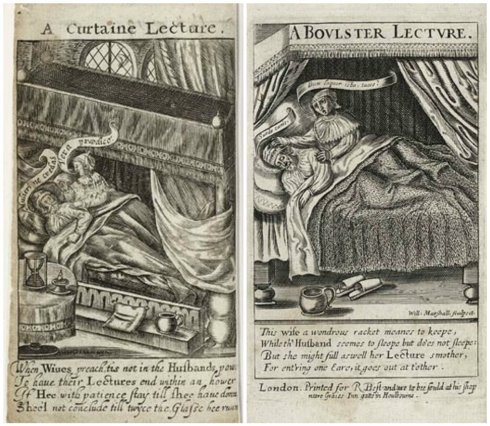
Burns certainly didn’t coin this phrase; it had been around for quite a while. In my courses, I use the frontispieces from Thomas Heywood’s Curtaine Lecture (1637) and Richard Brathwaite’s Art Asleep, Husband? (1640) but I think the expression predates these works as well. It seems very Shakespearian to me, but the heavily-curtained seventeenth-century bed provides the perfect “frame” for wifely “advice”.

Curtain Lecture collage

If you pop these images up before a class of 19-year-olds you are immediately rewarded with their focused engagement in the history of women, marriage, gender relationships, satirical discourse, and material culture (inevitably their attention strays to the “alarm clock” on the table in the Heywood illustration). Lots of comments, lots of questions, all of which can be contextualized and connected to other timely trends. Obviously the notion had a wide appeal—or recognition–in the seventeenth century and after, which is why it survived up until Burns’ time. In an earlier post, I showed the Richard Newton caricature that dates from around the time of The Henpecked Husband, and it is one of many variations on the theme published in this era, give or take a few decades. As the era of curtained-beds closed, the curtain lecture continued, and was revived quite dramatically by the publication of Mrs. Caudle’s Curtain Lectures by Douglas Jerrold in Punch in 1845. These 37 illustrated lectures were published in book form that same year, and reissued frequently thereafter, inspiring a wave of  variant visual expressions in all sorts of mediums: stereoviews, postcards, even a board game. Now it is a general rule of mine that once animals (or birds) take the place of people a concept has jumped the shark (with a few exceptions), and it’s hard to conceive the curtain lecture could have lasted through the twentieth century in any case, but nevertheless it survives as an effective teaching tool.

Curtain Lecture J. Lewis Marks 1824

Caudle2

Caudle 3 John Leech

mrs-caudle-s-curtain-lecture-victorian-card-from-punch-lecture-3-modelled-faces-and-real-hair_a-l-1585476-8880731

Curtain Lecture 1907 LOC

Curtain Lectures PC 1905

Curtain Lectures Chickens

Curtain DucksA Curtain Lecture pub. by J. Lewis Marks, 1824, British Museum; illustrations by John Leech for the first edition of Mrs. Caudle’s Curtain Lectures, 1845; Mrs. Caudle Card (with real hair!), Victoria & Albert Museum; 1907 stereoview from the Library of Congress; postcards, c. 1900-1910.


Caretaking and Curating

As frustrating as this past month has been with the prospect of Salem’s history being extracted by the relocation of the Phillips Library it has also been interesting, as I dove into the depths of its catalog so that I could develop a full appreciation of what we will be losing. I’m not an American historian so it was never an essential repository for me, and the life of this blog roughly corresponds with its closure. When I first moved to Salem I would research house histories and a few other things at the Phillips, but I was never truly aware of how rich and vast its collections were until just this past month: now I am awed. And as I discover and rediscover these holdings, I keep coming up with questions about their utility and accessibility: the slow process of digitization at the PEM remains confounding, but now I’m wondering if there is even an institutional interest in these materials. There is no question in my mind that the PEM is a responsible caretaker of its Phillips collections, but is there, or will there ever be, any enthusiasm for their interpretation? Historical records are not preserved merely for the sake of mothballing: they need to come alive through ongoing interpretation and curation. According to their messaging, the PEM hopes to attract scholars to its “state-of-the-art Collections Center” in Rowley via its digitized catalog, but does it have any interest in curating its own collections?  We all thought that the last library exhibition, 2011’s Unbound: Highlights from the Phillips Library at PEM, was meant to tide us over until the reopening of the Phillips in 2013, but perhaps it was indeed the last library exhibition.

Libraries comparable to the Phillips, as well as those with far less resources, have presented wonderful exhibitions over the past few years, both online and in their reading rooms. In lieu of the lists of books which I usually produce at this time of the year, I thought I’d list some library exhibitions from the recent past and present, set forth for the purposes of comparison and perhaps inspiration.

John Carter Brown Library, Global Americana: The Wider Worlds of a Singular Collection (2017). Given the PEM’s global interests and the nature of their collections, a similar exhibition would be easily within reach, really popular, and a great teaching resource. We’re applying for an NEH grant on the trade between Salem and Spain at SSU, so this particular exhibit item, in which a very young nation assesses its trade, caught my eye—but it’s probably the least colorful item in the exhibition.

Curatorian Global Americana JCB

Secretary of State’s Report on the Cod and Whale Fisheries, 1791, John Carter Brown Library, Brown University.


American Antiquarian Society, Louis Prang and Chromolithography. Artist, Innovator, and Collaborator (2015). This exhibition–archived online–features several works by Salem-born artist Fidelia Bridges. The PEM has some great lithographic images, including an amazing Prang process proof that was featured in Unbound—it was really the highlight of the highlights.

Curatorial Prang

L. Prang & Co., “Dipper missing,” Louis Prang: Innovator, Collaborator, Educator. American Antiquarian Society.


Harvard University Map Collection, Pusey Library, Look but Don’t Touch: Tactile Illusions in MapsEveryone loves maps, and the PEM has a great collection, especially of local maps. A chorographical exhibition would be very interesting, but perhaps a bit too local for the cosmopolitan PEM.

birds-eye-eastern-railroad

“Bird’s-eye View of the Eastern Railroad Line to the White Mountains and Mt. Desert.” Boston: Rand Avery Supply Co., 1890. Harvard University Library.


Delaware Art Museum, The Cover Sells the Book: Transformations in Commercial Book Publishing, 1860-1920 (2017). A wonderful exhibition of notable bookbindings in the collection of the Museum’s Helen Sloan Farr Library & Archives. Thanks to the Phillips librarians’ tweets, pins, and instagram posts, we know that they preside over a treasure chest of beautiful bookbindings, and could easily mount a similar exhibition (or three or four).

Curatorial Del

Helen Farr Sloan Library & Archives, Delaware Art Museum.


Baker Library, Harvard University Business School, The Art of American Advertising, 1865-1910 (ongoing). This digital exhibition of American advertising ephemera is an amazing resource that I visit often. Given the Essex Institute’s all-encompassing policy of collecting old bills, letters, and account books, books, pamphlets, newspapers, magazines, directories, etc…in fact, all articles which now or in the future may throw light on our history, or manners and customs”, there is no shortage of similar materials in the Phillips Library.

Curatorial Baker

Famous (or infamous) “Antikamnia” Skeleton Calendar for 1901, by Louis Crusius, a St. Louis pharmacist and physician. Baker Library, Harvard University.

Phillips Ephemera

Merrill & Mackintire Calendar for 1884, Phillips Library, Peabody Essex Museum.


And finally, photography, and a plea. The Phillips collections include the photographs and papers of two local photographers who established national reputations over their careers: Frank Cousins (1851-1925) and Samuel V. Chamberlain (1895-1975). While many of their photographs were published over their lifetimes and after, others remain entombed in the Phillips. Photography lends itself to digital exhibition particularly, so I’m really hoping that the PEM can release some of these images in that (or any!) form, forever.

Chamberlain collage

Samuel V. Chamberlain at work in France and New England, Phillips Library MSS 369, Peabody Essex Museum.


An Open Letter to the Leadership of the Peabody Essex Museum

Regarding the recent admission that the Museum plans to consign nearly all of the collections of the Phillips Library, including manuscript and printed materials central and unique to the history of Salem, to a new Collections Center in Rowley, before the December 6, 2017 meeting of the Salem Historic Commission.

To Mr. Daniel L. Monroe, The Rose-Marie and Eijk van Otterloo Director and CEO of the Peabody Essex Museum, and its Boards of Trustees and Overseers:

Please reconsider your decision to remove Salem’s historical archives from Salem.

I consider the Peabody Essex Museum to be an extraordinary asset to our city, fostering engagement, awareness, and edification. Furthermore, I understand that in order for it to flourish, it had to become greater than the sum of its two parts: the former Peabody Museum and Essex Institute. Yet those two institutions, the products of the fruits and labors of generations of Salem residents, created a foundation on which the PEM was built: a strong foundation that is acknowledged in the museum’s mission statement, which asserts its 1799 foundation and status as “America’s oldest continuously operating museum”. There are no explicit references to history in this statement, but it is implicit everywhere, especially in the aim to transform people’s lives by broadening their perspectives, attitudes, and knowledge of themselves and the wider world. A key path towards self-knowledge and knowledge in general is historical understanding, which is grounded in historical archives full of people as well as papers.

Like many in Salem, I am somewhat confused by the PEM’s shifting strategies towards the Phillips Library and the collections therein. For the purpose of clarification, I’d like to lay out my understanding in chronological format; if there are mistakes or misperceptions here I apologize.

1998: Following the merger of the Peabody Museum of Salem and Essex Institute and the consolidation of their two libraries, both named after members of the Phillips family of Salem, a newly-renovated Phillips Library emerges from a $10-million-dollar renovation, the first phase of the Peabody Essex’s $100 million expansion project. “The Real Witchcraft Papers”, on deposit from the clerk of the Superior Court Department of Essex County in order it increase access to historically valuable public records, are installed in a permanent exhibition. In an age of completely convincing copies, the mere knowledge that you’re seeing the originals is exciting, writes Christine Temin in the Boston Globe.

2004: Citing a reduction in visitation, the PEM cuts staff and hours for the Phillips Library,  incurring some serious resistance from scholars, librarians, and the general public (despite a coincidental announcement of its intent to increase its digitization efforts). Richard Trask, archivist for the town of Danvers (the former Salem Village) remarks that the Phillips looks like . . .  the ignored child. I certainly don’t want it to be the abandoned child of the institution.

2011: The Phillips Library in Salem is closed and its collections are moved eventually to a temporary location in Peabody, so that major renovations could be undertaken at its historic Salem buildings, Plummer Hall and Daland House. PEM public relations manager April Swieconek announced that the work would be concluded by 2013, and would guarantee the preservation of the Library’s 400,000 volumes and one linear mile+ of manuscripts, demonstrating just how important it was to the museum—It is a part of what we are and part of what Salem is– in an article in the Salem News by Matthew K. Roy.

2013-2017:  We waited and waited and waited and waited for the Phillips Library to return to Salem. I first heard of the “off-site Collection Stewardship Building”, intended to provide a “state-of-the-art conservation lab for the museum’s 1.8 million objects”, in a 2015 Boston Globe article by Malcolm Gay, which also referenced the ongoing renovations at the Phillips. In 2016, John D. Childs, formerly a conservator at Historic New England and the 9/11 Memorial Museum, was hired to become Chief of Collection Services, but he also acquired the title Ann C. Pingree Library Director at some point in that year, indicating a consolidation of conservation and library oversight. The language on the PEM website relative to the Phillips changed in 2017, with the ominous phrase moving from its temporary facility to a new location first appearing, and finally, after that fateful admission of December 6, The Phillips Library will be moving from its temporary facility in Peabody to a state-of-the-art facility in Rowley, Massachusetts. 

And so that brings us to the present, but I want to go back to 2011, when the PEM offered up two tributes to the Phillips, which in hindsight can only be viewed through a rather bittersweet lens: former Library Director Sidney Berger’s lovely exhibition of collection jewels: Unbound, Highlights from the Phillips Library at PEM and Swiss artist and photographer Marianne Mueller’s Freeport [No. 002] exhibition, Any House is a Home. Mueller mined the Phillips archives and walked the streets of Salem to evoke a sense of place rarely seen–or felt–in most PEM exhibitions, and one of her most poignant pieces is a photograph of a young Salem woman standing before one of the pillars of the Phillips “where all the history is stored”. No longer.

PEM History

Rachel Tonthat of Salem before the Phillips Library, “where all the history is stored”, in Marianne Mueller’s 2011 Freeport exhibition at the PEM: Any House is a Home

Mueller perceived that the Phillips was the place “where all the history is stored” because it was the place where all the history was stored in Salem from the mid-nineteenth century to the near-present. Looking back on the Essex Institute’s first fifty years in 1898, President Robert Rantoul sought to explain its overflowing archives (a problem then as now) by its contemporary regard as a place of deposit where everything typical of our heroic past, everything that can embalm the personality and keep alive the memory of actors in the scenes of long ago, may well repose in consecrated security forever. Not only valuable books and rare historical papers — the natural accretions of a great library — have been gathered here, but relics and manuscripts and pictures and ancient records — a priceless legacy to the antiquary and the student of local annals, rich material ready to the hand of the historian — have poured in upon us until our receptivity is overtaxed… Shall we cry, hold! enough!  No, he concludes, that would never do. As befitting its name, the Institute was collecting the history of all of Essex County, but its Salem location, mandated by its 1848 articles of incorporation, crowded out the formation of any competing historical associations in the city: Salem’s historical society was the Phillips Library, and it still is.

Essex Institute Incorporation

1848 Act of Incorporation for the Essex Institute, Commonwealth of Massachusetts

And consequently, nearly every Salem street, square, park, and many buildings, both public and private, can be matched to a corresponding collection in the Phillips Library. I could go on forever making these connections between people, places, and the past, but will confine myself to only one. Salem’s newest public space, Remond Park, is a memorial to the extraordinary Remond family, including the prominent abolitionists Charles Lenox and Sarah Parker Remond. We only have one photograph of their mother Nancy Lenox Remond, a true matriarch and entrepreneurial activist who ran several businesses while simultaneously advocating for national abolition and the local desegregation of the Salem schools, and that photograph is part of the Remond family papers in the Phillips Library, deposited there by her heirs, who saw their family history as part of the history of Salem.

MrsJRemonLenox_jpg_jpg

Mrs. Nancy Lenox Remond, n.d., Phillips Library, Peabody Essex Museum

I am fortunate to be able to access this photograph, and reproduce it: colleagues at Salem State University commissioned its digitization as part of a initiative called SALEM in History funded by a three-year Teaching American History grant from the U.S. Department of Education a decade ago. If not for this initiative, we couldn’t see Mrs. Remond; we still can’t access her family’s records, like those of other families who lived, worked, and built Salem over the centuries. We are cut off from them, and from the history of our city. Such a consequence seems completely inconsistent with the goals of an institution that invites its patrons to discover the inextricable connections that link artistic and cultural traditions as well as one that has indeed invested considerable funds in the maintenance of the Phillips collections and buildings. I do not doubt the PEM’s commitment to the preservation of the historical collections that have been left to its care, but an opportunity has arisen to demonstrate a corresponding commitment to Salem. It might require careful curation, it will certainly require more time and more resources, but the effort will situate the Museum on the right side of history.

Please return Salem’s historical archives to Salem.

Very Sincerely,

Donna A. Seger, Salem


Weekend at the Mt. Washington

My grandmother introduced me to two things of which I can never have enough: a parade of new dresses for back-to-school every fall and grand old hotels. One indulgence started early in life but endured because of my profession; the other started a bit later but is also still ongoing. It was a family tradition to stay at the Equinox in Vermont for long Thanksgiving weekends, and later the White Elephant on Nantucket, and the two of us traveled to a succession of historic hotels on an epic trip down the east coast and back twenty-plus years ago. Nana passed away just about a year ago after her 104th birthday, so I was thinking about her when I planned my last October getaway weekend at the Mt. Washington Hotel. Built in 1902 in a (Spanish) Renaissance Revival style that is meant to dominate, rather than blend into, its setting, the Mt. Washington was one of the last of the great Gilded Era New England resorts to be built before the onset of the automobile, and it remains a conspicuous survivor. I really only wanted to do two things from the moment we arrived on a sunny Friday afternoon: capture the hotel from every angle, and sit on the back veranda (drink in hand) and stare at Mt. Washington and the Presidential Range, like generations of guests before me.

MW 1

MW 2

MW3

MW 4

MW Veranda

The interior of the hotel has a formal-but-not-fussy aesthetic designed to frame the views outside and mix faded grandeur with modern comforts. In the central lobby, a large fieldstone fireplace “crowned” with a Moose bust contrasts with crystal chandeliers from the 1920s, which seems to be the decade that supplied most of the Hotel’s lighting–and glass inserts everywhere. A ballroom, dining room, several bars, and a domed conservatory are also on the first floor, along with the famous “Gold Room” where the International Monetary Fund agreement was reached in the closing year of World War II.

MW Interior2

MWLobby 2

MW Interior

mwi2

mwi

mwi3

Mount Washington collage

We had great weather on Friday and Saturday so I spent as much time as possible out on the 900+ foot veranda, watching the light and cloud patterns change over Mt. Washington every few minutes, especially at twilight, when I got my best picture (s) ever: behold below! No filters necessary: the sunset was gold and purple on Friday night.

MWView 5

MW View 3

MW View 4

MWView2

MWView

My husband was not content to hang out at the hotel all the time so we took a hike—where we happened upon a man playing his flute in the woods–and went to the top of Mt. Washington on the cog railway. When I was quite young, for some reason I read a book about all the people who died on Mt. Washington and these sad stories have always stayed with me so I’ve never been particularly drawn to the mountain, but our traverse did afford me several new vantage points of the Hotel—you can just see it in the valley down below from the summit in the next-to-last picture, a little bit of white encircled by green far far away. As usual, it’s man-made over natural for me!

mwe

mwe2

mw clouds

MW Train


Female Fancy-Dress, 1609-1980

I am so looking forward to Halloween night next Tuesday, not only because our long municipal nightmare will be over here in Salem for another year, but also because I actually do enjoy creative Halloween costumes, and they do appear on this night, glittering like stars in a sky of more generic garb. If an entire family is going to make the trek to Salem to trick-or-treat on Chestnut Street, they will often go all out, and in years past I’ve seen the Swiss Family Robinson, The Jacksons, the Addams Family (actually I think these three were all just last year), the Coneheads, the Jetsons, and a variety of historical characters, en masse and individually. I wish there were more conceptual costumes and less inspired by popular culture but that’s probably asking for too much for a holiday that is supposed to be for and about children. The most creative (and conceptual) costumes I have ever seen were made (or proposed) for masquerades or fancy-dress parties prior to 1920 or so, after which Halloween began to emerge as a major American holiday and the witches and the pumpkin-heads pushed out the nymphs and the sprites and the various ethereal forest creatures. Costumes begin with Queens, who were entitled to prance about in court masques long before actresses were, so I’m going to begin my portfolio with the Queen of the Amazons, one of many costumes designed by Inigo Jones for Ben Jonson’s Jacobean masques, which were commissioned by King James I’s (and VI’s) Queen Anne, my vote for bestdressed Queen of all time. Jonson’s The Masque of the Queens was presented at Whitehall Palace in February of 1609, the third masque written for Anne and the first to include an “anti-masque” featuring witches, of course, the opposite of the virtuous ladies played by the Queen and her ladies. Penthesilea, the Amazonian Queen, enters first (after the witches).

Costume Masques

Costume rowlandson500

Costume collage 3Inigo Jones’ Penthesilea costume for the Masque of Queens, 1609, British Library; Thomas Rowland’s Dressing for a Masquerade, British Museum;  Léon Sault’s designs for the House of Worth, 1860s: Eve with a snake and a Sorceress, Victoria & Albert Museum. 


A bit less custom, and a bit more commercialized, costuming commences in the later nineteenth century: more for fancy-dress parties than for Halloween. All sort of costumes can be found in pattern books from this era, such as Jennie Taylor Wandle’s Masquerade and Carnival. Their Customs and Costumes, published by the Butterick Publishing Company in 1892. As you can see, the Halloween archetypes (devil, witch, sorceress, little and big bat) are already popular. Women’s magazine also offer up lots of fancy-dress inspiration: below are some very……naturalistic costumes from the Ladies Home Journal in 1914 and a few more conventional examples from 1920.

Costume collage

Costume masqueradecarniv00wand_0053

Costume masqueradecarniv00wand_0114

Fancy Party Costumes LHJ Nov 1914

Costume collage 2

The transition from fancy-dress to Halloween costumes comes just around this time, 1920: I am marking it with an aptly-titled commercial publication,  Dennison’s Bogie Book, issued by the Dennison Manufacturing Company of Framingham, Massachusetts in 1920. This “book of suggestions for decorating and entertaining at Hallowe’en, Harvest Time, and Thanksgiving” contains lots of instructions, indicating that we’re at a moment where traditions are being invented. Of course all you need to have the perfect Halloween are Dennison products, which all seem to be made of orange and black crepe paper. It seems like full-blown commercial Halloween is right around the corner, but yet when I look at the photograph of Batgirl, St. Ann (wow, she’s the outlier here!), and Wonder Woman from New York city photographer Larry Racciopo’s Halloween (1980), it doesn’t seem like we’ve come that far at all.

Costumes 1920

Halloween Costumes 1980 Bat Girl, St. Ann, and Wonder Woman photographed by Larry Racioppo, New York Public Library Digital Gallery.


Great Wars and Ghosts

Despite my dislike for Haunted Happenings, I have to admit that the range of offerings is much more diverse and engaging than a decade or so ago, as nonprofits in Salem have entered the fray in a big way. A good example: on this Friday, Peter Manseau, the Lilly Endowment Curator of American Religious History at the Smithsonian Institution’s National Museum of American History, will be speaking about his new book, The Apparitionists: A Tale Of Phantoms, Fraud, Photography, And The Man Who Captured Lincoln’s Ghost at the Gothic Revival Chapel at Harmony Grove Cemetery. This setting seems perfect for this talk, which is co-sponsored by the Cemetery, the Salem Athenaeum, and the Salem Historical Society.

Apparitionists

The Apparitionists is about spirit photography in general and America’s first “photographer of disembodied spirits” in particular: William H. Mumler, who set up shop in Boston in 1862 after producing a dual image by accidental double exposure. He offered up an embellished story to The Liberator in November of that year: alone in the photographic saloon of Mrs. Stuart, 258 Washington Street, trying some new chemicals, and amusing himself by a taking a picture of himself which, when produced, to his great astonishment and wonder, there was on the plate not alone a picture of himself, as he supposed, but also a picture of a young woman sitting in a chair that stood by his side. He said that, while standing for this picture, he felt a peculiar sensation and tremulous motion in his right arm, and afterwards felt very much exhausted. This was all he experienced that was unusual. While looking upon the strange phenomenon (the picture of two persons upon the plate instead of one) the thought and conviction flashed upon his mind, this is the picture of a spirit. And in it he recognized the likeness of his deceased cousins, which is also said to be correct by all those who knew her. At first, Mumler disavowed any connection to the Spiritualist community which seemed to give him more credibility, as his doctored cartesdevisites of reunited husbands and wives and parents and children separated by death were much in demand. His claim was that his camera could capture these spirits, in medium-like fashion, yet he was not a medium himself.  Mumler’s time in Boston came to a close when several of his “spirits” were recognized as real live Bostonians, but he moved on to New York, where his continued success drew the attention of investigators and detractors like showman P.T. Barnum, and where he was ultimately prosecuted for “obtaining money from the public by fraud, trick, and device” in a sensational trial held in the spring of 1869, the very same year that Mary Todd Lincoln visited his studio to secure a photograph of herself and her dearly-departed husband. Mumler was acquitted due to lack of evidence, but spirit photography lived on, in America and especially in England. That’s the story for me: the survival, the hope, even after the notorious trial and all sorts of revelations about the technical process that could produce multiple images on one print.

Spirit Photography 1869

Spirit Photographs MET

Spirit Photograph Holmes MFAHarper’s Weekly, May 8, 1896; page from an album of spirit photographs by Frederick Hudson, 1872, Metropolitan Museum of Art; spirit stereoview from the collection of Oliver Wendell Holmes, 19th century, Museum of Fine Arts, Boston.

The context for that story has to be the wars–the great wars: the Civil War for America and the First World War for Britain. The collective mourning for the victims of these conflicts seemed unprecedented, unfathomable, and never ending–but of course it wasn’t. Just last week I was talking about all the crises of the fourteenth century with students in my Introduction to European History class: famine, war and plague, leaving millions dead, suddenly, languishing up there in Purgatory, without hope of salvation, unless some action was taken by the living. And suddenly the dead are everywhere: dancing, in the mirror, appearing in threes without warning at any time. Ghost stories emerged for the first time. Late medieval ghosts are often admonishing the living, to get their (spiritual) affairs in order or seize the day, whereas the spirits of the later nineteenth and early twentieth centuries seem to be conjured up for comfort only. In either case, medieval or modern, it’s more about the living than the dead. Given the long trend towards rationalism, it is difficult to understand how an essentially superstitious spiritualism would resurface in the nineteenth century, if viewed apart from the tremendous grief unleashed by the wars. All indications seem to point to the Spiritualism “conversion” of Arthur Conan Doyle, a physician as well as the creator of the ever-rational Sherlock Holmes, as occurring coincidentally with the Great War and the death of his son Kingsley: his earnest Case for Spirit Photography was first published in 1922, and was followed up by aspeaking tour across the United States which the New York Times labeled “The Second Coming of Sir Arthur”.

Spririts Medieval Getty

Spirit Photograph 3 LC 1901

Hutchinson-1922-12-14-the-case-for-spirit-photographyThe Three Living and the Three Dead from the Crohin-LaFontaine Hours, c.1480—85, Master of the Dresden Prayer Book or workshop, The J. Paul Getty Museum, Ms. 23, fols. 146v–147; A girl with three spirits, c. 1901, Library of Congress; the first edition of Arthur Conan Doyle’s The Case for Spirit Photography, 1922.

Among the Cathedrals

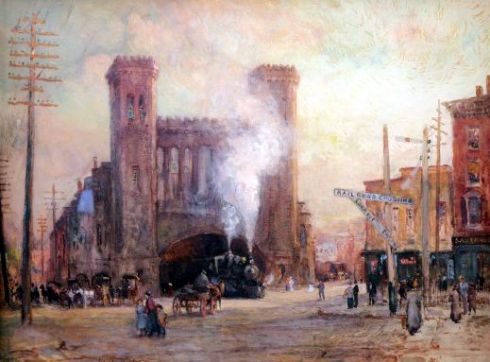
I’m always looking for artistic impressions of Salem’s long-lost train depot (1847-1955), so was thrilled to come across a painting by the Philadelphia-born artist Colin Campbell Cooper the other day. Campbell is universally characterized as an Impressionist, but he seems to have been fascinated by structure, as there are many cathedrals, skyscrapers, and train stations (the cathedrals of their day?) among his works: you can see why he was drawn to the Salem station. Here is his impression, from 1910, along with Walker Evans’ photograph from the 1930s and a street-level stereoview published by Charles Beckford: contrasting views of an imposing edifice.

Cooper Roundhouse

walker-evans-train-station

Salem Stereoview Beckford Cropped

Colin Campbell Cooper, Train Roundhouse, Salem, Massachusetts, c. 1910, Sullivan Goss Gallery; Walker Evans, Boston and Maine Train Station, c. 1931, ©Walker Evans Archive, Metropolitan Museum of Art; Charles A. Beckford, American Views series, n.d.

Cooper had a vibrant and varied artistic life. He was born in Philadelphia in 1856, and after his artistic education at the Philadelphia Academy of Arts (with Thomas Eakins) he was off: to New York, to Europe, to Asia, and eventually to California. While in the Netherlands in 1897, he met and married his first wife, Emma Lambert, who was also a promising and increasingly-prominent artist. They traveled extensively together: one dramatic voyage had them assisting in the rescue of Titanic survivors while aboard the RMS Carpathia en route to Gibraltar in the spring of 1912. Prior to this adventure they came to Salem together–perhaps they were visiting Frank Benson, or Philip Little, or maybe Ross Turner? I can’t discern the details, but three paintings bear witness to their time here in 1910-1911: Colin’s Train Roundhouse and Salem Mansion (alternatively titled A Salem Residence), for which he won the Beal Prize in 1911, and Emma’s Fruit Stand, Salem, Massachusetts.

Cooper Mansion

Cooper Market

Colin Campbell Cooper, A Salem Mansion, 1910, The International Studio, Volume 45; Emma Lampert Cooper, Fruit Stand Salem Massachusetts, Cottone Auctions.

After Emma’s death in 1920, Cooper relocated to California, where he became Dean of the Santa Barbara School for the Arts, and eventually remarried. He kept his studio in New York City, but California terraces began to replace the skyscrapers….and he became a playwright! He died in 1937, just a few years before the foundation of the Santa Barbara Museum of Art, for which he was an energetic advocate. Cooper’s paintings are in many American museums, and Sullivan Goss, the Santa Barbara gallery that represents his estate, is also a great resource for his life and work.

Cooper Glass Train Shed

CCC Grand Central Station MET

CCC Broadway

Cooper Beauvais Cathedral

Charles Campbell Cooper, Glass Train Shed, Philadelphia, and Grand Central Station, New York, both 1910 (the same year as his Salem paintings), Metropolitan Museum, New York; Broadway, c. 1909Biggs Museum of American Art; Beauvais Cathedral, 1926, Sullivan Goss Gallery.