Tag Archives: Photography

A Very Merry House Tour

I felt a lovely spirit among the volunteers and tour-goers at this year’s Christmas in Salem tour yesterday: a clear and sunny 40ish day which made every open house shine. There were proud owners, dedicated stewards, enthusiastic guides and curious visitors everywhere in attendance. As I emphasized in my preview, it was particularly impressive to see such strong collaboration between Salem’s heritage and civic groups, not only between the tour sponsor, Historic Salem, Inc., and this year’s focus and host, the House of the Seven Gables, but also the Salem Maritime National Historic Site, two churches—Salem’s first Catholic Church, Immaculate Conception, which is now part of the amalgamated Mary, Queen of the Apostles parish, and the amazing Russian Orthodox church, St. Nicholas—-as well as the beautiful Brookhouse Home, a residence for senior women since 1861. There was of course the conspicuous absence of that elephant on Essex Street, the Peabody Essex Museum, but special compensatory recognition should be given to the relatively new Salem Historical Society, a group of young historians who formed during the prolonged closure—now apparently permanent—of the PEM’s Phillips Library. The SHS has no archives, of course, because the bulk of Salem’s archival history belongs to the PEM and is now housed in the relocated Phillips Library 40 minutes north on Route One, but they have goals: and chief among them is to get more recognition for Nathaniel Hawthorne. This tour was a means to that end, and a very material measure of their success is a brand new sign marking the sight of Hawthorne’s birthplace on Union Street, installed just in time for this “Vey Hawthorne Holiday” tour. The actual house, which was moved to the House of the Seven Gables campus in 1958, was on the tour as well, along with the storied mansion itself, the Custom House where Hawthorne (reluctantly) worked, and his least-favorite residence in Salem, his very own “Castle Dismal” (which is neither a castle or dismal).

CIS 17

CIS 4

CIS 6

CIS Christmas

CIS 7

CIS 9

CIS 11

CIS collageFrom the brand new Hawthorne’s birthplace sign to the House of the Seven Gables, and then back to Herbert Street and “the house that Hawthorne hated” via Derby Street and the Custom House.

There were so many lovely houses on the tour interspersed among these Hawthorne sites: mostly early nineteenth-century, some eighteenth, with different degrees of detail and scale. There is a great range of houses along Derby Street, encompassing everything from the stately mansions alongside the Custom House and facing Derby Wharf, to simple Georgian cottages further along the street. I appreciated the diversity of structures, their number (this tour is an obvious bargain when compared to all the house tours I have attended this year!), and the mix between public and private buildings. It’s always a very personal commitment for a homeowner to open their doors for a house tour—and consequently it is an intimate experience for those that step within, and a privilege. But the public buildings have an intimate feel too, because the people that care for the House of the Seven Gables, the Brookhouse Home, the Custom House, and the churches, are so very committed to their preservation and interpretation. I ran out of time (because of a long lunch, another holiday tradition) and couldn’t quite make the Immaculate Conception by the end of the day, but several members of the congregation as well as the pastor of St. Nicholas Orthodox Church were on hand to share their beautiful parish church, which was established in 1901. Beautiful day, great tour: if you couldn’t make it yesterday, it’s also on today: the weather may be a bit frightful but I assure you the interiors will be all that more delightful!

Just a sampling here: there was so much to see.

CIS 1

CIS 10

CIS 36

CIS 32

CIS 35

CIS 33

CIS StairwayThe Captain William Lane House (with such a cheery laundry/mudroom! and decorated by Mr. Frank Bergmann who trims (other meaning) all my shrubs and trees; the Josiah Getchell House and the Thomas Magoun House along Derby Street–all absolutely charming.


CIS staircase collage

CIS 27

CIS 28

CIS 29

CIS 25

CIS 24

CIS Crush

CIS CHAMBERLAINI’m just obsessed with the staircases now–two very different ones, from the Brookhouse Home (1810-11) and the Ives-Webb-Whipple House (by 1760). More from the latter–one of my favorite houses in Salem which is now for sale. The Captain John Hodges House on Essex (c. 1750), whose owners have some very compelling ancestors! I never take pictures of recent family photographs, but ancestors from 100+ years ago are fair game: I could not resist this remarkably handsome man, plus I am a Maine girl so must show you Joshua Chamberlain (center, dark suit, hat in hand), the hero of Gettysburg, at his 1912 family reunion.


CIS Brookhouse

CIS 14

CIS 13

CIS 12

CIS Church

CIS Church interiorThe very festive Brookhouse Home and very serene St. Nicholas Russian Orthodox Church, on Forrester Street.


Salem during the Great War

I have been so impressed with the World War One centenary commemoration initiatives both in Europe (where they have been going on since 2014) and the United States (more recent initiatives, organized by towns, states, and the national Centennial Commission): poppies and lights galore, a real focus on humanity, and that amazing “We’re Here because We’re Here” living history event, which makes me cry every time I see more than one minute of video—nope, make that 30 seconds. Of course the commemoration has been more intense in Europe because the loss was more intense, but there have been some impressive American initiatives too: in our region, the Lexington Historical Society, in particular, has gone all out. Here in Salem, we have our veteran squares, which is a lovely program, but that’s about it: we have no organization committed to collecting and interpreting local history in its entirety and in context, and I doubt there’s much money to be made from commemorating the Great War. And that’s really too bad, because the history of Salem’s homefront experience during World War I is absolutely fascinating, and worthy of note. It took me about an hour to search for these items: just imagine if someone with more intent–and more time–did so.

By far the most news generated in local papers (besides reports of troop movements) in 1917 and well into 1918 is that concerned with fundraising, including relief initiatives and the Liberty Loan program by which the federal government financed the war. These were community efforts, involving drives, parades, and all sorts of events—and press. The national posters for the Liberty Loan are amazing (so many different themes and approaches, from full-on jingoism to fear to sentimentality) and the local response equally so. The Boy Scouts were deployed in this effort, and the boys of the Salem Fraternity clearly answered the call. The “Community Chest” initiative started just before the war, and during the war 300 American cities raised charitable funds according to set goals: Salem’s goal was $34,000 a month, which I’m not sure it met, but this big “War Chest” appeared on Washington Street so the effort must have been somewhat successful! There were several relief efforts in Salem: the one which seems to have been the most active was the American Fund for Jewish War Sufferers in the various war zones of Europe and Palestine, which raised 20,000,000 over the course of the war. Mrs. Nathan Shribman, the chair of the “Relief Bazaars” through which Salem would raise its share of those funds, is below in June 2017. One really does get the impression of frenzied fundraising during the entire war, even as the flu raged in the fall of 2018.

Liberty

World War Boy Scouts

WOrld War I Liberty Loan

World War I Salem 1918 Liberty Loan

Salem WWI Fraternity Liberty Loan

Salem World War I Treasure ChestLiberty Loan posters, 1917-1918, Library of Congress; Lining up to buy Liberty Bonds, Salem State University Archives and Special Collections; Salem Boy Scouts on Central Street during a Liberty Loan rally, October 1917, US National Archives; the War Chest on Washington Street, SSU Archives and Special Collections.

As we get into later 1917 and 1918, news from the front dominates the headlines of the Boston and Salem papers, but what happens over there always affects the home front. One of my favorite stories involves a film made by all the Salem families of soldiers in France and sent over there through the YMCA. A wonderful community effort—wish I could find it. Then there is the incredibly story of Salem’s own Ralph C. Browne, a self-taught “hitherto unknown Yankee inventor”, whose antenna firing device made possible the North Sea Mine Barrage in the closing phase of the war: local man wins the war!

WW I

WWI 2

WWI 5

World War I 8 Browne November 3 2018Boston Globe clips, 1918.

So many soldiers. Salem has its very own Saving Private Ryan scenario with the Gibney family, who sent four sons to France and were commended for their sacrifice by President Wilson in the Spring of 2018: this was a national story. Both the Salem and the Boston papers covered the war in a very personal way, sharing as many individual stories as possible, so these are just a few Salem soldiers who experienced terrible loss, joyful reunions, and distinguished themselves with great bravery. Meanwhile, back home, Salem’s residents were supporting their efforts in myriad ways right up until the end, and the Boy Scouts were drilling on Winter Island. Many came back, some did not, but the entire city seems to have turned out for the spectacular Armistice Day parade, a century ago.

World War I April 1918 Gibneys

PicMonkey Image

November 1918

Salem Fraternity Drill 1918

Salem World War 1 Armistice ParadeSalem 1918: just a few Salem soldiers’ experiences as reported in November, Boston Globe; the Boy Scouts drill on Winter Island, US National Archives; Armistice Day Parade, SSU Archives and Special Collections.


Stereo Scenes of Salem, 1897-1947

Browsing through the vast collections of the Digital Public Library of America (DPLA) last week,  I came across a haunting image of the Corwin or “Witch House” in Salem. It was a stereo image taken by photographer Harry L. Sampson in 1947, so I assumed it was an artistic composition as that is very late for a stereoview, but it is deceptive: it’s not a stereoview or card but rather a dual image on a contact sheet, and part of of the Keystone-Mast collection of 350,000 images at the California Museum of Photography located at the University of California, Riverside. About twenty percent of this collection  (with more to come) can be accessed digitally via the portal Calisphere, which is linked to the DPLA. The Keystone-Mast Collection is the archive of the Keystone View Company of Meadville, PA, which was active from 1892 to 1963,  and constitutes a major source of visual documentation of the twentieth-century world. I’ve seen some of these images before, but not all, and I’m grateful for the context and source information as so many Salem images are floating out there without either.

Witch House 1947

Witch House 1926 Keystone-Mast Henry Peabody

Witch House 1920 Keystone Mast Henry PeabodyViews of the Jonathan Corwin “Witch House” in 1947, 1926, and 1920 by Harry L. Sampson and Henry Peabody, Keystone-Mast Collection, UCR/California Museum of Photography, University of California at Riverside.

Hawthornes House 1926 Keystone Mast

Keystone-Mast Underwood and Underwood

Pioneer Village 2 Keystone-Mast

Pioneer Village KeystoneNathaniel Hawthorne’s birthplace in its original location in 1926 and 1897 (Underwood & Underwood); the newly-built Pioneer Village in 1930, Keystone-Mast Collection, UCR/California Museum of Photography.

Old Custom House 1926 Henry Peabody Keystone-Mast

Gables Keystone-Mast 1926

Conant Statue Keystone-MastThree 1926 images: the entrance to the Old Custom House, the House of the Seven Gables, and the Roger Conant Statue, Keystone-Mast Collection, UCR/California Museum of Photography.

While I’m discussing visual sources, repositories, digitization and access, I’m going to make a (-nother) little plea to the Peabody Essex Museum and Phillips Library: according to the 1925 Catalogue of Negatives in the Essex Institute Collections, the museum has among its collections thousands of negatives representing every single street in Salem (and many of towns and cities) in the early twentieth century: could some (many, all) these be digitized and shared via the DPLA, please? Such an initiative would be an amazing compensatory gesture on behalf of the PEM.

Negatives collageJust a few negatives listed in the 1925 Catalogue of Negatives in the Essex Institute Collections, which is available here


The Last Turban-Wearing Women of Salem

At a symposium on Hawthorne’s House of the Seven Gables last week, members of Salem State’s English Department offered really interesting insights into the text, its themes, context (and subtext) and characters. One presentation in particular, by the very prolific Nancy Schultz, focused on the connections between the two old characters in the book, the house itself and Hepzibah Pyncheon. This was particularly resonant for me, as I’m always interested in “Olde Salem” and Hawthorne’s description of Hepzibah, as quoted by Professor Schultz, immediately reminded me of a description of another woman, who lived in my house at almost exactly the same time in which The House of the Seven Gables was set: Mrs. Harriet Paine Rose. Let’s look at the descriptions of these two women, one fictional and the other real, but both very much characterized by their turbans.

Turban2

Turban Pickering Genealogy

Hawthorne is not very complimentary towards “Our miserable old Hepzibah”, a “gaunt, sallow, rusty-jointed maiden, in a long-waisted silk gown, and with the strange horror of a turban on her head!” The author of the entry in the Pickering Genealogy obviously holds Mrs. Rose in much higher esteem: she is (or was) beautiful and virtuous but was notably also “the last person in Salem who wore a turban”, implying that she was also a bit out of style. I would love to see the pencil sketch of the turban-wearing Mrs. Rose alluded to above, but haven’t been able to find it anywhere (it’s probably locked away in the Lee papers in the Phillips Library), but of course we have many illustrations of Hepzibah in her turban, as it was identified as such a “horrible” and characteristic feature of her persona. Such a contrast of an (un-)fashionable portrayal with those much more charming depictions of turban-wearing ladies earlier in the nineteenth century.

Turban MFA

Turban Portrait 1800-1810 Northeast

Turban Cowles collage

Turban Dixon collage

Turban 3

Turban Gables Graphic.jpgMary Ann Wilson, Young Woman Wearing a Turban, c. 1800-1825, Museum of Fine Arts, Boston; Portrait of a “fashionable” woman, c. 1810, Northeast Auctions; Hepzibah and her turban (or turbans, as they all seem to be different styles) by Maude and Genevieve Cowles (1899), A.A. Dixon (1903) and Helen Mason Grose (1924), and a more recent (1997) Classics Illustrated cover depicting a very grim turban-wearing woman indeed.

Hepzibah’s turban also reminded me of the most famous turban-wearer of all, Dolley Madison, who was photographed and painted wearing her characteristic headpiece in the year before her death in 1849, long after turbans were fashionable. This was her look and she was sticking to it, whether out of necessity or by design. It certainly does not look like a “strange horror”!

Dolley Madison Brady

Dolley Madison 2

Dolley collage Photograph of Dolley Madison by Mathew Brady, 1848, Library of Congress; Painting by William S. Elwell, also 1848, National Portrait Gallery. Dolley descends upon the White House and witnesses her husband’s presidential oath, be-turbaned of course, in two YA books, Dolley Madison, First Lady, by Arden Davis Melick (with illustrations by Ronald Dorfman), 1970 & Dolly Madison, Famous First Lady, by Mary R. Davidson (with illustrations by Erica Merkling), 1992.


Baseball Bearings

It’s high summer and high time for some baseball: of the ephemeral kind. The Library of Congress’s major summer exhibition, Baseball Americana, presents all sorts of compelling and colorful images of America’s pastime, but I want to add a few. The first two sections of the exhibition look particularly interesting to me–on the early game and the players–because I’ve always been curious how the “New York Game” beat out the “Massachusetts Game” (sometimes called Town Ball or the New England Game), which was basically a North American version of the rounders, a ball game that dates back to Tudor times. I think it would have been kind of cool if Massachusetts prevailed, if only because you could out someone by hitting them with a ball as they ran between the bases, but the New York game became “National” by the close of the Civil War.

Baseball collageThe Base Ball Player’s Pocket Companion. Boston: Mayhew and Baker, 1859.

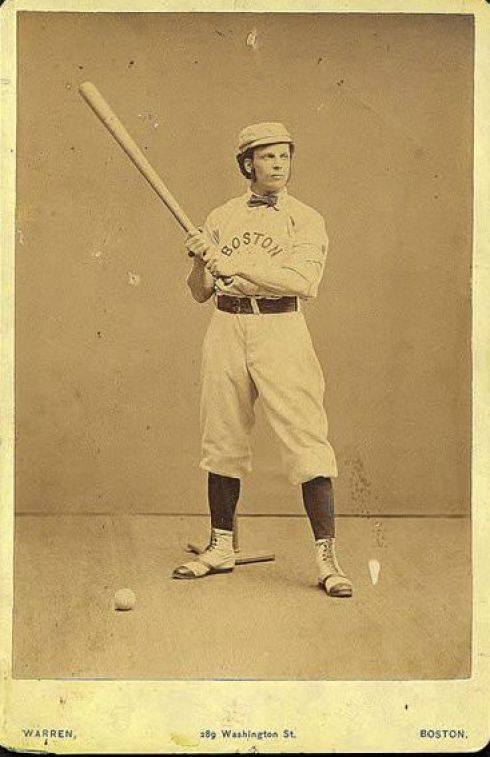
And once everyone was playing by the same rules, baseball took off, leaving a trail of PAPER in the wake of its ascent: scorecards, scouting reports, sheet music, advertisements, drawings and photographs and lots and lots of baseball cards. All and more is in the exhibition, but I’m going to insert a few of my own favorite items here, from my parochial perspective of course. For example, Baseball Americana features an uncut sheet of the first baseball cards depicting players from the Washington Base Ball Club in various stilted poses in 1887, when tobacco companies first started tucking these slips of paper into their product. There is nothing more charming than early baseball cards, and such uncut sheets are very rare, but Historic New England has a similar image that is even older: of just one famous Boston Red Stocking Player, George Wright, posing in a slightly more naturalistic way as he illustrates the key baseball “attitudes” or stances, for an 1875 instructional pamphlet. And as you can see, these images are by Salem photographers Smith & Bousley, who operated a studio at 214 Essex Street.

Baseball Uncut sheet of Baseball Cards

Baseball George Wright

George Wright’s Book for 1875 containing record of the Boston Base Ball Club, with scores of base ball and cricket trip to England, and other items of interest, also, base ball attitudes, in twelve different styles, with an explanation of each. Hyde Park, Mass., printed at the Norfolk County Gazette Office, 1875; Historic New England.

Wright was quite the sportsman, in Boston and elsewhere, and he is also a Hall-of-Famer, so let’s stick with him—which is easy to do as he appears to be one of the first celebrity pitchmen in early baseball: featured in an 1871 cabinet card, and an 1874 advertisement for Red Stockings Cigars. I’ve also included a Red Stocking cigar label from 1874, just because I love it. You can also see images (and words!) of George and his equally-famous brother Harry “the original Wright Brothers”), along with other Red Stockings, in this million-dollar appraisal on Antiques Roadshow.

Baseball George Wright 1871

Baseball 1874-red-stockings-cigar-advertising-display-poster-george-wright REA Auctions

Baseball 1874-red-stockings-cigar-labelAll images from Robert Edward Auctions, a sports memorabilia collector’s dream.

The Library of Congress has a great collection of baseball sheet music so I’m surprised more of these items are not included in Baseball Americana, but then again its breadth encompasses the entire history of baseball while I seem to be stuck in the pre-World War I era. To be worthy of its title, Baseball Americana has to deal with segregation and free agency and moneyball, while I can just dwell on the grand old game if I like.

baseball songs collageBaseball Sheet Music covers, 1910-12, Library of Congress.


Trimmed Out

I grew up a few towns over from the famous “Wedding Cake House” in Kennebunk, Maine, more formerly known as the George W. Bourne house, and so it’s always been a part of my life. But it’s been a few years, so I drove by last weekend and was saddened to see some of its famous “icing”, or Gothic trim, in poor condition due to a succession of harsh Maine winters. Really it’s a miracle that all that confection has lasted as long as it has in the New England climate: certainly its survival must be a testament to the fact that it remained in the Bourne family for three generations and only left the family’s ownership in 1983. I can’t imagine a Bourne failing to honor the personal craftsmanship and labor of Mr. Bourne, who utilized his ship-building skills after a trip to Europe brought him to gaze upon Milan Cathedral and inspired his construction of an elaborate Carpenter Gothic frame around his spare Federal house, by not taking very special care of all that trim.

Trimmed out KB

Trimmed out KB 2

Trimmed out KB 3

The Wedding Cake House, Kennebunk, Maine My pedestrian pictures, and a stunning photograph by Carol Highsmith in the 1980s, Library of Congress.

As you can see, everything was “Gothicized” in the 1850s: the main house, built in 1825 as a classic two-story late Federal, new barn with connector, and fence. There’s a few little Gothic outbuildings too. I remember always being absolutely awed by this house, every time I saw it, and after I went to Italy and saw the Milan Cathedral for myself I drove up to see if I could “see” Bourne’s inspiration upon my return. And I could! I still can, but this last time I saw the house I had a heretical thought: I wonder if it would look better without all that trim? 

Trimmed out 1965 LOC

Trimmed out 1965 barn

Duomo Milan

The George W. Bourne House and Barn in 1965, HABS, Library of Congress; the Duomo in Milan in 1846 by British photographer Calvert Richard Jones, Metropolitan Museum of Art.

Don’t get me wrong; I’m a big fan of the Gothic Revival, but after looking at lots of houses and house plans over the years I think I prefer those structures that were designed in this style from the outset rather than adapted to conform to ideals (and instructions!) offered up by Andrew Jackson Downing and others. Indeed, The Horticulturalist, a periodical edited by Downing from 1846 until his death in 1852, published an illustration of a “common country house” transformed and “improved” by the addition of gable, porch and trim in July of 1846. I have to admit: I prefer the “before”.

Trimmed Out Horticulturalist July 1846

But then again: Americans are (were?) ever in search of “improvement” and I can’t think of anything more American than George W. Bourne rushing home from Europe to transform–by hand–his “common country house” into a mini Milan Cathedral! I don’t think it happened quite like that, but I love that story, and I also love the ultimate Gothic conversion on the next street over: the Pickering House (although I must admit that I would really like to see an image of it in its original seventeenth-century form).

Trimmed Out Pickering


Art+Science

The Salem Arts Festival was this past weekend in Salem: its tenth anniversary. Last year plastic-bag jellyfish were suspended above Derby Square and Front Street; this year it was all about bees. Salem’s art scene is very vibrant now, but this little city has always had a bustling community of artists (well, after the Puritans morphed into the Congregationalists) and craftsmen. I’ve written about quite a few individual artists, but I thought I would look for more collective precedents, and that quest took me directly to the fairs of the Salem Charitable Mechanic Association (1817-1932). The records for this association, like those of nearly every Salem institution and organization, are relatively inaccessible, as they are in the Peabody Essex Museum’s Phillips Library, which has been closed in Salem, removed to Rowley, and for which digitization plans are nonexistent at present. But fortunately the Association wanted to showcase the creations of all its exhibitors, and so compiled a wonderful program for its first fair in 1849 that has been digitized in several places. This was held in its very own Mechanic Hall, built a decade before.

Art + Science collage

Art + Science The_Salem_Charitable_Mechanic_Association

Art + Science Mechanic Hall SSUTwo copies of  Reports of the First Exhibition of the Salem Charitable Mechanic Association, 1849, a certificate from the exhibition (Boston Athenaeum), and Mechanic Hall at the corner of Essex and Crombie Streets in Salem, built in 1839 and destroyed by fire in 1905 (Dionne Collection, Salem State University Archives).

This program makes for very interesting reading for several reasons. First of all, the judges of each category are very detailed and opinionated about their criteria for awarding diplomas and silver medals–although it appears that everyone who showed up got the former. The sheer eclecticism of the entries is notable, as is the relatively small number of industrial entries–surprising as the exhibition was occuring in the midst of the Industrial Revolution in Massachusetts. The organizers address this deficiency in their introduction: it is to be regretted that there was not a greater display of the Manufactures of Old Essex, especially of Cotton and Woolen Goods. Andover and Newburyport, with their numerous and extensive Cotton and Woolen Manufacturing Establishments, did not exhibit a single article. Saugus with her Flannel and Yarn Factories—-none, and Danvers, with her Carpet and Tweed Factories, was also deficient. When we consider that Essex County produces more than the whole State of South Carolina—-that her products are more than twenty millions of dollars—and a fair share of it in the articles alluded to—the display was not what it should have been. But notwithstanding these adverse circumstances, the energy and the perseverance of the mechanics of Salem, essentially aided by the Ladies, produced one of the most beautiful exhibitions ever witness in this vicinity. I guess they just didn’t get the word out! And yes, “the Ladies” are very well-represented in this 1849 exhibition, which showcased every possible type of art: mechanical and utilitarian, “fine” and decorative.

PicMonkey Image

1849salemmechassoc_obvDiplomas and medals for “drab” clothing, an artificial leg, mineral teeth, a miniature steam engine and a Patent Cloth Folder used at the Naumkeag Steam Mills in Salem, among other exhibits; a rare medal from the 1849 exhibition, from John Kraljevich Americana.

Above all, the integration of art and science seems very apparent in this exhibition: perhaps it is highlighted by the paucity of industrial exhibits but there are still many categories that we would consign to an arts festival today rather than one celebrating “mechanics”. Besides “Fine Arts”, everything created with a needle was on display, along with everything for the house and the body. This exhibition was all about creation, pure and simple. I love this universality and lack of separation between the artistic and the scientific: it illustrates the continued influence of the culture of the Renaissance, the period in which I was trained, during which everything was an art. But the Charitable Mechanic Association had its categories too, some of which seem rather arbitrary: the sole Daguerreotype exhibitor, one of Salem’s three practitioners at the time, was D.S. Bowdoin, who won a silver medal in the Fine Arts category for “a very admirable collection of Specimens, showing great skill in the mechanical execution, good taste in the arrangement of subjects, and in the management of light and shade”.  To me, the daguerreotype seems a near-perfect combination of art and science.

Bowdoin collageI couldn’t find any D.S. Bowdoin daguerreotypes from 1849, but here are two cartes de visite from later: studio portraits portrait of Robert Daley (or Daily), a Salem “expressman”, c. 1855 (Historic New England) and John Lewis Russell, a well-known botanist and Unitarian minister (Wisconsin Historical Society). According to the later photograph, Bowdoin’s studio was in the Downing Block, Salem.

Back in the present and now that I think about it, this arts festival does indeed bridge the gap between art and science in its own way: what could be more technological than transforming commissioned plastic bees into building materials? I have never really understood the stem vs. steAm debate, and let’s throw an H for history in there somewhere!

bee collage 2

Arts Festival 1

Arts Festival 3

Arts Festival 2

Arts Festival 4

Arts Festival 8

Arts Festival 6

Arts Festival 7

Arts Festival 9Scenes from the Salem Arts Festival on Saturday: my neighbor Racket Shreve’s “Best in Show” painting in the gallery in Old Town Hall along with “Remembering Georgie” by Heather M. Morris; the Mural Slam—just loved this work-in-progress of “Salem from Above” by Casey Stanberry, especially in its partially finished state.


The Dashing and Devoted Landers

Lately I’ve been thinking about a Salem native, descended from the city’s most-monied maritime family, the Derbys, but still devoted to public service, very well-known in his day but little-known in ours: Frederick William West Lander (1821-1862). Today, you can find hardly a trace of Lander in Salem, a city that has a statue of a fictional television witch in its most public square. Yet he was referred to as “the fearless solder, the bravest of the brave” and “the very beau ideal of an American soldier” in his New York Times obituary. Yesterday, the first truly warm spring day of the year, I wandered past Lander’s rather secretive grave in the Broad Street Cemetery and wondered about him—about all that he came from, all that he did, and what he might have done if not cut down in the prime of his life by pneumonia contracted in a West Virginia encampment towards the end of the first year of the Civil War. Lander was educated in private academies before he went to Norwich University in Vermont to study engineering. After Norwich, he worked at surveying and laying trails, first for the Eastern Railroad in Massachusetts and later the Pacific Railroad way out west, leading five expeditions to map out transcontinental routes between 1853 and 1858. He was a commissioned a Special Agent of the U.S. Department of the Interior that year, giving him superintendent responsibilities over what had become known as the “Lander Trail” through Wyoming and Idaho. In 1860, purportedly after a 12-year acquaintance and 3-year engagement, Lander married the famous British-American stage actress Jean Margaret Davenport in a San Francisco ceremony called the “The Union of Mars and Thespis” by the San Francisco Daily Times. Seventeen months later he was dead, after being commissioned as a Brigadier General and leading charges in several battles. His was the first full-fledged funeral with honors of the war, held in Washington with President Lincoln and members of the Cabinet and Supreme Court in attendance. And then his body was transported in a special train to Salem, for burial in Broad Street.

by Mathew B. Brady

Harvard_Theatre_Collection_-_Jean_Margaret_Davenport_Lander_TC-22Matthew Brady daguerreotype of Lander, Smithsonian; Jean Davenport Lander at about the same time, Harvard Theater Collection.

Those are the bare biographical facts, but there is so much more to say about Lander—-and Mrs. Lander: he was not all Mars and by no means was she solely a thespian. Though Lander was obviously a man of action (and I have not even mentioned his dueling), he was also a champion of the arts: he included the Massachusetts artists Albert Bierstadt, Francis Seth Frost and Henry Hitchens on his 1859 expedition team out west–with glorious results–and addressed the “aptitude of the American mind for the cultivation of the fine arts” on the Lyceum circuit back east. He was also a poet, and although at least one publisher told him effectively not to give up his day job, several poems were published before his death, and more after, including Ball’s Bluffhis poetic account of the Union defeat at the Battle of Ball’s Bluff, with an opening stanza responding to the purported Confederate claim that fewer Massachusetts soldiers would have been killed in the battle had they not been too proud to surrender. This was the battle that really “brought the war home” for Massachusetts: as soldiers in two Bay State regiments accounted for more than half of the approximately 1000 Union casualties. Lander lived to tell the tale, but not for much longer.

Landers MAP SLM

Bierstadt Rocky Mountains

Ball's BluffOne of Lander’s early road surveys, from Danvers to Georgetown, Massachusetts, State Library of Massachusetts; Albert Bierstadt’s The Rocky Mountains, Lander’s Peak, 1863, Metropolitan Museum of Art; Soldiers from the 15th Massachusetts Regiment charge the Confederate line at the Battle of Ball’s Bluff, Illustrated London Newspaper, November 23, 1861, Library of Congress.

Jean Davenport Lander played several important Civil War roles as well. In the early days of the war, before her husband’s engagement and after they had taken up residence in Washington, Mrs. Lander happened to hear (I can’t fix the details!) whispers of a plot to assassinate President Lincoln. Whether by the confidence of her celebrity or the urgency of the times, she made her way to the White House hastily to report the conspiracy. Perhaps this was not as serious a threat as the earlier “Baltimore Plot“, but still, she acted to foil a presidential assassination plot! Her husband’s tragic war-camp death apparently inspired her (as well as his sister, the sculptor Louisa Lander) to start nursing, and she served as the supervisory nurse at the Union hospital in Beaufort, South Carolina for several years. After the war was over, Mrs. Lander resumed her acting career and seems to have been constantly on stage for the next decade or so, playing her last role in 1877: somewhat ironically, Hester Prynne of The Scarlet Letter.

Lander collageJean Margaret Davenport Lander as a bride in 1860 and Hester Prynne in 1877. Below: I’m assuming the friendship of Lander and Albert Bierstadt brought the latter to Salem at some point, because Christie’s has a Bierstadt landscape titled Salem, Massachusetts up for auction on May 22.

Bierstadt SalemAlbert Bierstadt, Salem, Massachusetts, 1861.


PEM: Praise and Public History

Ever since that fateful night in early December 2017 when a representative of the Peabody Essex Museum disclosed that the vast majority of the collections in its Phillips Library, the major repository for Salem’s history, would be moved to a storage facility in Rowley, I’ve been both very critical of this decision and very focused on the institutional leadership which made it. This admission is no surprise to regular (likely suffering in silence) readers: much more so will be the praise that I’m actually going to heap on the PEM in this post! Just this past week the museum announced two new positions: a manager of historic structures and landscapes for its historic houses in Salem and a head librarian for the Phillips Library. From my perspective, both positions signal a renewed commitment to the Salem resources which the PEM inherited from its founding institutions, particularly the Essex Institute. I’ve never questioned the PEM’s stewardship of its assets: my major concern has been mothballing, so investment in these important areas is very welcome. The architectural position seems focused on preservation issues, but the new librarian will be charged with some big organizational and outreach responsibilities, including increasing the Library’s responsiveness to the needs of local, regional, national and international researchers, integrating it more fully into the Museum, and transforming the Phillips into an innovative and active intellectual hub supporting the overall mission and global scope of the PEM. All this and the long-awaited digitization plan! This is a very responsible position and the PEM should be commended for seeking to fill it.

Librarian collage

Librarian Library of Congress 1966Challenges & Opportunities:  The Head Librarian in Sam Walter Foss’s Song of the Library Staff (1906); “To the rescue. Many librarians believe computers are the only means to effectively cope with their bulging bookshelves” (1966). New York World-Telegram and Sun Newspaper Photograph Collection, Library of Congress. 

That said, I’m just not sure how the PEM is going to create the “innovative and active intellectual hub” it is referencing in this job description in a storage facility off Route One in Rowley, much less foster the community engagement that is referenced continually in all of its messaging. My continuing preoccupation with the relocation of the Phillips Library stems from outrage at the removal of Salem’s historical archives, but also confusion about how such a move aligns with the PEM’s own goals. I understand the PEM’s arguments about the logistics of conservation and digitization, but what about integration? How can the Library be integrated more fully with the Museum when the Library is in Rowley and the curators of the Museum—as well as the physical Museum itself—are in Salem? Perhaps the goal is a virtual/digital integration, but we all know that that’s a long way off for the PEM. Discussion of LAM (Libraries, Archives & Museums) integration has been evolving for over a decade, and the Head Librarian job description indicates awareness of this dialogue, but the PEM seems oddly out of touch with other cultural trends, namely the evolution (and rejuvenation in many cases) of libraries as places not only of collections but also myriad connections and the growth of a dynamic field and practice of public history which emphasizes a wider and more multi-faceted engagement with the past. The PEM is investing a lot of money in the restoration of the physical buildings which constitute the (former?) Phillips Library in Salem but what purposes—and who— will this space serve once it is finished?

AAR collagePast & Present: the Library of the American Academy in Rome in 1933 and today, “a perfect blend of the past with the contemporary demands of modern scholarship.”

I understand that the h-word is anathema in the upper realms of the PEM but why ignore the demands of its host community, the interests of hundreds of thousands of visitors to Salem each year, as well as the strengths of its collections and its stated goals of “community engagement” by abandoning history? The answer can only lie in a very simplistic (and musty) understanding of what historical interpretation in the public realm constitutes these days: Colonial Williamsburg blinders if you will. Many of the PEM/PM Third Thursday events (now defunct), had historical aspects, as exemplified in its (also now defunct?) Phillips Library blog, Conversant. “History” is not all about the War of 1812 or even the Salem Witch Trials (I swear): it’s also about fashion, food, play, cross-cultural encounters, and golden ages, all of which the Peabody Essex Museum clearly embraces. History is about home, and housing: just imagine a PEM-initiated public history project about housing in Salem past, present and future similar to the 2016 symposium organized by the Cambridge Historical Society entitled “Housing for All?”. I can’t imagine anything more relevant, more engaging, and more reflective of the Museum + Library’s integrated resources.

Before_the_Fire__Salem_Neighborhood_North_Side_of_Broad_Street

Redevelopment__Completed_Reconstruction_The_PointBefore & After the Great Salem Fire of 1914: Housing on the northern side of Broad Street before the Fire and Mill Hill after, Phillips Library Digital Collections.


Tea & Sympathy

This weekend, I gave a talk on Salem author Mary Harrod Northend, the Martha Stewart of her day (1904-26), at the House of the Seven Gables and my favorite part (not sure about my audience’s) was her commentary on tea rooms, accompanied by her always-illuminating photographs. In a 1915 article in American Cookery, Miss Northend hails “The Coming of the Tea-House” as a sign of both women on the move and an indication of increasing interest in her beloved Colonial style: even though she admits that tea houses are of Japanese origin those “that are dotted along the automobile routes of New England never fail to give to the tourist the savor of the time when the old coaches drove along the turnpikes, the travelers stopping at ‘ye ordinary’ or inn for crisp waffles, maple syrup and fragrant, steaming coffee” (I really did not know that waffles were colonial fare).  She highlights those that possess such ambiance, and also the social roles of tea houses and rooms, particularly for women: who opened them for respectable “livelihoods” and frequented them at all stages of life: as college students, young mothers, and empty nesters (although she of course does not use that term). Miss Northend seldom indulges in social history so this is interesting in general, and particularly so is her story of the Puritan Tea-House in Beverly, whose owner, “losing her home in the Salem fire, took refuge in a small, homely little house, just a minute’s walk from the station and cornering two roads. It is at the center of a group of all-year-round houses founded by people who had tired of the bustle and confusion of the city. It was an ideal spot for a tea-house and an easy matter to remodel the little old farmhouse to present-day use”. And so this Salem refugee thrived in Puritan-style.

Mary Harrod Northend’s Tea-Houses, c. 1915-1925, courtesy of Historic New England: The Tea House at the Gables, the Fernery and Martha Ann Tea Shop on Essex Street in Salem, and the sign for the Tea Kettle and Tabby Cat in Wenham.

Mary Gables Tea House 2

Mary Gables Tea 3

Mary Gables Tea House

Mary Fernery Tea Room 1913 Essex Street

Mary Martha Ann Tea House 2

Mary Martha Ann Tea House

Mary Tabby Cat Tea Room Wenham