Tag Archives: Photography

The Last Collector of the Custom House

The life of David Mason Little (1860-1923) began in Swampscott and ended in Boston, but most of it was led in Salem, and in the fullest way possible: he was an MIT-trained naval architect, an inventor, a photographer, a silversmith, a military officer, a historian, a bank director, a mayor, and the last Collector of the Salem Custom House. Born into the wealthy and accomplished Little family of Little’s Point, Swampscott fame, he had many, many advantages, but certainly made the most of them. He was a descendant of Revolutionary soldier and scientist Colonel David Mason, his siblings included the famous maritime artist Philip Little, who lived a few buildings down and across the way from his Chestnut Street mansion, the architect Arthur Little, and the biographer Grace Little Oliver, his wife was the granddaughter of Salem’s great philanthropist John Bertram, and his youngest son Bertram became an influential collector and the director of the Society for the Preservation of New England Antiquities (SPNEA), the forerunner of Historic New England. These bare biographical facts do not do justice to this man, who seems to have been that rare combination of civil servant and polymath.

Little Collage The Honorable David Mason Little, and a Boston Globe article dated July 17, 1904, shortly after his appointment as Salem’s last Collector of the Custom House.

Little’s service–as quartermaster of the Second Corps of Cadets and state ordinance officer during the Spanish-American War, as city councillor, school board member, and Mayor of Salem–is commendable of course, but his inventiveness and artistry are compelling, primarily because of his range of interests. Like his brothers, he traveled around Europe following his graduation and returned armed with a fascination for “instantaneous” photography (capturing movement) and new rapid dry-plate equipment designed to facilitate the technique. He tinkered with this for a bit, and designed a new camera shutter (patent # US 284645 A)) as well as a steam yacht “specially fitted for photographic work” which he took out into Salem and Marblehead harbors during regattas. The result was his pioneering portfolio of yacht photography, Instantaneous Marine Studies, published in 1883–with a cover designed by his brother Philip. Years later, after his term as Mayor of Salem was completed, Little turned to another craft: metalwork. Learning the art of silversmithing from Arts and Crafts smith George Gebelin (to whom he also became a patron), Little crafted housewares for the family home on Chestnut Street, as well as this beautiful teapot for his daughter Marguerite, two years before his death in 1923.

Little Collage2

Little One

Picture 094

Little ResidenceCover and plates from Little’s Instantaneous Marine Studies (1883), a Little silver teapot in the collection of the Museum of Fine Arts, Boston; the Little residence at 27 Chestnut Street Salem.


Give me Mrs. Miniver

My husband, myself, and my stepson can rarely find a movie we all want to see together: the latter is 16 so of course all summer movies are made for him, but I can’t stand the bombastic computer-generated imagery and violence and the predictable scripts. When Christopher Nolan’s Dunkirk came out, we all wanted to see it and so went together last week: a rare occasion. We did not return home together, however, as I had to run out less than halfway through! It wasn’t that it was bad–it was actually riveting–but also just too painful for me to watch all those men on the beach, so exposed and so vulnerable. I knew the Armada was coming but I couldn’t wait for it.

Dunkirk film

Dunkirk real The film and the reality, June 1, 1940 ©Imperial War Museum, London

It’s ridiculous I know, but I think I prefer the Mrs. Miniver version of Dunkirk, in which the gentleman-architect Mr Miniver takes his pleasure craft (conveniently docked in front of his Hollywood-perfect expansive English cottage) out into the Channel and returns only slightly battered (and bearded) a few days later. During his absence, Mrs. Miniver battles a downed Nazi in their kitchen. She wins, of course, but the Director William Wyler gives him a speech intended to bolster the Allied effort (by the time the film was released in 1942, the United States had already entered the war, but during its production Wyler was concerned about American isolationism): We will bomb your cities…Rotterdam we destroy in two hours. Thirty thousand in two hours. And we will do the same here! Combined with all other “inspirational” details in the film, including the bombing of the Miniver house, the heartbreaking death of their new daughter-in-law, and the village vicar’s closing sermon, it’s no wonder that Joseph Goebbels was afraid of it.

Mrs. Miniver 2

Mrs Miniver

It was acceptable to make propaganda films in the 1940s: today things must be as real as (technically) possible and sometimes that is unrelenting, at least for me: I fear my stepson is inured due to a steady diet of video games. I would like to see the Dunkirk miracle play out so I think I’ll have to steel myself to go back and see this film again, but in the meantime I’ll occupy myself with more distant records of this epic event, in paper and a paint. The Imperial War Museum in London has many photographs (including several of the Germans moving in after the evacuation), oral histories, and paintings of Dunkirk among its collections, although after I spent some (digital) time with these memorials I realized they weren’t that distant after all.

Dunkirk collage

Dunkirk 1940 IWM jpeg

Dunkirk painting 1940

Dunkirk Drawing IVW

Dunkirk abstractJune 3 headlines from the Sydney Morning Herald and the Los Angeles Times; a small fraction of the 200,000 British Expeditionary Forces who were evacuated (+140,000 French troops), ©IWM; Charles Ernest Cundall, The Withdrawal from Dunkirk, 1940, © IWM (Art.IWM ART LD 305); “little ships” in Muirhead Bone’s The Return from Dunkirk; Arrival at Dover, 1940, © IWM (Art.IWM ART LD 251); Rudolf A. Haywood, The London Fire-Boat ‘Massey Shaw’ approaching Dunkirk at 11 pm on the 2nd June 1940, © IWM (Art.IWM ART LD 248).


Scorched Earth/A Lost Salem Garden

Since I went in deep for the centennial anniversary of Great Salem Fire of 1914 a few years ago I have this date imprinted in my mind: I woke up this morning and my first thought was oh no. So much was lost that day—houses, factories, civic buildings, churches–as the fire devoured several wards of Salem. The recovery effort, which seems remarkably swift and efficient to me, focused primarily and rightfully on rebuilding, but there was an implicit concern for the loss of landscape as well, and so parks were planned and trees replanted. There was one notable Lafayette Street landscape that was lost on forever on that day, however: the garden of George B. Chase. There was no effort to reconstitute this creation; instead the large lot became the site of the new Saltonstall School, which rose from the ashes of the fire pretty quickly. The Chase Garden was indeed fleeting, but fortunately we have two great sources to remember it by: the wonderful 1947 guide book Old Salem Gardens, published by the Salem Garden Club, and several photographs in the American Garden Club’s Archives of American Gardens at the Smithsonian.

Chase Old Salem Gardens

Chase Old Salem Gardens 2

Chase Garden collageJust one of my many copies of the invaluable Old Salem Gardens (1947) with the Chase garden entry; the location of the Chase garden on the 1874 and 1891 Salem Atlases.

The Salem Garden Club ladies who produced Old Salem Gardens, chief among them Club President Mable Pollock, took great care to include historical information and personal reminiscences whenever possible, greatly enhancing the research value of their compilation:  this is no little pamphlet! We hear all about the Chase Garden from the “discussive and chatty” Miss Chase, who grew up on the property, as her memories are transcribed onto the page. She tells us about the beds of ostrich ferns and rhododendrons in the immediate proximity of her family house, above which swayed purple beech and weeping birch trees, and a “large bed containing 72 plants of Azalea mollis bought from Lewis Van Houtte of Belgium”. In the spring there was white narcissus poeticus, followed by red salvia. Laburnum and althaea screened the large vegetable garden, which included salsify, rhubarb, asparagus, peas, beans, carrots, summer squash, tomatoes, onions and corn: the seed of the latter [came from] a cousin, Benjamin Fabens, and was called “Darling’s Early”. It was most satisfactory in every way, for the ears were not too long, and they had deep kernels and a small cob; the husk was quite red, as were the blades….it was the sweetest corn ever eaten at that time. Continuing along towards Salem Harbor along a box-bordered path, we “see” fruit trees and more exotic trees and shrubs, including a very notable varieties of magnolia and viburnum which particularly impressed repeat visitors from the Massachusetts Horticultural Society. Near the back of the garden were beds of roses, and a cutting garden of annuals and perennials, encircled by yet another row of shrubs and trees, including the oldest growth on the property, a locust grove, which nature had planted. All swept away on one day: June 25, 1914.

Chase Garden

Chase Garden AAG 1904 Smithsonian

Chase Garden After

Chase Garden After 2Views of the front and back of the Chase Garden (including Mr. Chase himself on the bench), 1904, Archives of American Gardens, Smithsonian Institution; Ten years later on Lafayette Street: postcard views of the Fire’s immediate aftermath from the (commemorative???) Views of Salem after the Great Fire of June 25, 1914 brochure issued by the New England Stationery Company.


Harbor Views

Among my collection of Salem stereoviews I have very few of the coastline or harbor, preferring structures to nature, always. But Salem’s coastline–and especially its harbor–has been built almost from its founding as both a settlement and a working port, so I’ve started to look for some shoreline stereoviews. I haven’t had much luck in terms of items for purchase but the other day I dipped into the digital collections of the American Antiquarian Society and came up with several harbor views unknow to me–the only one I was aware of is the first one by Frank Cousins, the others are new (to me) perspectives. These are all undated but I think they are from the late 1880s and early 1890s: it is notable that I’m searching for “Salem Harbor” but finding very few images of the “working” harbor, which would have consisted of rotting wharves by this time. The images below portray a harbor of leisure: the Willows, beaches, docks for day trips. Salem was emerging as a tourist destination at this time because of its carefully-crafted history, but also because it could tap into the draw of the New England seashore. No one wants to see those old wharves at this time, but fortunately artists like Philip Little were capturing them for posterity.

Salem Harbor Stereoview Cousins “Pennsylvania Pier” by Frank Cousins, from his “Salem in 1876” series, which was published in the early 1890s.

Salem Harbor Stereovew 6

Salem Harbor Stereoview 7 Collins Cove “Collins Cove” is written on the back.

Salem Harbor Stereoview 8

Salem Harbor Stereoview 4

Salem Harbor Stereoview Naugus Head “Salem Harbor from Naugus Head”.

Salem Harbor Stereoview 2

Salem Harbor Stereoview 5

Salem Harbor Stereoview 3 This last view is the most rare and mysterious: no date, no photographer, no publisher. I think it is from the end of the Willows looking back towards Salem on the Beverly Harbor side but am not sure—any other ideas?

All Stereoviews courtesy the American Antiquarian Society.


She Wears the Green

I looked back through my posts of St. Patrick’s Days past and found: green cards, green plants, greenbacks, green fairies, and green men. Lots of men, in fact, but very few women, unless they were representing (rather negatively) envy or absinthe! So on this particular St. Patrick’s Day, I’m featuring only women, in more positive (though also rather frivolous) displays. I’ve recently discovered the short-lived and absolutely amazing Gazette du bon ton, a French fashion magazine packed with artistic illustrations which was published from 1912 to 1925. Was there a war in there somewhere? You wouldn’t know it leafing through these whimsical pages. The Gazette features lots of seasonal green, and it was also a favorite color of one of my favorite graphic artists from this same period, Mela Koehler. Perhaps these early twentieth-century representations of lively, festive green are meant to counteract the color’s toxic associations of the previous century? I am opening and closing my portfolio with two more serious real females, both anonymous: a folk art portrait from the mid-nineteenth century (featuring a woman who is hopefully not wearing an arsenic-dyed dress–though I fear for the anonymous artist), and a photograph of a (Salem?) girl taken by a Salem photography studio with which I have taken some liberties: I love her jacket so much I wanted to highlight it by “greening” it up a bit for the holiday.

Green Dress Folk Art MFA 1838

Green dress 19th C MET

Women_19001914_Plate_191

Green Dress Clover Girl Kirchner 1899

Green Dress MK 1910 3 MFA

Green Dress Koehler collage

Green Dress Philip Coles NYPL 1912

Green dress Gazette de BonTon Worth 1912

Green Dress Gazettedubonton00B_0355 1914

Green Dress Gazettedubonton00A_0303 1920 Poiret

Girl in Green

Portrait by unidentified artist, 1838-40, M. and M. Karolik Collection of American Watercolors and Drawings, Museum of Fine Arts, Boston; Dress and Coat, Costume Institute Collection of Fashion Plates, Metropolitan Museum of Art; Raphael Kirchner and Mela Koehler cards, c. 1910, Lauder Collection, Museum of Fine Arts, Boston; Coles Phillips, Woman in green dress sitting beside tulips, 1912, New York Public Library Digital Collections; Illustrations from Gazette du Bon Ton, 1913-1920, Smithsonian Libraries; undated Salem, MA photograph.


Salem Interiors, 1896

I came across a book I had never seen before the other day at the wonderful Digital Library for the Decorative Arts and Material Culture (beware, serious rabbit-hole potential here) at the University of Wisconsin, Madison: Newton Elwell’s Colonial Furniture and Interiors, published in 1896. I was doing something rather tedious so of course I put that aside and dug in. The book is not great in terms of information, and there were some pretty serious flaws that even an mere buff such as myself could spot immediately (such as referring to Samuel McIntire as James) but it is a treasure trove of plates, including many photographs of Salem interiors I had never seen before. These photographs are fascinating to me because many of them feature rooms decorated in a mishmash style that preceded the pure period room. Look at the east parlor of the Peirce-Nichols house below, for example: looking quite cluttered and Victorian rather than serenely Federal, with the exception of that beautiful fireside chair. Elwell wants to focus on the period furniture, but his photographs can’t always hide all the contemporary details of its setting.

salem-interiors-1896-east-parlor-pn

salem-interiors-1896-west-parlor-pn

salem-interiors-1896-sideboard-and-chair

salem-interiors-1896-furniture

salem-interiors-furniture-17thc

The sheer (and quite casual) display of Salem furniture from the seventeenth, eighteenth and early nineteenth centuries is a little overwhelming: some of the pictures seem to be taking us into attics (or the storage area of the Essex Institute) where tables and sideboards are lined up in a random fashion. The chair that is featured in the second photograph above, of the mantel of the west parlor of the Peirce-Nichols house, is one from a set of eight crafted by McIntire, one of which sold at a Christie’s auction last week for $15,000 (which seems like a bargain to me, no?) But the 1890s was a key decade in the development of a Colonial Revival consciousness that was both very national and very local: a key decade for the identification of  “Olde Salem”. Consequently along with the eclectic vignettes which mix periods and styles, there are also some “typical colonial” Salem rooms in Elwell’s book, forerunners of the period rooms of the next decades.

salem-interiors-1896-colonial-corner

salem-interiors-1896-typical-colonial-chamber

Plates from Newton Elwell’s Colonial Furniture and Interiors, 1896.


Doorways to the Past

I remain absolutely enraptured with Frank Cousins (1851-1925), Salem’s great photographer-author-entrepreneur and pioneering preservationist, after countless posts on his life and work. Today I want to feature his debut publication, Colonial Architecture, Volume One: Fifty Salem Doorways (1912). The title indicates that there was going to be a Volume Two, but instead Cousins went on to publish The Woodcarver of Salem: Samuel McIntire, His Life and Work (with Phil Madison Riley, 1916) and The Colonial Architecture of Salem (1919) and through his art company, sell his prints to pretty much every architectural author of his era. Fifty Salem Doorways is a large quarto portfolio of Cousins’ photographs of doors representing all the historic neighborhoods of Salem: Chestnut, Essex and Federal, the Common, and Derby Street.There’s very little text, just doors. I’m not quite sure why I’m so fascinated with this volume, but I am: I pick it up and browse through it quite frequently, discovering some new little detail every time. Details of DOORS. Yesterday I was talking to a few of my students in the research seminar that I’m teaching this semester in an attempt to aid them in narrowing down and focusing their very broad topics (this is always a struggle), and I said you need to find a window–or a doorway–into this topic, a point of entry. I was talking about sources, but also perspectives. So maybe that’s why I like Cousins’ doors so much: they give me a point of entry into that Salem of a century ago. And of course it’s always nice to engage in some past-and-present comparisons, which is what I’ve done below.

cousins-1

cousins-2

cousins-29-chestnut

cousins-41-chestnut

cousins-4

cousins-359-essex

cousins-6

cousins-7

cousins-peirce-nichols

cousins-314

cousins-129-essex

cousins-gardner-pingree

cousins-5

cousins-brookhouse

cousins-80-wash

cousins-92-wash

and one that got away: the entrance of the Francis Peabody Mansion formerly at 136 Essex Street (1820-1908).

cousins-peabody-mansion


Presidents in Carriages & Cars

This week, with the Inauguration looming, I’ve been going to the Library of Congress’s site pretty regularly, as there is a nice compilation of images and documents relating to inaugurations past, with interesting little details noted for each and every president’s swearing-in ceremony (ies). It’s interesting to see the ritual evolve over time, and the establishment of traditions. I became fixated particularly on the more contentious inaugurations: my absolute favorite is James Monroe’s first inauguration in 1817, which was forced outdoors as a feud between the Senate and the House of Representatives over whose chairs would be used for the indoor ceremony threatened to disrupt the event! Several presidents (including both Adamses) refused to attend the swearings-in of their successors and rode off in a huff. Some of the inauguration addresses are interesting; some not very. At first I thought I would feature impromptu inaugurations–or rather swearing-in ceremonies–following the abrupt death of the previous president, but that seemed a little dark, and ultimately what drew me in more than anything were the images of presidents on their way to or from their inaugurations: more candid images of expectations, excitement and resolve, depending on the circumstances. Of course this privileges the presidents who were photographed, but such shots are so very revealing:  look, for example, at the two views of President Wilson: pretty joyful at his first inauguration in 1913, much more serious at his second in 1917.

inauguration-carriage-fp-1853

inauguration-lincoln-1861

inauguration-cleveland-1893

inauguration-roosevelt-1905

inauguration-taft

inauguration-wilson-and-taft-1913

inauguration-wilson-1917

inauguration-hoover-and-roosevelt-1933

inauguration-eisenhower-1957

A century of Presidents in transit and transition: Franklin Pierce leaving the Willard Hotel for his Inauguration, 1853; Abraham Lincoln’s first Inaugural procession, 1861; Grover Cleveland and Adlai Stevenson in the Inaugural procession of 1883; Theodore Roosevelt in 1905; Mr. and Mrs. Taft in 1909; President Taft and President-Elect Wilson in 1913 and Mr. and Mrs. Wilson in 1917; President Hoover and President-Elect Franklin D. Roosevelt in 1933; President Eisenhower in 1957, all images from Prints & Photographs Division, Library of Congress.


Trudging Along

Yesterday was a beautiful winter day with everyone out and about cleaning up after the Saturday snowstorm, which was not as bad north of Boston as it was to the south.The streets of Salem were clear by mid-morning, if not before (I was sleeping in), and people were engaged in their regular Sunday activities. There were Sunday street-hockey players out my front windows, and hungry birds out back.

snowy-chestnut-street-hockey-game

snowy-garden

I suddenly became curious about snow removal in the past–mostly because I didn’t want to go out and engage in my own snow removal in the present. I have–and have seen–quite a few historic photographs of winter scenes in Salem in the later nineteenth and early twentieth centuries, but none of them feature snow carts, snow plows, or snow removal. Salem has always been quite urban, and people needed to get around, how did they manage? What was the system then that so preoccupies us now? Both the New York Public Library and the Boston Public Library have quite a few photographs of various methods of snow removal in their collections, from simple shovel brigades to “snow rollers”–I’ve never seen anything like that for Salem: anyone out there have anything?

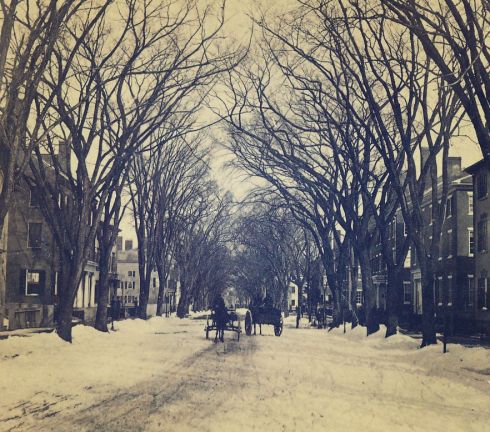
chestnut-street-in-winter

lafayette-street-in-winter

Chestnut and Lafayette Streets in the 1870s in stereoviews by Charles G. Fogg. Carriages on the snow—not even sleighs! But it’s not too deep here.

snow-chesnut-st-2-harvard

snow-chestnut-street-1899-harvard

Chestnut Street in the 1890s, deeper snow, no signs of plowing–but these carriages do look like they are on blades. I’ve shown these before; they are from a family archive in the Schlesinger Library at Harvard.

My problem is that I don’t have any winter scenes of Washington or Essex Streets with tracks that needed to be cleared: Chestnut was and remains strictly residential. I still think people trudged around a lot more than we do now, however. Look at these two wonderful photographs of students from the Horace Mann “Training School” associated with the Salem State Normal School (now Salem State University, where I teach) and their teacher, visiting historic sites downtown in the snow.Look at her skirt: she’s not troubled by a little snow.

snow-and-students-collage

E.G. Merrill photographs of Horace Mann students, 1904, Salem State University Archives and Special Collections. 

Like everything else, our toleration for snow in the streets changed with the automobile: we won’t settle for anything less than black the day after a snowstorm now. The wonderful book by Marblehead artist, photographer, and author Samuel Chamberlain, Salem in Four Seasons (1938) shows winter streets cleared for cars and pedestrians. And he agrees with me: some of Salem’s most beautiful moments are in winter, when few visitors see it (though a lot more now, fortunately).

chamberlain-four-seasons

Plowing Chestnut Street in the 1930s, from Samuel Chamberlain’s Salem in Four Seasons (1938).


Christmas on the Common

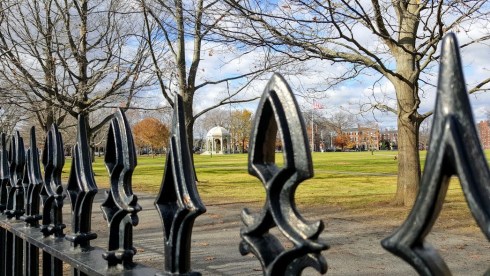
I am very excited about the 37th annual Christmas in Salem tour, which returns to the Salem Common neighborhood this year. The major fundraiser for Salem’s venerable preservation organization, Historic Salem, Incorporated, the walking tour of decorated homes and buildings rotates from the McIntire Historic District to the Common quite regularly and has also been centered on both North and South Salem, Derby Street, and the Willows. Each and every tour is great, but I’ve always liked the Common tours particularly for a variety of reasons: the mix of very stately and smaller, cozier homes, the focal point of the Common (no s!), and the ability to pop easily into the Hawthorne Hotel’s Tavern for a drink (you can also get your tickets at the Hotel on Saturday and Sunday). In any case, the Common deserves to be showcased this particular year: much restoration work has been done on its cast iron fence, its reproduction McIntire Washington Arch is looking good, and there have been several notable restorations in the neighborhood. Having gone through this myself several times, I am so very grateful to all the homeowners who are opening their doors: it is a generous gesture worthy of all of our support and praise.With the spotlight on the Common, I thought I’d take this opportunity to showcase some of my recent stereoview discoveries as well, so we can have a past-and-present perspective on a great public space: scene of militia drills and musters, hot-air balloon demonstrations, circuses, athletic competitions, concerts, rallies, demonstrations, bike races, Sunday strolls and Christmas walking tours.

common-christmas-10

Common CHristmas.jpg

washington-square-1920s

salem-common-stereoview-cropped

salem-stereoview-common-whipple-aas-2

Salem Common yesterday, in a 1920s (doctored) Maynard Workshop postcard, and in two later-nineteenth-century stereocards showcasing the cast iron fence, built in 1850, from two directions. The bottom card, showing the Andrew Safford House at right, is by G.M. Whipple & A.A. Smith, and courtesy of the American Antiquarian Society. Fence details today below, and the newly-restored Washington Arch.

common-christmas2

common-christmas-8

common-christmas-7

common-christmas-5

Overlooking the Common, one of my very favorite doorways in all of Salem, belonging to the White-Lord House at the corner of Washington Square and Oliver Streets. Frank Cousins loved to photograph it, and I do too (not to raise myself to his photographic level, but just so we can appreciate its constant ability to captivate!)

common-doors-collage

Look at this new-to-me stereoview! (No, I do not think that is President Lincoln on the Common). It was published by Charles G. Fogg and I do not have a date.

salem-common-aas-cropped

Returning to the present, just some of the decorations from yesterday; no doubt more will be on display this weekend, both outdoors and behind doors.

christmas-in-salem-collage

common-christmas-4

common-christmas-12

Christmas in Salem: Carol on the Common, a Christmas walking tour to benefit Historic Salem, Inc., Dec. 2-4: more information here.