
The Reverend William Bentley’s Diary is justly famous as a detailed source of much of Federal-era Salem’s history, but I think that three memoirs written by Salem women deserve a bit more storied reputation as sources: Marianne C.D. Silsbee’s Half Century in Salem (1886), Eleanor Putnam’s (the pseudonym of Harriet Bates) Old Salem (1886), and Caroline Howard King’s When I Lived in Salem 1822-1866 (1937). Of these three reminiscences, I find myself returning to Silsbee’s Half Century again and again, so I thought I would feature her on my third Salem Suffrage Saturday post. She is of the next generation, and in a much more enviable position, than the Hawthorne sisters of last week’s post: I think she was also a working woman (like all women!), but by choice rather than necessity.


 A Half Century in Salem, and two photographs of Marianne Cabot Devereux Silsbee from her 1861 photographic album at the Phillips Library in Rowley (PHA 58): the first dated 1851 and the second 1861.
Marianne Cabot Devereux was born in Salem in 1812 to Eliza Dodge Devereux and Humphrey Devereux: I believe that her father, who had been captured by the British during the War of 1812 and imprisoned on Bermuda, was not present at her birth. Upon his release and return, Humphrey eventually moved his family into a Chestnut Street mansion, but Marianne’s early life was spent elsewhere: I’m not sure exactly where her childhood residence was, but she remembered spending a lot of time at her maternal grandmother’s house on Front Street. Around the time that the Devereux family moved to Chestnut Street, Humphrey commissioned a pair of portraits of himself and his wife by Gilbert Stuart: I was thrilled to discover the latter in the collection of the Rehoboth Antiquarian Society, but I could only find a heliotype copy of Mr. Devereux’s portrait in the The Pickering Genealogy.


Mrs. Devereux looks rosy-cheeked in her Stuart portrait, which apparently pleased her very much (her dress apparently was not as pleasing, so the artist Chester Harding later repainted the ruff and drapery) but she was in fact an invalid, and died eleven years after this portrait, when Marianne was sixteen. I’m on the precipice on the dreaded psycho-history here, but I think that Marianne’s reverence for older women, so apparent in A Half Century as well as other works, might stem from her mother’s illness and death. I’m on stronger ground stating that the early years covered in A Half Century were based on her mother’s letters to Marianne, rather than her own reminiscences. So you kind of get a double feminine focus in this text, which dwells on food, shops, schools, entertainments, dress, homes—the life of women, or should I say relatively wealthy women—as well as “external” events: Lafayette’s visit in 1824, when the first steamship line commenced trips to Boston. The book is much more focused on personalities than events however, and women really pop out: the honorable Elizabeth Sanders (who will definitely be the subject of a later post), the charming Mrs. Remond, who catered all the meals at her beloved Hamilton Hall.


Marianne Cabot Devereux Silsbee expressed herself a bit more publicly, but she was a traditional woman of her time, focused on her family and friends. She married Nathaniel Silsbee Jr., son of a U.S. Senator and later two-term Mayor of Salem in 1829 and moved into the Silsbee mansion on the Common (now undergoing a major renovation and expansion). They had five children, two of whom, George and her namesake Marianne, died in childhood. The Silsbees left Salem for Boston in 1862 when he became Treasurer of Harvard, and there was another move to Milton following his retirement. Throughout this time she wrote poems and reminiscences, some published, some not. Her first publication, Memory and Hope, a compilation of mourning poems edited and introduced by her, was issued anonymously in 1851 (one can understand her interest in this topic given the early deaths of two children), and thereafter there are published children’s rhymes, a handwritten journal of poetry entitled My Grandmother’s Mirror, A New England Idyll (a reference to her maternal Dodge grandmother, who was a Pickering), a book about the Boston Ladies Club, and finally A Half Century in Salem.


 The Silsbee Mansion on Salem Common in 1884, George H. Walker; Memory and Hope (1851); Title page of My Grandmother’s Mirror (Essex County Collection, Phillips Library, E S585.3 1878).
Much of her writings dwell on home life, social life, all the little things that surround one’s daily existence: one poem in My Grandmother’s Mirror creates a scene in the old Pickering house, while another is written from the perspective of a woman who dwelt within the border, of the town of peace and order, Our pleasant little Salem, on the margins of the sea surrounded by her children and children’s children. Yet Mrs. Silsbee was also an active and engaged woman: a mayor’s wife who carried on a long personal correspondence with abolitionist Lydia Maria Child and whose personal photograph album compiled in 1861 contains as many photographs of soldiers and politicians as it does her own children and grandchildren. Most of the men in uniform are her own family, including her older brother, George H. Devereux, former adjutant general of Massachusetts, and his soon-to be heroic sons, Arthur F. Devereux, commander of the Salem Light Infantry and later the Massachusetts 19th at Gettysburg, and John F., a Captain in the 11th Massachusetts Infantry, as it was perhaps impossible to separate the private and public spheres at this particular time. Several photographs of President Lincoln are included, but also an image of what I can only presume to be the family cat! When it was over, once can hardly blame Marianne Silsbee for desiring to look back to a dimmer, and thus more pleasant past.


The private and the public: Mrs. Silsbee’s poetry and President Lincoln in her photograph album: Phillips Library E S585.3 (1878) and PHA 58 (1861).


 2020 Suffragists in the Rose Bowl Parade, Getty Images.

 Helen Hagar in 1915, courtesy the Local History Resource Center at the Peabody Institute Library. After her graduation from Peabody High School that year, Miss Hagar moved to Salem and lived there until her death in 1984, working for the Society of the Preservation of New England Antiquities and then the National Park Service to live in and conduct tours of the Derby House. She became an expert on traditional stenciling, and lectured and taught on its history, as well as producing some of her own stenciling work on tole and wooden objects and partnering with various antique dealers like Ethelwyn Shepard (flyer courtesy Historic New England). A cross stitch pattern by the Jenny Brooks Company, located at One Cambridge Street, Hagley Museum & Library.

 Goldthwaite & Shapley, Dressmakers, 269 Essex Street, Salem. Andrew Dickson White Architectural Collection, Cornell University Library.
 Needlework Sampler by Naby Dane (b. 1777), Sarah Fiske Stivours School, Salem, Massachusetts, Dated 1789, Sotheby’s; 6 Forest Avenue, Salem.
 Waters-Sigourney Dress and Southworth Hawes Daguerreotype, Museum of Fine Arts, Boston.


 Fame AND Authority: Occasionally Mary Harrod Northend would present wistful Wallace Nutting-esque views, but mostly she was all about bringing antique material culture into the modern world; notices in Who’s Who in New England and the Architectural Record, citations in trade catalogs were common from 1915 on.


 Essex Street, 1918-1927(including a new Novalux light decorating for Christmas), the Hawthorne Hotel, 1926 (showcasing streetlight AND stoplight) and Bridge Street, General Electric Company Archives, MiSci: the Museum of Innovation and Science.


 Lafayette Street, the intersection at West, Loring, and Lafayette, and (I think???) the road to Marblehead.

 Interior Lighting at the Almy, Bigelow & Washburn and William G. Webber stores on Essex Street.
 Washington Street during World War I: the new Masonic Temple building and the illuminated war chest; floodlights at a trapshooting competition somewhere in Salem.


 Summer Street from Broad with the Doyle Mansion on the right, Frank Cousins


 Views of the exterior and interior of the Doyle Mansion by Frank Cousins, collection of glass plate negatives at the Phillips Library of the Peabody Essex Museum, Digital Commonwealth.

 Boston Globe, June 1934; the Holyoke Mutual Fire Insurance building, built in 1936 and now owned by Common Ground Enterprises (and its rather weedy sidewalk!)

 The John P. Felt House on Federal Court past and present: despite a rough last half-century or so, the house is still standing in good form, lacking only its widow’s walk and shutters.
 Barton Square has been pretty much annihilated.
 Change and continuity on Bott’s Court: old house on the left, newer (both 1890s) houses on the right. Cousins is showing us the demolition of the former house on the right with his preservationist eye.
 Kimball Court present and past: Cousins is showing us the birthplace of Nathaniel Bowditch below: this house is in the top right corner above. In front of it today is a house that was brought over from Church Street during urban renewal in the 1960s when that street was wiped out.
 18 Lynde Street: this appears to be the same house, with major doorway changes.
 The house on Mall Street where Nathaniel Hawthorne wrote the Scarlet Letter: there was an addition attached to the house at some point in the 1980s or thereabouts.
 134 Bridge Street: As a major entrance corridor–then and now—Bridge Street has impacted by car traffic pretty dramatically over the twentieth century; Cousins portrays a sleepier street with some great houses, many of which are still standing—hopefully the progressive sweep of vinyl along this street will stop soon.
 17 Pickman Street seems to have acquired a more distinguished entrance; this was the former Mack Industrial School (Cousins’ caption reads “Hack” incorrectly).
 Great view of lower Daniels Street–leading down to Salem Harbor–and the house built for Captain Nathaniel Silsbee (Senior) in 1783. You can’t tell because of the trees, but the roofline of this house has been much altered, along with its entrance.
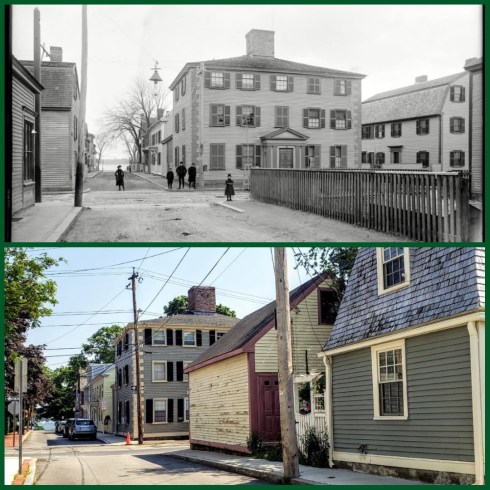 Hardy Street, 1890s and today: with the “mansion house” of Captain Edward Allen still standing proudly on Derby Street though somewhat obstructed by this particular view. You can read a very comprehensive history of this house
 The Frank Cousins “Team”/ Employees’


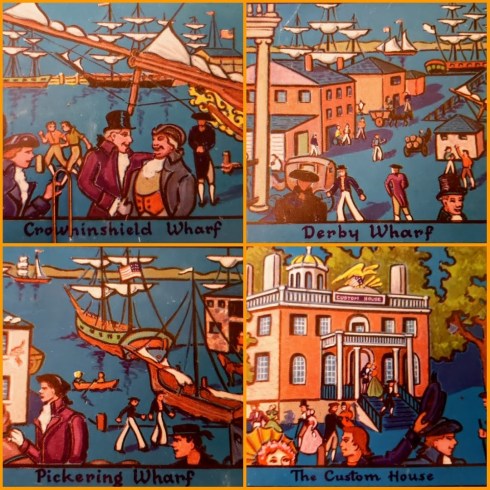


 The Hawthorne Hotel’s lobby and Main Brace cocktail lounge; Jonathan Butler, Harriet Shreve & John Pickering X in the Main Brace c. 1942 from Kenneth Turino’s and Stephen Schier’s Salem, Volume 2 (Arcadia Publishing, 1996); Larry O’Toole’s Salty Map of Cape Ann from


 Madame Beavoir’s Painting

 Madame Leroy and Rest in Peace; Revolutionary Dress Top (detail).

 Marie Antoinette is Dead; Boucher’s Portrait of Madame de Pompadour (Neue Pinakothek, Munich); Passing and Violin of the Dead. All photographs by Fabiola Jean-Louis with more + commentary at her website:






