Tag Archives: Newspapers

Reports of Leslie’s Retreat

This weekend brings the third annual commemorative reenactment of “Leslie’s Retreat” to Salem, an enthusiastic event that I think everyone enjoys because of its non-commercial, non-1692 focus: at least I do! The reenactment marks an event which might have sparked the American Revolution weeks before Lexington and Concord, if shots had been fired; it was nonetheless a notable occurrence of an armed (and potentially very dangerous) resistance. In late February of 1775 General Thomas Gage, the military governor of Massachusetts, got wind of a store of cannon in Salem and dispatched Lieut. Col. Alexander Leslie and 240 soldiers of the 64th Regiment by ship from Boston to Marblehead on the 26th (a Sunday!), with instructions to march to Salem and seize them. There’s a lot of whispering and distrust in this story as the “Tory” and “Patriot” sides do not seem firm, but several Marblehead patriots rode ahead in Revere-like fashion and warned the people of Salem, and thus “the Sabbath was disturbed”. By the time the soldiers arrived in Salem a crowd had assembled in the vicinity of the (old) North Bridge, as across the North River was the blacksmith’s shop where the cannons were being affixed to field carriages. A prolonged standoff ensued with the drawbridge raised, during which the cannons were moved west, several ending up in Concord, I believe. The bridge was lowered so that Colonel Leslie could fulfill his orders, but it was too late, and so he and his troops turned around and marched back to Marblehead, their ship, and Boston. I’ve written about this event several times (here and here), there’s a nice narrative of events here, and the most insightful accounts are on J.L. Bell’s brilliant blog Boston 1775 (I especially like this post but check this one out too, and this one), so there is no need to go into any more detail, but there are three issues I’d like to raise, two “open” and one relatively new (I think, maybe not, not my period!), all from newspaper accounts written in the weeks after Colonel Leslie’s retreat from Salem.

Leslies Retreat Collage

Leslies Retreat Newport Mercury

Leslies Retreat March 15 Masthead

There is some back-and-forth, especially in the first few weeks after the Retreat, but for the most part the papers are essentially publishing the standard story first published by the Essex Gazette. There are so many details to this story, however, that it’s notable what is put in and what is left out. So here are my “outstanding” issues, in the form of a question and two comments.

How many damn cannon(s) were there in Salem?  I can’t lock down the number (and I know “cannon” is plural but I think I have to use cannons here). Apparently General Gage had received reports that old ships’ cannons were being converted in Salem and eight additional cannons had been imported from abroad, while the Essex Register’s report on the Retreat included the assertion that twenty-seven pieces of cannon were removed out of this town, in order to be out of the way of the robbers. I’ve read (and quoted) seventeen cannons, nineteen cannons, and twenty cannons. I think we’ve go to go with the eyewitness account cited by J.L. Bell, in which Samuel Gray, who was nine years old at the time, went into the smithy on the day after and asked how many cannons had been there the day before and was told twelve; understood they were French pieces, and came from Nova Scotia after the late French war; were guns taken from the French; does not know to whom they belonged previous to being fitted up on this occasion. TWELVE. Gray’s remembrances were in response to interviews that Charles Moses Endicott conducted to produce his Leslie’s Retreat; or the Resistance to British Arms, at the North Bridge in Salem, on Sunday, the 26th of February of 1775, which was first published as a separate Proceeding of the Essex Institute in 1856.

 (The remembrance and reconstruction of what became known as “Leslie’s Retreat” enable us to see how Salem’s history was collected, preserved and interpreted by the Essex Institute, one of the founding institutions of today’s Peabody Essex Museum. Contrary to the claims of the PEM leadership: yes, the Essex Institute DID function as a historical society, and that’s why its historical collections, including its publications and historical manuscripts and texts assembled in the Phillips Library, constitute an important archive of Salem’s history, and no, no institution is fulfilling that role for Salem now, so the decisions to end the Institute’s interpretation and collection missions and remove its archival collections from Salem will have far-reaching consequences. These decisions were made by Mr. Dan Monroe, and since he has announced his retirement it is time to consider his legacy—and this is a truly momentous one.) Sorry–the spirit of RESISTANCE overwhelmed me!

Back to the question of the cannon(s): for some reason Endicott goes with 17 in his account, which has become classic, but he includes Gray’s number in his footnotes, clearly giving some credence to his claim. I don’t know why we can’t believe the boy: certainly his would have been a crystalline memory.

Major Pedrick was a Tory! None of the contemporary reports of the events of February 26, 1775 mention Major John Pedrick as the “alarming” figure who rode ahead of Leslie’s troops to warn the citizens of Salem of their imminent arrival, nor does Endicott. That’s because his role was made up after Endicott’s account. Pedrick was in fact a wealthy Tory who would not have been motivated to play such a conspicuous role at this time; he came around a bit later but anonymous Marbleheaders warned Salem on that Sabbath day. Again, I am relying on J.L. Bell’s succinct analysis of the “myth” of Major Pedrick, which has been perpetuated in the most recent scholarship as well as our reenactment. I was also inspired by Bell’s post to look around and see what else was made up about our event, particularly in the “creative” Marblehead accounts of the later nineteenth century. Samuel Roads Jr.’s History and Traditions of Marblehead (1880) turns Leslie’s Retreat into an all-Marblehead affair: Pedrick is prominent, of course, along with an entire Marblehead Regiment that came to Salem to take up with Leslie’s troops. Not a single Salem name is mentioned in Roads’ account, but we do hear of one Robert Wormsted, one of the young men from Marblehead,—who afterwards distinguished himself by his daring and bravery,—[and ] engaged in  an encounter with some of the soldiers. He was a skillful fencer, and, with his cane for a weapon, succeeded in disarming six of the regulars. Wow. No mention in Endicott of this cane-wielding Wormsted—or Pedrick—but Marblehead folk artist J.O.J Frost seems to have cemented the latter’s place in history in his early twentieth-century painting “Major Pedrick. To the Town of Salem, to Give the Alarm.“
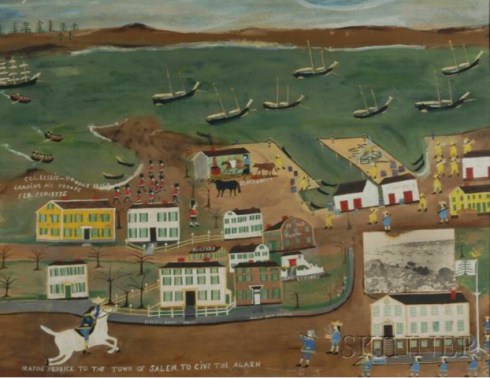
Leslies Retreat Frost Courtesy Skinner Auctions; note the anachronistic photo inserted on the right.

“Anniversary History” was alive and well in 1775: Even in the standard reports of Leslie’s Retreat published in the week after, I couldn’t help but notice the juxtaposition of what had just happened in Salem and the imminent fifth anniversary of the Boston Massacre. Side by side we can read of Leslie’s “ridiculous” expedition and “an Oration, in commemoration of the Massacre, perpetuated in King-Street, on the 5th of March, 1770, by Joseph Warren, Esq.” and several reports made the connection between the two, which occurred on successive sabbaths. Dr. Warren actually spoke on March 6, 1775, and I wish he had referenced Salem, but he did not. Nevertheless, you can really feel the drumbeat of rebellion when you read the New England papers published in March of 1775: there are lessons to be learned and anecdotes to be memorialized. The editors of the Newport Mercury were also thinking historically when they opined that as our brave ancestors used to carry their implements of war with them to their places of worship during the Indian wars, perhaps our brethren of the Massachusetts Bay have good reason to make use of the same precaution at this day. I also can’t resist adding another eyewitness testimony here, from a “True Son of Old Ireland” who was on the spot, as well as my very favorite photograph of the First Reenactment of Leslie’s Retreat, two years ago: these guys played their roles really well.

Leslies Retreat Lessons Learned Newport Mercury March 6

Essex Gazette March 7 1775 Leslies Retreat

Leslies Retreat best photoThe Newport Mercury of March 6, 1775 and the Essex Gazette of March 7, 1775; Lt. Colonel Leslie (Charlie Newhall!!!) exasperated and outflanked two years ago.

Commemorating Leslie’s Retreat on February 24:  Reenactment at 11:15-11:30 for Redcoats (meet at Hamilton Hall) and Patriots (meet at the First Church). Reception afterwards at First Church.

A Staged Reading of Endicott’s Leslie’s Retreat at the Pickering House by Keith Trickett, 3pm: https://pickeringhouse.org/events/special-leslies-retreat-performance/.

Toast the Retreat and Salem’s Resistance at O’Neill’s Pub on Washington Street from 4-7pm.

And coming in April: the Resistance Ball at Hamilton Hall: https://www.hamiltonhall.org/full-event-calendar/2019/2/1/resistance-ball


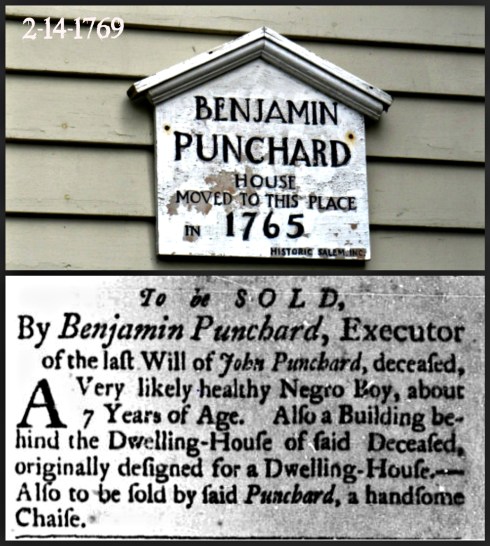
Enquiries and Enslavement

I’m in the process of teaching myself how to create digital maps with layers of history so I can visualize different times, places, events and environments. Such maps are a great teaching tool, and I also think it would be a great way to put all of the discoveries I’ve made while blogging into a more compact form. “Spatial history” is a very big trend in historical interpretation and the digital humanities, but it’s going to take me quite some time to reach this level of presentation. I thought I’d start small with a series of maps of Salem with one layer each: how many first period houses survived in say, 1890, houses of notable women of Salem from different periods, and houses (or locations) where enslaved people lived and worked before the abolition of slavery in Massachusetts in 1783. I decided to start with the latter topic because I thought it would be manageable, but it is not: there were far more enslaved people in colonial Salem than I thought—but this makes it all the more important that we place them.

Slave Adverts White Collage

I’m still working on my “data set”, having searched through newspapers (for both “for sale” and “runaway” advertisement, vital statistics, and the amazing 1754 census at the Phillips Library in ROWLEY (yes, I’ve been there; I will report later). The latter breaks down Salem’s residents into five categories: “rateable”, males under 16, females, widows, and negroes, and according to its survey, there were 3462 people in Salem in 1754, of which 123 were African-Americans. The word “slave” is never used; only servant. There are discrepancies between this survey, the advertisements, and the vital statistics, so I’m not sure how I’m going to be able to come up with an absolutely accurate number: this might have to evolve into a collective or crowd-sourced project. I’ve identified some of the larger slave-owning families though: an analysis of their papers (most are also in the Phillips) would undoubtedly reveal more information

Slave Adverts Punchard

Slave Adverts June 13 1769 Essex Gazette

Slavery 1 collage

Slave Adverts Oct 29 1771All Essex Gazette

Enquire of the Printer. Runaway slave advertisements are very detailed; for sale notices less so. It’s almost as if people don’t want to give their names out, with some notable exceptions, like Captain David Britton, who was definitely more than personally invested in this trade. The map will require me to place the enslavers and the enslaved, but I don’t have much information on Britton: all I’ve found so far is a reference in Phyllis Whitman Hunter’s Purchasing Identity in the Atlantic World. Massachusetts Merchants, 1670-1780 to his membership in a Salem club called “The Civil Society” which met at a local inn on Tuesdays and Fridays ” for friendship and conversation”. There were club rules against cursing and unrefined behavior, but apparently not against slave-trading.

Slave Adverts Boston Evening Post July 24 1738

Slave Adverts Pompey and Horse

Slavery Waite

Slave Adverts PhelpsBoston Evening Post and Essex Gazette

Once you start researching this topic, it shapes how you look at your environment. I’m sure people in the South are used to this, but not people in New England. There were enslaved people in the House of the Seven Gables, and the very wealthy merchant Aaron Waite, whose long partnership with Jerathmiel Pierce has inspired the naming of Salem Maritime’s gift shop, enslaved at least one person, named Pompey. Nathaniel Hawthorne’s great-grandfather Jonathan Phelps, let out both his blacksmith shop and his “excellent workman” in 1773. Several enslaved men were compelled to work for their master Samuel Barnard in the Ropes Mansion, and he also loaned them out to his nephew way out in Deerfield. Richard Derby owned at least one slave, as did William Browne, Jonathan Clarke, Daniel King, Edward Kitchen, Josiah Orne, William Pynchon, and Bezaleel Toppan, and many more residents of mid-eighteenth-century Salem, both wealthy merchants and less conspicuous craftsmen. The fabulously wealthy Samuel Gardner (1712-1769), whose house was located on the corner of Essex and Crombie Streets and whose many possessions are easy to find in auction archives and museum collections, listed several enslaved men among his possessions in his will: he left his “Negro boy Titus, as a servant for life” to his “beloved wife Elizabeth”, but freed a man named Isaac, adding the provision that if Isaac was “unable to support himself, that he be supported by my sons George, Weld, and Henry, in equal shares…..so as to free the Town of Salem from any charge”.

Slavery Ropes

Samuel Gardner's Sugar Box.Samuel Gardner’s sugar box, collections of the Museum of Fine Arts, Boston.


I Miss the Assembly House

I miss the Assembly House, a Georgian structure on Federal Street built as an assembly house in 1782 and transformed by Samuel McIntire into a more elaborate residence in the next decade: its proper name is the Cotting-Smith Assembly House (although it was charmingly called the “old Assembly House” after Hamilton Hall was built in 1805) and it was donated to the Essex Institute in 1965, the last building to be added to the Institute’s collection of historic houses, I believe. Of course the house still exists–I can see it at any time–but it has changed from when I first knew it: it has lost all of its trees–and its life. It is still, dark, and stark. It’s a shadow of its former self, or a ghost.

assembly house

assembly house 1926

assembly house howell-painting-1920-assembly-house mfa

assembly house cornell 8c73ca74-4027-453e-be51-e31e2437d593_size4

assembly house drawing hne bestThe Cotting-Smith Assembly House yesterday afternoon and in 1926, 1920 (in a painting by Felicie Ward Howell, collection of the Museum of Fine Arts, Boston), c. 1910 (Cornell) and an undated drawing (Historic New England).

I know, houses are not sentient beings as friends and family often tell me. But the Assembly House looks sad and it makes me sad to look at it, as I remember many happy times there in the 1990s, both before and after the Essex Institute and its houses were absorbed into the Peabody Essex Museum. I remember: teas, two baby showers, several anniversary dinners, a graduation party, a cooking class (???), coffees for candidates for local office—it seemed as if we were in there quite a lot! I remember feeling that the house was rather homey, despite its elegant interior details. I remember sitting on the back stairs talking to two friends who are no longer alive. I remember being wowed by the front staircase—with its second-floor landing and pedimented door—every time I saw it. But all these memories are from a long time ago, at least 20 years. I miss all of the Essex Institute/PEM houses, with the exception of the Ropes Mansion which was restored and reopened a few years ago. (Actually what I really miss is the Essex Institute, but that statement will always produce eye-rolls among those who believe that the Peabody Essex Museum rescued both the Institute and the Peabody Museum. This may be true–but it’s hard not to notice those dark stretches of Essex—and Federal—Streets).

assembly house hne

assembly house stairwell

assembly house hne 3

assembly house la sunday times aug 8 1926assembly house bg 1963

assembly house bg 1985Photographs of the Cotting-Smith Assembly House interior, Historic New England; Los Angeles Time, 1926; Boston Globe, 1963 and 1985.

The house where Lafayette danced in 1784 and Washington dined in 1789 and Susan Coolidge (above) came out and many other people celebrated weddings, anniversaries, and simply lived their lives was “restored, refurbished, and remembered” according to the 1985 story in the Boston Globe above but seems largely forgotten these days. It was celebrated across the country in 1926 as Salem marked its 300th anniversary, but seems likely to be overlooked as the city marks its 400th.


A River of Molasses

Today marks a big disaster anniversary in our region: the centennial anniversary of the Great Molasses Flood of January 15, 1919, which killed 21 people, injured 150, and laid waste to several blocks of the North End of Boston. I don’t really have much to add to the narrative of events of that day, but I feel like weighing in anyway, primarily because this tragedy is the perfect example of unmoored history, lacking context and consequently inhibiting understanding for many. There’s a great book about this event (Stephen Puleo’s Dark Tide: the Great Molasses Flood of 1919) but whenever you bring it up in general company, people generally smile or laugh because molasses is trivial in our society; it’s akin to people being drowned—-or smothered?—in jello. But molasses was a major industrial product in 1919, recognized simultaneously as both beneficial and potentially dangerous but above all, vital. And when you look at what happened on January 15, 1919 with a historical perspective, it’s possible to see both major precedents and consequences.

molasses panorama bpl

molasses bpl 4901511479_88c285b656_o

molasses bh bpl4902097496_f15e748c9c_o

molasses bpl

molasses page 2Headlines and pictures from the day after in the Boston Daily Globe and the Boston Herald: “Red Cross Ambulance and Nurses making their way through the River of Molasses”, Boston Public Library.

Molasses was not only much more integrated into our cuisine a hundred years ago, but its importance in alcohol production had intensified with the increasing demand for industrial alcohol, which entered a golden age of production following the passage of the 1906 Denatured Alcohol Act, permitting the production and sale of tax-free alcohol for industrial purposes. The author of The Practical Handbook on the Distillation of Alcohol from Farm Products, including the processes of malting : mashing and macerating : fermenting and distilling alcohol from grain, beets, potatoes, molasses, etc., with chapters of alcoholometry and the denaturing of alcohol…., issued the year before the Great Molasses Flood, cannot contain it his enthusiasm for this development, which “opened the door of a new market for the farmer and the manufacturer”, as Alcohol leaped at once into fame—not merely as the humble servant of the pocket lamp, nor as the Demon Rum, but as a substitute for all the cheap hydrocarbon fuels,  and as a new farm product, a new means for turning the farmer’s grain, fruit, potatoes, etc…into that greatest of all Powers, Money. Molasses had long been lauded as feed for cattle, horses, and poultry, but now its uses seemed limitless, in everything from road construction to the manufacture of varnishes, paints, and munitions. The 1907 act provoked a wave of hastily-built distilleries, such as the Boston tank owned and “maintained” by the Purity Distilling Company, which began leaking almost immediately after its construction in 1915 and finally burst open four years later. But the North End flood was not the first molasses disaster: it wasn’t difficult to find stories of exploding tanks and bursting hogsheads in the first few decades of the twentieth century—and just in the Boston papers. There are far more stories about the “adulteration” of molasses, however (generally with tin): and thus it is easy to understand how regulation, of industrial construction, production, and labor, would emerge as a major consequence of the Great Molasses Flood of 1919.

picmonkey image

molasses june 12 1886 boston heraldMolasses accidents in March of 1908 and December, 1911 reported in the Boston Journal; report of adulterated molasses (one of many!), Boston Herald, June, 1886. 


The Great Molasses Flood & Fluid Dynamics: https://www.nytimes.com/2016/11/26/science/boston-molasses-flood-science.html.

The Great Molasses Flood &  “Misunderstood History”: https://www.masshist.org/calendar/event?event=2762


An Eventful 1851 in Salem

The media—exclusively newspapers—looked back at the year’s events at its end in the nineteenth century just as it does today. This accounting was traditionally presented in the first few days of January by the Salem Observer, and it’s interesting to read what was considered “notable” and worthy of inclusion and what was not (although it would take some research to determine what was not and I’m not doing that now—researching “the negative” is incredibly difficult at the local level). The January 3, 1852 report on the “Events in Salem and Vicinity during the year 1851” prepared for the Salem Observer is below, and below that are my observations of what seems particularly notable (or just interesting): so we have two filters of newsworthiness at work here.

Events Salem_Observer_1852-01-03_[1]

Events of 1851 Salem_Observer_1852-01-03_[1] (1) 2

Events of 1851 Salem_Observer_1852-01-03_[1] (2) 3

Events of 1851 Salem_Observer_1852-01-03_[1] (3) 4

Events of 1851 Salem_Observer_1852-01-03_[1] (3) 5

Weather notations are always interesting: sudden changes in January, a “violent” snow storm in March, a big storm, including flooding, in April, hail in July, the first snowfall on October 27, a “great fall of snow” just before Christmas and very cold weather after.

Crime: always achieves notice. A gang of burglars strikes in January! A particularly crime-ridden May, with a strange attack that sounds like 17th century lithobolia on a house in Danvers, some female counterfeiters in Marblehead, and a stabbing in the street in Salem.

Fire: the partner of crime in notoriety. The Atlantic House in Beverly burned down in January and a Marblehead house in February, the same month in which Benjamin Lang’s house on Lafayette Street in Salem was severely damaged by fire. This is a reference to 49 Lafayette Street, the boyhood home of Benjamin Johnson Lang, who was an extremely famous organist and choral conductor in the later nineteenth century. The house was rebuilt, and both Benjamin Lang Sr. and Benjamin Johnson Lang Jr. held music lessons there before the latter’s departure for Boston and greater things in 1855.

Deaths: it is in the reporting of deaths that you can really perceive how restricted “notability” was as obviously many more people died in Salem and its environs in 1851 than are reported here. One does wonder about the “highly esteemed” young Deborah Howard, however, who died as a result of injuries sustained from a tragic carriage accident in July. I can understand why Captain Nathaniel West’s death (at aged 95) was included, as he was one of the great golden age Salem sea captains. He apparently bequeathed Derby Wharf to the Salem Marine Society in his will, and also left funds for the establishment of a school of navigation—I wonder what happened to that?

Lyceum Lectures: lots of lectures at both the Mechanic Lyceum and the Salem Lyceum and other regional venues as this is the heyday of the Lyceum movement. Most of the lectures seem pretty apolitical: the great abolitionist Lucy Stone spoke before the Salem Anti-Slavery Society rather than at either Lyceum. As we know, things will heat up, but in 1851 Lyceum audiences were hearing about “The American Mind”, “Character”, “New England and Her Institutions” and both women and men by both women and men speakers.

Salem Harbor: is dead. Hawthorne’s characterization is certainly confirmed here, as only one Salem ship is referenced, the barque Dragon, and it reports to Boston Harbor rather than Salem! But there was a regatta in July: wish we could resurrect this event.

Appendix: the “Shadrach” riot reference deserves its own post. On February 21, “Colored Barber” Alexander H. Burton of Salem was arrested on suspicion of being involved in the uproar following the arrest of the runaway Virginia slave Shadrach Minkins under the 1850 Fugitive Slave Law. Burton was released because he had an alibi–but I’d like to know more about his arrest and the connections between Salem’s and Boston’s abolitionist movements.


Victory New Year, 1919

All New Years are special as they are embedded with thoughts of hopefulness and fresh starts, but I think the dawn of 1919 might have been particularly so: the themes of victory and peace following the Great War ring out in all the accounts of its celebration, which might also have been particularly joyous as it marked the last “liquid” New Year with the onset of Prohibition approaching. The New York Times proclaimed 1919 the “Victory New Year” and the Boston Globe bid adieu to a battle-scarred pirate-gladiator representing 1918. Probably the best image expressing contemporary hopes for the coming year was a seemingly-ubiquitous poster equating world peace, (lady) liberty and (American) prosperity produced by the United Cigar Stores Company: this theme is manifest in all of the accounts of New Year celebrations and forecasts which I sampled, and most mentions of Prohibition were below the fold!

Victory New Year 1919 NYT

New Year 1919 Boston Globe

New Year's collage

I think I must have posted on all of the New Year’s traditions and symbols over the past eight (!!!) years, and horseshoes, pigs, toadstools, shamrocks, and chimney-sweeps are still in evidence on New Year’s postcards in 1919, but change was also inevitable, as the dominant German postcard industry collapsed with the onset of the war, and domestic producers gradually altered the style and substance of holiday cards. During and right after the war, there are a profusion of babies and comforting hearth scenes on holiday postcards, but also more patriotic and elevated expressions. The French influence seems strong, but American illustrators also shaped the image of seasons’ greetings—with emphasis on both domestic prosperity and universal peace: a major cultural consequence of World War I is the emergence of peace on earth as a popular holiday sentiment.

New Year 1918

New Year silk

New Year 1919 Card

Santa Snowman Delcampe (1)

_Peace._Your_Gift_To_The_Nation._A_Merry_Christmas.__-_NARA_-_512601

New Year RuzickaFrench silk New Years’ postcards for 1918 and 1919 featuring the Allied flags, Europeana; Xavier Sager and Santa planting the American flag on the North Pole postcards, 1919, Delcampe.net; Santa’s gift of peace poster by the U.S. Food Administration, Library of Congress; Rudolph Ruzicka holiday card for 1918-1919, Harvard.
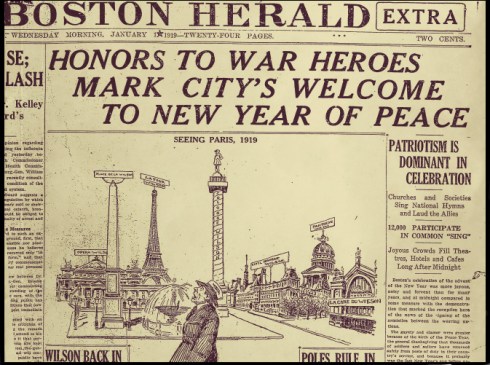
But all was not completely calm in the United States on January 1, 1919. Deaths from the Spanish Flu epidemic of the fall had dwindled, but they were still being reported. As President Wilson made his way to the Paris Peace Conference, there was both evident pride and anxiety about America’s evolving role in world affairs. As always, everyone was concerned about the economy. The front page of the Boston Herald shows a cartoon in which all of Paris’s landmarks have been renamed “Wilson” (Place de la Wilson, La Tour Wilson, etc.), but also features an interview with Massachusetts Governor-elect Calvin Coolidge who prescribes “thrift and industry” and expresses what seems to be a very real concern that now that Europe is peaceful, all Americans of European descent will return there! This is Calvin Coolidge in a new light for me (remember, I am not an American historian), expressing concerns over the labor market as well as the loss of “so many men who during their stay with us have given us so many models of good citizenship” and suggesting cash payments as enticements for these men to stay put!

New Year Boston Herald

New Year Coolidge Collage

The Suffragist leader Alice Paul also identified 1919 as the “Victory New Year” as she was determined to bring the long struggle for votes for women to a triumphant close in that year. President Wilson’s commitment to freedom and democracy overseas was recognized as a wonderful opportunity to expose his hypocrisy at home (as this was an age when people recognized hypocrisy) and so the Suffragists burned “watchfires” in front of the White House, “to consume every outburst of the President on freedom until his advocacy of freedom has been translated into support of political freedom for American women”. From New Year’s Day into February, the watchfires burned, despite the cold, the harassment, and the arrests, igniting the final push towards the passage of the 19th Amendment in the Congress in May and June of 1919, and its eventual ratification in August of 1920. And so it seems that victories were both in hand and at hand on New Year’s Day, 1919.

Watchfires LC

The+Suffragist,+June+14,+1919_NMAH-AHB2013q013138Library of Congress & National Museum of American History.


Mid (19th)-century Thanksgiving

In the middle of the nineteenth century, Thanksgiving was a very different holiday in some ways, but familiar in others. It did not become a national holiday until 1863: before that the Salem papers (I’m using the Salem Register in this post) note with each passing year how many governors have issued proclamations adopting the “joyous festival, so long the ‘peculiar institution’ of New England”. How jarring to see this phrase applied to Thanksgiving—when I thought it was an exclusive reference to slavery!  I’m not sure I’m really comfortable with the phrase “Universal Yankee Nation” in this 1847 article either.

Thanksgiving 1847 collage

Apart from the provincial pride, Thanksgiving was also a busy public holiday, rather than merely a family gathering. It was both sacred and secular, and everyone was out and about in the morning (for church services) and the evening (for concerts and dances). I assume they ate their Thanksgiving dinners in between, as there were lots of advertisements for various foodstuffs  in the weeks before the big day, which was always in November in Massachusetts despite some December dates chosen by other states. Provisioning and preparations were very important: not just for family meals, but also for the meals that were prepared by different civic groups for orphans, prisoners, “inmates of the Alms House”, and (during the Civil War) soldiers.

Thanksgiving Salem_Register_1848-11-30_3

Thanksgiving Salem_Observer_1849-11-24_[2]

Thanksgiving Salem_Register_1849-02-05_4

Thanksgiving Salem_Register_1851-12-15_1

Thanksgiving Salem_Register_1851-11-24_3

Thanksgiving 1852 collage

Thanksgiving Salem_Register_1853-11-14_2

Thanksgiving Salem_Register_1854-11-20_2

Thanksgiving Salem_Register_1857-11-30_2

Thanksgiving Salem_Register_1863-11-05_2

Thanksgiving Salem_Register_1865-11-06_2

Thanksgiving Salem_Register_1875-11-15_2

These advertisements from the Salem Register (from 1847-75) give some semblance of what Thanksgiving festivities were all about in mid-nineteenth-century Salem but are an under-representation: people really wanted to give thanks in as many ways as possible, especially during the Civil War. But they also wanted to celebrate: Thanksgiving is always referred to as a “festival”. Turkey–and other fowl– was definitely on the menu as you can see from the “warning” to Salem’s resident birds, and cranberries as well. I remain extremely impressed by the entrepreneurialism of Mr. John Remond, an African-American man who served as the resident manager and caterer of (a very busy) Hamilton Hall while also running several provisioning businesses downtown: he arrived in Salem from the West Indies in 1798, all alone and only ten years old, and seems to have transformed himself into one of the city’s major players by the 1820s. He and his wife Nancy (who also had her own business–and they had eight children) were also active abolitionists and do not seem to have suffered the handicaps faced by most African-Americans in the nineteenth century, but then again, advertisements only reflect one small sliver of their lives. But they can tell us that year after year in Salem, oysters, whether individually or in pies, were much in demand for Thanksgiving.


It Happened on Salem Common

Increasing concern that the City might locate a commercial carnival on Salem Common during Haunted Happenings has brought me out of my seventeenth-century reverie: the present interrupts the past! The Common has been the site of concessions and children’s activities for quite some time, but the carnival, adopted over a decade ago to enhance the family-friendliness of Salem’s long Halloween season, was situated on a vacant lot on Derby Street. This lot is presently in the process of being transformed into a waterside park, so the hunt is on for a new location. This first came to the public attention just last month: I think many people in Salem–myself included—simply assumed that we were done with the carnival but apparently that is not the case. As with everything else related to Haunted Happenings, commercial concessions and “attractions” are somehow translated into a public good, and this is the rationale for the location of a private enterprise in a very public place: the beautiful Salem Common.

Salem Common 1836 Barber

Salem Mechanick Quick Step

Common 1863Salem Common in 1836 and 1863: Historical Collections of Massachusetts by John Warner Barber; Fitz Hugh Lane for Moore’s Lithography, Art Institute of Chicago, Museum of Fine Arts, Boston.

It’s not a done deal yet: there is actually a municipal ordinance specifically prohibiting mechanical rides or amusements, including carnivals and circuses on the Common, as well as general guidelines stating that that activities on the Common should not interfere or disturb the peace and enjoyment of all the citizens of the city and protecting it from adverse wear and tear. Of course having a carnival on the Common runs contrary to all of these codes, but the necessities of Haunted Happenings are paramount, and the City Council can waive these restrictions. There was a public hearing last week which I could not attend, but from what I’ve heard there was considerable resistance but also support for the idea. Those in the latter camp make a consistent argument that the Common has always been a busy place, and they are correct: just a casual glance at the historical record reveals a succession of military drills, pageants, rallies, baseball games and bicycle races, as well as balloon ascensions, firemen’s musters, and concerts—with some events drawing very large crowds. Every year about this time there were huge festivals marking the end of the playground season during which children from all of the neighborhood parks in the city would gather, compete and perform: I’m wondering when this tradition ended? The Common was a refuge for those displaced by the Great Salem Fire in 1914, the venue for the 700-cast-strong pageant performed for the Salem Tercentenary celebrations in 1926, and the scene of many triumphs–and also a few tragedies.

Common 1916

Salem Common Pageant 1916

Salem Common 1918

Salem Common 1920 Northend HNE

Common 1923

Salem Common SSU 1925

Salem COmmon Pageant 1926

Common 1935 Processing Tax

Common 1961All newspaper articles from the Boston Globe: playground festivals in 1916 and 1923, a film for the troops in 1918, a farmer’s market in 1920 (Historic New England), the celebration of the opening of the Hawthorne Hotel in 1925 and the stage for the Tercentenary pageant in 1926, Salem State University Archives and Special Collections; a protest against the processing tax during the Depression, and an unfortunate death on Salem Common.

There is one thing that these very diverse events have in common: they were all public events. I’ve heard tales of sad circuses in more recent days, but for the most part Common events were held for the common good or were an expression of the common will. Even without taking into account the potential damage to the Common, or the noise, or the length of time involved (3 weeks?) it’s hard to see how a private carnival meets this criteria, but then again there is that very public portrayal of Haunted Happenings.  Another way of examining the civic perception of the Common is to look at projects, events and/or installations which were declined, and my favorite example of these is a statue proposed for the Common by millionaire Fred E. Ayer in tribute to his Southwick ancestors, who were persecuted intensely by Salem Puritans for their Quaker beliefs. In 1903 Ayer commissioned the very prominent sculptor J. Massey Rhind (who would later craft the statue of Joseph Hodges Choate at the corner of Essex and Boston Streets), who came up with a model depicting a Tiger, representing voracious Puritanism, about to devour his Quaker victims. After several years of deliberation, Salem’s Council said NO to the statue’s placement on the Common, the most treasured plot of ground in Salem, in the words of Alderman Alden P. White.

Salem Common 1906


Watered Down

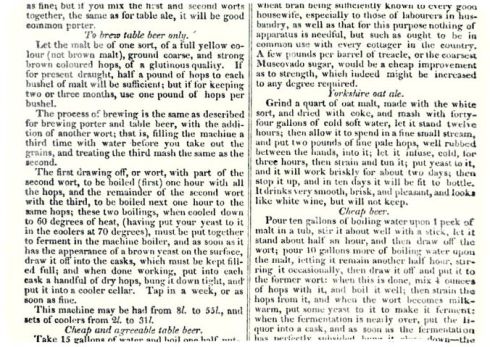
Salem is such a foodie/libations town now; I’m surprised there is so little culinary history served up. With countless restaurants, several bakeries and food shops, one brewery and another on the way, a cidery and distillery—all very busy—you would think there would be an ongoing audience for deep dives into the historical production and distribution of foodstuffs and beverages, but the only serious purveyors of such presentations (with ample samples!) are Salem Food Tours, and their affiliated attraction, the Salem Spirits Trolley, which runs in October. Good for them, but I think there’s room for more food-and-drink history, because Salem is not just a foodie town now; it always has been. The Peabody Essex Museum is hosting a brewing-themed event this week for which several area brewers have produced beverages based on the Museum’s collections: but only those collections that are right here in Salem so that’s not much to go on—the results must be somewhat watered-down if historical inspiration is the objective. A few trips up to the almighty Collection Center in Rowley and its encased Phillips Library would reveal more sources and more inspiration: here are some avenues of exploration that look particularly promising:

Women Brewers & Tavern-Keepers: there seem to have been quite a few in Salem!  One old Salem source that is quoted in all of the books about early American taverns and libations (quite a large genre) is a bill presented to the Parish Committee of the East Church for “Punch, Flip, Sangrey, etc.” by Abigail Brown, Tavern Keeper in 1767, and when Katherine Clarke inherited the Ship’s Tavern, one of Salem’s first, from her husband in 1645 she was licensed to keep it as long as she found a “fit man yt is godlie to manage the business”. Hannah Lemon Beadle also became the keeper of her family’s tavern on Essex Street following her husband’s death a bit later in the seventeenth-century, before it became the site of Witch Trial interrogations in 1692. 10 boxes of inn, tavern & retail licenses will yield lots of more information about just who was selling what.

Salem Spirits

Beadle's Tavern New England Magazine, 1892.

Spruce Beer. Logic tells me that Salem would have been a big producer of Colonial North America’s major contribution to the global world of beer, spruce beer, which compensated for shortages of both barley and hops in the New World and at the same time was recognized as a cure for scurvy. It was increasingly popular on both sides of the Atlantic in the later eighteenth and early nineteenth centuries: Dr. Bentley refers to it in his diary, and Jane Austen in her letters. It’s generally referred to as a home or “family” brew, however, so I supposed it was not produced commercially. I think there were alcoholic and non-alcoholic versions, and it seems to have been particularly popular in the summer. Here is General Jeffrey Amherst’s (of smallpox infamy) recipe:

Salem Spirits Spruce Beer

And here is Amelia Simmons’ recipe, with hops, from American Cookery (1796): it is notable that this is the only beverage recipe in the acclaimed “first” truly American cookbook:

Take four ounces of hops, let them boil half an hour in one gallon of water, strain the hop water then add sixteen gallons of warm water, two gallons of molasses, eight ounces of essence of spruce, dissol|ved in one quart of water, put it in a clean cask, then shake it well together, add half a pint of emptins, then let it stand and work one week, if very warm weather less time will do, when it is drawn off to bot|tle, add one spoonful of molasses to every bottle.

What’s in the mix? I suspect that a lot of brewing was home-based so it might be in the “black box” which historians cannot open, but the Phillips Library has manuscript and printed recipe collections which might yield some interesting intructions for all sorts of beverages. The most comprehensive of the latter seem to be Joseph Coppinger’s American Practical Brewer and Tanner (1815) and MacKenzie’s five thousand receipts in all the useful and domestic arts: constituting a complete practical library … : a new American, from the latest London edition (1829), but there are “small beer” recipes in many contemporary cookbooks. Beer is seldom advertised before the later nineteenth-century: I looked through the Salem Gazette and found every single beverage BUT beer referenced in the first decade of the nineteenth century, although Mr. Ropes (below) was always in the market for barley!

Salem Spirits American Practical Brewer

Salem Spirits Mackenzie's 5000 Reciepts Phillips

Spirit collage

There are more references to beer when it is mixed with something else: as in flip (which Abigail Brown furnished to the East Church Parish Council), the famous and “terrible” Salem drink Whistle Belly Vengeance, Bogus or Calibogus (spruce beer with rum), and Rattle-Skull ( dark rum and/or brandy and beer). Rum improved everything, of course, including cider (Stone-Wall or Stone-Fence).

Where are all the Tavern signs? I’ve got to admit that I’m as much, or more,  interested in the material culture of taverns as the consumption–especially tavern signs. Salem tavern licenses were granted with the requirement that “there be sett up in some inoffensive sign obvious ways for direction to strangers”, and apparently signs for The Sun and the Bunch of Grapes once existed in the collections of the PEM’s predecessor, the Essex Institute, but all I can find are Washington Hotel signs at present: as you can imagine, Washington taverns and hostelries were as common in every American town as Washington streets in the nineteenth century.

Washington collagePeabody Essex Museum and Alice Morse Earle, Stage-Coach and Tavern Days (1900).


A Souvenir of Salem

Salem has been a tourist city for a very long time, and that identity has inspired the production of countless souvenirs made from every material imaginable: ceramic, metal, cloth, wood, plastic, and a veritable forest of paper. I’ve been a rather casual collector of Salem souvenirs since I moved here many years ago, although I do have my periods of intensity if I come across something I haven’t seen before. I’m a paper girl, and I thought I had seen every bit of ephemera in this genre, but last week a little souvenir book with an embossed red cover popped up on ebay and I pounced. It arrived yesterday, and I was not disappointed: this little souvenir pamphlet contains some of the most beautiful prints of Salem structures I have ever seen. Even with its obvious damage, it is still a gem. There is no title page or publisher–although an advertisement for the Salem stationers Merrill & Mackintire is at the end, so I assume it is their offering. It is also undated, though I can come up with an approximate date just looking at some of the captions, which reflect the work of the tireless historian and “antiquarian” Sidney Perley to get dates and identifications just right at the turn of the last century—and after.

SS 1

SS2

SS3

ss6

ss10

Some historical “facts” are mutable. The site at which the accused and convicted “witches” of Salem were presumed to have been executed was commonly known as “Witch Hill” in the later nineteenth century but evolved into “Gallows Hill” at its end. This is still a Salem neighborhood and park, but from the 1890s Perley identified Proctor’s Ledge below as the site of the executions, and just last year this site was marked with a memorial by the City of Salem. Likewise, Perley confronted the long-held assertion that the small structure on the grounds of the Essex Institute was in fact the seventeenth-century First Church of Salem, and asserted that it was a Quaker Meeting House from later in the century. As you can see, the owner of our little souvenir book, whom I presume is the Charles Heald who signed the back of one of its prints, simply scratched out “First Meeting House” and wrote in “Quaker M.H.” And then Perley took on the “Roger Williams House” and asserted that Roger Williams never actually lived there: it then became the Witch House assertively, though in this first decade of the twentieth century it’s still either/or.

Antiquarian in Arms 1901

Witch House 1903Two Boston Post articles from 1901 and 1903 showing Perley in the midst of two big Salem historical “disputes”:  “Antiquarians are all up in arms again” is one of my favorite headlines ever.

The “Old Turner House” has yet to become the House of the Seven Gables, so I think I can date this souvenir booklet to sometime between 1903 and 1909 pretty comfortably. Yet there is not a car or trolley in sight: the cumulative vision is one of  “Olde Salem” with the exception of a few “modern” municipal buildings. Seaside Salem endures, and the Pickering House remains ever the Pickering House, unchanged from the seventeenth century except for the acquisition of its Gothic trim in the midst of the nineteenth.

SS7

SS8

SS4

SS5