Tag Archives: New England

Rails to Resorts

Even before our university archivist posted a 1914 Boston & Maine Railroad map of the “Summer Resorts of the Coast, Lake and Mountain Regions” along its routes (and despite this past week’s terrible train derailments in Quebec and Paris) I had been planning a vaguely conceived “summer railroads” post. I know all the wealthy people who lived on my street a century ago who summered (or “rusticated”) in Maine took the train, and since we’re going camping (!!!!!!!) in Acadia National Park on Mount Desert Island in a few weeks, I had the romantic notion of throwing all our stuff in the cargo car and making our connection to the Bar Harbor Express.  The train does indeed run through Salem, but no place in the U.S. is as connected by rail as it was a century ago, and the Bar Harbor Express no longer runs (we’ll need the car anyway, so I can sleep in it).

Mapping Vacation 1914

Mapping Vacation 1882p

Two Railroad Advertising Maps:  Boston & Maine “Summer Resorts”  1914 map, Salem State University Archives; an earlier (1882) version for New York’s train tourists, New York Public Library Digital Gallery.

These maps were just part of the railroads’ multi-faceted print advertising campaigns, which must have been extremely effective during hot summers like this one, when people were eager to leave the sweltering cities for cooler spots at the coast and mountains. In conjunction with its maps, the Boston & Maine railroad, which dominated the New England market until the 1960s, issued a series of stunning posters by Charles W. Holmes in the 1920s which focused on the appeal of summer resorts near (there’s even one for Revere Beach) and far. They really capture that air of interwar elegance, and represent the increasing accessibility of New England’s “vacationlands”.

Mapping Vacation 1925 Charles Holmes BPL

Mapping Vacation Old Orchard BPL

Mapping Vacation Holmes Win BPL

And for later in the year, the Snow Train………………..

Mapping Vacation Snow Train

Travel posters by Charles W. Holmes for Boston and Maine Railraod, 1920s, Boston Public Library travel poster collection.


Burning Times

My title is not a reference to the early modern witch trials, but quite literally to some of the larger urban fires in history: London, Boston, Chicago, Portland, Maine. I am trying to put the Salem Fire of 1914 in a larger context, and I also wanted a place/post to showcase a painting I found recently while auction archive-stalking (a major pastime of mine, along with realestalking). By an anonymous artist of the “American School”, The Burning of Treadwell’s Mill, Salem, Massachusetts shows what must have been the constant threat of fire in the densely-settled urban environment of a nineteenth-century Salem. I’m not sure exactly where Treadwell’s Mill was or what it produced (shoes? cotton? jute?) but the artist (C.C.R.?) certainly captures a striking scene.

Burning Times Treadwell Mill Christies

I’m also unsure as to when this fire occurred, but it appears contemporaneous with the Great urban fires in Chicago (1871) and Boston (1872). I imagine that these two huge conflagrations, happening in such quick succession and causing acres and acres of devastation, much have really raised the specter of fire in the public consciousness in the last quarter of the nineteenth century, and incited intensive discussions about fire prevention, water systems, insurance, and city planning. Much of the historical analysis of these fires and their impact focuses on the modern cities that emerged after the flames died down, almost as if fire was a (re-)generative force rather than a destructive one. These dramatic fires clearly inspired contemporary artists as well, who seem to focus on either the unbridled force of nature or more human perspectives. Painted several decades after the fire, Julia Lemos’s Memories of the Chicago Fire (1912) is all about the fire’s refugees, while the popular Currier & Ives lithograph of the Boston Fire shows the totality of destruction.

Burning Times Chicago

Burning Times Boston

Portland has always been one of my favorite little cities, but every time I go there I think something’s missing. Compared to other old New England ports like Providence, Boston, Salem, Newburyport, and Portsmouth, it seems  relatively new and very Victorian. Its urban landscape was shaped dramatically by the large fire of July 4, 1866, in which the joyous fireworks celebrating the first post-Civil War Independence Day triggered an inflammation that consumed much of downtown and presumably many colonial and Federal-era structures. Yet a new city emerged that took advantage of  the considerable charms of its geographic location. I like the transformation charted by the digital exhibition of the University of Southern Maine’s Osher Map Library:  from a “Blackened City, Laid in Ruins” to a “Green City, Reborn in Parks”. The environmental impact of the fire is emphasized by two contemporary images by Portland artist J.B. Hudson of Elms, Locust Street before and after the Fire of July 4, 1866. No mention of the charred remains of the built structures in the titles of these lithographs, just the trees!

Burning Times Portland 1

Burning Times Portland 2

It’s a big jump, back almost exactly two centuries, to the Great London Fire of 1666, but I’m going there. This was a fire that was truly “great”, both in terms of its devastation (some 13,000 buildings) and its impact, which included a rapid rebuilding response through what was one of the first examples of centralized urban planning–a model for disaster-devastated cities in the future. Very shortly after the Fire, King Charles II established a Commission for rebuilding the city, which proceeded with plans for wider streets, squares, and larger brick buildings. Not everything worked out as planned, but a new London emerged from the ashes fairly quickly, with 6000 structures built by 1670. Five years later, Commissioner Christopher Wren (ably assisted in the rebuilding process by the more-than-able Robert Hooke, the “English Leonardo” and the “man who measured London”) began work on his St. Paul’s Cathedral, which more than any other structure emerged at the triumphant symbol of the new and eternal London.

cropped to image, recto, unframed

Burning Times St Paul's

Old St. Paul’s and “New” St. Paul’s, in the midst of fire: unknown artist of the “British School”,  The Great Fire of London, with Ludgate and Old St. Paul’s, 17th Century, Yale Center for British Art, Paul Mellon Collection; Herbert Mason’s iconic photograph of Christopher Wren’s St. Paul’s during the Blitz, 1940.


Most Endangered 2013

My affection for history was fostered by places and buildings; it’s very material. And while I appreciate and am often awed by nature, I find the built landscape more accessible–and instructive. I’ve been an ardent preservationist since my teens, and am just passionate (geeky) enough to actually anticipate the release of the National Trust for Historic Preservation’s annual Most Endangered Places list every year. Yesterday brought the big announcement of this year’s list, which includes two New England properties with which I am familiar and nine more which I’m eager to see (most of them anyway, before they disappear). I have helped to create similar lists for our local preservation organization, Historic Salem, Inc., and if our deliberations are any indication, this list is the result of an intensive process:  you have to choose places that are threatened but are not too far gone, that possess the potential for recovery, there are always political factors involved, and historical and/or cultural significance has to be readily apparent. I’m sure the National Trust also has to take into account regional representation, as their Most Endangered Places are generally spread all over the U.S. map.

New England Most Endangered Places: Gay Head Lighthouse, Martha’s Vineyard, Massachusetts, and the Abyssinian Meeting House, Portland Maine.

Most Endangered

The Gay Head Light, Aquinnah, Martha’s Vineyard, Massachusetts, is threatened by erosion: it’s about 10 feet away from falling over the cliff. It’s wooden predecessor was faced with the same threat in 1844, and this brick structure, outfitted with a first-order Fresnel lens, dates from the 1850s.

OLYMPUS DIGITAL CAMERA

The Abyssinian Meeting House in Portland, Maine was built in 1828 to serve as a school and assembly house for Portland’s African-American community, and it also served as a stop on the Underground Railroad. It is the third oldest African-American meeting house in the country, which is amazing to me given its northern location. If you visit the Abyssinian Restoration Project website, you will see that an intensive preservation effort is ongoing; all they lack is resources.

Properties threatened by Development: The Village of Mariemont, Ohio, and the James River, Virginia.

Mariemont_619x350

The Village of Mariemont  in Ohio, a Tudor Revival planned community built in the 1920s, is threatened by highway construction. Of all the threats to historic structures, infrastructure development bothers me the most, because it is often short-sighted. Salem was faced with the threat of a road running down its historic center in the 1960s which was fortunately averted; I thought Urban Renewal had ended.

Most Endangered

The historic places that line its shores–Jamestown, Williamsburg, and a host of plantations–have given the James River the name “America’s Founding River”. Apparently “inappropriate development” threatens this region now. I’ll take the National Trust’s word on this, but I wish they were a bit more specific about the threat.

Most of the places on the list are quite modern, including Houston’s Astrodome, the Worldport at JFK Airport in New York, and several mid-twentieth-century buildings–all of which face demolition. By contrast, the oldest building on the list and one of the oldest buildings in North America, the San José Church (1523) in Old San Juan, Puerto Rico, is threatened by the deterioration that comes with time. The notes on its Historic American Buildings Survey record indicate that it was “in need of extensive repairs” in 1935, so you can imagine its condition now.

Endangered Historic P1341341

Church

Church 2

The Church of San José in Old San Juan, Puerto Rico, built by the Dominican Order in 1523. Black and white photographs from the Historic American Buildings Survey (1935), Library of Congress.


First Foray

Between my end-of-semester obligations and travel I have completely neglected my garden during its busiest season, so I took my first foray out there this weekend for a quick assessment. As usual, there have been losses (even with the impressive snow cover we had this year) and gains: ferns, ferns, and more ferns, popping up everywhere. My borders of lady’s mantle on one side and golden alexanders on the other are fine, but the center perennial bed needs work–so off to the nursery I went. There are several nurseries that I like in our (greater) area, but this weekend I went up to one of my most dependable destinations, Rolling Green Nursery in Greenland, New Hampshire: nice people, nice layout, good selection, good advice. This year, they seem to have expanded their selection of garden statues quite dramatically. After a brief glance at the big hand and mushroom, I went straight for the germander, a great herb for edging, of which Rolling Green seems to have a constant supply. Then it was off to the water garden for inspiration (ours is a mess), shade plants, and shrubs.

First Foray 001

First Foray 005

First Foray 007

First Foray 008

First Foray 006

First Foray 011

Back at home, I made my first foray into the dirt to plant and weed (already!) and rearrange; a few spots look okay, but most of the garden is not ready for prime time yet.

First Foray 024

First Foray 021


Marshes and Mountains

Last week, I discovered yet another Salem-born artist of the mid- and later nineteenth century in the usual way–by browsing through auction archives (a relatively new pastime of mine that I’ve got to nip in the bud, as it is very time-consuming!) This particular artist, Sylvester Phelps Hodgdon (1830-1906) did not dwell in Salem in his adulthood, but I continue to be amazed at the creative environment that existed in this era, another aspect of Salem’s history that is overwhelmed by its Witch City reputation.

Hodgdon was the son of a wealthy Salem currier who had married into one of Salem’s older families, which explains the prominent Phelps in his name (although he usually signed his paintings “S.P. Hodgdon”).  He appears to have moved to Boston in his early 20s, where he studied with the well-traveled Boston artist Benjamin Champney and worked for the L.H. Bradford lithography firm. For most of his life, he lived in the Dorchester section of Boston, and maintained a studio at the Tremont Studio building downtown, along with a host of prominent artists and architects. He was clearly part of the Boston art scene and community, teaching classes and exhibiting his work at the Boston Art Club in its heyday. But like so many Boston-based artists of this era, Hodgdon was drawn to northern New England for his subject matter: there are few streetscapes among his works, but rather gilded landscapes of marshes, valleys, and mountains–predominately in New Hampshire. Therefore he is generally characterized as one of the “White Mountain Painters”, along with Champney, who created one of America’s first art colonies by inviting a succession of painters, including Hodgdon, to come to his summer residence in North Conway from the 1850s on. This was clearly Hodgdon’s preferred milieu, but I did manage to find a few local scenes among his digitized works.

Hodgdon On the Marsh 1861

Hodgdon, Long Beach Nahant

Hodgdon Echo Lake, Franconia

On the Marsh/A Salem, Massachusetts landscape,1861, Skinner Auctions Archive; Long Beach, Nahant, 1861, Carlsen Gallery Auctions Archive; Echo Lake, Franconia Notch, 1858, Collection of  John J. and Joan R. Henderson. Photograph courtesy of the New Hampshire Historical Society. All the sources indicate that Hodgdon preferred to work at the “extremes” of the day, in the early morning and at dusk.

This last painting is among the most acclaimed of his White Mountains works, and as you can see, it dates from early in his career, while he was still in his 20s and working as a lithographer by day/artist by night (and summer). I was able to gather a few other images to add some context to Hodgdon’s life, including some examples of his lithography for the Bradford firm and a photograph of the Tremont Studio building in Boston: all traces of his past that are now sadly gone.

Tabernacle_Salem_Mass

Hodgdon American Antiquarian Society OMM

Studio_building_TremontSt_Boston,_Mass,_by_Soule_NYPL

Hodgdon’s lithographs for L.H. Bradford: “Old Man on the Mountain”, Franconia Notch (whose visage crumbled to the ground in 2003) American Antiquarian Society; Tabernacle Church, Salem, 1854, Boston Athenaeum, and the Tremont Studio in Boston, New York Public Library: gone, gone & gone.


Early May Meander

May is my absolute favorite month but also the busiest time of the year for me, with grading and other end-of-the-semester obligations, annual meetings for every single Salem organization to which I belong, and lots of stuff to attend to in the house and, of course, the garden. Frenzied activity and frustration, and lots of running around. This past week we have had absolutely beautiful weather: in typical New England fashion, everything just burst. So I took sporadic breaks from grading, not my favorite activity, and meandered about town. I did not have to go very far, as my neighborhood is particularly beautiful this time of year, and sometimes (often, after every other one) I can just raise my head up from the pile of blue books before me and look out the window and see something beautiful or interesting.

Early May 001

Early May 008

Early May 010

A photo shoot on Chestnut Street last weekend, involving quite a lot of people, and a single artist painting the park on the same day.

Early May 014

Early May 019

Admiring one neighbor’s lush yard, and another’s “spiderweb” window.

Early May 026

Early May 029

Early May 032

My jack-in-the-pulpits (Arisaema triphyllum) have arrived!!! Four this year!!!

Early May 043

Sorry this cardinal is a little blurry, but I chased him all around the neighborhood, determined to get his picture, and this is as close as I could get.


Wait a Minute

There is an oftquoted saying attributed to Mark Twain: if you don’t like the weather in New England, wait a minute.  Like most oftquoted sayings, this is a paraphrase of his more longwinded observation, made before the annual meeting of the New England Society in December, 1876:  I reverently believe that the Maker who made us all makes everything in New England but the weather.  I don’t know who makes that, but I think it must be raw apprentices in the weather-clerk’s factory who experiment and learn how, in New England, for board and clothes, and then are promoted to make weather for countries that require a good article, and will take their custom elsewhere if they don’t get it.  There is a sumptuous variety about the New England weather that compels the stranger’s admiration — and regret.  The weather is always doing something there; always attending strictly to business; always getting up new designs and trying them on the people to see how they will go.  But it gets through more business in SPRING [emphasis mine] than in any other season.  In the spring I have counted one hundred and thirty-six different kinds of weather inside of four-and-twenty hours…

March is certainly the cruelest month in terms of changeability, and to make my case I’ve got a series of photographs taken on Wednesday and Friday last week: a rather sleepless night was rewarded with a beautiful sunrise over Chestnut Street at midweek, and then two days later an unexpected (at least by me) storm dumped 14 inches of wet snow on the same landscape. As I’m writing this several days later, it is 50 degrees out and much of the snow is gone. And what will tomorrow bring?  Rain, of course!

Weather before

Weather 033

Weather 032

Weather before 2

Weather after 2

Weather after 3

Weather 047

Weather 012


Snow, Ice & Swans

Well, it wasn’t the most beautiful day in Salem yesterday but there were lots of interesting things to see while walking around town. Slushy snow fell from the grey sky onto the wet streets, but there was contrast in the form of ice sculptures from the annual Salems So Sweet midwinter festival, the architecture and shop windows, and a tranquil pair of swans at Pickering Wharf. As much as I love my native New England, this time of year can be rough; for me the urban environment provides a bit of relief from the starkness.

Snow and Ice 056

Snow and Ice 058

Snow and Ice 031

Salem Apothecaries window

Derby Wharf and The Friendship yesterday, the Custom House, and the windows of  the Modern Millie vintage clothing store on Central Street and Witch City Consignment on Essex Street.

The Salem’s So Sweet festival, focusing on chocolate and ice, is an initiative of Salem Main Streets and the Salem Chamber of Commerce; there is a very popular wine and chocolate tasting event followed by a weekend installation of ice sculptures sponsored by local businesses and institutions. Everything has been delayed a week this year because of last weekend’s blizzard, but yesterday morning all the sculptures were on the streets of Salem. There was a beautiful sculpture of the Friendship at Pickering Wharf, which my camera somehow did not capture, and the Peabody Essex Museum’s Taj Mahal (which the sculptors were still working on) and a snowy owl sponsored by a consortium of Salem businesses (Pamplemousse, Modern Millie, Mighty Aphrodite, the Salem Trolley and Trolley Depot) and were my other favorites.

Snow and Ice 047

Snow and Ice 050

Snow and Ice 023

Snow and Ice 026

Snow and Ice 035

Snow and Ice 037

Snow and Ice 042

The Peabody Essex Museum has enhanced the rather bleak landscape of Essex Street (all the shuttered tacky witchcraft-related shops are depressing even on a bright sunny day, much less a grey one, and the perpetually misspelled Witch Tee’s sign never fails to annoy me) not only with its Taj Mahal sculpture (to complement its current exhibition, Midnight to the Boom:  Painting in India after Independence) but also with colorful placards on the construction fence surrounding its latest phase of expansion.  Images of the coming year’s exhibitions work as street art for me.

Snow and Ice 019

Snow and Ice 017

Snow and Ice Placard

And then there were these amazing swans at Pickering Wharf, gliding around (with their big webbed feet) in the company of rather less majestic ducks, very close to the dock. They were a pair, of course.

Snow and Ice 082

Snow and Ice 062

Snow and Ice 072


Old Wethersfield

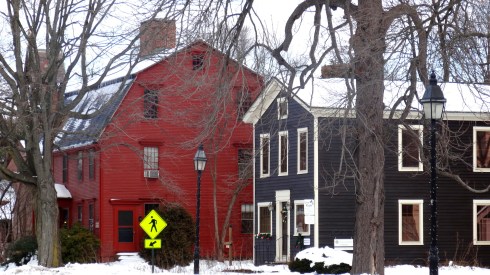
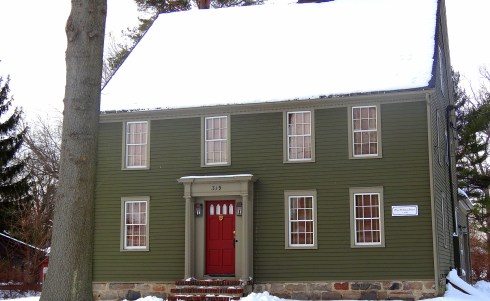
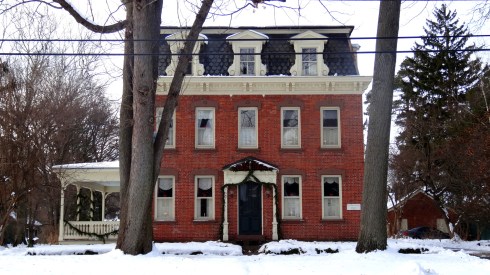
Whenever I’m heading home from New Jersey or New York or points south, I always like to stop in at Old Wethersfield, Connecticut:  it’s a beautiful village just off the highway and just outside Hartford:  a convenient respite for a weary traveler. Old Wethersfield is a National Register Historic District, comprising 100+ houses from the seventeenth, eighteenth and nineteenth centuries situated along a main thoroughfare and a slender rectangular green, which is part of the larger town of Wethersfield. I had two restless guys with me yesterday but they still let me stop for a bit, to take pictures of some of my favorite houses and briefly run into Comstock, Ferre & Company, which has been selling heirloom seeds for two centuries. Wethersfield is known not only for its colonial architecture, but also for its venerable seed companies, including Comstock and the Charles C. Hart Seed Co. in the present and a whole host of provisioners in the past. The most profitable product of these companies, a red “Wethersfield Onion”, even gave the old town the nickname “Oniontown” for a while. I am also compelled to mention Wethersfield’s fascinating/notorious founder, John Oldham, who was exiled from the Plymouth Colony for “plotting against pilgrim rule” and went on to establish settlements in Hull, Gloucester, and Watertown, Massachusetts, and eventually Wethersfield, the first English settlement in Connecticut. (Oldham seems to have rubbed shoulders with Salem’s founder, Roger Conant, on more than one occasion). Travel and Leisure magazine just designated Old Wethersfield one of America’s “prettiest winter towns”, and it certainly appeared so yesterday afternoon with snow lining the brick sidewalks and artfully draped on the colorful colonial houses.

Just a small sampling of Old Wethersfield, New Year’s Day 2013:

Wethersfield 052

Wethersfield 046

Wethersfield 044

Wethersfield 045

The plaques and signs refer to the house above, as in the case of one of Old Wethersfield’s most famous houses, the Webb House, pictured below with its neighbors.

Wethersfield 080

Wethersfield Webb House 083

Wethersfield 084

Wethersfield 074

Wethersfield 077

Wethersfield 076

Wethersfield 086

More!!! And as you can see, there are “newer” houses in Old Wethersfield too.

Wethersfield 091

Wethersfield 092

Wethersfield 056

Wethersfield 053

Wethersfield 060

Wethersfield 090

The Comstock building, obviously a livelier place in the summer but still very much open, and an 1899 seed catalog cover featuring the Wethersfield Onion, the “greatest onion on earth”,  from the Smithsonian Institution Libraries’ Collection.

Wethersfield 049

Wethersfield Onion Smithsonian


Selling the Psalms

There’s been a lot of discussion here in the Boston area over the last week or so about the decision of the Old South Church to sell one of their copies of the Bay Psalm Book, the first book to be printed in North America.  There are only eleven copies of this 1640 hymnal; each is precious (and worth about 10 million dollars, at the very least), and the Old South Church has two:  hence the decision to sell one to support its mission. I am certain that it was not an easy decision; deaccessioning an institutional legacy never is.  I’ve been on several boards of venerable institutions here in Salem which had to undertake similar considerations, and it was painful:  how do you honor the past while meet the demands of the present?

Bay Psalm Book LCp

The Library of Congress copy of the Bay Psalm Book (Cambridge, Massachusetts, 1640), more formally known The Whole Booke of Psalmes Faithfully Translated into English Metre. Whereunto is prefixed a discourse declaring not only the lawfullness, but also the necessity of the heavenly Ordinance of singing Scripture Psalmes in the Churches of God.

Everything about the Bay Psalm Book was imported:  paper, press, printer. The Puritans had brought several books of psalms with them, but their quest for the true word of God was essential and ongoing. The connection between printing and the Reformation was almost as well-known then as it is now, so the desire to have a press here in the New World must have been strong. The man with the plan was the Reverend Jose Glover, an English Puritan minister and shareholder in the Massachusetts Bay Company, who financed the purchase of the press (most likely Dutch, as was the type), the paper (most likely French), and the hiring of a “printer” named Stephen Daye in London. Glover died on the voyage to the New World, but his printer set up a press in Cambridge upon his arrival (with the aid of Glover’s widow, Elizabeth, who later married the first president of Harvard College, Stephen Dunster). There’s a lot of speculation about Daye; he was not a member of the Stationers’ Company, the printers’ and booksellers’ guild in London, rather he seems to have been trained as a locksmith and was barely literate. Nevertheless he is recognized as America’s first printer.

Bay Psalm Printing Press Stephen Daye

Bay Psalm First Printer restaurant

Daye’s Cambridge Press, Cambridge Historical Society; the First Printer restaurant at 15 Dunster Street, Cambridge, the site of Daye’s press.

The Bay Psalm Book went through several editions and remained in print through the seventeenth century. Even before the American Revolution, it was recognized as a foundational American text and included in the Prince Collection, the 2000 + rare texts collected by the Reverend Thomas Prince, the Pastor of the Old South Church in the 1740s and 1750s. These texts were stored in the steeple of the Church when it was transformed into a stable by the British during the Revolution (as I wrote about in an earlier post, the British stole Bradford’s Plymouth Plantation from the Church at this time but apparently felt the Bay Psalm Book was less valuable). In the later nineteenth century, the Church deposited the Prince Collection in the Boston Public Library for safekeeping. Of its two copies of the Bay Psalm Book, only one belongs to the Prince Collection so I assume that it’s the other that will go on the market, for the first time since 1947. All of the other 1640 copies (including one that was owned by Salem’s Federal-era chronicler, the Reverend William Bentley) are owned by institutions (you can see a great census here), so this is a rare opportunity for an individual to scoop one up.

Bay Psalm book title

Bay Psalm Book Singing Morgan

Title page of the Bay Psalm Book; Monks singing psalms in an earlier age: Pierpont Morgan Library MS M.193 fol. 277v (French, 13th century).