Tag Archives: New England

First Snow

On Saturday we had our first snow here in Salem; by Sunday it was gone.  I was very happy to see it and hope to see more:  last year, we had no snow in the winter, not a flake. There was the Halloween storm on my birthday (while a month or so ago my birthday fell on Superstorm Sandy, or vice-versa: what is the cosmos trying to tell me?)  So this year, I”d like a white winter:  not the huge, towering snowbanks of winters past, but just a little snow on the ground. Here are a few photographs of my garden and downtown, with barely a whisper on the ground.

First Snow 019

First Snow 011

First Snow 014

As you can see, where there was no grass, there was no snow. Not much of a display for New England, but I’m a little desperate as it has been a while. When I feel like waxing rhapsodic about snowflakes, I always conjure up the charming images from Robert Hooke’s Micrographia (1665), but I think I’ve already done that once or twice on this blog.  So instead, I want to focus on another man, several centuries later, who was similarly obsessed with snowflakes:  Wilson Alwyn Bentley (1865-1931), a pioneer in photomicrography. Bentley was a self-taught farmer from Jericho, Vermont who developed a process by which snowflakes could be photographed before they melted; he captured over 5000 images, demonstrating (like Hooke before him) that no two snowflakes were alike. Bentley was so taken with the singular, fleeting beauty of snow crystals, that he strove to capture them forever, on film, and first did so in 1885. Just after his death, about half of his images were published in a book entitled Snow Crystals (1931) which was republished by Dover in 1962. You can also see many his images at sites maintained by the University of Wisconsin and the Jericho Historical Society, as well as a few other places. Apart from their scientific and photographic value, Bentley’s images are just simply beautiful. Washington photographer Theodor Horydczak was inspired by Bentley to create his own grouped snowflake images, but I think I prefer the singular sensations.

First Snow Bentley Camera

First Snow Bentley 1910

First Snow Wilson Alwyn Bentley 1910

First Snow LC

Wilson Alwyn Bentley with his special microscope/camera in Vermont; lantern slides of two of his captured crystals, c. 1910, Metropolitan Museum of Art; Theodor Horydczak photograph, 1920, Library of Congress.


Factory Girls and Boys

I always feel a bit sorry for myself on Labor Day weekend, as it’s back-to-school time and usually I am engaged in a mad dash to get my course syllabi done.  Of course this is ridiculous, as I have the cushiest job ever and most of the summer I’ve been free to do as I liked.  It’s good to remind myself what labor really is, and nothing does that better than the photographs of Lewis Wickes Hine (1874-1940), who transitioned from educator to social activist, all the while armed with a camera.  In 1908 Hine became the official photographer for the National Child Labor Committee (NCLC) and began his life’s work:  documenting child labor across the United States. This was a time when one in six children between the ages of five and ten worked outside the home in “gainful occupation”, and the percentage increases dramatically for children over the age of ten.  The members of the NCLC began a successful campaign to end child labor and Hine’s often-haunting photographs were their chief weapon.

In the fall of 1911, Hine was in New England, then at the height of its industrial history, documenting child labor in Boston, Lowell, New Bedford, Lawrence and Salem. There are 17 photographs of Salem children, all accessible at the Library of Congress, which has a vast Hine collection. Most of the child laborers are shown outside of their place of work, presumably because their employers didn’t allow the conspicuous photographer inside. My favorite has always been this group of smiling girls, workers at the Cass & Daley Shoe Factory on Goodhue Street.

Caption:  Group of girls working in Cass & Daley Shoe Co., Salem.  Saw a number of children from 14 to 16 (apparently) and two or three probably under 14.  Smallest girl in photo is Odella Delisle.

Smiling Salem girls, for the most part, a striking contrast to one of Hines’ most famous child laborers, Addie Card of North Pownal, Vermont, captured in August of 1910.  Hines’ captions for this photograph are perhaps even more poignant than the image: an anaemic little spinner, 12 years. Girls in mill say she is ten years. She admitted to me she was twelve; that she started during school vacation and now wouldstay.”  Of course many have wondered what become of Addie Day:  here is one exploration.

Back in Salem, a few more of my favorite Hine photographs from the fall of 1911:  a group of somewhat serious boys outside the factory with some very serious men (the factory owners?) behind them, and young John Parent, quite alone despite the fact that there are people all around him.

Caption:  Group, all working in #2 Spinning Room. Smallest boy (right hand end of front row) is Rene Barbin, 61 Perkins St. Next to Rene is Philip Beaulieu.  Next to Philip is Alfred Corriveau, 14 Perkins St. Smallest boy in back row is Willie Irwin, 16 Perkins St. Next smallest in back row is Ernest Dionne, 5 Prince St. 

Caption:  Boy is John Parent, 14 Congress St. Works in Spinning Room #2, Fifth Floor.

There is only one Salem photograph in which Hine was allowed into the factory, where he photographed a ragged-yet-dignified Henry Fournier before some massive machinery.  I’m sure Hine wanted to get the machines in his photographs whenever possible, because they represent both the work and the potential danger.  A Smithsonian/National Archives traveling exhibition entitled The Way We Work (opening this weekend at Historic New England‘s Governor John Langdon House) includes a Hine photograph of child laborers in Georgia that is particularly haunting with regard to danger:  small barefoot boys who appear as almost part of the machines on which they work.

Caption:  Henry Fourner [i.e., Fournier?], 261 Jefferson St., Castle Hill; has been sweeper and cleaner in #2 Spinning Room two months.

Caption:  “Bibb Mill No. 1, Macon, Ga. Many youngsters here. Some boys and girls were so small they had to climb up on to the spinning frame to mend broken threads and  to put back the empty bobbins”.


Road Trip, Part One

My husband is preoccupied with a kayak fishing tournament, my house is being painted, and my street (finally–the last time was in the early 1970s by all accounts!) is being paved:  it was time to get out of town.  So off I went yesterday, on a circular tour of New Hampshire, Vermont, (a bit of) New York and Western Massachusetts.  That’s the thing about New England:  it is small, and you can cover a lot of ground–even when you only travel on routes marked “A” and stop at every historical marker, as is my inclination. I drove leisurely towards my childhood home of Strafford, Vermont, perhaps the most picturesque village on the planet, and then poked around central Vermont for a bit.

Strafford Meeting House, built 1799 with additions of belfry and tower in 1832.  As a child, I lived in the shadow of this amazing building, described in a 1959 HABS report as “a well-preserved, severe, wooden structure on an imposing site”.  Severe indeed.  Often mistaken as a church, it has served in a secular function for most of its life, and I remember:  rummages sales, plays, and of course town meetings.

The Meeting House yesterday and in a 1959 HABS photograph, Library of Congress, along with a 1964 cover of Vermont Life (my little brother and I were actually on a cover about 10 years later, but I can’t find it!)

My childhood memory of Thetford, next to Strafford, is of a town of brick houses.  It did not disappoint, although there were some non-brick houses too.  These two neighboring houses were perfect, and perfectly situated on lovely grounds.

The corn is high in central Vermont::

The Cornish-Windsor Covered Bridge, linking the New Hampshire town of Cornish and the Vermont town of Windsor, is one of the longest covered bridges in the United States.  It was built in 1866 and substantially rebuilt in the 1980s. Also in Windsor (actually I guess the bridge is actually in Cornish) is the Old Constitution House, where the constitution of the Vermont Republic was signed in 1777 , in effect until Vermont was admitted to the US as the fourteenth state in 1791.

On to Woodstock, where I spent the night. You could spend several days in Woodstock:  there are shops, restaurants, the Billings Farm & Museum,the Marsh-Billings-Rockefeller National Historic Park, and countless amazing houses.  It is yet another one of those achingly beautiful towns in Vermont, but also a busy and obviously wealthy one.  It’s a “shire town”, or county seat, to use the term we use in the rest of New England. Vermont is always a little bit different, perhaps because of its brief republican experiment.

Woodstock:  houses, another bridge, and a case of vintage tins in FH Gillingham & Sons General Store.


Mourning in England and America

When I found the painting below, alternatively titled The Saltonstall Family, or Members of the Saltonstall Family, and painted by David Des Granges about 1636-37, I was immediately drawn to it for several reasons.  I teach several courses on this period, so I thought it would be very useful in illustrating the importance of family in Stuart England. And then there was the Salem connection:  the Saltonstalls were one of the founding families of Massachusetts and of Salem:  Nathaniel Salstonstall (1639-1707) was one of the judges in the witch trials and Leverett Saltonstall (1783-1845) was the city’s first mayor and later a U.S. representative. We have a Saltonstall School and a Saltonstall parkway.  However, a little genealogical research (I never like to engage in too much genealogy–it’s a tangled web) has convinced me that I don’t really have a Salem story:  the man in the painting is indeed Sir Richard Saltonstall, but he is not THE Sir Richard Salstonstall (1586-1661), who sailed up the Charles River in 1630 and became the founder of the Massachusetts Saltonstalls of later fame and fortune. This Sir Richard Saltonstall (1595-1650) never left England, and in the same year that the man who shared his name was exploring the New World he was losing his first wife, who is also pictured below, along with his second, and the children he had with both women.

David Des Granges, The Saltonstall Family, 1636-37.  Tate Museum, London.

This, then, is a mourning portrait, depicting the living and the dead, together:  a truly blended family!  Sir Richard is pictured alongside his dead first wife, Elizabeth Basse, who is pointing to their two surviving children, Richard (wearing a long skirt as was customary for English boys of a certain class until age 6 or 7) and Ann, who link hands with each other and with their father, demonstrating the bonds of family.  Sir Richard’s second wife, Mary Parker, is seated with their newborn child on the right, completing the framed family.

Though some might think it a little creepy to have a dead person in the picture (though certainly far less creepy than those Victorian photographs of the dearly departed), I think that this painting is a rather tender portrayal of remembrance. Sir Richard’s outstretched hand seems to be including everyone in his family, and reminding his children not to forget their mother.  Here mourning is about remembering the dead, rather than just dwelling on loss by putting something on–a dress, a ring, a brooch, an armband.  In terms of aesthetics, I have always admired the elegant American mourning paintings from the Federal period–usually painted on silk and with the requisite weeping willow taking center stage–but this earlier English example strikes me as far more personal, and poignant.

New England mourning paintings on silk from 1810, 1811 & 1815, Metropolitan Museum of Art, New York, and a D.W. Kellogg chromolithographic print of an 1825 painting, Library of Congress.


High Summer Gardens

August is beyond peak time in New England gardens but there is still a lot of color out there:  primarily from phlox, phlox and more phlox. I’ve been taking pictures on my local travels and those below are from eastern Massachusetts, coastal New Hampshire, and southern Maine. The first group were taken during a visit to Fuller Gardens in North Hampton, New Hampshire. The garden was designed by landscape architect Arthur Shurcliff (of Colonial Williamsburg fame) for the 50th governor of Massachusetts, Alvan Fuller,  and his wife Viola, who maintained a summer seaside home in North Hampton, which is only about ten miles from the Massachusetts border. The house is no longer there, but its adjacent gardens are, laid out in a series of  “rooms” in the Colonial Revival fashion. Everything is so immaculately maintained, especially Mrs. Fuller’s beloved roses, that it is a treat to visit here in August when nearly every other garden I see (including my own) is looking a bit tired and overgrown.

Up the road a piece, some gardens and flowers in Portsmouth, New Hampshire:  Prescott Park in the afternoon and early evening, a vertical garden on a utility box, and the terraced garden across from the MoffatLadd House (1763) on Market Street.

Some very diverse images of plants and landscapes in southern Maine:  a coastal garden in Kittery Point, a checkerboard courtyard, a border, and my father’s cabbage, all in York.

Back home in Massachusetts, the colonial garden at the Parson Capen House in Topsfield, with its raised beds and very practical herbs and flowers, and my own Salem garden, which I think is a bit behind due to its sheltered location:  the bee balm is still reigning, the phlox (I have only the white, mildew-resistant David variety) is just starting to bloom, and the ferns are starting to sag:  August is not their month.


Overgrown, “Old-fashioned” Gardens

For the decade that I’ve worked on my garden I’ve been going for a lush, flower-packed, “old-fashioned” look, popular a century ago when there was a strident Colonial Revival reaction against Victorian gardens. Recently a good friend gave me a copy of a special edition of The Mentor (which had a logo/mission which I just love:  learn one thing every day) published in 1916 with a focus on “Historic Gardens of New England”, and after perusing the pictures inside, I realized that I’ve attained my goal, in a way. The author of the featured article, Mary Harrod Northend, was a native of Salem and consequently asserts that “the old-fashioned garden of New England reached its highest development” in her (my) fair city, though she highlights gardens in Newburyport, Portsmouth, and other New England towns as well.  Besides axial paths, arbors, and sundials, the key characteristic of her chosen gardens are their flowers:  not the exotic varieties preferred by the Victorians, but native (or better-yet, brought over by the colonists) varieties that will attain that perfect, bursting-forth-from-the-border look: peonies, hollyhocks, phlox, dianthus, bachelor buttons.  All contained within box borders, of course.

I’ve got the box borders (which really need trimming now) and the sundial, and some of Northend’s preferred flowers but others (hollyhocks and peonies) would take over my small garden so I’ve chosen other plants–like the meadowsweet on the left–that are still taking over my small garden.

To control the chaos, I’ve been putting in germander for edging; Northend doesn’t mention this great plant (similar to rosemary but hardy here in New England) but the Elizabethans loved it for their knot gardens. I’ve also included a few close-ups of some of my favorite plants, in bloom now:  alstroemeria (set against variegated calamint) and red baneberry (set against astilbe).

In the shade garden in the back is a “plant” over which I’ve clearly lost control:  a monstrous hydrangea shrub, now grown into a tree.  It seems to be tapping into the water pump for the pond right next to it, and is reaching for the sky! Follow the path and you run right into it–unfortunately I can’t seem to get a good picture of just how giant it is.  It’s scary.

And now some of Northend’s 1916 Mentor pictures for comparison:  the first is of the Hoffman house on Chestnut Street in Salem (now currently for sale), which featured a famous garden established by merchant/horticulturalist Charles Hoffman in the late 1830s and maintained for over a century.  The photograph below is centered on the “ancient” Dutchman’s Pipe-draped summer house, no longer there.  There has to be some structure in the center: pergolas, arches and arbors prevailed in the old-fashioned garden.


New England Takes Shape

While looking for an early map to illustrate the Gulf of Maine for my last post, it became increasingly clear to me how important Cape Cod was to early modern navigators and cartographers.  It’s such a distinctive landmass, jutting, or curving, out into what was originally known as the “Western Ocean”;  it’s no wonder the Pilgrims landed first on its tip, in present-day Provincetown.  The more maps I looked at, the more it appeared to me that the Cape was absolutely central to the cartographic creation of New England as a region, though this might just be my eastern (or southern) bias.  I assembled a chronological succession of early maps from the digital collections at the Fordham University Library, the Osher Map Library at the University of Southern Maine, and the Norman B. Leventhal Map Center at the Boston Public Library to illustrate my point.

One of the earliest maps of the eastern coast of North America was drawn by the Italian cartographer Giralamo Ruscelli in 1561.  Ruscelli’s Tierra Nueva is based on the discoveries of the French-sponsored explorers Giovanni di Verrazzano and Jacques Cartier, consequently the place-names are in French and Latin and the depiction of New England (called Nurumberg and later “Norumbega”) is extremely minimized and conjectural.  There’s a small curved peninsula on the right-hand side of the map but as the island  of  “Terra Nova” (New World—Newfoundland) is just off of it, I doubt it is Cape Cod.  For reference (you can zoom in on the map at the BPL), the place labelled “Angoulesme” at center right is roughly equivalent to New York City.

Norumbega in the Theatrum Orbis Terrarum of Abraham Ortelius, 1570

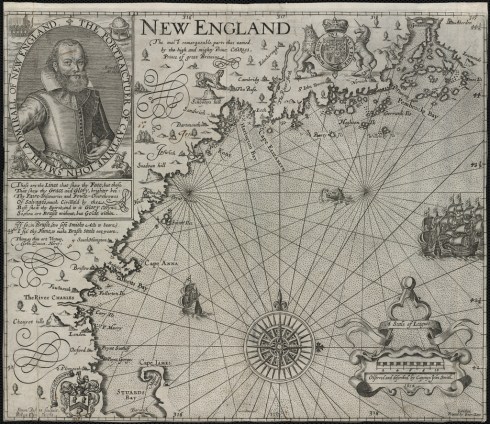
Jumping forward several decades, New England begins to assume a recognizable shape, and gets its name, on the 1624 map of Captain John Smith, based on his explorations of a decade before.  This map was first published just after Smith’s return to England, and was very influential in the Pilgrims’ planning.  Here you see a very realistic Cape Cod (named “Cape James” for the King) and lots of English place-names, some of which stuck, most of which did not. “Cape Anna”  did become Cape Ann, though Salem (or Beverly, I can’t tell)  replaced Bristol and my home town of York did not retain its designation of “Boston”.

As there was constant competition for colonial territory in North America, French and Dutch maps also depict New England and its waters in detail.  Dutch cartography was the most advanced in Europe in the seventeenth century, and Dutch mapmakers issued a succession of “Nova Anglia, Novum Belgium et Virginia” maps from the 1630s, including that of  William Blaeu below.  Despite its distinct orientation, Cape Cod (or Codd) is immediately recognizable, and it is equally prominent in two late seventeenth-century English maps.  The last map below, published by John Seller in 1679, is entitled A Chart of the Sea Coasts of New England, New Jarsey, Virginia, Maryland & Carolina from Cape Hatteras to Cape Cod.  European cartographers clearly had a grasp on southern New England by this time, but northern New England, most especially Maine, remained elusive.

In the eighteenth century, everything intensified:  competition for empire, mapmaking technology, and settlement, consequently we see quite sophisticated political and navigational maps, like the detailed charts of the Atlantic coastline by the Swiss-born cartographer Joseph Frederick DesBarres, produced for his 4-volume atlas American Neptune (1777-1781).  The marine galleries at the Peabody Essex Museum feature a blown-up version of the DesBarres charts, revealing their intricate detail much more effectively than is possible here.


By contrast, London publisher Carington Bowles’ “pocket map”, also issued in the Revolutionary era, emphasizes the Inhabited parts of New England (Library of Congress).

From Ruscelli to Russell.  After the Revolution, New England endures as an assemblage of states rather than colonies.  The John Russell map of 1795 illustrates the “Northern or New England” states of America, and the District of Maine, just prior to the boundary settlement between America and Great Britain.

And finally, a completely different view of the Cape, from a century later and the golden age of  “bird’s eye” maps:  looking southward from Boston.