Tag Archives: Local Events

Just One Remond Triumph in Salem

I’ve been collecting all sorts of information and anecdotes about the Remonds of Salem, an African-American family who are in the center of many movements and activities in mid-nineteenth-century Salem: they were zealous pursuers of the abolition of slavery and the desegregation of schools and transportation and every aspect of daily life and work, but they also advocated for other forms of social justice in their day, including women’s suffrage and the abolition of capital punishment. They were extremely entrepreneurial: the parents, John and Nancy Remond, served as the resident caterers of Hamilton Hall right, while also operating a number of sideline businesses until well in their seventies, and their children followed suit, pursuing advocacy work and building up successful businesses in the fields that were open to them. I’ve been fascinated with the Remonds—all of the Remonds—for quite some time, I guess ever since I moved into this house, right next door to what was their base of operations at Hamilton Hall, almost twenty years ago. I posted about them several years ago when Salem announced it would be naming a new park after the prominent abolitionists Charles Lenox and Sarah Parker Remond, but I know a lot more now. The Board of Hamilton Hall secured a grant last year to prepare educational materials on the Remonds, and I supervised a Salem State intern named Katherine Stone to help with the research: she uncovered some great family history, I kept going this summer, and I’ll be offering a general presentation of the family’s activities and networks on September 24 and 29 at Hamilton Hall as part of Essex Heritage’s annual Trails and Sails programming.

20190914_205430Some of my Remond files; for some reason I’ve been keeping all of the genealogical information in a notebook I bought in Portugal.

There’s a lot to say about this family: and that’s my central theme, that they worked together as a family, and as part of network of African-American families, both in Salem and up and along the northeastern coast, who all worked together to improve their lives and the lives of other African-Americans at a contentious but somehow still-hopeful time. At least it seems that way to me; I’m not trained in American history so my knowledge is impressionistic. The Remonds are kind of like my window into this time, and they are so gung-ho, I’m like, let’s go! But certainly they had their share of disappointments: they left Salem from 1837 to 1842 after Salem’s schools were re-segregated, transferring all of their energy, entrepreneurialism, and activism to Newport, Rhode Island, and poor Charles Lenox Remond, intrepid agent of the Massachusetts and American Anti-Slavery Societies, was always appealing for reimbursement of his expenses. The networks are so amazing: it’s no accident that Charlotte Forten, now herself the namesake of a Salem park, ended up with the Remonds when they returned and Salem’s schools were desegregated yet again, as well as another famous future educator, Maritcha Remond Lyons.

Remonds

Dinner 8Signatures of Susan, Nancy, and Maritcha Remond on a petition to abolish the death penalty, 1850, Harvard Antislavery Petitions Dataverse; Trade card from the Remond Family Papers, courtesy of the Phillips Library of the Peabody Essex Museum at Rowley, Massachusetts. The Library staff made lovely reproductions of several Remond items for me, and Hamilton Hall, and we’ll be using these in our educational materials.

There’s so much to say that I’m worried that my presentation will not have enough focus: it’s always easier to explain the importance of someone or something if you focus. I wish I could give an entire talk on just one of the Remond’s big dinners—and there were many: for the Marquis de Lafayette, for Chief Justice Joseph Story, for Nathaniel Bowditch, for President John Quincy Adams, and more. But I think the biggest dinner happened TOMORROW in 1828, a feast for the 200th anniversary of the arrival of John Endicott in Salem. It’s probably just because I have more sources for this particular dinner, but it seems to have been a very big deal. The Phillips Library has two menus for the dinner, a clean version and an annotated one: John Remond contracted for a fixed price with the owners of Hamilton Hall for these dinners, but if the number of attendants rose above the agreed-upon number he was paid more. He was not just the cook (in fact, I think Nancy was doing most of the cooking, with his elder daughters Nancy and Susan as they came of age–not for this dinner) he was very much the event planner: and no detail was overlooked. The newspapers recorded every detail of this dinner: all the attendees, all the speeches, and decorations, including “pictures of our distinguished forefathers, and of individuals of more recent date, whose characters, and whose services, were not forgotten in the libations of gratitude poured out upon this joyous occasion.” The article in The Salem Observer also noted “the tables loaded with the richest viandes, and the most delicious wines and fruits served up in elegant style by Mr. Remond. In the centre of the Hall, stood the identical table which belonged to Governor Endicott, and covered with a profusion of pears recently gathered from the tree which he planted.” [Where is that Endicott table?]

Dinner 6

Dinner 5

Courtesy Phillips Library, Peabody Essex Museum.

And then we have another, anonymous, account of a visitor who was in town for the big anniversary celebration and dinner. It was quite a day, a “grand celebration” in which it “seemed as if all Boston had moved to Salem. Many great men there beside myself.” This observer is constantly remarking upon the festivity of the day and wondering what the Puritan people of Endicott’s day would think of it: at the North Church for the anniversary program, he finds “the house blazing with beauty and fashion. Contrasted ladies with Puritan mothers. Imagined good dames of 1628 coming into assembly, and finding daughters decked out in such trim. Guessed they’d make fine havoc of laced veils, flounced petticoats, love-locks (???) and whole alphabet of sinful finery.” By the time that dinner rolls around in the later afternoon, however, our anonymous observer has forgotten 1628 and is completely in the culinary moment.

Anniversary Dinner Anonymous observer Salem_Observer_1828-09-27_[2]

Turk's Caps Book of Cakes

Salem Observer, September 27, 1828; turn-of-the-century Turk’s Caps from the Book of Cakes (1903) by T. Percy Lewis and A.G. Bromley.

Tables loaded with dainties of all climes…..went through the whole bill of fare from oyster-patties to transmogrified pigeon. Thought Remond best cook in the universe. I guess he still has 1628 on his mind a bit (before he gets into the champagne), as he “wonders what Pilgrim Dads would have said to such a carnival.” This is a colorful illustration of the authority that Mr. Remond (he is generally referred to as Mr., though also by just his last name) held throughout his career, and it is very clear from all the references I have collected that this is an authority that extended to his family, and that came not only from their professional achievements but also their role in the community, in Salem. So I just have to establish this is my presentation in the most succinct, but yet revealing and representative, way. And regarding this menu: it looks impressive and exotic to us, but these are some pretty conventional dishes for the early 19th century, with recipes that can be found in a succession of European and American cookbooks. I explored Pigeons Transmogrified here, Green Turtle soup is everywhere in the nineteenth and early twentieth centuries, and teals are small ducks. Molded jellies are also very popular in this time, and a “Turk’s Cap” was a tubed and scalloped mold used primarily for cakes: in Remond’s time they look like pottery versions of a bundt-cake mold, but later on they were made of cast iron and resemble muffin tins. The use of the plural in the menu suggests individual little cakes to me, and Nancy Remond was by all account a spectacular baker well-ahead of her time–but I’m not sure her Turk’s Caps would have been quite as “Victorian” as those above. So here you have the other challenge before me: not letting the delicious little details get in the way of the big picture.


Requiem for a Carriage House

There is nothing, nothing, that is worse than neglect, of anything that is in your care. I am always material-minded so I’m going straight to architecture: demolition by neglect infuriates me. It’s expensive to own an old house: I have a long list of tasks that my house needs and I wish I could spend the money that I’m going to spend on the house on travel, or a Sheraton sofa, or lustreware from the 1820s, but I can’t: I bought this house and I therefore I must be a responsible steward of it. I work hard to maintain it in the condition that it demands, as does my husband. The down payment for this house came from money I inherited from my grandfather, who also worked long hours to provide for his extended family; his father came over on a boat from southern Italy all alone at age 10 and worked as a tailor to send all four of his American-born children to college (even the girls) and leave them legacies which they passed down to their children. My legacy is my house, and I would never neglect it: it would be an insult to my family as well as my community. So when I see families of much more ancient American lineage, with the possessions to prove it, exhibiting carelessness at best, and neglect at worst, towards their properties, I get mad. Such is the case with a beautiful brick Federal house overlooking the Ropes Garden, left to rot for years by a family that first arrived in Salem in the seventeenth century, and only recently undergoing renovation. This house will be saved, at long last, but its owner has applied for permission to demolish the mansard-roofed carriage house in the rear of the property. The Historical Commission rules through the granting of certificates: non-applicability, appropriateness, hardship. The owner of this carriage houses seeks the latter, but this is clearly a case of willful neglect over many, many years, initiated by a man who is called, incomprehensibly, “an outspoken champion of historic preservation” in his obituary and carried on by his heirs.

20190903_072519

20190903_072752

20190903_072840

Felt House and Carriage House 2

20190903_073056

As you can see from the photographs (the black-and- white is a Frank Cousins view from the 1890s and the Phillips Library of the Peabody Essex Museum), the Victorian carriage-house doesn’t exactly go with the Federal house adjoining it: it was built as an outbuilding of the Italianate George. C. Shreve house fronting Federal Street and only purchased by our “outspoken champion of historic preservation” in the late 1960s, I believe. The Shreve House was converted to condominiums a while ago, and its residents are probably very tired of having this derelict building looming over their parking lot. But what a loss: of a once-elegant structure, of historical texture and fabric, of opportunity. It’s not difficult to find examples of Victorian carriage houses transformed into residences of all kinds, and just when the City of Salem is seeking to expand its inventory of “accessory dwelling units” (ADUs) in response to an intensifying housing shortage in our region, the impending demolition of this likely candidate seems even more tragic.

Carriage House Kauffman CMA

CARRIAGE-HOUSE-2Larry Kupferman, Victorian Carriage House, Carnegie Museum of Art; the converted carriage house at A Cambridge House Inn, Cambridge, Massachusetts.


Boats and Bells

This past weekend was beautiful, with just a touch of autumn chill in the air and no discernible humidity. I spent Saturday painting my front fence, which is just about the most social thing you can do in a small city, and Sunday we went to one of my favorite annual Salem events, the Antique & Classic Boat Festival, and then to the Salem Maritime National Historic Site for its commemoration of 1619, the year that enslaved African-Americans officially first set foot in North America. The very clangy bell of the site’s reproduction East Indiaman Friendship (back at Derby Wharf after many years in dry dock for repairs, but still missing its masts) rang out for several minutes, along with bells across America, at precisely 3 pm. We had planned to go out on our own boat, but it was just too breezy, so we were seaside (or harborside) wanderers all day long, which was not very difficult duty.

20190825_130815

20190825_130840

20190825_132638

20190825_142109

20190825_141518

20190825_132805

20190825_134859

20190825_132619-1

20190825_140113

20190825_140231

20190825_135846

20190825_135012

20190825_132345

20190825_140817

20190825_131026

20190825_140616

20190825_142406

Just some boat shots which I’m not really equipped to annotate—my favorite was the Half Circle, second to last above, a 1954 pocket cruiser. Between the boat show and the bell-ringing, we stopped at the Derby Street gallery of local artist Paul Nathan–more boats were there and these really cool eyes. The onto the Friendship.

20190825_143833

20190826_094206

20190825_144907

20190825_150005


The Architecture of Memory

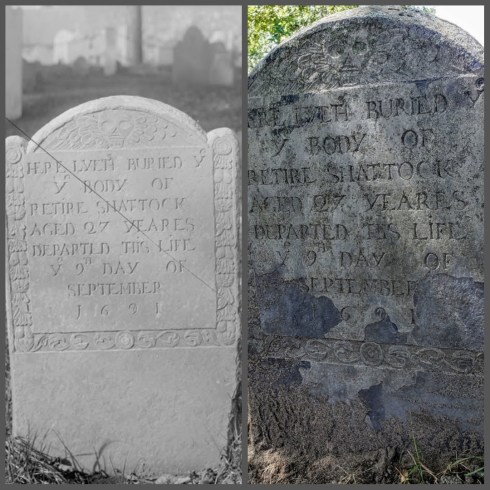
I suppose it’s a bit melancholy to be dwelling on cemeteries in the midst of a golden August but the community conversation around the proposed closure of Salem’s oldest cemetery, the Old Burying Point on Charter Street, during October when it is besieged by crowds, has my head spinning in several directions. I’m thinking about preservation, education, memory, and reverence, public history and family history. Cemeteries are more complicated than I thought, but generations past valued these spaces in ways worthy of revisiting, and to do so I started searching through some old photographs of Charter Street, most by Frank Cousins, whose large collection of glass plate negatives has recently been digitized by the Peabody Essex Museum and Digital Commonwealth. There are no people in Cousins’ photographs of Salem cemeteries in the 1890s and 1910s, so they don’t shed any light on social practices, but the fact that he made so many photographs of both graveyards and gravestones is a testament to their perceived value in the urban landscape. I always thought of Cousins as primarily an architectural photographer, but of course cemeteries are a form of architecture, and he was also a contemporary of Harriette Merrifield Forbes (1856-1951), whose Early New England Gravestones and the Men who Made Them, 1653-1800 (1927) was a groundbreaking work on colonial funerary art. Forbes included Charter Street gravestones in her work, and I think every single regional guidebook from this fledgling age of heritage tourism drew Salem visitors to the Old Burying Point in general and the graves of Bradstreet, Mather, Lindall, Hathorne, McIntire, More (and more) in particular.

Charter Street Forbes

Charter Cousins_00314 Lindall

Charter Street LindallIt seems as if Timothy Lindall’s gravestone has always been in the spotlight.

Cousins photographed all of Salem’s cemeteries–the “newer” ones, Greenlawn and Harmony Grove as well as the Colonial grounds, Broad, Howard, and Boston Streets—but he really focused on Charter Street, in more ways than one. We see all the details of the individual stones as well as the big picture, including a built context which is very different now. The photographs are just beautiful, and important, as he captured fragile objects for all time.

Charter First

Charter Cole

Charter Pratt

Charter James Jeffrey

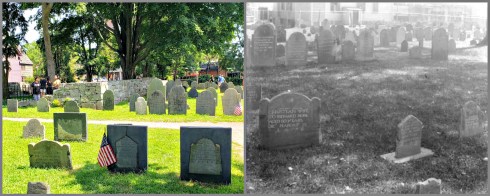
The fragility of these memorials is very apparent when we compare Cousins’ photographs to their condition today (though I am not the photographer that Cousins was obviously and I think black-and-white really serves cemetery photography better). Of course time wears everything down, and the competing demands of Salem’s rich material heritage necessitate prioritization: as I said in my last post, I think the City should be commended for its preservation initiatives of recent years. But we really need to remember that these memorials are going to deteriorate under the best of conditions, and the intense crowds of every October are the worst of conditions.

pixlr

pixlr-1

pixlr-2

pixlr-3

Charter Cousins Mores Collage

pixlr-4I feel particularly bad for Mr. and Mrs. Nutting, put to rest in a lovely calm neighborhood and now in the midst of the Salem Witch Village! And I really wish that Cousins had photographed my very favorite Charter Street gravestone: that of Mr. Ebenezer Bowditch. What are those carvings? Does anyone know?

20190816_120541

When our descendants look at photographs of the Old Burying Point in our time a century from now, what will they see? I really hope it’s these weathered but still-stately stones, and not the props I saw when I searched through several social media sites with the hashtag #salemcemetery. This is just a sampling, I’m sorry to say.

pixlr-5Old Burying Point Cemetery, Charter Street, Salem, October 2017 & 2018.


A Cemetery under Siege

The Agenda for the meeting of the Salem Cemetery Commission tonight includes a “Recommendation to Close Charter Street Cemetery during  October”. I support this recommendation, and urge others who do so to either attend the meeting or forward their thoughts to the Commission. Here is my letter.

I urge the Salem Cemetery Commission to authorize the complete closure of the Old Burying Point Cemetery on Charter Street during the month of October, when it is clearly exposed to unrelenting population pressures which threaten its vulnerable monuments and landscape. Certainly it is within the discretion of the Commission to authorize this closure and provide access to those who formally request it on a much more limited basis. Salem already has one closed cemetery, the Quaker Burying Ground on Essex Street, and the Massachusetts Department of Conservation and Recreation grants municipalities wide latitude in their recommendations for library stewardship, particularly for historic cemeteries located in urban areas. The City of Boston has closed nine of its 16 historic burying grounds.

The City of Salem is to be commended for its preservation initiatives of recent years, including the ongoing restoration work at Charter Street funded by the Community Preservation Act and the Massachusetts Cultural Council, and the safeguarding of this investment is certainly an important justification for the closure of the cemetery during October. Another reason, equally compelling, is the opportunity for the City to express reverence for a site that is not only historic, but sacred. The dramatic escalation of Haunted Happenings has turned downtown Salem into a for-profit playground during much of the fall, and the Charter Street Cemetery and bordering Witch Trials Memorial must be excluded from this commercial context: their unfortunate proximity to the adjacent Salem Witch Village diminishes (no, eradicates) the line between carnival and commemoration.

As an educator, it concerns me to see any historical resource removed from public access. I wish that the Charter Street cemetery could serve as an authentic counterweight to the dramatic excesses of Haunted Happenings where visitors could learn from real remnants of the past but that can’t happen in an environment of crushing crowds and rampant irreverence; instead it is utilized as a textual backdrop for photographs at best and for more active endeavors at worst. Over the years, I have seen people eat, drink, sit, lie, jump, dance and skype on or near graves in Charter Street; I didn’t see the infamous diaper-changing incident but was not surprised. It’s lovely to trail behind individuals and families in April or June or even September as they read the inscriptions and revel in the sheer weight of the past that is so very evident in our most ancient cemetery, but that’s not possible in October. October in Salem is a time for a quite different type of revelry, and the Old Burying Point should not be its scene.

20190812_125343

20190812_125405

20190812_125218

20190812_125030

20190812_124932

20190812_125514The Old Burying Point on Charter Street in mid-August.

Charter Street Linden Tea FlickrThe Old Burying Point in October via @Linden Tea on Flickr.

Update: last night the Cemetery Commission voted to continue the matter to its September 10 meeting. The Friends of the Downtown Salem Historic Cemeteries submitted a proposal to the Commission which you can see on their website: https://www.salemcemeteries.org/. This proposal calls for the Old Burying Point Cemetery to remain open during the week and be restricted to approved tour groups on the weekends. I have great respect for the Friends group, which has been advocating for better interpretation and preservation of the downtown cemeteries for several years, but I think I’ll stand by my statement and plea for complete closure during October: I have simply seen too much disrespectful behavior in the cemetery and I have the luxury of speaking only for myself rather than having to mitigate between different vested interests as the Friends group does. To me, Charter Street is a cemetery, rather than an “attraction”, and I think we owe the Dead and their families more respect than we do tourists accommodation. But Charter Street is also a public space, and a public process in which all interested parties have an opportunity to weigh in must govern its use, so I’m grateful to the Cemetery Commission for overseeing this process, and to all parties for their input.


Whirlwind Weekend

I am pleasantly tired at the end of a busy weekend, which included: a sunset sail, several garden walks, a tour of the Coast Guard’s tall ship Eagle, long conversations into the night, the annual vintage car show on Chestnut Street, and a Red Sox game. Highlights of a New England summer all in one weekend! We have (for now) made it out of the muggy days of midsummer and are in the golden days of late summer: no humidity, just bright sun, warm days and cooler nights with just a whiff of Autumn in the evening breeze. The disappearance of humidity always recovers my will to live: I am not a summer person, but as long as there is a cool breeze mitigating the hot sun I’m fine—-everybody’s fine. I’m sure the humidity will return—and Fall will be here soon—which makes beautiful August days like these all the more precious.

20190809_194910

20190809_200341

20190810_121237

20190810_121143

20190810_131746

20190810_130914

20190810_130640

20190810_130449

20190810_130432

20190810_130426

20190810_130231

20190811_105355

20190811_105608

20190811_105142

20190811_110313

20190811_110138

20190811_105121

20190811_105416

20190811_105844

20190811_110435

20190811_122918

20190811_125522

20190811_151931Mid-August in Salem and Boston: a sunset sail on the Schooner Fame Friday night, Salem Story Walk in the Ropes Garden & a visit to the US Coast Guard’s Barque Eagle on Saturday, the Phillips House-sponsored annual vintage car meet on Sunday morning, at Fenway Sunday afternoon (the Red Sox lost in extra innings–I was so impressed with the score-keeping of the kid in front of me, who only took a break for an ice cream cone).


Pinnace in Port

The highlight of this year’s annual Salem Maritime Festival, hosted by the Salem Maritime National Historic Site, was the Kalmar Nyckel, a reproduction seventeenth-century full-rigged pinnace built by the state of Delaware as a tribute to the Scandinavian founders of New Sweden, who were transported across the Atlantic on such a ship. While we’re all happy to have our own reproduction East Indiaman, the Friendship, back in Salem Harbor after a long spell away, the two ships called to mind a cardinalesque comparison with the brown and still-mastless Friendship looking like the drab female, and the colorful Kalmar Nyckel as the dashing male. Just to push the bird analogy a bit further, my husband referred to the latter as a “peacock” of a ship. And it is.

Pinnace CM

20190804_111618

20190804_111454

20190804_110648

20190804_111054

20190804_111000

20190804_111219

I thought I knew what the word “pinnace” meant: a small ship’s boat, used for landing and other purposes which required a smaller size and more flexibility. Apparently the Dutch, the most innovative and productive shipbuilders of the seventeenth century, adapted the pinnace design to create a larger full-rigged version for war and trade, and the original Kalmar Nyckel and many of the ships you can see in all of those golden-age Dutch seascapes represent this innovation. The English built larger pinnaces as well: the first of many ships named The Defiance went head to head with Spanish galleons during the attack of the Spanish Armada in 1588 and Governor Winthrop reported that several daring Salem men took pinnaces all the way to Sable Island off Nova Scotia in search of “sea horses” (walruses) in the later 1630s.

Pinnace Cornelis_Verbeeck_-_Een_Nederlandse_pinasschip_op_een_woelige_zee

Pinnace Playing Card Collage

Pinnace RiggedCornelis Verbeeck, A Dutch Pinnace in Rough Seas, National Maritime Museum of the Netherlands; Armada cards from the later 17th century, Royal Museums Greenwich, Wenceslaus Hollar, view of the Tower with pinnace-rigged ships, 1637, British Museum.

So it was great to see a pinnace in Salem Harbor again, along with a reproduction Viking ship, and booths representing (and reproducing) all the traditional maritime crafts and various local organizations, along with myriad performers, on shore. Salem is very fortunate to have the constant institutional presence of Salem Maritime, whose staff operate all of its venues and initiatives (including the Salem Regional Visitor Center) in such a professional and engaging manner. This year marks the 200th anniversary of the Custom House, and no building—-certainly not the Witch “Museum” or even a creation of Samuel McIntire— represents Salem’s multi-layered past better.

20190802_110232

20190802_110521

20190801_210326


(Reen-)Action in Marblehead

There is filming or preparation for filming all around us this July: on Salem Common, in Forest River Park, in nearby Danvers and Marblehead. On Saturday I drove over to see Marblehead’s Old Town dressed as Salem during Halloween for a Netflix film starring Adam Sandler titled Hubie Halloween. I knew that the Revolutionary reenactment company Glover’s Regiment would also be camped out at Fort Sewall in Marblehead, and I thought the two “sets” might make for an interesting cultural clash. I was right: it was a theatrical afternoon. I have to admit to being a little annoyed that Salem could not play itself: we have to deal with the real Halloween but aren’t good enough to play the fake one? But watching the set designers put together their perfect Halloween town, it was obvious that they were going for a cute, hometown Halloween, not the darker version that has emerged in Witch City. At least Salem Common will see some action. The camp at Fort Sewall was well-established by the time I got there, with cream canvas tents all in a row, and visiting “French” and “British” soldiers—the latter were appropriately camped outside the fort’s walls!  For an hour or so, it really did seem like I was wandering around some Hollywood backlot to go from Halloween in July to an eighteenth-century encampment.

20190713_124346-1

20190713_134107

20190713_124537

20190713_124703

20190713_134040

20190713_133935

20190713_133633

20190713_125438

20190713_125234

20190713_125348

20190713_125425

20190713_131439

20190713_130837

20190713_131017

20190713_131335

20190713_131306

20190713_131720


Salem’s Newest Park

Salem’s newest public space was recently unveiled, situated in the former gas station/carnival lot at 289 Derby Street along the South River. The reaction has been a bit mixed, I would say. I think some people were expecting more of a green space, but it is not really that kind of park; it’s more of a concrete (plaza? court? square?) built for activity rather than rest and contemplation. Some people are critical of its cost, particularly of the land. It’s also been identified as a homeless magnet, which strikes me as an unjustified criticism as it is a public space after all. I first went down to see it on a bright sunny day and it did seem a bit inhospitable as it is primarily a bright swath of concrete, but I returned at night and found it much more inviting. I’ve decided that I like it: the swings, the topographical “maps”, and particularly the lighting around the perimeter.

20190705_100841

20190705_101253

20190705_101054

20190705_101017

20190705_202228

20190705_202240

20190705_101037

20190705_202151

20190705_203125

20190705_101145

20190705_203205

As you can see, it’s built for movement (and sound), to be a happening place rather than a tranquil one, so when things start happening we will see how the space works. We have been invited to name the new park but restricted in our choices: South River Park, Charlotte Forten Park, Nathaniel Bowditch Park, 289 Derby, Naumkeag Park. While I’d love to see something in Salem named after Charlotte Forten, the first African-American teacher in the Salem Public Schools and a graduate of Salem State, this is not the place: I can’t see how it has anything to do with her, spatially, thematically, or aesthetically. Same with Bowditch; the other names are bland and generic. Because this is a playful place, I propose moving the dreadful Samantha statue from Town House Square (where she does not belong) to this new park and naming it Bewitched Park. People seems to think that a few days of shooting that show on location here in 1970 somehow saved Salem by enabling it to realize its full potential as Witch City, so naming rights seem in order.


Mid-Century Maritime

The Peabody Essex Museum’s new building, or at least its exterior, is now completed, creating a sweep of contrasting structures along Essex Street, with the East India Marine Hall centered between two more modern monolithic structures. During the long construction process, and after we learned that the PEM would be removing Salem’s archival heritage to a new Collection Center in Rowley, it was revealed (not in a press release, of course) that the large anchor which was placed in front of the Marine Hall over a century ago would also not return. I believe it’s up in Rowley too. I don’t know the rationale for this decision with absolute certainty, but I did hear a rumor that the leadership of the museum believed that the anchor reeked of “maritime kitsch”, which is obviously incompatible with its new profile and identity. If that is indeed the case, it’s amusing to see several “Ladies of Salem” figureheads hanging prominently in front of the PEM’s sleek facades.

20190617_091632

20190617_091657

20190617_091739

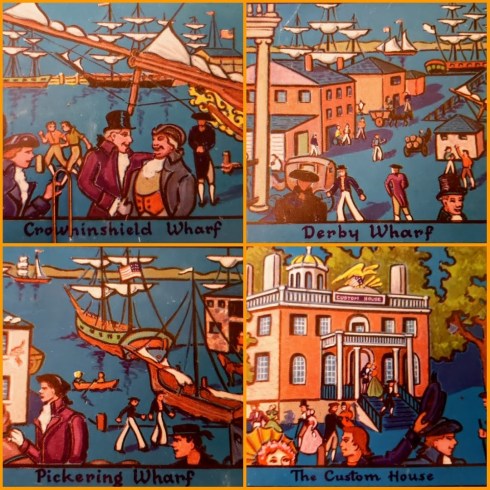
Salem is awash in witch kitsch; I think a little maritime kitsch would balance things out. But the anchor is hardly kitschy when you compare it with some nautical designs from half a century ago, when Salem was embracing its maritime identity a bit more than its witch-trial one: before Bewitched white-washed the latter and paved the way for full-scale exploitation. The sleek nautical images of the 1920s and 1930s gave way to more idealistic and pictorial depictions in the 1940s and 1950s, and I don’t think you could find any better representative of this mid-century aesthetic than the marketing materials of the Hawthorne Hotel. I have a menu and a flyer which present a very colorful past, enabling the hotel to offer “the charm of Old Salem in a modern manner.”

20190618_203026

20190618_203119

20190618_203139

20190618_203051

pixlr-1

I don’t really see how the Hawthorne’s 1950s lobby “captured the spirit of Old Salem”, but its Main Brace cocktail lounge was indeed very “salty”. It featured murals by the Rockport maritime artist Larry O’Toole, who also produced a famous pictorial map, “A Salty Map of Cape Ann”, in 1947-48, as well as maritime murals and paintings commissioned by institutional and individual patrons. The netting, the captain’s chairs, the mural: not a nautical detail was overlooked in the Main Brace.

20190618_204044

20190618_204349

Mid Century Maritime HH Main Brace 1942

Mid-Century MapThe Hawthorne Hotel’s lobby and Main Brace cocktail lounge; Jonathan Butler, Harriet Shreve & John Pickering X in the Main Brace c. 1942 from Kenneth Turino’s and Stephen Schier’s Salem, Volume 2 (Arcadia Publishing, 1996); Larry O’Toole’s Salty Map of Cape Ann from Geographicus.

The idealized maritime aesthetic was not just a presentation or projection: it was also a perspective, as illustrated in the many “great men in their great ships” books which were published in the 1950s and 1960s portraying American history as the history of expansion by land and sea—-and Salem playing an absolutely central role in the latter. Consequently when tourists came to Salem they wanted to see the remnants of this glorious past. Arthur Griffin’s photographs of Salem in the 1940s and 1950s (at the Digital Commonwealth) depict well-dressed tourists looking at all manner of maritime relics in the old Peabody Museum of Salem: how far we’ve come from that innocent age.

Mid-century Collage

mid century collage 2

Mid Century Griffin 3