Tag Archives: Local Events

The Forces Align

This past weekend was happening; the streets of Salem were full of tourists and the historical events in which I was somewhat involved came off very well: the Salem Resistance Ball at Hamilton Hall and the “Salt Cod for Silver” symposium at the Salem Maritime National Historic Site. Clever costumes and a joyful spirit imbued the former, while a packed house turned out for the latter—for fish, and a deep dive into this often-overlooked Atlantic trade which brought a lot of wealth to Salem and the North Shore. The Resistance Ball is kind of important to me for several reasons, so I’m very grateful to everyone who made it a success. It benefited Hamilton Hall, a beautiful historic hall with a slight endowment that has to work for a living: the more support the Hall gets from its fundraising activities the more it can support the community (as for example, by providing its ballroom to Salem High School for the Junior Prom free of charge on Friday night) and the fewer weddings it has to host. I live right next to the Hall and I was president of its Board of Trustees for six years. But more than all of that, this particular event represents a relatively unique attempt to showcase the comprehensive and the progressive forces in Salem’s history, rather than one singular dark event that serves (and provides) the basis for constant exploitation. This is a city in which the commercial symbol of that exploitation is situated in its chief city square, so an event that celebrates resistance to: British rule in particular, imperialism in general, segregation, slavery, gender and racial discrimination, inequality, let alone Star Wars, is very welcome. Hester Prynne was in attendance as well as a lightsaber-wielding Rey. There is always some power force which provokes resistance, so how universal is this theme?

Forces 10

Forces 11

Forces 9

Forces 6

Forces 13

Forces 7

Forces 14Tried to get more juxtapositions of historical and modern dress but what can I say? I was enjoying the party! Above is my beautiful friend and a very talented seamstress, Louise Brown, in her own creation of course. Below is our committee (with a few conspicuous absences) with chair Michael Selbst in the middle, to the right of me! And then we have some swag…..thanks to all our sponsors too!

Resistance Ball Committee

Forces Swag

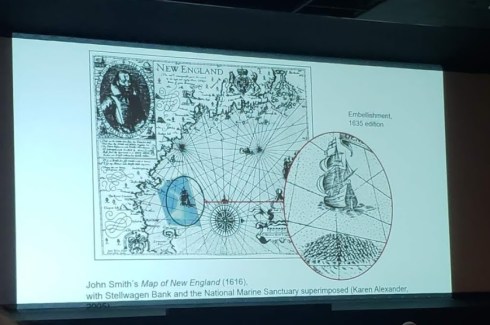
Saturday night to Sunday afternoon: from festivities to fish! Salem is so fortunate to have a National Park in its midst: the Salem Maritime National Historic Site is always the perfect host, the perfect partner, the sole steward of our maritime history with the retreat of the PEM. The symposium went off beautifully and I was particularly interested to see some maps I had never seen before in the presentation by Karen Alexander of the University of New Hampshire (including a 1774 map from the British Museum which shows a very-populated and strategic Salem). It’s always interesting to hear about how port cities actually work, and I thought that Xabier Lamikiz of the University of the Basque Country explained the inner (and outer) workings of Bilbao really well. It was kind of odd to be staring at a screen with sources from the Phillips Library while the Salem storage facility for the same was being dismantled just next door, but I doubt very many people in the crowd were aware of that dissonance.

Forces 1

Forces 4

Forces 3

Forces 2

Forces AlignScenes from the Salt Cod for Silver Symposium, and the demolition of the Stacks next door.


Historic Happenings in Salem

As always, I’m excited for the Salem Film Fest commencing this weekend and running through most of next week, but next weekend will see two big events inspired by Salem’s dynamic 18th-century history: the Resistance Ball at Hamilton Hall on Saturday the 6th, and “Salt Cod for Silver: Yankees, Basques, and the North Shore’s Forgotten Trade”, a symposium focused on greater Salem’s trade with the Basque port of Bilbao on Sunday the 7th. I wish every weekend in Salem could be like next weekend, highlighting history in creative, comprehensive, and collaborative ways. The Resistance Ball is co-sponsored by Hamilton Hall and the Leslie’s Retreat Committee, dedicated to the ongoing interpretation and commemoration of the event of February 26, 1775 in which a large group of Salem citizens foiled the attempt of a British regiment to confiscate concealed cannon in particular and the spirit of resistance in general, while the “Salt Cod for Silver” symposium is co-sponsored by the Salem Maritime National Historic Site, the Salem State History Department, Historic Beverly, the Marblehead Museum, and the Bilboko Itsasdarra Itsas Museoa (Bilbao Maritime Museum).

20190329_081935

Historical Flyer

I am going to both events and you should too if you are in our area: tickets for the ball are still available here, and the symposium is a first-come, first-seated event (the capacity is 200 at the Visitor Center). This is the second run for the Resistance Ball, and we hope to make it a regular occasion. Do not be deterred by fear of period dress: there will be some 18th-century dress (both reproductions and costumes) in attendance but also formal and creative garb. I prefer to be inspired by the spirit of resistance rather then the actual eighteenth-century event myself. I made a list of my favorite female resistors, and at the very top was Joan of Arc, but I do think this is an American history-themed event so I am forgoing armor in favor a toile dress with quite a modern, short cut: I guess I’m just going as myself, the perpetual PEM resistor! There will be period dancing, but again: do not be fearful: the caller from the last ball, whom we have engaged again, was an amazing instructor and so it was really easy and fun to participate.

Salem Resistance Ball

Salem Resistance Ball2There WILL be fiddlers—and dancing! (Not really sure who took these pictures at the last ball two years ago, sorry)

I’m excited about the symposium for several reasons. In terms of interpretation, it seems like all Salem trade is China trade and even a cursory glance at the sources contradicts that perception. Yet I imagine that China is still part of the picture. Years of teaching European and World History in the early modern era has familiarized me with the concept of the Chinese “Silver Sink”: the west wanted so many things from China, but all it really had to offer (before Indian opium) was American silver, the first truly global commodity, and consequently much of it ended up there. So North Shore merchants are trading are trading fish for silver, which I presume they are using to purchase Asian wares and commodities? A variation on the same theme, or did more silver stay in Salem rather than just flowing eastward? We shall see. Any research on this trade has got to be based on the rich sources in the Phillips Library, so it will be wonderful to hear about what has been mined in these treasures, particularly the papers of the Orne and Pickman families. (The Essex Institute used to publish such information: see the wonderful text by its librarian Harriet Tapley published in 1934, Early Coastwise and Foreign Shipping of Salem; a Record of the Entrances and Clearances of the Port of Salem, 1750-1769). And of course I’m also eager to discover the stance of Great Britain regarding this trade, particularly before the Revolution.

The Ornes

cousins-timothy-orne-house-266-essex

Salem merchant Timothy Orne, flanked by his daughters Rebecca and Lois, in paintings he commissioned from Joseph Badger in 1757. The portraits of the girls (I have always loved Rebecca and her squirrel, so I took this opportunity to showcase her again, and Lois is the mother of the woman who lived in my house for its first few decades) are from the Worcester Art Museum, and the Orne’s portrait belongs to the Newport Restoration Foundation.  The Orne House at 266 Essex Street (here in a Frank Cousins photograph from the “Urban Landscape” collection at Duke University Library) is still standing, though much changed. Orne is a very good representative of Salem’s “codfish aristocracy”, with more than fifty ships in operation over his commercial career, sailing to the West Indies and Europe and carrying fish, spirits, molasses, cloth and other commodities, as well as slaves, in addition to a fleet of fishing ships.

Below: As I don’t think the technology of drying cod has changed over the centuries, I thought I’d add this photograph of a shop in Lisbon two weeks ago.

Cod in Lisbon


Receptive Reenactments

I do not think that most professional historians care for reenactments of past events, primarily because of their belief that people in the present can never truly “reenact” the past and so any attempt to do so will lead inevitably to trivialization. There is also a general disdain for battle reenactments, which seem to dominate such endeavors. I share those views, but I also see a lot of positive aspects of communities coming together to explore various aspects of their past. I think activity is important, especially for the generation I’m teaching now, whose engagement in the past seems confined to video games. I was fortunate to grow up around reenactments of the more “festival” type, so I don’t associate period dress-up with formations necessarily, and here in Salem I’m an enthusiastic supporter of any attention to any event that does not revolve around profiteering from the tragic events of 1692. Looking at reenactment trends, it appears that we’re moving away from big battles and towards progressive social movements: suffragists, labor actions, protests. There are attempts to capture the spirit of the past in more engaging “pop-ups”, rather than by slavish devotion to every little stitch: just contrast this New York Times article about the diminished ranks at Gettysburg with this blog post on events celebrating Chicago’s more colorful past. Even though I am having real difficulties with the writing of PBS’s Victoria this year, I did like Lucy Worsley’s recreation and reenactment of Victoria and Albert’s 1840 wedding, which was all about the details: dress, venue, menu, CAKE. BUT Worsley was able to take all those details and weave them into something that had lasting significance: the reinvention of the British monarchy in the nineteenth century through big majestic events. Obviously we are still affected by royal weddings today.

Reenactment Cake

Leslie’s Retreat (which happened on this date in 1775), is a perfect event for reenactment as it involves both a military maneuver and social protest against that maneuver, is a local event that can be tied into a much larger context, and must be played out with both words and actions. Despite the weather, the third annual enactment went off very well on Sunday: instead of taking it outside and down to the riverside, everything happened in the confines of the First Church. Even though his role is mythical, Major Pedrick warned the congregation of the imminent arrival of the British, they marched, the compromise was reached, and the reception began.

Reenactment 2

Reenactment 10

Reenactment 1I am not showing you Major Pedrick because he should not have been there!

Reenactments can trap you in their details if you are not careful. Even though it was largely irrelevant to the day’s discourse, I became fixated on the logistics of the British soldiers’ landing and march. So off to Marblehead I went, to see the two referenced landing locations, very near to one another, and then their possible routes to Salem. There I also saw the Marblehead plaque marking the occasion, which (like the account of Samuel Roads in my last post) seemed to imply that the story was all about Marblehead!  Well there you have it: there are at least two sides to every story, so you might has well just aim for the spirit of the occasion.

Reenactment 3

Reenactment 8

Reenactment 9

Receptive Reenactment

Reenactment 5

Reenactment 6

March Map 1776 2 Des Barres

Thanks to Tom P. for leading me to what I think are Homan’s Cove and Lovis’s Cove, the landing places referenced in the sources. From there I presume that the British marched through the town of Marblehead (on what streets I do not know) and then to Salem along the above road on the 1776 Des Barres map (Leventhal Map Center, Boston Public Library).


Reports of Leslie’s Retreat

This weekend brings the third annual commemorative reenactment of “Leslie’s Retreat” to Salem, an enthusiastic event that I think everyone enjoys because of its non-commercial, non-1692 focus: at least I do! The reenactment marks an event which might have sparked the American Revolution weeks before Lexington and Concord, if shots had been fired; it was nonetheless a notable occurrence of an armed (and potentially very dangerous) resistance. In late February of 1775 General Thomas Gage, the military governor of Massachusetts, got wind of a store of cannon in Salem and dispatched Lieut. Col. Alexander Leslie and 240 soldiers of the 64th Regiment by ship from Boston to Marblehead on the 26th (a Sunday!), with instructions to march to Salem and seize them. There’s a lot of whispering and distrust in this story as the “Tory” and “Patriot” sides do not seem firm, but several Marblehead patriots rode ahead in Revere-like fashion and warned the people of Salem, and thus “the Sabbath was disturbed”. By the time the soldiers arrived in Salem a crowd had assembled in the vicinity of the (old) North Bridge, as across the North River was the blacksmith’s shop where the cannons were being affixed to field carriages. A prolonged standoff ensued with the drawbridge raised, during which the cannons were moved west, several ending up in Concord, I believe. The bridge was lowered so that Colonel Leslie could fulfill his orders, but it was too late, and so he and his troops turned around and marched back to Marblehead, their ship, and Boston. I’ve written about this event several times (here and here), there’s a nice narrative of events here, and the most insightful accounts are on J.L. Bell’s brilliant blog Boston 1775 (I especially like this post but check this one out too, and this one), so there is no need to go into any more detail, but there are three issues I’d like to raise, two “open” and one relatively new (I think, maybe not, not my period!), all from newspaper accounts written in the weeks after Colonel Leslie’s retreat from Salem.

Leslies Retreat Collage

Leslies Retreat Newport Mercury

Leslies Retreat March 15 Masthead

There is some back-and-forth, especially in the first few weeks after the Retreat, but for the most part the papers are essentially publishing the standard story first published by the Essex Gazette. There are so many details to this story, however, that it’s notable what is put in and what is left out. So here are my “outstanding” issues, in the form of a question and two comments.

How many damn cannon(s) were there in Salem?  I can’t lock down the number (and I know “cannon” is plural but I think I have to use cannons here). Apparently General Gage had received reports that old ships’ cannons were being converted in Salem and eight additional cannons had been imported from abroad, while the Essex Register’s report on the Retreat included the assertion that twenty-seven pieces of cannon were removed out of this town, in order to be out of the way of the robbers. I’ve read (and quoted) seventeen cannons, nineteen cannons, and twenty cannons. I think we’ve go to go with the eyewitness account cited by J.L. Bell, in which Samuel Gray, who was nine years old at the time, went into the smithy on the day after and asked how many cannons had been there the day before and was told twelve; understood they were French pieces, and came from Nova Scotia after the late French war; were guns taken from the French; does not know to whom they belonged previous to being fitted up on this occasion. TWELVE. Gray’s remembrances were in response to interviews that Charles Moses Endicott conducted to produce his Leslie’s Retreat; or the Resistance to British Arms, at the North Bridge in Salem, on Sunday, the 26th of February of 1775, which was first published as a separate Proceeding of the Essex Institute in 1856.

 (The remembrance and reconstruction of what became known as “Leslie’s Retreat” enable us to see how Salem’s history was collected, preserved and interpreted by the Essex Institute, one of the founding institutions of today’s Peabody Essex Museum. Contrary to the claims of the PEM leadership: yes, the Essex Institute DID function as a historical society, and that’s why its historical collections, including its publications and historical manuscripts and texts assembled in the Phillips Library, constitute an important archive of Salem’s history, and no, no institution is fulfilling that role for Salem now, so the decisions to end the Institute’s interpretation and collection missions and remove its archival collections from Salem will have far-reaching consequences. These decisions were made by Mr. Dan Monroe, and since he has announced his retirement it is time to consider his legacy—and this is a truly momentous one.) Sorry–the spirit of RESISTANCE overwhelmed me!

Back to the question of the cannon(s): for some reason Endicott goes with 17 in his account, which has become classic, but he includes Gray’s number in his footnotes, clearly giving some credence to his claim. I don’t know why we can’t believe the boy: certainly his would have been a crystalline memory.

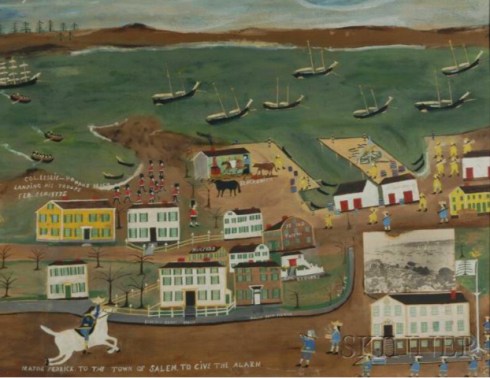
Major Pedrick was a Tory! None of the contemporary reports of the events of February 26, 1775 mention Major John Pedrick as the “alarming” figure who rode ahead of Leslie’s troops to warn the citizens of Salem of their imminent arrival, nor does Endicott. That’s because his role was made up after Endicott’s account. Pedrick was in fact a wealthy Tory who would not have been motivated to play such a conspicuous role at this time; he came around a bit later but anonymous Marbleheaders warned Salem on that Sabbath day. Again, I am relying on J.L. Bell’s succinct analysis of the “myth” of Major Pedrick, which has been perpetuated in the most recent scholarship as well as our reenactment. I was also inspired by Bell’s post to look around and see what else was made up about our event, particularly in the “creative” Marblehead accounts of the later nineteenth century. Samuel Roads Jr.’s History and Traditions of Marblehead (1880) turns Leslie’s Retreat into an all-Marblehead affair: Pedrick is prominent, of course, along with an entire Marblehead Regiment that came to Salem to take up with Leslie’s troops. Not a single Salem name is mentioned in Roads’ account, but we do hear of one Robert Wormsted, one of the young men from Marblehead,—who afterwards distinguished himself by his daring and bravery,—[and ] engaged in  an encounter with some of the soldiers. He was a skillful fencer, and, with his cane for a weapon, succeeded in disarming six of the regulars. Wow. No mention in Endicott of this cane-wielding Wormsted—or Pedrick—but Marblehead folk artist J.O.J Frost seems to have cemented the latter’s place in history in his early twentieth-century painting Major Pedrick. To the Town of Salem, to Give the Alarm.

Leslies Retreat Frost Courtesy Skinner Auctions; note the anachronistic photo inserted on the right.

“Anniversary History” was alive and well in 1775: Even in the standard reports of Leslie’s Retreat published in the week after, I couldn’t help but notice the juxtaposition of what had just happened in Salem and the imminent fifth anniversary of the Boston Massacre. Side by side we can read of Leslie’s “ridiculous” expedition and “an Oration, in commemoration of the Massacre, perpetuated in King-Street, on the 5th of March, 1770, by Joseph Warren, Esq.” and several reports made the connection between the two, which occurred on successive sabbaths. Dr. Warren actually spoke on March 6, 1775, and I wish he had referenced Salem, but he did not. Nevertheless, you can really feel the drumbeat of rebellion when you read the New England papers published in March of 1775: there are lessons to be learned and anecdotes to be memorialized. The editors of the Newport Mercury were also thinking historically when they opined that as our brave ancestors used to carry their implements of war with them to their places of worship during the Indian wars, perhaps our brethren of the Massachusetts Bay have good reason to make use of the same precaution at this day. I also can’t resist adding another eyewitness testimony here, from a “True Son of Old Ireland” who was on the spot, as well as my very favorite photograph of the First Reenactment of Leslie’s Retreat, two years ago: these guys played their roles really well.

Leslies Retreat Lessons Learned Newport Mercury March 6

Essex Gazette March 7 1775 Leslies Retreat

Leslies Retreat best photoThe Newport Mercury of March 6, 1775 and the Essex Gazette of March 7, 1775; Lt. Colonel Leslie (Charlie Newhall!!!) exasperated and outflanked two years ago.

Commemorating Leslie’s Retreat on February 24:  Reenactment at 11:15-11:30 for Redcoats (meet at Hamilton Hall) and Patriots (meet at the First Church). Reception afterwards at First Church.

A Staged Reading of Endicott’s Leslie’s Retreat at the Pickering House by Keith Trickett, 3pm: https://pickeringhouse.org/events/special-leslies-retreat-performance/.

Toast the Retreat and Salem’s Resistance at O’Neill’s Pub on Washington Street from 4-7pm.

And coming in April: the Resistance Ball at Hamilton Hall: https://www.hamiltonhall.org/full-event-calendar/2019/2/1/resistance-ball


My First Visit to the Phillips Library in Rowley

Well, I knew the day had to come: my first visit to the Phillips Library in Rowley. Even as many were protesting the move of the Peabody Essex Museum’s research library, which includes the historic records of hundreds of Salem families, institutions, and organizations, to a town 40 minutes to the north, the Museum opened up its Collection Center in Rowley this summer with a new Phillips Library within the great expanse of a former toy factory. Shuttles delivered scores of curious Salemites to Rowley for an open house in July, but that’s the last we have seen of this service. If you want to go to Rowley, you must drive there, but it is indeed worth the trip for any Salem history lover (or any history lover, because Salem’s history is so rich and multi-faceted), because that’s where Salem’s history is: it is not convenient, it is not right, but there it is. 

PEM1

PEM 2

PEM3

This sign on Route One says everything: “Collection Center” rather than “CollectionS Center”. The entire rationale for the move was the conflation of object collections with the texts of the library, but libraries are very different things than storage facilities. Libraries are about community, and it’s difficult to understand how this transplanted Phillips Library is going to develop a community in this rather remote and odd place. The small and utilitarian reading room—very different from all of the research libraries I’ve worked in with texture and age and wood–is on the immediate right of the building above. Just walk in through glass-box door, register with the very nice guard at the entrance, put your coat and accessories in a locker, and go into the reading room, where you will be directed to register as a researcher. I paged the documents I wanted to see beforehand (at research@pem.org) and they were right there waiting for me when I got there, but I also asked for additional materials while I was there. The librarians were very friendly, helpful, and professional.

PEM 5

PEM 4

That’s as close to a document that I can show you—it might even be too close: I was just trying to photograph the room. The Library’s photography policy specifies study/research purposes only. I was doing some research for Hamilton Hall on the Remond family who lived and worked there, and so I was looking at amazing stuff—menus, bills and orders for all sorts of commodities, trade cards, letters—I took pictures for myself but can’t show them to you. If you find things that you want to reproduce, you must go through the PEM’s rights and reproductions process, which I did, though this too seems more oriented towards objects than texts. This is pretty standard procedure, although many research libraries now allow photography for social media purposes and you will see lots of researchers sharing their discoveries in the Houghton Library, the Folger, the American Antiquarian Society, the Beinecke Library, and more, on Twitter and Instagram: hashtags are a great way to showcase collections and build communities. This type of scholarly sharing is not the policy of the Phillips Library at present, although the Library’s old Instagram account (@pemlibrary) has been revived so you can see some of its treasures there.

PEM 6Nostalgic call slips featuring the old Salem locations in Daland and Plummer Halls.

But that’s about the extent of efforts to engage for now. Will there be exhibits, lectures, or workshops? It’s hard to envision the general public clamoring to convene in this rather remote location (especially at night!), so I’m thinking the only form of community which might form around this new Phillips Library is a virtual one of dedicated researchers. Digital crowdsourcing initiatives would be great, because so much of its collections remains undigitized. But for now, it is imperative that people go: we need to extract Salem’s stories from this place! Even if the PEM had lived up to its promises of digitization made years ago, the real Phillips Library is going to yield surprises and discoveries for decades, wherever it is. Libraries are not only essentially about community, they are also about discovery, and there is a lot to discover among the rich collections of the Phillips. I’ll give you an example from this first visit. Included in one of my Remond folders was a letter about the African-American caterer who succeeded John Remond in Hamilton Hall, Edward Cassell, dated July 25, 1910, addressed to someone named “John” and written by N.D. Silsbee of Cohasset, Massachusetts (I think this must be Nathaniel Devereux Silsbee). John had obviously asked Silsbee for his recollections of Cassell, who was lauded in a celebratory article in the Boston Globe at just about the same time. In this letter, Silsbee delivers, and I learned all sorts of things about Cassell which I did not know: I transcribed the whole thing and will report later! Unfortunately, to establish some sort of intimacy between himself and John, or some strange type of context, Silsbee also includes one of the most racist lines I’ve ever read (TRIGGER WARNING): “There, John, is a reminder of the good old slavery days,’ befo de wah’, when good servants were cheap and plenty!” (MSS 271 BI F6, “Letter of N.D. Silsbee, page 2). Discoveries, of both the pleasant and unpleasant kind, always happen in libraries with collections as large as that of the Phillips: catalogs and finding aids inevitably miss things. That’s the thrill of the hunt, and the reason that opening up a folder of manuscript materials is always going to be more exciting than clicking on a link.

Cassell Photograph HNE The always dignified Mr. Edward Cassell (who catered events at far more places than Hamilton Hall!) standing before the Peirce-Nichols House in Salem, 1907. Courtesy of Historic New England.


The Christmas Ball at Hamilton Hall

It is formally called the “Holiday Dance” now, but I always think of it as the Christmas Dance or better yet, the Christmas Ball, held next door at Hamilton Hall since whenever. I’ve been going for decades, and it really never gets old for me. I remember well my first attendance, clad in some old Laura Ashley velvet frock, when appeared before me a woman in the most elegant vintage black gown, from the 1930s I think, and I immediately thought: I must up my game. I’ve tried to do so every since, and this very same woman, clad in a very different–but equally elegant–gown from India, was one of the dance patronesses this year. Yes, there are patronesses (and for the last few years patrons) to whom we bow and curtsey, escorted before them by ushers. There’s an amazing traditional punch which led to the loss of several Sundays in my past, but now I’m too smart (experienced) to imbibe, and a rather loose “grand march” at the end of the evening. I was in bed by that time, so no pictures, sorry.

Ham Hall Exterior Day

Hamilton Hall Invitations

Ham Hall CD 6

Ham Hall CD 4

Ham Hall CD 5

Ham Hall Marco

Hamilton Hall Dance 2

Ham Hall CD

Hamilton Hall CD Collage

HH Christms Dance

This is a very traditional event, but not an exclusive one. Anyone can go: well, as many as can fit into the Hall. In years past, I remember smaller crowds but last night was definitely a crush. This event, along with a lecture series on world affairs that began right after World War II, is one of two major fundraisers for the Hall, which is primarily maintained through revenues from weddings and a more recent membership initiative. As a next-door neighbor, I would rather that the Hall was a little less busy, frankly (although the weddings are limited to 25 per year and there are none in July and August), but I know that it has to work for its living. It was built by subscription and maintained by its “proprietors” until the 1980s, when it was transformed into a non-profit. Everyone turned in their shares, but these were just paper: not an endowment. I’m really interested in how the “Proprietors of the South Buildings” (which included not only the Hall but Samuel McIntire’s majestic South Church across the street, which burned down in 1903) conducted their business: all the corporation’s records, like those of every Salem organization, are in the collection of the Phillips Library but as the shares were held privately you often see them on ebay or at ephemera sales. There were various management companies that ran the Hall and employed caterers and that famous “conductor of affairs” John Remond, who is announcing some major redecorations in 1844 below. Just before Christmas in 1850, the gaslights were turned on at Hamilton Hall, the very same chandelier and sideburners that shone so brilliantly via electricity last night.

Hamilton Hall Certificates Collage

Hamilton Hall Salem_Register_1844-12-23_1

Hamilton Hall Gas

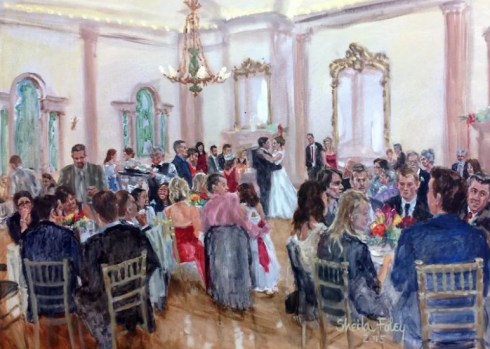
Hamilton Hall SHeila FoleyI love this view of the Hamilton Hall ballroom, with its “Russian” mirrors and green chandelier, by artist Sheila Foley: see more of her live event paintings here


Joy and Remembrance

My husband was down south in the snow this past weekend while I was home alone for the bright and chilly December weekend. It was quite festive: with a dinner, drinks, an open house and an estate sale, although I missed one event due to an extended nap! When I wasn’t out I watched my favorite holiday movies on TCM, so Barbara Stanwyck was much in view as she is in most of them. I finished decorating all of my mantels, although we still don’t have our Christmas tree up yet: several years ago we had a dried-out tree well before the holiday, a traumatic experience which has led me to push it later and later ever since. I’m worried that I’ve pushed it too late this year as my favorite Christmas tree lot just sold out! For those of you who might be surprised that I have included an estate sale among these festivities, let me elaborate: I have found that local estate sales are often community events which not only provide people (Yankees, of course) to obtain a bargain but also an opportunity to remember–and celebrate–the deceased through admiration and remembrance of his or her items. They really are quite poignant occasions. As I walked through the adorable house of a recently-deceased lady among her cherished collections, I kept hearing the phrases I remember when and she loved that. This particular lady was obviously an enthusiastic keeper of Christmas, so the sale was even more festive—and she had great taste (I hope people will say that same about me as they sift through my things—I better purge a bit). The weekend ended on a high note when I was invited to attend an open house in the home of my “daguerreotype crush” from last week’s tour: his name is Benjamin Kendall, by the way.

The second week of December in Salem: at home

Seasonal Sights 15

Seasonal Sights 13

Seasonal Sights 9

Seasonal Sights 14

Around the McIntire District:

Seasonal Sights 7

Seasonal Sights 8

Seasonal

Seasonal Sights 5

Seasonal Sights 6

Seasonal Sights 3

At the estate sale & a drink with Mr. Benjamin Kendall

Seasonal SIghts 20

Seasonal Sights 19

Seasonal Sights 18

Seasonal Sights 17

Sights 4


The Year of Lost Archives

I must interrupt my festive holiday posts to mark a somber anniversary today: a year ago a representative of the Peabody Essex Museum admitted that there were no plans to reopen the long-shuttered Phillips Library in Salem, and that its archives and texts were soon to be relocated to a consolidated Collection Center in Rowley, in response to questions from members of the Salem Historical Commission. This admission was historic in a dual sense: it concerned history, the collected history of generations of Salem’s families and institutions, entrusted to an institution which couldn’t even be bothered to announce their removal, and it marked a moment in which Salem’s historic identity could now be cast in considerable doubt. It also triggered a series of responses and events which revealed so much to me about how history–and access to history—is perceived and valued in Salem. I was going to write an anniversary post anyway, just to wrap up this dismal year, but then an extraordinary coincidence manifested itself, and now I have a comparative format for my retrospective review. It happens that not only has my adopted hometown lost its archives, the hometown of my youth is on the verge of losing its as well! I feel like the personification of some powerful archival curse.

York Archives

Essex Institute IncorporationMr. James Kences of York, Maine protesting the imminent removal of Old York’s archives to a collections center in nearby Kittery, utilizing the same by-law precedent that we’ve employed here in Salem. Photo of Mr. Kences by Rich Beauchesne/Seacoastonline.

This may seem like an apples and oranges comparison with the only link being my personal interest, as the Peabody Essex Museum is a large, multi-faceted and well-endowed institution of international stature and the Museums of Old York constitute a local heritage organization with far fewer resources, but I think there are some interesting contrasts, particularly in the words and actions of the interested parties. Salem (1626) and York (1624) are also both venerable colonial settlements, with historical influence beyond their municipal boundaries. The Old York move is mandated by the sale of an old bank building in the center of town for redevelopment: not only have Old York’s plans been completely transparent since the publication of its strategic plan in 2015, but its Director, Joel Lefever, publicly acknowledged that York residents had the right to “raise questions” about the relocation of the archives out of town and even applauded the colorful protest of Mr. Kences. Compare this attitude and these statements to those of the now-retiring PEM Executive Director Dan Monroe: There was an expectation by a number of people that we had a responsibility to consult with them about what would be done with the Phillips collection…an expectation we didn’t particularly share or understand (Boston Globe, January 13, 2018).

Salem Hex

Old York’s decision to sell a downtown administrative building to focus resources on its historic buildings further afield was dictated by economic necessity and made in collaboration with the Town of York, which is embarking on a York Village revitalization project; the PEM’s decision to relocate the Phillips Library was a choice, not a necessity, made in isolation and opacity. Several organizations which had placed items on deposit in the Library, including the Salem Athenaeum and the Pickering House, were not even notified that their materials were to be relocated out of Salem. It was also revealed during the many hearings before the Historical Commission following the December 6 admission that the PEM had failed to file a master plan with the city of Salem, contrary to municipal regulations. While Salem residents are always in the dark when it comes to the PEM; I do hope our Planning Department knows more!

PEM Expansion PlanA romantic rendering of what might have been—if the PEM had fulfilled its promises to develop the Salem Armory and preserve the Phillips Library: not sure about the new situation of the John Ward House but it’s been moved once before. Not sure of the source or date either–I found it unlabeled on social media. Obviously the PEM went in quite a different direction.

There has also been a stark contrast in the reactions of municipal officials in York and Salem. Apparently there is no avenue to avoid the relocation of York’s archives to Kittery for the short term, but both the Town Manager and Board of Selectmen seem committed to finding a way for them to return. In an article in the York Weekly by Deborah McDermott, Town Manager Steve Burns allowed that there was no place suitable for the archives in York at present, But long term, the town I believe has an obligation to the heritage of the town to see if we can do something. This does not satisfy the passionate Mr. Kences, but I would be thrilled to hear a similar sentiment spoken in Salem: an obligation to the heritage of the town. For her part, Mayor Kimberley Driscoll never questioned publicly either the preservation-in-Rowley vs. decomposition-in-Salem scenario sold by PEM or its place-detached vision of history, and celebrated the Museum’s “investment in history” at the opening of the Collection Center in Rowley this past July. I do hope that the Museum makes a considerable investment in Salem’s history in the forms of library staff and digitization: at present (and as has been the case for some time) its most essential materials on commercial and cultural encounters in East Asia, so very valuable for the understanding of both local and world history, are accessible only behind a very expensive paywall at the digital publisher Adam Matthew and so inaccessible to Salem’s residents—and Salem students. While Salem’s history has been packaged as a digital “product”, the old Essex Institute buildings which once housed it remain dark and empty.

Abbot-Philips-Library-Plummer-Hall-Hi-Res-edited

There are also some interesting comparisons to be made regarding the quest for institutional and municipal vitality: the goal of both the PEM and Old York as well as their host communities. Old York’s archives are just that, historical archives, whereas the Phillips Collections of PEM constitute a large and multi-dimensional library, constituting myriad print and manuscript materials. It’s a bit difficult to see how the former collection could foster the development of a lively cultural community in York Village, but a Phillips Library returned to its original location could enhance Salem’s already vibrant cultural scene in many ways and expand its own community in the process. Libraries are meant to be used, and library collections are different than curatorial collections: the consolidation of both in a remote Collection Center–inaccessible via public transportation–may make sense from an administrative point of view, but it can only handicap the former in terms of its essential function. Just as I hope for more digitization of Phillips materials, I also hope that researchers are flocking to Rowley, but as yet I don’t see any evidence of the sorts of activities that are associated with other research libraries like those of the Massachusetts Historical Society, the American Antiquarian Society, and (most familiar to me) the Folger Shakespeare Library: exhibits, events, brown bag talks, teacher workshops, crowdsourced transcription projects. It is early days for Rowley’s Phillips Library, so maybe these will come, but I believe such engagement would evolve far more easily in Salem’s Phillips Library, enlightening a dark stretch of Essex Street in the process.

Phillips last december

Anniversary 5In my open letter to the Trustees of the Peabody Essex Museum from nearly a year ago, I focused on Nancy Lenox Remond, because I wanted to emphasize the connection between place and history. I couldn’t imagine a better example of someone whose history was made by Salem and who made Salem’s history in return! Mrs. Remond and her husband John were the resident caterers at Hamilton Hall and also operated several other businesses in downtown Salem. There were organizing members of Salem’s African-American church and abolitionist societies, and they advocated successfully for the desegregation of Salem’s schools. They raised eight children in Salem, among them the prominent abolitionists Charles Lenox Remond and Sarah Parker Remond, for whom a seaside park in Salem is named. Here’s a photograph of Mrs. Remond and the Lafayette plaque at Hamilton Hall–which references a famous banquet which she and her husband John prepared. I didn’t understand a year ago, and I still don’t understand now, why the records of the lives and work of these extraordinary people, and all of the extraordinary people who made Salem, have to be located in Rowley.


A Very Merry House Tour

I felt a lovely spirit among the volunteers and tour-goers at this year’s Christmas in Salem tour yesterday: a clear and sunny 40ish day which made every open house shine. There were proud owners, dedicated stewards, enthusiastic guides and curious visitors everywhere in attendance. As I emphasized in my preview, it was particularly impressive to see such strong collaboration between Salem’s heritage and civic groups, not only between the tour sponsor, Historic Salem, Inc., and this year’s focus and host, the House of the Seven Gables, but also the Salem Maritime National Historic Site, two churches—Salem’s first Catholic Church, Immaculate Conception, which is now part of the amalgamated Mary, Queen of the Apostles parish, and the amazing Russian Orthodox church, St. Nicholas—-as well as the beautiful Brookhouse Home, a residence for senior women since 1861. There was of course the conspicuous absence of that elephant on Essex Street, the Peabody Essex Museum, but special compensatory recognition should be given to the relatively new Salem Historical Society, a group of young historians who formed during the prolonged closure—now apparently permanent—of the PEM’s Phillips Library. The SHS has no archives, of course, because the bulk of Salem’s archival history belongs to the PEM and is now housed in the relocated Phillips Library 40 minutes north on Route One, but they have goals: and chief among them is to get more recognition for Nathaniel Hawthorne. This tour was a means to that end, and a very material measure of their success is a brand new sign marking the sight of Hawthorne’s birthplace on Union Street, installed just in time for this “Vey Hawthorne Holiday” tour. The actual house, which was moved to the House of the Seven Gables campus in 1958, was on the tour as well, along with the storied mansion itself, the Custom House where Hawthorne (reluctantly) worked, and his least-favorite residence in Salem, his very own “Castle Dismal” (which is neither a castle or dismal).

CIS 17

CIS 4

CIS 6

CIS Christmas

CIS 7

CIS 9

CIS 11

CIS collageFrom the brand new Hawthorne’s birthplace sign to the House of the Seven Gables, and then back to Herbert Street and “the house that Hawthorne hated” via Derby Street and the Custom House.

There were so many lovely houses on the tour interspersed among these Hawthorne sites: mostly early nineteenth-century, some eighteenth, with different degrees of detail and scale. There is a great range of houses along Derby Street, encompassing everything from the stately mansions alongside the Custom House and facing Derby Wharf, to simple Georgian cottages further along the street. I appreciated the diversity of structures, their number (this tour is an obvious bargain when compared to all the house tours I have attended this year!), and the mix between public and private buildings. It’s always a very personal commitment for a homeowner to open their doors for a house tour—and consequently it is an intimate experience for those that step within, and a privilege. But the public buildings have an intimate feel too, because the people that care for the House of the Seven Gables, the Brookhouse Home, the Custom House, and the churches, are so very committed to their preservation and interpretation. I ran out of time (because of a long lunch, another holiday tradition) and couldn’t quite make the Immaculate Conception by the end of the day, but several members of the congregation as well as the pastor of St. Nicholas Orthodox Church were on hand to share their beautiful parish church, which was established in 1901. Beautiful day, great tour: if you couldn’t make it yesterday, it’s also on today: the weather may be a bit frightful but I assure you the interiors will be all that more delightful!

Just a sampling here: there was so much to see.

CIS 1

CIS 10

CIS 36

CIS 32

CIS 35

CIS 33

CIS StairwayThe Captain William Lane House (with such a cheery laundry/mudroom! and decorated by Mr. Frank Bergmann who trims (other meaning) all my shrubs and trees; the Josiah Getchell House and the Thomas Magoun House along Derby Street–all absolutely charming.


CIS staircase collage

CIS 27

CIS 28

CIS 29

CIS 25

CIS 24

CIS Crush

CIS CHAMBERLAINI’m just obsessed with the staircases now–two very different ones, from the Brookhouse Home (1810-11) and the Ives-Webb-Whipple House (by 1760). More from the latter–one of my favorite houses in Salem which is now for sale. The Captain John Hodges House on Essex (c. 1750), whose owners have some very compelling ancestors! I never take pictures of recent family photographs, but ancestors from 100+ years ago are fair game: I could not resist this remarkably handsome man, plus I am a Maine girl so must show you Joshua Chamberlain (center, dark suit, hat in hand), the hero of Gettysburg, at his 1912 family reunion.


CIS Brookhouse

CIS 14

CIS 13

CIS 12

CIS Church

CIS Church interiorThe very festive Brookhouse Home and very serene St. Nicholas Russian Orthodox Church, on Forrester Street.


A Very Hawthorne Holiday

This year’s Christmas in Salem house tour, the perennial seasonal fundraiser for Salem’s venerable preservation organization Historic Salem Inc., is Hawthorne-themed in recognition of the 350th anniversary of the House of the Seven Gables and features 15 decorated interiors in the greater Derby Street neighborhood along with a full schedule of associated offerings. The tour is on Friday night, Saturday, and Sunday afternoon, and there are tie-in events (including a food tour, wine-tasting, meet-up of Salem history buffs, lectures on Hawthorne’s Utopian experience and the long history of celebrating Christmas) throughout the weekend. This tour is always a wonderful event for so many reasons: it supports preservation efforts and advocacy, does not exploit the witch trials in any way, and represents true collaboration between Salem’s heritage organizations. It’s a seasonal reminder of just how many beautiful old houses survive in Salem, and a great opportunity for decoration inspiration. I always emerge from the weekend full of empathetic gratitude for those generous homeowners who open their doors to hundreds of people during one of the busiest times of the year: I’ve been there, and done that (twice) and it is always quite the effort!

Hawthorne Poster

I like the theme of this particular tour as it harkens back to a time when Salem’s heritage identity was much more civic and civil, more diffuse, and much less commodified and concentrated on 1692. The neighborhood—and Hawthorne himself—are legacies of all of Salem’s history, dark and bright. Salem’s history and landscape gave Hawthorne his material: he always acknowledged his debt to his native city even as he distanced himself from it with obvious determination. In 1860, the Essex Institute had sustained a significant debt from moving their library (cabinet) into its permanent location (well, until the Peabody Essex Museum relocated it out of Salem) in Plummer Hall on Essex Street, and organized a fair to raise funds to pay off the debt. Hawthorne was asked for a story to contribute to the fair’s newsletter, The WealLeaf, and he acquiesced promptly, offering up an intense topographical memory rather than a story as his narrative inclinations had deserted him for the moment and he did not wish to be “entirely wanting to the occasion”. The relationship between the Essex Institute and Nathaniel Hawthorne was forged through moments like these, along with the deposit of Hawthorne family papers and the acquisition of additional papers and editions of all of Hawthorne’s works by the Institute, including The Spectator, his self-published (as a teenager!) newsletter.

Hawthorne collage

As Hawthorne evolved into a truly national figure following his death, the Essex Institute enhanced its reputation through its Hawthorne collections, most particularly during the centennial anniversary of his birth in 1904, for which the Institute organized a series of summer events: as this most American of authors was born on the fourth of July. National headlines all summer long focused on the author and Salem, and most particularly on the “ancient” houses associated with Hawthorne, in accordance with the form of heritage tourism that was popular at the time: the literary pilgrimage. Even a century later, the collections of the Essex Institute, now absorbed into the greater Peabody Essex Museum (PEM), were the focus of the bicentennial commemoration of Hawthorne’s birthday: consequently it’s not very difficult to imagine an open Phillips Library in an open Plummer Hall, and an exhibition of Hawthorne texts and papers assembled as a complementary and contextual feature of this weekend’s house tour. But we can only imagine such a scene, as Plummer Hall has been closed since 2011, and the Phillips collections, encompassing nearly all of Salem’s archival history, have been relocated to a vast Collection (not plural–specificity is discouraged) Center in Rowley. Nathaniel Hawthorne is gone.

Boston_Herald_1904-05-29_48 (1) Hawthorne

Hawthorne at Salem NYPLBoston Herald, May 1904; New York Public Library Digital Gallery.

Sorry—–digression into a rant: the anniversary of PEM’s reluctant admission to the permanent relocation (dislocation) of the Phillips collections approaches (December 6) and so this momentous move is on my mind. I fear that each and every historical occasion in Salem will be impacted by the withdrawal of its archives and the historical disengagement of such a large cultural force in the city. I’m trying to focus on what remains, and this tour provides a great opportunity to do that. The Salem houses in which Nathaniel Hawthorne lived, worked, and was inspired by remain, as well as organizations like Historic Salem, Inc., the Salem Maritime National Historic Site, and the House of the Seven Gables, which are devoted to their preservation—and his memory. We also have more than a century of scholarship on Hawthorne in physical context—and his memorial statue of course, a stark contrast to that dreadful marker to Salem’s other claim to “fame” on the other side of town.

Closson Hawthorne

Hawthorne book collage

SAAM-S0001933The emphasis on Hawthorne’s “Homes and Haunts” begins with the Prang publication of William Baxter Palmer Closson’s portfolio in 1886 and continues today! Salem: Place, Myth and Memory was edited by my colleagues at Salem State University and includes a great chapter on Hawthorne by Nancy Lusignan Schultz. I haven’t read Milder’s Hawthorne’s Habitations yet, but it sounds like it is more focused on his time in England and Italy. The Smithsonian photograph above, of the newly-installed statue in front of the newly-built Hawthorne Hotel in 1925, was taken by Salem’s great horticulturist and planner Harlan Kelsey.