Tag Archives: Local Events

Hotel Happening

And now for some good (re-)development news: the conversion of the 1895 Newmark’s Building on Essex Street into the new Hotel Salem, a 44-room boutique hotel complete with rooftop bar, ground-floor restaurant, and shuffleboard in the basement. The Hotel Salem will join The Merchant as the second Salem hostelry to be operated by Lark Hotels, which manages a string of unique properties in New England and California. The renderings invite one to imagine the Essex Street pedestrian mall actually working; in fact, Lark’s “chief inspiration officer” (what a great job title!) Dawn Hagin specifically referred to it last week in an article on the new hotel in Boston Magazine: A lot of New England towns, or towns across America, don’t have pedestrian walking malls anymore, says Hagin. And the fact that it still exists in Salem, and this anchor store that used to be there—which was the heart of that—could be embraced and brought out today with what we are doing with the Hotel Salem—it is very exciting to us.  

hotel-essex-street

hotel-facade

boxes-hotel

Well of course the pedestrian mall was a 1970s development, but no matter, Lark clearly chooses its properties for their unique place-specific character, rather than imposing some generic corporate vision on them: Hagan goes on to explain how the “bones of the building” and its mid-century department store vibe is going to influence the new hotel’s interiors. This building was at the “heart” of a very vibrant Essex Street, as a proliferation of postcards indicate (it’s the fourth building on the right in the c. 1910 view below). Even though everyone refers to it as the Newmark’s Building because of the ghost sign on the side and the long-standing art deco lettering in front, it was actually built for the Naumkeag Clothing Company in 1895–they moved from down the street and seem to have occupied the building for several decades until Newmark’s took up residence–and business.

essex-street-north2

naumkeag-cc

It’s really quite a building: I don’t think I ever really appreciated it because of the incongruous first-floor facade but now I can’t wait for its big reveal! This is a project that appears to be “opening up” to Essex Street–and Salem– rather than turning away.

hotel-boarded-up

hotel-bricks

hotel-side

hotel-scaffolding

The future Hotel Salem, opening summer 2017 @ 209 Essex Street, Salem.


Developer-driven Design

Salem has been experiencing a building boom for the past several years and 2017 promises to intensify that trend with major projects rising on several ends of Washington Street, a new 40,000 square-foot wing on Essex Street for the Peabody Essex Museum, a new building on Lafayette Street adjacent to Salem State University, the completion of the Footprint power plant on Fort Avenue, and various other public and private developments around town. Given recent completion of the new courthouse addition and MBTA parking garage along Bridge Street, I think this is going to be the year that the “new” Salem almost overtakes the old when it comes to the downtown streetscape, and this makes me sad, because the new buildings do not live up to the standards of design and construction upheld by the old. This is a subjective opinion, of course, but I believe that it is shared by many people in Salem. None of us knows what to do about it, however: we are all, it seems, at the mercy of developer-driven design.

integration-big-box-district-courthouse

integration-district-court-building-2nd-design

integration-district-court-building

The first and second (current) designs for the District courthouse site on Washington Street; the second is heralded as more “contextual” ; the former Essex County District Court building, which currently occupies the site, is slated for demolition soon.

I don’t mean to demonize developers: I’m sure they’re all lovely people (at least the ones I know are), but they are generally driven by economic factors rather than aesthetic ones unless they are steered towards the latter by some approving authority. Is this happening in Salem? I just don’t know. From my perspective it looks like the boards are tinkering with the generic designs submitted to them, making improvements where they can but never altering the basic bland box in any substantive way. We end up with a building that simply fills a space rather than enhancing a specific place: Salem. I’m dreading the construction of the condominium building on upper Washington Street (above) so much that I have become increasingly attached to the 1970s modernist building that presently occupies that space: at least it has a distinct design. As bad as the proposed new structure for this site is, it cannot compare to the building planned for further along Washington Street to the south: the Mill Hill/East Riley Plaza development, which will include a Hampton Inn. A great project but a dreadful design: I’ve yet to find a single fan: just “it’s better than what is there now” (which is just an empty space at present, so I’m not sure about that).

boxes-hotel-hampton

The RCG LLC Mill Hill East Riley Plaza Development–I think this is the final plan, unfortunately.

I  do not discern a great deal of excitement about the Peabody Essex Museum’s new wing either: I’ve no doubt the design details and construction materials will be superior to the projects above but on paper it looks like a cube with little or no relation to the prominent building next to it: the stately East India Marine Building (1825). I’m going to reserve judgement for now, as this building has had a series of incongruous structures adjacent to it in its long history and sometimes the contrast between old and new can be striking, but I already miss the Japanese Garden, which is now a jobsite. I can’t help but think of the words of the architectural critic Ada Louise Huxtable, who was so instrumental in saving Salem’s downtown from complete destruction during the wave of urban renewal in the early 1970s. Much later, in a retrospective interview about her career in the Boston Globe, Huxtable opined that she had had a major impact on Salem, where they were going to eliminate the beautiful Japanese garden next to the museum, and now that garden is gone.

rendering-view-of-expansion-from-essex-street-ennead-architects-copy

enndraw16

integration-3

east-india-marine-hall

Renderings of the new PEM wing, © Ennead Architects; the jobsite last month and the East India Marine Hall in the 1890s by Frank Cousins.

The other day I was walking downtown along Federal Street and came upon another recent project: the massive curtain-walled and faux-columned J. Michael Ruane Judicial Center. My immediate thought, as always, was why it so big? But then I noticed, and again, not for the first time, the contrast provided by the juxtaposition of the former First Baptist Church, now a law library. I remember the citizen effort behind that building’s situation, just so, following the lines of the street and enhancing the adjacent (hulking) buildings’ placement here in Salem. Maybe all these new buildings will benefit from a similar effort, with positive results. And maybe not. But just imagine what it would look like if that old building was not there.


integration-2


Christmas in Salem 2016

A stellar Christmas in Salem tour around Salem Common this past weekend, featuring all the things that I love about Salem houses and Salem people. The combination of generous and creative homeowners, perfect clear and crisp December weather, and myriad magical details made for a very special experience. Here’s just a short list of attractions (I really could go on and on): a McIntire spiral staircase, beautiful views of the Common (as seen through very clean windows–the first thing I noticed when I got home was how dirty mine are), an artist’s atelier/bedroom, an alpine-decorated deck, kitchens extraordinaire, an architectural dollhouse, exceptional artwork and collections. To be honest, I barely noticed the Christmas decorations as I was so focused on the architecture and interior design. I was a bit pressed for time, so I skipped the three institutional stops on the tour–the PEM’s Andrew Safford House, the Bertram House, and St. Peter’s Church–and went right for the private homes, all along the Common and a few adjacent side streets. It seemed to me that the tour was curated for contrast: of scale (larger institutional or single-family homes contrasted with smaller structures and condominiums), of architectural style (everything was built in the nineteenth century but what a difference between the Federal, Greek Revival, Victorian and Colonial Revival!), of design (very modern and more traditional), of embellishment (very decorated and more minimalistic), and above all, of expression: the homeowners expressed themselves in various ways: through their own art or design, or through their collections, or both!

I was fortunate to obtain a press pass so I could take photographs of the houses, but 1) I am not a professional photographer and 2) I got completely overwhelmed by all I had to see/ “capture”, so please go on over to Creative Salem  or to Historic Salem for more polished and comprehensive portfolios: it was really all too much for me, in the best possible way!

Let’s start with a sampling of beautiful rooms, and then I’ll try to present some of the details that caught my eye–just some, because there was so much to see.

christmas-in-salem-tree

christmas-in-salem-room-2

christmas-in-salem-room

christmas-in-salem-tree-3s

christmas-in-salem-kitchens

christmas-in-salem-detail-8

Let there be light! This  was a very enlightened tour, in more ways than one:

christmas-in-salem-window-2

christmas-in-salem-window-3

christmas-in-salem-foyer1

christmas-in-salem-staircase

Myriad Mantles……..

christmas-in-salem-mantle-2

christmas-in-salem-mantle-4

christmas-in-salem-mantle-5

christmas-in-salem-mantle

Dazzling Details…….of collections, an amazing restoration, and all sorts of embellishment, including an historic Salem gallery wall, an exterior Christmas tablescape (set up by the homeowner of a beautiful condo, who felt that she need to offer a “bit more”), and the ultimate dollhouse.

cis-details-collage

cis-details-collage-restoration

cis-collage

christmas-in-salem-detail-5

christmas-in-salem-deck1s

christmas-in-salem-dollhouses

It was impossible for me to capture the complete creativity of Salem artist Thomas Darsney’s stunning home/gallery: his canvases were luminous but the entire home was in fact a canvas, with no surface or detail unconsidered. 

christmas-in-salem-detail-6

christmas-in-salem-detail-7

christmas-in-salem-detail-10

christmas-in-salem-detail-11

Just a few exterior shots because again, the light was so beautiful on Sunday……

christmas-in-salem-exterior-3

christmas-in-salem-exterior-2

christmas-in-salem-exteriors

Why not tie everything up with a big red bow?

cis-bow


Christmas on the Common

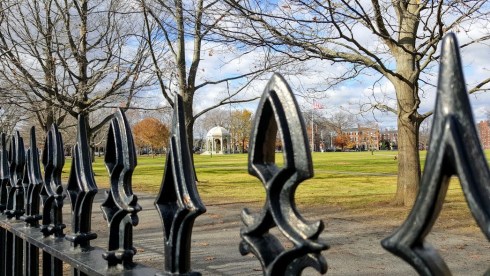
I am very excited about the 37th annual Christmas in Salem tour, which returns to the Salem Common neighborhood this year. The major fundraiser for Salem’s venerable preservation organization, Historic Salem, Incorporated, the walking tour of decorated homes and buildings rotates from the McIntire Historic District to the Common quite regularly and has also been centered on both North and South Salem, Derby Street, and the Willows. Each and every tour is great, but I’ve always liked the Common tours particularly for a variety of reasons: the mix of very stately and smaller, cozier homes, the focal point of the Common (no s!), and the ability to pop easily into the Hawthorne Hotel’s Tavern for a drink (you can also get your tickets at the Hotel on Saturday and Sunday). In any case, the Common deserves to be showcased this particular year: much restoration work has been done on its cast iron fence, its reproduction McIntire Washington Arch is looking good, and there have been several notable restorations in the neighborhood. Having gone through this myself several times, I am so very grateful to all the homeowners who are opening their doors: it is a generous gesture worthy of all of our support and praise.With the spotlight on the Common, I thought I’d take this opportunity to showcase some of my recent stereoview discoveries as well, so we can have a past-and-present perspective on a great public space: scene of militia drills and musters, hot-air balloon demonstrations, circuses, athletic competitions, concerts, rallies, demonstrations, bike races, Sunday strolls and Christmas walking tours.

common-christmas-10

Common CHristmas.jpg

washington-square-1920s

salem-common-stereoview-cropped

salem-stereoview-common-whipple-aas-2

Salem Common yesterday, in a 1920s (doctored) Maynard Workshop postcard, and in two later-nineteenth-century stereocards showcasing the cast iron fence, built in 1850, from two directions. The bottom card, showing the Andrew Safford House at right, is by G.M. Whipple & A.A. Smith, and courtesy of the American Antiquarian Society. Fence details today below, and the newly-restored Washington Arch.

common-christmas2

common-christmas-8

common-christmas-7

common-christmas-5

Overlooking the Common, one of my very favorite doorways in all of Salem, belonging to the White-Lord House at the corner of Washington Square and Oliver Streets. Frank Cousins loved to photograph it, and I do too (not to raise myself to his photographic level, but just so we can appreciate its constant ability to captivate!)

common-doors-collage

Look at this new-to-me stereoview! (No, I do not think that is President Lincoln on the Common). It was published by Charles G. Fogg and I do not have a date.

salem-common-aas-cropped

Returning to the present, just some of the decorations from yesterday; no doubt more will be on display this weekend, both outdoors and behind doors.

christmas-in-salem-collage

common-christmas-4

common-christmas-12

Christmas in Salem: Carol on the Common, a Christmas walking tour to benefit Historic Salem, Inc., Dec. 2-4: more information here. 


Footcandy in Salem

And now for the shoes. While I didn’t find the latest PEM blockbuster material exhibition Shoes: Pleasure and Pain to be particularly probing, it was definitely aesthetically pleasing, and I enjoyed the insights into the production and collection of shoes. For me, the other exhibition themes of transformation, status and seduction did not seem quite as well-developed as those of creation and obsession. The cumulative presentation focuses on the extreme rather than the mundane, and on the colorful rather than the neutral, and thus is tailor (cobbler?)-made for social media. I kept thinking that I had seen it before, and then I realized I just missed it at the Victoria & Albert Museum when I was in London last winter, but must have absorbed a lot of the publicity when planning my trip. Two minor comments: 1) I was really happy to see a high-heeled King Charles II rather than the usual Louis XIV, Sun/Shoe king (after all, Charles II was a tall man whose shoes were a choice of fashion while the much-shorter Louis XIV’s heels were partly an invention of necessity); and 2) Loved the creative use of shoe boxes, and our opportunity to “peak” into the closets of some local collectors.So what’s next?  We have seen myriad garments, hats and now shoes: perhaps purses or gloves? Since the PEM seems to follow in line with the Victoria & Albert Museum with these types of exhibitions I went to the latter’s website to look for upcoming events, and my bet is on lingerie based on their spring show, Undressed: A Brief History of Underwear.

My highlights from Shoes: Pleasure and Pain, beginning with perspectives on Charles II’s coronation portrait by John Michael Wright, Sebastian Errazuriz’s “Heart Breaker” shoe and iconic heels from Christian Laboutin and Manolo Blahnik. 

shoes-charles

shoes-charles-ii

shoes-with-arrow

shoes-laboutin-pem

shoes-blahnik

An assortment of heels, one of several Latchet shoes in the exhibition, North Shore shoes, and myriad embellishments: feathers, polka dots, pom poms, laces………………

shoe-heels

shoes-pem-latchet

shoes-local

shoes-with-feathers

shoes-with-polka-dots

shoes-with-pom-poms

shoes-with-laces

The last part of the exhibit, on collection/obsession, was probably the most introspective, if only because it featured the collections of some local shoe lovers–and insights into how they wear/store/display their shoes. Love the last shoe “box”, which I suppose can double as an ottoman in the dressing room.

shoes-under-glass

shoe-collage

shoe-box2


Cabinets on Canvas

After stuffing ourselves with Thanksgiving dinner the day before, and Thanksgiving breakfast pie yesterday morning, we walked downtown to the Peabody Essex Museum to see their latest blockbuster exhibition, Shoes: Pleasure and Pain. It is a fine visual feast for sure, but not exactly thought-provoking for me (and I’m not really a shoe girl–but I did get some great pictures for another post), so I wandered next door to another current exhibition, Samuel F.B. Morse‘s “Gallery at the Louvre” and the Art of Invention. This traveling exhibition focuses on Morse the artist and “copyist” rather than Morse the inventor: his 1831-33 painting of an imagined exhibition of 40 artworks at the Musée du Louvre in Paris, combined with his role as the “father of American photography” based on his early experimentation with the daguerreotype process, is the inspiration for a complementary display of over 65 photographs from the PEM’s extensive collection. I must admit I didn’t quite grasp the connection between the painting and the photographs—“the spirit of curation, storytelling, and cross-cultural affinities”—but I was happy to see both, and I spent some time trying to find my own connections, which is the very best impact any exhibition can have.

cabinets-1

cabinets-2

cabinets-5

1992-51-morse-8-center-figureslowres

Samuel F.B. Morse’s Gallery at the Louvre (Terra Foundation for American Art) in the PEM show, along with his copy of Titian’s portrait of François I and a crop of the artist/inventor instructing his daughter in the center of the painting from a blog post by Shoshana Resnikoff on the PEM blog Connected.

After a bit of thought and browsing around, ultimately I think I made one of the connections the curators of this exhibition wanted me to make by comparing Morse’s “gallery painting” with the original examples of this genre from the seventeenth century. The whole idea of collecting and creating a “cabinet” of curiosities, wonders, or magnificent works of art is so very early modern, and best expressed by Francis Bacon who prescribed that every Renaissance Man should have a goodly huge cabinet, wherein whatsoever the hand of man by exquisite art or engine hath made rare in stuff, form or motion; whatsoever singularity chance and the shuffle of things hath produced; whatsoever Nature hath wrought in things that want life and may be kept; shall be sorted and included. In idealized ways, these cabinets were depicted by a succession of artists, and most ardently by Flemish and Dutch Golden Age painters such as members of the multi-generational Francken dynasty and David Teniers the Younger. There are notable differences between gallery paintings of the seventeenth century and Morse’s painting (besides the fact that the earlier paintings are obviously much better): the people depicted in the former are engaged with the art on the walls and tables through collection and admiration, not replication. As (old) Europeans living in an age of confidence–they probably thought they would always be surrounded by art: the gallery of Archduke Wilhelm, in the Teniers painting below, was newly-assembled following a bout of Swedish looting during the Thirty Years’ War (and many of these same painting came from the estates of English Royalists confiscated by Oliver Cromwell!). Morse’s painting seems more about capturing and transmitting art and culture–by whatever means possible– from the Old World to the New, which seems very appropriate for the inventor of his namesake code.

cabinet-of-an-art-collector

cabinet-of-art-and-curiosities-f-francken

david_teniers_el_joven_-_el_archiduque_leopoldo_guillermo_en_su_galeria_de_bruselas_kunsthistorisches_museum_de_viena_1650-52-_oleo_sobre_lienzo_123_x_163_cmHieronymus Francken II, The Cabinet of an Art Collector, 1621, Royal Museum of Fine Arts, Brussels; Frans Francken II, Chamber of Art and Curiosities, 1636, Kunsthistorisches Museum, Vienna; David Teniers the Younger, The Archduke Leopold Wilhelm in His Gallery at Brussels, c. 1650, Kunsthistorisches Museum, Vienna.


Memorial Markers

Look up: at many intersections of Salem streets, intensively but not exclusively in the center of the city, you will see bright black and gold markers with the names of veterans who sacrificed their lives in twentieth-century wars. I really don’t remember focusing on these plaques until late last spring, when all of the faded markers were replaced with new and shiny ones: just in time for Memorial Day, as I recall. Then suddenly they were very conspicuous to me–and hopefully to others. The markers are placed adjacent to the soldiers’ neighborhoods, so you can also ascertain the various ethnic neighborhoods of Salem in the last century, now not quite as distinct. They are as detailed as possible: name, rank, service, conflict, exact date and place of death: I immediately noticed how many young men died in the closing months of the Great War, just before Armistice Day.

memorial-markers-chestnut

memorial-markers-9a

memorial-markers-2a

memorial-markers-3a

memorial-markers-4a

memorial-markers-5a

memorial-markers-6a

memorial-markers-7a

memorial-markers-8a

memorial-markers-11a

memorial-markers-12a

Squares of service in Salem, beginning with that dedicated to Private George C. Trask at the beginning of Chestnut Street. Nichols Square at Federal Street is dedicated to Captain Henry C. Nichols, who served in both world wars and Korea and was a “man about town” (and also the author of a popular little pamphlet titled Bewitched in Historic Salem). The distinct red marker designates veteran firefighter Raymond McSwiggin, killed in the line of duty in 1982. You can see a map of all of Salem’s Veterans’ Squares here: https://www.mapsonline.net/salemma/index.html.


Liberation Day

November 1 is Liberation Day in Salem: the long Halloween is over, quite suddenly it always seems, and the city is returned to its residents. I’m in much better spirits than last year because of my boyc0tt of downtown Salem: the image of the Witch Trials Memorial turned into a food hall is somewhat faded from my mind. It’s comforting to know that in this month, and the months leading up to next September and October, civic resources and energies will be liberated from propping up the seasonal Halloween industry and thus enabled to focus on promoting Salem’s less-ephemeral attributes. As usual trick-or-treating generally mollifies my feelings about Halloween as the kids are so cute, but still, I’m glad it’s over (again).

My favorite trick-or-treaters (or costumed people who walked past my door–sorry, the pictures of an entire Game of Thrones crew and the Swiss Family Robinson (I think?) did not come out well).

halloween

halloween-3

halloween-2

My feelings today, illustrated : “Liberty Triumphant” (against oppression) in the Revolutionary war and World War I (Library of Congress) , joyful skipping by Harold Edgerton (© Harold & Esther Edgerton Foundation, courtesy of Palm Press, Inc., Museum of Fine Arts, Boston), My cat Trinity at peace.

liberty-triumphant

halloween-liberty-wwi

halloween-skipping-rope-mfa

halloween-4


October Orchids

This past Saturday I took a brief respite from the rain to go to Historic New England’s Lyman Estate in Waltham for their annual orchid sale. After spending some time in the historic greenhouses built originally to house the camellias that nineteenth-century Yankees craved (which are still there, along with orchids, ferns, and a variety of venerable houseplant varieties), I walked around the grounds a bit before the rain starting falling again. The Vale, as the estate is sometimes called, is one of Samuel McIntire’s few non-Salem commissions, although it has gone through several architectural “transitions” (Victorian and Colonial Revival) since its construction in 1793. I actually prefer the architecture of the other HNE Waltham property, Gore Place, although I love the Vale’s greenhouses and carriage house.There are several special plant sales during the year: begonias and camellias in the winter, herbs in the late spring and early summer, and orchids in October, but you don’t have to wait for these occasions to visit the greenhouses in particular, or the estate in general.

october-orchids-lyman-4

october-orchids-2

october-orchids-lyman-7

october-orchids-3

october-orchids-lyman-house-1

october-orchids-collage-1

october-orchids-collage-2

october-orchids

lyman-carriage-house

Orchids and other plants at the Lyman House greenhouses; the main house and carriage house.


Two Nights in Salem

As you might imagine, my teenage stepson is not at all sympathetic to my I don’t want to see tacky & exploitative witchcraft “attractions” attitude in October so we have ventured downtown for the last couple of nights.The weather has been warm but rainy so there weren’t that many people milling about but we did avoid the more commercial sites. I think I first took him to the Salem Witch “Museum” when he was six or seven and he thought it was ridiculous then; so he has no desire to return now, thankfully. On Thursday night we went to a few shops on the way to one of the Peabody Essex Museum’s monthly themed PEM/PM evenings, which are always great.This month’s theme was “Moon Landing”, in reference to their brand new exhibition “Lunar Attraction”, which is just the kind of multi-media, multi-genre, multi-era, and multi-perspective presentation that I always enjoy. We spent a lot of time watching the colorized version of Georges Méliès’ A Trip to the Moon (1902) that was playing continuously, but I found many of the exhibit items almost as captivating.

two-nights-pem

two-nights-to-the-moon

two-nights-melies

two-nights-vaca

two-nights-2-the-moon

two-nights-rabbit

two-nights-holyoke-eclipse

The Peabody Essex Museum on Thursday evening past: atrium and “Lunar Attraction” exhibits, including screen shots from A Trip to the Moon; Beth Hoeckel’s “Campground” collage from her ongoing series “Point of View”; Scott Listfield’s “To the Moon”, 2004, a Japanese moon rabit, and Edward Holyoke’s ink illustration of a solar eclipse, 1713.

On our way over to the Museum we stopped in at the Salem Arts Association, where there were works both timeless and ephemeral and seasonal-macabre, some more witty than others. I liked these little coffins in the window and a “Vampire Test”mirror; my stepson liked a map of the United States divided into regions which have Waffle Houses and regions which do not.That came home with us.

two-night-arts-2

two-nights-arts

On Friday night, before the deluge we had later and the PBS documentary on the making of Hamilton, we went to the House of the Seven Gables for one of their seasonal experiences, “Legend of the Hanging Judge”, in which actors play out different roles relating to the witch trials in the rooms of Nathaniel Hawthorne’s birthplace: the author himself was in residence, consumed with guilt, as his ancestor is the title character. The one good thing about Salem’s crass commercial Halloween tourism is that it gets tourists through the doors of real museums like the Gables, although I fear out-of-town sausage sellers make more money.

two-nights-gables-at-night

The Gables at Night. I can never get a good night shot–was trying for the contrast of garden and house and this is the best I could do!