Tag Archives: Local Events

Spectral Visions on Derby Wharf

All summer and fall the Salem Maritime National Historic Site is featuring a virtual exhibition called “The Augmented Landscape” which brings eight spectral sculpture assemblages–visible only through a smartphone equipped with the layar app–to Derby Wharf. It’s a more artistic form of Pokémon Go, with global and topical themes and layered connectivity. Everyone in Salem is missing the site’s major attraction—the Friendship–and while this exhibition/experience is not a replacement, it is certainly a distraction! The creations are the work of four artists commissioned by Boston Cyberarts: John Craig Freeman, Kristin Lucas, Will Pappenheimer and Tamiko Thiel. Thiel’s “GardenAnthropocene” imposes a vivid and chilling vision on a familiar place, a “dystopian science fiction future for the landscape as we enter the Anthropocene, a new geologic time period created by human activity……[in which] native plans grow and mutate in response to the earth’s changing conditions, adding to their evolving climate and altering the landscape as we know it”. This doesn’t sound–or look–good!

Spectral Collage

Spectral Garden GardenAnthropocene

Thiel’s other installation, “TreasuresOfSheRem” focuses more on the past than the present, featuring the coins and commodities that Salem traders brought to the East to exchange for tea, spices, porcelain and other exotic goods. Poppies, yes, but somehow I didn’t know that sea cucumbers were so important to the China Trade……

Spectral Money

Spectral Treasures 2

Spectral Treasures TreasuresOfSheRem

More familiar cod hover over the wharf in Will Pappenheimer’s “Ascension of Cod” and privateers clash, visualized through a “virtual ball of classic galleon type ship masts obtained from disassembled ship models accessed from shared 3D model websites”. I think I was supposed to conjure this up (and that’s what it feels like) in front of the Derby House rather than by Pedrick’s storehouse—I couldn’t quite master the geographical aspect of these installations and ended up with strange things in strange places (but maybe that’s the point?)

Spectral Cod

Spectral PrivateersAscension of Cod and Privateers

My favorite installation is Kristin Lucas’s “Elephant in the Room”, referencing the Crowninshield Elephant that landed in Salem in 1796. He looked funny in the Derby Garden and a bit better in front of the Custom House, but never really in his element. Lucas’s “Goodbyes” also stressed out-of-element images, representing departure, which (on the other hand) is of course quite appropriate for a port. For me, the most literal of the virtual installations are John Craig Freeman’s “Virtual China” and “Virtual Russia”, which project images of Wuhan and St. Petersburg onto Salem’s port[al], emphasizing global connectivity, past and present.

Spectral Goodbye

Spectral people

Specral China

Spectral RussiaGoodbyes, Virtual China and Virtual Russia


Preservation Awards 2017

Every May (which is Preservation Month in case you didn’t know it), Salem’s venerable preservation organization, Historic Salem, Inc., holds its annual meeting at which a slate of officers are elected and a slate of preservation awards announced–with the latter taking up considerably more time than the former. The awards are culled from nominations by HSI’s membership and the community, and generally include a variety of projects: private residences meticulously restored, adaptive re-use projects, large public projects that privilege preservation. I look forward to these awards every year, but for some reason I haven’t “covered” them in my blog:  I think it’s because annual meeting nights have fallen on teaching nights in years past and so I haven’t been able to attend, but that’s a poor excuse as I certainly could and should have featured the list in years past. These awards go to individuals (owners, developers, architects) but represent material and aesthetic contributions to the entire community as preservation is a public good. In any case, this year the HSI annual meeting fell on a Friday, but I would have attended regardless as (shameless full disclosure here) my husband’s firm received not one but two awards: for the Howard and Derby Street condominium projects through which a 1960s convent and the former Settlement House of the House of the Seven Gables were transformed into residential buildings. These projects were in good company: the newly-restored (and expanded) Essex Probate and Family Court (now the Thaddeus Buczko Building) the Notch Brewery & Tap Room, the Pickering House, the Baker’s Island Light Station, Old Town Hall, the former Klondike Building–turned-offices for the North Shore Community Development Corporation, and a beautifully-refurbished Victorian house in North Salem were also recognized on this past Friday night. Together, they represent the sheer variety of preservation work going on in Salem by individuals and institutions, efforts that are more important than ever in this era of bland new building.

Preservatio Overview

Preservation Old Town Hall

Preservations Awards Nursery

Preservation Awards Lafayette Street

Preservation Awards Howard Street

Preservation Derby

Preservation Awards Federal Street

The 2017 HSI Preservation Award winners: Old Town Hall was recognized for the rehabilitation of its historic windows, and the Pickering House for its fence and balustrade. The Nursery Street Victorian sets the standard for meticulous restoration, inside and out. The second-floor North Shore CDC offices on Lafayette Street, also stunning. Seven Howard Street is a mid-century modern convent turned condominiums, and the former Settlement House of the House of the Seven Gables led many lives before its recent transformation into residences.

Looking forward to 2018: The Salem Maritime National Historic Site is in the process of restoring the windows of the Derby House, the old “Grimshawe House” on Charter Street (where Nathaniel Hawthorne courted his wife Sophia) is in the midst of a thorough rehabilitation, and I’m really hoping that my employer, Salem State University, not only saves but restores this historic bungalow on Loring Avenue.

Preservation Derby 2

Preservation Charter

Loring Bungalow


The Spring of Presentism and the Salem Witch Trials

My department has been co-sponsoring topical symposia for the past few years, first on the Great Salem Fire of 1914, and last year on northern slavery. These are day-long events, very much open to a very participatory public. This year, we are focusing on the Salem Witch Trials, in recognition and commemoration of its 325th anniversary, as well as the imminent dedication of the Proctor’s Ledge execution site. The Trials are a rather intimidating topic to take on, especially as we are attempting to focus not only on the well-established narrative of events but also on their comprehensive impact on Salem’s own history and identity: time and place. The symposium, entitled Salem’s Trials: Lessons and Legacy of 1692, is jointly sponsored with the Salem Award Foundation and the Essex National Heritage Area, and will be held on June 10: the registration will be live in a few weeks and I’ll post a link here.

Salem's Trials Card Cover Mockup Framed

The symposium committee has been meeting for a year and I think we have a great program: presentations and panels on the trials themselves, teaching the trials (a key challenge for educators in our region), some European comparisons and context, a panel on the making of Witch City, an opportunity for descendants of the victims to record their “testimonies”, the attendant expertise of Salem experts Emerson Baker, Margo Burns and Marilynne K. Roach, and a keynote address by Dr. Kenneth Foote of the University of Connecticut, author of Shadowed Ground. America’s Landscapes of Violence and Tragedy. It’s rather late in the game to add anything, but I keep thinking we’re missing something, something about the dreaded “pit of presentism” into which the discourse of 1692 always seems to fall. I suspect presentism will pop up in several places, however, and most definitely in the discussion on the development of the “Witch City” identity.  We had hoped to keep this discussion centered on a relatively distant past–the 1890s in particular–when you start seeing witches on everything coincidentally with the 200th anniversary of the Trials–but I’m realizing that we can’t stop there: we must proceed to the 1950s, when the solid foundation of witchcraft–presentism was laid with the sequential publication of Marian Starkey’s The Devil in Massachusetts. A Modern Inquiry into the Salem Witch Trials (1949) and Arthur Miller’s The Crucible (1953). From that point on, psychological diagnoses, allegories, and moral judgements flow, and flourish. The 1890s Witch City projections are coming from inside Salem, and are strictly commercial, taking the form of logos and trinkets for the most part, but the 1950s projections are external and national, even international, derived from the massive popular reception of Starkey’s and Miller’s works–and all the publicity they both received. Just look at this lavish spread of photographs by Nina Leen taken for a feature article on The Devil in Massachusetts in the September 26, 1949 issue of Life magazine: Starkey with her cat and wandering around Gallows Hill, “the girls”, a Putnam descendant posing, the newly-restored Witch House. Salem as set piece.

Starkey 5

Starkey Gallows Hill

Starkey collage

Starkey 3

Starkey 10 Photographs by Nina Leen taken on August 8, 1949 for the September 26 issue of Life magazine, ©Time, Inc.

And onto this set strode Arthur Miller (who strangely does not credit Starkey), inspired to write the play that is continuously on stage and in print and is as much or more about his time as their time. The past as present for all time, it seems.


The Salem Resistance Ball

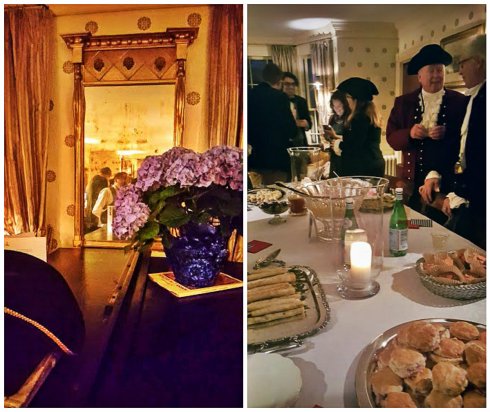
On Saturday night, a new event was held at venerable Hamilton Hall: the Salem Resistance Ball, commemorating the British Colonel Leslie’s forced retreat from Salem in February of 1775 in particular and a more universal spirit of resistance. Congratulations to the board of Hamilton Hall and the Ball committee for a job well done: there were lots of special touches to be admired about the event, and attendees clearly enjoyed themselves immensely. People turned out in a mixture of authentic period dress, costume, wigs, and formal wear, and there was even a suffragette in attendance! I think I got my act together, and wore a 18th-century-esque ball gown (from the 1980s), with a very new and puffy petticoat and my “old” reproduction 1805 corset underneath. There were several pre-parties and then we all arrived at the Hall, where there was lots of rum, a photo booth, lovely lighting, reproduction historical flags lining the ballroom, a light supper in the supper room, and lots and lots of dancing, led by period dancers and a caller who was an excellent instructor: I learned a lot. In particular, I learned that the “Grand March”, which signals the end of each and every Christmas Dance that I’ve attended at Hamilton Hall over 20+ years, is not supposed to be a sloppy melee, but actually a much more intricate promenade, and that it generally happens more towards the beginning of the dance rather than at its end. Perhaps the Hall’s newest ball can lead to some reform of one its oldest?

Before the ball Before the ball: a particularly beautiful sunset from Chestnut Street.

ball collage A very gracious pre-party.

ball 8

ball 13

ball collage 2

ball 10 The Setting.

ball 2

ball 1

Ball 7

Ball 20170408_220357-ANIMATION

ball 28 Dancing.

ball collage 3

After the Ball

morning after Best dresses & the day after.


18th-century-esque

Next weekend is the first-ever Resistance Ball at Hamilton Hall, commemorating Leslie’s Retreat, Salem’s opening act of the American Revolution, as well as the spirit of resistance over time and in our own time. Its organizers are encouraging, but not demanding, period dress so I have to figure out what I’m going to wear. I have a magic closet on the third floor full of evening dresses from the late 50s and early 60s that I rely on for all formal occasions, but I think this event calls for something different. It’s too late to go the custom reproduction route and I detest cheap costumes. About a decade ago, I commissioned a period gown (and stays!!! which were actually more expensive than the gown) for a ball marking the 200th anniversary of the Salem Athenaeum: I just assumed I would wear this regency gown for the Resistance Ball but when I took it out, put it on, and pranced around in it the other night I realized it was wrong, wrong, wrong. Too late, too Jane Austen, not enough Abigail Adams. So now I’m at a loss as to what to wear.

Resistance Ball

If I had realized my mistake sooner I probably would have ordered a dress or a robe à l’Anglaise from one of the amazing seamstresses out there: I have an old silk petticoat that would suffice. I particularly like the silk jacket below, but putting together an outfit around that little number would take time and considerable money, not just for the jacket, but for all the underpinnings: it’s all about the silhouette in historical clothing. With my time constraints, I’m thinking about the basic design elements of late eighteenth-century fashions—corsetry, cinching, embellishment, neckline, silhouette–and seeing if I can come up with something “18th-century-esque” for next week. I don’t think I’m going to go as far as the Versace corset dress from the 90s below, but I definitely want an updated eighteenth-century look.

18th century jacket

18th century ish 2

There is lots of inspiration out there because of the combined aesthetic influence of Hamilton and Outlander: polyvore sets abound! American Revolutionary women have never been singled out for their sartorial style, but their near-contemporary across the Atlantic, Marie Antoinette, seems to have a fashion moment every twenty years or so. Now, however, the Schuyler sisters and Clare Fraser rule. There are lessons for updating in the strategies of the costume designers of both productions. Hamilton designer Paul Tazwell seems to focus on color, and notes that “in keeping the overall design as contemporary feeling as possible while still in the silhouette of the 18th century, I kept the detailing as simple as possible so that it didn’t feel too decorative and fussy. I used mostly silk taffeta for the dresses on the women because it stays crisp and light and moves in a way that viscerally feels like the 18th century to me”. Outlander designer Terry Dresbach (who maintains a beautiful blog with many insights into her process) is dealing with a time-traveler, so a bit of adaptation is required: a 1940s Dior jacket that Clare might have worn in her 20th century life is transported to the eighteenth century along with her, and both are altered in the process!

Hamilton Girls

outlander-christian-dior-exclusive-designHamilton’s Schuyler sisters on stage, dressed by Paul Tazwell; the Dior inspiration for Outlander’s “time-traveling” jacket by Terry Dresbach.

Thinking about both the essentials of eighteenth-century style and their adaptation, I browsed around for hours (what a rabbit hole!) and put together a working digital inspiration board. Pinned mostly from ebay and various designer archives, these are the dresses that seem to represent the look I’m going after best. Moving around the board clockwise, we have a very editorial look by Jean Paul Gaultier, a detail of a really beautiful Prada black taffeta gown, an Azzedine Alaia wedding ensemble (for some reason this screams 18th century to me!), a Zac Posen dress, a Carolina Herrera gown, and Dita von Teese in a Vivienne Westwood toile dress complete with panniers. Even if I could find one of these pieces, I couldn’t afford them, but they got me thinking in different directions about bodices, bows, draping, and toile…….what about a toile dress? Too day/summery? It would have to be the right toile, and the right style–too late for that now.

Resistance collage

Of all the designers above, it is clearly Vivienne Westwood who has been the most immersed in and influenced by the eighteenth century over her long career. She’s amazing at focusing in on the key elements and bringing a new artistic sensibility to them. The poster for the big present/past fashion moment several years ago, Le XVIIIeme au goût du jour (The 18th Century Back In Fashion) exhibition at the Palace of Versailles, features (half of) her bold dress on its poster, and two years ago her eighteenth-century-esque clothes were exhibited in situ at the newly restored Danson House in London (lately seen in the television series Taboo). Westwood’s “Sunday” day dress from a few years back looks to me like the perfect distillation of eighteenth-century style, but it’s really too informal for a ball and I can’t find one anyway.

Resistance collage 2

18th century Westwood Cut From the Past Danson House 2015 A Vivienne Westwood corset at Danson House.

So that’s where I am now, pretty much nowhere, although I can just raid my third-floor closet and wear classic vintage formal. I’m trying to remember what my now-vintage Laura Ashley dresses, which I think are still at my parents’ house up in Maine, look like, though I seem to recall they are more nineteenth-century-esque than eighteenth-century-esque. And very puffy sleeves: all wrong.


Howard Pyle and Salem

Spring break week and I’m going nowhere, unfortunately. Yet I am actually content to have the extra time to catch up on a backlog of administrative and academic work, with the freedom to follow a few wandering trails as they come my way. Last night I was working out some of the details of the forthcoming symposium on the 325th anniversary of the Salem Witch Trials that my department is co-sponsoring (Salem’s Trials: Lessons and Legacy of 1692–June 10, said details to follow) when I came across one of my favorite illustrations by the golden-age illustrator Howard Pyle: A Wolf had not been Seen at Salem for Thirty Years.  The “making of Witch City” is one of the topics that we will be examining at the symposium, so I wondered what role Pyle might have played in this evolution. And so symposium planning went by the wayside as I pulled up as many of his illustrators as possible: wolfs and witches, along with Puritans and Pirates, were some of Pyle’s favorite subjects. This was a pleasant diversion as I’ve always enjoyed Pyle’s work, and not altogether indulgent: he was of an era (coinciding with the decades on either side of the 2ooth anniversary of the Witch Trials) when the image of the Salem witch was imprinted in the public mind in both pictures and words, and that’s why many of the images below look so very familiar.

Pyle The Salem Wolf_0000

pylewitch1

Pyle witch2

Pyle Flock of Yellow Birds

Dulcibel collage

Pyle Broomstick Train

Pyle collage 2

Salem images by Howard Pyle: title page of “The Salem Wolf”, Harpers Monthly Magazine, December 1909; “Arresting a Witch” and “Grany Greene falleth into ill repute”, Harpers New Monthly Magazine, December 1883;  “A Flock of Yellow Birds abover her Head”, from Giles Corey, Yeoman, by Mary E. Wilkins, 1892; two illustrations from Dulcibel: a Tale of Old Salem by Henry Peterson, 1907; illustrations from Oliver Wendell Holmes’ The Broomstick Train, or the Return of the Witches, 1905 color edition.


Wired for “Effortless Living”

There is a well-maintained Colonial Revival house on Loring Avenue in South Salem for sale right now: it looks unassuming, but when it was built in 1924 it was famous, surpassing, very briefly, Salem’s other notable structures. This house was one of hundreds, maybe even thousands, of model “electrical homes” built across the country in the 1920s and 1930s, and people lined up outside to see just how bright their domestic futures were going to be.

Wired House

The Salem Electrical Home was actually one of the first “Modern Homes” in the Boston region, joined in the next decade by equally popular electrical homes in Needham, Reading, Jamaica Plain, Lynnfield and Marblehead. Lines were long everywhere, with the Boston Globe reporting that 150,000 people visited the Marblehead home in 1935: Women are largely attracted to the displays of electrical homes, although there is a good proportion of men among them. Kitchen appliances and the kitchen arrangement is as attractive to women as a mile of shop windows. The electrical kitchen preserves the food, cooks the meals, disp0ses of the garbage and attends to numerous of the household tasks. It really does seem to be all about the kitchen, which assumes the character of an autonomous entity, “saving” time, energy, and ultimately money (spent on all those servants no longer needed): there’s no mention of the increase in disposable income necessary to purchase all these miraculous gadgets, of course.

Wired collage

Wired Kitchen NY 1930s

Wired Kitchen NY Worlds Fair NYPLDG

Wired 1911

Newspaper headlines about electrical homes around the country, 1920s; photographs of the Electrical Kitchen at the New York World’s Fair in 1939; Philip Atkinson’s Electricity for Everybody, 1911, New York Public Library Digital Collections.


Time Travellers

Generally there are several films on my Salem Film Fest “itinerary”, but this year (the Festival’s 10th) I seem to be focused exclusively on one documentary: Jay Cheel’s How to Build a Time Machine. I don’t think I’m quite as fixated on time travel as the two subjects of the film, animator Rob Niosi and theoretical physicist Ron Mallet, but I’m a Time Machine aficionado too: of the book and both (major) movies. I think there are personal motivations behind their mutual quest, but I haven’t seen the film yet. Beyond Wells’ storytelling abilities, the attraction for me is the steampunky notion of playing with time: I certainly don’t want to conquer or even control it! Like most historians, I don’t have a romantic attachment to the past either: I know it was dirtier, smellier and dark, but not, perhaps, as dark as the future, so I would still prefer to go back, if only for a spell, in my dependable machine.

time-machine-poster

time-machine-collage A century of time machines, from Enrique Gaspar’s “time ship” (1887) to the 1960 Wells machine, to TARDIS.

I’m just a casual delver into science fiction, but it seems me that The Time Machine is seldom discussed in the context of its lighter predecessor, Mark Twain’s A Connecticut Yankee in King Arthur’s Court (1889), probably because the latter is so light and not as concerned with the logistics of time travel. It is interesting to me that at this time, the tail end of the nineteenth century, so many people were interested in going back or forward or to anywhere but where they actually were! These two works initiated a time travel genre that will no doubt be with us forever, encompassing everything from Time Bandits, to Back to the Future to Midnight in Paris and everything in between, including my personal favorite, The Navigator: A Medieval Odyssey.

time-trave-aconnecticutyankeeillustratedepub

time-travel-connecticut_yankee4_new

time-traveling-navigato3_

pickering-house-and-knight

chestnut-street-pc-with-knight Knights descend on Salem!


Leslie Retreats Again

The 242nd anniversary of Leslie’s Retreat was marked by a spirited reenactment in Salem yesterday, with the central “characters” reprising their roles earnestly and enthusiastically amidst an equally enthusiastic crowd. I stopped over at Hamilton Hall first, where I heard the British were gathering, and was not surprised to encounter Colonel Leslie himself there, with his adjutant and a few supporters in scarlet. I was surprised to run into Major Pedrick from Marblehead on my way out (well, I knew they knew each other…..), but he (in the form of my old friend David Williams, whom I understand is a Pedrick descendant) walked on ahead to the First Church to give the alarm. There we waited a while for events to unfold, but once they did some serious parleying ensued between Colonel Leslie, Colonels Pickering and Mason from the local militia, and the Reverend Thomas Barnard, who had burst out of his church and rallied his congregation to the bridge (or rather a convenient parking lot adjacent to the present-day overpass) so that he could mediate. The discussion was heated, but eventually Colonel Leslie was allowed to cross over the bridge/overpass– a much dicier endeavor in 2017 than 1775 owing to traffic. When no cannon was found on the other side, the ever-gracious Reverend Barnard invited the Colonel–and all of us– to retreat to the First Church parish hall for refreshments, which made for an appropriate end to an event of compromise and commemoration.

reenactment-14

pedrick-2

cambridge-street-collage

first-church

reenactment-8

reenactment-9

reenactment-10

reenactment-collage

reenactment-best

reenactment-2

reenactment-3

reenactment-picture

Colonel Leslie (Charlie Newhall) and The Reverend Thomas Barnard (The Reverend Jeffrey Barz-Snell) face-off in 2017; a great day for community and picture-taking.


Re-engaging with Leslie’s Retreat

Salem is gearing up for a multi-event, multi-venue commemoration of a key event in its history and American history: Leslie’s Retreat, whereby a crowd of civilians compelled the 250-strong 64th Regiment of the Foot under the command of Colonel Alexander Leslie to retreat to Boston on February 26, 1775. The Redcoats came in search of rumored cannon and military stores and left with nothing: a week later the Essex Gazette brazenly reported that twenty-seven pieces of cannon were removed out of this town [neighboring Danvers], to be out of the way of the robbers. No shots were fired and no one was (really) hurt, but a stand was taken that would lead to more standing, most dramatically at Lexington and Concord, several weeks later. The significance of this stand-off was recognized in both the colonial and British papers at the time, and for several months thereafter: passages from the London Public Advertiser (May 2, 1775) and the Gazette (March 7, 1775) are representative of the not-too divergent perspectives.

leslies-retreat-public-advertiser-may-2-1775

leslies-retreat-essex-gazette-march-7-1775

The British view: REBELS enough to have eaten them up.      

And the American: not less than 12 or 15,000 men would have been assembled in this town within twenty-four hours after the alarm, had not the precipitate retreat of the troops from the Draw-Bridge prevented it.

Press accounts on both sides of the Atlantic generally portrayed the Salem event (along with the colonial capture of Fort William and Mary in Portsmouth Harbor in December 1774) as a prelude to the larger opening acts of the Revolution: Lexington and Concord. And that’s pretty much the standard view for the next 200+ years, with occasional moments (like this one!) in which the event’s significance is recognized for its own merits. I’ve written a more detailed post on the actual event before; now I’m more interested in the history of its commemoration, which was shaped by two key factors: its name and its anniversaries. Events generally become “historic” when they are named, and remembered in some form or fashion on anniversaries, and Leslie’s Retreat was no exception. The first reference that I can find to the name dates from 1840, but after the publication of Charles Moses Endicott’s Account of Leslie’s retreat at the North bridge in Salem in 1856 it really stuck, leading to a commemorative “oration”in 1862, a major Centennial commemoration in 1875, the dedication of a memorial stone in 1886, and anniversary services in 1896, 1902, 1925, and finally (long gap here), 1975. Leslie’s Retreat was also an “act” in the elaborate Salem Pageant of 1913, during which several scenarios of Salem history were reenacted by local notables to reinforce proper American values and benefit the House of the Seven Gables. The Centennial was marked with bell-ringing throughout the city at morning, noon and night, a 100-gun salute, flags unfurled everywhere, and a ceremony filled with addresses and hymns, while the Bicentennial featured a reenactment and a ball–just like this year–and inspired national headlines (The Shot Not Heard around the World).

leslies-retreat-arch

leslies-retreat-1875-program

leslies-retreat-1913-pageant

leslies-retreat-1975

The 1875 Memorial Arch and Program; Colonial dress-up for act #4 of the Salem Pageant, 1913; 1975 reenactment.

I can’t find any big splashy commemorations between 1925 and 1975, with the exception of the Salem and Marblehead tercentenaries in 1926 and 1929, but that doesn’t mean Leslie’s Retreat was forgotten: it became part of the civic curriculum, so much so that I found repeated references in the local papers along the lines of the story of Leslie’s Retreat is too well-know to be recounted here. A commenter on my earlier post noted that in the 1950s “Leslie’s Retreat was something every 8th grader had to do a project on” in Salem. The event received national attention again in 1960-61, when an American Heritage article by Eric W. Barnes (All the King’s Horses…and All the King’s Men, with charming illustrations by Edward –see below ) was reprinted in all of the major dailies. Still, I can’t help but think that the rise of Witch City overwhelmed Salem’s revolutionary reputation.

leslies-retreat-illustration2

leslies-retreat-color

leslies-retreat-collage

leslies-retreat-illustration-3

Edward Sorel’s illustrations for American Heritage, October 1960.

leslies-retreat-2017

(Re-) engaging with Leslie’s Retreat in 2017:  A community reenactment this coming Sunday, on its 242nd anniversary, at the First Church on Essex Street from 11:00 to 1:00; a talk by Dr. Peter Charles Hoffer, author of Prelude to Revolution. The Salem Gunpowder Raid of 1775 on March 26 at the Pickering House; a talk by J.L. Bell, author and super-blogger at Boston 1775 on “The Salem Connection” on April 7 at the Salem Athenaeum; a March to Revolution walking tour through Marblehead on April 8; and a “Salem Resistance Ball” at Hamilton Hall, also on April 8.