Tag Archives: Literature

The Death of Nathaniel Hawthorne

150 years ago today Nathaniel Hawthorne died, far from either his native city of Salem or his adopted town of Concord, in the company not of his beloved family but that of his devoted friend, former President Franklin Pierce. Really he died alone (as Pierce reported), very peacefully, in his sleep. I don’t think there are any plans to mark this memorial here in Salem (remember, we are Witch City, not Hawthorne city, and Nathaniel doesn’t seem to have cared much for Salem anyway), but (as usual) there will be events in Concord. It appears that Hawthorne had been unhappy and unsettled for some time before his death (just shy of 60; his birthday is July 4): there were money worries, health issues, the separation from his family, and of course the war–he doesn’t seem to have been enough of an Abolitionist or enough of a Yankee for his friends and neighbors– but at least his passing was peaceful, very peaceful according to President Pierce. I did a quick search of newspaper front pages for the week after May 19–and Hawthorne’s death was on the front page of every single newspaper I scanned, even in the South, although generally it was just a line or two in the midst of all the war news. He was famous in his own time, and has become even more so with time. There are many compelling and contradictory things about the work and the character of Nathaniel Hawthorne–he was both intensely shy and so handsome that people would stop him in the street– but for me, he’s always been the ultimate New Englander, and that is how and why I am thinking about him today.

PicMonkey Collage

Hawthorne's birthplace-001

Hawthorne on the Move

ourworldsgreatb01drakgoog_0411-001

Hawthorne Plymouth

Manuscript copy of The Dolliver Romance, which Hawthorne was working on before his death, New York Public Library; Newspaper reports from The (Washington, D.C.) Evening Star and The Daily State Sentinel (Indianapolis), May 20, 1864, Library of Congress Historic Newspapers Collection; Hawthorne’s birthplace in its original location on Union Street in Salem and its journey to the House of the Seven Gables campus in 1958; Hawthorne’s Concord milieu, from Samuel Adams Drake, Our World’s Greatest Benefactors (1884); The Pemigewasset House in Plymouth, NH: where Hawthorne died on May 19, 1864, Library of Congress


Enchanted Gardens

I’m rather depressed about my garden: I think I lost a lot of perennials–including many dear old friends–over this past bitter winter. This is generally the week–or even earlier–that my favorite spring plants pop up, but so far all I see is trillium and pulmonaria in the “woodland garden” out back. Notably missing is my all-time favorite, the almost-magical Jack-in-the-pulpit (Arisaema triphyllum), which should definitely have popped up by now. I think my Jacks are dead, although several of my gardening friends tell me to not give up hope as we are as much as four weeks behind this year, but there is not a single little sprout to be found peeping through the mulch. I fear for my Lady Slippers, but they come up a bit later so I have not given into despair quite yet. The center perennial beds seem to be in better shape than the shady back, with the exception of the germander edging border that I’ve been slowly developing over the past few years: quite a few of the individual plants have been lost, breaking the uniformity of the border. I’m tempted to just rip them all out and start fresh with a hardier plant, and so I would really welcome suggestions for low-lying, traditional, hardy, front of the border alternatives.

So I am not spending these first precious days of May dancing around my lush, flowering garden (in a flowing white dress) because it is neither lush nor flowering: looking for inspiration (or escape) I am instead delving into the “Enchanted Garden” sub-sub-sub genre of paintings. Of course medieval-esque fantasy gardens are a favorite Pre-Raphaelite theme, but even before their Decameron-inspired images appeared in the nineteenth century, artists were inspired to amplify nature in rather seductive ways. In the later sixteenth century, the popular poem by the Italian poet Tarquinato Tasso, Gerusaleme Liberata (Jerusalem Liberated), inspired several paintings of enchanted gardens. The poem turns the Crusades into an epic fantasy, in which heroic Christian knights confront all sorts of obstacles in the Holy Land. One particular knight, Rinaldo, is enticed by the beautiful Saracen sorceress Armida to enter her lush garden, and there she keeps him occupied for quite some time, until he is rescued by his comrades. I like the painting by Flemish artist Jan Soens best among several illustrations of Rinaldo and Armida, because it seems to focus as much on the garden as on the sorceress.

Enchanted Garden 16th C

Jan Soens, Rinaldo and Armida in the Enchanted Garden, c. 1581-1611, The Walters Art Museum

Several centuries later, Giovanni Boccaccio’s Decameron inspired several pre-Raphaelite painters to depict one of its most popular stories (the 5th to be told on the 10th day): the tale of the besotted Ansaldo, who conjured up a magical May garden in the midwinter for his lady love, Dianora, who had promised him that she would leave her husband and run away with him if he completed this seemingly-impossible task. Ultimately Ansaldo releases Dianora from her promise, and the garden dissolves “like the morning dew”, but it seems to have been a collective aim of British romantic painters to recapture it and other enchanted gardens for posterity.

Enchanted Garden Stillman

(c) Lady Lever Art Gallery; Supplied by The Public Catalogue Foundation

Enchanted Garden Waterhouse tree-001

Marie Spartali Stillman, Messr. Ansaldo Showing Diavola His Enchanted Garden, 1889; John Waterhouse, The Enchanted Garden, 1917, Lady Lever Art Galler, and study for above, Victoria & Albert Museum Collections

Also romantic, in a more naive way, are the paintings of British artist Helen Fielding (1900-1979) who depicted her Lancashire environment in an ever-charming way, including a garden that seems enchanted in all seasons, here pictured, as vividly remembered, in the spring of 1908. I love the inscription on the back, from the Christie‘s catalog: The Enchanted Garden was very/beautiful in April, when Father thought it would be better to send Mother, George and I also the Aunts, Grandma and Miss/Carter (who wore pink) to Grandpa’s at Blackpool/to be safely out of the way of the Suffragettes/in Lees. We saw for the first time the/Wild Cherries in flower and small trees/covered in the palest pink blossoms/which Grandpa said was the Crab apple, George and I had never seen trees/with blossom which covered them like/snow, also in the Enchanted Garden was/the pond which would soon be full of frogs/and tadpoles and the year was 1908/Helen Layfield Bradley 1975. I know just what she means by “trees covered with blossoms like snow”, don’t you? Still waiting for that here.

Enchanted Garden Bradley

Helen Fielding, The Enchanted Garden, 1975


Spring Snow

We certainly did not suffer the weight of snow dumped on the upper midwest yesterday, but T.S. Eliot’s weighty observation that April is the cruelest month seemed particularly apt when we woke up to white: and it seemed more like ice than snow! It might be aesthetically pleasing to see newly-sprouted grass and flowers frosted with white, but it does make you fear for your garden. Mother Nature is indeed a cruel master to tempt plants out of the protective earth with a warm weekend, and then slam them with an arctic frost! It was so warm a few days ago that I finally switched out the evergreen shrub in my front stoop pot with a tender purple-flowered variety, and now its leaves are black and curled. The same cats which frolicked in the back yard a few days ago are now back on their radiator perches, looking at me with suspicion.

April 001

April 004

April 005

april-001

April is the Cruelest Month-001

iPad version of T.S. Eliot’s The Waste Land (1922), with really neat annotations.


A Russian Alphabet Book

I thought the opening ceremony of the Sochi Olympics was absolutely captivating last Friday: it’s always interesting to see how a country and a people perceive themselves in terms of their history, although this particular presentation was probably more official than popular. There was certainly a strong imperial focus, I thought, and a bit less emphasis on the 20th century–except for the big red train! There was a lot of effort and energy out there but actually my favorite part of the whole presentation was the very beginning: the introductory video that prepared us for the live whimsy to follow as well as the Cyrillic alphabet. This impressed me both in terms of pedagogy and aesthetics, and of course if you paid attention you were prepared for the out-of-(western) order parade of nations that followed. I quickly learned that the images in the video were based on the Alphabet in Pictures book of Alexandre Benois (1870-1960), a Russian artist, set and costume designer (most famously for the Ballets Russes), historic preservationist, and art historian who was the Curator of Painting at the Hermitage Museum from 1918 to 1925, after which he left Russia: the Stalinist era clearly didn’t suit this Renaissance man, who perhaps inspired the Sochi spectacular in more ways than one (and he was the great-uncle of actor Peter Ustinov)!

Benois’ ABC book was published in a lavish 1904 edition by a Russian art publisher; it encompasses 35 chromolithographic plates illustrating each letter with scenes and figures from traditional folkloric, religious, and historical sources. Each page is a whimsical work of art and you can see all the images here and here; I’m glad that it has been digitized but would really like to spend some time with a real volume. It’s highly collectible (the last copy I could find at auction went for nearly $10,000), and I bet that it’s appearance at Sochi will drive its price up even higher. Much more accessible is Benois’ Russian School of Painting (1916), with its sad (in retrospect–knowing what would soon be his fate) portrait of Tsar Nicholas II on the frontispiece and entire chapter devoted to history and folklore.

ABC Cover 2

ABC Cp

ABC 3p

Abc Lastp

Digitized pages from Alexandre Benois’ Alphabet in Pictures, St. Petersburg: Expedition of State Papers, 1904.

The Alphabet book made me curious to see more of Benois’s work, and there is a lifetime of it! Watercolors, set designs, costumes, magazine illustrations. Apparently there was an 2006 exhibition at the Boston Public Library, which holds some of his papers, but he was not on my radar screen at that time. The paintings and sketches for sets and costumes evoke some of what we saw the other night, but the BIG HEADS must have come from somewhere else: Pushkin, perhaps?

Alexander-Benois-xx-Parade-under-Paul-I-1907-xx-The-State-Russian-Museum

ABC Nutcracker 1938

Pushkin 2

Alexandre Benois, Parade under Paul I, 1907, Tretyakov Gallery, Moscow; Nutcracker Costume for La Scala, 1938, Victoria & Albert Museum; Illustration in Pushkin’s Lyudmila and Ruslan by Nikolai Kochergin (1897-1974).


In the Bleak Midwinter

Its title does not really conjure up Christmas cheer, but In the Bleak Midwinter is one of my favorite carols. I heard its melody repeatedly over the holidays and made a mental note to look into it a bit. And now that we are in the post-Christmas bleak not-quite-midwinter it seems like an appropriate time to do that. Surprisingly it is a creation of the Victorian era and after: I thought it was much older. Two early nineteenth-century composers set Christina Rossetti’s 1872 poem (first published in Scribner’s magazine) to music, creating an almost-instant classic: In the bleak midwinter, frosty wind made moan, Earth stood hard as iron, water like a stone; Snow had fallen, snow on snow, snow on snow, In the bleak midwinter, long ago. 

While the rest of Rossetti’s poem is Christocentric, this opening stanza, setting the scene, is universal. Combined with the melodies of Gustav Holst and Harold Darke, the song seems ageless, which is why I thought it was older than it actually is. Darke’s version (a nice version of which is here) won “best Christmas Carol” in a poll of the world’s leading choirmasters in 2008. Besides the beautiful melodies assigned to Rossetti’s words, I’m interested in the use of the word “bleak” here: usually this term connotes a definite pessimism, despair, even hopelessness; but I think the combination of words and music creates a feeling of comfort and hopefulness, to get everyone through the bleak midwinter. My own understanding of bleakness comes more from images than sounds, and I think midwinter can be beautiful, both as a barren landscape and as a setting for all the little details within.

Midwinter Pickering House 1900

Midwinter Boston Common 1904

Midwinter A Wolf Had Not Been Seen at Salem for Thirty Years Pyle

Midwinter Museums Karolik Collection MFA

Midwinter Tile Kate Greenaway

Favorite midwinter images, not so “bleak”:  the Pickering House, Salem, c. 1900 from a private family collection; Boston Common, c. 1904, E. Chickering & Co., Library of Congress, Howard Pyle, “A Wolf Had not Been Seen in Salem for Thirty Years”, illustration for his 1909 Harper’s Monthly story, “The Salem Wolf”, Delaware Art Museum; Anonymous American painting, 19th century, Karolik Collection, Museum of Fine Arts, Boston; Kate Greenaway wall tile for Burslem, c. 1881-1885, Victoria & Albert Museum, London.


A Poe Parlor

Last year around this time (of course), the private sales site Joss & Main featured a “Destination Salem” shopping event, comprised of items chosen to conjur up the spirit of my fair city. I was pleased that the selections were not all kitschy witchy, but included some maritime, colonial and Federal (quotations around all terms, please) items as well. This year I’ve been looking out for another Salem collection, but instead the site curators have showcased Design Icon Edgar Allan PoePoe is certainly having quite a moment, with his big show at the Morgan Library & Museum! It’s hard to think of him as a “design icon” but he certainly was proficient at setting the scene. The curators of the Joss & Main collection seem to have gone in an exclusively dark and literal direction: all black and gray (think ravens and cats) and no red (think hearts, masques, and blood). I think I can do better.

Macabre Poe NYT Fred R. Conrad credit

Man of the moment Edgar Allan Poe, © Fred R. Conrad, New York Times.

The Salem and Poe collections actually share quite a few items: black-painted tables, windsor chairs, grey upholstery, raven-embellished pillows. There are some nice looking desks, although they’re a bit undersized (why is it that modern desks are so small and coffee tables so big?) I think the items below represent the Joss & Main portfolio quite well.

Bartow+Rug

Macabre Chair Joss and Main

macabre study table

In putting together my Poe-inspired room, I took into consideration two influences. One is Poe himself who, oddly enough, did write an article on interior decoration, “The Philosophy of Furniture”, published in Burton’s Gentlemen’s Magazine in 1840. The other is my more imaginative conception of the Poe ambiance, based on my reading of his works: what I want my Poe room to look like rather than what he would have wanted his room to look like. We obviously have a much clearer vision of the former, and an illustration, as the reading room at the Poe National Historic Site in Philadelphia is decorated according to the preferences laid out in “The Philosophy of Furniture”:  silver-grey walls with lots of crimson and gold accents, landscapes and female portraits, no flowers, minimal window hangings (Poe seems to have had a disdain for swags, like most men I have known), the Empire furniture of his time. Taking all these preferences together, you get a pretty conventional mid-nineteenth century Empire room–I think I need a little bit more texture, a bit more drama, a Gothic air.

Poe Reading Room

Poe doors

Poe Basement

The Reading Room (and spooky basement) at the Edgar Allan Poe National Historic Site in Philadelphia, recreated according to Poe’s “Philosophy of Furniture”.

Poe writes a lot about “arabesque” motifs in his “Philosophy” piece, and the importance of carpets, so I’ve picked the Jaipur “Narratives” carpet below for my Poe parlor, from Joss & Main’s inventory site: this rug has all of his favorite colors, it looks perfect to me. I would keep the Empire sofa that you see above (I already have one), but I am very inspired by the Gothic doors of Poe’s Reading Room, so I would look for some Gothic revival side chairs with a similar silhouette: the perfect one sold in a Doyle’s auction last year, but I need more! In front of the Empire sofa I would put a neo-Gothic table made of metal; there are no “period” coffee tables so you might as well go for something cool.

Jaipur-Rugs-Narratives-Red-Crafts-Rug

Poe Parlor Chair

contemporary-wood-metal-table-65024-1638325

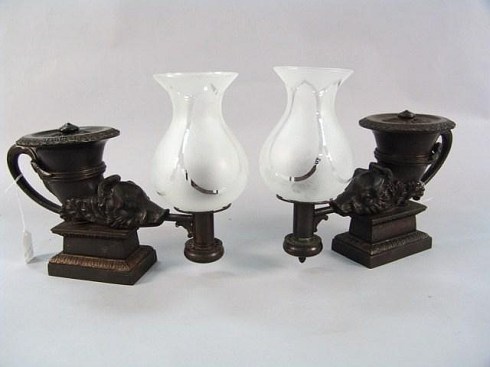
I love this gilded mirror from Christopher Jones Antiques, which is contemporary with Poe: it would go over the mantle of the dark marble fireplace, with two Argand lamps on either side:  the pair below are perfect: they just went for $3500 at a Connecticut auction gallery last weekend.

Mirror

Lamps

Now all we need are some whimsical/literal accessories and finishing touches: footstools and/or drapes in this “Nevermore” fabric, a Poe pillow or two, Raven candles from Target on the mantle, interspersed with these amazing metal sculptures. A great, beating (ticking) clock. I’m not sure about paintings; Poe’s preferred landscapes are boring and (against his wishes) I would definitely have a textured wallpaper rather than plain painted walls. I’m torn between the Pugin wallpapers below, created in 1848 for a client named Lockhart, which might be too much with my rug, and something more silvery and spidery. My Poe parlor is a work in progress.

Poe fabric

Poe Gothic Pillow

Raven Sculptures

PicMonkey Collage


Eastern Carpets on Western Tables

I’m off to New York City tomorrow for a big wedding, and although time is limited, I’ve got to go to at least one exhibition while I am there. I’m torn between the Morgan Library & Museum’s Edgar Allen PoeThe Terror of the Soul  and an equally new exhibition at the Metropolitan Museum of Art:  Interwoven Globe:  the Worldwide Textile Trade, 1500-1800.  I think the latter is going to win out for two reasons: 1) the early modern period is my teaching specialization and; 2) it features textiles–materials, stuff–which is going to win out over literature any and every time. Anybody that has ever studied–or even casually glanced at–European paintings over this long period can see the increasingly liberal display of eastern textiles throughout the era, and most especially in the art of the Renaissance and Dutch Golden Age: this is material evidence of the “interwoven globe”.  The value that was placed on eastern textiles, most prominently carpets, is indicated not only by their appearance but also by their placement; I use a lot of art in my classes, and inevitably my students always ask: why is that oriental rug on the table?

Carpets 1 The Ambassadors

This famous painting, Hans Holbein’s The Ambassadors (1533; National Gallery of Art) is a perfect case in point. I use it to illustrate the ideal of the Renaissance Man: these two young French ambassadors, amidst the symbols of their expertise, with an anamorphic skull lurking in the foreground to warn the viewer against excessive worldliness, create quite the composition. There’s a lot to see and discuss, but inevitably my students ask why is that oriental rug on the table? Before they notice the skull.

Carpets from the Middle East appear in European works of art as far back as the thirteenth century, after the Crusades opened up this exchange, but they become a much more common decorative element several centuries later. Renaissance artists like Carlo Crivelli and Lorenzo Lotto used carpets frequently in their works, so much so that they even have distinct carpet patterns named after them. The presence of the carpet in these paintings immediately conveyed an image of wealth, education and achievement to the onlooker; it was a decorative (but certainly not unsubtle) way of conveying status in this aspirational age.

785px-Lorenzo_Lotto_-_Portrait_of_Giovanni_della_Volta_with_his_Wife_and_Children_-_Google_Art_Project

Carpet 2 Lotto

Lorenzo Lotto, Portrait of Giovanni Della Volta with his Wife and Children, 1547, National Gallery of Art & Husband and Wife, c. 1523, State Hermitage Museum, St. Petersburg, Russia (the carpet is easily understood, but what about the letter and SLEEPING squirrel?)

Jumping  forward to another aspirational era, the Dutch “golden age” in the seventeenth century, and carpets seem to be on every painted table, particularly those of Johannes Vermeer and Gabriel Mëtsu. They appear so often they start to look common, rather than like possessions of the privileged; Vermeer in particular is rather egalitarian with his carpets, which appear in the close proximity of several maids and even a prostitute. Before long, they’ll end up on the floor.

Johannes_Vermeer_-_The_Wine_Glass_(c_1658-1660)

455px-Gabriel_Metsu_-_Man_Writing_a_Letter

Johannes Vermeer, The Glass of Wine, 1658-1660, Staatliche Museen Preußischer Kulturbesitz, Gemäldegalerie, Berlin; Gabriel Mëtsu, Man Writing a Letter, c 1662-1665; National Gallery of Ireland.

PicMonkey Collage

PS. In terms of exhibition souvenirs, I think I prefer the Interwoven Globe tee shirt to the Poe magnet. That clinches it.


Boccaccio’s Birthday

Now that I’ve made this big transition to chair of the History Department, I’m doing very little teaching: only one class (on the Renaissance and the Reformation) as opposed to the normal four-course-per-semester load. That’s just how administrative the job is. I’d much rather be teaching three more courses, frankly, but at the same time I have a renewed appreciation of the time I do get to spend in the classroom. The Ren/Ref course is an old standard, easy and fun to teach with its contrasting and continuous movements and its visual and theological drama, and my students are open and engaged and undemanding. It takes me a while to get into the period as the course has no prerequisites and most of them need some medieval footing in order to proceed; consequently we’ve just finished an examination of the late medieval crisis (intense famine, plague, war, schism, all at the same time) and the “worlds” of the “three crowns” of early Italian Renaissance literature:  Dante, Petrarch and Boccaccio. I usually focus almost exclusively on Petrarch as the key transitional figure in the emergence of the Renaissance humanist mentality, and this course was no exception, but all of the celebratory initiatives associated with the 700th anniversary of Giovanni Boccaccio‘s birth are making me reconsider my practice. Perhaps the Decameron, Boccaccio’s allegorical collection of 100 stories told by ten young Florentines seeking to distract themselves and pass the time while they wait out the Black Death in a deserted rural villa, should be read for more than its plague prologue.

Vasari002

Boccaccio, in the company of Petrarch, Dante, and three other Renaissance writers, in Giorgio Vasari’s Six Tuscan Poets, 1544, Minneapolis Institute of Arts.

Boccaccio 2013” is a multi-disciplinary, multi-event happening in Italy, and Boccaccio is also being celebrated in Britain, where he has always been recognized as an inspiration for another essential late medieval work, Chaucer’s Canterbury Tales (as well as John Lydgate’s Fall of Princes). There was a major conference at the University of Manchester this summer, as well as a coincidental, and ongoing exhibition, focused on Boccaccio’s currency.  He endured because (like any true Renaissance man) he sought fame in his own time and among his contemporaries, but also because his accessible prose and format inspired a succession of authors, from Shakespeare to Voltaire, to Tennyson, Longfellow and Poe. Readers past and present also wanted to see those beautiful noblemen and -women telling their tales–as well as the characters in their tales–while the world was dying all around them, and so centuries of artists have been inspired by Boccaccio as well. Renaissance escapism:  modern and universal at the same time.

Boccaccio

Decameron Crivelli Bodleian

Boccaccio Botticelli

Boccaccio Stothard 1825

Boccaccio after Stothard etching

Boccaccio Waterhouse

Boccaccio the author, in a French manuscirpt of his De Claris Mulieribus, 1440, British Library MS Royal 16 G V; Eat, drink, and be merry for tomorrow we die:  illustrations of the Decameron from Taddeo Crivelli’s 1467 manuscript edition, Bodleian Library MS Holkam mis. 49, and by Sandro Botticelli, the Story of Nastagio degli Onesti: The Banquet in the Pine Forest, 1483, Museo del Prado, Madrid, Thomas Stothard, c. 1820, British Museum; and John Williams Waterhouse, A Tale from the Decameron, 1916, Lady Lever Gallery, Liverpool.


Ginger Men

Back to Salem and the material world. August is the traditional Americana month in the world of Antiques auctions and shows, and one particular lot from this weekend’s upcoming Skinner Americana auction has me transfixed: Ammi Phillips’ Portrait of a Gingerhaired Young Man, which has an estimate of $15,000-$25,000. What a portrait! Riveting blue eyes, patrician profile, the 19th century hand-in-waistcoat pose, and very notable ginger hair.

Ginger-Haired Man POrtrait

Ginger is the preferred term for red hair in the nineteenth century, and before. The relative rarity of this hair color created a folkloric characterization (shiftless, hot-tempered) that endured for centuries. The weakness of William the Conqueror’s heir, William Rufus, was attributed to his hair color, as was the voracious personality of Henry VIII. Much later, the prejudices subsided, but the titles of nineteenth-century portraits of redheaded men, women and children always reference hair color, still the conspicuous characteristic of the sitter.

Ginger Man William Rufus

Ginger Henry VIII

Ginger Man 1590 V & A

Ginger-Haired Gentleman Skinners

Ginger-Haired Gentlemen Skinners

Ginger Man

The assassination of William Rufus, British Library MS Royal 20 A II;  the ginger-haired Henry VIII, anonymous artist after Hans Holbein, c. 1600, New College, Oxford University; Portrait miniature of an unknown ginger-haired man (previously thought to be Sr. Francis Drake), bu Isaac Oliver, c. 1590, Victoria & Albert Museum; Two nineteenth-century miniature portraits of ginger-haird men, Skinner Auction Archives; Irish Author J.P. Donleavy’s 1955 picaresque novel The Ginger Man, which (apparently) JOHNNY DEPP is considering bringing to the screen.


Mapping the Book

For some reason, I belong to all of these membership shopping sites. They send me daily notices of their “special” sales, which usually just annoy me; seldom do I click through and look at their wares. But I did click on the Fab link the other day, and found some really neat pictorial maps of the scenes, plots, characters and places of some classic books, including Moby Dick, Huckleberry Finn, and Robin Hood, produced by the Harris-Seybold  Company of Cleveland, Ohio in the 1950s, presumably to showcase their cutting-edge printing equipment. These are different from the make-believe maps you find in children’s books (NeverlandMiddle Earth) because they are representations of real places, superimposed with fictional characters (well, all of them except for Treasure Island). The Library of Congress also featured these maps, in its exhibition and accompanying book Language of the Land:  Journeys into a Literary America.

Literary Maps Moby Dick

Literary Maps Huck Finn

Literary Maps Virginian

Literary Maps Robin Hood

Literary Maps Treasure Island

Harris-Seybold Literary Maps of Moby Dick, Huckleberry Finn, and The Virginian, 1953, Library of Congress, and of Robin Hood and Treasure Island, 1953, Fab.com.

So much better than those old-fashioned literary maps where authors’ heads are placed on their state or town–but many of these can be found in the Library of Congress’s exhibition as well. I spent considerable time (now lost) trying to make a literary map for Salem based on Hawthorne’s House of the Seven Gables following this Google Earth procedure, with less than impressive results. Instead, I’m featuring a cropped image from another vivid mid-century map, Alva Scott Garfield’s Scott-Map of SALEM MassachusettsThe Wealth of the Indies to the Uttermost Gulf!” Scott’s maps are always extremely well-annotated–and often very cleverly so: the caption underneath the requisite witch on her broomstick reads “aviation started in Salem” while a nearby musket-bearing Puritan is captioned “the anti-aircraft is surprised” (see below). In the proximity of the actual House of the Seven Gables she has assembled many of the characters from the House of the Seven Gables (Clifford and Hepzibah, Phoebe, Judge Pyncheon), creating a perfect literary map of this little corner of Salem. And in another corner, Scott has placed characters from The Scarlet Letter, and the author himself, near the Mall Street house where Hawthorne penned his first novel, charting more literary territory.

Literary Maps Scott

Scott Salem

Scott Map

Alva Scott Garfield, A Scott-Map of Salem, c. 1950s, Barry Lawrence Ruderman Antique Maps, Inc.