Tag Archives: Graphic Design

Film Fonts from the 1930s

Big time transition here from the 1180s to the 1930s but that’s my life! As even the casual reader of this blog may know, I’m an avid classic film buff who is regularly tuned in to Turner Classic Movies–on which I watch (or glance at, while I’m doing other things) even bad movies. It doesn’t matter: if the plot doesn’t hold my attention something else will:  the sets, the costumes, even the titles. The other night an extremely lightweight Ann Sothern film from 1936 entitled The Smartest Girl in Town (working model “Cookie” Cooke seeks rich husband and reluctantly falls for a man whom she presumes is another model but is in fact–and of course–a millionaire) caught my attention simply by its title sequence, featuring an amazing font which I had never seen before. I taped the film and have since gone back again and again just to look at these letters:

Film Font 1936

And aren’t they amazing? Look at all those circles and parallelograms–they really liven up what looks (to my untrained eye) like a pretty standard 1930s font. My preoccupation with this particular title drove me to look for those of some of my favorite films from this era, and led me to discover a great resource: the website of Dutch graphic and web designer Christian Annyas, who has collected hundreds of screen shots of film titles from the 1920s to the present in his The Movie Title Stills Collection. You can search by title, designer, director, or actor, but the best thing to do is just browse through the decades so you can see the evolution of letters on film. I did that briefly, and then went right back to the 1930s, which produced my favorite films and my favorite fonts, and here are just a few of them:

design-for-living-movie-title

Design for Living (1933): almost as good a title as The Smartest Girl, but a much better film. It’s very modern, and is basically about a menage à trois!

39-steps-title-still

The 39 Steps (1935): Hitchcock attended to every little detail–all his titles are great.

theodora-goes-wild-title-still

Theodora Goes Wild (1936): not sure this is as classic as some people say, but it is charmingly well-acted by Irene Dunne and Melvyn Douglas–and I love this font!

Film Font Godfrey

My Man Godfrey (1936): more 1930s shadows–the “forgotten man” gets into the picture!

Film Font Dead End 1937

Dead End (1937): a more realistic Depression-in-New-York film by William Wyler with Humphrey Bogart and one of my favorites, Joel McCrea.

Film Font Wings

Only Angels have Wings (1939): I don’t really care for this sandy font, to tell the truth, but as this is probably my favorite movie of that stellar movie year 1939, I felt I had to include it. You can tell we’re about to go through a typographical transition…….


Casabella Covers

For the most part, I think I’ve been pretty productive during this snowbound February, but I’ve also frittered away a fair amount of time: reading not very scholarly books and searching through some of my favorite databases for anything that might catch my attention: images, fonts, ideas. I love magazines about architecture and interior design, so I browsed through digital collections of twentieth-century publications and found several that intrigued me, not so much for their content (traditionalist that I am) but for their striking covers. Magazine covers are so boring now (with the exception of the New Yorker and a few other titles): there’s no abstraction or design, just a literal representation of what’s inside. This was not the case in the mid-twentieth century, when the images and letters of design magazines like Casabella seemed to (literally) leap off the page. La casa bella, a monthly magazine of “radical” modern architecture, commenced publication in 1928 in Milan and is still published today. Its first covers are pretty sedate, but in the 1930s (about the same time that the title was changed to Casabella) they get quite a bit more interesting, reflecting not just what’s inside but their time. Here’s a portfolio of images from 1929-73, all taken from the magazine’s current website.

la-casa-bella-2-cover

Casabella 1930

Casabella Covers 1932 collage

Casabella 1950s

Casabella 1960 collage

Casabella 1960s

Casabella Cover 1

Casabella Covers from 1929, 1930, 1933, the 1950s, 1963, 1969 & 1973.


Hip (-Hop) Hamilton

It seems to me that from time to time one of our Founding Fathers emerges from the pack, to glow just a little brighter in a blaze of adulation. Certainly John Adams had his time a few years back, singled out by David McCullough’s book and the HBO series; more recently “Sexy Sam Adams” emerged as the hero of the History Channel’s (or as most historians refer to it, the Hitler Channel) Sons of Liberty miniseries, sponsored, of course, by Sam Adams beer. Now it’s all about Alexander Hamilton, the star of a namesake, sold-out musical on off-Broadway. Hamilton, written, directed and starring Tony winner Lin-Manuel Miranda, is based on Hamilton’s rag-to-riches life, as charted by Ron Chernow’s 2004 biography, set to a score that sounds far more lively than that of 1776.

Hamilton the Musical

Hamilton the Musical 2

Hamilton Poster

I don’t find the spotlight on Hamilton, or the success of Hamilton, even remotely surprising. After all, I live in Alexander Hamilton world: the first thing I see every morning when I wake up is Hamilton Hall, the c. 1805 assembly hall named after the Federalist hero/martyr, and the sign boldly attesting to that fact. And even if you’re just familiar with the outline of his life you can understand that it would make for a good story: illegitimate Caribbean orphan sent to New York, student, lawyer, lover, soldier, author, first Secretary of the Treasury, victim of a duel. Fill in the details and you’ve got a blockbuster!

Alexander Hamilton 1957 Rand McNally Ad

Hamilton Batman Bill

Hamilton Birthday Card

Hamilton Vodka

Hamilton updated: 1957 Rand McNally ad; defaced $10 Batman bill; Alexander Hamilton birthday print by A5/Day; Alexander Hamilton small-batch Vodka.


Architectural Alphabets

Architecture and Alphabets: two of my favorite things, together. I’ve been meaning to post some images from Jean Baptiste de Pian’s clever alphabet ever since I discovered it a year or so ago, but just never got to it. There’s already some images and admirers out there, but I’ll add more. The lithographs below, part of a series of 26, were actually created and colored by Leopold Müller in 1842 after paintings by Pian. The series is very rare and valuable: one set sold for over $32,000 at a Christies’ auction last year, and another is currently available at Bromer Booksellers for $65,000. Apparently a facsimile edition was published in 1973 but I can’t find it anywhere. As you can see in the images below (which I have taken from the Christies’ listing), the letters are not just affixed to the structures but rather an integral part of them.

Architectural Alphabet 1842

Architectural Alphabet F

Architectural Alphabet U 1842

As impressive as they are, Pian/Müller’s letters are not completely original conceptions: just a few years earlier the Italian artist and theater designer Antonio Basoli had published his own, predominately classical,architectural alphabet, Alfabeto Pittorico, comprised of 24 letters and an ampersand. Basoli’s Alphabet, as it came to be known, is rare today as well, though apparently not quite so rare as that which it might have inspired: it fetched $15,000 at the same 2013 Christies’ auction. Before Basoli, there was the plan-based architectural alphabet of the German architect Johann David Steingruber, published in 1773. Viewed individually, I don’t think Steingruber’s letters are as impressive as the more consolidated forms of Pian/Müller and Basoli, but collectively (as in this canvas by Ballard Designs from a few years back) they pack a punch.

Alphabetical Alphabet Basoli

Architectural Alphabet Z

steingruber1

steingruber6

Steingruber Ballard Designs

Scans of Basoli & Steingruber at the venerable blog Giornale Nuovo, a feast of information and images.

The architectural alphabet looks like a seventeenth-century invention to me: a direct consequence of the rebirth of classicism and the emergence and development of the printing arts in the centuries before. But I think I’ll move up (back) to our own time, where the architectural alphabet still survives, indeed thrives! Two great examples: Federico Babino’s alphabet of architects, cleverly titled Archibet (he also builds an Archibet City), and the (less integrative but more whimsical) Architectural Alphabet of Andrew Zega and Bernd Dams.

Archibet-alphabet-of-architects-by-Federico-Babina_dezeen_A-01

Archibet-alphabet-of-architects-by-Federico-Babina_dezeen_Z-01

zega and dams


Paper Queens

It’s back-to-school time and that mean I’m spending money: on myself. When I was a little girl, my elegant grandmother (still quite immaculately dressed at 101) would drive up from Massachusetts to Maine with a trunkful of dresses in late August or early September, and I would immediately run up to my room with all my loot, change into these beautiful frocks, and “treat” everyone to a fashion show. Many years later, I still think I deserve a back-to-school shopping spree every September, even though I’m a professor rather than a student (and I have to pay for it myself). I remain the clotheshorse/monster that my grandmother created, but this year I haven’t been spending much money on clothes:  instead I seem strangely drawn to stationery. In the past week I’ve purchased calendars, planners, notecards, mousepads and other pads, and lots and lots of folders. I’m concerned that this is the administrative side of me taking over, now that I’ve been department chair for a year, and hope that my materialistic side reasserts itself when my term is over. And looking at the array of paper spread out before me, one thing is patently obvious: there are a lot of queens. Apparently mere mundane paper products are not enough for me; I must have royalty.

Just a few of my purchases:

Paper Queens elizabeth-notebook

marie-notebook

Queen Elizabeth I and Marie Antoinette notebooks from SHHH My Darling.

Paper Queens Eliz

Paper Queens Marie

Queen Elizabeth I and Marie Antoinette note cards by Rifle Paper Co.

Paper Queen Album

Post-marked Photo Album from Campbell Raw Press.

Paper queens wrapping paper

Queen Elizabeth II stamp wrapping paper at Kate‘s Paperie

Alexa Pulitzer — Royal Elephant Mousepad Notepad

And a reorder of a perennial favorite, Alexa Pulitzer‘s Royal Elephant mousepad (although I think he’s a king).


Illustrating August

August is probably one of my least favorite months, but I’m trying to adopt a different attitude this year. As I’ve either been in school or teaching school for my entire life (except one year) it is generally the last, fleeting, month of freedom before the resumption of academic responsibilities (I know everyone is really feeling sorry for me now): the first part of the month is really hot and the last part is all about completing my syllabi. But since I’ve been chair of my department, my perspective has changed, because the administrative responsibilities lighten, but do not cease, in June and they definitely intensify in August. So there really is no going back; and consequently there is no fleeting end of the summer. Chairs also teach less, so there are fewer syllabi to complete and more time to enjoy September, which is truly one of the most glorious months of the year. While there is a general perception that August is a transitional “back to school” time for everyone today; this was not always the case. Calendar pages, seeking to characterize each month according to activities, originally focus on work (the ever-present scythe, threshing) and later on leisure (tennis, boating, wandering among the flowers) but always in a lush landscape. August, for the most part, is all about abundance, until we get to the more-stark present.

August MS KL

August MS KB

August Bening V and AM

August Fruits Detail 1732

August Fruits 1732


August Grasset 2p

August Mucha crop

August 1969 Marchbanks

August 2012 DV

Illustrating August in three Renaissance Books of Hours ( The Hague KB 76 F 14, Paris, c. 1490-1500; The Hague KB 133 D 11, Liège, c. 1500-1525; Simon Bening, 1510-60, Victoria and Albert Museum); details from the August page of  Robert Furber’s Twelve Months of Fruit, by John Clark et. al. after Peiter Casteels, 1732, Rooke Books; two art nouveau Augusts (Eugene Grasset, La Belle JardiniereAugust, 1896; Alphonse Maria Mucha, 1899, Mucha Foundation); modern Augusts–a bit more stark–by Harry Cimino and Dione Verulam


Tedious Details

Among the books up for “adoption” and restoration at the Salem Athenaeum this spring and summer is a first (1891) edition of Caroline Upham’s Salem Witchcraft in Outline, which has the outrageous subtitle the story without the tedious detail. It’s a beautiful little book, but I just can’t get past that subtitle, a knife to the heart of any historian: THE STORY WITHOUT THE TEDIOUS DETAIL. Caroline was the daughter-in-law of the first serious historian of the Salem Witch Trials, Charles W. Upham, whose Salem Witchcraft: with an account of Salem Village and a History of Opinions on Witchcraft and Kindred Subjects (1867) approached the event and topic with unprecedented context and detail. With her Outline, she admits that she is neither a brilliant essayist nor an historian, but offers her little book to the public as one would the photograph of a notable scene, not a great original painting. And if, as it must be, the rich coloring and delicate effects are missing in the reproduction, it is hoped the drawing may be found true, and no important lines set in awry. Having been desired by the heirs of the late Charles W. Upham to draw freely from the History, paragraphs from it have been woven into the sketch giving strength to the little story, and serving the reader better than a feminine pen I could do”.  Her “photograph” is certainly framed well, with a beautiful cover, amazing fonts, and lovely pen-and-ink illustrations of the seventeenth-century houses that “witnessed” the events of 1692. I also like the “signature page” featuring the names of some of the major participants in the trials: Governor Phips, several judges, the victim John Proctor: this represents Caroline’s approach and emphasis on personal stories, which actually anticipates the focus of witchcraft histories from a century later.

Upham 009

Upham 010

Upham 013

Upham 011-001

Upham 016

So there’s a lot to like about this little book, but again, there is also that objectionable subtitle: THE STORY WITHOUT THE TEDIOUS DETAIL. For me, it’s all about the details: the details make the “story”. I do want to give Caroline the benefit of the doubt, however: it’s clear to me that nineteenth-century Salemites were tired of their witchcraft past (Nathaniel Hawthorne being the best example); they couldn’t quite conceive yet (actually Daniel Low’s witch spoon would appear at just about the same time as Salem Witchcraft in Outline, for the 200th anniversary of the Trials) how to turn their dark past into commercial opportunities. They wanted to acknowledge, but move on. So a succinct outline, produced just in time for the big anniversary, might have seemed sufficiently reverential. And I also have to admit, as one who has delved in Victorian volumes quite a bit, that nineteenth-century history writing is a bit tedious, with its focus on great men, big battles, and past politics. I can appreciate the images below, even though the first one is every professor’s worst fear!

NPG D12938; William Smyth ('A petty-professor of modern-history, brought to light') by James Gillray, published by  Hannah Humphrey

Tedious Tissot

James Gillray, William Smyth (‘A petty-professor of modern-history, brought to light’), c. 1810, ©National Portrait Gallery, London; James Tissot, The Tedious Story, c. 1872, Private Collection


Willow Ware Redux

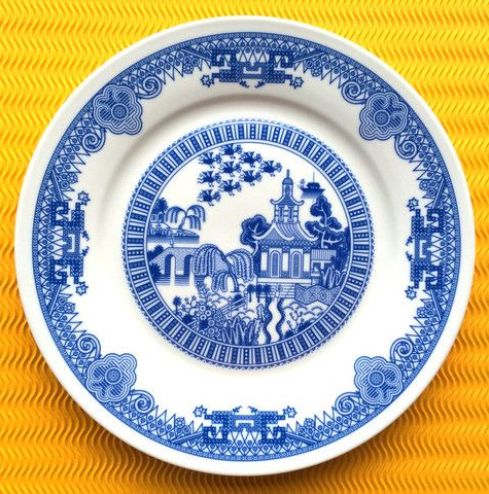
I am not fond of blue-and-white china (or anything blue, to tell you the truth), nor do I particularly like the Willow pattern, one of the most popular and replicated in the western world for several centuries. But I do love both the idea and the act of updating something that is classically familiar—even overly familiar–in a clever and creative way. So when I saw a little story about Calamityware, in which flying monkeys and flying saucers, along with robots and Renaissance sea creatures, are right there on the plate along with the traditional “Chinese” structures, figures, and landscapes, I went right to the source: artist Don Moyer’s site, on which his earlier drawings are coming to life (or pottery) on a Kickstarter-funded production line. So many things about these plates appeal to me (despite their color): they are blatantly anachronistic, purely whimsical, and perfect examples of my favorite fusion of past and present, traditional and modern, new and old. The flying monkeys were first off the line, and we may see kings and oligarchs later, though surely they won’t be as scary.

Calamityware

New Willow Ware Calamity 2

New Willow Ware Calamity 3

Calamityware is not the first variation on the Blue Willow pattern; in fact it was inspirational almost from its inception–and wildly popular. I’ve got a bowl full of Willow shards uncovered in my back yard when I was digging out my herb garden. Willow ware was first produced in the late eighteenth century by Thomas Minton, an English potter who adapted designs featured on Chinese export porcelain for domestic production. There was no patent protection, and his competitors–Wedgwood, Royal Worcester, Spode–began producing their own Blue Willow, and continued to do so for the next two centuries. In an early stroke of advertising genius, a story was composed to sell the dishes: when a powerful Chinese lord discovers that his daughter has fallen in love with his lowly clerk, he locks her up in a secluded pagoda behind a fence and betrothes her to a rich and elderly duke. The young couple flee before the wedding, but are hunted down and killed (there are different versions of their deaths). True love prevails, however, as the gods transform the lovers into a pair of lovebirds which remain together forever, hovering above the willow tree that once shaded their clandestine meetings. The story expanded the reach of Blue Willow–beyond the pottery business and into popular culture: poems, books, textiles, and pictures told the Blue Willow love story over and over again in the Victorian era, and after.

Willow ware Spode V & A-001

New Willow Wares Mercer-001

Spode Blue Willow plate, c. 1800-1820, Victoria & Albert Museum; Joyce Mercer (1896-1965) illustration, 1920s.

And now, Willow ware seems to be having a moment, once again. In fact, this “moment” seems to encompass the past decade or so, or perhaps the pattern, in all of its variations (and colors–I could go for the red), is always having a moment. And that, of course, is the definition of classic. In 2005 ceramicist Robert Dawson digitally-designed a line of “After Willow” dishes for Wedgwood, and more recently we have Pokemon Willow by Olly Moss (note the lovebirds, still flying above!) and there are more calamities to come.

Willow Ware Dawson V and A-001

pokemonwillow


A Scary Map of the World, with no London or Amsterdam or……Salem

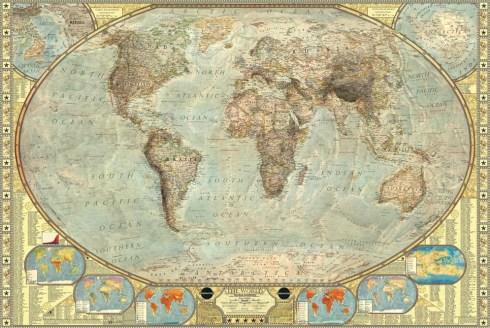
On this Earth Day, it seems appropriate to feature the scary but beautiful map of the world with unfrozen polar caps created by Slovakian student/graphic artist/cartographer Martin Vargic. At first glance, the map looks like a traditional nineteenth-century decorative map of the hemispheres, but then you look closer (just click on it) and see that many unshaded coastal areas are “missing” and that new seas and lakes have opened up in the midst of continental interiors: there is an Amazon Sea in the middle of South America and a new “Artesian Sea” in Australia. The map presents a rather radical vision with sea levels 260 feet higher than today (most scientists seem to project a 3 foot rise by 2100), and consequently all the coastal cities of the eastern seaboard in North America are gone (including Salem, of course), along with those of the Gulf Coast and what looks like the entire state of Florida. Across the Atlantic, London is gone, along with Amsterdam, and DenmarkVargic, whose work can also be found here, seems to have one-upped his earlier map of the internet, which went viral earlier this year.

climate1

Climate Vargic 1

Climate Vargic 2

Climate Vargic 3

Map Images © Martin Vargic @ Halcyon Maps

Appendix: Climate maps are nothing new, although predictive ones certainly are. Those from the 17th through the 19th centuries seem to be more of the recording or empirical nature, like the circular map of London’s annual temperature cycle below. Things get a little bit more subjective later in the nineteenth and the early twentieth centuries, when “scientific racism” (and environmental determinism) tried to assert “rational” explanations for the industrial progress (and supposed superiority) of the West. The 1924 map below seems to be doing just that.

L0027564 Luke Howard, The climate of London...

L0029476 Civilization and Climate, world map

Map from Luke Howard, The Climate of London, deduced from meteorological observations, made in the Metropolis, and at various places around it…(London, 1833),Wellcome Library; and map from Ellsworth Huntingdon, Civilization and Climate (London, 1924), Wellcome Library.


Soviet Scenery

Despite all the unsettling things about the Sochi Olympics (“urban renewal”, intolerance, dead dogs, slushy snow), I’ve been trying to watch the events pretty consistently–especially skiing and speed skating, which I really enjoy. In general, I prefer the Winter Olympics to the Summer (watching swimming is boring), but there are several things that are really bothering me about these particular games. Actually the first thing is more general than specific: NBC’s coverage, which always annoys me–and they have broadcast the Olympics for as long as I can remember. In prime time, there are far too many commercials, personal stories, and muttering commentators, and not enough consistent coverage of single events–except, of course, figure skating and ice dancing, which I’m not convinced is even a sport (if we have ice dancing in the Winter Olympics shouldn’t we have other types of dancing in the Summer games?)  And by the time I tune in, I know much of what has already happened anyway–this strikes me as an odd way to broadcast a global event in this internet age. The second thing that troubles me about Sochi is its subtropical climate: I still don’t understand why (besides Putin’s will) we are having the Winter games in a city with an average winter temperature of 52 degrees. The mild temperatures and fog seem to have affected the events and the athletes in myriad ways, and obviously Russia has many more winter-appropriate locations.

But what troubles me most of all about these games is the increasing dissonance between the activities in Sochi and what is happening to the north–in the same general Black Sea region–in Ukraine. The juxtaposition between the ringing cattle bells in Sochi and blood in the streets of Kiev is striking, all the more so because of the relative physical proximity and recent historical context. I had been planning to feature some mid-century Winter Olympics posters here, but instead I’m going for posters issued by Intourist, the official Soviet travel agency, which beckoned tourists to Ukraine and its surrounding regions just a few years after (or even during?) the dreadful Soviet-induced Ukrainian Famine (Holodomor) of 1932-33, which caused the death of over 6 million people (the estimates of mortality vary widely according to source). Such striking, cheerful graphic images: dissonance indeed.

PicMonkey Collage

Soviet Poster Armenia

Soviet Poster Georgia

Soviet Poster Caucusus

Soviet Hunting Poster BPL

Soviet Poster Winter BPL

Soviet Intourist posters from the 1930s from Radio Free Europe; the “See USSR” exhibit at the Gallery of Russian Arts and Design, London; and the Boston Public Library.