Tag Archives: Flora and Fauna

Still Standing

Here in Salem, we have survived both Hurricane Sandy and Halloween quite well:  just a few downed trees and lines and lots of leaves from the former and trash on the streets from the latter. Most of which has already been swept away. With all the devastation in New York and New Jersey, where I have family, it seems almost silly to draw attention to the impact of Sandy here on the North Shore of Massachusetts:  I think I have heard the phrase dodged a bullet about a thousand times since Tuesday. We did lose a few nice old trees, but the strong ones are still standing.  Late afternoon on Halloween, the sun began to peak out of the clouds for the first time in days, so I took a walk before the hordes of trick-or-treaters descended on my house.  I went to Harmony Grove ceremony in North Salem to inspect the old trees–and it was All Saints’ eve, after all.  I made it in just before they closed the gates.

On the way to the cemetery, I walked across Mack Park, where a few victims of the storm still lay on the ground.  Superman was there, cleaning up some of the debris.

Just a few branches down in Harmony Groves:  the trees are all so well-rooted, particularly those of the old beeches (???), which seemed almost supernatural.


The Spider and the Fly

A little tweet from one of my favorite history bloggers brought me to a charming web illustration in the collection of the Library of Congress and then I was off–there is nothing better than a parable, especially one as universal and flexible as the spider and the fly. There have been all sorts of illustrative variants on this age-old story over the centuries, and I must begin with my very favorite, John Heywood’s 1556 illustrated poem, The Spider and the Flie. I understand that literary scholars have little love for this poem, but it is a very illuminating historical source, and a window into a very contentious time.  Heywood was a passionate Catholic in a time of surging Protestantism:  he envisions this religious conflict as a war between devious Protestant spiders and stalwart Catholic flies, with insect allies on both sides. The Catholic Queen Mary (“Bloody Mary” to the Protestants) is portrayed as a housemaid, squishing spiders and sweeping England clean.

The inspiration:  a couple caught up in a web of romance on the sheet music cover of the 1901 song, “The Spider and the Fly”, J.D. Cress, Library of Congress.

More serious matters at stake:  illustrations from John Heywood’s Spider and the Flie (LondonThomas Colwell, 1556).  Heywood looks on as a Catholic fly gets caught in a web with a Protestant spider army approaching, and then as the maid/queen Mary rids England of the spider.

An emblem engraving from the later sixteenth century: print made by Johann Theodor de Bry, Frankfurt, 1592 (British Museum).

The satirical and metaphorical use of the Spider and the Fly parable only intensifies in the nineteenth and twentieth centuries, with new printing and printmaking technologies and the publication of Mary Howitt’s famous poem in 1829, with its leading line:  will you walk into my parlor?  But even before Howitt, the device was used by British caricaturist Thomas Rowlandson (1756-1827) to depict the central figure of his age, Napoleon:  pictured below surrounded by an army of European flies. After Howitt, cunning spiders armed with webs were everywhere, luring naive young me into taverns and the big city.

Thomas Rowlandson, “The Corsican Spider in his Web”, 1808, Metropolitan Museum of Art; a London temperance poster from the 1820s, Wellcome Library, London; a 1916 New York cartoon, New York Public Library Digital Gallery.

You can always count on Puck magazine for this type of anthropomorphic visual satire, and I found two “Spider and the Fly” illustrations among its archive of covers:  I’m afraid that the precise issue regarding the Interstate Commerce Commission escapes me in the first (1907) image, but the second one, from 1913, looks pretty timely.


What Remains

On the last sparkling sunny day we had here (last Friday), I took some pictures on my way to and from work. The streets and gardens of Salem were displaying their last bursts of color, which could last a while, depending on the weather.  I’ve got lots of reblooming in my own garden, which I’m not showing due to presence of lots of ladders back there–we’ve been painting the house.  But out my front door, all looks well:  Chestnut Street (or at least half of it) has been repaved for the first time in 40 years by most recollections!

On the way to work: a bountiful garden and a colorful cottage, off Lafayette Street.

Back after classes—I made a beeline for the Ropes Mansion garden on Essex Street.  With its mixture of annuals and perennials–and lots of late-season perennials at that–this garden always holds its color.

Just outside of the gates of the Ropes Mansion, there is a huge butterfly bush that was literally FULL of butterflies–they were dancing all around it, actually.  They don’t show up in the pictures very well, but a few were ready for their close-ups.

Back home, where the light was dwindling both outdoors and in the house, much to the dismay of Mr. Darcy.


Columbus and the Guinea Pig

Christopher Columbus has been perceived as both a hero and a villain over the centuries, but the most historically objective way to glean his ongoing impact is through the prism of the “Columbian Exchange”, which focuses on the biological and environmental consequences of 1492.  The term was coined by Alfred Crosby, whose 1972 book of the same name influenced a succession of environmental, epidemiological, and commodity histories, including Jared Diamond’s Guns, Germs and Steel.  It is difficult to underestimate its impact, and it is one of the few academic historical theories that has trickled down to the general public.

A very simplified view of the Columbian Exchange; for a more comprehensive discussion, go to the source:  Alfred Crosby, The Columbian Exchange:  Biological and Cultural Consequences of 1492.

Crosby’s concept has become classic because it is so accessible; it’s about very basic things:  plants, animals, diseases–and their effect on people. Just a glance at my very basic annotated map reveals how momentous the merging of the eastern and western hemispheres was (and continues to be).  The most devastating consequences of the exchange were caused by the chain of events initiated by the introduction of Old World germs and smallpox into the New World:  the annihilation of the native population is linked to the trans-Atlantic slave trade through the introduction of cash crops like sugar and rice. On a much lighter note, it is difficult to imagine a world without American horses (and cowboys), Italian tomatoes, and potatoes everywhere.

For Europeans in the century after Columbus, America was an unexpected land of brightly-colored plants, exotic birds, and naked people, as exemplified by the popular print of Amerigo Vespucci (rather than Columbus) arriving in America–or rather waking up America.  Here we see another sensationalistic stereotype–cannibalism–illustrated by the leg-on-a-spit in the background.

Theodore Galle engraving, after Stradanus (Jan van der Straet), Discovery of America, from Nova reperta (New inventions and discoveries of modern times), c. 1599–1603.

Galle’s engraving was one of many images of New World flora and fauna produced for early modern audiences.  I’ve assembled a folder of favorites over the years, and thought I would share some on this Columbus Day, beginning with a very scary guinea pig, and an “Indian little Pig- Cony”  cut down to size from Edward Topsell’s History of Four-footed Beasts and Serpents (1658), a popular English bestiary. Like most early modern “scientific” texts, Topsell included both real and mythological creatures in his compilation, so there is another American (or “Guinean”) animal, an armadillo, along with a very strange creature from the “new-found” world. I am wondering if these last two would have been equally credible.

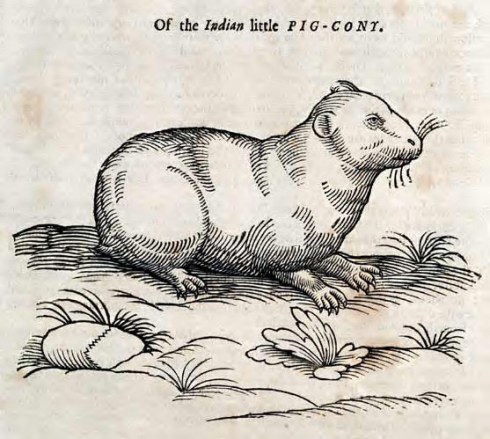
Large “Guinea Pig” illustration by Balthasar Anton Dunker, from Livre de divers animaux pour dessus de portes par les meilleurs maitres (1769); Edward Topsell, The History of Four-footed Beasts and Serpents. London : E. Cotes for G. Sawbridge,1658

In addition to guinea pigs, armadillos, and the odd fantasy creature for sensation’s sake, turkeys get a lot of ink in the early modern era, as do parrots, which could often symbolize the New World all by themselves. Turning to the plant family, the most influential (and beautiful) printed herbal of the sixteenth century, De historia stirpium commentarii insignes, or “Notable Commentaries on the History of Plants,” (1542) by Leonhart Fuchs, introduced five plants from the New World, including maize, marigolds, pumpkins, kidney beans, and chili peppers. It would take a little while longer for news of the most consequential American plants, potatoes, tomatoes and tobacco, to catch on. Of these three, tobacco was certainly the most popular, celebrated for both its pleasure and health benefits:  it was thought to smoke out toxins in the body rather than deposit them.

A turkey from Konrad Gesner’s  Historiae animalium (1551-1587), from which Edward Topsell “borrowed” heavily, chili peppers in Leonhart Fuchs’ Historia Stirpium, tobacco in Nicolas Monardes’ Joyfull Newes out of the New-founde World (1577), and exotic tropical American plants by Arnoldus Montanus, 1671.

Well, I could go on and on and on…..this is a big topic!  But I’ve already posted on tobacco at greater length, and tomatoes, and potatoes certainly deserve their own post. So I think it’s time to return to guinea pigs. The evidence is mounting to support the view that these little (easily transportable) creatures were kept as pets in some illustrious sixteenth-century households, including that of Queen Elizabeth. By the seventeenth century, they are depicted among more familiar animals, apparently assimilated into the European–global– menagerie as one very small manifestation of the Columbian Exchange.

Guinea Pigs in the center of two seventeenth-century Dutch scenes:  in the midst of a barnyard in a drawing by Jan Fyt (British Museum) and among the animals entering Noah’s Ark, by Jan Breughel the Elder (in the immediate foreground, with the turtles, squirrel and porcupines; Getty Museum).


Big Pumpkins

In typical contrarian fashion, I left Salem on Thursday when everyone was coming in for the big parade that signals the beginning of our city’s Haunted Happenings festivities. I was going to try to get in the spirit this year, but I’m not sure if I can. It is certainly difficult to be dour all the time when there are so many fairy princesses running around Salem and I’m sure I annoy everyone around me with my constant critique, but it’s just difficult for me to jump on the “festival” bandwagon:  Salem’s transformation into Witch City, the Halloween destination, seems so solidly and cynically grounded in the 1692 witch trials and the tragic death and suffering of innocent people. I can’t forget that, so I went to the Topsfield Fair in search of big pumpkins.

The Topsfield Fair has been held every year since 1898 as the county fair for Essex County, a region that was urban/rural a century ago but is now quite suburban.  Essex County farmers are dwindling but Essex County gardeners are still going strong, so there were great fruits and vegetables on display but relatively few animals:  and far too few pigs!  Here are some prize-winning chickens (in the Court of Honor–love that), carrots, garlic, honey and a quilt that seems to summon up the spirit of the fair: a very random sampling.

But it was the pumpkins I came for, and one in particular:  the pumpkin grown by a Rhode Island man that set the world record at 2,009 pounds.  I found it encased in the middle of the plants and vegetables building, while the second, third, and fourth-place finishers were shunted off to an empty arena, alone and forgotten. I accidentally came upon them when I went to look for the Clydesdales. I was glad to see the white one (grown by one of Topsfield’s own) as I jumped on that bandwagon quite a while ago.

Appendix:  One idea for my own (smaller) pumpkin, back in Salem:


Iron Animals

It seemed like everywhere I went this (past) summer there were animals made of iron or some other metal.  Large or small, inside or out, they were in shops, parks, and museums.  So I snapped away, and here are some of my favorites, in chronological order of sighting.

All Summer long: horse sculpture by Deborah Butterfield in the atrium at the Peabody Essex Museum; in the midst of what used to be a Salem street.

Early July:  a stag and yet another noble horse at Smith-Zukas Antiques @ Wells Union Antique Center, Route One, Wells, Maine.

Late July:  a climbing tree frog by North Shore artist Chris Williams in Ipswich. 

Late August:  Big cats by Wendy Klemperer face off each other in Lenox.

Late August, again:  a tortoise and a hare in Copley Square, Boston.


Dolphin Decoration

In my ongoing quest for the perfect mirror, and more mirrors, I came across this Carvers’ Guild mirror embellished with intertwined dolphins, gracing a San Francisco house designed by Benjamin Dhong in the current issue of House Beautiful.  It caught my eye because I have two very similar mirrors in my “mirror files”:  another reproduction one from Mecox Gardens, and a Regency example from the blog Paisley Curtain.  All similar and all beautiful, I think.

As you can see, the “dolphins” embellishing these mirrors are not your typical Flipperesque variety.  The first English explorers named the large fish they observed patrolling the waters off the eastern coast of North America “dolphins”, thus causing centuries of confusion with the better-known marine mammal.  This confusion finally cleared for me just last year, when I wrote a post about the Lady Pepperell House in Kittery Point, Maine, which features dolphin-fish decoration on its exterior, and the commentators cleared it up for me.  I’m not completely certain, but I think the source of this confusion is John White, who accompanied both Richard Grenville and Walter Ralegh on exploratory tours of the New World in the 1580s, charting and illustrating what he saw along the way.  White’s “Duratho” became Dolphin in common Elizabethan English, and endured.  The Dolphin fish later became known as “dorado”, and later still as “mahi-mahi”.

Dolphin fish seem to have been popular decorative motifs in furniture of the English Regency and American Federal and Empire periods, carved in relief or in part on sofas and tables as well as mirrors. There are lots of dolphin feet, as illustrated by the sofa (circa 1820), Lannuier pier table (1815), and Indian tilt-top table (made for the British market after 1825) below.  The American examples generally come from Philadelphia or New York, not New England, where no doubt the almighty cod was still golden.

Mahogany sofa and rosewood pier table by Charles-Honoré Lannuier, Detroit Institute of Arts via ARTstor; Indian tilt-top table, Walters Art Gallery via ARTstor.


A Swarm of Bees in July

According to the old English nursery rhyme: A swarm in May is worth a load of hay; a swarm in June is worth a silver spoon; but a swarm in July is not worth a fly. Even if we could muster enough bees in these days of ever-dwindling bee populations, apparently it’s too late in the season for a regenerating swarm. Nevertheless, there still seem to be bees around, in my garden, on the streets of Salem, and in my bookmark folder labeled interesting insects. So it’s a good time to showcase most of the above.

For the past few years, the city of Salem has been initiating public art projects, and this year the goal is all about transforming mundane surfaces into works of art.  All the utility boxes around town have been painted, and my favorite is the “bee box” near the intersection of Essex and Summer Streets: here we have a real swarm, or at least a utilitarian representation of one.

I think bees are on everyone’s minds now that their numbers are in decline, but in fact representations of them go way back: the royal associations, their industrious and organizational nature, and the fact that they were the source of Europe’s native sweetener made them very conspicuous insects in western culture.  Sometimes they even seem to transcend insect-hood, or at the very least represent all of insect-hood, as in God made the birds and the bees.

Some medieval bees:  pollinating, confronting a bear, and making honey:

British Library MSS Harley 3244 (after 1236), Harley 3448 (15th century) and Sloane 4016 (c. 1440).

Bees were big in the early modern era, as their role in pollination was universally known and expensive imported sugar could not fulfill the demand for sweet treats. They also became, very notably, the subjects of the first publication of empirical observations made with one of the revolutionary instruments of the era, the microscope, in Federico Cesi’s and Francesco Stelluti’s Apiarium (1625; detail below).  In England, all of the practical gardening manuals from the sixteenth and seventeenth century contain sections on bee-keeping; it seems to be a natural component of cultivation, not a specialization by any means. Sometimes women are the designated bee-keepers, sometimes men.  There were also books focused particularly on bee cultivation and bee culture, like John Levett’s classic Ordering of Bees (1634, below) as well as satirical allegories like John Day’s Parliament of Bees (perhaps 1607, but not printed until 1641). Given that bees live in a matriarchy as well as their general nature and attributes, I’ve always wondered why Elizabeth never made more iconographical use of them; perhaps it was too patently obvious.

Centuries later, Napoleon had no such subtlety: he used bee motifs to project legitimacy for his very new regime.  The bee enabled him to project royalty–as it was associated with France’s very first royal dynasty, the Merovingians, and with France’s early medieval emperor, Charlemagne–while disassociating himself with the fleur-de-lys-bearing Bourbons whom he displaced.

Bonaparte among the Bees:  portraits of Napoleon by Anne-Louis Girodet de Roucy-Trioson  (after 1804) and Jacques-Louis David (1812; National Gallery of Art, Washington).

Bees were too universal and essential to be stigmatized by their association with Napoleon, and after his fall they became an important decorative motif in the nineteenth and early twentieth centuries, appearing on textiles, ceramics, and jewelry, and in many illustrations and lithographs. At the same time, this very industrious era produced several key innovations in bee-keeping, most notably Langstroth’s movable frame hive, bringing about a revolution in the management of bees. Art, science, and industry were inextricably connected when it came to bees, and I haven’t even touched on advertising.

Wedgwood Sugar Caster, early 19th century, and French bonnet veil, c. 1860, Victoria & Albert Museum, London; illustration from Brockhaus Konversations-Lexicon : allgemeine deutsche Real-Encyklopädie. (Leipzig : F.A. Brockhaus, 1883-1887), New York Public Library Digital Gallery.

Of course bees continue to be inspirational for artists, designers, and crafters.  Given that the bee population is declining at an alarming rate (30%!!!), I hope that their ongoing popularity is not merely a sentimental urge.  There are too many items emblazoned with bees to showcase here, but I am drawn to British ceramicist Fenella Smith‘s bee mugs and jugs, which you don’t see everywhere (yet).


Blue Lobsters

The rare discovery of a blue lobster by several Rockport lobstermen was all over the Boston news late last week, prompting a search to discover just how rare these crustaceans are.  I kept coming up with the odds of 1 in 2 million, which would indeed make them pretty rare, but I also found bright blue lobsters pulled out of the waters off Ocean City, Maryland last week, two from Canadian waters over the past year, and another off Scotland last year.  Before that, not much news; in fact, the last mention of a blue lobster in Boston was in 1926!  So I am wondering if something is up in the lobster world? Here is the very bright blue–quite aptly referred to as cobalt–Scottish lobster, and an even more rare (1 in 30 million) mutant calico lobster, in the New England Aquarium.

Natural History Museum/Solent

I wish I could blow up this little negative of the 1926 lobster on exhibit in a Boston hotel from the Smithsonian, because it looks like a great picture.  The caption reads:  Boston, Mass.: Rare lobster exhibited at hotel exposition. Ann Donnelly, an attendant at the exposition in the Mechanics Building, holds a blue lobster, one of the very few which has been taken out of New England waters in many years. 5/20/26.

Out of the water, there are lots of blue lobsters, on pottery and paper, fabric and canvas (besides lots of restaurants and Nike sneakers). I particularly liked this platter from Apartment 48, a repurposed nineteenth-century image from Etsy seller Ephemera Press, and an original watercolor called A Lobster Tale by Sarah Storm.


Coney-Catching

Back to the reign of another long-reigning queen, Elizabeth I.  For my summer graduate course, I’ve been immersed in the pamphlet literature of the 1590s, including those relating the exploits of  London rogues, vagabonds, pickpockets, card-sharks and coney-catchers, to use the language of the day. In the contemporary vernacular, coneys (alternatively spelled conys, connys, connies) were domesticated rabbits (as opposed to wild hares), bred for the table and easy prey. Consequently coney-catchers were those who preyed on similarly-vulnerable human targets in the streets of London:  in today’s language, con-men.

The term seems to have been crafted by playwright, poet and pamphleteer Robert Greene (1560-1592), one of the “university wits” of late Elizabethan London, and an author who definitely wrote more for the public than the court.  Before his untimely death in 1592, Greene waged a war in print on those who had taken advantage of him while he was down and out, in the streets (quite a common state for him due to his profligate lifestyle).  The pamphlets were popular, and the term caught on. Its meaning, fool-taking or-making was easily grasped by everyone, and satirical responses kept the rabbits in print, as did Greene, by publishing under pseudonyms like “Cuthbert Conny-catcher”.

Greene’s conies between the covers.

All of these rabbits (coneys) remind me of those that magicians (conjurers) pull out of a hat:  there must be a connection. The John Derian decoupage tray on my mantle, called “the magician’s apprentice”, is making me think so too.