Tag Archives: Flora and Fauna

Reynard the Fox

That fox pulling the papal tiara off Celestine V’s head in my last post reminded me of Reynard the Fox, a very popular medieval fable which developed in the later twelfth and thirteen centuries in France and Germany, from where it spread throughout western Europe:  the many “branches” of Reynard verse are generally grouped together as the Roman de Renart cycle. Reynard is an anthropomorphic fox who is always up to no good, a cunning trickster whose escapades are both entertaining and illuminating. He is the animal representative of the medieval outlaw, far less benevolent than Robin Hood, and utilized by medieval scribes (who were of course, monks) as a form of satirical and whimsical criticism.  But Reynard is also a fox, and like all sly foxes, quite capable of feigning vulnerability (and piety) in order to elude capture and capture his next meal. One of the most common images in medieval manuscripts is of Reynard preaching, to an audience of birds whom he intends to eat.

Royal 10 E.IV, f.49v

Fox Preaching Stowe

British Library MS  Royal 10 E IV, late 13th/early 14th century, and MS Stowe 17, “The Maastricht Hours”, early 14th century.

In every Reynard tale, the fox is summoned before a court of his animal peers, headed by a lion, of course, and called to task for his bad behavior. He always manages to outfox his judges by his cunning. He feigns remorse, confesses his sins, and sets off on a holy pilgrimage of atonement, only to get into more trouble. A death sentence leads to more displays of cunning, exploits and opportunities, and consequently he becomes the sympathetic “hero”, the one for whom we root.

Reynard the Fox Bod MS Douce 360

Reynard Bod Ms Douce Reynard Dead

Reynard as a “pious” pilgrim and on the cart of a fishmonger who has presumed him dead–meanwhile, the fox is working his way through the stock of fish:  Bodleian MS Douce 360, “The Romance of Reynard and Isengrin”, 1339.

I definitely think Reynard’s popularity increased in the late medieval era along with anticlericalism and lay piety, and he makes it into print relatively early. In England, William Caxton published his own translation in 1481, and the “history” was reprinted regularly in the sixteenth and seventeenth centuries. There followed all sorts of literary adaptations, as Reynard, like any outlaw, is readily adaptable. The most famous modern adaptation is Reneike Fuchs, an epic poem produced by Johann Wolfgang von Geothe in 1794, supposedly influenced by the events of the French Revolution. The editions of this text issued from the mid-nineteenth century, illustrated by Wilhelm von Kaulbach and Joseph Wolfe, must have been extremely popular as they were constantly in print. There were also a succession of children’s versions of the fable issued in the nineteenth century, and really beautiful artistic editions published by William Morris’s Kelmscott Press in 1892 (a reprint of Caxton) and the Insel Verlag Press in 1913.

V0023068EL A fox in a monk's habit is apparently deeply engrossed in pr

Reynard the Pilgrim

Reynard Kelmscott Press 1892

Reinke Voss 1913

Reynard posing as a monk in order to access the chicken coop of a monastery, and as a pilgrim being blessed by a ram-priest, Wolfe and von Klaubach illustrations from 1853 & 1846; first page of the Kelmscott Press Caxton edition, 1892; Cover of first edition of Reinke Voss, 1913.

Reynard lives on in a variety of forms and formats in the twentieth century, and today can be found on everything from pillows to china to chess sets. He seems to have shed a lot of the satirical and moralistic messages of his medieval origins, but he was never that moral a character to begin with so I guess it doesn’t matter!

Reynard the Fox Coffee Service

Reynard the Fox Etsy

Two Reynards that I covet:  a Royal Doulton coffee service from 1935, and pencil illustration of Reynard the Fox Detective.


A Sentimentalist in Salem

For me (so far), blogging is a remarkably easy, even effortless activity; every post comes from 1) a walk or a drive; 2) a glance at the calendar; 3) reading–either for pleasure or class preparation; 4) looking at art-again, either for pleasure or class prep; and 5) stumbling around the web. Since I do all of these things daily blog posts naturally follow, without much consternation. But there is one more source of inspiration that is a bit less immediate: my digital folders of things (images, articles, news items) that catch my interest but are so singular that they don’t really call to mind some larger topical theme–even one sufficient for a fleeting post. Most of these items have no context, but if you keep collecting them, patterns emerge.

A good case in point is my rather bulging (if digital files could, in fact, bulge) file which I have labeled “Fading Salem”. In this file are a number of items and articles from national periodicals about how far Salem has fallen from the glorious heights of its commercial ascendency at the beginning of the nineteenth century. These items all date from the period 1850-1914:  the end date does not refer to the beginning of World War I (as it would for the rest of the world) but rather to the Great Salem Fire. There are references to crime and poverty, general malaise (one item is even titled “Dull Salem”) and the faded grandeur of “old Salem”. As the century turns, there is definitely an emphasis on the latter:  rather than looking at Salem as in decline, a succession of observers note how well-preserved it is, and how it serves as a bastion of tradition in a rapidly-changing world. There is one article that captures this transition perfectly, written and illustrated by a Canadian-born artist named Charles Henry White and published in Harper’s Monthly Magazine in June of 1908. White (1878-1918) traveled around the country sketching and writing little impressions of a host of American cities for Harper’s in the first decade of the twentieth century; before he came to Salem he had produced articles on New York, Pittsburgh, Chicago, Charleston, Richmond, New Orleans, Boston and Philadelphia, and his view of Washington D.C., “Queer Folk at the Capital”, came a year after his “Salem” article.  Just before the war broke out, he was off to Europe, where he eventually died in 1918 at age 40.

White starts out with the traditional late-nineteenth century impression of Salem:  As you center Derby Street on your way to the Custom House, where, in more prosperous times, the main current of the commercial life of the city ebbed and flowed, making the streets ring with the cheerful din of business activity, and reach the deserted quays, you feel not unlike a stranger who has wandered into an abandoned theater and walks alone across the stage, picking his way gingerly through the tattered scenery, long after generations of actors who made the place echo with their laughter have departed. 

Frankly, his writing is a little dramatic for me but I do like his accompanying illustrations.

White etching of Salem wharf Harpers 1908

C.H. White, “Deserted Quays once Redolent with Foreign Spices”, 1908.

As he strolls around town, it does not take long for White to discover a more charming Salem. Just a step away from the rotting wharves, he finds himself continually stumbling across eloquent reminders of past splendor in the numerous old mansions of former Salem merchants, still marshalled in broken line, looking seaward, with their graceful porticos tufted with ivy, fluttering in the clear sunlight……and he goes on and on:  the streets, spanned by titanic elms, become cathedral naves; and through the lofty arch of whispering foliage steal at infrequent intervals into the cool depths below shafts of limpid sunlight, sifting across the splendid rows of Colonial mansions….and I could go on and on quoting him, but you get the general idea. And again, I think his etchings are more eloquent.

White etching of streetscape 1908 Harpers

White etching of Essex Street Salem 1908

C.H. White, views of Chestnut and Essex Streets, Salem,  1908.

Fortunately few of the stately mansions that White alludes to throughout his piece were swept away by the fire a few years later; but much later in the century the “titanic elms” were of course decimated by Dutch Elm Disease. So there is an aura of bittersweetness when one reads his words with the benefit of hindsight, knowing what was on the horizon for those trees, for Salem, for the world, and for White himself in five short years.

White etching of Lower Salem Harpers 1908

White etching of Bridge Street Salem Harpers 1908

C.H. White, “Lower Salem” and “An Old Corner”,  Harper’s Monthly Magazine, June, 1908.


Snow, Ice & Swans

Well, it wasn’t the most beautiful day in Salem yesterday but there were lots of interesting things to see while walking around town. Slushy snow fell from the grey sky onto the wet streets, but there was contrast in the form of ice sculptures from the annual Salems So Sweet midwinter festival, the architecture and shop windows, and a tranquil pair of swans at Pickering Wharf. As much as I love my native New England, this time of year can be rough; for me the urban environment provides a bit of relief from the starkness.

Snow and Ice 056

Snow and Ice 058

Snow and Ice 031

Salem Apothecaries window

Derby Wharf and The Friendship yesterday, the Custom House, and the windows of  the Modern Millie vintage clothing store on Central Street and Witch City Consignment on Essex Street.

The Salem’s So Sweet festival, focusing on chocolate and ice, is an initiative of Salem Main Streets and the Salem Chamber of Commerce; there is a very popular wine and chocolate tasting event followed by a weekend installation of ice sculptures sponsored by local businesses and institutions. Everything has been delayed a week this year because of last weekend’s blizzard, but yesterday morning all the sculptures were on the streets of Salem. There was a beautiful sculpture of the Friendship at Pickering Wharf, which my camera somehow did not capture, and the Peabody Essex Museum’s Taj Mahal (which the sculptors were still working on) and a snowy owl sponsored by a consortium of Salem businesses (Pamplemousse, Modern Millie, Mighty Aphrodite, the Salem Trolley and Trolley Depot) and were my other favorites.

Snow and Ice 047

Snow and Ice 050

Snow and Ice 023

Snow and Ice 026

Snow and Ice 035

Snow and Ice 037

Snow and Ice 042

The Peabody Essex Museum has enhanced the rather bleak landscape of Essex Street (all the shuttered tacky witchcraft-related shops are depressing even on a bright sunny day, much less a grey one, and the perpetually misspelled Witch Tee’s sign never fails to annoy me) not only with its Taj Mahal sculpture (to complement its current exhibition, Midnight to the Boom:  Painting in India after Independence) but also with colorful placards on the construction fence surrounding its latest phase of expansion.  Images of the coming year’s exhibitions work as street art for me.

Snow and Ice 019

Snow and Ice 017

Snow and Ice Placard

And then there were these amazing swans at Pickering Wharf, gliding around (with their big webbed feet) in the company of rather less majestic ducks, very close to the dock. They were a pair, of course.

Snow and Ice 082

Snow and Ice 062

Snow and Ice 072


Wonder on Display

I’ve been wondering about wonder for much of my academic career, and particularly interested in its transformation from a spiritual concept to a secular one, from a manifestation of God’s will to an awe-inspiring curiosity or construction. I’ve already written about wondrous weather here, and of course witchcraft, most definitely a wonder of the early modern world, is something I can never abandon for long given my context.  But perhaps the most direct way to approach wonder is through the wunderkammer, the “rooms of wonder” or “cabinets of curiosities” assembled in the sixteenth, seventeenth and eighteenth centuries by gentlemen of learning and leisure. These private collections are the forerunners of public museums, and the focus of a current exhibition at the Grolier Club in New York City entitled “Rooms of Wonder:  from Wunderkammer to Museum, 1599-1899″, which runs through the end of next week. This exhibition follows the Smithsonian’s “The Great American Hall of Wonders” exhibit from last year pretty closely, so it appears that wonder is having a moment.

780px-RitrattoMuseoFerranteImperato

Wonder Peale 1822

From cabinet of curiosity to museum:  iconic images from two exhibitions.  From 1599, an engraving of the wunderkammer of Neapolitan apothecary Ferrante Imperato in DellHistoria Naturale (Naples 1599), and from 1822, Charles Willson Peale’s The Artist in his Museum, The Pennsylvania Academy of Fine Arts, Philadelphia. Gift of Mrs. Sarah Harrison (The Joseph Harrison Jr. Collection), 1878.

As you can see, wonder was first connected to the natural world and only later became associated with human creations, artistic and otherwise. Imperato has an alligator on the ceiling of his room, and in his self-portrait, Peale is revealing his own natural history collection, which became America’s first public museum. Before the eighteenth century, cabinets of curiosity were encyclopedic in nature, with the goals of “capturing” nature and creating a worldly microcosm in one or more rooms. Specialization was not a goal, and so they appear to us rather random, a somewhat controlled chaos, or maybe it’s just the prominent and interesting displays of mummified alligators (or crocodiles?), which seem to be the must-have object in any cabinet of curiosity. In any case, many of the early modern images of wunderkammer show people really marveling at the wonders on display. People are part of the picture.

Wonder Basilius Besler

Engraved title page of Basilius Besler’s Continuatio rariorum et aspectu dignorum varii generis (Nuremberg 1622).

With the collections of the John Tradescents, father and son, we see a combination of natural and created wonders, or “rarities”, which became the basis of a family museum in greater London called “the Ark” which drew a steady stream of marveling visitors in the mid-seventeenth century. One such visitor, a German traveler named George Christoph Stirn, made this report in 1638:

“In the museum of Mr. John Tradescant are the following things: first in the courtyard there lie two ribs of a whale, also a very ingenious little boat of bark; then in the garden all kinds of foreign plants, which are to be found in a special little book which Mr. Tradescant has had printed about them. In the museum itself we saw a salamander, a chameleon, a pelican, a remora, a lanhado from Africa, a white partridge, a goose which has grown in Scotland on a tree, a flying squirrel, another squirrel like a fish, all kinds of bright colored birds from India, a number of things changed into stone, amongst others a piece of human flesh on a bone, gourds, olives, a piece of wood, an ape’s head, a cheese, etc; all kinds of shells, the hand of a mermaid, the hand of a mummy, a very natural wax hand under glass, all kinds of precious stones, coins, a picture wrought in feathers, a small piece of wood from the cross of Christ, pictures in perspective of Henry IV and Louis XIII of France, who are shown, as in nature, on a polished steel mirror when this is held against the middle of the picture, a little box in which a landscape is seen in perspective, pictures from the church of S. Sophia in Constantinople copied by a Jew into a book, two cups of rinocerode, a cup of an E. Indian alcedo which is a kind of unicorn, many Turkish and other foreign shoes and boots, a sea parrot, a toad-fish, an elk’s hoof with three claws, a bat as large as a pigeon, a human bone weighing 42 lbs., Indian arrows such as are used by the executioners in the West Indies- when a man is condemned to death, they lay open his back with them and he dies of it, an instrument used by the Jews in circumcision, some very light wood from Africa, the robe of the King of Virginia, a few goblets of agate, a girdle such as the Turks wear in Jerusalem, the passion of Christ carved very daintily on a plumstone, a large magnet stone, a S. Francis in wax under glass, as also a S. Jerome, the Pater Noster of Pope Gregory XV, pipes from the East and West Indies, a stone found in the West Indies in the water, whereon are graven Jesus, Mary and Joseph, a beautiful present from the Duke of Buckingham, which was of gold and diamonds affixed to a feather by which the four elements were signified, Isidor’s MS of de natura hominis, a scourge with which Charles V is said to have scourged himself, a hat band of snake bones…….”

Now this is a collection that almost defies description, and one which would surely challenge any system of categorization or classification! The elder John Tradescent has risen to wealth and prominence as a gardener to the landed gentry, and so his early collecting interests were primarily botanical, but both his travels and that of his son gradually expanded their interests and their collection, which was cataloged in 1656 under the title Musaeum Tradescantianum and later (1683) became the basis of Britain’s first public museum, the Ashmolean Museum at Oxford University.

tradescant-tp500x754

In the eighteenth and early nineteenth centuries, several forces combined to push serious collecting more toward the public sphere: the development of taxonomic systems, the Enlightenment drive to educate and elucidate, urbanization, and the burgeoning “commercialization of leisure”. Certainly some quirky private collections continued to be assembled, but the trend was definitely towards the institutional. Here in America, natural history museums popped up all along the east coast, from the Charleston Museum to Peale’s Museum to the Peabody Academy of Science established here in Salem in 1869:  the forerunner of the Peabody Museum and today’s Peabody Essex Museum.

1869_PeabodyAcademy_ofScience_Salem_FrankLesliesIllustratedNewspaper_Sept4

Wonder on Display Peabody Museum of Salem 1910

Illustration of the Peabody Academy of Science in Salem from Frank Leslie’s Illustrated Newspaper, Sept. 4, 1869 / James M. Lindgren. “That Every Mariner May Possess the History of the World”: A Cabinet for the East India Marine Society of Salem. The New England Quarterly, Vol. 68, No. 2 (Jun., 1995); Detroit Publishing Co. photography, 1910, Library of Congress.

I do wonder if the institutionalization of wonder (and pretty much everything else about our modern world) has lessened our capacity to marvel, or maybe it has increased it. I’m just not sure. Fortunately, however, the more whimsical wonder of  early modern cabinets of curiosities has survived over the last century in the work of artists like Joseph Cornell and Massachusetts’ own Rosamond Purcell, who quite literally recreated the collection of a seventeenth-century Danish medical professor Ole Worm for the Santa Monica Museum of Art and Harvard University’s Science Center.  Indeed, an influential art gallery in Italy includes the instillation of wonder in its mission statement:  Wunderkammern adopts the inspiring principle of those homonymous collections of scientific curiosities and extraordinary objects that used to be gathered together in Renaissance Europe by rulers and aristocrats, merchants and early practitioners of science. Like those historical cabinets of wonders, precursors to museums, WK explores how suchamazementis manifested within todays artistic discourse.

worm_1

worm2

An illustration of the  Museum Wormianum of Ole Worm (Leiden, 1655), and Rosamond Purcell’s installation. Photo by Dennis W. Purcell.

Appendix:  Bring wonder home with these three great books; they are bibliographic cabinets of curiosities!

Cabinet of Natural Curiosities

Cabinets of Wonder Christine Davenne Abrams 2012

Natural Curiosities 2

Albertus Seba’s Cabinet of Natural Curiosities (which seems to have been mined intensively by interior designers over the past decade) (Taschen, 2001); Cabinets of Wonder by Christine Davenne (Abrams, 2012); Alfred Russell Wallace’s Natural Curiosities (Parkstone Press, 2011).


Old Wethersfield

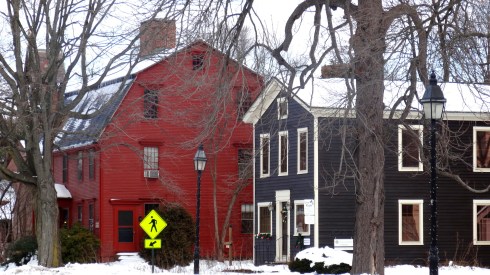
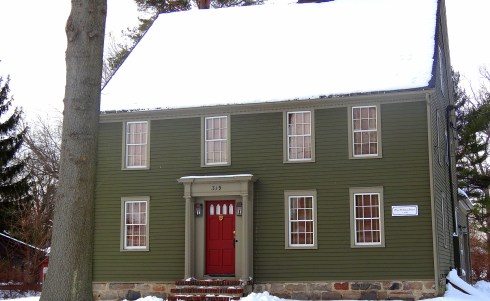
Whenever I’m heading home from New Jersey or New York or points south, I always like to stop in at Old Wethersfield, Connecticut:  it’s a beautiful village just off the highway and just outside Hartford:  a convenient respite for a weary traveler. Old Wethersfield is a National Register Historic District, comprising 100+ houses from the seventeenth, eighteenth and nineteenth centuries situated along a main thoroughfare and a slender rectangular green, which is part of the larger town of Wethersfield. I had two restless guys with me yesterday but they still let me stop for a bit, to take pictures of some of my favorite houses and briefly run into Comstock, Ferre & Company, which has been selling heirloom seeds for two centuries. Wethersfield is known not only for its colonial architecture, but also for its venerable seed companies, including Comstock and the Charles C. Hart Seed Co. in the present and a whole host of provisioners in the past. The most profitable product of these companies, a red “Wethersfield Onion”, even gave the old town the nickname “Oniontown” for a while. I am also compelled to mention Wethersfield’s fascinating/notorious founder, John Oldham, who was exiled from the Plymouth Colony for “plotting against pilgrim rule” and went on to establish settlements in Hull, Gloucester, and Watertown, Massachusetts, and eventually Wethersfield, the first English settlement in Connecticut. (Oldham seems to have rubbed shoulders with Salem’s founder, Roger Conant, on more than one occasion). Travel and Leisure magazine just designated Old Wethersfield one of America’s “prettiest winter towns”, and it certainly appeared so yesterday afternoon with snow lining the brick sidewalks and artfully draped on the colorful colonial houses.

Just a small sampling of Old Wethersfield, New Year’s Day 2013:

Wethersfield 052

Wethersfield 046

Wethersfield 044

Wethersfield 045

The plaques and signs refer to the house above, as in the case of one of Old Wethersfield’s most famous houses, the Webb House, pictured below with its neighbors.

Wethersfield 080

Wethersfield Webb House 083

Wethersfield 084

Wethersfield 074

Wethersfield 077

Wethersfield 076

Wethersfield 086

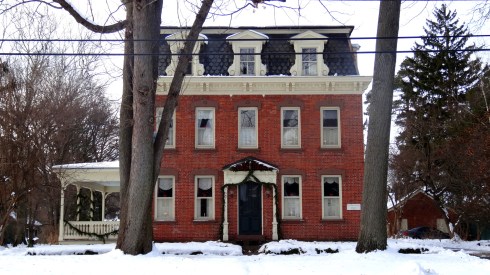
More!!! And as you can see, there are “newer” houses in Old Wethersfield too.

Wethersfield 091

Wethersfield 092

Wethersfield 056

Wethersfield 053

Wethersfield 060

Wethersfield 090

The Comstock building, obviously a livelier place in the summer but still very much open, and an 1899 seed catalog cover featuring the Wethersfield Onion, the “greatest onion on earth”,  from the Smithsonian Institution Libraries’ Collection.

Wethersfield 049

Wethersfield Onion Smithsonian


Best Bedside Books 2012

Well, it’s the time of year for lists, lots of lists:  best and worst, most important, so on and so forth, lists of ten things that characterize the passing year in one way or another. I’ll do my part with a best books list, with a qualification:  these are titles that were published in 2012 which I consider to be essential for bedtime reading, or bedtime reference, to be more precise. I do like to read in bed before I sleep, but I drop off quite rapidly, so I need a quick hit of compelling information, and/or some visual stimulation, before I’m gone. I’ve given up fiction altogether for this purpose, and I never read any sort of academic history later at night:  my bedside books need to be “dippable”; I will pick up one or the other from the stack–too tall for the bedside table–and dip into it every other night or so, in order to see or learn something before I fall asleep (books that do not perform these services leave the stack rather quickly). Several amazing natural histories were published this year which are perfect for this purpose, so I’ll start with them.

Natural Histories cover

Natural Histories. Extraordinary Selections from the Rare Book Archive of the American Museum of Natural History Library. Edited by Tom Baione.  Sterling Signature, 2012.

Nothing fascinates me more than the merger of art and science and this first book illustrates that historical merger in an extraordinary way. It is the ultimate gift and coffee table book, as it comprises a collection of historical sources relating to every branch of natural history from anthropology to zoology, succinct yet substantive contextual essays, and lots of images, as well as frame-ready prints, but it is also incredibly informative and inspirational. Similar in its historical range and the compelling nature of its images is the National Library of Medicine’s Hidden Treasure, and rather more whimsical (yet still empirical) is Caspar Henderson’s The Book of Barely Imagined Beings.  A 21st Century Bestiary. These books are just visual feasts, and I also learn something every time I pick them up.

Hidden Treasure

the-book-of-barely-imagined-beings-a-21st-century-bestiary

Hidden Treasure:  the National Library of Medicine.  Edited by Michael Sappol.  Blast Books, 2012; The Book of Barely Imagined Beings by Caspar Henderson.  Granta Books, 2012.

I’ve been interested in folklore for quite some time, and an amazing new edition of Grimm’s Fairy Tales was published this year: this bicentennial edition of The Annotated Brothers Grimm was edited and annotated by Maria Tatar, Chair of the Program in Mythology and Culture at Harvard.  It really is a definitive edition, and also includes many classic illustrations.  There’s nothing better than reading Grimm fairy tales before you fall asleep:  food for dreams!

9780393088861_custom-4b83bd148becf10073c6395f14fbda06c18a1daf-s6-c10

The Bicentennial Edition of the Annotated Brothers Grimm. Edited by Maria Tatar.  W.W. Norton, 2012.

I always have architecture and design books in my bedside stack, also good for dreaming, and the ones I purchased this year are American Decoration by Thomas Jayne and London Hidden Interiors by Phillip Davies.  Their titles are self-explanatory. I love Jayne’s traditional style, and with its 180 properties and 1200 photographs, Hidden Interiors is positively encyclopedic.

Book Jayne

philip-davies-london-hidden-interiors1

American Decoration:  A Sense of Place, by Thomas Jayne. Monacelli Press, 2012. London Hidden Interiors, Phillip Davies. An English Heritage Book, Atlantic Publishing, Ltd., 2012.

Both art history and history texts seldom function well as bedside books, as they require a bit more sustained concentration. If they are far removed from my academic interests, sometimes I can make them work out of sheer ignorance/ interest and curiosity (or if they have relatively short chapters!)  Right now I have two books in these categories by my bed, both very recently published:  Eleanor Jones Harvey’s The Civil War and American Art, which is the companion volume to the exhibition that’s on right now at the Smithsonian Museum of American Art, and Todd Andrlik’s Reporting the Revolutionary War, which presents a narrative of the American Revolution through contemporary newspaper reports, including several from the Salem Gazette.

CivilWar_500

Reporting

Eleanor Jones Harvey, The Civil War and American Art. Yale University Press, 2012; Todd Andrlik, Reporting the Revolutionary War. Before it was History, it was News.  Sourcebooks, 2012.

Salem is a “walkable city”, and I think more places in car-obsessed America should be walkable cities, which is why I purchased urban planner Jeff Speck’s Walkable City. How Downtown can Save America, One Step at a Time. I’m learning a lot from this book, but I do think it is better read in the daytime rather than just before bed. And last but not least, a perfect bedside book that my brother just gave me for Christmas:  Simon Garfield’s Just My Type. A Book about Fonts. This was actually published in 2010, but I also have another Garfield book that was published this year, On the Map: A Mind-Expanding Exploration of the Way the World Looks, (Gotham) so together they can fill out my top ten list.  Typography and cartography: two very interesting, yet contained topics.  Perfect for end-of-day reading.

Walkable City

Just-My-Type

Jeff Speck, Walkable City. How Downtown can Save America, One Step at a Time. Farrar, Straus and Giroux, 2012; Simon Garfield, Just my Type. A Book about Fonts. Gotham reprint, 2012.


Trees in the House

I was intent and inspired to have a rather spare Christmas tree this year, but once again we have a huge and furry white pine (I think I incorrectly called last year’s tree a Scotch pine) tree, over nine feet tall, that just eats ornaments.  Oh well, the house probably calls for such a display, in contrast to the more minimalist Scandinavian looks, featuring branches and twigs more so than trees, that I collected in a pile of tear sheets. I particularly like this beautiful Toronto house, owned and decorated by designer Ingrid Oomen, that is featured in this month’s issue of Canadian House and Home.

Tree in the House HH

Tree in the house CHH 3

I don’t know why the second scan came out so grainy–sorry. These minimalist tree branches go so well with this decor, and they could really be maintained all year round, minus the ornaments. I also like this simple display from Country Living, counterposed with the more traditional tree in the adjoining room.

Tree in the House Country Living

I have not managed to go the overly-creative or minimalist route this year.  The Christmas season is always a little frustrating for me, as I have high decorating hopes and not much time, with lots of papers and exams to correct and grades to turn in. I have a few little live trees around the house, like this one on the dining room mantle next to my new deer from Wisteria, and then the big tree in the front parlor (which I am showing you in both undecorated and decorated states so you can see what a monster it is). It doesn’t matter how many ornaments or garlands you put on this tree, it still looks essentially green.

trees Mantle

tree in the house

trees2 007

Two of my favorite historical images of Christmas trees: Eastman Johnson’s Christmas-Time, The Blodgett Family (1864) and a print of President Roosevelt’s children showing him their closeted Christmas tree in 1903:  he was an avid environmentalist and would not have one in the house (or so he proclaimed).

Christmas-Time, The Blodgett Family Eastman Johnson 1864

Tree Roosevelt 1903 WH Hist Assoc

Eastman Johnson, Chistmas-Time, The Blodgett Family (1864), Metropolitan Museum of Art; The Roosevelt children show the President their tree, 1903, White House Historical Association.


Arctic Animals

I had an arctic weekend. It wasn’t particularly cold here in Salem (rather the opposite), but since I was in a Santa Claus frame of mind, I thought I’d follow up my St. Nicholas post with a historical look at the North Pole, and that led to full immersion in the Arctic. This northern orientation (and two great books: Robert McGhee’s Imagining the Arctic:  the Human History of the Arctic World; Francis Spufford’s I May Be Some Time:  Ice and the English Imagination) gave me new insights into lots of things, but for the sake of imagery, I’m going to go for arctic animals:  great white beasts of the frozen north.

Before they set out to explore all the unknown corners of the world in the fifteenth and sixteenth centuries, Europeans had lots of ideas about the North which had been passed down from ancient geographical writers like Pytheas, Strabo and Pliny the Elder. The typical Renaissance endeavor involved the engagement, verification and/or dismissal of classical knowledge and for the Arctic, nothing was more influential than the posthumous publication of Gerhard Mercator’s world map, which portrayed the North Pole as a magnetic black rock surrounded by a clearly-marked Northwest Passage. In England, this inspired the erection of “arctic poles” all over the country and Martin Frobisher’s three voyages, from 1576-78, to Meta Incognito (the “unknown limits”; really southern Baffin Island, though Frobisher claimed the entire Arctic for England).

arctic1595

Gerhard Mercator, “Septentrionalium Terrarum descriptio”, from his posthumously published atlas, Atlantis pars altera. Enlarged fascimile, Historic Collection, Princeton University: part of a Princeton digital exhibition, Of Maps and Men.  In Pursuit of a Northwest Passage.

Imagine the surprise (or perhaps the expectation) when Frobisher’s men found a unicorn washed up on a Baffin Island beach, or rather a “Sea Unicorn”, as they referred to the creature. This fabled creature seemed to confirm that they were somewhere special, and previously elusive. From this first discovery, northern fish and fauna were always described and depicted as especially monstrous, especially large, especially white.  From narwhals to polar bears, from foxes to hares, these were almost-otherworldly creatures.  The Frobisher “Sea Unicorn” is pictured below, from George Best’s account of the second voyage, followed by two relatively modern caricatures of really large Arctic creatures.

Arctic Sea Unicorn

Arctic Hare 1890s Smithsonian

AMICO_PHILADELPHIA_103883058

Anonymous drawing of a BIG arctic hare, c. 1890, Smithsonian Institution, and Charles Sidney Raleigh, “Chilly Observation”, 1889, Philadelphia Museum of Art

The Arctic Hare (Lepus articus) is the largest North American rabbit, but it’s not that big! And of course it’s the same for the polar bear:  these images convey a sense of the (literal) diminution of man in the vast, frozen Arctic.  I’m quite taken with the hare, so much so that I even “adopted” one through the World Wildlife Fund (I figured that polar bears have more advocates). They are grey in the summer, but apparently turn into white fuzzy balls in the arctic winter.

Arctic Hare

Arctic Hair Greenpeace Ad

Arctic hares in their natural habitat; South African Greenpeace “white is the new green” ad, 2010.

For an Arctic animal in scale, there is no better image than William Bradford’s An Arctic Summer:  Boring through the Pack in Melville Bay (1871) with what looks like an arctic fox walking along the ice undisturbed or unaware of the nearby ship. Yet man is still humbled–isn’t that a piece of a wreck on the shore?  Bradford was a Massachusetts artist whose work, based on his own observations while on an 1869 polar expedition, figured heavily in the Peabody Essex exhibit Journey to the Ends of the Earth:  Painting the Polar Landscape a couple of years ago. More of Bradford’s paintings, as well as amazing photographs from his illustrated book, The Arctic Region:  Illustrated with Photographs taken on an Expedition to Greenland can be found at the Clark Art Institute.

Arctic Bradford

Arctic Fox

William Bradford, An Arctic Summer:  Boring through the Pack in Melville Bay, 1871, Metropolitan Museum of Art; cast earthenware Arctic fox, Hornsea Pottery Co., 1956, Victoria & Albert Museum, London.


Cranberry Picking

“…as why are Strawberries sweet and Cranberries sowre, there is no reason but the wonderfull worke of God that made them so…”.  John Eliot, the Puritan “Apostle to the Indians”, used the “American” name rather than the preferred English fenberry (variantly bear-berry and mosse-berry) in his 1647 treatise The Day-Breaking if not the Sun-Rising of the Gospell with the Indians in New-England, one of several seventeenth-century references to the sour little berry that was so common in Massachusetts. Along with corn, this was one native American crop that captured the attention of  the English early on–though most of their efforts seem to have been directed at transforming cranberries into something sweeter:  syrups, tarts, sauces.  They could not ignore a berry that ripened in the winter!

One last Thanksgiving weekend post on a fruit that remains one of Massachusetts’ few commercial crops, although we are no longer the country’s leading producer:  that title is now claimed by Wisconsin.  Still, there’s a major harvest every year starting in late September, and it’s a beautiful sight to see.  I just couldn’t make it down to the southeastern part of the state this busy semester, but here’s a great recent photograph of a bog at the A.D. Makepeace Company in Wareham, one of the state’s oldest producers.

Photo credit:  Charlie Mahoney for the Boston Globe; 1907 Makepeace Co. cranberry sign,Etsy.

The conditions of cranberry picking have changed a lot over the last century, for the better. Documentary photographers like Lewis Wickes Hine focused on the industrial exploitation of child and migrant labor in the early nineteenth century, and contemporary photographs of very small children, native Americans, and newly-arrived Europeans (in the case of southeastern Massachusetts, primarily Portuguese “bravas” from New Bedford, led by bog bosses called padrones) abound.

Portuguese cranberry pickers at the Eldridge Bog in Rochester, Massachusetts, and the “tenement” that housed them, September 1911, and a boy “scooper” at the Makepeace Bog. The caption of the last photograph reads: Gordon Peter, using scoop with metal teeth not covered. Said 10 years old. One of the smallest scoopers that we found. Usually scooping is done by adults. Been picking 3 years. Location: Makepeace near Wareham, Massachusetts. Lewis Wickes Hine, Library of Congress.

The pictures above contrast sharply with the recent photograph of the cranberry harvest at Makepeace, but also with artistic representations of cranberry picking in the nineteenth and twentieth centuries. Two paintings that fall on either side of Hine’s photographs are Eastman Johnson’s Cranberry Pickers, Island of Nantucket (1880) and Provincetown artist Ross Moffett’s circa 1930 Cranberry Pickers. Moffett’s modernistic representation of the workers in their spare Cape Cod context is a lot bleaker than Johnson’s more romantic image, but both artists seem to focus on the landscape at least as much as on the pickers.

Eastman Johnson, Cranberry Harvest, Island of Nantucket, 1880, Timken Museum of Art, San Diego; Ross Moffett, Cranberry Pickers, c. 1927-30, Smithsonian American Art Museum.


Calligraphic Cats

I was watching a mash-up rebroadcast of Antiques Roadshow the other night when a pair of Victorian calligraphic drawings suddenly appeared, including one very charming cat. You can see the appraisal–with appraiser Carl Crossman stating that he and his colleagues have seen plenty of calligraphic deer and eagles but few cats–here. Crossman loved the cat (and valued it at around $3500-$4000) and so do I, so of course I had to find one for myself. Calligraphy has always been a more integral feature of Islamic and East Asian art than that of the West, and I found some nice Asian BIG cats, but domestic calligraphic cats from Europe and America were indeed difficult to track down.

Calligraphic Tigers from Japan (18th century) and Pakistan (19th century), Victoria & Albert Museum, London.

In the west, calligraphic drawings seem to emerge first in the general instructional workbooks of eighteenth- and nineteenth-century tutors and their students. The owl and the pussycat below, which come closest to capturing the charm of my beloved Antiques Roadshow cat, were drawn by Dutch instructor Jacob Labotz for his students to copy and thus perfect their hands. So I started my search through the available instructional texts, starting with the later seventeenth century and working my way up to the later 1800s, when “flourishing” offhand calligraphy, combining writing and drawing, flourished. Mr. Crossman was correct: I found lots of birds (more doves than eagles), and no cats.

“Mary Serjant her book scholler to Eliz Bean Mrs. in the art of writing and arithmetick”, 1688, Beineke Rare Book and Manuscript Library, Yale University.

I expanded my search to include museum collections, antique-shop inventories, and auction archives and could only find more calligraphic birds, in addition to a few horses and donkeys, rabbits, the occasional dragon, and this wonderful elephant, produced in Ohio in the mid-to-late nineteenth century. I would have snapped it right up if it was not already sold.

This elusive elephant inspired me to dig deeper and reminded me of an image that I do have:  a calligraphic deer in the form of a John Derian tray:  perhaps the source could lead me to a similarly drawn cat? Fortunately the Real PenWork. Self-Instructor in Penmanship (Pittsfield, MA: Knowles & Maxim, 1881) is available online:  there I found my deer, along with flourished and fanciful birds of all feathers, fish, horses, and a big cat.

I’m going to keep looking for the perfect Spencerian calligraphic cat drawing, but in the mean time I think I’ll settle for yet another John Derian plate (I’m embarrassed to count how many I have), because this one comes very close to my feverishly-sought-after feline.