Tag Archives: design

Work and the WPA

The artwork produced by the artists of the Federal Arts Project, the major visual initiative of the New Deal Works Progress Administration, is always accessible and often compelling. I think this because of the complete lack of abstraction in the works, but also because of their timeliness. During the period that the Project was operational (1935-43), the artists it employed produced over 200,000 works of art, including the iconic poster that informed the public, their employer, how and on what they were working.

486px-Archives_of_American_Art_-_Employment_and_Activities_poster_for_the_WPA's_Federal_Art_Project_-_11772

Where the federally-employed workers worked in 1936:  Archives of American Art, Smithsonian Institution.

I like how the FAP artists visualized work, both their own and that of other contemporary sectors. In advance of Labor Day, I was looking through their occupational posters, and thinking about work in the past, work in the present, and work in the future. For me, the Labor Day Weekend and Labor Day itself has always been less about the end of summer and more about heading back to work/school, whether as a student or a professor. This year, I’m going back as chair of my department, so I’m thinking about work in a different way altogether: rather than my own work, I’m thinking about how I can support and evaluate the work of my colleagues and facilitate the path of our students towards gainful and satisfying employment. As chair, I will also have to answer that dreaded question that always comes from students and their parents:  what can you do with a History major? There’s a long-winded answer (basically anything and everything), and I wish I had one of the FAP’s occupational posters to help me animate it! I just might have to commission one.

Workers LC household

Workers LC industrial

Workers LC

PicMonkey Collage

PicMonkey Collage

PicMonkey Collage

PicMonkey Collage

FAP/WPA Posters from the collection of the Library of Congress.


Intricate Insects

There are beetles in my garden and some West Nile-carrying mosquitoes in Salem: I’ve got bugs on the brain. On a more pleasurable note, the Getty Museum has expanded access to thousands of its digitized images through its new Open Content Initiative. Another treasure trove to explore (and eat up time)! One of the most precious manuscripts in the world is in the Getty collection, the Mira Calligraphiae Monumenta, or Model Book of Calligraphy, the collaboration of two late Renaissance artists who never met! In this first age of printing, when it was feared that the skill and beauty of writing would soon be lost, Holy Roman Emperor Ferdinand I commissioned his court scribe, George Bocskay, to produce the Model Book; 30 years later, his grandson Rudolf II instructed his court artist, Joris Hoefnagel, to illustrate it. And thus the beautiful little (6+ inches by 4+ inches) was created, over the period from about 1561 to 1591.

Bugs About Hoefnagel Getty

Bugs About Hoefnagel 2 Getty

Hoefnagel (1542-1601) worked in every medium and all over Europe: though generally classified as a Netherlandish artist he also spent time in England and really flourished in central Europe at the courts of two major royal patron-collectors, Albert V, the Duke of Bavaria, and Rudolph II, who was in the process of assembling the largest Kunst- and Wunderkammer (“Cabinets” or collections of art and natural wonders) of the era. While in Munich, he completed his three encyclopedic collections of  zoological and botanical miniatures, Animalia Aqvatilia et Cochiliate (Aqva), Animalia Volatilia et Amphibia (Aier), and Animalia Rationalia et Insecta, between 1575 and 1580. These images are amazing blends of art and science, and while the animals are compelling (especially the hairy people–more in a later post), the insects almost jump off their pages!

D13029.jpg

E11250.jpg

Insects Hoefnagel 2

E11363.jpg

Joris Hoefnagel’s insect miniatures, watercolor and gouache on vellum, 1575-1580, National Gallery of Art, Washington.

Is Hoefnagel’s inspiration primarily artistic or scientific? Sometimes it’s hard to tell, really. He is a transitional artist in so many ways–transitioning between the Renaissance and the Scientific Revolution, between manuscript culture and print culture, between the medieval miniature and the early modern still life with his precise eye for detail. But at the same time he is merging all these things rather than evolving from one to another. At about the same time that he was engaged in his “collaboration” with Bockskay, Hoefnagel was part of another artistic partnership, this time with his son, the teenaged Jacob Hofsnaegel, whose collection of printed botanical and entomological engravings, Archetypa Studiaque Patris (1592)  was inspired by his father’s early allegorical drawings and accompanying verse. You can see more of the younger Hoefnagel’s images here and here, as well as at the British Museum.

Hoefnagel Allegory of Winter Louvre

Hoefnagel Insects and the Head of a Wind God

Hoefnagel Archetypa frontspiece

Hoefnagel Archetypa 2 BM

Hoefnagel Archetypa 3 BM

Joris Hoefnagel, Allegory of Winter, c. 1589 (The Louvre, Paris); and Insects and the Head of the Wind God, c.  1590-1600 (Metropolitan Museum of Art, New York); Jacob Hoefnagel, frontspiece and plates from Archetypa Studiaque Patris Georgi (Joris) Holfnaegeli, 1592 (British Museum, London).

Below: Art and nature, father and son, INSECTS:  Allegory on Life and Death, Prague, 1598: Figure and landscape within oval drawn by Jacob Hoefnagel, surrounding flora, fauna and bugs, by Joris Hoefnagel, Metropolitan Museum of Art, New York.

Hoefnagel Allegory of Life and Death Met


Rails to Resorts

Even before our university archivist posted a 1914 Boston & Maine Railroad map of the “Summer Resorts of the Coast, Lake and Mountain Regions” along its routes (and despite this past week’s terrible train derailments in Quebec and Paris) I had been planning a vaguely conceived “summer railroads” post. I know all the wealthy people who lived on my street a century ago who summered (or “rusticated”) in Maine took the train, and since we’re going camping (!!!!!!!) in Acadia National Park on Mount Desert Island in a few weeks, I had the romantic notion of throwing all our stuff in the cargo car and making our connection to the Bar Harbor Express.  The train does indeed run through Salem, but no place in the U.S. is as connected by rail as it was a century ago, and the Bar Harbor Express no longer runs (we’ll need the car anyway, so I can sleep in it).

Mapping Vacation 1914

Mapping Vacation 1882p

Two Railroad Advertising Maps:  Boston & Maine “Summer Resorts”  1914 map, Salem State University Archives; an earlier (1882) version for New York’s train tourists, New York Public Library Digital Gallery.

These maps were just part of the railroads’ multi-faceted print advertising campaigns, which must have been extremely effective during hot summers like this one, when people were eager to leave the sweltering cities for cooler spots at the coast and mountains. In conjunction with its maps, the Boston & Maine railroad, which dominated the New England market until the 1960s, issued a series of stunning posters by Charles W. Holmes in the 1920s which focused on the appeal of summer resorts near (there’s even one for Revere Beach) and far. They really capture that air of interwar elegance, and represent the increasing accessibility of New England’s “vacationlands”.

Mapping Vacation 1925 Charles Holmes BPL

Mapping Vacation Old Orchard BPL

Mapping Vacation Holmes Win BPL

And for later in the year, the Snow Train………………..

Mapping Vacation Snow Train

Travel posters by Charles W. Holmes for Boston and Maine Railraod, 1920s, Boston Public Library travel poster collection.


Storybook Structures 3.0

My preference for classical American architecture does not stop me from seeking out more whimsical structures: the “storybook” style of the interwar years is a particular obsession, though there are not many examples in our region. One of my very favorite Salem houses, which I wrote about here and check in on often, is classic storybook, as is Santarella in western Massachusetts. Most of the houses below would probably be classified more as Arts and Crafts or “eclectic” houses by architectural historians, but it’s all in the details for me: a few fanciful touches makes the grade. The first house, which is situated on a street that runs parallel to ours here in Salem, has long fascinated me. It was built on a swath of land that was devastated by the great Salem fire of 1914, I think shortly afterwards, both because it was the city’s policy to rebuild as soon as possible, and the appearance of similar (but not identical) structures in building periodicals from the World War One era.

Storybook 022

Storybook Low Cost Homes

Storybook 019

A Salem cottage, and its inspiration? Rendering from Richardson Little Wright’s Low Cost Suburban Homes; a Book of Suggestions for the Man with the Moderate Purse (1916).

This next house is right around the corner in the same Salem neighborhood, but it fortunately survived the fire. The main structure dates from the 1840s, but a very fanciful wing was added at some point after the turn of the century. The entire composition is really charming, as you can see:  even the fence.

Storybook 008

Storybook 011

Storybook 014

The towns that line the coast just south of Salem, heading towards Boston, have rich inventories of older houses, many with whimsical details. These next two houses definitely date from before the storybook era (if indeed there is one): they are essentially and eclectically Victorian. But how can I resist including Moorish and Norman “castles” in this company?

Storybook Structures 060

Storybook Structures 046

Storybook Victorians in Swampscott (top) and Lynn (bottom), Massachusetts.

Storybook intersects with all of the other architectural styles of the first decades of the twentieth century: Arts and Crafts, Cottage, Tudor Revival, among others. These last two houses, in Swampscott and Nahant respectively, illustrate this assimilation. The first house, with its spectacular slate-tiled roof, looks like an embellished bungalow, while the second is (unmistakably) an all-American Tudor. But  both have that fairy-tale feel, accentuated by their settings.

Storybook Structures 066

Storybook Structures 053

lowcostsuburbanh00wrig_0030

Swampscott and Nahant cottages, and a photograph from Wright’s Low Cost Suburban Homes (1916).


Yellow Roses

The combination of last week’s very hot weather followed by serious rain meant that this weekend the roses started popping out, about a week or so earlier than usual. In the past I have been a negligent rosarian (t is a word) but this summer I’m determined to do better: as you can see below, some of my roses are being attacked by some little pest, whether it’s an insect or a mildewy disease I do not know–but I am determined to find out and root it out! Though I love red in general and red roses in particular, I don’t like that color in my garden:  it’s too dramatic. I like everything in the garden to be kind of faded and mixed together, and red doesn’t mix well. So I prefer yellow roses above all, even though Kate Greenaway (my source for all things Victorian) tells me that yellow roses mean “a decrease of love, jealousy” in her Language of Flowers.  Surprising symbolism for such a warm and sunny color! For some reason, I also have a bright orange rose bush, which I don’t particularly care for but as it’s such a vigorous climber–and completely resistant to any pest– I would never tear it out. And if the roses are blooming in New England the lady’s mantle is too–this year it looks particularly abundant.

Yellow roses 021

Yellow roses 014

Yellow roses 024

Yellow roses 037

Yellow Roses Wallpaper V and A William Morris 1877

Yellow Roses Briar Wallpaper CFA Voysey 1901

Yellow roses 054

Yellow roses 049

Yellow (and pink and orange) roses in my garden interspersed with Mr. Darcy on the deck, “Roses” wallpaper by William Morris (1877) and “Briar” wallpaper by C.F.A. Voysey (1901), Victoria & Albert Museum London.


Purple Reigns

I was looking at pictures of the recent commemoration of the 60th anniversary of Queen Elizabeth’s coronation, and even the Anglophile in me thought: aren’t they done? Haven’t the British been celebrating anything and everything for the past several years? Enough. But I did like this one photograph of royal purple banners, and it inspired me to find some purple in my own city. I’ve been working my way through the palette of paint colors here in Salem for several years, beginning with Old Orange Houses, so it’s all about purple today.

Purple Reigns in London

Purple banners in London last week and Salem (and one Marblehead) houses below:

purple reigns 058

purple reigns 057

One of my favorite houses in (south) Salem, a mid-nineteenth-century extended “cottage” that extends for quite a bit and is set on a very nice property. Love these long windows on the side and the purple-with-green paint scheme.

Purple Reigns 2

purple reigns 063

A purple Salem triple-decker, and a c. 1710 house in nearby Old Town Marblehead.

purple reigns 071

purple reigns 075

Side by side in North Salem, an 1830 house and one from the turn-of-the-century or after (not quite sure about this style; it almost looks storybook to me. This house is a very, very, very pale greyish purple with purple trim and it is for sale now–no, under agreement; I just checked).

purple reigns 086

purple reigns 091

Two High Victorian houses in purple on Federal Street.


Paper Dresses

When I visit my brother in the Hudson River Valley I head for downtown Rhinebeck and one of my favorite shops, Paper Trail, as soon as it is politely possible: this is a destination shop. It’s not only the merchandise, it‘s the merchandising, and the paper creations that are in the windows and scattered about the store. Every time I go there there’s always a dress or two, shoes, and other works of art that make this shop a gallery. This time, there was a beautiful paper wedding dress (with butterfly back) in the window, fashioned by local paper couturier Linda Filley of upcycled materials. And much more inside:  Filley’s “windblown girl” dress made of recycled craft paper and shoes, paper chandeliers, flowers, birdhouses, map art, and even not-so-mundane cards.

Paper Dresses 002

Paper Dresses 003

Paper Dresses 016

Paper Dresses 008

Paper Dresses 006

Paper Dresses 009

Paper Dresses 013


Flemish Renaissance Revival

I thought I had my architectural revival styles straight–Greek, Gothic, Colonial–but somehow I never accounted for the different varieties of Renaissance revival styles until yesterday, when, in my continuous search for double-parlor inspiration, I came across a beautiful photograph of the interior of a Flemish Renaissance Revival house in a New York Times article about upcoming house and garden tours across the country. This parlor took my breath away, and also took me back, to the Flemish (Northern) Renaissance, of course.

Flemish Renaissance Revival

720px-Rogier_van_der_Weyden_-_Seven_Sacraments_Altarpiece_-_WGA25602

The parlor of a 1903 Flemish Renaissance Revival House in Park Slope, Brooklyn, one of several houses open to the public during the upcoming Park Slope Civic Council Tour, and Rogier van der Weyden’s triptych, the Seven Sacraments Altarpiece, c. 1445-50, Royal Museum of Fine Arts, Antwerp.

I don’t know why this style is such a surprise to me: there were several Renaissances, so it only makes sense that there would be several Renaissance Revival styles. The Renaissance itself was a revival of sorts; revivals are eternal. I immediately set off on a walk around Salem to see if I could find buildings of similar inspiration here, but to no avail:  this is not a Salem style, perhaps not even a New England one–though I do think there are brownstones in the Back Bay of Boston that feature the distinct roofline. A digital search will have to do for now, but I look forward to future forays. I would expect that this style would flourish in New York, but my preliminary search for more examples of the Flemish Renaissance Revival seems to indicate its particular popularity in the Midwest:  surely the Pabst Mansion in Milwaukee, built in 1892 is an exemplar.

Flemish Renaissance Revival Pabst Mansion 1892

Flemish Renaissance Vanderslice Hall 1895-96 Kansas City Art Institute

Flemish Renaissance Parkside West Philadelphia

Flemish Renaissance NYC

Flemish Renaissance Revival houses in America: the Pabst Mansion in Milwaukee, Vanderslice Hall in Kansas City (1895-96), built for the Meyer family and now the Kansas City Art Institute, rowhouses in the Parkside neighborhood, West Philadelphia, and at 13-15 South William Street, Manhattan.

Bruges Getty Images

in-bruges-poster1The inspiration:  the beautiful, storybook city of Bruges (Getty Images), and I’m throwing in the great 2008 film here too, just because I also think it’s converging on CLASSIC, the basis for any revival.


Patriotic Patterns

Given my armchair observance of Patriots’ Day, and then everything that happened on that sad day (and is still happening), I thought I’d retreat into a safe material world and examine some of the patriotic products that were produced in the decades after the American Revolution, some in the new country and some for the new country. It seems appropriate to continue exploring expressions of patriotism; after all, the real anniversary of Lexington and Concord is today. Right after the Revolution (literally) home furnishings which reflected the revolutionary spirit were produced both in this country and oddly enough, in Britain. Maybe it’s not odd:  Britain was in the midst of the Industrial Revolution which was initiated by what I’ve always considered a uniquely pragmatic entrepreneurial attitude. I wish I could see the imagery more clearly in this first woodblock-printed wallpaper, but obviously it has deteriorated with time. Here is the catalog description from the Cooper Hewitt Museum: perhaps it will help you make out the Lexington Minuteman and his associates: Beside an Indian maiden, representing America, a patriot tramples British laws underfoot and extends the declarations of July 4, 1776, to Britannia, who weeps over a pedestal containing an urn, or a tomb. The whole is contained within a curtained arch. Printed in black, white and gray on a light colorless ground.

Patriotic pattern Minuteman

This paper was produced in America in the last quarter of the eighteenth century, the same time as the textiles below, which are obviously in much better condition: The Apotheosis of Benjamin Franklin and George Washington  is a copperplate-printed toile fabric produced in several colorways in Britain between 1785-1800, right after the first big defeat of the British Empire. I love George Washington’s leopard-driven carriage!

Patriotic pattern Apotheosis Winterthur 2

Patriotic Pattern Apotheosis

Patriotic Pattern Apotheosis Bed Valence Dumbarton

Apotheosis of  Benjamin Franklin and George Washington fabrics in black and red colorways, collections of the Winterthur Museum and the Society of the Cincinnati; bed valence at Dumbarton House/National Society of the Colonial Dames of America.

British pottery manufacturers were also quick to take advantage of the newly-independent emerging American market. Even if you’re just a casual picker, I’m sure that you have run into some of the blue-and-white transferware of the Clews Brothers, James and Ralph, decorated with American scenes and symbols at their factory in Cobridge, England in the 1820s and 1830s. You see it everywhere, in all sorts of forms.

Patriotic Patterns  Clews at Skinner Auctions

Patriotic Patterns Clews Platter Skinner

“American” transferware, including a “States Design” platter below,  made by James and Ralph Clews in England,c. 1819-36, Skinner Auctioneers Archives.

And how many gilt mirrors emblazoned with eagles were produced in the Federal era (or reproduced afterwards)? So many, and again, produced in all shapes and sizes in both America and England. Below is a particularly nice eglomise (reverse-painted) example featuring the USS Constitution made in Providence by Peter Grinnell & Son right after the War of 1812. And from the next decade, a beautiful “patriotic overmantle painting” from a Rockport, Massachusetts home. It is tempera on plaster (I’m wondering how they took it off the wall???), and sold for $61,ooo at a Christie’s auction in 2008.

Federal Mirror Eglomise Providence

Patriotic Overmantle painting Rockport MA

This last painting does not really qualify as a commercially-produced product or a pattern, but it is so beautiful I wanted to include it. My last item–a handmade woven wool and linen coverlet with patriotic themes and symbols–dates from the mid-nineteenth century (1851 to be precise), just before patriotism becomes divided and divisive with the coming of the Civil War. Actually, even before 1850 the Abolitionist and Temperance movements produced their own patriotic/promotional objects. This lovely coverlet expresses a more personal patriotism, but also one in keeping with the functions of these other objects:  Americans wanted the symbols and imagery of their new nation on their walls, on their tables, and on their beds.

Patriotic Woven Wool and Linen Coverlet 1851 Skinnersp

Addendum:  Last night on Salem Common: thousands walking, running, praying in support of Boston.

Salem News David Le Staff Photo

Salem News:  David Le/Staff Photo.


The Art of Letters

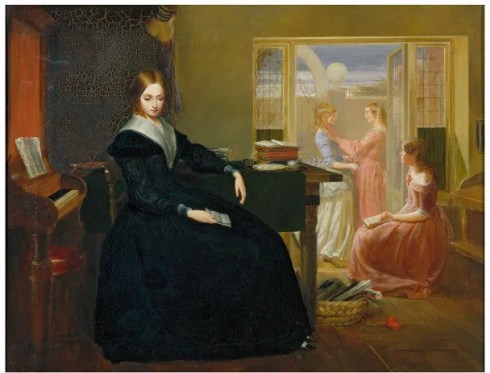
I wanted to follow up my Post Office post with one featuring the art of letters, but I’m not sure exactly how to categorize these images:  these are not examples of typographic art, as they feature script rather than print, or ephemeral art, because I’m including works of art which feature letters as well as a few letters that I believe rise to an artistic level.  I looked up “scriptural art”, but that category seems to be reserved for religious works, and scribal art for calligraphy.  So that leaves me with the rather bland title “the art of letters”.***  It happens that some of my favorite images have a focus on reading or writing letters, or present an assemblage of writing materials, or a scrap of paper, with writing, that makes us wonder what’s going on here?  what does that letter say?  The letter is a great device to draw us into the painting: we want to read it!  Look at the note in the hand of this Victorian governess in Richard Redgrave’s 1844 painting:  it–or rather her reaction to its contents–has separated her from the “lighter” children under her watch. The painting was exhibited with the quotation “She sees no kind domestic visage here”, indicating that the letter brought memories of a missed home at best, and news of a death in her family at worst.
Letter Governess

Richard Redgrave, The Governess (1844), Victoria & Albert Museum, London

My very favorite letter painting doesn’t really delve into the emotional aspects of letters and their reception, but rather it presents us with a trompe l’oeil display of printed and writing materials:  an early modern bulletin board!  This is a very ephemeral painting in several ways:  the newspapers and almanac represent the “news” of Queen Anne’s accession in 1702, as does the medal representing her grandfather, Charles I. The painter has included his “signature” on the folded sheet in the center. I love trompe l’oeil in general, but this particular painting has captivated me since the first time I laid eyes on it several years ago; I think that George Tooker’s 1953 painting, The Letter Box, is its perfect companion piece.

Colyer Tromp l'oeil

George_Tooker_The_Letter_Box

Edward Collier (Collyer), Trompe L’Oeil with Writing Materials, c. 1702, Victoria & Albert Museum, London; George Tooker, The Letter Box, 1953, Hirshorn Museum and Sculpture Garden, Washington, D.C.

Moving back to my period, I noticed a while ago that the Tudor court painter Hans Holbein the Younger often included scraps of paper with writing, tucked into a book, laying on a table, or even posted to the wall, in a number of his portraits. The well-known portrait of Thomas Cromwell (of whom I am a fan) is a good example, as is the amazing portrait of Georg Gisze, a German merchant stationed in London (like Holbein). I think the use of written and writing materials is a bit more straightforward here:  Cromwell wants to present himself as a pious public servant and a master of the (written) law, while Gisze is an equally-earnest man of business who holds in his hand a letter from his brother, back home.

Cromwell Frick Collection

Hans-Holbein-the-Younger-Portrait-of-Georg-Gisze-Oil-on-Wood-Panel-1532-Staatliche-Museen-Berlin--904x1024

Hans Holbein the Younger, Portrait of Thomas Cromwell, 1532-33, Frick Museum; and Portrait of Georg Gisze, 1532, Staatliche Museen, Berlin.

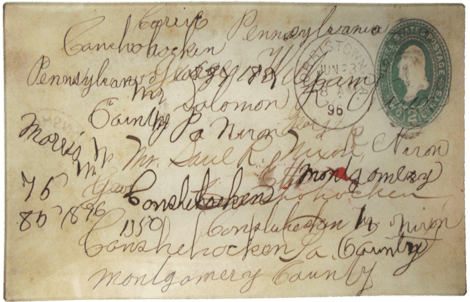
I’m including a few actual letters in this post, both because I spent quite a bit of time searching through the digital collection of the National Postal Museum at the Smithsonian for my last post and because many of the letter “covers” in this collection do rise to the level of art, in my humble opinion. The range is incredible, encompassing patriotic examples from all the American wars, letters from the prisoners of those wars which were delivered in specially-marked envelopes, and letters delivered by planes, trains, and zeppelins. These covers are also a way to look at print and script together. This first envelope, from my own collection, was issued by the Locke Regulator Company of Salem in 1899 (as you can see by the postmark), and then there’s a letter from a Union prisoner of war from 1864 and a letter carried out of Paris by balloon in 1871.

Scan0004p

Letter from Union Prisoner of War

Letter Smithsonian

Covers from 1864 & 1871, National Postal Museum, Smithsonian Institution.

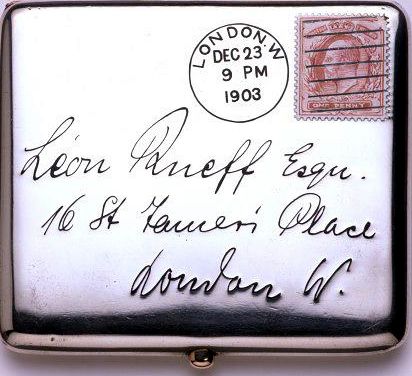
These letters look like likely candidates for a John Derian decoupage tray to me: that man loves his fonts and scripts!  But letters moved to the foreground in the decorative arts a while ago, as exemplified by the beautiful silver cigarette case below, “postmarked” in 1903. I wish we could bring these cases back (with an alternative use), and while we’re at it, letters too!
LT-Script-Sampler_1_large

Silver Cigarette Case Albert Barker Ltd London

John Derian “Sample Script” decoupage tray; Silver cigarette case by Albert Barker, Ltd., London, Collection of the Victoria & Albert Museum.

***EPISTOLARY Art!!! As recommended by Secret Gardener, who has one of the most beautiful blogs out there.


