
This is generally a beautiful time of year to take photographs around Salem but it’s been rather cold and dreary for the past few weeks, with the exception of a few isolated days. I’m sure that when everything dries out we will be living in a lush and green world, but for right now I’m more predisposed to take out a book than go outside. So after I finished my grading (always a celebratory moment), I curled up with some old architecture and photography books and soon realized that one “Salem artist” whom I have never featured is Philip Kappel (1901-1981), an etcher and book illustrator who spent several years working with Philip Little and in his waterfront studio off Derby Street. Kappel was not really a Salem artist: he was born in Connecticut, educated in New York City, and as he was employed by several steamship lines over his career, he traveled the world six times over, gathering materials for his etchings everywhere he went. But he did publish a lovely book in 1966 titled New England Gallery with several Salem images inside, as well as some interesting commentary on his time here.


 See what I mean about the weather? But Kappel’s Ropes Mansion and Witch House hint at brighter and warmer days, even with no color!


 The Custom House (which is celebrating its 200th anniversary this year) Derby Wharf Lighthouse, The Little Studio (just above the compass star)–where both Philip Little and Philip Kappel worked, in different seasons—and the House of the Seven Gables.
Kappel relates the standard histories of most of the Salem structures presented in New England Gallery but is more effusive about Chestnut Street because that is where his friend and mentor, Philip Little, lived. Little summered on MacMahan Island off Boothbay Harbor every year, and during a visit to the mainland he chanced upon a small exhibition of Kappel’s drawings and sought the young artist out. Kappel was teaching art in Boothbay, but Little thought he should and could do better, and offered him his Salem studio on Daniels Street Court, “hard by Salem Harbor, in the heart of the area which made Salem a great seaport in its heyday.” There, Kappel reveals, “inspired by its moods and reveling in its historic past, I never worked harder or produced more work. Every summer passed too quickly.” Kappel’s depiction of the Little house at 10 Chestnut Street includes the entrance pillars of Hamilton Hall, which gives him an opportunity to pass along a charming little anecdote: Many years ago Philip Little took me on a tour through Hamilton Hall. As we were descending the long flight of stairs that led to the second floor from the first, I notices a series of large white circles painted on the top step, and a similar treatment accorded the last step. (I have since learned that the circles have been removed.) When I asked the purpose of this unusual feature, Philip Little forthrightly informed me that the circles served as warning signals for those who might have “sipped too long and too much at the punchbowl,” alerting them to the impending dangers of a fall when taking the first step into the space, the circles on the last step indicating that all was well; a successful landing had been effected. There is carpet on those stairs now, but having been to one or two enthusiastic events at Hamilton Hall over the years, I’m wondering if we should put those circles back!

 Chestnut Street

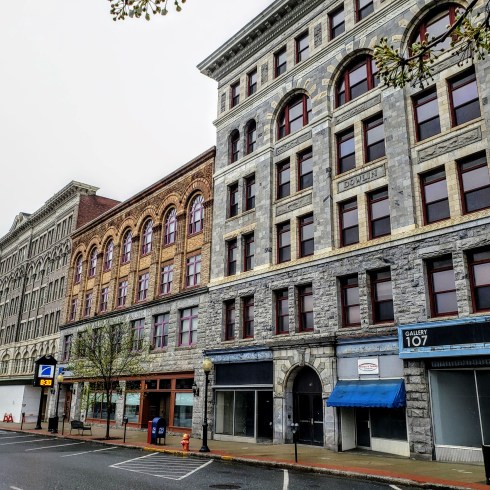


 Some of the larger Victorians on Church Street (just above) need some help, but just up the hill is a lovely neighborhood of mostly-restored structures. Below: the Arnold Print Works produced a full line of textiles over their long history, but one of their popular products in the 1890s were these stuffed animal templates (examples below from the collections of the Rhode Island School of Design Museum & Cooper Hewitt): the finished products are very collectible and you can buy reproductions too (here are some Etsy


 Port Royal Parlor at Winterthur and South Drawing Room at Sir John Soane’s Museum, photograph by Derry More.


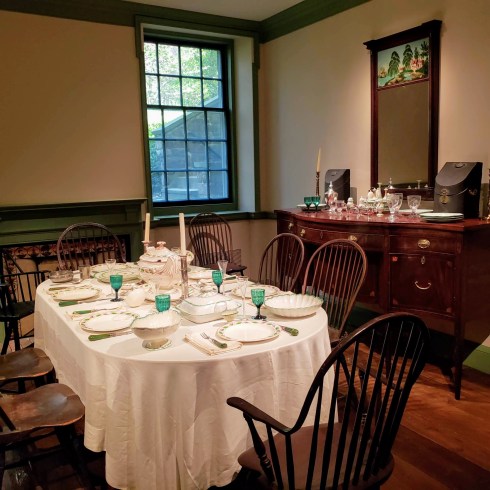
 So many rooms—and stuff—for eating and drinking, of course, but dining rooms can be very revealing in their details. After the famous Chinese Parlor are several shots of the Du Pont Dining Room, with the Derby family’s green knives and knife boxes (+ McIntire chairs and Needham secretary, and adjacent candlestick closet. I can’t remember the name of the second, simple dining room, which is one of my favorite Winterthur rooms, but the photograph just above is of Queen Anne Dining Room, which really represents Mr. du Pont’s creative abilities (as well as his collecting efforts).

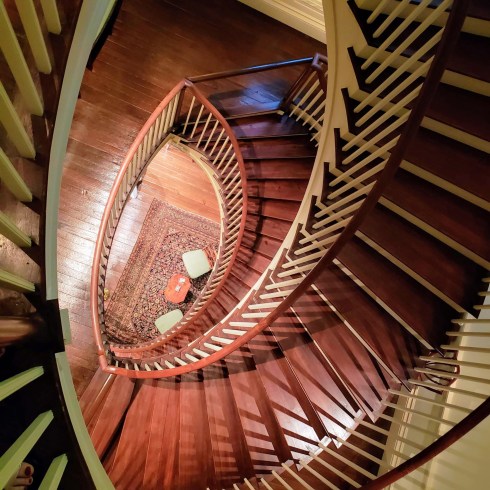


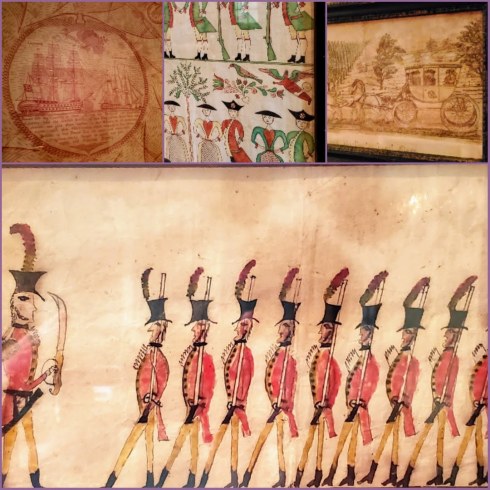


 The Montmorenci stair, taken from a North Carolina house, replaced the “baronial” staircase which Mr. du Pont’s father installed. Folk objects and images, just a few tea tables, and just one china room. Several Salem items: the chimneypiece embroidered by Sarah Derby Gardner, a Silsbee chair, Mr. du Pont’s secretary (and bed), and the Corné mural from the Lindall-Barnard-Andrews House.


 Longwood Gardens + Conservatory and “Green Wall” surrounding restroom doors!


 Treasures of the Brandywine River Museum of Art, including: Howard Pyle’s influential “historic” illustrations and a N.C. Wyeth cover, Andrew Wyeth’s Snow Hill and Jamie Wyeth’s Lime Bag, N.C.’s studio exterior and interior and in Andrew’s North Light, N.C. Wyeth, framed by his parents and looking down on his talented family, a Jamie Wyeth Christmas card for his beloved wife Phyllis.


 Madame Beavoir’s Painting

 Madame Leroy and Rest in Peace; Revolutionary Dress Top (detail).

 Marie Antoinette is Dead; Boucher’s Portrait of Madame de Pompadour (Neue Pinakothek, Munich); Passing and Violin of the Dead. All photographs by Fabiola Jean-Louis with more + commentary at her website:


 There WILL be fiddlers—and dancing! (Not really sure who took these pictures at the last ball two years ago, sorry)


 Historical artist Peter Waddell’s
 Peter Waddell’s recreation of one of Dolley Madison’s “Wednesday Squeezes” with many turbans and feathers in evidence, White House Historical Association; the capture and burning of Washington in 1814, New York Historical Society. Mrs. Madison continued to be an active hostess in her temporary quarters, which Mrs. Crowninshield tells us all about, but she does not have much to say about the post-war state of Washington.


 The arch of the Praça do Comércio, the Square of Commerce, is the proper entry to Lisbon, from the sea, but it’s a nineteenth-century construction after the rebuilding of the square following the earthquake of 1755. A great mural in the Museu Nacional de Arte Antiga shows the pre-1755 square. The Church of


 I’m trying to show the integration and proximity of new and old with these pictures, which include several streetscapes, views from the Castelo de S. Jorge, the Church of


 Belem: site of the iconic Manueline


 Museums: so many! History museums and museums of every conceivable form of art: “ancient” (pre-1850), modern, decorative, TILES, marionettes. The famous Gulbenkian collection and several less well-known house museums: I was blown away by the


 The House in 1940; HABS, Library of Congress.

 Other Benson houses, including his own, top right; the Benson family home on Salem Common and Willowbank in Kittery Point, Portsmouth Athenaeum.






