Tag Archives: Art

The Lynde Ladies of Salem

I’ve always admired these three portraits of women from the Lynde family: the wife and daughters of Benjamin Lynde Jr., chief justice of the Massachusetts Superior Court of Judicature and one of the justices who presided over the trial of Captain Thomas Preston following the Boston Massacre. As the portraits were produced by very esteemed and in-demand artists, their existence seems to me to represent the extreme wealth and prestige of the family, and by extension Salem, with which they were all identified. But since I’ve had my “enslavement enlightenment” lightbulb moment, I find I can’t look at them in the same way I used to: a little personal perspective on a challenge faced by many towns, cities, and universities these days. I can’t admire the rich folds of velvet and silk swathing these women without thinking of their other “possessions”.

Lynde Jr Wife Mary Feke Huntington

Robert Feke, Mrs. Benjamin Lynde Jr., c. 1748. The Huntington Library, Art Collections, and Botanical Gardens. Gift of the Virginia Steele Scott Foundation.

01-02_full

Joseph Blackburn, Mary Lynde Oliver, c. 1755. National Gallery of Art.

Lynde Lydia Copley

John Singleton Copley, Lydia Lynde (Walter), c. 1762-64. Lydia Lynde, ca. 1762-64.  New Britain Museum of American Art, Stephen B. Lawrence Fund and through exchange.

Maybe I can look at the silk without guilt: there are references to at least two enslaved men in the various accounts of Justice Lynde’s household, implicating his wife Mary (Bowles) Lynde (1709-91), but I do not know if the Lynde’s two daughters, Mary Lynde Oliver (1733-1807) and Lydia Lynde Walter (1741-1798) are so-tainted. As Mary Jr. was married to a gentleman scientist (Andrew Oliver) and Lydia married the Rector of  Trinity Church in Boston (the Reverend William Walter), I would like to think that they despised the institution and practice of slavery, but that might be anachronistic wishful thinking on my part as science, religion, and slavery seem to be compatible in the eighteenth-century Atlantic world. Mary’s 1751 diary is among other Oliver collections at the Massachusetts Historical Society, and I bet that would yield some clues. Slavery was abolished in Massachusetts during the lifetimes of all of these women, and it would be interesting to know their reactions to that epic event. While the two Marys led much of their lives in the Lynde family home on the corner of Essex and Liberty Streets (demolished in 1836, and then of course the PEM engulfed that latter so that no longer exists either) in Salem, Lydia lived with her husband in Boston until 1776 when they decamped for Nova Scotia with other Loyalists, to return only in 1791. While The Loyalists of Massachusetts described both of Benjamin Lynde’s sons-in-law as “staunch Loyalists”, I’m just not sure that is the case with Andrew Oliver, Mary’s husband. He was certainly part of a conspicuous Loyalist family as his father was the last royal Lieutenant Governor of Massachusetts and his uncle its last royal Chief Justice, but he seems to have been more passionate about science than politics and he and Mary remained in Salem during the Revolution.

Lynde Andrew Olliver

Joseph Blackburn, Andrew Oliver, Jr., c. 1755, National Gallery of Art. In the companion portrait to that of Mary above, Andrew Oliver looks even more resplendent, with his waistcoat and dovecote!

Andrew Oliver by Copley MFA

John Singleton Copley, Andrew Oliver, Jr., 1758. Museum of Fine Arts, Boston

At least I think they did: they’re pretty quiet, only emerging towards the end of the war as executors (she with her maiden name) of her father’s estate. I’d like to think that Mary and Andrew fulfilled the dictates of Benjamin Lynde Jr.’s will and freed his long-term “man” Primus joyfully, and on the most generous of terms. No advertisements for lost or runaway humans before that, thank goodness, only books. We do get some insights into Mary’s character from the ever-quotable Reverend Bentley, although they are not very complimentary: she was “of real piety but not of that mind which could have rendered her a fit companion for her husband who took a high rank in American Literature. She was feeble limited in her enquiries, & a century too late in her manners.” (Diary II, 335-6).

Lynde Salem Gazette 1781

Lynde Essex Gazette 1769

Addendum: There is a fourth portrait of a Lynde lady: Benjamin Lynde Jr.’s mother, Mary Browne Lynde, in the collection of the Peabody Essex Museum: I don’t remember ever seeing it, but it is featured in Lorinda Goodwin’s book An Archaeology of Manners: The Polite World of the Merchant Elite of Colonial Massachusetts (2002) as well as the Smithsonian’s catalog of American portraits, where it is attributed to none other than Sir Godfrey Kneller, the “Principal Painter” of the late Stuart courts. It is quite something to think of a Salem girl being painted by the same artist who portrayed James II, William and Mary, Anne, Locke and Newton! There is no online catalog of its object collections on the PEM website, so I can’t check out their attribution, though Goodwin lists it as unattributed. Mrs. Lynde Sr. appears to have been a very beautiful woman, but not only were her father and husband slave owners, she lived in an age in which slavery became integrated inextricably with the British Atlantic Empire. In 1713 Britain was granted the asiento, the exclusive contract to supply the Spanish American colonies with slaves, in the treaty that ended the War of the Spanish Succession, thus enabling its domination of the Atlantic Slave Trade for the rest of the eighteenth century. 

Mary Browne Lynde

Queen Anne Kneller

Two Kneller portraits? Mary Browne Lynde and Princess Anne before her accession in 1702, Sir Godfrey Kneller, Chirk Castle © National Trust.  After the asiento was granted to Great Britain by the terms of the Treaty of Utrecht, the South Sea Company, in which both Anne and her successor George I were large shareholders, was awarded the contract to supply slaves to Spain’s colonies. 


Edwardian Tudors

I’m back teaching this semester after a productive sabbatical, although I’m a bit out of practice. Thankfully I’ve got my favorite Tudor-Stuart survey scheduled, a course that I’ve taught many, many times but always in a different way. This semester we are focusing on “disorder” in general and crime in particular and they are reading accounts of sensational crimes interspersed with the usual narrative of Reformation and Revolution. Before we get to any of that, however, I drag my students through a lot of historiographical and cultural context, because I find that they already have so many preconceived notions about this era, even those who have never really studied it, from films and television…..and Shakespeare, even though they don’t know that their “history” is Bard-derived. Yesterday we were examining how the Victorians perceived the Tudors, as you generally have to burst through Victorian interpretations to get close to anything resembling the historical truth, and we ended up with these wonderful Edwardian murals, installed in the East Corridor of the House of Commons in 1910. They are images of Tudor monarchs (for the most part), of course, but they are also Edwardian projections, chosen to represent the ideals of that time: a more popular-based sovereignty, empire, education, and the long-term consequences of the Reformation. What is so interesting is that several of the murals are not based on any documented historic event, but rather on Shakespeare’s depiction of an historical event: with their prominent situation in Parliament, they represent a multi-layered representation of the past.

Parliamentary prints first Plucking_the_Red_and_White_Roses,_by_Henry_Payne.jpgHenry Arthur Payne, The Origin of Parties. Plucking the White Rose in the Old Temple Gardens

Let’s take the first East Corridor mural as a case in point: Henry Arthur Payne’s The Origin of Parties. Plucking the White Rose in the Old Temple Gardens, which depicts a scene taken from Shakespeare’s Henry VI, Part I in which the noble factions about to wage what would become known (much later) as the War of the Roses are choosing sides/roses. This is a pre-Raphaelite depiction of a pre-Tudor “scene”, and a bit of a stretch to consider the York and Lancaster factions as the “origin of parties”. Apparently even the artist questioned the first subtitle given to his work, but as the murals project was being overseen by the American artist Edwin Austen Abbey of the Royal Academy, who most definitely looked upon Shakespeare as his muse, the inclusion of this scene is understandable. Abbey was also responsible for the homogeneity of the East Corridor murals, as he specified the red, gold, and black color scheme which unites all six murals, as well as the uniform height and perspective of the characters portrayed.

cooper john-cabot-and-his-sons-receive-the-charter-from-henry-vii-to-sail-in-search-of-new-landsDenis William Eden, John Cabot and his Sons Receive the Charter from Henry VII to Sail in Search of New Lands 1496

henry_vii_at_greenwichFrank Cadogan Cowper, Erasmus and Thomas More Visit the Children of Henry VII at Greenwich, 1499

katherine and henryFrank O. Salisbury, Henry VIII and Catherine of Aragon before the Papal Legates at Blackfriars, 1529.

(c) Palace of Westminster; Supplied by The Public Catalogue FoundationErnest Board, Latimer Preaching before Edward VI at St. Paul’s Cross, 1548.

mary enteringJohn Byam Liston Shaw, The Entrance of Mary I with Princess Elizabeth into London, 1553

And there you have them: representatives of Tudor history from an Edwardian perspective. The emphasis seems to be on: the story, empire, the “new learning”, and the relationship of the royal government to the people. We have an equal representation of both Protestantism and Catholicism, hinting at the secularism of the era. I’m happy to see that my favorite Tudor, Henry VII, has a larger role in this story than Henry VIII, but surprised to see such a supporting role for Elizabeth: perhaps she was too powerful an opponent of parliamentary power.

Images and more information about the murals here: https://www.parliament.uk/worksofart/collection-highlights/british-history/tudor-history.

and more context here: https://www.paul-mellon-centre.ac.uk/publications/browse/9780300163353.

edwardian sense


Reverence for Ruzicka

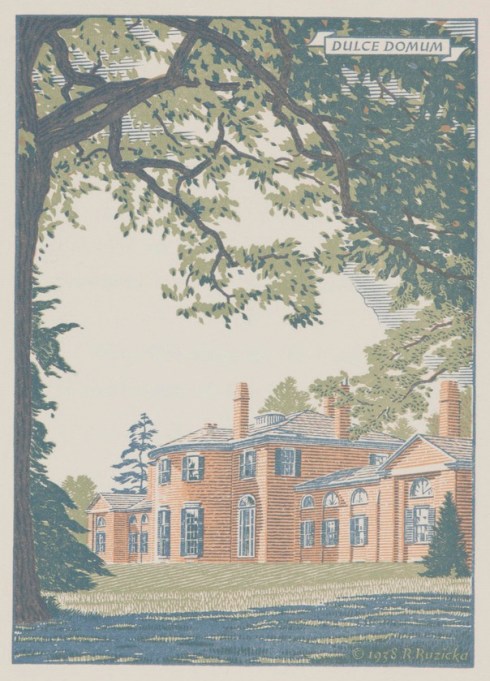
I’ve long admired the prints of Bohemian-born Rudolph Ruzicka (1883–1978), both pictures and fonts—both are characterized by the “optical ease” which he sought for all of his work. Ruzicka migrated to the United States as a child, and received his art training in Chicago and New York City before launching his career as an engraver and designer: he operated his own shop but also worked for the Mergenthaler Linotype Company for his entire professional life, as well as for Merrymount Press in Boston. His body of work includes several portfolios of prints of New York City, Newark and Boston, at least four typefaces (including the classic Fairfield which I use a lot), and a beautiful book of calligraphic fonts titled Studies in Typeface Design (1968). Ruzicka’s pictorial work looks to my untrained eye like the perfect combination of early to mid-twentieth-century central European and American aesthetics (they have that WPA look before the WPA!), and I love that he obviously loved New England: he moved to Massachusetts in 1948 and then to a farm in Brattleboro, Vermont. While he portrays an obvious appreciation for the “pictorial aspects” of New York (and Newark as well) his scenes of greater Boston are beautiful. And as a bonus, the series of greeting cards designed by Ruzicka and produced by the Merrymount Press from 1911-1941 include several prints of notable Salem landmarks, which you can see below.

ruzicka louisberg square carnegie

ruzicka beacon hill gardens carnegie

ruzicka beacon hill view

ruzicka charles street church

ruzicka cornhill boston

ruzicka granary burying ground

ruzicka washington monument

ruzicka frog pond carnegieRuzicka’s views of Boston (including the old Cornhill and swimming in Frog Pond) above, and of greater Boston (including Peacefields in Quincy, Walden Pond in Concord, McIntire’s Gore Place in Waltham and Derby summer house in Danvers, and the House of the Seven Gables and Old Town Hall in Salem) below.

ruzicka carnegie 3

ruzicka quincy

ruzicka walden pond

ruzicka gore place

ruzicka glen magna carnegie

ruzicka gables carnegie

ruzicka market house carnegieAll images from the collection of the Carnegie Museum of Art; the Harvard Museums also have a large collection of Ruzicka prints.


Fadeaway Women

Since I discovered the earlier version (1883-1936) of Life magazine this fall, I’ve been browsing through its content and covers: this Life 1.0 was a very different medium than its successor! I put together a portfolio of Christmas covers for a post, and then I realized that the work of one particular illustrator was more interesting, whatever the seasonal expression. These covers are the work of Clarence Coles Phillips (1880-1927), known first as C. Coles Phillips and for most of his career as Coles Phillips: an innovative illustrator who utilized the technique of negative space (and imagination) to portray a series of stylish and independent women on the covers of Life (and other periodicals) from 1908 to the end of his short life. The Christmas cover from 1909 caught my attention first, but it is not my favorite: I just love the ladies playing with boy toys in 1911—-a far cry from the Gibson Girls who preceded them!

Life xmas

December 22, 1909

Life 1909-10-14

Life 1910-03-03 C. Coles Phillips

Life C. Coles Phillips

Life 1911-07-27 C. Coles Phillips

Life mghl_phillips-5 Aug 24 1911

Life 1911-08-31 C. Coles Phillips

Life 1911-09-28 C. Coles Phillips Fade Away Women

Life 1911-11-30 C. Coles Phillips Fadeaway

Life 1912-06-13 C. Coles Phillips Fadeway

Life1912-12-26 C. Coles Phillips

Life phillips_l7apr21

Life mghl_phillips-9

October 14, 1909/ March 3, 1910/ May 12, 2010/ July 27, 1911/ August 24, 1911/ August 31, 1911/ September 28, 1911/ November 30, 1911/ June 13, 1912/ December 26, 1912/ April 7, 1921/ May 13, 1926. All covers from MagazineArt.org.


The Christmas Ball at Hamilton Hall

It is formally called the “Holiday Dance” now, but I always think of it as the Christmas Dance or better yet, the Christmas Ball, held next door at Hamilton Hall since whenever. I’ve been going for decades, and it really never gets old for me. I remember well my first attendance, clad in some old Laura Ashley velvet frock, when appeared before me a woman in the most elegant vintage black gown, from the 1930s I think, and I immediately thought: I must up my game. I’ve tried to do so every since, and this very same woman, clad in a very different–but equally elegant–gown from India, was one of the dance patronesses this year. Yes, there are patronesses (and for the last few years patrons) to whom we bow and curtsey, escorted before them by ushers. There’s an amazing traditional punch which led to the loss of several Sundays in my past, but now I’m too smart (experienced) to imbibe, and a rather loose “grand march” at the end of the evening. I was in bed by that time, so no pictures, sorry.

Ham Hall Exterior Day

Hamilton Hall Invitations

Ham Hall CD 6

Ham Hall CD 4

Ham Hall CD 5

Ham Hall Marco

Hamilton Hall Dance 2

Ham Hall CD

Hamilton Hall CD Collage

HH Christms Dance

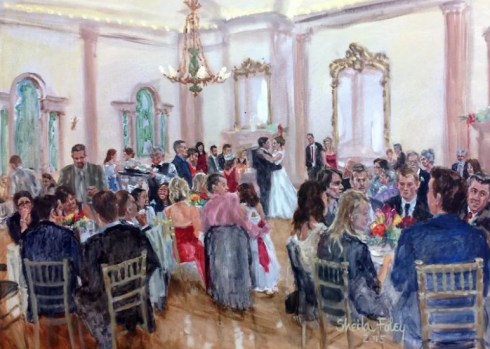
This is a very traditional event, but not an exclusive one. Anyone can go: well, as many as can fit into the Hall. In years past, I remember smaller crowds but last night was definitely a crush. This event, along with a lecture series on world affairs that began right after World War II, is one of two major fundraisers for the Hall, which is primarily maintained through revenues from weddings and a more recent membership initiative. As a next-door neighbor, I would rather that the Hall was a little less busy, frankly (although the weddings are limited to 25 per year and there are none in July and August), but I know that it has to work for its living. It was built by subscription and maintained by its “proprietors” until the 1980s, when it was transformed into a non-profit. Everyone turned in their shares, but these were just paper: not an endowment. I’m really interested in how the “Proprietors of the South Buildings” (which included not only the Hall but Samuel McIntire’s majestic South Church across the street, which burned down in 1903) conducted their business: all the corporation’s records, like those of every Salem organization, are in the collection of the Phillips Library but as the shares were held privately you often see them on ebay or at ephemera sales. There were various management companies that ran the Hall and employed caterers and that famous “conductor of affairs” John Remond, who is announcing some major redecorations in 1844 below. Just before Christmas in 1850, the gaslights were turned on at Hamilton Hall, the very same chandelier and sideburners that shone so brilliantly via electricity last night.

Hamilton Hall Certificates Collage

Hamilton Hall Salem_Register_1844-12-23_1

Hamilton Hall Gas

Hamilton Hall SHeila FoleyI love this view of the Hamilton Hall ballroom, with its “Russian” mirrors and green chandelier, by artist Sheila Foley: see more of her live event paintings here. 


Remembrance Roundup

Never have I been so happy to live in the time of the world wide web, as I could see and share all the forms of remembrance this past weekend as the world marked the centenary of the end of World War I. I have been profoundly touched by the cumulative efforts in Britain, starting with the amazing installation Blood Swept Lands and Seas of Red four years ago, and under the auspices of the 14-18 Now WWI Centenary Arts Commission more poignant and engaging initiatives and installations followed, right up to the centenary of Armistice Day. The culture of commemoration in Britain appears deeply ingrained from my vantage point, but as the First World War was a global event so too is its remembrance: there were thoughtful exhibitions and installations in all of the Commonwealth countries, across continental Europe, and here in the United States. Here in Salem, I was really happy to see the Salem Maritime National Historic Site tell the story of the Second Corps of Cadets during the Great War on facebook all day long on Sunday, and more than a little confused that the Peabody Essex Museum decided to have a festive “dance party” the night before.

My favorite expressions of remembrance are below, but please nominate others! There is a much more comprehensive roundup of #ArmisticeDay100 in its entirety on Google Arts and Culture.

Blood-swept-lands-seas-of-red-Tower-of-London-poppies-002

Blood Swept Lands and Seas of Red, Paul Cummins and Tom Piper, 2014.

Wave Poppies

Wave Poppies at Yorkshire Sculpture Park, 2015. Paul Cummins and Tom Piper. Getty Images.

Were Here

We’re Here because We’re Here, 2016. Jeremy Deller in collaboration with Rufus Norris.

There

There but not There Tommy Silhouettes in Arundel Cathedral, June 2018. An initiative by the UK Charity Remembered.

"La Nuit Aux Invalides : 1918 La Naissance D'Un Nouveau Monde" - 1918 The Rise Of A New World Show In Paris

La Nuit aux Invalides, Bruno Seillier, Summer 2018. Getty Images.

FRANCE-HISTORY-WWI-CENTENARY

Dame de Couer, October 2018. Ludovic Marin / AFP / Getty.

Poppies-1-1020x765

Weeping Window poppies @Imperial War Museum, London, Paul Cummins and Tom Piper, 2018.

A visitor looks at a dove-shaped formation of thousands of artificial red poppies, made out of red bottle tops, at the Botanic Garden in Meise

A Dove of Poppies, Meise, Belgium, November 2018. REUTERS/Francois Lenoir.

Tervuren

A “Trench” of Poppies, Tervuren, Belgium, November 2018. Sven Vangodtsenhoven and Hans Tuerlinckx of Art-Ex.

Some of the 72,396 shrouded figures that form part of the 'Shroud of the Somme' installation by British artist Rob Heard are seen in London's Queen Elizabeth Olympic Park, in Stratford, London, Britain

Shrouds of the Somme, 2016-2018, Rob Heard. Toby Melville / Reuters.

Pages of the Sea

Pages of the Sea, November 11, 2018, Danny Boyle.

Ghost Soldiers

“Ghost Soldiers” in a Gloucestershire cemetery, November 11, 2018. Jackie Lantelli.

Poppies

Sydney Opera House, November 11, 2018.


It started in Salem for John Derian

I’ve been a fan of decoupage artist and entrepreneur John Derian forever or what seems like it: since I bought my first piece at a little Marblehead shop named C’est la Vie, which is still very much up and running. And then I bought more glass trays: most from this same shop but I also took pilgrimages to his stores in New York City and Provincetown. Thanks to his collaborations with Target, I was able to obtain even more of Derian’s rediscovered prints, covering utilitarian objects like storage crates, coffee cups, and jewelry boxes. Beautiful stationery that I can’t even bring myself to use. So now there’s probably something Derian in every room in the house (except for those inhabited exclusively by my husband and stepson) but despite his omnipresence in my life I somehow never knew that it all began in Salem for John Derian! I knew he was from Massachusetts, Watertown in particular, but not until I read the forward to an engagement diary which my parents gave me for my birthday last week did I realize that a few colorful prints found at the Canal Street Flea Market in Salem in 1983 inspired his whole brilliant career!

Derian

Derian Collage

Colorful nineteenth-century floral prints found in a box of broken-up antique books and loose papers at a flea market in Salem, Massachusetts. I’m pretty sure this was the Canal Street Flea Market, which was before my time: I checked with Salem’s chronicler of record, Jim McAllister, to see if he had an image but no luck. This was a rather famous flea market though—I can remember hearing about it when I started poking around in markets a bit later than this—so I can understand how it might have drawn Derian up from Watertown. His description of how he was struck by the “power” of these particular images resonates with me completely—I’ve felt that power time and time again on my hunts. How impressive to be able to turn that reaction and appreciation into a decorative arts empire—and how neat that I can add this empire to the increasingly-long list of things that started in Salem.

John Derian around the house–not an exhaustive portfolio!

Derian 10

Darien 7

Darien 6

Darien 5

Darien 3

Darien 11

Darien 12

Darien 9

Darien Sheep


Dark Flora

I picked up this beautiful coffee table book the other day: Foraged Flora by Louesa Roebuck and Sarah Lonsdale, floral designer and writer/editor respectively. The photographs were so beautiful, I had to have it, but I hesitated, as apart from those on architecture, I tend to leaf through coffee table books only once or twice so they are extravagant purchases. But this one seemed different: it’s like a farm-to-table book for floral arranging. Think local and seasonal; forage and embellish every day. And it is so beautiful…..so I bought it, and I’ve been looking at it quite a bit. I have a small urban garden which I tend to ignore as soon as September comes around, but there are lots of fluffy white spent flowers out there now, and berries come later, so hopefully this book will help me to take advantage of my natural resources.

Foraged Flora Book

The other reason I keep turning the pages is this book reminds me of some of my favorite Dutch Golden Age still lifes, particularly those by two women: Clara Peeters (c. 1594-1657–who was actually Flemish) and Rachel Ruysch (1664-1750). Ruysch was much more well-known in her day than Peeters’ in hers, but there was a big exhibition of the latter’s works at the Prado a couple of years ago so at least she is getting some recognition hundreds of years after her death. The work of both women is amazing, and you’ll see why I was reminded of it as I glanced at the photographs of Laurie Frankel in Foraged Flora. The first images below are Frankel’s photographs; the next two paintings by Peeters and Ruysch.

Foraged Flora Laurie Frankel

Photograph by Laurie Frankel for Foraged Flora

Foraged Flora Laurie Frankel 2

Photograph by Laurie Frankel for Foraged Flora

Foraged Flowers Clara Peters Prado

Clara Peeters, , Museo del Prado

Ruysch, Rachel, 1664-1750; A Spray of Flowers

Rachel Ruysch, A Spray of Flowers with Insects and Butterflies on a Marble Slab, The Fitzwilliam Museum

I just love the combination of flowers against a dark background—I had to pick up a pillow along with the book! The Dutch paintings generally show special flowers in full bloom; Foraged Fauna follows suit, but its hunter-gatherer-renderers are a bit more adventurous with their materials, which is inspiring.

Foraged Flora garden

Garden October 2018The last rose of 2018 (?) and more plant material in my garden + my new pillow and what remains.


Cauldron Connections

Every year about this time, there is a “it could only happen in Salem” story in the news: this year’s version reports a recent incident of assault and battery by cauldron in a downtown witchcraft shop. Trite but true, and it got me thinking about the association of witches and cauldrons, which I know dates back to the fifteenth century at the very least, and possibly earlier. So I took a little break from my various sabbatical projects and dug in, promising myself that I would devote only one hour to this diversion. It took me away for about 90 minutes, so that’s not too bad. Of course what immediately comes to mind, and is quoted in the newspaper article and all of its variants, is Shakespeare’s quote from Macbeth: Double, double toil and trouble; Fire burn and cauldron bubble. Fillet of a fenny snake, In the cauldron boil and bake. But that’s not the source of the connection; Shakespeare’s words and phrases, clever as they are, are generally a reflection. So what is the connection? I think there are three actually: the Hell-Mouth, the image of the concocting witch as an inversion of the nourishing mother, and poison. 

Cauldron Lamb Charles and Mary Lamb, Tales from Shakespeare, 1807

There’s nothing too terribly original about the first two connections; the last, maybe. The Hell-Mouth dates back to the early medieval era, when Hell was first personified as demonic monster who tortures and ultimately devours damned souls: the cauldron-like mouth is both the entrance to Hell and the scene of the torture and devouring, but increasingly in the later medieval manuscripts additional cauldrons (and demons) are added to this horrific depiction. As the cauldron is a tool of Satan, so too is the witch, who also utilizes cauldrons to stir up magical concoctions (with the bodies of unbaptized babies as a primary ingredient) in intensely-anecdotal late medieval texts like Johannes Nider’s Formicarius (1475). By the end of the fifteenth century and the beginning of the sixteenth, we can see these witches, encircling and stirring their cauldrons, in Ulrich Molitor’s De Lamiis et Pythonicis Mulieribus (Of Witches and Diviner Women, 1489) and Hans Baldung’s various witch woodcuts (c. 1510).

Cauldron Hell-Mouth BL 2

Cauldron Hell-Mouth

bosch_hieronymus_-_the_garden_of_earthly_delights_right_panel_-_detail_bird-headed_monster_or_the_prince_of_hell_-_close-up_head_lower_right

Cauldron weather-witches-molitor-14

Cauldron BaldungTwo hundred years of cauldrons: British Library MS Additional 47682, the Harrowing of Hell in the Holkham Bible Picture Book, 1327-35; British Library MS Additional 38128, cauldron-like Hell-Mouth, late 14th-early 15th century; the Prince of Hell with his Cauldron Hat in Bosch’s Garden of Earthly Delights, 1500, Museo del Prado; Molitor’s Weather Witches, 1489; Baldung’s Witches’ Sabbat, c. 1510, Metropolitan Museum of Art.

From the sixteenth-century depictions, which will become increasingly lurid into the next century coincidentally with the intense persecution of witchcraft, I think it’s a hop, skip and jump to the folk-tale witches of the nineteenth century and postcard witches of the twentieth from the early twentieth, but there’s one more connection I think is worth exploring, even though I haven’t quite worked it out. A key contributing cause of the early modern witch hunt was the translation of a particular Old Testament passage, Exodus 22:18, into the vernacular as Thou Shall not Suffer a Witch to Live, a translation which Reginald Scot contested in his early and popular skeptical treatise on witchcraft and its prosecution, The Discovery of Witchcraft (1584–one of Shakespeare’s sources). Scot maintained that the original Hebrew word utilized in the passage, which he referred to as Chasaph but is usually referenced (in its root form) as Kasaph, really meant diviner, seer, or poisoner rather than the “witch” of Christian demonology. Before the seventeenth century, the crime of witchcraft in England was perceived more specifically as maleficium, or harmful magic, rather then devil-worship, and poison was the most pernicious form of maleficium: it required knowledge, and skill (and perhaps a cauldron) and those found guilty of bringing about death by poison were sentenced to death by boiling in a cauldron! A sensational poisoning case in 1531 involved Richard Roose, a cook in the household of John Fisher, Bishop of Rochester, who attempted to murder his master by poison. The bishop was spared but two people in the household did indeed die before Roose was arrested, tried, convicted and sentenced to death by “boiling” in a cauldron in Smithfield.  So much inversion tied to the cauldron and the witch beside it: from nourishment, healing and life to poisoning and death, from childbirth and mother’s milk to infanticide and poisonous gall (referenced by Lady Macbeth) before both are transformed into innocent vessels.

Witchal©Historic New England


Where are all the Quince Trees?

I am encountering so many references to quinces in my early modern recipe books and regimens: to eat, to preserve, in tarts and jellies and marmalade, of course. These English people really loved quinces, or they depended on them, and so they brought them to New England, where every garden apparently had a quince tree or bush; apparently only one was needed because they were so fruitful. There was even a moment in time when quinces were considered as a possible staple crop here in Salem: according to Felt’s Annals of Salem, there was a succession of crop failures which led to scarcity of corn in the 1760s, provoking a public inquiry “whether some foreign vegetables might not be introduced, which would serve as a substitute for bread”. The “quince of Portugal” was proposed, along with the “Spanish potato” (did they not know that the potato was a native North American crop?). This is a good clue, confirmed by some of the English evidence: apparently the English variety of quince was not so pleasing as the Mediterranean variety, thus it needed a lot of cooking, steaming, boiling, roasting and sugaring: just perfect for what the English liked to do to all sorts of foods. According to Thomas Moffatt in Health’s Improvement (1655), quinces were worth the trouble: though their raw flesh be as hard as raw beef unto weak stomachs, yet being roasted, or baked, or made into Marmalade, or cunningly preserved, they give a wholesome and good nourishment.” This was fine for the seventeenth century, but in the nineteenth century I think people wanted to just pick a piece of fruit off the tree and eat it, and consequently Robert Manning, Salem’s superstar horticulturist (and Nathaniel Hawthorne’s uncle) just gives a few paragraphs to quince trees in his New England Book of Fruits and seems more interested in grafting his beloved pears onto them to create dwarf varieties. As quince also served as a type of pre-modern gelatin the development of alternative sources and processes in the nineteenth century were factors that must have aided its gradual disappearance as well. By the later nineteenth century, there were only to be found in “grandmothers’ gardens” and now—nowhere.

Quince San Diego

Quince Fuchs

Quince Cakes

quince newenglandbookof00mannrich_0070 1847

Quince Bush Arthur Wesley Down 1895 MFAQuince, Cabbage, Melon & Cucumbers, by Juan Sanchez Cotan, 1602, San Diego Museum of Art; a Quince tree in Leonhart Fuchs’ De historia stirpium commentarii insignes (Notable Commentaries on the History of Plants), 1542; the eighteenth-century recipe book of the Marchioness of Wentworth and a recipe for “Quince Cakes”;  “Quince stock when grafted or budded with a Pear”, Robert Manning’s New England Book of Fruits, 1847; Arthur Wesley Dow, “Our Quince Bush”, 1895, Museum of Fine Arts, Boston.

Well, except for the Bonnefont Herb Garden at the Cloisters (below) and there are a few quince boosters out there so maybe we will see a revival. Since they are small trees, they are perfect for urban courtyard gardens like mine, so I’m looking for a space…..and speaking of small urban gardens, for those of you in Salem (or nearby), the creator of one of the most impressive gardens in Salem (which you can see here) is giving a talk this Thursday night in the atrium of the Peabody Essex Museum. No doubt her garden is illustrative of her knowledge, which means we will all learn a lot!

Quince Cloisters

Tony Cenicola/The New York Times

Gardening event