
I’m off camping in the Maine woods for the next week, so no posts for a while. IF I survive, I should have some nice pictures next weekend………..

I’m off camping in the Maine woods for the next week, so no posts for a while. IF I survive, I should have some nice pictures next weekend………..
In the midst of a royal-birth-dominated media week I found myself in my graduate class, interpreting two iconic Renaissance portraits with ermines in them. And thus a post was provoked. How did this little weasel get associated with royalty, pretentious nobility, and the academic and clerical hierarchy? The answer lies in the (rare) white fur of this beast (more scientifically know as the stoat, or short-tailed weasel) as well as the emblems incorporated into what became a distinct ermine design: for no animal has the “ermine” black and white coat, it is a heraldic invention.


Leonardo da Vinci, Lady with an Ermine (Cecilia Gallerani, the mistress of Ludovico Sforza, the Duke of Milan), 1489-90, The Czartoryski Museum and Library, Krakow; Nicholas Hilliard, The Ermine Portrait of Queen Elizabeth, 1585, Hatfield House.
Leonardo has a real ermine in his portrait of a woman who is presumed to be Cecilia Gallerani, the mistress of his powerful patron Ludovico Sforza, the Duke of Milan–whose heraldic emblem was an ermine. But the little creature on Elizabeth’s arm, wearing a crown collar, is an artistic creation based on the ermine pattern, in which the distinctive black tips of the animal’s (several animals actually) tail is stitched onto the fur, sometimes cut into distinct heraldic shapes. I think you can see this most clearly in the portrait below, in which a sixteen-century German merchant’s wife is wearing very distinct ermine sleeves (and a lot of jewelry) with her family crest in the corner.

Bathel Bruyn the Younger, Portrait of Woman of the Slosgin Family of Cologne, 1557, The Metropolitan Museum of Art, New York.
As eminent (and wealthy) as she might have been, this woman is not a Queen–or even the mistress of a Duke: it seems like anyone can wear ermine in the sixteenth century, at least outside of England. The black-and-white (or white-and-black) patterned “fur” had become a device of conspicuous consumption and social mobility, because of its long-held associations with majesty, wealth, and a Christ-like “purity bought with his own death”, in which it was said that the ermine would give himself up to the approaching hunter, so not to sully his pure white winter coat (not quite sure why this was royal). The sheer expense of ermine is most likely the ultimate source of its desire and association with the wealthy and privileged: the stoat’s coat is pure white only in winter, and then there are all those little black tails. I do think ermine maintains its exclusive association with royalty longer in England than on the Continent, but I could be wrong.


Ermine in various incarnations, through the ages: The Duke of Bedford prays before St. George in his ermine-lined robe, c 1423, the Bedford Hours, 1423 (Additional Ms. 18850 ), British Library, Mezzotint of King George I by John Smith, 1715, British Museum; Drawing for a sign for the Crown Inn, c. 1750, Victoria & Albert Museum, London; The Stout wearing his summer and winter coats, Prang & Co., 1878, New York Public Library Digital Gallery.
Appendix: as a stark contrast to Leonardo’s portrait, I could not resist adding this Ermine with a Lady “portrait” by Ellen Paquette!

Well, I’m a bit disappointed (but not surprised) that the new British prince has not been named Alfred, but I must return to my more mundane life. The heat wave is over, thank goodness, but I am remain aggrieved: bruised and beaten from gardening and various athletic activities, bitten by a variety of bugs, burned by the sun. Consequently I have become completely dependent on, and enraptured with, witch hazel. I can’t get enough. I love its simplicity, its cheapness, its effectiveness, its old-fashionedness. Yet I know little about it–there are so many bottles around the house my stepson asked me what it was, and I had to admit complete ignorance. So I looked it up.


Witch hazel (Hamamelis virginica): fruiting stem with flowers and seed. Colored engraving, c. 1792, after F. J. Schultz; Pierre Redouté, Hamamelis Virginica = Hamamélide de Virginie, c. 1801-19, New York Public Library.
I do know quite a bit about European medicinal plants and their history, but witch hazel is a North American native (actually there are Asian varieties too) so it doesn’t turn up in any of the medieval or Renaissance herbals with which I am familiar. The Native Americans used its bark medicinally, but Europeans (in typical European adaptive fashion) amplified its potency by mixing it with distilled alcohol–and consequently it became a stillrooom/medicine cabinet staple. The standard recipe seems to be 84% witch hazel extract and 16% alcohol today; I’m not sure what is was several centuries ago, but certainly not standard. From past to present, it has been prepared in a variety of forms–poultices, lotions, potions, tinctures and salves–as well as the common “tonic”.


John White’s depiction of a Virginian chief with witch-hazel bow, c. 1585-93, British Museum; an advertisement for Hazeline Witch Hazel, c. 1903, Wellcome Library, London. This latter image reminded me of John Derian‘s apothecary series of decoupage trays, so I clicked over, and there was witch hazel, of course.

Apparently the witch hazel shrub is also beautiful, and a very early bloomer: I might have to get one of my own. Or I could just by a print. And lots and lots of more bottles of this panacea.


Witch Hazel at the New York Botanical Garden this early spring, photograph by Ivo M. Vermeulen; “Witch Hazels on Salmon Wood” by Kate Halpin, Etsy.
Very soon we will have a name for the new royal prince and it will probably not be Alfred (all the odds seem to be on boring George or James), but I say: why not? The Anglo-Saxon kings are the most English of all English monarchs, and Alfred was, of course, the Great. His lifetime (849-899) was contentious and “dark”, but he shed light whenever he could. Though officially King of the West Saxons, he styled himself King of the Anglo-Saxons, and most historians think of him as the first King of England–at least that part not occupied by the Vikings. Alfred contained these same Vikings, by building a strong fortification system and a navy (again–what could be more English than this?) He was also that very rare early medieval king–a scholar–and as such translated classical and religious works into the language (Anglo-Saxon, Old English) of his countrymen, promoting knowledge and his native language at the same time. Alfred was truly a keeper of the peace and a unifier of England–both in terms of his military and administrative systems and his codified laws–and the only English king to be titled “the Great”: what better namesake?


The only way to see Alfred as his contemporaries did is on the many coins from his realm, another sign of his effective kingship. Much later, his image becomes much more legendary: Ninth-century coin, and 1712 print by John Faber Sr., both National Portrait Gallery, London; “King Alfred the Great forming a Code of Laws and Dividing the Kingdom into Counties, Tythings, Hundreds, &”, Charles Grignion illustration from Raymond’s History of England, British Museum, King Alfred the Great attributed to Samuel Woodforde, c. 1810-15, The National Trust @ Stourhead; Print of Frank O. Salisbury’s King Alfred the Great Rebuilding the Walls of the City of London, 1912, British Museum.
Even before our university archivist posted a 1914 Boston & Maine Railroad map of the “Summer Resorts of the Coast, Lake and Mountain Regions” along its routes (and despite this past week’s terrible train derailments in Quebec and Paris) I had been planning a vaguely conceived “summer railroads” post. I know all the wealthy people who lived on my street a century ago who summered (or “rusticated”) in Maine took the train, and since we’re going camping (!!!!!!!) in Acadia National Park on Mount Desert Island in a few weeks, I had the romantic notion of throwing all our stuff in the cargo car and making our connection to the Bar Harbor Express. The train does indeed run through Salem, but no place in the U.S. is as connected by rail as it was a century ago, and the Bar Harbor Express no longer runs (we’ll need the car anyway, so I can sleep in it).


Two Railroad Advertising Maps: Boston & Maine “Summer Resorts” 1914 map, Salem State University Archives; an earlier (1882) version for New York’s train tourists, New York Public Library Digital Gallery.
These maps were just part of the railroads’ multi-faceted print advertising campaigns, which must have been extremely effective during hot summers like this one, when people were eager to leave the sweltering cities for cooler spots at the coast and mountains. In conjunction with its maps, the Boston & Maine railroad, which dominated the New England market until the 1960s, issued a series of stunning posters by Charles W. Holmes in the 1920s which focused on the appeal of summer resorts near (there’s even one for Revere Beach) and far. They really capture that air of interwar elegance, and represent the increasing accessibility of New England’s “vacationlands”.


And for later in the year, the Snow Train………………..

Travel posters by Charles W. Holmes for Boston and Maine Railraod, 1920s, Boston Public Library travel poster collection.
Salem is a boom town/construction zone right now with big projects ongoing, or about to begin, all over town: a large housing project on the site of the demolished St. Joseph’s Church on Lafayette Street and two more on the outskirts of town, a new “Gateway” center on one of the major entrance corridors, a new parking garage for the train station, more expansion for the Peabody Essex Museum and my own university, a huge (and great) power plant demolition/reconstruction project, and, of course, infrastructure work, a constant activity in a city as old as Salem. There is so much going on that the city has put up a separate website just to handle information about these projects.

I am glad that Salem is doing so well in terms of development, and I believe that most of these projects will benefit the city tremendously. But not all. Certainly the Mayor’s office and city government facilitated these proposals, and are doing a good job overseeing the process of their implementation. However, I can’t help thinking that much of this development is compartmentalized and not part of a plan, that our city is reacting to proposals rather than seeking them out, vision in hand and mind. Too often a proposal skates by the various boards, simply because it’s better than what is there now. As is my general inclination, I can’t help but compare past and present, and as I’m teaching a summer-long graduate class on the Renaissance, a time when urban planning became an art (like everything else) that is my past. Ideals were very important to Renaissance society, for both human development and urban development. The rediscovery of Vitruvius’s Ten Books of Architecture in 1414, the desire to build structures on a human scale. and the influence of mathematics combined to create an ideal vision for Renaissance cities, exemplified by three panels produced in the 1480s, all called The Ideal City.


Ideal Cities in Baltimore, Urbino & Berlin museums: Fra Carnevale, Walters Art Museum; Piero della Francesca or Leon Battista Alberti ?, Galleria Nazionale delle Marche, Urbino; Gemaldegalerie, Berlin.
It’s really not fair to hold up these panels as standards because they were, in fact, idealized rather built cities: “windows into a better world”. Yet the ideal, the plan, the desire to live in a better world, still has merit. I know we lost the sense of human scale and aesthetic detail in the twentieth century, but we can still seek better and more beautiful buildings, that assimilate easily into their material landscape. Perhaps it’s not the lack of planning but the actual architecture that is troubling me. This is certainly the case with one project: a proposed $45 million complex that would include a possible hotel, residences and retail stores to be built on a downtown block that definitely needs some help–this would be an easy case of it’s better than what’s there now so the expectations, and the standards, will be low. The renderings for the project reveal a (cheap) brick and glass multistory building which is a mirror image of the “Tavern on the Square” structure affixed to the old Salem News building across the way: both are more suited for the suburban corporate office parks found along Route 128, Boston’s inner beltway, than a historic port city like Salem. Both buildings, like several structures built in Salem in the past few years, are not only grace-less but also place-less: they have no relation to our city’s built environment and are also, quite frankly, boring. Can’t we do better?


“Mill Hill” proposal conceptual rendering for Salem & the Waltham Corporate Center along Route 128.
I detest hot weather and we’ve had a long stretch of it, so instead of extending my energies outdoors I have been lingering indoors, working on a couple of academic projects and watching old movies and Wimbledon. It’s been an unusually passive July Fourth long (long) weekend, though not an unpleasant one–perhaps I’m living vicariously through images on the television and computer screens–and not breaking a sweat! Anyway, for some time I have admired the work of two very different artists who captured the girls of summer in very different, though equally charming ways: Hamilton King’s “Sports Girls”, issued as a series of oversized cigarette cards promoting Turkish Trophies and Helmar Cigarettes before World War I, present the idealized (ironed!) view, while Boston photographer Leslie Jones captured many real sporting girls in the interwar era and after, most of whom seem rather sweat-less as well.


Three of Hamilton King’s “Sport Girls” , Series T7-6, 1913, Metropolitan Museum of Art, New York.
Leslie Jones, long-time photographer for the Boston Herald-Traveler, was not an artistic photographer but a working one, who covered both everyday life and the big regional events from 1917 to 1956. There’s a large collection of his photographs on the Boston Public Library’s Flikr photostream, and also here. All of his work is amazing, but I find his coverage of sporting events particularly interesting, because it focuses more on the athletes and their surroundings as much (or more) than the action: Jones’ girls of summer are real women, smiling and completely in context.


Leslie Jones’ photographs of Betty Nuthall at Longwood Cricket Club, Brookline, Massachusetts, 1930s,Yachting girls during Marblehead Race Week in the 1940s, and champion sculler Genevieve Peabody of Salem, 1920s. Boston Public Library and © Leslie Jones.
There were several national women’s golf tournaments at the Salem Country Club and the Kernwood Country Club in Salem in the 1930s, and Jones was there, but he was also sent to Revere Beach, just north of Boston, on the hottest days in July and August, where both casual groups and the “peek-a-boo” girls frolicked in and out of the water. I absolutely adore the center picture below, taken in July 1919: it reveals Jones’ ability to put his subjects completely at ease.


Champion golfer Helen Hicks at Salem Country Club, 1932, “Bathing Girls” at Revere Beach in 1919 and “Peek-A-Boo” Girls on Revere Beach in 1920, all Boston Public Library and © Leslie Jones.
I recently found another Salem painting in the Christie’s Auctions archive that captured my attention and fancy: “Portrait possibly of a Girl of the Derby Family” by C.L. Carter, early nineteenth century (she actually looks more eighteenth-century to me). She’s a lovely girl, but I think she entranced me not only because of her Salem connection, but because she reminds me of another “merchant princess” from long ago and far away: Bia Medici, the illegitimate daughter of Cosimo I de’ Medici, as envisioned by Bronzino. I say “envisioned” because while the portrait of the Salem girl captured the fullness of life (I think), the Bronzino portrait is a memorial image of the recently deceased girl. In life and death and in these paintings, both girls represent the privileged positions their respective families held in two mercantile oligarchies, centuries and an ocean apart.
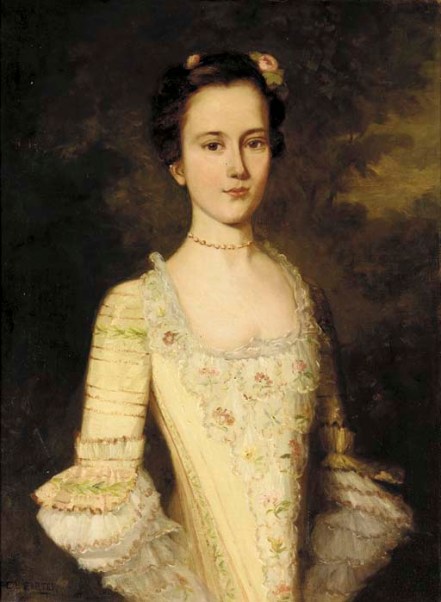

C.L. Carter, Portrait Possibly of a Girl of the Derby Family, Christie‘s; Angelo Bronzino, Untitled, known as Portrait of Bia Medici, Daughter of Cosimo I or Portrait of Bia, illegitimate daughter of Cosimo I de’ Medici, Uffizi Gallery, Florence.
Bronzino’s Medici princess has become iconic I think; I use her in my Renaissance classes to illustrate contemporary themes of family, death and remembrance, and Medici power and the students are always very taken with her, perhaps because of the angelic quality Bronzino (working from a death mask) gave her. Joseph Cornell was apparently taken with her as well, as she is the featured image of his 1948 collage sculpture that was part of the Navigating the Imagination exhibition originating at the Smithsonian American Art Museum and shown here in Salem at the Peabody Essex Museum. Another artist who seems to have been inspired by the portraits of these and other merchant princesses is the Australian photographer Bill Gekas, who has posed his very alive 5-year-old daughter in a series of “reimagined” scenes, with adorable, and engaging, results.


Joseph Cornell, Untitled (Medici Princess), c. 1948, Private Collection; Bill Gekas, The Merchant’s Daughter, © Bill Gekas.
My title is not a reference to the early modern witch trials, but quite literally to some of the larger urban fires in history: London, Boston, Chicago, Portland, Maine. I am trying to put the Salem Fire of 1914 in a larger context, and I also wanted a place/post to showcase a painting I found recently while auction archive-stalking (a major pastime of mine, along with realestalking). By an anonymous artist of the “American School”, The Burning of Treadwell’s Mill, Salem, Massachusetts shows what must have been the constant threat of fire in the densely-settled urban environment of a nineteenth-century Salem. I’m not sure exactly where Treadwell’s Mill was or what it produced (shoes? cotton? jute?) but the artist (C.C.R.?) certainly captures a striking scene.

I’m also unsure as to when this fire occurred, but it appears contemporaneous with the Great urban fires in Chicago (1871) and Boston (1872). I imagine that these two huge conflagrations, happening in such quick succession and causing acres and acres of devastation, much have really raised the specter of fire in the public consciousness in the last quarter of the nineteenth century, and incited intensive discussions about fire prevention, water systems, insurance, and city planning. Much of the historical analysis of these fires and their impact focuses on the modern cities that emerged after the flames died down, almost as if fire was a (re-)generative force rather than a destructive one. These dramatic fires clearly inspired contemporary artists as well, who seem to focus on either the unbridled force of nature or more human perspectives. Painted several decades after the fire, Julia Lemos’s Memories of the Chicago Fire (1912) is all about the fire’s refugees, while the popular Currier & Ives lithograph of the Boston Fire shows the totality of destruction.


Portland has always been one of my favorite little cities, but every time I go there I think something’s missing. Compared to other old New England ports like Providence, Boston, Salem, Newburyport, and Portsmouth, it seems relatively new and very Victorian. Its urban landscape was shaped dramatically by the large fire of July 4, 1866, in which the joyous fireworks celebrating the first post-Civil War Independence Day triggered an inflammation that consumed much of downtown and presumably many colonial and Federal-era structures. Yet a new city emerged that took advantage of the considerable charms of its geographic location. I like the transformation charted by the digital exhibition of the University of Southern Maine’s Osher Map Library: from a “Blackened City, Laid in Ruins” to a “Green City, Reborn in Parks”. The environmental impact of the fire is emphasized by two contemporary images by Portland artist J.B. Hudson of Elms, Locust Street before and after the Fire of July 4, 1866. No mention of the charred remains of the built structures in the titles of these lithographs, just the trees!


It’s a big jump, back almost exactly two centuries, to the Great London Fire of 1666, but I’m going there. This was a fire that was truly “great”, both in terms of its devastation (some 13,000 buildings) and its impact, which included a rapid rebuilding response through what was one of the first examples of centralized urban planning–a model for disaster-devastated cities in the future. Very shortly after the Fire, King Charles II established a Commission for rebuilding the city, which proceeded with plans for wider streets, squares, and larger brick buildings. Not everything worked out as planned, but a new London emerged from the ashes fairly quickly, with 6000 structures built by 1670. Five years later, Commissioner Christopher Wren (ably assisted in the rebuilding process by the more-than-able Robert Hooke, the “English Leonardo” and the “man who measured London”) began work on his St. Paul’s Cathedral, which more than any other structure emerged at the triumphant symbol of the new and eternal London.


Old St. Paul’s and “New” St. Paul’s, in the midst of fire: unknown artist of the “British School”, The Great Fire of London, with Ludgate and Old St. Paul’s, 17th Century, Yale Center for British Art, Paul Mellon Collection; Herbert Mason’s iconic photograph of Christopher Wren’s St. Paul’s during the Blitz, 1940.
Today marks the anniversary of the nativity (as opposed to the death by beheading, or decollation) of one of the most important medieval saints, St. John the Baptist. The devout veneration of the Saint determined the observation of his feast day, which was “summer Christmas”, with fire in the fields (the pre-Christian holdover), three masses, and garlands and wreaths made of golden flowers, including those from the Saint’s own namesake herb, St. John’s Wort (Hypericum perforatum), which seems to have survived, even flourished in this modern world. In the past it was first and foremost a protective herb, hung over doors, windows, and religious images (its Latin genus name–Hypericum–means “above a picture”) to keep evil away, but it was also used medicinally. I consulted my two favorite (post-medieval) herbalists, William Turner and Nicholas Culpepper for their take. Turner’s New Herball (1551) deems the great herb (as opposed to the more common St. John’s grass) good for sciatica, heartburn, and the purging of “choloric humors”, while Culpepper’s Complete Herbal (1653) is more forthcoming: it is a singular wound herb; boiled in wine and drank, it heals inward hurts or bruises; made into an ointment, it open obstructions, dissolves swellings, and closes up the lips of wounds. The decoction of the herb and flowers, especially of the seed, being drank in wine, with the juice of knot-grass, helps all manner of vomiting and spitting of blood, is good for those that are bitten or stung by any venomous creature, and for those that cannot make water. Two drams of the seed of St. John’s Wort made into powder, and drank in a little broth, doth gently expel choler or congealed blood in the stomach. The decoction of the leaves and seeds drank somewhat warm before the fits of agues, whether they be tertains or quartans, alters the fits, and, by often using, doth take them quite away. The seed is much commended, being drank for forty days together, to help the sciatica, the falling sickness, and the palsy. No mention of the anti-depressant virtues attributed to St. John’s Wort today–but also no mention of the magical protective qualities previously attributed to the plant.


The “great” St. John’s Wort, which I use as a groundcover in partial shade, and common (British Library MS Egerton 747) and Chinese varieties (painting, c. 1770-90,Victoria & Albert Museum, London).
This day is a charmed day, with hidden treasures hiding in plain sight, so keep your eyes open! As St. John’s Day coincided with the first day of summer, all of nature’s bounty was displayed in abundance. The days are not quite in synch now, but close enough, as is evident (at least here in the northeast US) by the bloom of other golden-flowered plants like Lady’s Mantle and another one of my favorites, Rue, which was also classified as one of Johanneskraut (St. John’s herbs). For best results in protection and healing, I should have plucked off some of these flowers last night, on St. John’s Eve; I think it’s too late this morning.


Rue in my garden, and common St. John’s Wort in Giorgio Bonelli’s Hortus Romanus, 1772, New York Public Library Digital Gallery.
My very favorite artistic depictions of St. John’s Wort (and other plants) are those of Mary Delany, who started making paper flower “mosaics” in her 70s, at the end of the eighteenth century. With precise, almost scientific, detail, Mrs. Delany pasted flower parts onto black backgrounds, creating a whole new genre of botanical art. You can see more of her collages at the British Museum, and in Mary Peacock’s book: The Paper Garden: An Artist Begins Her Life’s Work at 72 (2012).


Two of Mary Delany’s St. John’s Wort collages, 1777 & 1780, British Museum, London.





