
Tag Archives: Art

Pope Night in Salem

The colonial American equivalent of Bonfire Night, which has been celebrated in Britain ever since the foiling of Guy Fawkes’ and his fellow Catholic conspirators’ attempt to blow up King James I and Parliament on November 5, 1605, seems to have flourished in eighteenth-century New England as “Pope-Night” or “Pope-Day”. We have a pretty good idea of how Pope Night was observed, at least in Boston, thanks to the survival of a remarkable 1768 broadside: South End Forever. North End Forever. Extraordinary Verses on Pope-Night, Or a Commemoration of the Fifth of November, giving a History of the Attempt, made by the Papistes, to blow up King and Parliament, A.D. 1588……..[interesting that the author has confused the Gunpowder Plot of 1605 with that other big triumph over militant Catholicism, the defeat of the Spanish Armada in 1588].

Pope Night Broadside LC

The “extraordinary verses” above can be supplemented with more narrative accounts in the Boston and Massachusetts Gazettes from around the same time. They describe elaborate “pageants” and processions in which effigies representing the Pope, the Devil, the Stuart Pretender, and other representations of “tyranny, oppression, and slavery” were paraded about before enthusiastic spectators before their consignment to the flames of majestic bonfires. While some accounts stress the “order” of the event: Boston Pope Nights in particular seem to have been characterized by considerable disorder, including brawling between the North End and South End gangs, extortion, destruction, and all sorts of mischief. They seem divisive, but also representative of the agitated environment of pre-Revolutionary Boston. One would think that this most British of holidays would have been dispensed with once the American Revolution began, but George Washington’s order of November 5, 1775 indicates that this was not the case:  As the Commander in Chief has been apprized of a design form’d for the observance of that ridiculous and childish custom of burning the Effigy of the pope–He cannot help expressing his surprise that there should be Officers and Soldiers in this army so void of common sense, as not to see the impropriety of such a step at this Juncture; at a Time when we are solliciting, and have really obtain’d, the friendship and alliance of the people of Canada, whom we ought to consider as Brethren embarked in the same Cause. The defence of the general Liberty of America: At such a juncture, and in such Circumstances, to be insulting their Religion, is so monstrous, as not to be suffered or excused; indeed instead of offering the most remote insult, it is our duty to address public thanks to these our Brethren, as to them we are so much indebted for every late happy Success over the common Enemy in Canada.

482px-Washington_Before_Yorktown_Rembrandt_Peale_1823Washington and Lafayette in Rembrandt Peale’s Washington Before Yorktown, 1824, National Gallery of Art—Washington would not meet Lafayette for some time after his Pope Night order, but I imagine he was also thinking about France as well as Canada at that time.

And it is to our second President that we owe the first reference to Pope Night in Salem, long before he became our second President. When he was attending court in Salem he made the following note in his diary for November 5, 1766: Spent the evening at Mr. Pynchon’s [on Summer Street–a house that is still with us but much changed], with Farnham, Sewall, Sargeant, Col. Saltonstall &ct. very agreeably. Punch, wine, bread and cheese, apples, pipes and tobacco. Popes and bonfires, this evening at Salem, and a swarm of tumultuous people attending. I don’t know if people in Salem abstained from following General Washington’s order, but Pope Night certainly continued on after the Revolution: I can find references up to 1819 in the Reverend William Bentley’s famous diary. His entry for the 5th of November, 1792 reads: Not all the revolutions which have passed over our Country can efface the remembrance of this anniversary. The boys must have their bonfire. But the light of it is going out. We have little concern in powder plots of Kings at this day. The Town of Boston have determined not to disturb any ground in the antient Burying places. For a long time these grounds have been crowded & it was impossible to observe decency in the opening of graves. The Charge is just in a great degree against the old ground in this Town, but the objections have not yet become serious. I’m not exactly sure what he is referencing here: the Boston festivities did occur at Copp’s Hill Burying Ground in the North End, but I can’t find any references to Pope Night events occurring in Salem cemeteries: the bonfires were always lit at Salem Neck. He sounds like me complaining about the toll of Halloween on the Old Burying Ground! Every other year or so the Reverend makes a Pope Night entry, all of which express his increasing irritation, until his final words on the matter in 1819: We have had this evening the full proof of the obstinate power of superstition & habit. The 5 of Nov. was celebrated by the ritual & rubric of the English Church for political purposes. The history of the plot against all fact most pertinaciously insisted upon rea, & the popular celebration, by the carrying about the Pope & the Devil, most zealously encouraged. Tho we have lost all connection with Great Britain & have detected the fraud & the purpose, yet our common people still keep the 5 of Nov. and we had a roaring fire on the Neck on this occasion. We had not the old fashion transportation through the streets, nor the riots & quarrels, but we had enough to shew us that old habits are invincible against all the light which can be offered them.

Pope Night Dr. Bentley's Rock at Salem Neck SSU “Dr. Bentley’s Rock at Salem Neck”—the site of the Pope Night bonfires?—many decades later, Nelson Dionne Collection, Salem State Archives & Special Collections.

And after 1820 or so, no other Salem references, save Nathaniel Hawthorne’s short story “Old Times” where Pope Night is something distinctly past. The “holiday” seems to survive over the nineteenth century in a few other places, namely Marblehead, Newburyport, and Portsmouth, where it became known as Pork Night. I think the boys of Salem transferred all of their mischief and mayhem and bonfire-building energies to two other more American holidays: Halloween and the Fourth of July.

gunpowderplot21

GunpowderSome exciting news!  BBC One’s Gunpowder miniseries, starring Kit Harrington of Game of Thrones (a descendant of conspirator Robert Catesby), will be coming to the US next month on HBO.


Female Fancy-Dress, 1609-1980

I am so looking forward to Halloween night next Tuesday, not only because our long municipal nightmare will be over here in Salem for another year, but also because I actually do enjoy creative Halloween costumes, and they do appear on this night, glittering like stars in a sky of more generic garb. If an entire family is going to make the trek to Salem to trick-or-treat on Chestnut Street, they will often go all out, and in years past I’ve seen the Swiss Family Robinson, The Jacksons, the Addams Family (actually I think these three were all just last year), the Coneheads, the Jetsons, and a variety of historical characters, en masse and individually. I wish there were more conceptual costumes and less inspired by popular culture but that’s probably asking for too much for a holiday that is supposed to be for and about children. The most creative (and conceptual) costumes I have ever seen were made (or proposed) for masquerades or fancy-dress parties prior to 1920 or so, after which Halloween began to emerge as a major American holiday and the witches and the pumpkin-heads pushed out the nymphs and the sprites and the various ethereal forest creatures. Costumes begin with Queens, who were entitled to prance about in court masques long before actresses were, so I’m going to begin my portfolio with the Queen of the Amazons, one of many costumes designed by Inigo Jones for Ben Jonson’s Jacobean masques, which were commissioned by King James I’s (and VI’s) Queen Anne, my vote for bestdressed Queen of all time. Jonson’s The Masque of the Queens was presented at Whitehall Palace in February of 1609, the third masque written for Anne and the first to include an “anti-masque” featuring witches, of course, the opposite of the virtuous ladies played by the Queen and her ladies. Penthesilea, the Amazonian Queen, enters first (after the witches).

Costume Masques

Costume rowlandson500

Costume collage 3Inigo Jones’ Penthesilea costume for the Masque of Queens, 1609, British Library; Thomas Rowland’s Dressing for a Masquerade, British Museum;  Léon Sault’s designs for the House of Worth, 1860s: Eve with a snake and a Sorceress, Victoria & Albert Museum. 


A bit less custom, and a bit more commercialized, costuming commences in the later nineteenth century: more for fancy-dress parties than for Halloween. All sort of costumes can be found in pattern books from this era, such as Jennie Taylor Wandle’s Masquerade and Carnival. Their Customs and Costumes, published by the Butterick Publishing Company in 1892. As you can see, the Halloween archetypes (devil, witch, sorceress, little and big bat) are already popular. Women’s magazine also offer up lots of fancy-dress inspiration: below are some very……naturalistic costumes from the Ladies Home Journal in 1914 and a few more conventional examples from 1920.

Costume collage

Costume masqueradecarniv00wand_0053

Costume masqueradecarniv00wand_0114

Fancy Party Costumes LHJ Nov 1914

Costume collage 2

The transition from fancy-dress to Halloween costumes comes just around this time, 1920: I am marking it with an aptly-titled commercial publication,  Dennison’s Bogie Book, issued by the Dennison Manufacturing Company of Framingham, Massachusetts in 1920. This “book of suggestions for decorating and entertaining at Hallowe’en, Harvest Time, and Thanksgiving” contains lots of instructions, indicating that we’re at a moment where traditions are being invented. Of course all you need to have the perfect Halloween are Dennison products, which all seem to be made of orange and black crepe paper. It seems like full-blown commercial Halloween is right around the corner, but yet when I look at the photograph of Batgirl, St. Ann (wow, she’s the outlier here!), and Wonder Woman from New York city photographer Larry Racciopo’s Halloween (1980), it doesn’t seem like we’ve come that far at all.

Costumes 1920

Halloween Costumes 1980 Bat Girl, St. Ann, and Wonder Woman photographed by Larry Racioppo, New York Public Library Digital Gallery.


The Hanged Man

Is it just me (here in Salem) or is Tarot experiencing a major resurgence? If so, I would point to our own anxieties and its flexibility, which encourages and drives myriad interpretations and paths: the Economist kicked off the year with its annual predictions issue featuring a spread of Tarot cards suggesting a dystopian future for “Planet Trump”. Regardless of their meaning, I love visual metaphors that are enduring and flexible, or so flexible that they are enduring: reflective of a particular era’s beliefs and values time and time again. One Tarot card that seems to represent this genre well is trump XII, The Hanged Man, which can represent a state of suspension, punishment, suffering, self-sacrifice, and also a critical crossroads at which one has the opportunity to change course. In the first Tarot decks, produced in fifteenth-century Italy and France, he was simply the traitor, perhaps reflecting contemporary “shame paintings” of conspirators and criminals, who were hanged by one leg for all to see.

Hanged Man collage

Shame Paintings collageHanged Men from the Visconti-Sforza deck, c. 1428-50, Cary Collection of Playing Cards, Beinecke Rare Book and Manuscript Library, Yale University and Morgan Library & Museum ; Samuel Y. Edgerton’s CLASSIC book on pittura infamante, with one of  Andrea del Sarto’s drawings (Galleria degli Uffizi, Florence) on the cover and inside.

The hanged man crosses the alps and is presented as Le Pendu in Tarot decks produced in early modern France and Flanders in the characteristic hanging-by-one-leg pose, (sometimes with bags of coins weighing him down in reference to the ultimate traitor, Judas). It’s important to note that before the end of the eighteenth century and the publication of French occultist Antoine Court de Gébelin’s The Primitive World Analyzed and Compared with the Modern World (1773-1782), Tarot cards were merely for play. The Primitive World asserted an ancient Egyptian lineage and ascribed much more power to all of the cards, and replaced the Hanged Man dangling from a rope to Prudence in the presence of a snake. A few years after the publication of de Gébelin’s tome, Jean-Baptiste Alliette reinforced and popularized his claims and offered up a more practical approach to Tarot practice in How to Entertain Yourself with the Deck of Cards called Tarot (1785), completing its transition to an occult art. The Hanged Man reappears in the nineteenth century, looking much the same as his pre-modern form but with enhanced powers and meaning.

Tarot Pack BM

Tarot Worth BMThe Hanged Man in a Flemish Tarot deck from the eighteenth century, and Oscar Wirth’s 1889 deck, British Museum.

The troubled twentieth century was a golden age for Tarot, beginning with the deck that popularized and standardized its “divinatory meanings”: the Rider-Waite Deck, with illustrations by Pamela Coleman Smith, which was first published in 1909 and reissued in a major way in 1970. In A.E. Waite’s accompanying Pictorial Key to the Tarot, the Hanged Man is described as “a card of profound significance, but all the significance is veiled…..the face expresses deep entrancement (represented by the saintly halo), not suffering…the figure, as a whole, suggests life in suspension, but life and not death”. While Tarot meanings were widely disseminated and standardized by Rider-Waite, the archetypal images were subjected to a range of modern interpretations over the next century. Perhaps the second most influential deck of the twentieth century was the “Thoth Tarot”, a collaboration between Aleister Crowley and Lady Frieda Harris which was published in 1969, well after both artists’ deaths. Much more multidisciplinary, the Thoth Deck broke the mold and inspired decades of creative interpretations–“traditional” (whatever that means when referencing Tarot), commercial, allegorical and abstract. Several Crowley-Harris paintings, the Hanged Men among them, were exhibited at the Venice Biennale in 2013, which I think began this current preoccupation with Tarot. There have been several Tarot exhibitions over the past few years, encompassing everything from emblematic installations to hooked rugs, as the Tarot cards are “reimagined” over and over again. Right here in Salem, photographs from Jim Bostick’s  “Salem Arcanum” Tarot series, featuring a Hanged Man who seems both traditional and modern and definitely illustrates “life in suspension”, are currently on view in the October exhibition at the Mercy Tavern.

Hanged Man 1909

Hanged Man Crowley-Harris

Hanged Men collage2

HWT collage

Hanged Man Woodcut

Minimalist Tarot

SONY DSC

A century of Hanged Men: Pamela Coleman Smith, from the Rider-Waite deck, 1909; Aleister Crowley and Lady Frieda Harris, 1969; Dürer & Bruegel Hanged Men by Giocinto Gaudenzi, 1989, and Pietro Alligo & Guido Zibordi Marchesi, 2003 accessed from this amazing site which showcases Tarot through the ages; the Housewives Tarot by Jude Buffum and Paul Kepple for Quirk Books, 2003; Woodcut @ HorseAndHair, 2013; photographs by Ayla El-Moussa for 25th Century, 2016; and Jim Bostick of Salem, 2017.


Exorcising my Anecdotes

We are now in the midst of Salem’s annual Haunted Happenings celebration, marking the fortuitous link between the tragic events of 1692 and that second-most festive of holidays, Halloween. I think this year’s festivities began sometime in September, and the calendar is packed through October 31: tonight is the annual parade, which used to be the kick-off event event but is now late to the party. As long-time readers of this blog will know, I’ve never been able to see the connection between innocent victims and festivity, but believe me, I’m in the minority, and the majority definitely rules on this matter in Salem. I was going to skip my annual rant this year because it is getting tiresome (for me as well as others, I’m sure) but this was a big year for witch-trial remembrance connected to the observance of the 325th anniversary of the Trials, and I heard several things in its course that I just can’t forget, so I thought I’d use this post to process a few anecdotes. Readers and followers of the blog have increased by quite a bit over the past year (for which I am very grateful!) so I also want to offer these new viewers some orientation: even though my blog is called streets of Salem, this is not the place to go for event listings and coverage of all the things going on in the streets of Salem in October–you should click over to Destination Salem or Creative Salem if that is what you are seeking. These are both very comprehensive and informative sites that serve as great guides to Salem happenings in October or throughout the year (because a lot does happen throughout the year). I cannot be your October guide because I will be either hiding in my house or getting out of town. Well, obviously that is an exaggeration: I must work after all, I will sneak out on mid-week mornings because Salem is very beautiful at this time of year, and there are several cultural events happening this month that I don’t want to miss. But after my re- and full immersion into the experience of Haunted Happenings a few years ago, I realized that I needed to keep my head down and my mind on the victims of 1692—or anything else.

So before I leave this subject for another year, here are the assertions which I have been contemplating ever since I first heard them. I know; I am a bad historian to utilize only anecdotal evidence, but this is a blog, not a book. These moments have lasted with me because I think they speak volumes.

Cotton Mather promoted Wonders of the Invisible World in the London papersThis fact (Mather’s publisher did put a notice for Wonders in several London papers in December 1692 and February 1693) was uttered by the executive director of Salem’s “Most Visited Museum” and a major beneficiary of Haunted Happenings, the Witch Museum, in the context of a panel discussion on the Proctor’s Ledge site in July of this year. There was a general discussion of how the Trials had became sensationalized over time, and this was her response, meaning, in essence, it began then–we’re not first. I thought it was rather astonishing to hear Cotton Mather, the contemporary apologist for the trials, used as a role model!

Cotton Mather Quinton Jones Cotton Mather and the Witch of Endor, by the extraordinary and eccentric Salem artist Quinton Oliver Jones (1903-1999), who is currently the subject of an exhibition at the Salem Athenaeum.

I have no doubt Elizabeth Montgomery the person would have spoken out against injustice in 1692, had she been here at the time. And her character, Samantha, DID just that !  This was a comment in response to a letter in the Salem News (not by me!) in opposition to the Bewitched statue, essentially asking why this statue of a fictional television character was located in Salem. Apparently the statue is not of Samantha Stevens, but Elizabeth Montgomery, who was an advocate for social justice….but nevertheless Samantha did stand up! What can you say in response to such thinking? Does real history even exist?

Bewitched Thanksgiving I must be honest: this a THANKSGIVING episode of Bewitched; I couldn’t find an image of Samantha at the Witch Trials so Plymouth had to stand in–but Puritans are Puritans, right?

You need a licenseThis happened just the other day: one of my colleagues, who is teaching a First Year Seminar (required for all freshmen at our university) on “Hamilton and Salem” took his students on a walking tour of Salem so that they could learn about, you know, Hamilton and Salem. Standing in front of old Custom House on Central Street and explaining what the (then-waterfront) looked like in 1800 when Hamilton did in fact visit Salem, a man came up to him and asked him which tour company he worked for. When my colleague replied that he was a history professor at Salem State taking his students on a walking tour, the man replied:  you can’t do that; you need a license (and stop blocking the sidewalk). My colleague (with a Ph.D., two books, and 15+ years of teaching under his belt) didn’t quite grasp that this man was trying to get him to stop teaching, so the man repeated himself, assertively: Stop. You need a license.

Exorcising 5 No teaching here!

The commodification of history has its costs. No doubt there are benefits too: the official line is that Haunted Happenings revenues offset taxes and many downtown businesses report that the Halloween season is the time when balance sheets move from red into the black. We hear about the benefits of Haunted Happenings a lot, but never about the costs, literal or otherwise. I can’t speak to the former, but in reference to my anecdotes I see: a declining historical empathy, a declining historical understanding, and…..increasing restrictions on free speech? (perhaps this is going too far but I find the last anecdote simply chilling, though I was relieved to read that unlicensed teaching is actually allowed in Salem). Certainly our ability to engage in a meaningful dialogue is limited by the constraints of official boosterism when questioning public policy is interpreted solely and simply as threatening private livelihoods and the collective refrain is embrace or retreat, love it or leave it–and stop whining.

Exorcising 1

Exorcising 2

Exorcising 3

Exorcising 4 A joyful walk down Federal Street yesterday (Salem IS beautiful at this time of the year–do come during the week, if you can)–but then I went downtown and saw that the Museum Place Mall has been renamed the Witch City Mall.


Where Angels Once Tread

We were so fortunate to be the recipients of an invitation to visit the vacation home of (very) close Salem neighbors and friends this weekend, and now we know why they’re always leaving town. Their house is located in Dublin, New Hampshire, overlooking the lake and at the foot of majestic Mount Monadnock—-which drew genteel and monied urbanites and scenery-seeking artists to its midst like a magnet in the later nineteenth and early twentieth centuries, creating a summer colony which shaped Dublin to a great degree, both in terms of its materiality and its vitality (not to mention the preservation of vast acreage). Our friends’ house was built by one of the founders of this colony: Miss Mary Amory Green, a great-granddaughter of John Singleton Copley, who became so taken with local artist and instructor Abbott Handerson Thayer (1849-1921) that she offered to build him a cottage/studio on her property. He took her up on her offer, and because he was apparently as enticing an instructor as he was an artist, a succession of artistic pilgrimages to Dublin ensued. So here we were staying in the house that began it all, itself a beautiful creation, both enhanced by and reflective of its setting.

Monadnock House Best

Monadnock House Best Entrance Fernlea, early morning: designed by Russell Sturgis for Miss Mary Amory Greene, 1882-1883.
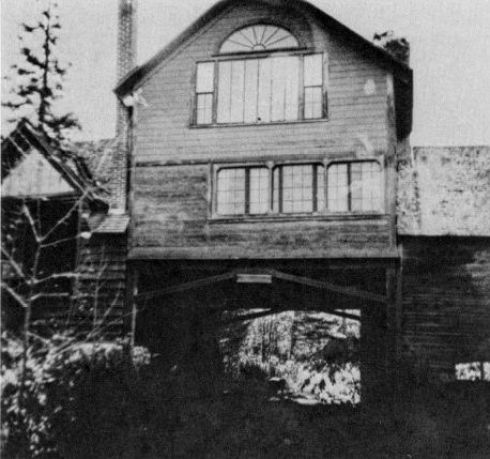
Unfortunately (for posterity but probably not for my friends), Thayer’s cottage was demolished around 1935. I began searching for images of it the moment I returned home, and as you can see below, it was more of a complex than a cottage as Thayer had some rather eccentric and austere ideas about living–and especially sleeping. Living in the age of that great “white plague”, tuberculosis, and losing his first wife to the dreaded disease, he came to believe that heat was a vehicle of its transition, a belief that his physician father apparently encouraged. The house that Miss Greene built for him was a summer house with no “conveniences”, and no alterations were made when he and his family took up year-round residence in 1901. Fires in the central house were allowed, but everyone had to retreat to open-air “sleeping huts” at the end of the day as Thayer believed that sleeping in the open, and in close communion with nature, was a particularly effective preventative against tuberculosis.

Monadnock Thayer

Monadnock Thayer Studio

downloadThe Thayer cottage complex and studio, and Gladys Thayer (Abbott’s daughter) in her sleeping hut, circa 1900. Nancy Douglas Bowditch and Brush Family papers, circa 1860-1985, Archives of American Art, Smithsonian Institution: cited in Susan Hobbs, “Nature into Art: the Landscapes of Abbott Handerson Thayer”, The Journal of American Art 14 (Summer 1982): 4-55.

And in this setting Thayer painted nature, portraits, and angels, who were not historical or theological figures but rather the characteristically-angelic women who crossed his path and touched his heart: all-the-more magnetic because of their humanity, and the wings that he gave them. You’ve got to be impressed by an artist who gave us both angels and camouflage!

Monadnock Dublin Pond Thayer Smithsonian

Monadnock 15

Thayer Angel 1903 MFA Abbott Handerson Thayer, Dublin Pond, New Hampshire, 1894, Smithsonian American Art Museum (painted as a gift for Stanford White); my early-morning view across from Fernlea; An Angel, 1903, Museum of Fine Arts, Boston.

I’ve got to leave Thayer territory and move on to Dublin at large: there are so many houses, so many stories, and I’m not even going to touch on the natural assets of the area. Probably one of the most famous public intellectuals and authors of the day (on a par with Mark Twain who also spent one summer in Dublin–is there anywhere Twain did not vacation?) was Thomas Wentworth Higginson from Cambridge, the so-called “Dean of Literary Boston” who built his Dublin cottage, the adorably-named “Glimpsewood” just down the Lake road from Fernlea in 1890. It’s now for sale. According to a very detailed 1899 article titled “Old Times and New in Dublin, New Hampshire (The New England Magazine, Volume 20) by George Willis Cooke, the colony was “complete” by about 1900, after several decades of steady cottage-building, although I think we should probably extend that up to World War One.

Monadnock glimpsewood collage

Monadnock cottages

Monadnock1

Monadnock 7

Monadnock 10

Monadnock 9

Monadnock 8

Monadnock 2

Monadnock 14

Monadnock Salem

“New” Shingle-style cottages, including a little gatehouse leading us up to the ruins of Pompelia, with its views of lake and mountain (torched by vandals in 1979), Our Lady of the Snows (1904), and a very charming boathouse; the “old” Eli Morse farmhouse, 1822, and the very new (1916) Colonial Revival “Skyfield” in nearby Harrisville, designed by Lois Lilley Howe, the founder of Boston’s first all-female architectural firm. This house apparently has several Salem mantels in it, and I need to determine from which house they were pulled.

The key to understanding Dublin is that it developed as one of several Gilded-Age alternatives to Newport: almost an anti-Newport. The “Old Times and New” article is very clear about this: the “summer resort” aims and methods have not found manifestation [in Dublin]. Almost exclusively the persons who have purchased and built in the town have sought a summer home for rest and recreation; they have not wished for society or fashion; and the life has been kept natural and simple. While there is a kindly interchange of social courtesies on the part of summer residents, any display of fashion or wealth has been discarded to a large degree and many interests bring persons together in a simple and unconventional manner. To keep to the ways of nature in yards, walks, roads and fields has been accepted as desirable; and an unwritten law has been adopted, that nature is to be interfered with as little as possible. Newport was shiny, marble grandeur for grandeur’s sake; Dublin was soft, shingled elegance for art’s (or nature’s) sake. I can completely relate to this aesthetic, having grown up in another anti-Newport, York Harbor, Maine, in a shingled summer cottage that was not quite winterized: I’m even wondering if my own father might have been exposed to the Thayer regimen!

A Harrisville appendix: driving to the town next door (in my host’s ’56 Morgan) and there we are in another archetypal New England setting: the small mill town, perfectly preserved.

Monadnock 6

Harrisville collage


Change in the Weather

The weather actually did change very perceptibly here, at about 9:30 or 10:00 yesterday morning, from muggy late summer into breezy crisp fall. In about a half hour: I felt it, and everyone I ran into yesterday felt it too. But I still have weather history on the brain, so my title is referring to a volume by the amazing antiquarian of a century ago, Sidney Perley: Historic storms of New England : its gales, hurricanes, tornadoes, showers with thunder and lightning, great snow storms, rains, freshets, floods, droughts, cold winters, hot summers, avalanches, earthquakes, dark days, comets, aurora-borealis, phenomena in the heavens, wrecks along the coast, with incidents and anecdotes, amusing and pathetic (1891). What a title! And it does not disappoint.

Weather Historic Storms of NE

I have written about Sidney Perley many, many times here before as his works are the starting place for anyone interested in Salem history and culture—and often the culmination of inquiries as well: that’s how good he was. Perley (1858-1928) was lawyer by profession but an historian by passion—I’ve met many people like this over my career but Perley managed to somehow excel at both pursuits simultaneously, publishing a steady stream of books (History of Boxford, 1880, Poets of Essex County, 1889, History of Salem, 1924, and all those invaluable articles in his Essex Antiquarian along with many texts on probate law) over the course of his career. Quite logically he was an expert in utilizing the will and the deed as a historical source, but he clearly mined any and every source he could find for essential “anecdotes”. When I begin to delve into the history of a Salem house I always start with Perley, a practice that began long ago when I first moved here and started researching house histories for Historic Salem, Incorporated. He remains an essential guide to the history of Salem for me, and I thought about him a lot last summer, when Proctor’s Ledge was formally recognized and memorialized as the execution site of the victims of the Salem Witch Trials—culminating a process that began in the 1920s with his advocacy for this site. With the inaccessibility and closure of the Phillips Library it is apparent to me that his works are probably our best connection to Salem’s early history. The other day I found an old copy of his Historic Storms on my bookshelf, opened it up, and just like that, several hours went by in what seemed like a minute. It’s one of those books that is quite easily read intermittently but I had lots of other less interesting stuff to avoid so I just settled in and read about the weather.

Perley2

Perley 3

Because the book is focused on weather events, you come away with a perception of very dramatic weather, and maybe it is just because the crisp coming-of-October breeze was coming through the windows of my study while I was reading, but it seemed to me, anecdotally, that October had the most changeable weather of all: severe drought and rain, snow, thunder, lightning, shipwrecks, earthquakes, Indian Summers, and above all, excessive winds. The first of the famous “Dark Days” (of 1716 and 1780, now attributed to forest fires in the north, then very mysterious and perhaps the wrath of God), occurred in October, the second in May, another very changeable month. During the “great” Dark Day of 1780 in Salem, the Reverend Nathaniel Whittaker’s congregation heard that the gloom was divine judgement of their cumulative sin, while out in the streets, [drunken?] sailors paraded about, “crying out to ladies who passed them by, ‘now you may off your rolls and high caps'”. A bit over a century later, Perley serves as his own source in his account of the less famous “Yellow Day” of September 6, 1881: On the morning of “the yellow day” there was no apparent gathering of clouds, such as occurred on the dark day 0f 1780 but early in the morning the sun and sky appeared red, and towards noon every part of the sky assumed a yellow cast, which tinged everything, buildings, ground, foliage and verdure, with its peculiar novel shade. All things were beautiful, strange and weird, and it seemed as if nature was passing into an enchanted state. It was at first intensely interesting, but as the hours dragged on, and but slight change occurred the sight became oppressive. The wonderful spectacle will never be forgotten by those who witnessed it. Love that line, all things were beautiful, strange and weird. Perley was also, it should be acknowledged, a very good writer.

Perley 5

Perley 6

Perley 4

Nocturne: Black and Gold - The Fire Wheel 1875 by James Abbott McNeill Whistler 1834-1903

Scenes from the first crisp Autumn day of 2017 in Salem cast in darker, yellowish hues—as preparations for our annual neighborhood party were ongoing across the street in the Chestnut Street park + James Abbott McNeill Whistler’s Nocturne: Black and Gold – The Fire Wheel (1875, Tate Museum), just because.


Hallowed House

There have been several Salem houses—houses that are no longer standing—that have haunted me; I get almost desperate to find out as much as I possibly can about them and if and when I do I’m done. If they remain inscrutable, they remain with me. There is one house that I’ve been thinking about for years: I’ve learned quite a bit about it but not enough: I’m not sure I’ll ever learn everything I want to know (at least not now, while I can’t get into the Phillips Library!). I’m posting on this house today just so I can stop thinking about it for a while.

The house in question is (was) the Colonel Benjamin Pickman house, built in either 1740 or 1750 or sometime in the decade between depending on the source, right on Essex Street, adjacent to where the Peabody Essex Museum’s East India Marine Hall now stands. Its former site was the Museum’s Japanese garden, recently transformed into a construction site–which is why I’ve been thinking about the Pickman House: have the workers found any material remains? Or does it just survive on paper–and in pieces? This is a house that was famous in its day, and well after. It was designed by an English architect–previously unknown but possibly identified as Peter Harrison, who also possibly designed the Cabot-Low-Endicott House further along Essex Street and the “King” Hooper Mansion in Marblehead. Whoever the architect or builder was, all agree that it was the client, the Colonel himself, who had carved and gilded codfish affixed to every riser of the house’s central stairway in acknowledgement of the source of his wealth and position, thus inspiring that perfect phrase, “Codfish Aristocracy”. Its elegant furnishing were much commented upon by contemporary observers and diarists, as was its rusticated wooden siding, meant to mimic stone. There’s a long list of prominent diners at the house, including Alexander Hamilton: on June 20, 1800. The house was successively celebrated, lithographed, photographed, obscured, picked-apart, measured and drawn, and ultimately demolished in 1940 or 1941.

Pickman Lithograph Boston Athenaeum

Pickman collage

Pickman Cod

Benjamin Pickman Doorway Cousins

All representations of the Pickman House are based on the c. 1830 lithograph published by Pendleton’s Lithography which shows the house in its pristine eighteenth-century state (courtesy Boston Athenaeum); an amped-up Pickman codfish from Mark Kurlansky’s Cod: a Biography of the Fish that Changed the World; A Frank Cousins photograph of the enclosed doorway which Samuel McIntire added to the house c. 1800. 

We can’t see this famous house for most of its life, which only adds to its air of mystery (and vulnerability). Charles Webber and Winfield Nevins, the authors of Old Naumkeag: An Historical Sketch of the City of Salem and the Towns of  Marblehead, Peabody, Beverly, Danvers, Wenham, Manchester, Topsfield and Middleton (1877) inform us that a certain “Mrs. LeMasters” constructed several low shop buildings in front of the house in the 1870s, and so we only see dormer windows peaking out from above in all the late nineteenth and early twentieth-century views of Essex Street and the East India Marine Hall.  The Pickman family had moved west–into the residential McIntire District–away from the increasingly-busy downtown. A correspondent from the Philadelphia Inquirer who visited Salem in September of 1918 to see all the old storied mansions noted that the charming old house next to to the Peabody Museum has been all but obliterated by the shop front built out over its first and second stories…the gambrel roof, with its picturesque dormer windows, may still be seen overlooking the horrid shops, but all the inside fixtures have been destroyed. Progress is painful!

Pickman 1912

Pickman PEM PC

Pickman 1920s

20170924_180714

You can see the Pickman House dormer windows peaking out from above the storefront on the right of the two postcards and just above the P&Q shop, c. 1920s. These images were sourced for me from the Salem State Archives and Special Collections by Jen Ratliff–thanks! The house is completely invisible in the street- view photograph above from the late 1800s and the Phillips Library–it’s just behind the shops on the left, beginning with the “Importers of Crockery” storefront.

We do get to see the the unobstructed house (or what’s left of it), as a team of architects and photographers from the Historic American Building Survey went in to document it on the eve of its demolition–no doubt inspired by a succession of architects who had made the pilgrimage to Salem to measure and sketch this house, beginning with Arthur Little in 1877. As you can see, the storefronts didn’t just obstruct the house, they cut into it on the first and second stories. From that point on it must have been open season for house parts: an archway and a golden cod went to the Essex Institute, and all the other codfish went to a Pickman descendant’s Newport mansion: I think this one (where there is also a reproduction McIntire summer house) but I’m not certain.

pickman-house-parlor-arthur-little-early-new-england-interiors

Pickman House

Pickman HABS 1

Pickman HABS 2

Pickman HABS 3

Pickman HABS 4

Arthur Little sketch of the Pickman House parlor, Early New England Interiors (1878); William Martin Aiken sketch of Pickman architectural elements, 1883, Lowcountry Digital Archive; HABS MA-332 photographs and drawing, Library of Congress.

I’m not just interested in wood or architecture; I’m also interested in Colonel Pickman–but he remains pretty inscrutable too. Ultimately the only way to get to know him is through material remnants (like the silver he left to the First Church) or his family: his son Benjamin Pickman Jr. (whom I’ve written about here and here), was a Loyalist who left Salem during the Revolution but managed to easily assimilate into its social and political society upon his return–hence the dinner with Hamilton at the house! The more patriotic Colonel had died in 1773, so he doesn’t figure very prominently in the edited volume of his son’s diary and letters published in 1928. There is a beautiful portrait of the elder Benjamin by John Greenwood in the collection of the Peabody Essex Museum, but I’ve never seen it on display–nor the fluted archway and golden cod that is all that is left in Salem of the beautiful house that was once next door.

Benjamin PIckman collage

Colonel Benjamin Pickman of Salem, 1708-73.


A Folio for the Worst Day

September 22: the first day of fall, and the worst day of the Salem Witch Trials, I am aware of both markers every single year. The beginning of the end. In successive posts on this day over the years, I’ve tried to focus on remembrance of the eight victims, the last victims, who were executed on this day 325 years ago: Ann Pudeator and Alice Parker of Salem, Martha Corey of Salem Farms (Peabody), Samuel Wardwell and Mary Parker of Andover, Wilmot Redd of Marblehead, Margaret Scott of Rowley, and Mary Easty of Topsfield. Looking over these posts, I see one big change: we finally have a memorial at the execution site on Proctor’s Ledge. No longer do I have to wander around the Gallows Hill area in search of the sacred spot (like so many before me). It’s been an incredible year of remembrance really, with our anniversary symposium and the dedication of the new Proctor’s Ledge Memorial, at which my colleague Emerson Baker, so instrumental in the verification of this site, asserted that we need less celebration in October and more commemoration and sober reflection throughout the year. I am not hopeful that Salem will see less celebration in October (or now—the celebration seems to start earlier every year), but those who seek more sober reflection now have two memorials at which to meditate: the downtown Witch Trial Memorial turns into a food court in October so head to Proctor’s Ledge if you are so inclined.

Memorial Collage The two memorials: Proctor’s Ledge this summer; downtown in October 2015.

One does not need a memorial to reflect, of course: words and images work just as well for me. The other day I rediscovered a slim (and dusty) volume in my library which I hadn’t seen for years: The Witches of Salem, a “documentary narrative” edited by Roger Thompson, with amazing linocut illustrations by Clare Melinsky. Like all Folio Society books, it’s a beautiful book, encased in its own hard-case slipcover: I think it was a gift but I don’t remember from whom! The Witches of Salem is an an annotated compilation of primary sources with a chronological format, and a good introduction to the Trials. There’s nothing really new here in terms of information, but Melinsky’s illustrations enhance the presentation in myriad ways: aesthetically, of course, but also contextually. They strike me as a cross between Ulrich Molitor’s first woodcut witches from the later fifteenth century and the chapbooks issued in the eighteenth century—after Salem–which featured deliberatively-primitive images to suggest just how backward belief in witchcraft was. To my eye, the illustrations look more European than American but there are some very familiar scenes….

Folio 2

Folio 13

Folio 3

Folio 6

Folio 8

Folio 5

Folio 7

Folio 12

Folio 11

Folio 4

So much suffering on this day 325 years ago, before and after. We do have our memorials here in Salem, so I suppose that gives us free rein to milk the Trials for all they are worth. The worst day, the beginning of fall, the beginning of the ever-longer, ever-bolder Haunted Happenings: they all converge. Even the stately Peabody Essex Museum, which has always been above the fray, has joined in the celebration, moving their monthly Thursday PEM/PM event to Friday this month: September 22.

Appendix:

 A really good article about the “holiday creep” of Haunted Happenings and Salem in general by someone much more objective than I!  http://www.atlasobscura.com/articles/salem-and-the-rise-of-witch-kitsch    


Busy Bees

I know that bees are experiencing some serious challenges at the moment, but it seems to me that there are much more of them out there than in previous summers—at least in our region. I’ve encountered mini-swarms on rural walks in both New Hampshire and Massachusetts over the past month, it seems like individual bees have been buzzing around my garden constantly since July, and just the other day I saw hundreds of bees affixed to the sunflowers in the large patch at Colby Farm up in Newbury: neither bees nor people can resist this flagrant perennial display!

Bee Sunflowers Best

Bee Sunflowers Closeup

I went into my clip file—comprised of very random digital images which I find interesting or attractive and store away for whenever or whatever (other people seem to use Pinterest this way but I just don’t)–and found several bee images there that I had clipped or snipped over the last few months: books, ephemera, creations. So clearly I’ve had bees on the brain: maybe because I decided to forego sugar over the summer and thus became more intensely focused on honey. In any case, this seems like a good time to get these images out there–Thomas Tusser suggests that the ongoing process of “preserving” bees demands a bit more human attention in September in his classic agricultural manual Five Hundred Points of Good Husbandry (1573):  Place hive in good air, set southly and warm, and take in due season wax, honey, and swarm. Set hive on a plank (not too low by the ground) where herbs and flowers may compass it round: and boards to defend it from north and northeast, from showers and rubbish, from vermin and beast. Tusser is one of many British and continental authors writing about bees and beekeeping in the sixteenth century, and over the succeeding centuries this sub-genre continued to flourish, right up to the wildly-popular Beekeeper’s Bible. I’ve written about bee books before, but my favorite recent discovery is Samuel Bagster’s Management of Bees, with a description of the Ladies’ Safety Hive (1834). Bagster has a very entrepreneurial attitude towards bees, and is striving to transform their keeping into a feminine avocation with his promotion of the “Ladies Safety Hive”: they can be built at home or delivered by Bagster, fully-equipped.

bee collage

Bees Bagster

My apian ephemera is focused less on the bees than their hives: which of course serve as an accessible symbol of industry and by extension, achievement. The most prominent uses of beehive symbolism on Salem ephemera that I have found were issued by the Salem Charitable Mechanic Association (which it clearly borrowed from the Massachusetts Charitable Mechanic Association, or vice-versa) and Frank Cousins’ many trade cards advertising his Bee-Hive store but there is also an early trade card for the Salem goldsmith and jeweler Robert Brookhouse which features the very Salemesque combination of hive and ship. I discovered a completely new type of ephemera this summer–watch papers–of which there is an interesting collection at the American Antiquarian Society, including several embellished with beehives.

Bee Certificate

Bee Hive MA Charitable HNE

Trade Card beehive

Bee Brookhouse

Bee Hive Watch Paper AAS

Ephemeral beehives: Phillips Library (printed in EIHC Volume 113); Historic New England; and courtesy American Antiquarian Society.

Another discovery of this fading summer are the amazing textile creations of Mister Finch, which you must see for yourself. His bee is among the more realistic of his species–check out his website for more surrealistic creatures. And then there is Tamworth Distilling, to which I returned several times, which manufactures several varieties of botanical gins, including the Apiary Gin pictured below. To be honest, this was a bit too honey-based for me: gin is my favorite spirit and I tend to be a London Dry traditionalist. But I love the bottle, of course (and their cordials).

bee

Bee Gin

Mister Finch Bee and Tamworth Distilling Apiary Gin.


Posters (and More) @ the PEM

In my recent post on the Phillips Library, I deliberately excluded any commentary on the Peabody Essex Museum, but most of the commenters did not. Any large expansive institution inserting and asserting itself in the midst of a small city like Salem is going to incur a lot of commentary, and the Peabody Essex Museum is not an exception. I wanted my post to focus on Salem’s material heritage, so I excluded its enveloping institution, but in fact my feelings towards the Peabody Essex are mixed. I understand that in order to be successful, the 1992 merger of the former Essex Institute and the Peabody Museum of Salem had to result in a completely new museum, rather than a Frankenstein-esque amalgamation of the two former institutions. That has happened: the Peabody Essex is new, and dynamic, and thriving. I do miss the dusty Essex Institute a bit, just because I like those sorts of institutions, and I think Salem needs a historical society/museum run by professionals for passion and preservation, rather than profit. But I know it is never coming back. However, its archive, the Phillips Museum, must come back. And meanwhile, the Peabody Essex is here, and expanding like a force of nature: one must embrace it. I appreciate many things about the PEM: its collections, its community programming, even its shop. It is a constant resource for me as both a curious individual and a teacher. But just as I want to see more of its historical records, I want to see more of its collections–and it seems to me that the showcase, display, and interpretation of the PEM’s permanent collections are deemed secondary to the mounting of blockbuster exhibitions time and time again: DRESSES, HATS, SHOES. The first great expansion of the relatively new PEM over a decade ago was explained in terms of the need to have more exhibition space to display the Museum’s collections, as is its current project, but in the interim we have seen lots of DRESSES, HATS and SHOES (and several months of McIntire and Gould, to be fair).

At present, the PEM has two blockbuster exhibitions on view coincidentally: the summer-long exhibition Ocean Liners: Glamour, Speed and Style and It’s Alive, a showcase of classic horror and science fiction movie posters from the collection of Kirk Hammett. When I first heard about both, I thought, oh no, posters and posters taking up precious gallery space (away from the permanent collections): ephemera. But I have visited Ocean Liners several times over the summer and I think it comes very close to the “glocal” vision first expressed at the time of the merger of the Essex Institute and Peabody Museum: local history with an enhanced global context. It is maritime history ramped up several notches, encompassing art, history, culture, and style. There are posters, of course, but wow, several of them speak volumes in terms of their impact and message. It’s Alive just seems like a collection of movie posters to me, not really an exhibition, but if I were a curator at the PEM with October hordes passing by my door, I wouldn’t have turned them down either!

PEM ExhibitionsPortholes and eyes at the PEM.

PEM Exhibitions 3

PEM Exhibitions 4

PEM Clyde

PEM Exhibition LinersPEM Exhibitions 7

PEM Exhibitions 5

PEM Murals

PEM Fashion

PEM Luggage

PEM Exhibitions 6

PEM Exhibitions 2

PEM Enlist

PEM Enlist LOCJust a few items from Ocean Liners, which also includes some amazing ship models of which I don’t seem to be able to take a good photograph. Stanley Spencer’s Shipbuilders on the Clyde: Riveters (1941) is amazing! The panel from the Titanic’s sister ship Olympic is displayed in full majesty, altar-style, in the midst of renderings from other pre-World War I ships–this was an era in which the interiors were certainly not streamlined. I never knew there was Titanic “recreation diorama” for tourists just a couple of years after the disaster! This Fred Spear Enlist poster from 1915, showing victims of the Lusitania sinking, really stopped me in my tracks–the last image is from the Library of Congress. 

PEM EX CATS

PEM EX Wallpaper

PEM Exhibitions KarloffMy favorite posters from It’s Alive, on either side of some very atmospheric wallpaper.

