Category Archives: History

Tudor Texture in London

Besides far superior public transportation systems and many more public smokers, I think the thing that Americans notice the most when they travel to Europe is texture: a built environment that looks comparatively embellished, nuanced with symbolism, and venerable. Despite London’s dynamic growth over the past twenty years or so, there is still a lot of historic fabric in the city–but much of it is deceptively and relatively “modern”, i.e., Victorian. The Houses of Parliament are probably the best example, but scattered around the city are myriad buildings that “look” older than they really are: especially pubs! I was charged with finding Tudor sites in London on this trip: a task that was not as easy as you might think. The successive catastrophes of the Great Fire of London and the Blitz obliterated much of the city’s pre-modern fabric and in between there were those “improving” Victorians! So what remains of Tudor London? Lots of things, primarily to be found in the National Portrait Gallery, Tate Britain, The Victoria & Albert Museum, and the Museum of London. Several places, namely the Henry VII Chapel at Westminster Abbey, St. Margaret’s Church nearby, Lambeth Palace just across the river, and the Tower of London and the sister churches of St. Helen’s Bishopsgate and St. Andrew Undershaft in the City. There is also the Staple Inn of my last post, whose very Tudor appearance probably owes much to an early twentieth-century “restoration”, and St. Bartholomew’s Gatehouse and the oldest residence in London, located on the picturesque City street of Cloth Fair. To the west, Hampton Court Palace, and to the east, Sutton House in Hackney, which was one of the highlights of my recent tour. You can’t quite immerse yourself in the Tudor era in modern London–but you can come close, for an hour or two, if you find the right spot.

Tudor Texture windows

Tudor Texture Queen's

Tudor Texture Sutton Windows

Tudor Texture Sutton Window

Hampton Court 4

Windows into the Tudor era: exterior of the Chapel Royal at Hampton Court (where we attended a service!), featuring the Tudor emblems of the portcullis and rose; looking out from the Tower towards the Queen’s apartments, built c. 1530 for Anne Boleyn; windows at the Sutton House, c. 1535; one of many impressive oriel windows at Hampton Court Palace.

Henry VIII at Hampton Court

NPG 4618; Catherine Parr by Unknown artist

Tudor Texture tomb_margaretcountessof lennox

Tudor Texture Holme Family

Tudor People: Henry VIII at Hampton Court; my favorite of his wives, Katherine Parr at the National Portrait Gallery; the tomb of  his niece (and the grandmother of King James VI and I) Margaret, Countess of Lennox, in the Henry VII Chapel at Westminster Abbey; not quite Tudor-era people but I love this triptych portrait of the Holme family in the Victoria & Albert Museum, c. 1628.

Hampton Court

Hampton Court 2

Hampton Court 5

Sutton House

Sutton House 2

Sutton House 4

Gherkin and St. Andrews

Hampton Court courtyards and Sutton House and its central courtyards in Hackney; St. Andrew Undershaft in the City of London dwarfed by the Gherkin (my photograph didn’t turn out so well as the Gherkin wasn’t so textured; this is one credited to Duncan which I found here. It’s a pretty classic composition now, as you can imagine!)

So now finally for some real interior texture: the Tudors could not bear an unembellished surface and were particular fond of tapestries and wood paneling for their interiors. At Hampton Court, the private Tudor apartments were demolished to make way for the Baroque “restoration” of William and Mary’s reign, but the Great Hall of Henry VIII’s time remains, with its decorated hammer-beam roof and walls lined with The Story of Abraham tapestries. On the day that I was there last week, this room was full of English schoolgirls (in the best uniforms ever) drawing details from the tapestries in close consultation with their teachers, so it was hard for me to get a clear shot of the interior details (plus I was very taken with these uniforms–fortunately there are lots of pictures of the Great Hall online). Later in the week, at Sutton House, I walked around the house in complete isolation and marveled at each and every surface: it was like stepping back in time in some rooms, while in others the National Trust’s conservation/interpretation approach enabled one to look beyond the decorative facade into the bones of the house, which is a must-see for any Tudor fan.

Hampton Court Great Hall

Great Ware Bed.jpg

Sutton House Door

Sutton House doorway

Sutton House Linenfold Paneling

Sutton House plain paneling

Sutton House paneling

Sutton House Details

Sutton House upstairs

Schoolgirls in the Great Hall at Hampton Court; The very famous “Great Ware Bed”, c. 1590, at the Victoria & Albert Museum (this item could have a post of its own); The National Trust’s Sutton House in Hackney: front door, doorway, paneling, details from fireplace surround & hops woodcarving; upstairs drawing room.        


Londonopolis

I have returned from my whirlwind tour of London, which is itself a whirlwind, continuing and even intensifying the dynamic expansion (up and out) that I witnessed the last time I was over there, with no cessation in sight! There’s nothing new about this: the metropolis (Londinopolis, according to the title of James Howell’s 1647 survey Londinopolis an historicall discourse or perlustration of the city of London, the imperial chamber, and chief emporium of Great Britain: whereunto is added another of the city of Westminster, with the courts of justice, antiquities, and new buildings thereunto belonging) emerged in the later sixteenth century and just kept growing all the way up to the twentieth century, when wars stopped and then resuscitated its regular redevelopment. London remains the “chief emporium” of Great Britain, but also of the world. It was difficult to take a picture anywhere in the city without capturing a crane in the background: construction zones abound in every district. And even where there are no cranes there are constant contrasts between old and new–some quite shocking–and some more subtle. But London remains an amalgamation of neighborhoods, and I do wonder what its citizens think of the relentless development pressure. You hear complaints of “blackened” Belgravia, where wealthy foreigners have purchased flats in which they will never live, and “iceberg houses” with hugely built-out basements below ground, but what looks like folly architecture to me seems okay to Londoners. I purchased a book by Rowan Moore, the architecture critic for the Observer, to give some insights into London’s 21st-century building boom during the long flight home, but Slow Burn City was more about anecdotal building than perceptions of planning, for the most part.

I did complete my planned itinerary (including Botticelli Reimagined at the Victoria & Albert, which was ok, but from my perspective presented in backwards order; the Pepys exhibition at the National Maritime Museum, which adhered to its one man’s life and times format without fail, and the AMAZING sixteenth-century Sutton House in Hackney, which will get its own post), and took students to Hampton Court, Westminster, Greenwich, and the Tower of London. The rest of the time I spent in the east end–in Spitalfields and Shoreditch– exploring bustling neighborhoods that I didn’t know very well, inspired by the wonderful blog Spitalfields Life and steadfastly avoiding the Salem-like Jack the Ripper Museum, which was supposed to be about the lives of the female victims (and working-class women in general) but is somehow not. Spitalfields is surrounded by modern buildings but its core is eighteenth-century, and it has been a long-time refuge for immigrants: French Huguenots in the seventeenth and eighteenth centuries, Irish and Jews in the nineteenth, and Bangladeshi today. It is home to the Old Spitalfields Market, which is probably the best market in London, a city of great markets. I fell hard for an architect there, and I don’t mean my husband (who came along): one sight of Nicholas Hawksmoor’s Christ Church, Spitalfields and I was a goner–so he’s going to get his own post too.

Some of my favorite places and photographs: more focused posts to follow all week.

London Staple Inn

London Staple

London Liberty

London Busts

Real Tudor and Faux Tudor: Two of my favorite buildings in London: the Staple Inn in Holborn and Liberty of London; busts from Liberty, the National Maritime Museum in Greenwich, and the Victoria & Albert Museum.

London Trooping

London Tower View

London 483

London Tower

London Graffiti Collage

London V and A courtyard

London Greenwich.jpg

Troops trooping near Buckingham Palace; In the Tower yard; armour in the White Tower; “graffiti” on window frames in the Tower and at Hampton Court Palace; The view from the White Tower–fortress against modernity! In the garden at the Victoria & Albert; the view south across the Thames from the Royal Observatory, Greenwich.

London St Pancras

Pancras todayLondon Marleybone 2

London Marylebone

London Placques

The amazing St Pancras train station and adjoining hotel, saved from demolition by Poet Laureate John Betjeman, whose statue is prominently situated inside; Marylebone streets; a few blue placques.

London 455

London Spitalfields

London bags Spitalfields

IMG_20160313_215701[1]

IMG_20160320_155918[1].jpg

London Fournier

Very Vibrant Spitalfields: Nicholas Hawksmoor’s STUNNING Christ Church, Spitalfields (completed 1729) with which I am OBSESSED; the view from the Church: old and new buildings encasing the market; a few items from the market (thanks Carol!), the beautiful Fournier Street; an effigy of London Mayor Boris Johnson (or Donald Trump)?


Off to London, Leaving Links to Salem Ladies

I’m off to London for Spring Break so will not be posting for a while, but I wanted to leave some links to some of the posts I’ve written on Salem women to fill in for me in my absence. It is Women’s History Month after all, and some of these ladies did not get the love and attention that I feel they deserved! Finding these ladies was an exercise that convinced me that I need to figure out how to develop an index for this compendium when I get back.

I know London is not the typical Spring Break destination, but it is always my favorite destination: for this particular trip (on which I will be accompanied by students!!!!) I have the Botticelli Reimagined exhibition at the Victoria & Albert Museum on my agenda as well as Samuel PepysPlague, Fire and Revolution at the National Maritime Museum, and I really want to visit Sutton House in Hackney, as Tudor structures are relatively rare in London. Then all (or some) of the usual places. I know London pretty well but am open to suggestions (particularly for food–I never know where to eat) so comment away: I am not bringing my laptop but will check in with my phone.

Botticelli London Vand A

Pepysp

Sutton House Hackney

A Botticelli variation, a Pepys poster, and a drawing-room in Sutton House, Hackney.

So here are some links that will lead you to Salem ladies, if you are so inclined. Despite years of blogging, I’ve hardly scratched the surface when it comes to interesting and notable Salem women, as I have sought to expose those whose stories don’t get told again and again and again. I seem to be drawn to artists, but there are lots of entrepreneurs and activists and just interesting women whom I have yet to “cover”–some men too!

Colonial women: A Daring Woman; Ann Putnam; The Pardoning of Ann Pudeator; Four Loves; Minding the Farm.

Authors:  A Scribbling Woman from Salem; The Little Locksmith; Mary Harrod Northend; Mrs. Parker and the Colonial Revival in Salem (could also go under “artists”); Tedious Details.

Artists:  Painting Abigail and Apple Blossoms; Fidelia Rising; Miss Brooks Embellishes; Salems Very Own Wallace Nutting;Paper Mansion.

Uncategorized:  The Mysterious Miss Hodges; A Salem Suffragette; The Woman who Lived in my House;  Ladies of Salem; A Salem Murder Mystery; The Hawthorne Diaries; Factory Girls and Boys; Little Folks and Black Cats; Bicycle Girls.


Hawthorne’s Homes and Haunts

In the later nineteenth century there emerged a particular genre of topical nonfiction writing which focused on literary “shrines”, and Nathaniel Hawthorne received lots of attention from its practitioners. There were several periodical articles and books published with variant titles in the “Homes and Haunts of Hawthorne” realm, exploring the role of environment on his works with varying degrees of depth. As he was a native son, obviously Salem plays a central role in these analyses, generally as an urban and conversely puritanical place from which he wanted to escape to Concord and pastoral points west. No doubt all these authors were inspired by Hawthorne himself, not just his works but also his (quite self-conscious) words, written in 1840 about a garret room in his uncle’s house on Herbert Street where he spent quite a bit of time: Here I sit in my old accustomed chamber, where I used to sit in days gone by….Here I have written many tales–many that have been burned to ashes, many, doubtless, that deserved the same fate….If ever I should have a biographer, he ought to make mention of this chamber in my memoirs, because so much of my lonely youth was wasted here, and here my mind and character were formed.  All of the Hawthorne biographers did indeed make their way to the stark Herbert Street house (which Hawthorne later described as “Castle Dismal”) and it is interesting to see its comparative depictions. Winfield S. Nevins calls it a “severely plain”, common, though tidy, tenement house in his 1894 article in The New England Magazine, while Helen Archibald Clarke goes much more negative in her 1926 book, Hawthorne’s Country: It is now a tenement house, into which one does not care to intrude farther than the yard, so untidy that no amount of enthusiasm for shrines can blind one to it. When asking the way to the house, one is apt to be met by the reply: ‘I cannot speak English’. It is a comfort to remember that in Hawthorne’s day the district was not so closely built up [YES IT WAS],and was at least quiet and clean, and that however unlovely the lines of the house, the beach and boundless ocean were not far off.  Well, you can tell that she is going to prefer Concord to Salem!

Hawthorne Collage

Sepia drawings of Hawthorne’s birthplace, then on Union Street, now on the campus of the House of the Seven Gables, and the adjacent rear window of 10 Herbert Street from  W.B. Closson’s Homes and Haunts of the Poets, a series of etchings issued by Prang in 1886, and a photograph of the same buildings from Winfield S. Nevins’ “Homes and Haunts of Hawthorne” from New England Magazine (15) 1894.

Both authors include lots of illustrations in their works, including drawings, prints and photographs, but Nevins wants to portray a past Salem for the most part, devoid of people, while Clarke lets us see some 1926 inhabitants in the Witch City: children are prominently placed on Gallows Hill, even though it is not exactly clear what this site has to do with Hawthorne. The time span between the two texts affords us to see the restoration (or creation) of the House of the Seven Gables, never the home of Hawthorne but perpetually his most conspicuous Salem “haunt”.

Homes and Haunts Dearborn

Hawthorne Homes and Haunts Chestnut

Hawthorne Houses Mall Street

Hawthorne Homes and Haunts Custom House Clarke

Hawthorne Homes and Haunts Main

hawthornescountr00claruoft_0133p

Gables collage

Hawthorne Homes and Haunts Gables2

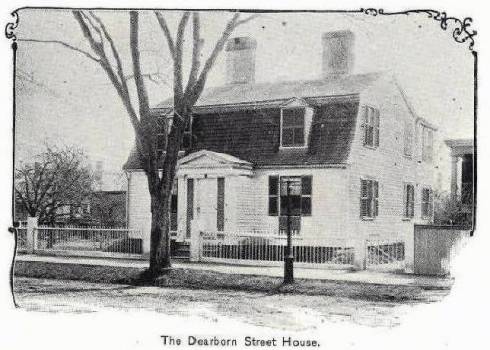
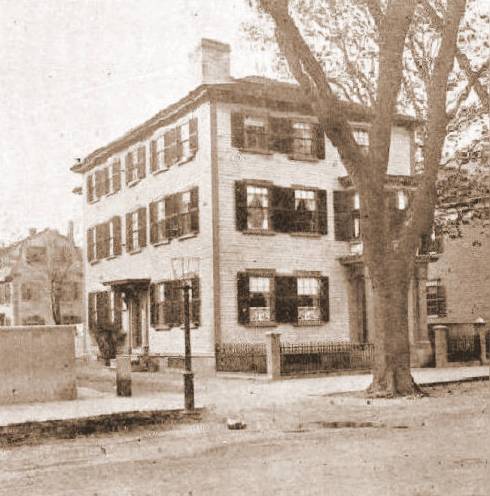
Photographs of Hawthorne’s Dearborn and Chestnut Street residences, along with the Turner-Ingersoll House before its transformation into the House of the Seven Gables (on the left above) from Winfield S. Nevins’ 1894 article, “The Homes and Haunts of Hawthorne”; photographs of the Mall Street house, the Customs House, a view towards Washington Square, the “Sockets” of Gallows Hill, and the House of the Seven Gables from Helen Archibald Clarke’s Hawthorne’s Country (1926).


High Street

Generally the “High Street” of a city or town is a main street but this is not the case with Salem’s High Street which was named, I think, because it was literally a relatively high street which looked down towards Salem Harbor. It’s a short cut-through street today, and offers an instructive perspective on Salem’s architectural developments as seventeenth, eighteenth, nineteenth and twentieth-century structures line its sidewalks. There are several really nice Georgian houses, a few Federal houses, and the first-period Gedney House, which is maintained by Historic New England as a study house. High Street was spared the obliteration by development of its neighboring street to the north, Gedney, and the obliteration by fire of its parallel street to the south, Endicott, though you can definitely see that the Great Salem Fire of 1914 cut a swath through its eastern end. Most of the street is remarkably preserved, even though in some cases it is through the fortification of asbestos siding. Unfortunately I only have a shallow understanding of the social history of High Street, but enough to know that it was the center of Salem’s African-American community in the earlier part of the nineteenth century and part of its Italian-American neighborhood a century later. That chatty diarist of the earlier era, the Reverend William Bentley, recalled an 1816 visit to “the square laying between Mill Street, High St., the Pickering Hill burying ground & the Mill Pond vulg[arly] called Roast Meat Hill. It was a mere pasture when I came to Salem. There is now a Twine factory & about 100 huts and houses for Blacks from the most decent to the most humble appearance.” (Bentley, vol 4, pp. 382-383). Less than a century later Salem’s Italian-American community built their own Catholic Church at the foot of High Street, St. Mary’s, which was closed by the Archdiocese of Boston in 2003 (you can see some of its beautiful interior here).

High Street looking up

High Street 1874 Atlas

High Street 10

Looking “up” High Street, the neighborhood in the 1874 Salem Atlas, #10, one of three Georgian Colonial houses on the street.

There are several interesting houses on High Street but I suppose the most “notable” are the aforementioned Gedney House (1665), the neighboring Benjamin Cox House (1775), and the William Fabens House (1804). If you check out the Gedney materials at the Historic New England website (which includes the 1912 photograph of the house below) you can see a gallery of wallpaper samples taken from the house, including a fragment of my favorite “tumbling blocks”. The Cox House was acquired at the same time (1967) as the Gedney by Historic New England (then SPNEA) for use as an overseer’s house and extended to the rear for that purpose. The Fabens house is one of the most unusual in Salem: it has brick sides, each with its own entrance, and a stuccoed front facade—I’m assuming the latter is a legacy of the Great Salem Fire, which passed so close to the street.Not so renown, but impressive nonetheless, is the circa 1820 house at #16, which has been stripped of its Victorian embellishments to reveal a more streamlined Federal facade.

High Street Gedney Facade

High Street Pan

Gedney House 1912 Historic New England

High Street Cox House

High Street Cox House Side View

High Street Fabens

High Street plaque

High Street no 16 collage

Historic New England’s Gedney and Cox Houses; one of the side entrances of the William Fabens House; No. 16 High Street in the 1970s and today.


Leaping Ladies on the Loose

On this quadrennial February 29, a follow-up post to one from the last leap year. I don’t have any radical new insights into the public perception of this occasion in the past, but I do see some connections and characterizations of which I was previously unaware. As before, and as usual, it was the Victorians who cemented the idea of women “leaping” outside of their conventional role at this time by proposing to their prospective spouses, beginning with Victoria herself. It was widely known that the young Queen proposed to her beloved Alfred in 1839 (not a leap year but she was Queen), and their marriage did occur in the following bissextile year. Apparently it was fine for Victoria, but such assertiveness among mere mortal women was not quite so tolerated, as Leap Year depictions became more cutting and critical in several ways as the nineteenth century progressed. Postcards were used to depict mismatched marriages: the woman is too rich, too old, too large. The “tall bride” is a consistent trope, and I think the very popular Raphael Tuck & Sons Leap Year postcard of a bride towering over her royal groom is a reference to the sensational marriage of Consuelo Vanderbilt and the Duke of Marlborough in 1895. In addition to images of brides buying their grooms, Leap Year postcards from the peak period of 1896-1916 depict women who are pushing against the constraints of their gender: women who “scorch” the streets on a bicycle or ask for the vote, women who sought to “wear the pants” not only on February 29 every four years, but on every day in every year. Ladies are pictured hunting, trapping, and hooking men in Leap Year post and trade cards up until the teens, after which milder messages predominate, most likely because of the twin forces of the First World War and women’s suffrage.

Leap Year Life 1896 Cover

Leap Year Vanderbilt Marlborough Wedding

Leap Year Gauntlet Tuck 1911-12

Leap Year Raphael Tuck

Leap Year Tuck Collage

Leap Year Brill Collage

Leap Year Card Collage

Leap Year 1908 BPL

Leap Year Text 1904p

Life Magazine February Leap Year Cover, 1896, New York Public Library Digital Gallery; Raphael Tuck & Sons Oilette Leap Year Cards, 1904-1912, from a selection here; “Cupid’s Coffin” illustration of the Vanderbilt-Marlborough Wedding by Charles Dana Gibson for Life, sourced here; George Reiter Brill Cards, Playles; Trade card and Postcards from the Boston Public Library and Smithsonian Institution.


Through the Spyglass

While watching Admiral, the lavish Dutch film about the great Michiel de Ruyter (1607-1676), Lieutenant-Admiral of the Dutch Fleet during the Anglo-Dutch Wars of the mid-seventeenth century, all I could think about was spyglasses. He had one on deck, of course, as did everyone around him, and it also seemed as if we were watching these epic naval battles through them from the shore. So in addition to seeing spyglasses on the screen, I felt like I had one, and was therefore able to get very close to this meticulously made-up world (sometimes too close–see below). Admiral is not a great film by any means (although its original Dutch version, titled Michiel de Ruyter, is probably a lot better as the English dubbing is really distracting; I would have preferred subtitles), although it is very engaging one. It’s also not a great historical film: the history is off and compressed; no one ages or is the right age.The peripheral royal characters, the foppish Prince William III of Orange and the decadent King Charles II of England, are just caricatures, but very watchable caricatures nonetheless. And fair warning: the violence is explicit as the film recreates one of the most horrifying events in European history, the lynching of Johan and Cornelis de Witt by an organized Orangist mob in 1672. I really wish I had looked away sooner. Nevertheless, for all the violence and the video-game attributes of the film, it does present an interesting corrective to the dominant British or French perspective one usually sees in historical films and the acting and material details are really wonderful. Like our founding fathers, Michiel de Ruyter is on the money in the Netherlands, so not just anyone could play him: the Dutch actor Frank Lammers was perfect. And I also started to think about naval formations for the very first time.

Admiral Film Poster 2015

Admiral Michiel_de_Ruyter_1607-1676

Admiraal_Michiel_Adriaensz._de_Ruyter_en_zijn_familie_door_Jurriaen_Jacobson_1662

Admiral Spyglasses Still

The poster for the 2015 English-language film; Ferdinand Bol, Michiel de Ruyter as Lieutenant-Admiral, 1667, Rijksmuseum; Juriaenn Jacobsz., Michiel de Ruyter and his family, 1662, Rijksmuseum; a still from the film with spyglasses.

As you can see in the contemporary paintings above, de Ruyter’s spyglass was like an extra appendage: he wields it even in the family portrait. A century or so later it will be commonplace to see admirals and sea captains pictured with their spyglasses, but this is a new composition/characterization in the seventeenth century–the telescope was invented by Dutch spectacle-makers (NOT Galileo) for maritime purposes only a few decades before the beginning of de Ruyter’s career. It’s almost like a national symbol for the Dutch Republic in the seventeenth century, when it was commonly referred to as the “Dutch Telescope”. From this time until well into the nineteenth century it’s fairly difficult to find a portrait of a sea captain without a spyglass by his side: it looks like this is yet another legacy of the Dutch Golden Age.

Some Anglo-American sea captains of the eighteenth and nineteenth centuries, spyglasses in hand:

Admiral Warren NMM

Captain Sir Edward Vernon NMM

Sea Captains nineteenth century

Thomas Hudson, Admiral Sir Peter Warren, 1748-42, National Maritime Museum, Greenwich; Francis Hayman, Captain Sir Edward Vernon (who later became an Admiral, SWOON), c. 1753-56, National Maritime Museum, Greenwich; and two mid-nineteenth century merchant captains from either side of the Atlantic: an anonymous English merchant captain, c. 1830 and portrait of Captain John Howland of New Bedford (1802-46) by an unknown artist, New Bedford Whaling Museum.


What I want now: George Washington

I have no intention of discussing current politics on my blog which is supposed to be a break from reality for me and my readers (I hope), but the rhetoric and reality of this election is really depressing me; I’ve got to get out from under its weight in the only way I know how: by going back. We need a hero! And since today is the birthday of one (the real birthday, as opposed to last week’s more generic “Presidents’ Day”), let us focus on George Washington. Now remember, I am not an American historian so I have a rather romantic view of our first president, which suits my purpose of historical escapism. My glasses are not quite as rose-colored as those of Parson Weems and his fellow hagiographers of the nineteenth-century, but I still want to see the General and the President in vivid twentieth-century color, as an example of someone who was truthful, moderate, restrained and resigned, heroic yet humble, selfless yet self-conscious, never-seeking but always-serving, and predisposed more towards action than words. Here are some twentieth-century images, in color, which capture those qualities.

parson-weemss-fable-amon-carter-museum-of-american-2

Grant Wood, Parson Weems’ Fable, 1939, Amon Carter Museum of American Art; (I do believe Washington was truthful, but the cherry tree story is still a fable created by Parson Weems–this is an amazing HISTORICAL painting). Below, the cherry tree story is integral to Washington’s depiction by Rosalind Thornycroft in Herbert and Eleanor Farjeon’s Heroes and Heroines (1933).

George Washington Thornycroft 1933

George Washington 1910 Penfield NYPLDC picture

Washington Lithograph 1930 poster

George Washinton Schuker 1920s

Washington War Bond WW

Washington Morality Poster 1974 Smithsonian

Washington from the 1910s through the 1970s: leaving Mount Vernon by Edwin Penfield, the popular General by Charles Schucker, the standard of civic duty and morality. New York Public Library Digital Gallery and Smithsonian Institution.


Miss Brooks Embellishes

I am featuring yet another new-to-me Salem artist today, Mary Mason Brooks (1860-1915), who worked primarily in watercolors over her career. Mary’s biography is spare: the obituary in the 1915 American Art Directory consists of only two brief lines: a painter in water colors, died September 20, 1915. She was born in Salem, Mass, studied in Rome and Paris; exhibited in New York and Boston, her home being in the latter city. I can fill in these lines a bit: she was born into an old and well-connected Salem family, grew up on Lafayette Street, and her father was the long-time Secretary of the Essex Institute who also published quite a few antiquarian pieces over his long career. After her training in Europe, Mary returned to Salem briefly and maintained a studio and school in the famous “Studio” at #2 Chestnut Street among her fellow Salem artists, but she was off to Boston and Jamestown, Rhode Island by her early 30s. She had both family and friends in Jamestown, located right over the bridge (then ferry!) from Newport, where an artists’ colony was emerging and where she eventually died, “suddenly”, at age 55. That’s about it for the written record on Mary Mason Brooks: her works are going to have to embellish her character for us. And there are many: it is apparent that Miss Brooks was no dilettante, but rather a professional, working artist. Most are watercolors: some European scenes, lots of flowers and trees, several structures, the occasional (appropriate for a Salem girl) ship. But the most charming–and in many ways most revealing–work of Miss Brooks that I could find is a book illustrated by her after its publication: a one-off edition of Eleanor Putnam’s Old Salem (1886 & 1899). This charming little book is a collection of previous-published Atlantic Monthly articles written by Harriet Leonora Vose Bates, who preferred to use the pseudonym of her ancestor Eleanor Putnam, published posthumously in two editions. It is basically a series of reminiscences about the stuff of old Salem—shops, schools, homes and things–which Miss Brooks illustrates in her special edition.

Miss Brooks Embellishes Old Salem

Miss Brooks Embellishes Old Salem Collage2

Miss Brooks Embellishes Old Salem Collage

I think it’s pretty gutsy to illustrate a book after its publication, and after its author’s death! And to sign your name right there on the title page! Miss Brooks probably thought her special edition would never see the light of day, but it made its way on to ebay, of all places, a century after her own death. I like the marginalia, which transforms a charming but mere book into something else entirely, but I also feel that I should present some of the artist’s more formal works which were represent her public oeuvre. They testify to a life well-lived, if short, in some beautiful places.

Mary Mason Brooks Salem Schooner

Brooks Garden Poppies

Brooks 3 Viewsp

Mary Mason Brooks watercolor Weston Historical Society

Watercolors by Mary Mason Brooks: Lumber Schooner; Garden of Poppies, Isles of Shoals; Three European Views, Skinner Auctions; and my favorite, a watercolor of the pool at Haleiwa, the Horace Sears Estate in Weston, Massachusetts, Weston Historical Society.


Ever in Transition

The tensions between public and private interests, commercial and residential concerns, and historic preservation and economic growth are nothing new to Salem, which has always been a dynamic city proud of its past and poised for the future. Some eras are more dynamic than others, however, and I think we’re in a particularly dynamic period now, but any city or town or settlement is always in transition, of course. When I hunt for historic photographs I’m always on the lookout for the mix of “ancient” and “modern”, residential and industrial, small-scale and larger, dirt roads and railroad tracks. My very favorite visual chronicler of Salem, Frank Cousins, who was himself living through a very dynamic age, was clearly attracted to that mix as well, as one of the photographs that he submitted as part of Salem’s exhibition at the 1893 Columbian Exposition was that of a divided Derby Street doorway labelled “modern” and “colonial” (A subtle distinction for our modern eyes).

In Transition Cousins 1892 Columbian Exposition

Frank Cousins photograph of a Derby Street doorway, c. 1892, courtesy of Duke University’s digital Urban Landscape collection.

More illustrative of the city in transition, as opposed to a co-joined household, are the many pictures of Town House Square that date from the 1880s to about 1910. There you see predominantly brick multi-story commercial buildings, but if you look closer, there are still some surviving wooden residential structures (although they are probably serving a multitude of uses). For several years, I have had in my possession a stereoview of a building labeled “Ward-Goldthwaite & Co. Salem” which I thought might be one of these structures, only to realize that I had made a rookie historian’s mistake (not questioning a label): the Ward-Goldthwaite Company was located in Chicago, not Salem (even though it was published by the Moulton firm of Salem). Nevertheless, it’s a great image of a city in transition: you know that house isn’t going to last long.

In Transition Cousins Town House Square 1892 LOC

In Transition 1906 LOC

Stereoview Ward Golthwaite Co Salem

Town House Square at the intersection of Essex and Washington Streets, Salem, (Library of Congress) and a stereoview of the Ward Goldthwaite & Company in Chicago published by J.W. and J.S. Moulton of Salem as part of their “American Views” series.

The idea of zoning starts to catch on in Salem after 1900, and it was definitely accelerated by the Great Salem Fire of 1914. But before this momentous event, factories and residences co-existed in close proximity in the Point, Blubber Hollow and even the more residential North Salem, where the large Locke Regulator Company bordered the North River and a line of colonial houses on North Street. Some of the houses are still there, serving mixed uses as they did a century ago, while the Locke factory has been replaced by a junkyard and a car wash. The streets along Salem Harbor have always been among the most densely settled in Salem, but the 1903 photograph seems to show structures which are primarily residential–I’m not sure of the precise vantage point, but I’m assuming these buildings were all swept away by the Fire. The last photograph, from the PEM’s Phillips Library, shows fire bystanders watching the conflagration on Lafayette Street from the roof of a building on Highland Avenue: a view of mixed-used zoning with the new High School, the factory, and residences all in close proximity to one another. Highland Avenue became a preferred location for commercial development over the twentieth century, but as this photograph indicates, residences were built along it as well–and a few older structures, drastically transformed–still stand among the big box stores.

In Transition North Bridge 1890s

Salem 1903 Locomotive's Journal

phillipslibrarycollections.pem.org

Looking north along North Street from the old bridge, 1890s, Boston Public Library; A Perspective on Salem Harbor, 1903, Brotherhood of Locomotive Engineers Monthly Journal, September 1903; Watching the Great Salem Fire from Highland Avenue, 1914, Phillips Library, Peabody Essex Museum