Category Archives: History

A Bigger Picture for Bridge Street

I have been watching and listening to the public hearings over the proposed redevelopment of the former Universal Steel and Trading Corporation site on Bridge Street with great interest and concern. The site is located adjacent to a distinctive late nineteenth-century factory building owned by the F.W. Webb Company, a large distributor of plumbing supplies, which seeks to abandon this same building and build a new (far less distinctive) showroom and sales facility next door. Objections to the proposed building could be based on its rendering alone–it’s the typical glass and faux-brick generic building that we’re seeing everywhere and anywhere–but there are several other key factors which make this project troubling and controversial. The site is also located adjacent to the northern boundaries of the McIntire Historic District, in close proximity to the well-preserved colonial and Federal houses of Federal and River Streets. The owners of these houses do not want a large commercial building (the actual elevation of the proposed structure is a matter of debate) casting a shadow over their streets, and the intensity of their opposition has been fueled by the fact that they believed that the long planning process resulting in the creation of the “North River Canal Corridor” a decade ago ensured that more creative uses for this area would be pursued. The second factor is the contamination of the site and the costs and consequences of cleaning it up. The property was transferred to the city of Salem after Universal Steel ceased operations, and the city requested aid from both the EPA and the Massachusetts DEP to conduct a partial clean-up, which involved the removal of over 4,000 tons of contaminated soil. After this process, the city paved over the site to create a temporary parking lot while the new MBTA garage was being built. Once that project was completed the city sought a more profitable use for this parcel–and F.W. Webb put forward the only proposal. The new construction will require a more comprehensive clean-up, and the costs and potential health threats of such an invasive process are a matter of concern to everybody, but especially those in the adjacent neighborhood. A third major factor is the transfer of an “ancient way” from public ownership and use to Webb: Beckford Way, in existence from the seventeenth century, which will be transformed from public pedestrian path to private truck access and loading dock. Opponents of the Webb proposal ask (quite logically I think): if the Company is going to abandon its present building altogether, why doesn’t it relocate to a section of Salem that is dedicated exclusively to commercial uses and leave our neighborhood–and our way–intact?

Big Picture Bridge Street

UniversalSteelTradingCorpSite EPA

Bridge Street Salem January

Beckford Way

Aerial view of the site of the proposed new F.W. Webb building, marked by the X; the initial clean-up in 2012, with River Street houses in the background, EPA; these same houses last month (before our recent snow) looking over the temporary parking lot and reflected in the North River; Beckford Way.

You can read a more detailed summary of the project here, and also peruse project documents. The narrative presents a decidedly pro perspective, but you can easily discern the debate in the FAQ section. We’re in the midst of the process: already the City Council has held two public hearings on the project and there are more to come. As I intimated above, I’m very sympathetic to the concerns of my McIntire District neighbors (and believe the present Webb building would make fabulous housing given its proximity to the train station) but am also striving to widen–or elevate–my perspective, inspired by both a phrase I heard repeatedly at the first public meeting—“spot zoning”—as well as one of the more thoughtful observations of the night, expressed by an earnest River Street resident: Salem’s fabulous history and outstanding architecture is constantly at risk from unsound planning. These words resonated with me immediately as I feel that way all the time: our city’s piecemeal planning has led to undistinguished architecture, unlimited accommodations, and unceasing divisiveness, and it will continue to do so until we can all look at a bigger picture. Salem is hardly the only historic city facing myriad redevelopment challenges and opportunities at the moment: why can’t have a more comprehensive and proactive plan rather just reacting, reacting, reacting? Look at the example of our neighboring seaport to the north, Portsmouth, NH, which is pursuing “character-based zoning” (which must surely be the antithesis of “spot zoning”) by plotting out its development goals and proposals in “textured” 3D models that are available to the public on a web portal, so that everyone can see what proposed buildings will look like, in context and as part of a whole. We don’t even seem to know the actual height of the proposed Webb building on Bridge Street, much less how it will look in relation to its neighboring buildings (but I’m thinking, not good).

3DPortsmouthLead_920_557

3DPortsmouth1

Webb building

Plan Portsmouth 3D Model/Developed by Tangram 3DS;  our only view of the proposed Webb building.

Hard-Pressed Hearts

The heart assumed its modern form by the Renaissance but its symbolic meaning was still more sacred than secular: it represented faith more than mere mortal love. And much more so than love, faith must be schooled and tested in order to strengthen: consequently hearts in emblem books from the sixteenth and seventeenth centuries feature hearts that are not only broken but chained, beaten, scourged, wounded, pierced, and set on fire, mimicking and memorializing the suffering of Christ and his love. The heart is hardly the only featured symbol in emblem books, which were incredibly popular in the sixteenth and seventeenth centuries when print accommodated a semi-literate population, but it was certainly a prominent one. Emblems were made up of three components: a title or motto (inscriptio), an image (pictura) and an explanatory text in either prose or verse (subscriptio), and the combination of words and pictures could appeal to a wider audience.Some titles become standardized, included The school of the heart, or, The heart of it self gone away from God, brought back again to him, and instructed by him = in 47 emblems, a very popular English emblem title. My alternative Valentine’s Day hearts are from an Italian variant of the School of the Heart: Francesco Pona’s Cardiomorphoseos Sive Ex Corde Desvmpta Emblemata Sacra (1645). Pona’s illustrations are just a bit more….charming than those in the other books of this genre, if you can call an image of cupid carving up a heart charming! So here you see the origins of today’s cute Cupid with his bow: tough love, indeed.

garlandp Pona 1p Pona 2p Pona 3p Pona 4p Pona 5p Pona 6p Pona 7p Pona 8p Pona 9p Pona 10p Pona 11p garlandp

The Heart emerges whole and strengthened from its Trials and Travails, preparing one to ACT COURAGEOUSLY. Mottoes and images from Francesco Pona’s Cardiomorphoseos.


Bits of Bosch

I show a lot of art in my classes but most of the time the images are serving as mere backdrops for the era or issue I am discussing rather than the focus of our collective attention. This is due to the fact that I am historian, rather than an art historian, so art is primarily illustrative for me, and I also find that many paintings (apart from portraits) require a great deal of explanation and elaboration–time that I just don’t have–so I use them to evoke the past rather than explain it. When I do focus in on a painting, and spend some time with it and on it, it’s usually the details on which I dwell. For this reason, I am absolutely enraptured with this amazing high-resolution zoomable “interactive documentary” of The Garden of Earthly Delights (c. 1490-1510) by Hieronymus Bosch. You can–I did–spend hours zooming in on every little detail: strange and familiar animals, birds big and small, large strawberries and tempting apples, grotesque figures, wanton entanglements, horrific punishments, bewildering vignettes. You can acquire an intimate knowledge of the painting, much more intimate than could ever be possible any other way (even by examining it in person at the Prado where the whole overwhelms the parts). You can “take” an audiovisual tour if you like, or just wander around on your own in silence, zooming and opening up helpful notes as you move from place to place. And you can go back, again and again and again. As the Garden of Earthly Delights is a triptych, so too is this particular presentation: it is part of a “transmedia triptych” which also includes a documentary film, “Hieronymus Bosch, Touched  by the Devil” and the “virtual reality documentary” “Hieronymus Bosch, the Eyes of the Owl'”.  You can check out all three projects here.

A few bits of Bosch, starting with my own triptych of his favorite owls: an elephant, mouse in a tube, hedgehogs or porcupines, coupling in a mussel shell and moving into hell, the dreaded knife between the ears, strange music, the mirror reveals all, hanging through a key.

Bosch Owls

BoschElephant

Boschmouse

Bosch Hedgehogs

BoschShell

Bosch Ears

BoschButt

Bosch Mirrorp

Bosch Keyp

The entirety here.


The Wayfaring Chapel

To stick with cinema for just a bit, I’ve always believed that those in Salem who favor the maritime over the witchcraft in terms of tourism focus are handicapped a bit because Salem was not a whaling port like New Bedford. Merchants are simply not as dashing and courageous as whalers; there is no Hawthornian equivalent of Moby Dick. When I think of the latter, I must admit that images from the 1956 film come to mind much more quickly and vividly than detailed passages from the 1851 book, and the very first image that comes to mind is the passionate preaching of Father Mapple (Orson Welles) from that amazing pulpit shaped like the bow of a ship in a seamen’s chapel, or Bethel, packed with mariners. Both the preacher and the place were based on reality; in the case of the former, the “Mariner’s Preacher” of the Boston Bethel, Edward Thompson Taylor, and the Bethel was based on that of New Bedford, which is still standing (its original pulpit was not the elaborate one depicted in the film, but a similar one constructed to satisfy the tourists who made their way to New Bedford in increasing numbers due to the popularity of the film–a version of Salem’s Samantha statue).

Bethel

Bethel Collage

Orson Welles in John Huston’s Moby Dick (1956); The New Bedford Bethel or “Whaleman’s Chapel”, exterior and interior.

Like nearly every seaport of a certain size, Salem had a Seamen’s Bethel too, but it was a wandering one. It clearly existed in the early part of the nineteenth century (there is an extant sign, and several references to a chapel at the head of Phillips Wharf), but was reincarnated later on. The French Catholic parish, St. Joseph’s, purchased an old Bethel on Herbert Street in 1873, and then it turns up in two locations on Turner Street: first right on the water in the House of the Seven Gables’ front yard, and then alongside it on the street. A large bequest by Captain Henry Barr funded the construction of this later building in 1890-91, but a decade later newspapers across the country were commenting on Salem’s fading maritime glory, testified to by the fact there were simply not enough sailors in Salem to attend services in this new Bethel; consequently the YMCA took over the building in 1911. By the 1920s it was moved to another location on Turner Street to accommodate the expanding House of Seven Gables Settlement Association, and by the 1930s it was gone. The last picture of the Bethel below, taken by the Boston-based architectural photographer Leon Abdalian in 1929, was probably more notable for the blimp than the Bethel at the time!

Seamen's Bethel Salem on Water

Bethel on Turner

The Salem Seamen’s Bethel, 1914 and 1929, Boston Public Library.


One Photograph and Three (?) Mantels

Today I am featuring another lost Salem house that we can only “see” in the form of its surviving pieces and photographs–only one photograph, really, which I presume was taken just before it was demolished in 1856 to make way for the Salem Athenaeum’s new Plummer Hall (now part of the Peabody Essex Museum). This is the Nathan Read House (1793), designed by Samuel McIntire for a man who was not a Salem merchant and/or shipowner but distinguished himself nonetheless, as an entrepreneur and the inventor of such diverse machines as a steamboat with paddles, a nail-cutter, a self-winding clock, and a coffee-huller, as well as a congressman and judge. Read’s house was McIntire-made but Bulfinch-inspired and it is reminiscent of another Essex Street house that is no longer with us: the Ezekiel Hersey Derby House further along Essex Street–Salem’s commercial “high” street was too dynamic and valuable for residences, even ones as lovely as these. It’s a miracle that the Gardner-Pingree House survived. The Read House was short-lived but pretty imposing while it lasted.

Read House Salem MA

The Nathan Read House (1793-1856).

In 1799, Read sold the house to Captain Joseph Peabody, a very wealthy Salem shipowner, and eventually decamped for Maine. For the rest of its existence, the Read House remained in the Peabody family, who eventually sold it to the shareholders of the Salem Athenaeum. Joseph’s son Francis dismantled several McIntire mantels from the house before its demolition, and installed them at his summer house in nearby Danvers, the eighteenth-century “King” Hooper mansion, better known as “The Lindens”. There they remained until the 1930s, when the Lindens itself was dismantled, shipped to Washington, D.C. in pieces, and reassembled in the Kalorama neighborhood of the District. The intermediary (and short-term owner of the Lindens) in this transaction was up-and-coming antiques dealer Israel Sack, who arranged for the house to be measured and photographed by HABS architects and also sold some parlor paneling to the Nelson-Atkins Museum of Kansas City: the mantels appear in the HABS photographs (but looking quite different from previous photographs!) but not in the collections of the Nelson-Atkins museum, and they certainly don’t seem to be down in Washington (where the house is now for sale), so I’m not really sure where they are. The whole is demolished, but the parts are scattered: a not-uncommon Salem story!

McIntire Mantels Collage

McIntire Mantels HABS

Lindens Listingp

Lindens Living Room AD

Above: McIntire Mantels at the Peabody Essex Museum (upper right) and installed at the Lindens, Danvers, from Cousins’ and Riley’s Woodcarver of  Salem (1916) and Arthur Haskell photographs, 1934, Library of Congress. Below: the Lindens in its current Washington, DC location from its current listing, and its living room from January 2014 Architectural Digest. No McIntire mantel here!

See a related house story at the great blog Stories from Ipswich.


Anglo-Americana at Auction

There’s quite a bit of buzz here in Salem about a particular lot in an upcoming “Printed and Manuscript Americana” auction at Swann Auction Galleries: #84, a hitherto unknown edition of the Bay Psalm Book with Salem connections. It caught my attention a few weeks ago because of its importance in printing history, but of course the headlines here in Salem are all about its connections to the Witch Trials of 1692: it was owned by one of the judges, Jonathan Corwin and his wife Elizabeth, and later passed into the family of one of the trial’s victims, John Proctor. His descendants have held on to the book (which they apparently called “the witch book”) for over a century and are now parting with it. I wonder if its estimate of $30,000-$40,000 is due to its bibliographic importance or its ties to Salem? 

Anglo Americanap

I think it’s the former but I could be wrong. Two years ago, a copy of the first edition (1640) owned by the Old South Church in Boston set a new world record for a printed book at a Sotheby’s New York auction when it sold for $14, 165.000. The estimate for this newly-discovered seventh edition might be low.

No doubt the Bay Psalm Book will be the star, but several other items in this auction caught my attention: a first edition of one of the most important–if not the most important–early histories of English exploration, Richard Hakluyt’s Principall Navigations, Voiages and Discoveries of the English Nation (1589), a really neat anthology of shipwrecks and maritime disasters titled God’s Wonders in the Great Deep, or, a Token for Mariners (I am very slowly writing a book on wonder in early modern England and I had not thought of it in this way before–as deliverance from disaster), an engraving of a sketch made by British spy Major John André on the morning of his execution illustrating his voyage to meet Benedict Arnold (I’ve always had a thing for André), and last but not least, the expansive diary of a young Vermont woman named Elizabeth Houghton, including recollections from 1820 to 1836 and an AMAZING vernacular drawing of two women dressed in WILD “regency” dresses. Quite a treasure trove, this Anglo– Americana auction.

Anglo American Hakluytp

Anglo Americana Wonderp

Andre on the Hudson

Diary Dressesp

Lots from Swann Auction Galleries Printed and Manuscript Americana Auction, February 4, 2016: #84, an unknown 7th edition of the Bay Psalm Book; #152, a first edition of Hakluyt’s Principall Navigations; #177, God’s Wonders in the Great Deep (1731);#29, an engraving of Major André’s last drawing; and #270, Elizabeth Houghton’s Diary.


The Most Poignant Epitaph Ever

The Old Burying Point is a sacred site best visited in the winter, or the summer, or the spring, or anytime other than October when costume-clad tourists are not draped over the graves taking pictures of each other. I prefer winter, because the very gnarly trees are bare, and nothing other than these same trees competes with the graves themselves. I was walking by the other day, thinking about the very recent death of a young scholar whom I knew, when I remembered a famous epitaph on a seventeenth-century grave of another young scholar: Nathanael Mather, son of Increase, and brother of Cotton. Nathanael died in Salem in 1688 at aged 19 and his grave is located on the western perimeter of the cemetery, just behind the Peabody/”Grimshawe” house. I went through the gate, turned right, and there he was, there it was, the most poignant epitaph ever.

Epitaph 026

Epitaph 030

An Aged person/ that had seen but Nineteen Winters in the World.

An Aged person that had seen but Nineteen Winters in the World is a sentiment that is immediately and universally affective, and timeless: as moving now as it was when it was inscribed in 1688 (or later? see below). There are testimonies to these words that date back to the early nineteenth century; no doubt there are far more that I am aware of. Hawthorne incorporated a similar epitaph into his first novel Fanshawe for the title character (one imagines him sneaking out back before or after he visited his future wife Sophia at the Grimshawe house) and Lovecraft referenced it a century later. In between, my favorite photographer Frank Cousins gave it pride of place in a portfolio of Salem images which he marketed nationally.

Epitaph Cousins 1890s 2p

Epitaph Cousins 1890sp

The Grave in the 1890s

And what of Nathanael, the inspiration for this memorable epitaph? By all accounts he was a young man feverish with the desire to learn, both for his own sake and as way to know and glorify God, and this “fever” ultimately killed him. His “unusual industry” drove him to enter Harvard University at age 12, and during his time there he mastered Latin, Greek, and Hebrew and wrote several books. His “pious education” continued after his graduation, and he followed a disciplined regime of constant study and prayer which rendered him a virtual shut-in. Real fevers set in, and “distemper”, and ultimately he was sent to Salem as a patient of Dr. John Swinnerton, at whose home he eventually died. His elder brother Cotton Mather, who apparently “closed his dying eyes” wrote later that it may be truly written on his Grave, Study kill’d him. In his Diary, Samuel Sewall recounts visiting Nathaneal at Dr. Swinnerton’s and, quite perplexingly, an alternative epitaph: the Ashes of a hard Student, a good Scholar, and a great Christian, which is also asserted in Cotton Mather’s Magnalia Christi Americana. So now we have an epitaph mystery: are both Sewall and Mather mistaken, or do we have an instance of an “enlightened” epitaph substitution at some later date?

Epitaph 038


Animal Adaptations

I don’t think I will ever tire of anthropomorphic animals, no matter how old I get. This weekend, to mark National Handwriting Day (not really, but any excuse to shop), I purchased a print of a letter-writing fox from the Litus Gallery, and then went back for more. The very dynamic discussion in response to my Samantha statue post last week referenced the word “whimsical” several times, so I wanted to reorient myself to that word and sense and to me, these works are most definitely whimsical, fanciful, even dreamy. But beyond the aesthetics, many of the Litus images (as alluded to by their titles) are also referential: the title of my fox is “Michael Drayton writing the Second Part of the ‘Poly-Olbion’, Fleet Street, 1617 and I also purchased a print of a clerk-like cat titled “John Selden leaving Hare Court, Inner Temple, August, 1614.” I don’t think that either the poet or the jurist was painted in these situations, but other examples of the Gallery’s work are based directly on particular paintings. I thought it would be interesting to match up the originals with the adaptations. The differences are not hard to discern!

Fox Writing Letters

Animal Adaptations Collage 1

Animal Adaption Collage 2

PicMonkey Collage 3

PicMonkey Collage 4 Rembrandt

Animal Adaptation Collage 6 Blake

Animal Adaptations Collage 5

Weighing the Fruits after Jan Vermeer’s ‘Woman Holding a Balance’; Johannes Vermeer, Woman Holding a Balance, 1664, National Gallery of Art, Washington, D.C./ The Turnip Spinner (After Chardin’s ‘Gabriel Godefroy watching a top spin’/ Jean-Siméon, Portrait of the Son of M. Godefroy, Jeweler, Watching a Top Spin, c. 1735, The Louvre/ The Eight Lives of Mr. Tybalt (after Nicolaes Eliaszoon’s ‘Portrait of Nicolaes Tulp’; Nicolaes Eliaszoon Pickenoy, Portrait of Nicolaes Tulp, 1633, Stedelijk Museum, Amsterdam/The Book-Keeper (after Rembrandt’s ‘Young Man at His Desk,’); Rembrandt, Scholar at his Desk, 1631, Hermitage Museum/ I want, I want, after William Blake; William Blake, “I want, I want” from For Children: the Gates of Paradise (1793)/ Il Ladro di Fragola (after Jean Baptiste Chardin’s ‘Basket with Wild Strawberries’; Jean Baptiste-Simeon Chardin, Basket with Wild Strawberries, 1731.

All Animal Adaptations available at the Litus Gallery.


The Fount of Penmanship

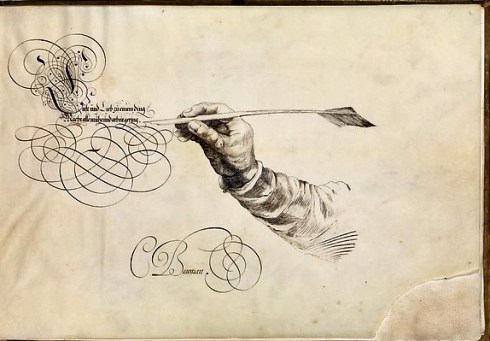
I don’t usually subscribe to those specially-designated days–you know, Boston Cream Pie Day or Talk Like a Pirate Day–preferring the old saints’ days of yore with all of their associated traditions and folklore, but I am acknowledging National Handwriting Day today simply because I like the written word almost as much as I like the printed one, and scripts almost as much as fonts. And I fear penmanship might be on its way out. This Day was established by an entity with a vested interest, the Writing Instrument Manufacturers Association, all the more reason to ignore it, but they chose John Hancock’s birthday as the day and I welcome any occasion to acknowledge Mr.Hancock, one of my favorite founding fathers. I learned a lot about penmanship pedagogy a few years ago when I fell in love with a calligraphic cat and plunged myself into the world of nineteenth-century American writing manuals, but now I think the seventeenth century is a more important era in the development of writing instruction, at least in England. Influenced and inspired by continental influences like Jan van den Velde’s 1605 book, Spieghel der Schrifkonste (Mirror of the Art of Writing), English writing became penmanship, separated from “orthography” or grammar, segregated into a variety of hands and scripts, standardized through the dissemination of a succession of manuals and “copy books”. All those Victorian flourishes and calligraphic creations? Old news.

Mirror of the Art of Writing after 1620 met

Mirror of the Art of Writing 1605

MartinBillingsley-ThePensExcellencie-1618

Above: writing samples from the early seventeenth century: a 1620 pen-in-hand engraving after Jan van den Velde, c. 1620, Metropolitan Museum of Art; a page from van den Velde’s influential Mirror of the Art of Writing, c. 1605; and title page of Martin Billingsley’s  The Pen’s Excellencie, or The Secretaries Delight (1618).

Below: in the later seventeenth century, it was all about “Colonel” John Ayres, master of a writing school in St. Paul’s Churchyard “at the sign of the hand and pen” in London, and the author of a series of copy books published in many editions between 1680 and 1700, including The Accomplish’d Clerk or Accurate Pen-man and The New A-La-Mode Secretarie or Practical Pen-Man (both 1682-83).

Ayres_John-The_accomplished_clerk_or_Accurate-Wing-A4298-1472_08-p2p

Ayres_John-The_accomplishd_clerk_regraved-Wing-A4299-1376_05-p19p

Ayres_John-The_new_alamode_secretarie_or_Practical-Wing-A4303B-1805_05-p1p

Ayres_John-The_new_alamode_secretarie_or_Practical-Wing-A4303B-1805_05-p16p


John Dee, Renaissance Man

The first ten or so years of my teaching career I would bring up John Dee (1527-1609) in one of my classes–he’s relevant to most of them really, whether it’s English history, or Atlantic history, or my courses on the early modern witch trials or the Scientific Revolution–and my students would look perplexed:  who? Once I told them a bit about the “Arch-Conjurer of England” they definitely wanted to know more, but they had no prior knowledge. That all changed about a decade ago when the first book in Michael Scott’s adolescent novel series The Secrets of the Immortal Nicholas Flamel was published, which features John Dee as a central character (Joan of Arc, Machiavelli and Shakespeare also show up as the series unfolds): now I’ve got a generation of students who know all about John Dee, or at least they think they do: in any case, the stage has been set.

(c) Wellcome Library; Supplied by The Public Catalogue Foundation

Anonymous English Artist, John Dee, c. 1594. Wellcome Library; Supplied by The Public Catalogue Foundation

For me, Dee represents one of the last generations of men who could pursue “magic” and “science” at the same time: his life’s work represents just how blurry the line was between these two endeavors in the sixteenth century. He’s also a great example of the multi-faceted Renaissance Man, or at least an English example thereof. It’s really difficult to confine Dee’s interests and activities to a short blog post, but I’ll try: he was first and foremost a mathematician, but this foundational field drew him into so many others: astrology, astronomy, alchemy, geography, cartography, linguistics, cryptography, optics. He started out his professional life, while still in his teens, as an academic, but clearly sought to be a courtier, and enjoyed a close relationship with Elizabeth I, who at one point called him “hyr philosopher”. This connection gave him security, prestige, and influence, which he used to advocate for a stronger imperial policy for England; indeed he is generally credited with coining the term “British Empire”. It must have enriched him too, as he spent considerable money (and time) amassing a huge library which he installed at his primary residence at Mortlake, just outside London. He was an avid manuscript-hunter, pursuing and collecting all written knowledge on “high” (learned) magic, predominately alchemy and cabalism. But written, human knowledge was never enough for Dee: he came to believe that all of his questions could be answered only by beings of a higher order: angels. His pursuit of communion with the angels ultimately drove him down a path that threatened both his livelihood and his reputation, as a Renaissance magus practicing learned, “white” magic had to be very careful not to cross the line into the “black” arts of divination and necromancy in this age of intensive witch-hunting. Dee died a natural death, but lost his fortune, and his complex character was reduced to that of Prospero and Dr. Faustus by his contemporaries Shakespeare and Marlow.

(c) Wellcome Library; Supplied by The Public Catalogue Foundation

The Victorian View of Dee as Conjurer: Henry Gillard Glindoni (1852-1913), John Dee Performing an Experiment before Queen Elizabeth, c. 1880,Wellcome Library; Supplied by The Public Catalogue Foundation. Apparently the skulls in the original painting were painted over at some point!

Modern scholars (as well as authors of adolescent fiction) love Dee and have restored much of his complexity, but it is a difficult task to reconcile the scientist and the spirtualist. And now there is a new exhibition of materials (and instruments) from his own library at the Royal College of Physicians Museum in London: Scholar, courtier, magician: the lost library of John Dee. Perhaps this is an opportunity for Dee to “speak for himself”: the RCP website states that: “Our exhibition explores Dee through his personal library. On display for the first time are Dee’s mathematical, astronomical and alchemical texts, many elaborately annotated and illustrated by Dee’s own hand. Now held in the collections of the Royal College of Physicians, they reveal tantalising glimpses into the ‘conjuror’s mind’.” I’m bringing students in my Tudor-Stuart class over to London during spring break this year, and this is on my itinerary–I think we can build on Nicholas Flamel a bit.

johndeemagic02-768x512

johndeemagic06-768x512

johndeemagic09-768x802

John Dee’s own illustration of a page of the complete works of Cicero. (‘Opera,’ published Paris, 1539–1540) (© Royal College of Physicians / John Chase);  A horoscope chart scribbled in the lower margin of Claudius Ptolemy’s Quadriparti, Venice, 1519 (© Royal College of Physicians / John Chase); another great Dee doodle of three bearded faces in the margin of a treatise on alchemy (Arnaldus de Villanova, ‘Opera,’ published Venice, 1527) (© Royal College of Physicians / Mike Fear). You can see more items from the exhibition here.