Category Archives: History

Cabin in the Sky

The evening before last I was incredibly privileged to be able to attend a gathering in a ship’s cabin at the top of the Hawthorne Hotel. Not an actual cabin of course, but a rather convincing model, built for the Salem Marine Society in the 1920s as a condition of the sale of their building to the developers of the hotel. The Society, which was founded in 1766, had met continually at this location since 1830, and while its members do not seem to have been particularly attached to their Italianate Franklin Building (which replaced the earlier McIntire Archer Block, destroyed by fire in 1860), they were very attached to the site. And so the new hotel opened in 1925 featuring not only six stories and the latest accouterments, but also a rooftop cabin room, inspired by the actual captain’s cabin of one of the last great Salem East Indiamen, the barque Taria Topan. This cabin in the sky also represents the fruitful collaboration between the barque’s one-time commander, Captain Edward Trumbull, and the architect of the Hawthorne, Philip Horton Smith. It remains the private meeting room of the Salem Marine Society and their occasional guests, of which I was fortunate to be one.

Salem Marine Society Cabin HH

Cabin Room HH

SMS Cabin Interior

Hawthorne Hotel Buildings Collage

Cabin HH Exterior

Nathaniel Bowditch presides over the Salem Marine Society’s cabin at the top of the Hawthorne Hotel, the evolution of construction on the spot, from Samuel McIntire’s Archer Block (completed by 1810) to the Franklin Building (built after 1860) to the Hawthorne Hotel (built in 1925); X marks the spot of the rooftop cabin.

I was so excited to be in this space that I was a bit frenzied and not very good company, I’m afraid. I just wanted to see and capture everything. My skittishness was compounded by the fact that it was an absolutely beautiful early evening, and the ship’s cabin opens up onto an equally enticing (on such a day) ship’s deck, affording amazing views of Salem in every direction. Up in the air, surrounded by water on three sides, Salem’s original maritime orientation is all too apparent: the next time someone complains to me about how inaccessible is, I’m going to tell them to take a boat.

View of the Harbor from HH

View of Salem Common

View of Essex Street from Rooftop

But all those dashing sea captains were back inside, hanging from the teak-paneled walls in the form of portraits (alongside navigational instruments and paintings of ships) and encased in the Society’s registry of masters, a vast compendium of faces from 1766 to the present. I could have spent hours with this volume, gazing at all these drawings, paintings, silhouettes, and photographs of men and (finally!) women. There are so many ways you could use this source: it’s not just a record of maritime history, but also genealogy, social history, military history, even fashion history. Hats, no hats, hats, no hats.

Captain Abbot

Captain Fisk of Salem

Captain Collage

Captains Collage

Captain Fillebrownp.

Captains Abbot, Fiske, Chipman, Millet, Ward (clockwise), Tucker (right) and Webb, masters and members of the Salem Marine Society; a 20th century portrait of Captain John Fillebrown, who served in the War of 1812 and died a prisoner of war at Dartmoor Prison in England, along with 270 other Americans.

There were stories to be found in the cabin as well. The most apparent and dramatic one concerned the status of the Society’s very first honorary member, Matthew Fontaine Maury, Commander in the U.S. Navy and the first superintendent of the U.S. Naval Observatory. Despite his maritime magnificence, Maury was a Virginian and so not eligible for membership in the Society, but its membership honored his achievements by bestowing an honorary membership on him in 1859 and hanging his portrait on the wall of their original rooms.Two years later, after Maury resigned his commission and joined the Confederacy upon the start of the Civil War, the Salem mariners rescinded his membership, condemned him as a traitor, and placed his portrait head down and against the wall. This “reverse orientation” remains to this day, though a visiting delegation of the Mary Washington Branch of the Association for the Preservation of Virginia Antiquities gifted the Society with another image of Commander Maury in 2008, which hangs alongside the reversed portrait. And so now, in the words of the southern Commander, “All is Well”.

Salem Marine Society Cabin Interior

Sticken from our rolls


Preparing to Paint

Is there anything more engaging than an artist’s sketchbook? Or even a notebook with a few sketches in it? I suppose the end product doesn’t have to be visual, it’s the insight into that conception/creation/ working it out process that I’m interested in, but imagery tends to be far more accessible, of course. I use Leonardo’s notebooks extensively in my Renaissance, Scientific Revolution, and early modern courses, and students are immediately engaged, entranced even, far more than they are when I show them the finished product. It’s interesting to see the wanderings of a very fertile mind in his case, what inspired him and what he also had to work out: perspective, motion, hands. Most of Leonardo’s sketches never made it onto canvas; once a particular challenge was overcome he moved on to the next one, but the sketchbooks of more (focused, disciplined, on-task???? it’s hard to compare Leonardo negatively to anyone) artists illustrate the progress from page to paint: those of Claude Monet immediately comes to mind. But again, it doesn’t have to be about images. The sketchbooks of  Massachusetts artist Alvan Fisher (1792-1863), a pioneer in American landscape, genre, and “view” paintings, gives us insights into his preparation for one of the first views of Salem from “Gallows Hill”, a scene that would be imitated time and time again over the course of the nineteenth century. Fisher jotted down notes about the Salem Witch Trials in his sketchbook, indicating that his inspiration for the Salem painting was not just the view he saw before him, but the events that brought him to this particular place.

Fisher View of Salem from Gallows Hill

Fisher Sketchbook no 5 1824

Alvan Fisher’s View of Salem from Gallows Hill (1818), Collection of the Peabody Essex Museum, Salem, and Sketchbook no. 5, containing notes about the Salem Witch Trials, Museum of Fine Arts, Boston. With the recent validation of Proctor’s Ledge below rather than Gallows Hill above as the 1692 execution site, it occurs to me that the inspiration for this famous “view” is based on a falsehood! Indeed, I think that the figures in the foreground are sitting on THE ledge. But clearly a perspective from that point would not be as revealing of the city below.

From what I can see, most of the sketches in Fisher’s notebooks in the Museum of Fine Arts contain more conventional preparatory sketches: houses, hills, streams, animals. Creatures, particularly creatures in motion and even more particularly birds, seem to captivate artists for centuries, from Leonardo to Salem’s most famous artist, Frank Benson. Browsing around sketchbooks which have been digitized (especially those included in this archived exhibition at the Smithsonian’s Archives of American Art), I can’t tell which is more captivating to me: individual sketches or the entire sketchbook, the works themselves or the works in progress. 

Fisher Notebook 1

Benson Sketchbook 1882

Bird Collage

Sketchbook Rockport

Sketchbook Porter

Page from Alvan Fisher’s Sketchbook no. 1, Museum of Fine Arts, Boston; Autographed sketch by Frank Benson, 1882, Skinner Auctions; Leonardo’s sketches from the Codex on the Flight of Birds and one of Benson’s bird sketches, Northeast Auctions; Covers of sketchbooks of Harrison Cady (1943) and Fairfield Porter  (1950) from the Archives of American Art.


Random Scenes of Summer

The only unified themes of today’s post are the season and the necessity of cleaning out the photograph folders on my phone, camera, and computer: everything seems very vivid this time of year so I snap, snap, snap away and now I must purge! There’s always something to see in Salem, and then we ran up to my hometown of York Harbor to escape the heat–but the heat was there too. I am not a beachgoer, so I spent the hot days in the “cottage” (which was supposedly built for precisely such weather) indoors and the cool day (we had three successive days of 95 degree-70 degree-95 degree weather) walking around looking at other cottages. Even though I grew up in York,  I still see something new every time I take a walk–as in Salem. I missed the annual vintage car show while up in Maine, but before I left I checked out two of the city’s newest enterprises: Waite and Pierce, the new shop on the grounds of the Salem Maritime National Historic Site, and Notch Brewery & Taproom, a beautiful space crafting for drinking in good company, with no obtrusive televisions and bad food (just big soft pretzels, for now).

Mid-August, Salem: the scuttelaria are out in my garden (along with the phlox), Java Head window exhibition at Salem Maritime’s West India Goods Store (curated by an SSU History student who did much more research than I did for my post), goods at Waite and Pierce, and the Notch experience.

Summer 4

Summer 5

Summer 1

Summer 2

Summer 3

In York and York Harbor: gardens at the Stonewall Kitchen company store; antiquing (the watercolor below, which was quite expensive, is supposedly a Salem street scene–not sure where–maybe Sewall Street before it became a parking lot for the YMCA?), York Harbor map (1910) and cottages present and past (on this particular stroll I was taken by the older, smaller, mostly-white cottages on the Harbor side), our family house (brown) and the Elizabeth Perkins House (red) and garden on the York River.

Summer 6

Summer 7

Summer 8 Sewall Street

Summer 13

Summer 14

Summer 17 the Samuel Donnell Garrison today and on the left in the older photograph–across from the entrance to the Harbor beach

Summer 10

Summer 12

Summer 11

Summer 9 an ongoing–and ambitious– restoration by a family: it was fun to see them working together……..

Summer 15

Summer 19

Summer 18.jpg goldenrod time at the Elizabeth Perkins House garden

An appendix:  While hiding from the heat indoors, I browsed through several old photographic books of York, and became intrigued (for the fourth or fifth time) with “The Comet”, an odd contraption featured at Short Sands Beach in York Beach a century ago, in which tourists were carried out onto the sea on a track: has anyone seen such a thing anywhere else? Was this a contemporary seaside fad or a unique York Beach attraction?

Comet Collage The Comet in action


Signs, Signs, everywhere a Sign

This summer I have given several thematic walking tours around Salem to various groups and have found myself looking at the city as a tourist might. One gets the impression of a very busy place, not just in terms of activities and traffic on the streets (which are nearly all torn up!) but also because of superfluous signage: I think Salem has a mild case of sign pollution. Recent efforts to streamline and standardize signs have resulted in some very nice “official” signs throughout the city, but many of the older signs from a more haphazard era still remain, and then we have the customary cases of Witch City exemptions. Here is a great illustration of what I mean: I took this photograph, but it was 100% inspired by a Salem Instagrammer who often captures interesting perspectives.

sign 2

A mixture of private and public signs on one Salem corner, and on one Salem street sign!

Attempts at sign conformity, emphasizing both information and aesthetics,are represented by the “Great Stories Begin Here” banner signs scattered throughout the city–which enable advertising through sponsorship–and the official signs which direct visitors to established heritage locations and neighborhoods.I think these stand out for the most part, except at certain locations where there are simply too many signs in close proximity.

Sign 8

sign

Sign 7

The worst cases of sign pollution by far are when public street signs have signs for private institutions affixed to them, as in the first photograph above. What are the signs for the Salem Witch Dungeon (which again, for the 99th time, I feel compelled to point out is not situated on the actual location of the former Witch “Dungeon” or jail) and the Gallows Hill Museum/Theatre (which is neither located on Gallows Hill or a “museum” or fully-functioning theatre) doing on public street sign? This is the Witch City exemption of which I spoke above: apparently witch “attractions” are allowed to affix their signs anywhere.

Sign 10

Sign 6

A lot of information here, but we always know that all of the streets of Salem lead to the Salem Witch Museum!

Apart from these unfortunate mishmashes, there are quite a few notable business signs in Salem, which is perhaps a topic for another post. But I’ll leave you with my favorite old and (relatively) new signs, for Bunghole Liquors on Derby Street and Turner’s Seafood on Church Street. The Bunghole sign reminds me of days gone by, when a sign was the only way for businesses to draw businesses in, and subtlety was not an option.

Signs 9

Sign 3

Witch City Vulcanizing Company 1917 SSU

Bunghole and Turner’s Seafood signs in Salem today, and the Witch City Vulcanizing Company on lower Lafayette in 1917, Salem State University Archives and Special Collections.


A Hidden House with quite a History

Hidden behind a four-story brick apartment block built in the early twentieth century on lower Essex Street is a much older, much-altered house which has the appearance of a Georgian cottage. It’s not quite that, but close. The Christopher Babbidge House has been through quite a……..metamorphosis; I’m not sure if I have it completely straight or correct but here goes. According to Frank Cousins’ Colonial Architecture in Salem, the house is first period, built by tailor Babbidge as early as the 1660s on Derby Street. It descended in the Babbidge family until the mid-eighteenth century, at which time is was acquired by Richard Derby, patriarch of the famous Salem merchant family. Cousins is the only source of the original Derby Street location and seventeenth-century origins, but all the other sources (Sidney Perley, Historic Salem Inc., plaque research, and MACRIS seem to agree that it acquired its Georgian appearance and was considerably enlarged (and presumably moved to Essex Street if you follow Cousins) at this time or shortly thereafter, as Mr. Derby transferred it to his daughter Mary and her new husband George Crowninshield as a wedding gift. So by the 1760s we have a large (five-bay) Georgian house with a gambrel roof located directly on Essex Street. This was the house in which several of the famous Crowninshield sons (George Jr., Jacob, and Benjamin) were born.The wealthy Crowninshields had many Salem houses, so this one was eventually sold to a succession of owners, and in 1859 it was cut in half by current owner Phineas Weston, who wanted to build a new (Italianate) structure on the eastern end of the lot. The eastern half of the house was removed to Kosciusko Street while the western half remained on Essex, presumably shored up. The house seems to have flourished under the ownership of the Bowker family in the later nineteenth century, when Cousins took some lovely pictures, but in 1914 it was moved (again, according to Cousins) to the rear of its lot to make way for the brick buildings in front. So there we have it: a house that was moved, remodeled, expanded, cut in half, remodeled, and moved again. A true survivor on (or just slightly off) the streets of Salem!

Babbidge House Essex Street Cousins

Hidden House 2

Hidden House Babbidge

Babbidge House Stairways

Derby House Stairway HABS

The Babbidge-Crowninshield-Bowker House on Essex Street by Frank Cousins, 1890s, and today; drawing by Sidney Perley from the Essex Antiquarianits celebrated stairway by Cousins and Perley, and detail of the newel post at the Richard Derby House on Derby Street (HABS, Library of Congress, 1958)–so you can see the Derby connection.


The Two Mrs. Fenollosas

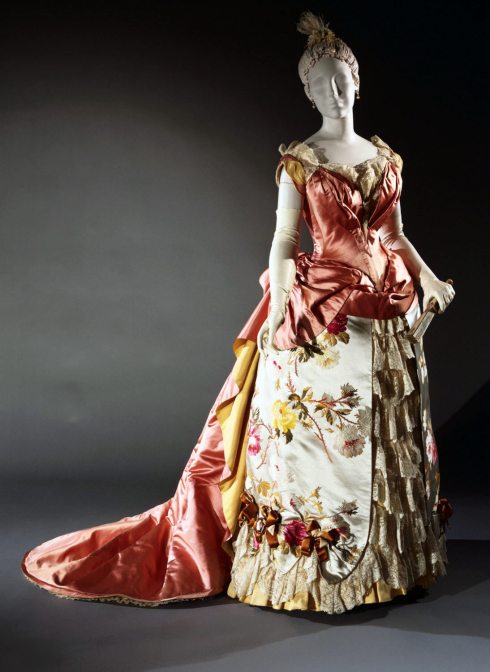
I came across a dress so beautiful the other day that I started thinking about its owner/wearer, Elizabeth Goodhue Millett Fenollosa, wife of the famous “Orientalist” and cultural ambassador Ernest Fenollosa, who happened to grow up in the house right next door to mine here in Salem. Actually “Lizzie” Fenollosa, who was also Salem-born and -raised, was Fenollosa’s first wife, who accompanied him to Japan, where he was eventually appointed Director of the Imperial Museum in Tokyo in 1888. Here is the Worth dress, which the curators of the Philadelphia Museum of Art believe might have been worn for her presentation at the Imperial Court coincidentally with her husband’s appointment. [Correction: please see comment below; Mr. Fenollosa was a professor of philosophy at Tokyo University and a curator at the Imperial Museum, but not its director.]

Fenollosa Dress

Women’s Evening Dress: Bodice and Skirt. Designed by Charles Frederick Worth, English (active Paris), 1825 – 1895. Worn by Mrs. Ernest Fenollosa, c. 1886-1887, Philadelphia Museum of Art. Gift of Mr. and Mrs. Owen Biddle, 1978.

I had never seen this stunning dress before but I was not surprised to see it in the collection of the Philadelphia museum, as the Fenollosas’ daughter Brenda was married into the prominent Biddle family of that city in 1913. Her son Owen Biddle and his wife donated the gown (along with another) to the museum, and she herself donated a lovely Meiji scroll from her father’s collection (and in his memory) in 1941. I was surprised to see another Fenollosa-related item in the museum’s collection, however: a photograph of her father’s second wife, Mary McNeil Fenollosa, by the photographer Eva Watson-Schütze, dated 1905. Obviously this item was not donated by the Biddle family, for the Fenollosa divorce was scandalous its day. I have no idea what Brenda’s feelings were, but her mother named Mary as a co-respondent in the 1895 proceedings.

Fenellosa Mary

Portrait of a Woman in Japanese Dress (Wife of Ernest Fenollosa), Eva Watson-Schütze, 1905. Philadelphia Museum of Art, 1905. Gift of Harvey S. Shipley Miller and J. Randall Plummer, 2004.

Ernest and Lizzie Fenollosa were childhood sweethearts in Salem; they were married right after his graduation from Harvard and then set off together for Japan, where he took up a position at the Imperial University at Tokyo and became fully immersed in traditional Japanese culture, eventually rising to his post at the Imperial Museum. He converted to Buddhism, but they did not appear to lead an ascetic lifestyle, if their house, their many western visitors (and her dress!) are any indication. During their time in Japan, Fenollosa also acquired a huge collection of traditional Japanese art, which he sold to Boston physician and philanthropist Charles Goddard Weld with the condition that it eventually be donated to the Museum of Fine Arts, Boston, where it now constitutes the Fenollosa-Weld Collection. The Fenollosas returned to Massachusetts in 1890, where he was appointed curator of the Department of Oriental Art at the MFA and organized several high-profile exhibitions. After he took up with Mary McNeil Scott, a twice-married southern secretary at the Museum, both his marriage and his curatorial career were over–although he continued in his scholarly activities. Lizzie and Brenda remained in the Boston area, but Ernest and Mary took off after their marriage: to New York, back to Japan (she had spent time there too, which explains much of their instant connection), to Mobile, Alabama (her hometown), and to London, where he died of a heart attack in 1908.

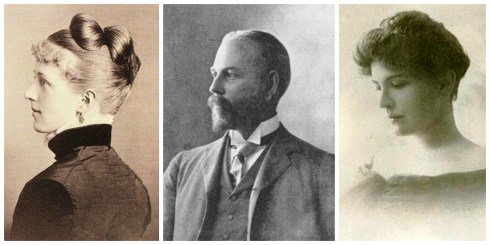
Fenollosa CollageElizabeth Goodhue Millett Fenollosa, Ernest Fenellosa, Mary McNeil Scott Fenollosa.

The two Mrs. Fenollosas were very different women bound together by one man, as well as their experiences in Japan, I suppose. Elizabeth Fenollosa seems to have been a private woman, although by all accounts she was a gracious hostess and certain details about her divorce did leak out to the papers…..Mary Fenollosa was much more public, writing popular novels under the pseudonym Sidney McCall, poems under her own name, and serving as an advocate for her husband’s work after his death. Truth Dexter, her first and most popular novel, tells the story of a southern wife (the title character) whose marriage is endangered by a brazen Boston socialite! That was too much for Lizzie, who told the New York Times that her intellectual ex-husband must have collaborated on the book as it contained too many little-known details of their lives together. I think that book, plus the fact that she’s a Salem girl, puts me on Team Lizzie, but both women certainly lived colorful lives that took them far from their places of origin.

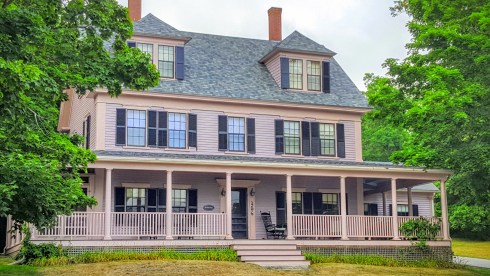
Fenollosa House Buffum Street

Fenollosa House Japan Harvard Houghton

From Salem to Tokyo: Elizabeth Fenollosa’s childhood home on Buffum Street in Salem, and the Tokyo home she shared with Ernest, Fenollosa Papers, Houghton Library, Harvard University.


Pokémon and Public History

Public history is about engaging the public with the past and its public memory, often through places, so you would think that an augmented reality game that drives people to historical sites would be welcomed by museum professionals and heritage site managers. Their reaction to Pokémon Go, however, has been decidedly mixed.While park sites seem to embrace the game and its players, several museums and sacred sites have just said no to Pokémon Go. In Washington, D.C., the United States Holocaust Museum opted out after a photograph of a poisonous-gas-emitting Pokémon named Koffing in the museum elicited quite a response online. The museum’s communications director, Andrew Hollinger, issued a statement that “Playing Pokémon Go in a memorial dedicated to the victims of Nazism is extremely inappropriate. We are attempting to have the Museum removed from the game”. Likewise, Arlington National Cemetery tweeted the following statement on July 12: We do not consider playing “Pokemon Go” to be appropriate decorum on the grounds of ANC. We ask all visitors to refrain from such activity. Many cemeteries across the country have followed suit, but several museums have invited visitors to “catch ’em all” within their walls. I think that art museums can embrace Pokémon Go as perfomance art that brings in much-needed millenials, but history sites have a different mission and response, especially those charged with commemorating tragedy.

Pokemon PEM

Pokemon character 5Pokémon popping out in the vicinity of the Peabody Essex Museum and Salem Maritime National Historic Site Visitors Center downtown–I have no idea what their names are: they just appear and I “throw” balls at them and take their pictures. They’re everywhere–even in my backyard and office!

So that brings me to Salem, a real hotbed of Pokémon Go activity from the release, and especially last weekend when an event called SalemGo! Catch ‘Em All! PokéWalk organized by the always-inspired folks at Creative Salem brought hundreds of Pokémon players to downtown. With its compact urban streetscape and multitude of historic markers, sites, and museums (real and “experiential”), Salem is a perfect setting for Pokemon, so I followed these enthusiastic hunter-gatherers to see how they engaged with all of the above. To be honest, I didn’t see a lot of engagement: most people proceeded with eyes fixed on their phones from Pokésite to Pokésite, barely passing a glance at the actual building/ monument/ installation/entity. However, I did not see any historically-insensitive trespassing (even though both the Old Burying Point and the adjacent Witch Trials Memorial are Pokésites, as well as the Quaker Cemetery on Essex Street) and it was fun to see so many backpack-bearing players out there, on the streets of Salem: in teams, in pairs, entire families, fathers and sons, fathers and daughters, grandfathers and granddaughters.
Pokemon Team

Pokemon Team 2

Pokemon Pair 2

Pokemon Pair

Pokemon Pair 4

Pokemon quartet

I soon realized I couldn’t make an evaluation of the impact of Pokémon Go on heritage sites during this event–it was a Pokéwalk not a Pokéstroll. I’d have to go out on my own and see just how the hunt for these virtual creatures could impact connections to both place and the past. So that’s what I did, as early in the morning as possible. I didn’t come to any great conclusions, but here are my thoughts, descending from nitpicky and Salem-specific to a bit more substantive and general.

  1. It’s Salem COMMON, not Commons!
  2. So happy that the Witch Museum is NOT a Pokéstop; but unfortunately the Witch Dungeon Museum and the Gallows Hill Museum/Theater and 13 Ghosts or whatever it is called are.
  3. BUT super excited that the ACTUAL site of the Salem Gaol is a Pokéstop (and not just the Witch Dungeon Museum–which appropriated the plaque of the actual site).
  4. Where oh where is the United States Lightship Museum? I thought it was on Nantucket, but Pokémon Go tells me it is a PokéGym here in Salem.
  5. I spoke to several Park Service rangers, all of whom told me they were excited to see hundreds of visitors on Derby Wharf. Pokémon Go could well be a boon to all of our National Parks, in this their centennial year.
  6. A Pokéstop is just that, a stop. But wild Pokémon can appear anywhere, at any time, and lure you anywhere. Strange creatures tried to lure me into both the Witch Trials Memorial and the Old Burying Point, but I resisted.
  7. So many churches and monuments!  You can definitely tell that Pokémon Go is based on the Historical Marker database, which includes sites both conventional and a bit more obscure–driving people to the latter, even if they’re not spending much time there–has got to be a benefit. Awareness is always a benefit.

That’s about it: I don’t really have any particularly penetrating insights into this phenomena, as you see. I would love to hear from some heritage professionals–particularly those who manage sites that are a bit more….sensitive. I must say that while I don’t particularly care about catching Pokémon in the context of the game, I love capturing them on my camera. There’s something about the juxtaposition of obviously unreal things in real settings that is quite captivating: I expect to see notice of some big exhibition soon! In the meantime, here are my own offerings, starting with the creature at the Witch Trials Memorial.A surreal site indeed: I really don’t want to see similar creatures getting any closer to those benches.

Pokemon character 4 WTM

More Pokémon in less sensitive settings below. There are a whole bunch on Federal Street, particularly in the vicinity of the Peirce-Nichols House., so heads up. ….

Pokemon character 8

Pokemon character 7

Pokemon character 9

Pokemon character 10

Pokemon character 11

This guy appeared in my office at Salem State, also a hotbed of activity.

Pokemon office 2


Time for Salem Switchel

July was pretty hot; August will likely be cooler, but I still think it’s time to revive an old summer drink here in Salem called switchel. A colonial “ade” made of ginger, vinegar, and a sweetening agent, switchel has enjoyed a revival over the last few years, and is currently being produced in such variant hipster havens as Vermont and Brooklyn. In older texts, it’s often referred to as “haymaker’s punch”, implying agrarian origins, but I’ve also found plenty of references to switchel in maritime and military sources. There’s a famous reference to it in the account of one of the major naval battles of the War of 1812, between the USS Constitution and the HMS Guerriere off the coast of Nova Scotia. Anticipating a great victory, the Guerriere Captain James Dacres ordered his cooks to “prepare the switchel” for the soon-to-be captured Americans. After Old Ironsides prevailed, this phrase was incorporated into a mocking/patriotic American sailors’ song: When prisoners we’ve made them, With switchel we will treat them; We’ll welcome them with Yankee Doodle Dandy, O. It’s definitely one of the first American beverages. There’s a very nice reference to Salem switchel in the memoirs of Boston Brahmin Robert C. Winthrop, who marched up to Salem on a hot summer’s day in 1822 in the company of the Boston Light Infantry to camp out on the Common:a wisp of straw for our bed, and a bit of thin bunting above our heads, through which we could see the sentinel stars keeping their watch in the sky, more vigilant than any sentinels we could station, were our only and all-sufficient accommodations; and a little molasses and water and ginger–a switchel I think it was called–was our best drink. Elizabeth Hall’s Practical American Cookery and Domestic Economy (1857) contains the basic recipe (mix half a gallon of molasses, one quart of vinegar, 2 ounces of powdered ginger with five gallons of water, boil and cool to make a beverage that is not only “very pleasant”  but also “highly invigorating and healthful”) but it is clearly suitable for all sorts of substitutions and additions: the modern Vermont versions contains maple.

Switchel Vitick's

Salem is a major foodie town today, with countless restaurants and bars, a distillery, a cider taproom, a brand new beer brewery, beer hall & garden, and a whole bunch of clever and crafty people: surely someone could produce and market a special Salem Switchel drawing on our city’s past and present? A Salem variety should no doubt feature molasses, but I think rum would also be an appropriate (and appealing) ingredient. And I have the perfect containers for inspiration: these are beautiful vintage bottles produced for S.B. Winn & Son, producers of ginger ale and other beverages, and Eldredge’s Lagers, all made in Salem over a century ago.

bottles 3


bottles 6

Salem Bottle

Winns Ginger Ale Ad


24 Hours in Richmond

Just back from an abbreviated visit to Richmond, Virginia for a family event: shortened by the wild weather down there which grounded us in Boston on the evening of our departure. So everything was compressed: family time, touring time, time in our amazing hotel, The Jefferson, a monumental Italianate (its style is described alternatively as “Spanish Baroque” and eclectic; it seemed Italianate to me) palace in the heart of the city. Designed by the well-known architectural firm Carrere and Hastings, it opened in 1895 with all the modern conveniences, including complete electrical, heating, and plumbing systems for all of its 324 rooms, service telephones, and elaborate lobbies for both ladies and gentlemen. Alligators roamed these lobbies as late as 1948. The Jefferson is nearing completion of an extensive renovation: there was still scaffolding in the gentlemen’s lobby but our room was lavishly luxurious. I was particularly impressed by its scale and furnishings; while my husband was wowed by the television embedded in the bathroom mirror! I ran around and took pictures in my limited time, and then spilled out into the neighborhood the following morning: very early, before it got too hot.

Richmond Lobby

Richmond 1

Richmond 4

Richmond 13

Jefferson Collage

Richmond 12

Richmond 11

Richmond 33

Richmond 31 Main St Entrance

The Jefferson Hotel, Richmond: main lobby with statue of Thomas Jefferson by Edward V. Valentine and lobby ceiling; the gentlemen’s lobby from two perspectives; memorabilia; Franklin Street entrance day and night with alligator statue; Main Street entrance to the gentlemen’s lobby. 

Snapshots which comprise a literal snapshot of one small section of Richmond are below: historic preservation is definitely a priority, but I also got the impression from my quick tour of downtown that the city is open to more modern structures as well. Preserved row houses in that soft brown Virginia brick co-exist with more colorful and stark structures: I saw none of the boxy pastiches now plaguing Salem in this particular section of Richmond! I was also struck by how well Virginia Commonwealth University was integrated into the city: such a lost opportunity for Salem that Salem State is confined to a residential section into which it doesn’t quite fit. I’m really looking forward to returning to Richmond so that I can explore the designated historic districts…and more: I picked up a copy of Garden and Gun (a great magazine, but kind of an incongruous name, no?) to read on the plane ride home which featured an article on an ongoing community effort to rescue the overgrown African-American cemeteries of the city and now I must see these too.

Richmond 25

Richmond 26

Richmond 22

Richmond 19

Richmond 18

Richmond Collage

Richmond 14

Richmond 30

Richmond 29

Richmond 20

Richmond 21

Richmond 27

Richmond Crozet House 1814

A short walk on a few streets of downtown Richmond on a hot July morning: LOVE these last two houses with their amazing entrances and windows: the latter one is the Crozet House, built in 1814.


The Salem “Heritage” Trail needs more…..Heritage

It is pretty well-known here in Salem that the Red Line that runs though downtown, the official “Heritage Trail”, is more representative of commerce than history. It encompasses heritage sites like the House of the Seven Gables, the Corwin (“Witch”) House and the Salem Maritime National Historic Site, but also more dubious enterprises like the Salem Witch Museum, the Salem Witch History Museum, and the Salem Witch Dungeon Museum, with no discernment. There are no standards along the Heritage Trail: the Peabody Essex Museum with its vast collections, blockbuster exhibitions, and professional staff and the Witch History Museum, a storefront shop which lacks collections, curators, and content, have equal status in terms of their roles as provisioners of “heritage”.  According to the American Alliance of Museums (AAM), a museum is a nonprofit institution, which maintains, interprets, and exhibits its collections for the public good. As Salem’s witch museums are for-profit enterprises, which maintain no collections and offer their performances and “exhibits’ exclusively for their private gain, I don’t think they qualify as museums under the professional definition: I prefer to refer to them as “experiences”.

Museum Collage A Tale of Two Museums; Alvin Fisher’s View of Salem from Gallows Hill, 1818, Peabody Essex Museum, and the Gallows Hill exhibit at the Witch History Museum (Of course now we know that the victims of 1692 were hanged at Procter’s Ledge rather than Gallows Hill).

Of course, people are free to choose whatever experiences they would like, but if tourists stick to the Red Line they are going to be missing out on much of Salem’s heritage. And they do stick to the Red Line, believe me: I followed several groups of tourists the other day (on the hottest day of the year) as they walked along it with great dedication, all the way from the Salem Witch Museum to the Salem Witch Dungeon Museum, bypassing several sites which are related to the real history of the Witch Trials: St. Peter’s Church, under which the body of Philip English lays, the Howard Street Cemetery, adjacent to where Giles Corey was pressed to death, the former sites of Bridget Bishop’s house and orchard, the Salem Jail and Court House where the accused witches were held and tried. The Salem Witch Dungeon Museum removed the plaque which marked the spot of the original jail and affixed it to their building, so now they “own” that history. The imprimatur of the Red Line makes it official.

lynde-street-076

Plaque on the Witch Dungeon Museum along the Red Line; the second, smaller plaque was added a decade later than the first.

The problem with the existing Red Line/Heritage Trail is not just its presentation of an incomplete and often-shoddy history of Salem. Because it is so obviously inadequate, it has led to a form of cultural “segregation”: other organizations, chiefly the National Park Service in collaboration with local groups, developed alternative walking trails to fill the gaps: architecture tours, a maritime tour, a tour featuring sites related to Salem’s African-American history, and a Hawthorne tour (you can download all the brochures here). There are also a wide range of commercial tours, which seem to have multiplied dramatically over the past few years. Visitors to Salem can have quite a different experiences depending on their degrees of preparation, resourcefulness, and curiosity. I also think that Salem’s reputation has suffered by comparison with the other Red Line (what I have often heard called the real Red Line), Boston’s Freedom Trail, which does not include commercial sites.

Salem has been a tourist destination for a long time, over a century, and we could learn from our past projections. The map included in my favorite old guidebook, What to see in Salem (1915) projects a route that is not dissimilar from today’s Heritage Trail in terms of geography, but exhibiting very different priorities: public places rather than private enterprises, an integrated city of real museums, sites associated with Hawthorne and the Revolutionary War as well as the Witch Trials, colonial and Federal houses and gardens. The problem with the 1915 route is immediately apparent, however, especially if you compare it with the current Heritage Trail map: no one stood to make any money.

What to see in Salem map 1915

What to see in Salem text 1915

Red Line Map 2016

Map and Key from What to see in Salem (1915) and current Heritage Trail Map, available here–all the numbers refer to local businesses and the museums, real and faux, are in text. Judging by font size, the Gallows Hill Museum/Theatre looks like the place to go! (But it’s never open, except in October).