Category Archives: History

Keeping Christmas

Well, after all that immersion into Puritan anti-Christmas tracts I was doubting my own Christmas observances–powerful stuff! I’m pretty Protestant in my religious sentiments (though raised Episcopalian—on the fence) so there is something there that resonates with me, plus I’ve been teaching Reformation history for 20+ years! So I thought I would go back to the ultimate source (well, after the bible), Martin Luther, and see what he thought about Christmas. Next year, coming fast, is the 500th anniversary of Luther’s 95 Theses and the commencement of the Reformation, so I have a stack of timely publications by my bedside to consult, but the best source by far was an older compilation, Martin Luther’s Christmas Book, edited by the eminent Reformation historian Ronald Bainton. It is very clear from this collection of Luther’s sermons that he was no Puritan, and some of his most inspiring words were written about the Nativity. Luther does not tell us how to celebrate this event, but given his exuberance at Christmas time, combined with his natural hospitality (offered through his wife Katharina, who regularly had visitors at her table in addition to their six children and assorted hangers-on), we can imagine that he would not condemn a festive observance of the holiday. Three centuries later, the German artist and illustrator Carl Schwerdtgeburth created an image of Luther and his family with a Christmas tree in their midst, an image that went viral just at the time that the Christmas we know and love was created. There is no historical basis for this image, but it was disseminated so far and widely in its time–and even more so in ours–that the legend of Luther’s Christmas tree will never die.

martin-luther-christmas-book

keeping-christmas-luther-wheat-sheaf

The nineteenth century interprets the sixteenth: Carl Schwerdtgeburth’s popular print of Luther and his (lit) Christmas tree, courtesy of the American Antiquarian Society.

While all Protestants sought to reduce the power of the saints by disdaining the observance of traditional Feast Days, Christmas was an exception for Luther (and even for Calvin, though not for all Calvinists–the Puritans a notable case in point) who clearly perceived it not only as a day that rightly focused on Christ but also as a social holiday. There is a liberation and a joyousness in Lutheran theology–attained only through God’s gift of grace in return solely for faith–that can support all sorts of festivity: for if you possess faith your heart cannot do otherwise than laugh for joy in God, and grow free, confident and courageous. For how can the heart remain sorrowful and dejected when it entertains no doubt of God’s kindness to it, and of his attitude as a good friend with whom it may unreservedly and freely enjoy all things. Such joy and pleasure must follow faith; if they are not ours, certainly something is wrong with our faith (2nd Christmas sermon, 1522). This is only one small passage of a much longer sermon, but I think it’s representative–and a great antidote to all those dour Puritan tracts!

I’ve always been a bit concerned that the joy and pleasure that I experience during the Christmas season is too materialistic–not focused on gifts per se but rather on the “trimmings” of the season: lights, decorations, trees, wreaths, food, drink, stuff.  But this year I’m given myself license to “unreservedly and freely enjoy all things”. Luther’s Christmas tree might be the stuff of lore and legend, but I don’t think he would have any problem with decking the halls.

“Keeping Christmas” in Salem, 2016–my favorite trimmings:  a beautiful Italianate house (which has been going through an extensive restoration) all dressed up for the season, wreaths, wreaths, wreaths, downtown lights, and Paxton’s perfect window.

keeping-christmas-italianate

keeping-christmas-wreath-1keeping-christmas-collage

keeping-christmas-assemble-house2

Downtown lights.jpg

keeping-christmas-window

I’m not hosting Christmas this year, so I instead of the usual HUGE tree I went for two smaller potted ones, because I hate seeing trees die. The mantles and bookcases have the usual creature compositions, including mice, deer, foxes, elephants, rabbits, and a lone giraffe.

keeping-christmas-window-with-trinity

keeping-christmas-interiors

keeping-christmas-mice-mantle

keeping-christmas-animals

keeping-christmas-presents

And hedgehogs from medieval manuscripts for my gift tags: they supposedly rolled on the ground to collect grapes for their young, making them look quite Christmassy. Merry Christmas, everyone!


A Suspect Source in the Christmas Wars

One positive impact of the recent presidential election has been enhanced awareness of “fake” news and an emerging scrutiny of sources in general. Educators have been aware of the challenges in the information realm for a while, but it seems like a more general concern has emerged now, and this can only be good news. With time, I think we can tame the flood of fake words on the internet (or at least our reception of such stuff), but I am more concerned about images: they are potentially more impenetrable, and definitely more impactful. The problem is not just the images themselves, but the attribution that all-too-often accompanies them, or all-too-often does NOT. The phrase public domain covers a spectrum of sins, ranging from simple laziness to outright deception. A case in point is an image that has bothered me for a while now, as I simply cannot finds its source: I suspect it was crafted. It turns up quite a bit at this time of year, as it concerns the banning of Christmas in the mid-seventeenth century either here in Massachusetts or across the Atlantic in not-so-merry “old” England. Here it is, in characteristically fuzzy form from the Wikipedia entry on “The Christmas controversy” and in a variant form with “antiqued” edges which first popped up on a genealogical site. Both images are unattributed and have been shared tens of thousands of times.

puritanchristmasban-wikipedia

img

These images are featured in pat little articles about the “cancellation” of  Christmas in both New and old England: sometimes its place of publication and date is given as Boston, 1659 or 1660, and other times it is identified as a parliamentary proclamation that was “nailed to every tree in England” during the Cromwellian regime. Amazing! It’s just passed around with no scrutiny–or even curiosity. Several things bother me about this “document”: its appearance, its font, its composition–but most of all I am bothered by its absence from the English Short-Title Catalogue (ESTC), Early English Books Online, or Early American Imprints. I would love to stand corrected, but right now, I’m thinking this thing is an ephemeral imposter.

I’m not quite sure why someone would create this image as there are real historical documents that attest to the Puritan abhorrence of Christmas very vividly. Disorderly “Old Christmas” was a major flashpoint in mid-seventeenth-century England, between Reformers and “Papists”, Parliamentarians and Royalists. Everything about its observance–its date, its rituals, its length, its sheer revelry–were all major points of contention in a conflict that was religious, political, and cultural. After a war of words in the 1640s, Parliament did mandate that business as usual be conducted on December 25 in 1651, but there was considerable pushback, with more words and deeds. Likewise the Massachusetts Bay proclaimed a penalty for keeping Christmas in 1659, in a document which features some vaguely familiar words and phrases.

england_and_wales-resolved_by_the_parliament_that-wing-e2258-1700_28-p1

puritan-christmas

Early English Books Online: Wing E2258; Massachusetts Historic Legal Documents and Laws, 1620-1799, Massachusetts Court System.

I’ve written about the Puritan disdain for Christmas both in general and as it pertained to Salem before (most recently here), and it is a pretty well-trodden field, but as I was searching (yet again) for this dubious document I uncovered several contemporary texts with which I was unfamiliar and can add even more context. In general, those under attack–the keepers of “Old Christmas” and “Christmas-mongers”– employ a wistful, humorous, satirical (and anonymous) defense of their holiday while the Puritans (as always!) are more strident in their opinions. Poor Father Christmas, forced to leave the country and come to (Puritan-dominated) London, where he was “arraigned, convicted and imprisoned”, but [fortunately] able to escape and get away “only left his hoary hair, and gray beard, sticking between two iron bars of a window”. The debate between Mistresses “Custome” and “New-Come” over the keeping of Christmas in Women will have their Will: or, Give Christmas his Due is a perfect expression of the power of custom–I’m going to use this one in class. Robert Skinner’s Christs Birth Misse-timed illustrates the Puritan concern about the dating of Christmas, more attuned to pagan traditions than biblical ones, and finally, Samuel Chidley’s Christian Plea against Chrissmass, and an Outcry against Chrismas-mongers is probably the most forceful indictment of Christmas merriment I have ever read. Appealing to Lord Protector Cromwell to be more vigorous in the repression of revels, Chidley asserts that the “Christmas-mongers” serve not Christ, but their own bellies. For Christ was not as they set him forth to be. He was no Mass-monger or belly God. No drunkard. He wanted neither cards, dice, nor tables to play with, to pass away the time, nor Lord of mis-rule to take his place. He needed no new Games to make him merry, no Holly or Ivy to dress his windows, nor mistletoe to conjure his lovers, nor other toys to please his fancy, or blindfolded fools, or Hot Cockle payers to make him sport. Wow! Great stuff–again, no need to make anything up. And the fact that Chidley is appealing to Cromwell at this relatively late date is a strong indication of the Protectorate’s failure to put down “old” Christmas: in just four short years the more merry Stuarts would be restored.

anon-christmas_lamentation-stc-5203-2123_48_49-p1

anon-the_arraignment_conviction_and-wing-a3749-52_e_315_12_-p1

anon-women_will_have_their_will-wing-w3327-167_e_1182_12_-p1

skinner_robert-christs_birth_missetimed_or_a_resolution-wing-s3945-76_e_477_24_-p1

chidley_samuel-a_christian_plea_against_chrismass-wing-c3834c-2568_25-p1

Christmas Lamentation, /For the losse of his Acquaintance, showing how he is forst to leaue the/ Country, and Come to London. ESTC S108691;  The Arraignment, Conviction and Imprisoning of Chrismas on St. Thomas Day las. ESTC R200516; Women will have their Will: or, Give Christmas his Due. ESTC R208164; Christs Birth Misse-timed. ESTC R205570;  A Christian Plea against Chrissmass. ESTC R173825.


Tom and Jerry for Christmas

I spent a lot of time last weekend de-stressing in front of and around the television watching Turner Classic Movies, to which my little set is almost permanently tuned. There were old Christmas movies on, and it seemed like every time I looked up from whatever I was doing various characters were getting tipsy on a seasonal drink called a “Tom and Jerry”. It appeared to be an eggnog-like concoction but I had never heard of it: what was it and where did it go? I did a little Google research, and turned up multiple recipes, images of vintage Tom and Jerry punch bowls and cups (which got me even more curious and excited), and some nice sentimental articles about this “all-American” drink’s survival in the upper Midwest. Tom and Jerry is a lighter eggnog variant, which utilizes many eggs but milk (or even water, see below) instead of cream, sugar and spices and rum and brandy, and is typically served warm. Based on the sheer survival of all the punch sets on the second-hand market alone, it must have been very popular in the middle decades of the twentieth century.

tom-and-jerry-bowl

Just one of many Tom & Jerry bowls on Etsy, Vintage mid-century Fire King.

This old drink has nothing to do with the cat and mouse cartoon: according to my (exclusively internet, I must admit) sources, its origins can be traced to either an extraordinary 1821 book by a British journalist, Pierce Egan, titled Life in London, or, The day and night scenes of Jerry Hawthorn, esq., and his elegant friend, Corinthian Tom, accompanied by Bob Logic, the Oxonian, in their rambles and sprees through the metropolis or to a legendary nineteenth-century American bartender named Jerry Thomas whose pioneering 1862 mixologist tome How to Mix Drinks, or the Bon-Vivant’s Companion featured a recipe for the Tom and Jerry. No one seems to have connected all the dots between the popular British Tom and Jerry characters and the American drink, but the recipe seems very British to me, reminiscent of all the frothy “lambswool”- like drinks of centuries past. And no matter, I’m always more interested in the search for the source rather than the actual commodity/consumable, and the research into the drink’s origins led me to Egan’s text, featuring his Tom and Jerry characters exploring the highs and lows of London society with delightful illustrations by the Cruikshank brothers. Alcohol was definitely a major part of their exploits.

tom-jerry-f60156-501

tom-jerry-f60156-491

egan-pierce-life-838i2-002617-111

egan-pierce-life-838i2-d40091-38-111

egan-pierce-life-838i2-064425-21

tom-jerry-f60156-5511

Illustrations/scenes from Pierce Egan’s Life in London, British Library.

And I also discovered Jerry Thomas’s Bon-Vivant’s Companion which is available in many reprint editions as well as here. I could spend some time with this book, but for now, and for the holidays, here is his Tom and Jerry recipe (for a crowd):

To make the batter:  5 lbs sugar/ 12 eggs/ a half glass Jamaica rum/ 1 ½ tsp. ground cinnamon/ ½ tsp. ground cloves/ ½ tsp. allspice. Beat the whites of the eggs to a stiff froth, and the yolks until they are as thin as water, then mix together and add the spices and rum, thicken with sugar until the mixture attains the consistence of a light batter.

To deal out Tom and Jerry to customers: Take a small bar glass, and to one tablespoon of the batter, add one wine-glass of brandy, and fill the glass with boiling water, then grate a little nutmeg on top.


Pomanders and the Plague

Early December is busy for any academic, so just about the only handcrafted Christmas decoration/gift I can manage is the humble pomander. I wrap rubber bands and ribbons around oranges and lemons as Martha Stewart advises, and then stick in the cloves. But it doesn’t matter how many beautiful photographs of Martha’s Christmas vignettes I peruse for pomander-inspiration, I’m always going to think about the plague when I make these things. Given the contemporary belief in the spread of the pestilence through a fog-like miasma of foul air, a corollary faith in the preventative pomander was equally long-held over the late medieval and early modern eras. If you could not smell the plague, you could not contract it. Sweet-smelling herbs, encased in little silver balls which were also called pomanders if you were rather rich, never left your side, indoors or out. Paintings of patrons with pomander in hand became almost conventional–these little balls were the symbol of an infectious age.

perfect-pomanders

Hanneman, Adriaen, c.1601-1671; John Evelyn (1620-1706)

Perfect Pomanders present and past: the portrait of seventeenth-century diarist John Evelyn (©Shakespeare Birthplace Trust) by a follower of Adriaen Hanneman features one of the most modern pomanders I have ever seen!

The Evelyn portrait above is very unusual: I suspect this was a hollowed-out orange filled with the usual plague herbs but it looks like one of my little pomanders! Much more common in the sixteenth and seventeenth centuries were images of sitters with silver and gold pomanders in hand, chained, ever-present: a display of wealth and fortitude. The Flemish sitters below were far more typical in their presentation: the plague was endemic, it could strike at any time, so you must be ever ready with your “preservatives”. They might as well be encased in a spectacular piece of jewelry.

de Vos, Cornelis, c.1584-1651; Portrait of a Lady

pomander-painting-3-met

Cornelis de Vos, Portrait of a Lady, ©The Wallace Collection; Heinrich vom Rhein zum Mohren, a Copy after Conrad Faber von Creuznach, Metropolitan Museum of Art.

So what was inside those little chalices (or “swete” bags if you were less wealthy)? There are lots of “recipes”, with many constants and some variation. Here are a couple of concoctions from the Certain Necessary Directions ; As well for the Cure of the Plague As for Preventing the Infection approved and offered up by the College of Physicians in 1665, a terrible plague year. For the common sort: angelica, rue, zedoary (a type of tumeric), myrrh, camphor, labdanum (most of these don’t actually sound very common–I think most people just grabbed some rue when they went outside). For the “richer sort”: “citron pilles”, angelica, zedoary, red rose petals, sandlewood, lignum aloes, gallic moschat, stozar benzoin, camphor, labdanum, gum tragacanth, and rosewater.

pomander-anon-certain_necessary_directions_as-wing-c1709-1629_22-p1

pomander-recipes

Pomander recipes with a seventeenth-century skull pomander, Metropolitan Museum of Art.

Well, of course, none of these things actually worked to preserve the body from plague. Yet despite their ineffectiveness, the major plague “preservatives” survived through evolution into much less serious substances: vinegar–a major plague fighter–evolves into vinaigrette, theriac, the most powerful supposed plague antidote, into sweet treacle, and pomanders into perfume and sachets and various forms of aromatherapy, as well as Christmas decorations.

pomander-diptyque-candle

Diptyque Paris Pomander Candle.


Pastry Castles

There is much focus on food and drink during December, of course, and today I’m thinking about “pastry castles”, an early form, perhaps, of our own American gingerbread houses? The British Library recently digitized one of the oldest English cookbooks (which is actually a cook-scroll), the Forme of Cury (Add MS 5016), and the recipe for “chastletes” is a conspicuous entry. The Forme of Cury ( a Middle English title for “method of cookery” having nothing to do with England’s current national dish) was written by the chefs of Richard II’s kitchen in the later fourteenth century, and includes recipes for both “common” and “curious” foods, and “for all manner of states, both high and low”. One assumes that the pastry castles, which are a curious mix of sweet and savory in typical late medieval fashion, were produced for the former.

forme-of-cury-scroll-bl

recipe-pastry-forme-of-cury-add5016

feast

Forme of Cury scroll and recipe for pastry castles, BL Add MS 5016; a feast featuring a “chastlete” in a late-medieval Bruges manuscript, BL Royal MS. 15 D I.    

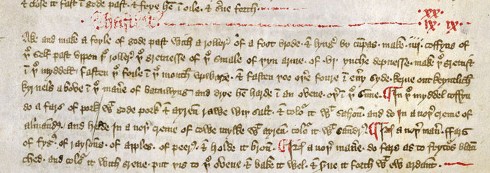
Here is the recipe for chastletes in its original Middle English:  Take and make a foyle of gode past with a roller of a foot brode. & lyngur by cumpas. make iiii Coffyns of þe self past uppon þe rolleres þe gretnesse of þe smale of þyn Arme. of vi ynche depnesse. make þe gretust in þe myddell. fasten þe foile in þe mouth upwarde. & fasten þee oþere foure in euery syde. kerue out keyntlich kyrnels above in þe manere of bataiwyng and drye hem harde in an Ovene. oþer in þe Sunne. In þe myddel Coffyn do a fars of Pork with gode Pork & ayrenn rawe wiþ salt. & colour it wiþ safroun and do in anoþer Creme of Almandes. and helde it in anoþer creme of Cowe mylke with ayrenn. colour it with saundres. anoþur manur. Fars of Fygur. of raysouns. of Apples. of Peeres. & holde it in broun. anoþer manere. do fars as to frytours blanched. and colour it with grene. put þis to þe ovene & bake it wel. & serue it forth with ew ardaunt.

The “Coffyns” refer to the pastry shell, encasing the savory mixture of pork, saffron (amazingly dear at the time!), almonds, raisins, apples and pears—mincemeat essentially. The entire form was not made of “bread”, consequently it’s difficult to make the link between these constructions and our own modern gingerbread houses, which seem to have more modern, continental origins, although Elizabeth I purportedly instructed her cooks to make gingerbread men and women in the recognizable forms of her courtiers and guests. I think we’re talking about multiple lines of food cultural evolution here—pies, cakes, ginger, ginger cakes, breads, and houses–and perhaps I shouldn’t mix them up except under the label of “architectural pastry constructions”.  If I could make my own pastry castle, which I would fill with cake and not mincemeat, I would certainly recreate one of Elizabeth’s very favorite castles, Nonsuch Palace, built by her father in the last years of his reign. This is well beyond my baking abilities, but wow, just imagine such a structure!

nonsuch_palace_by_joris_hoefnagel

nonsuch-2

Two views of Nonsuch Palace by Joris Hoefnagel–the second was just acquired by the Victoria & Albert Museum.


Christmas in Salem 2016

stellar Christmas in Salem tour around Salem Common this past weekend, featuring all the things that I love about Salem houses and Salem people. The combination of generous and creative homeowners, perfect clear and crisp December weather, and myriad magical details made for a very special experience. Here’s just a short list of attractions (I really could go on and on): a McIntire spiral staircase, beautiful views of the Common (as seen through very clean windows–the first thing I noticed when I got home was how dirty mine are), an artist’s atelier/bedroom, an alpine-decorated deck, kitchens extraordinaire, an architectural dollhouse, exceptional artwork and collections. To be honest, I barely noticed the Christmas decorations as I was so focused on the architecture and interior design. I was a bit pressed for time, so I skipped the three institutional stops on the tour–the PEM’s Andrew Safford House, the Bertram House, and St. Peter’s Church–and went right for the private homes, all along the Common and a few adjacent side streets. It seemed to me that the tour was curated for contrast: of scale (larger institutional or single-family homes contrasted with smaller structures and condominiums), of architectural style (everything was built in the nineteenth century but what a difference between the Federal, Greek Revival, Victorian and Colonial Revival!), of design (very modern and more traditional), of embellishment (very decorated and more minimalistic), and above all, of expression: the homeowners expressed themselves in various ways: through their own art or design, or through their collections, or both!

I was fortunate to obtain a press pass so I could take photographs of the houses, but 1) I am not a professional photographer and 2) I got completely overwhelmed by all I had to see/ “capture”, so please go on over to Creative Salem  or to Historic Salem for more polished and comprehensive portfolios: it was really all too much for me, in the best possible way!

Let’s start with a sampling of beautiful rooms, and then I’ll try to present some of the details that caught my eye–just some, because there was so much to see.

christmas-in-salem-tree

christmas-in-salem-room-2

christmas-in-salem-room

christmas-in-salem-tree-3s

christmas-in-salem-kitchens

christmas-in-salem-detail-8

Let there be light! This  was a very enlightened tour, in more ways than one:

christmas-in-salem-window-2

christmas-in-salem-window-3

christmas-in-salem-foyer1

christmas-in-salem-staircase

Myriad Mantles……..

christmas-in-salem-mantle-2

christmas-in-salem-mantle-4

christmas-in-salem-mantle-5

christmas-in-salem-mantle

Dazzling Details…….of collections, an amazing restoration, and all sorts of embellishment, including an historic Salem gallery wall, an exterior Christmas tablescape (set up by the homeowner of a beautiful condo, who felt that she need to offer a “bit more”), and the ultimate dollhouse.

cis-details-collage

cis-details-collage-restoration

cis-collage

christmas-in-salem-detail-5

christmas-in-salem-deck1s

christmas-in-salem-dollhouses

It was impossible for me to capture the complete creativity of Salem artist Thomas Darsney’s stunning home/gallery: his canvases were luminous but the entire home was in fact a canvas, with no surface or detail unconsidered. 

christmas-in-salem-detail-6

christmas-in-salem-detail-7

christmas-in-salem-detail-10

christmas-in-salem-detail-11

Just a few exterior shots because again, the light was so beautiful on Sunday……

christmas-in-salem-exterior-3

christmas-in-salem-exterior-2

christmas-in-salem-exteriors

Why not tie everything up with a big red bow?

cis-bow


St. Andrew’s Cross

I’ve been writing posts on various saints days over the years and yesterday I realized I had never posted about St. Andrew on his feast day, a notable omission both in general and for me, in particular, as I was fortunate to spend my junior year at St. Andrew’s University, and the town remains one of my very favorite places on earth. Though I think most people associate St. Andrew exclusively with Scotland, he is venerated widely: in much of eastern Europe, in the Caribbean and even South America. Andrew was the first Apostle, the brother of Peter, and an ardent missionary: it is said that he continued to spread the gospel during much of his crucifixion, on an x-shaped cross forever associated with his name: the saltire or St. Andrew’s Cross. Such a powerful symbol of assertion, both against a field of blue as the Scottish flag, or as the southern cross on the Confederate flag. The connotations of the former are all positive as compared with the latter, of course, and St. Andrew’s Day has been a bank holiday in Scotland since 2006.

st-andrew-collage

martirio_de_san_andres_por_juan_correa_de_vivar-xlarge_transqvzuuqpflyliwib6ntmjwfsvwez_ven7c6bhu2jjnt8

st-andrews-the-saltire-flag Late medieval manuscript images of St. Andrew from the British and St. Andrew’s University Libraries; Juan Correa de Vivar, Crucifixion of St. Andrew, c. 1540, University of St. Andrew’s Special Collections; the saltire unfurled.

Scotland’s claim to St. Andrew has always struck me as a little convoluted, but it became official, and lasting, with the Declaration of Arbroath (1320), a letter written by the barons of Scotland to Pope John XXII asking for recognition of the country’s independence and acknowledgment of Robert the Bruce as its rightful king. Scotland’s “Declaration of Independence” incorporated the esteemed St. Andrew as part of its plea, for “The high qualities and deserts of these people, were they not otherwise manifest, gain glory enough from this: that the King of kings and Lord of lords, our Lord Jesus Christ, after his Passion and Resurrection, called them, even though settled in the uttermost parts of the earth, almost the first to His most holy faith. Nor would He have them confirmed in that faith by merely anyone but by the first of His Apostles – by calling, though second or third rank – the most gentle Saint Andrew, the Blessed Peter’s brother, and desired him to keep them under his protection as their patron for ever.”  Another very powerful assertion, as St. Andrew certainly outranked the emerging patron saint George of Scotland’s perennial enemy, England. Combined with a classical origins story, language, literature, Presbyterianism, the “auld alliance” with France, and myriad other claims and customs, St. Andrew helped Scotland preserve a very distinct national identity even after it became part of Great Britain. And then, in that golden age of romantic nationalism that was the nineteenth century, the Saint and his cross seem to be emblazoned on all forms of material culture associated with Scotland, transforming him into a more secular patron and ensuring his survival into the modern age.

st-andrews-glass

st-andrew-tile-minton-vanda

st-andrew-wallpaper-crane

st-andrews-day-projection-edinburgh-2013

The symbolic British Empire in glass, c. 1840: stained glass panels by C.E. Gwilt representing St. Andrew of Scotland, St. Patrick of Ireland, and St. George of England; a Minton tile, c. 1875; Walter Crane’s “National” wallpaper, 1890s, all collection of the Victoria and Albert Museum; St. Andrew’s Day 2013 in Edinburgh.


Cabinets on Canvas

After stuffing ourselves with Thanksgiving dinner the day before, and Thanksgiving breakfast pie yesterday morning, we walked downtown to the Peabody Essex Museum to see their latest blockbuster exhibition, Shoes: Pleasure and PainIt is a fine visual feast for sure, but not exactly thought-provoking for me (and I’m not really a shoe girl–but I did get some great pictures for another post), so I wandered next door to another current exhibition, Samuel F.B. Morses Gallery at the Louvreand the Art of InventionThis traveling exhibition focuses on Morse the artist and “copyist” rather than Morse the inventor: his 1831-33 painting of an imagined exhibition of 40 artworks at the Musée du Louvre in Paris, combined with his role as the “father of American photography” based on his early experimentation with the daguerreotype process, is the inspiration for a complementary display of over 65 photographs from the PEM’s extensive collection. I must admit I didn’t quite grasp the connection between the painting and the photographs—“the spirit of curation, storytelling, and cross-cultural affinities”—but I was happy to see both, and I spent some time trying to find my own connections, which is the very best impact any exhibition can have.

cabinets-1

cabinets-2

cabinets-5

1992-51-morse-8-center-figureslowres

Samuel F.B. Morse’s Gallery at the Louvre (Terra Foundation for American Art) in the PEM show, along with his copy of Titian’s portrait of François I and a crop of the artist/inventor instructing his daughter in the center of the painting from a blog post by Shoshana Resnikoff on the PEM blog Connected.

After a bit of thought and browsing around, ultimately I think I made one of the connections the curators of this exhibition wanted me to make by comparing Morse’s “gallery painting” with the original examples of this genre from the seventeenth century. The whole idea of collecting and creating a “cabinet” of curiosities, wonders, or magnificent works of art is so very early modern, and best expressed by Francis Bacon who prescribed that every Renaissance Man should have a goodly huge cabinet, wherein whatsoever the hand of man by exquisite art or engine hath made rare in stuff, form or motion; whatsoever singularity chance and the shuffle of things hath produced; whatsoever Nature hath wrought in things that want life and may be kept; shall be sorted and included. In idealized ways, these cabinets were depicted by a succession of artists, and most ardently by Flemish and Dutch Golden Age painters such as members of the multi-generational Francken dynasty and David Teniers the Younger. There are notable differences between gallery paintings of the seventeenth century and Morse’s painting (besides the fact that the earlier paintings are obviously much better): the people depicted in the former are engaged with the art on the walls and tables through collection and admiration, not replication. As (old) Europeans living in an age of confidence–they probably thought they would always be surrounded by art: the gallery of Archduke Wilhelm, in the Teniers painting below, was newly-assembled following a bout of Swedish looting during the Thirty Years’ War (and many of these same painting came from the estates of English Royalists confiscated by Oliver Cromwell!). Morse’s painting seems more about capturing and transmitting art and culture–by whatever means possible– from the Old World to the New, which seems very appropriate for the inventor of his namesake code.

cabinet-of-an-art-collector

cabinet-of-art-and-curiosities-f-francken

david_teniers_el_joven_-_el_archiduque_leopoldo_guillermo_en_su_galeria_de_bruselas_kunsthistorisches_museum_de_viena_1650-52-_oleo_sobre_lienzo_123_x_163_cmHieronymus Francken II, The Cabinet of an Art Collector, 1621, Royal Museum of Fine Arts, Brussels; Frans Francken II, Chamber of Art and Curiosities, 1636, Kunsthistorisches Museum, Vienna; David Teniers the Younger, The Archduke Leopold Wilhelm in His Gallery at Brussels, c. 1650, Kunsthistorisches Museum, Vienna.


Happy Thanksgiving

I’m hosting Thanksgiving this year, an intimidating task for me, and I’ve been too busy with my various preparations to come up with a proper (thematic, colorful, aspirationally interesting?) post for the holiday, but I did want to say Happy Thanksgiving to everyone, however briefly. May we all have the calm and the company to reflect on what we are truly grateful for in this…..interesting year. Back in a few days with something more substantive, and leaving you with a few images for the day: Trinity (helpfully) serving as a centerpiece until I came up with something more stable, the glittery squirrels I seem to be placing everywhere (tacky I know, but I just love them), and Governor Belcher’s 1730 Thanksgiving Proclamation for Massachusetts Bay. What were our predecessors thankful for? Peace, a good harvest, and the diminution of pirates and smallpox. The basics.

thanksgiving-trinity1

thanksgiving-squirrels1

thanksgiving-belcher-broadside1

Courtesy Winterthur Museum Collections.

    I have therefore thought fit, with the advice of His Majesty’s Council, to appoint THURSDAY the TWELFTH of NOVEMBER next, a day of Public THANKSGIVING throughout this Province, hereby exhorting both ministers and people in their several assemblies, religiously to solemnize the same by offering up their sincere and grateful PRAISES for the manifold blessings and favors which GOD of His undeserved goodness hath conferred upon us; PARTICULARLY, in continuing to us the invaluable life of Our Sovereign Lord the KING, with His Royal Consort Our Most Gracious QUEEN, His Royal Highness the PRINCE OF WALES, and the rest of the royal issue; In succeeding His Majesty’s wise councils FOR RESTORING and establishing the peace of EUROPE; In prolonging the ecclesiastical and civil privileges of this people; In granting his gracious conduct and assistance in the administration of the civil government of this Province; In restoring HEALTH to many of our towns lately visited with a contagious distemper [small pox], and preserving others from the infection thereof; In maintaining our PEACE with the Indian Natives, and granting us a plentiful HARVEST, in giving success to our MERCHANDISE AND FISHERY, and protecting it from the insults and ravages of PIRATES, with other numberless instances of the Divine beneficence: And all servile labor is prohibited on the said Day.


Fantastic Beasts (and where to find them)

When I need to find fantastic beasts I know precisely where to go: straight to Conrad Gessner’s five-volume Historiae animalium (1551-1558) or to its English variant, Edward Topsell’s History of FourFooted Beasts and Serpents (1658), both of which are illustrated extensively and digitized. Why do I need fantastic beasts? Principally for teaching purposes: there’s nothing better to illustrate the sense of the wonder of discovery in the early modern era along with a fledgling (in Topsell’s case very fledgling) scientific empiricism. Both authors describe what they have seen or heard about these beasts, and that is the difference between the early modern approach and the modern one: hearing about things seems to be just as valid as seeing them in the sixteenth and seventeenth centuries. Consequently a unicorn can be just as real as a rhinoceros, as neither had actually been seen. What I generally do with the images and descriptions of these texts is examine very real, even mundane animals side by side with more exotic, fantastic ones, and compare the details of their descriptions: a more scientific empiricism is evident in descriptions of dogs, horses and sheep, while the much shorter chapters on camels and lions and tigers–and their more mysterious but fellow four-footed beasts–rely on ancient “authorities” and “sundry learned” authors. We do not see the hearsay purged from natural history texts until the later seventeenth and eighteenth century, and thereafter fantastic beasts roam into the realm of the imagination.

gessner-camel-1

topsell-camel1

You can see how dependent Topsell (bottom) was on Gessner (top) in their comparative illustrations of camels, along with many of the other beasts–both common and exotic–featured in both books. Gesner’s peacock is particularly beautiful, and he also includes a North American turkey.

gessner-peacock_43

Beavers are very interesting to both Gessner and Topsell, as the European beaver had become very scarce, if not extinct, in the region and its American counterparts were the source of both valuable fur and a musk-like substance called castoreum, which is secreted by both male and female beavers every spring. Gessner and Topsell both feature rather ferocious beavers, and the latter added an alternate view exposing the supposed source of castoreum.

gessner-beaver_28

topsell-beaver-side

topsell-beaver-illustration1

Now for some truly fantastic beasts: the unicorns of Gessner and Topsell, a satyr from Gessner, along with some sea monsters and a seven-headed hydra.

gessner-unicorn_16

gessnerunicorn_topsell_olio00000003472md

gessner-satyr_monster_36

gessner-sea-monsters

gessner-hydra

Topsell’s Baboon looks rather wondrous/monstrous, but his manticore, a composite beast of ancient Persian origin, and the legendary lamia, a vampire-like siren, represent a more threatening form of hybrid monster. Here be dragons and sea serpents too, as well as beast from the New World (where wonders abound) called the Su, all part of God’s plan.

topsell-baboon1

topsell-manticore

topsell-lamia2

topsell-dragons1

topsell-sea-serpent1

topsell-su1 Illustrations from Conrad Gessner’s  Historiae animalium (1551-1558) and Edward Topsell’s History of FourFooted Beasts and Serpents (1658), National Library of Medicine and University of Houston.