Category Archives: Architecture

The Snow Castle

We haven’t had many snowstorms this winter, but two nights ago about a foot of snow dropped onto the streets of Salem. My first thoughts when I woke up were: how much snow did we get (and) should I run down the street and take a picture of the snow house? Classes had been cancelled the night before, so that was no concern of mine. I saw that we had quite a bit of snow, so of course I thought of the Wheatland/Pickering/Phillips house, a Classical Revival confection that I always think of as the “snow house” or the “snow castle” as it looks so beautiful when its exuberant trim is frosted with snow. I adore this house in every season, but especially in the winter. It really is my first thought when I wake up on a snowy morning.

Snow Castle 3

Snow Castle 2

Snow Castle

It was quite warm yesterday morning, and so the snow had already started to melt by the time I made it down the street (as a snow day meant an extra cup of coffee) so here are some “freshly frosted” views from a few years back, when the blue sky afforded more contrast and shadow.

Snow Castle 2011

WHite Castle 2014

My Snow Castle, which I guess we should call the Wheatland-Phillips House after its original and present owners, was designed by Salem native John Prentiss Benson (1865-1947), a brother of the well-known American Impressionist Frank Benson who became an esteemed artist himself after his retirement from architecture. I don’t possess the architectural vocabulary to describe this house so I’ll use the words of Bryant Tolles from Architecture in Salem: “a spectacular, flamboyant example of the Colonial Revival style……[in which] the architect employed a variety of Colonial Revival idioms, including the ornate cornice (with dentils and pendants in relief), the wide fluted Corinthian pilasters (reminiscent of the work of McIntire, the flat window caps, the second-story Palladian window with miniature pilasters, the broad doorway with semi-elliptical fanlight, and the overly large flat-roofed porch with Corinthian columns” in a “innovative, almost whimsical manner”. Tolles concludes that “the house gives the impression of being an original late 18th century building” even though it is in fact one of the newest houses on Chestnut Street, constructed in 1896 for Ann Maria Wheatland, the widow of Stephen Wheatland, who served as the Mayor of Salem during the Civil War. I’m not sure why Mrs. Wheatland desired such a large house, but she lived in it until her death in 1927. Despite its mass, the house has always seemed whimsical to me, and also timeless, and its allure is no doubt enhanced by its stillness as I don’t think anyone has lived there during the whole time I’ve lived on Chestnut Street. I have to resist trespassing every time I walk by this house, in every season: in summer I see myself having a gin & tonic on its left-side (deck? seems to mundane a word) and I would love to see if there is a veranda out back. I do resist, so I don’t know.

Snow Castle 1940 HABSThe House in 1940; HABS, Library of Congress.

By many accounts, John Prentiss Benson wanted to be an artist from early on, but as that trail was blazed by his brother Frank, he settled for architecture. Nevertheless, he seems to have had a successful career, with a New York City practice and several partnerships. He lived for several years in Plainfield, New Jersey where there are several John P. Benson houses: there was a tour devoted to them in 1997 titled the “Mansions of May”. None of these houses—or that designed for his other brother Henry on Hamilton Street in Salem—seems to bear any resemblance to the Wheatland-Phillips House: it’s as if he just let loose with wild abandon. Perhaps Mrs. Wheatland gave him carte blanche, or very strict instructions. Or maybe he was influenced by memories of the Benson family home on Salem Common: an exuberant Second Empire structure that was situated on what is now the parking lot of the Hawthorne Hotel.

Snow Castle Jersey Houses

Snow Castle Portsmouth Benson Family Home

Snow House WillowbankOther Benson houses, including his own, top right; the Benson family home on Salem Common and Willowbank in Kittery Point, Portsmouth Athenaeum.

After his retirement from architecture in the 1920s, Benson moved to a waterside estate in Kittery Point, Maine named Willowbank and began painting full-time until his death in 1947: he was prolific, and consequently his identity is more that of a maritime artist than an architect at present. The Portsmouth Athenaeum has his papers, and has digitized many photographs of his life and work at Willowbank, which also happens to be the birthplace of the 6th Countess of Carnarvon, Ann Catherine Tredick Wendell, who became mistress of Highclere Castle in 1922. And thus we have a very distant and indirect connection, through John Prentiss Benson, between the Snow Castle and Downton Abbey!

Snow Castle Collage

Benson Galleon Vose Galleries

Galleon, 1923 by John Prentiss Benson @Vose Galleries: I love galleons, and I’m using this one to sign off for a while as I’m off to Portugal on spring break! I’ll be back with many pictures of azulejos, no doubt.


Blank Buildings

Periods and events of the past are generally identified after they are over: history is about remembrance, and imposing order and meaning on what has happened. There’s no better way to convey this essential point than to reference wars: obviously people in the midst of the Hundred Years’ War, the Thirty Years’ War, and the Seven Years’ War had no sense that these were the historic events in which they were participating or enduring! Often historical and cultural eras overlap, and that means that styles are identified well after their expression: medieval, colonial, Victorian. But there are also cultural descriptions detached from precise historical periods: Gothic and Palladian come to mind but I suppose any “revival” style could fall into this category. This long preamble is just my mind wondering how people of the future will categorize Salem’s current architectural style: in a city long identified by its architecture, how will the buildings of the early 21st century be branded? I think we are turning a corner with the latest downtown building slated for construction—a condominium development on the site of the District Courthouse on Washington Street–but I’m not sure where this turn will take us.

Blank Architecture 1 Coming Soon on Washington Street via Building Salem.

The style–or perhaps I should say form–of this rendering is familiar: similar buildings have been built in the last decade on Federal and Lafayette Streets. But what is it? I am architecturally naive, but it looks like a Prairie-esque type design on steroids, shorn of craftsmanship and charm. I’ve often heard Frank Lloyd Wright characterized as the most influential architect of the last century, both for better and for worse. All I see when I look at these buildings are the shallow or flat roofs with their overhanging eaves, sometimes slanted and sometimes straight, and their bulk. They look vaguely Italianate, vaguely “Mediterranean”, vaguely Prairie, and like they could belong anywhere and everywhere, and as more of them are built in Salem, Salem becomes less and less Salem-esque.

Blank Architecture 2

Blank Architecture 3

Blank Architecture 6

Blank Architecture 5Ten Federal and 135 Lafayette; I think this “style” started with the Ruane Judicial Center nearly a decade ago, on the far right: it is very bulky with a conspicuous overhang. The panorama of courthouses on Federal Street makes quite a statement!

My title is a double entendre: I really don’t know what this architectural style is called or what architectural era we are in so I am inviting readers to fill in the blank______, but I also think that this architecture is blank: empty, soulless, devoid of any connection to its surroundings. We could do so much better; inspiration is all around us. A building in Lynn caught my eye just as I was driving back from the airport this morning: it features some of the very details that characterize these stark buildings in Salem but is clearly a composition rather than just a composite. It has texture, ornamentation, depth, craftsmanship: its builders were obviously proud to cast their mark on it, and mark its time, as it was built to last.

Blank Architecture 7

Blank Architecture 8The Loraine Apartment Building in Lynn’s Diamond District, designed by architect Samuel Rogers.


Wooden Houses on Beacon Hill

I had two appointments in Boston yesterday, but I parked my car in a spot that was rather inconvenient to both just so I could go over the hill: Beacon Hill, one of the few neighborhoods in which all the variant architectural styles of the nineteenth century coalesce into a completely harmonious quarter. Victorian exuberance was definitely restrained–to rooflines for the most part–for the greater good, and the Federal and Greek Revival aesthetic appears to have lingered and evolved rather seamlessly into the Colonial Revival. Brick is it on Beacon Hill, so it’s the wooden houses that really stand out: I snapped a few on my way over the hill to one appointment and back to another, but I was a bit pressed for time so I certainly didn’t capture them all. I always stop at one of my favorite Beacon Hill houses, which is also the oldest house in the neighborhood: the George Middleton House at 5 Pinckney Street, built in 1786-87. Distinguished by his service in the American Revolution as well as his roles as founder of the African Benevolent Society and Grand Master of the Prince Hall African Lodge of Freemasons, George Middleton is an important figure in Boston’s African-American history, just as Beacon Hill is an important locale: the Black Heritage Trail links his house to other important historical sites such as the African Meeting House and the Abiel Smith School. The Middleton house and One Pinckney Street, just two doors down, form a perfect little corner of Beacon Hill’s earliest built history on its North Slope.

beacon hill 5

beacon hill 5a

beacon hill 5b

beacon hill middleton house hneHistoric New England

Even though wooden houses are few and far in between on Beacon Hill, there are quite a few houses in which one or more part is clapboarded: a front facade or a side wall, or some “dependent” part. My favorite example of this is the amazing John Callender House on the corner of Walnut and Mount Vernon Streets, built in 1802 as a “small house for little money” according to Allen Chamberlain’s Beacon Hill: its Ancient Pastures and Early Mansions (1925—a really great book) and the long-term home of Atlantic Monthly editor Ellery Sedgwick a century later: every source refers to its conspicuous “boarding” along Mount Vernon Street as unusual for Beacon Hill. And then there are those bay windows made of wood, some very conspicuous and not quite so-understated: Beacon Hill was home to a vibrant artistic community in the later nineteenth and early twentieth centuries and some homeowners obviously wanted to bust out a bit.

beacon hill 6

beacon hill 6a

beacon hill 4

beacon hill 7

beacon hill walnut collage

beacon hill leon abdalian 1920s bpl

beacon hill collage 14 Walnut Street historic photographs from Historic New England, Allen Chamberlain’s Beacon Hill, MACRIS, the City of Boston’s Archives, and the Boston Public Library.


Reaching for McIntire

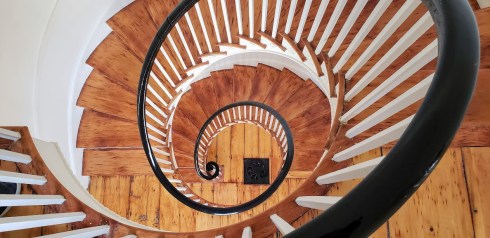
There might be a bit of fiction, or historical reach, in the narrative part of this post, but really it’s just an opportunity to show you some pictures of a newly-restored McIntire house which is available for RENT. The Butman-Waters House at 14 Cambridge Street, built in 1806-1807 by Samuel McIntire for Salem merchant (tailor, merchant, captain, colonel?) Thomas Butman, has been beautifully restored under the direction of one of Salem’s foremost residential architects, Helen Sides, and is available for rent immediately: it’s refreshed and ready and stunning, as you can see from these photographs. It features the most beautiful serpentine stairway I have ever seen.

mcintire first

mcintire re

mcintire re 2

mcintire staris re

mcintire 2

mcintire mantle detail

I told you, but you need to see more. The first, next-to-last, and last photographs are mine; while those in the middle are from the listing: which is here. The photographs speak for themselves but probably don’t convey what I can only call the humanistic proportions of the house: some architectural histories refer to the Butman-Waters house as “simple” and maybe that word is appropriate when comparing it with other McIntire houses, but it is “simply” elegant. The details make it so, but also the scale—and that staircase.

mcintire mantle re

mcintire mantle 2

mcintire detail collage

mcintire 11

mcintire second floor

mcintire third floor collage 1

mcintire 3rd view

mcintire stairThat staircase!

Every house has a story so here comes the semi-creative part, because Thomas Butman is a hard man to pin down. He was born in New Orleans, and he died in New Orleans, in the yellow fever epidemic of 1819-20, only 45 years old, along with the son and daughter from his first marriage. From at least 1803 until his death, he was in Salem. His second marriage, to Nancy Gedney Clarke, who was descended from two old Salem families, had occurred only three years before his death, and she and their infant son survived the yellow fever—actually I can’t determine whether they were even in New Orleans. Nancy and Thomas were married just two years when the beautiful house he had commissioned from Samuel McIntire a decade before had to be sold at public auction: when I patched together the succession of commercial notices Butman placed in the Salem newspapers from 1814-1818 it is clear that he was struggling, changing partners and storefront locations frequently. At first he is a tailor, and then a merchant: it’s hard to see how he could have afforded 14 Cambridge Street in the first place unless his first wife was very rich, and she’s even more mysterious than he is. Occasionally he is referred to as “Captain”, but “Colonel” or “Major” are his designations after 1811, when he and John G. Waters were named majors of the Salem Regiment which was preparing for what would eventually be called the War of 1812. Waters would eventually purchase 14 Cambridge Street: I like to imagine a kind of “band of brothers” bond which inspired to him to rescue Butman from financial distress but in reality the house was sold at public auction in 1818 and had a series of short-term owners before Waters acquired it in 1834. But it appears that while Butman was reaching for the life of a rich Salem merchant, Waters achieved it, primarily through the Zanzibar trade which reinvigorated the Salem economy in the middle of the nineteenth century. When Waters made news, it is about exotic cargos, including the two Arabian horses he brought to Salem, along with their “Arab handler”. The Waters family retained possession of 14 Cambridge Street all the way until 1962, when it was purchased by the Salem architect James Ballou and his wife Phyllis, and it remained in the Ballou family until just last year.

butman collage

14 cambridge collage1818 & 1912

And a few more views of the staircase, about which I learned an interesting fact from my friend Michael Selbst, the realtor: apparently it was reinforced by Mr. Ballou with the addition of iron rails every 10th spindle–you can see the brace if you look closely. What a great idea!

staircase

staircase 3

staircase 2

14 Cambridge Street, the Butman-Rogers House: rental listing here.


Joy and Remembrance

My husband was down south in the snow this past weekend while I was home alone for the bright and chilly December weekend. It was quite festive: with a dinner, drinks, an open house and an estate sale, although I missed one event due to an extended nap! When I wasn’t out I watched my favorite holiday movies on TCM, so Barbara Stanwyck was much in view as she is in most of them. I finished decorating all of my mantels, although we still don’t have our Christmas tree up yet: several years ago we had a dried-out tree well before the holiday, a traumatic experience which has led me to push it later and later ever since. I’m worried that I’ve pushed it too late this year as my favorite Christmas tree lot just sold out! For those of you who might be surprised that I have included an estate sale among these festivities, let me elaborate: I have found that local estate sales are often community events which not only provide people (Yankees, of course) to obtain a bargain but also an opportunity to remember–and celebrate–the deceased through admiration and remembrance of his or her items. They really are quite poignant occasions. As I walked through the adorable house of a recently-deceased lady among her cherished collections, I kept hearing the phrases I remember when and she loved that. This particular lady was obviously an enthusiastic keeper of Christmas, so the sale was even more festive—and she had great taste (I hope people will say that same about me as they sift through my things—I better purge a bit). The weekend ended on a high note when I was invited to attend an open house in the home of my “daguerreotype crush” from last week’s tour: his name is Benjamin Kendall, by the way.

The second week of December in Salem: at home

Seasonal Sights 15

Seasonal Sights 13

Seasonal Sights 9

Seasonal Sights 14

Around the McIntire District:

Seasonal Sights 7

Seasonal Sights 8

Seasonal

Seasonal Sights 5

Seasonal Sights 6

Seasonal Sights 3

At the estate sale & a drink with Mr. Benjamin Kendall

Seasonal SIghts 20

Seasonal Sights 19

Seasonal Sights 18

Seasonal Sights 17

Sights 4


Stereo Scenes of Salem, 1897-1947

Browsing through the vast collections of the Digital Public Library of America (DPLA) last week,  I came across a haunting image of the Corwin or “Witch House” in Salem. It was a stereo image taken by photographer Harry L. Sampson in 1947, so I assumed it was an artistic composition as that is very late for a stereoview, but it is deceptive: it’s not a stereoview or card but rather a dual image on a contact sheet, and part of of the Keystone-Mast collection of 350,000 images at the California Museum of Photography located at the University of California, Riverside. About twenty percent of this collection  (with more to come) can be accessed digitally via the portal Calisphere, which is linked to the DPLA. The Keystone-Mast Collection is the archive of the Keystone View Company of Meadville, PA, which was active from 1892 to 1963,  and constitutes a major source of visual documentation of the twentieth-century world. I’ve seen some of these images before, but not all, and I’m grateful for the context and source information as so many Salem images are floating out there without either.

Witch House 1947

Witch House 1926 Keystone-Mast Henry Peabody

Witch House 1920 Keystone Mast Henry PeabodyViews of the Jonathan Corwin “Witch House” in 1947, 1926, and 1920 by Harry L. Sampson and Henry Peabody, Keystone-Mast Collection, UCR/California Museum of Photography, University of California at Riverside.

Hawthornes House 1926 Keystone Mast

Keystone-Mast Underwood and Underwood

Pioneer Village 2 Keystone-Mast

Pioneer Village KeystoneNathaniel Hawthorne’s birthplace in its original location in 1926 and 1897 (Underwood & Underwood); the newly-built Pioneer Village in 1930, Keystone-Mast Collection, UCR/California Museum of Photography.

Old Custom House 1926 Henry Peabody Keystone-Mast

Gables Keystone-Mast 1926

Conant Statue Keystone-MastThree 1926 images: the entrance to the Old Custom House, the House of the Seven Gables, and the Roger Conant Statue, Keystone-Mast Collection, UCR/California Museum of Photography.

While I’m discussing visual sources, repositories, digitization and access, I’m going to make a (-nother) little plea to the Peabody Essex Museum and Phillips Library: according to the 1925 Catalogue of Negatives in the Essex Institute Collections, the museum has among its collections thousands of negatives representing every single street in Salem (and many of towns and cities) in the early twentieth century: could some (many, all) these be digitized and shared via the DPLA, please? Such an initiative would be an amazing compensatory gesture on behalf of the PEM.

Negatives collageJust a few negatives listed in the 1925 Catalogue of Negatives in the Essex Institute Collections, which is available here


An American Athens

Driving home to Massachusetts from the Hudson River Valley last weekend, I actually drove west, as my brother told me there was a village across the river which I might enjoy: Athens. All the day before when we were touring the riverfront estates of my last post we would look across and see some great house and every time I asked him where it was he would say Athens. I don’t think he was correct as it is a bit more to the north, but still I had Athens on my mind when I woke up the next day and was determined to go there. It’s just across the Rip Van Winkle bridge from Hudson, north of Catskill, which I visited last year, bordered by Cairo (of course) on the west. Apparently there is both a town and a village of Athens and I believe I was in the latter; no one has ever been able to explain the differing jurisdictions that you find in New York and New Jersey—hamlets, villages, boroughs, towns and townships—to me so I am perpetually confused. This seemed like a village, a river village, and it was absolutely charming. Probably the most famous building in Athens is its lighthouse, which really is a lighthouse, but my sentry was the 1706 Jan van Loon house: how different Dutch and English First-Period houses are!

Athens 1

Athens 2

There are several streets of historic houses clustered along the river and I immediately focused on the brick structures. The Northrup house (1803, first up below) is in need of some work but it features the characteristic elevated first floor that I saw on several Athens houses, an architectural feature which I always associated exclusively with southern houses for some reason. There were some lovely wooden houses, but the region’s clay banks supported as many as eight brickyards in nineteenth-century Athens, and fostered masonry construction: I just couldn’t capture enough of these old brick houses, glowing in the autumn sun.

Athens 3

Athens 9

Athens 10

Athens 4

Athens 7

Athens 5

Athens 11

Athens 15

Athens 14

Athens 8

Athens 13

Athens 12

Athens 16


Land of the Livingstons

This past weekend I toured six “country seats” built by various members of the venerable and prominent Livingston family of the Hudson River Valley in the later eighteenth and nineteenth centuries: most privately-owned, one owned by the state of New York. My brother and brother-in-law live in Rhinebeck, so I have visited this region quite a bit, but I find new old houses every single time I return, and this time was no exception. When we started off, I was thinking only 6 houses? we’ll be done in a flash and $60 for six houses! as our Christmas in Salem tour features more houses and a lower ticket price but it took us most of the day and was well worth it: I had an urban house tour in my mind where you just walk from place to place but these are rural county seats situated on vast acres of land—-mostly waterfront. The scale of both houses and land was much larger than your average house tour, and the tour was a bargain: I’m alway happy to support historic preservation in any case, and in this case it was Hudson River Heritage. I’m going to present the tour in the very order that we saw these houses and give you my impressions of each along the way: no interior photography was allowed except in the state-owned property, Clermont, but as one of the houses is currently for sale and others are included in the amazing (again, expensive but worth it) newly-published book by Pieter Estersohn titled Life Along the Hudson. The Historic Country Estates of the Livingston Family and other publications I can show you some interior views.

You will notice it getting progressively brighter; the day started out pretty dreary and ended with sun. Still all houses shone.

RICHMOND HILL, built in 1808

This federal—-no I think proper Palladian is more accurate–house was simply stunning: beautiful proportions and details. It is the most formal farmhouse I have ever seen as it sits in the midst of 58 acres and many outbuildings, including a period Dutch barn, also unlike anything I have ever seen (I’m such a New Englander!). It has not been lived in for some time and is currently for sale: the photographs on the real estate site (I’m including the west bedroom and basement kitchen below–there’s a modern kitchen too!) are not really doing it justice in terms of the details: one of the mantles had a pinecone design which (again) I have never seen before. 

Hudson 1

Hudson 7

Hudson 6

Hudson 10

Hudson 11

Hudson 2

Hudson 8

Hudson 4

Hudson 5


CHIDDINGSTONE, Built in 1860

This is a “Bracketed Italianate” house which has recently been restored and redecorated with 15-foot ceilings and a stunning river view. The interior is all about height over width: the rooms were not all that large in terms of size but those high ceilings, along with the floor-to-ceiling windows and furnishings, made them seem positively grand.

Hudson CH 2

Hudson CH 3

Chiddingstone_834_510_000000_s

The front parlor photographed by Pieter Estersohn

Hudson CH 4


CLERMONT, Built from 1779-82

Then it was on to the oldest Livingston house, Clermont, which was built in the 1730s but burned mostly to the ground by the British during the Revolutionary War and rebuilt between 1779 and 1782. Clermont is a state historic site with an informative visitors’ center and extensive grounds along the river. Here we had a proper (essentially genealogical) tour and were able to take photographs: the interiors are furnished in the Colonial Revival style adopted by the last Livingstons to live at Clermont in the 1930s.

HUDSON CL2

HUDSON CL 3

HUDSON CL 4

HUDSON CL 5

HUDSON CL 6

HUDSON CL 7

HUDSON CL


MIDWOOD, built in 1888

Midwood is a sprawling Colonial Revival house situated on 87 acres along the Hudson: it made quite the contrast from Clermont as it is a very much lived-in and lively house, furnished in an eclectic style that must reflect the spirit of its owner and felt very “Bloomsbury” to me: we spent quite some time there just because there was so much to see and we were not alone. You can take your own tour here, and I’m sharing two interior views below.

Hudson M3

Hudson M4

Midwood collage

Side Parlors photographed by Christopher Baker


CLARKSON CHAPEL, built c. 1860

One of many board and batten Carpenter Gothic structures in the region, the Clarkson Chapel was built following a dispute–a schism, I suppose– at St. Paul’s Episcopal Church in nearby Tivoli. Here we met a wonderful guide/steward who had made her own chart of the division of the original Livingston Manor. This was very helpful, and another informative source is here.

Hudson Chapel

Hudson Chapel 2


EDGEWATER, Built in 1825

Our last stop was at Edgewater, a magnificent Greek Revival mansion perched on the Hudson shore in Barrytown, the long-time home of Richard Jenrette, who died earlier this year. My first house was a Greek Revival, and so I studied and bought everything I could about this iconic architectural style, and Mr. Jenrette’s Adventures with Old Houses (1995) became a bible of sorts: my copy is coffee-cup stained, page-marked, and well-worn. Edgewater is preserved, polished, and furnished to perfection, and signs of Mr. Jenrette were all around within: notes, cards, the lift on the magnificent stairs, the program to his memorial service. Of course the whole house is a memorial to him, as is the foundation which now owns Edgewater and his other homes: the Classical American Homes Preservation Trust. I had pored over pictures of Edgewater so many times that when I finally found myself inside, I felt like I was returning to it, which is the first time I’ve had that experience. That said, it’s even more beautiful than its photographs and is a very real, much-loved house indeed.

Edgewater

Edgewater 2

Edgewater 3

Edgewater 7

Edgewater 8

Photographs of the Music Room and Dining Room by Dorothy Hong for the Wall Street Journal (above); the Edgewater guesthouse (below) was built in 1996.

Edgewater 6

Edgewater 4

Edgewater 5


A Converted Convent

Disclosure of shameless showcasing of husband’s work! On a beautiful Indian Summer day, with the sun streaming in through the large windows throughout, I toured the former Convent of the Sisters of Notre Dame on Federal Street yesterday with my husband, the architect responsible for its conversion into eight residential units. The convent was built in 1878 for the Sisters, who joined St. James Parish in 1864 and served as instructors in the large parochial school next door. Ten years later, a regional Catholic directory records 14 sisters living in the building, with their Mother Superior, Sister Mary Felicitas, and the school office on the first floor (the Sisters were real educational heroines, who opened parochial schools all over the state, but particularly in its industrial cities: they arrived in Salem in 1854 to join the Parish of Immaculate Conception right in the midst of the Know-Nothing frenzy and then later came over to St. James—you can read much more about the Massachusetts Sisters here). I honestly don’t know how long the building has been vacant, but it is part of a large complex on Federal Street built because of the initiatives of Father John J. Gray, including his Italianate rectory across the street (also converted to residences), and the school and “new” (1891) church next door. The St. James Parish, Salem’s second Catholic parish, has now been merged with its first, Immaculate Conception, as Mary, Queen of the Apostles. The sale and conversion of archdiocesan buildings is a huge trend here in Eastern Massachusetts: this is my husband’s second convent conversion in Salem. With sensitive architectural adaptations we can all continue to enjoy these well-built buildings for quite some time. As you can see from the photos I ran around snapping, this particular building is BIG, with wide, long corridors and very high ceilings on both the first and second floors, but there are nooks and crannies as well (particularly on the third floor) and a finished basement. In back, there is a HUGE parking lot (very precious in Salem) right next to the brand-new new Community Life Center on Bridge Street. As the building was restored with Massachusetts Historic Rehabilitation Tax Credits, the units will be rented for a period of five years and then converted to condominiums.

Convent 1

Convent 2

Convent 3

Convent 16

Convent 7

Convent 6

Convent 4

Convent 12

Convent 5

Convent 10

Convent 11

Convent 9

Convent Collage

Convent 14

Convent 8Looking out these windows to the east and west, you see Old Salem in the form of the parochial school, which will also be converted into residences, and New Salem in the form of the Community Life Center and River Rock housing development beyond.


Saratoga September

We were in Saratoga Springs for a big family wedding this past weekend, one of four (or did I hear six?) that the city absorbed effortlessly: by all appearances Saratoga has its tourism game down and seems to be just as accommodating and entertaining to its permanent residents. Everything about it speaks to careful planning and “showcasing” for lack of a better word: wide boulevards, strong commercial and residential architecture (in close proximity), a Visitor’s Center and History Museum both in the city center within a beautifully-maintained park (+carousel), a performing arts center a bit further out in the Saratoga Spa State Park, an intact Armory transformed into a military museum, a mixture of commercial and boutique hotels, uniform, aesthetically-pleasing SIGNS (including iron markers for every neighborhood), public art that both reflects and enhances its streetscape, a seasonless economy, and clean sidewalks. Saratoga Spring has been a city of attractions for a long time, offering up a succession of healing waters, potato chips, horse racing, gaming, and a variety of arts to its many visitors over a century and a half, and its experience—and pride–shows.

Saratoga 1

Saratoga 2a

Saratoga 2

Saratoga 7

Saratoga 6

Saratoga 10

Saratoga 4

Saratoga past and present

Saratoga past and present 2Horses and ballet slippers (a nod to the New York City Ballet’s summer residence at the Saratoga Performing Arts Center) abound on Saratoga’s main streets as do markers; the Saratoga History Museum in the former Canfield Casino has both permanent and rotating exhibits and tours; two views of old and new—I really liked this gallery floor made up of scanned postcards of all Saratoga’s great hotels. AND now for some houses: this is just a sampling, as there are MANY to see, mostly different varieties of Victorian and some early twentieth-century styles. You could take a walking tour focused entirely on variations of the Italianate.

Saratoga 31

Saratoga 29

Saratoga 21

Saratoga 20

Saratoga 18

Saratoga 30

Saratoga 17

Saratoga 16

Saratoga 19

Saratoga 12

Saratoga 15

Saratoga 11

Saratoga 14

Saratoga 32