
My fascination with the newly-digitized glass plate negatives of Frank Cousins, documenting Salem at the turn of the last century, continues: right now I’m curious to know all there is to know about the legendary Doyle Mansion on Summer Street, home to many members of ancient Salem families, whether they were “in transition” or truly settled in. Cousins gives us a glancing view of its Summer Street facade in one photograph, but he’s clearly more interested in its rambling additions in the rear. There are also several drawings by a Miss Sarah E. C. Oliver included in an absolutely wonderful 1948 article in the Essex Institute Historical Collections based on the memoirs of Miss Bessie Fabens, whose aunt was a fabled resident of the Doyle Mansion. This same article also includes the first-floor plan of the “ell-ongated” composition by architect Phillip Horton Smith, likely rendered just before the mansion was taken down in 1936.


 Summer Street from Broad with the Doyle Mansion on the right, Frank Cousins collection of glass plate negatives from the Phillips Library at the Peabody Essex Museum, via Digital Commonwealth; drawings by Miss Sarah E.C. Oliver and first-floor plan by Phillip Horton Smith in “The Doyle Mansion—Some Memories and Anecdotes” by Bessie D. Fabens, Essex Institute Historical Collections, Vol. 84 (1948); Cousins’ views of the back of the house and its many addition (+ the lost Creek Street).
This house was huge and home to 30-35 inhabitants during its peak years: from the 1880s until its closure in 1933. The original rectangular Federal construction was built by the Reverend Joshua Spaulding of the Tabernacle Church around 1800, but a half-century later it became a boarding house under the ownership of an Irishman named Thomas Doyle: as the tenants of “Doyle’s” increased so did its additions. Miss Caddie (Caroline Augusta) Fabens, Bessie’s great-aunt and the inspiration for her mansion memoir, moved in in 1878 intending to stay only a few weeks; instead she became its “star boarder” over the next 58 years. Bessie visited her often, and got to know the house very well, and so her memoir is incredibly detailed. As verified by Cousins’ photographs, she notes that “ell after ell” was added on “until one side extended the whole length of the old-fashioned garden which sloped down from the back of the house”. These ells very clearly demarcated on the exterior, but inside “no one knew where the original house ended and the additions began”. Bessie describes a rabbit warren with eleven staircases, countless rooms, but only three toilets (all on the ground floor), and a single bathtub for the mansion’s 30+ residents, secured by “appointment only”. Within members of all the “distinguished” families of Salem lived together, “stray survivors” of the Silsbee, King, Cushing, Shepard, Trumbull, Brown and Chase families, in relative harmony, as “not only did [the Doyles’] denizens all know each other, but they knew all the ramifications of their family histories for at least four generations. It was sort of a big family party with the likes and dislikes which go with New England families, and the impersonal toleration which prevents them from being obnoxious”. Wouldn’t this be a great setting for a novel or play?


 Views of the exterior and interior of the Doyle Mansion by Frank Cousins, collection of glass plate negatives at the Phillips Library of the Peabody Essex Museum, Digital Commonwealth.
All of these people brought their furniture and furnishings—including “shelves of blue Staffordshire and Canton China never used in all those years”, documented by both Bessie and Cousins. Bessie adds that “almost every room had its fireplace or Franklin stove” and all the comforts of home except perhaps for the “scanty” plumbing, and concludes that A legend grew up that every true Salemite must at sometime or other stay at the Mansion and there were very few of us who had not done our time there. The Mansion’s time came to an end in 1933 and much of the land on which it sat—as well as Samuel McIntire’s house next door at #31–was sold to the Holyoke Mutual Fire Insurance Company for the construction of their behemoth concrete building in 1934. Despite the recognition that both houses were “historic”, they were both swept away (along with Creek Street) by 1936 for the block-filling structure that still stands there.


 Boston Globe, June 1934; the Holyoke Mutual Fire Insurance building, built in 1936 and now owned by Common Ground Enterprises (and its rather weedy sidewalk!)


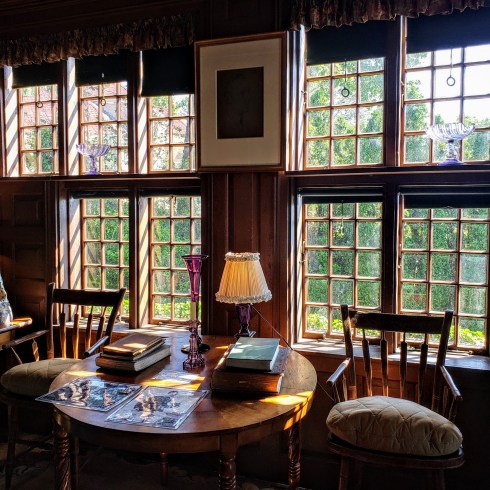


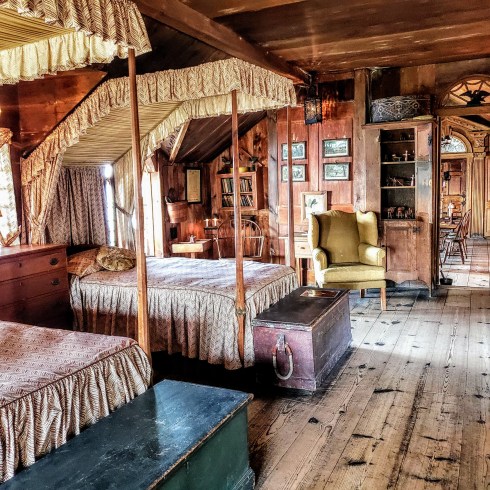


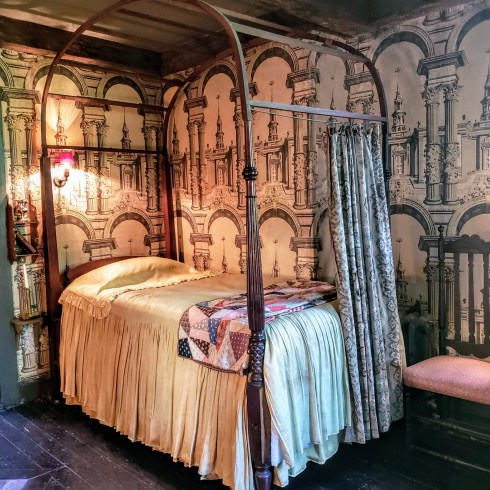


 The Frank Cousins “Team”/ Employees’


 Signs everywhere in Raleigh, which has held on to its state heritage markers (even for sites that no longer exist) and added lots more.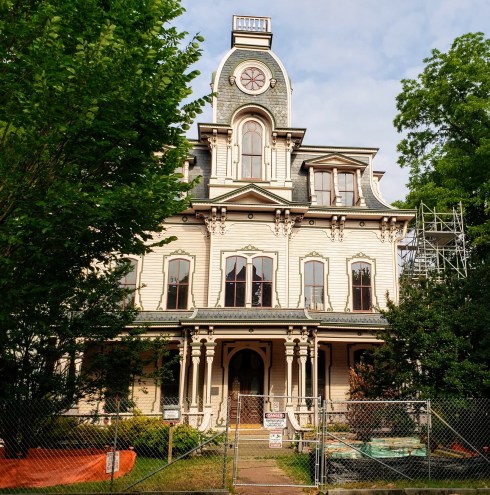


 The Heck-Andrews House (under renovation), Polk House, and Executive Mansion in the city center, and Oakwood beyond—and beyond Oakwood.

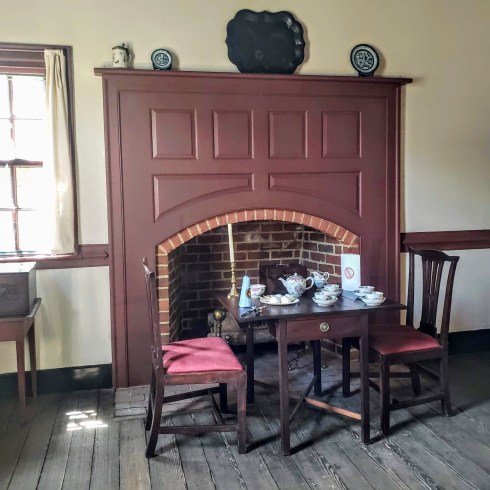


 Exteriors and Interiors of the Lane and Mordecai Houses + their gardens and the Andrew Johnson birthplace, adjacent to Mordecai.


 The City of Raleigh (COR) Museum: a must-visit spot; this last question is existential!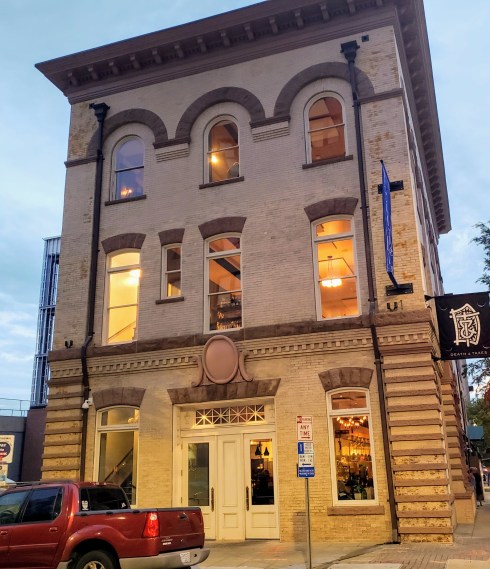


 Pages from Gardner’s Sketchbook, Volume One at Duke University Library’s


 Calvin Townes of the First Regiment; the surviving Regiment at Salem Willows, 1890; Memorials at Spotsylvania and in the Essex Institute, from the History of the First Regiment of Heavy Artillery, Massachusetts Volunteers, formerly the Fourteenth Regiment of Infantry, 1861-1865 (1917); the demolished Harris Farm.


 The Munroe House on Lexington Green (which is presently for

 The Jonathan Corwin (Witch) House, in all of its incarnations in an early 20th century postcard, Historic New England; in 1947 as restored by Gordon Robb and Historic Salem, Inc., and photographed by Harry Sampson, and in the tourist attraction in the 1950s, Arthur Griffin via Digital Commonwealth.

 Port Royal Parlor at Winterthur and South Drawing Room at Sir John Soane’s Museum, photograph by Derry More.


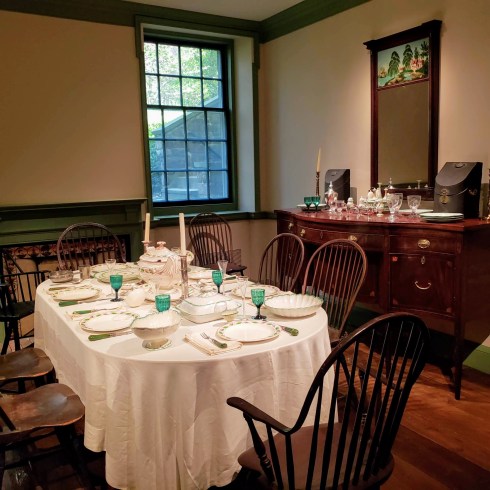
 So many rooms—and stuff—for eating and drinking, of course, but dining rooms can be very revealing in their details. After the famous Chinese Parlor are several shots of the Du Pont Dining Room, with the Derby family’s green knives and knife boxes (+ McIntire chairs and Needham secretary, and adjacent candlestick closet. I can’t remember the name of the second, simple dining room, which is one of my favorite Winterthur rooms, but the photograph just above is of Queen Anne Dining Room, which really represents Mr. du Pont’s creative abilities (as well as his collecting efforts).

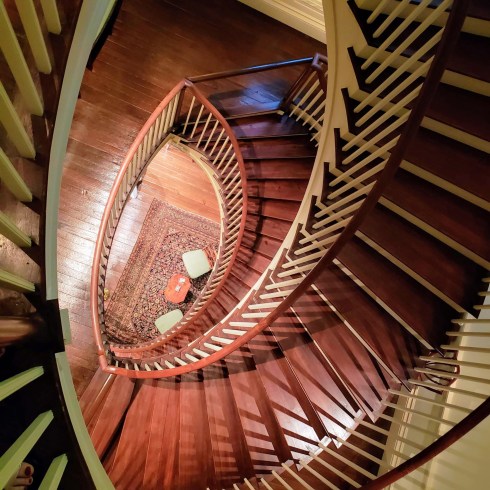


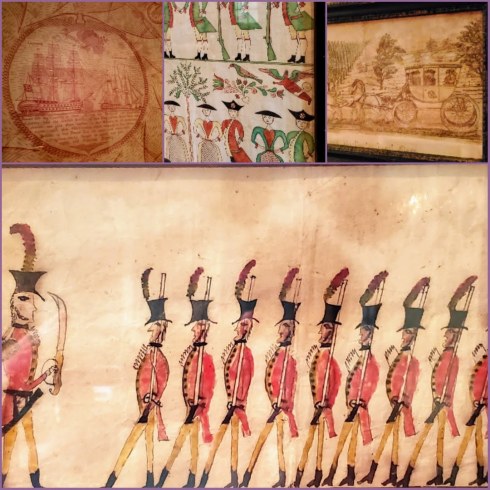


 The Montmorenci stair, taken from a North Carolina house, replaced the “baronial” staircase which Mr. du Pont’s father installed. Folk objects and images, just a few tea tables, and just one china room. Several Salem items: the chimneypiece embroidered by Sarah Derby Gardner, a Silsbee chair, Mr. du Pont’s secretary (and bed), and the Corné mural from the Lindall-Barnard-Andrews House.


 AP Photo by Thibault Camus
 The Cathedrals of Reims and Nantes in their present glorious condition. Photographs by Nicolas Janberg for


 Edwards’ book and paintings; two 1914 postcards; Charles W. Wyllie, The Burning of Reims Cathedral after the Severe Bombardment of the Germans, 17-24 September 1914. From The Sphere, 7 December 1914.
![[The Angel of the Resurrection on the Roof of Notre-Dame, Paris]](https://i0.wp.com/streetsofsalem.com/wp-content/uploads/2019/04/notre-dame-angel-of-resurrection-1853-getty-charles-negre.jpg?resize=490%2C690&ssl=1) Nantes Cathedral in flames on the night of January 28, 1972, Museum of firefighters Loire-Atlantique. Hervio Fund; Charles
Nantes Cathedral in flames on the night of January 28, 1972, Museum of firefighters Loire-Atlantique. Hervio Fund; Charles 


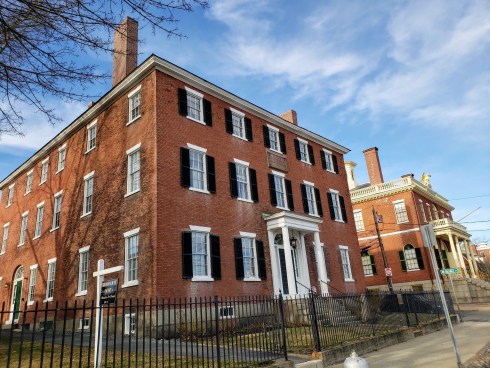
 Historical artist Peter Waddell’s
 Peter Waddell’s recreation of one of Dolley Madison’s “Wednesday Squeezes” with many turbans and feathers in evidence, White House Historical Association; the capture and burning of Washington in 1814, New York Historical Society. Mrs. Madison continued to be an active hostess in her temporary quarters, which Mrs. Crowninshield tells us all about, but she does not have much to say about the post-war state of Washington.






