Monthly Archives: October 2026

Mapping a Century of Salem

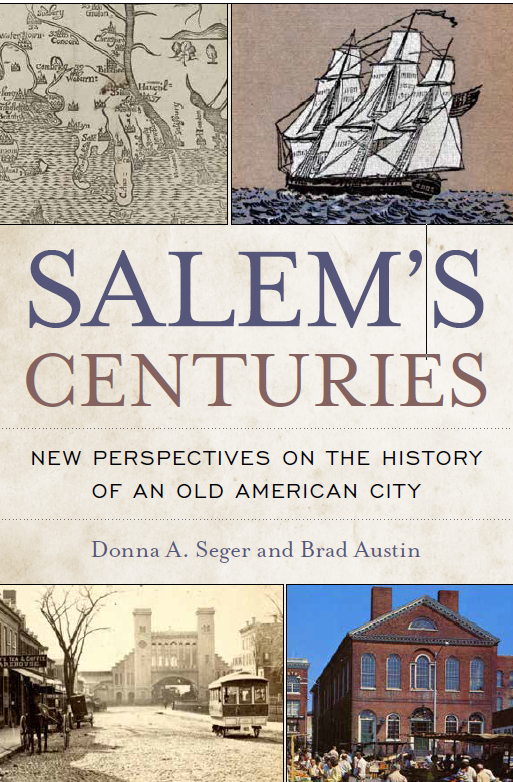
Salem’s 400th anniversary year has been full of events large and small. What I missed was one big “coming together” moment: maybe the parade was that, but it didn’t feel that way to me. Nevertheless, Salem has many social, cultural, and historical organizations and all of them stepped up, for sure: it’s been kind of a decentralized rolling commemoration. Salem State University sponsored several cool events, and the one I worked on was an exhibition of Salem’s last century (1926-2026) entitled Mapping a Century of Salem which was displayed in the Old Town Hall all summer long and has now moved to the Berry Library on our campus. My Salem’s Centuries co-editor, Brad Austin, and I suggested the century focus, but that was about it: the rest of the exhibition prep was pure collaboration with my colleagues in other departments, in the administration, from the library. This collaboration was almost unprecedented in my career. You might think that there are myriad interdisciplinary initiatives in a university setting, but I have never found that to be the case. And I have never worked with administrators on any project apart from accreditation and strategic planning, so the Mapping project was extra special, with deans and directors out in full force.

Packing up at Old Town Hall, and the newly-reinstalled exhibit at the Berry Library, Salem State University.

Exhibit planning developed several themes: the Salem Tercentenary of 1926 (with four parades and myriad happenings, all of which generated so many great pictures we wanted to showcase), the commercial heyday of the 1940s, when Salem was truly a “walkable city,” Salem’s “long big dig” encompassing the construction of a new train tunnel and urban renewal in the 1950s and 1960s, immigration, and the rise of Witch City tourism. All these themes can be well-illustrated by the expanding collections of the Salem State Archives and Special Collections. We were focused on, and centered by, the amazing 1946 Nirenstein real estate map of downtown Salem which illustrates the amazing commercial vibrancy and diversity of the city at mid-century and which we used as background for most of the exhibit’s sections. It gradually became clear that we needed to expand our geographical range, however, as Salem’s later 20th century immigration could not be confined to the downtown and we also wanted to tell the story of our own institution.

There are a several features of the exhibition that deserve a special spotlight in my opinion, most prominently the coverage of the home front during World War II and the focus on immigration in the 1960s and 1970s. Both topics are presented in a very personal way and enhanced by oral histories. We also invite people to tell their stories, and at Old Town Hall we collected hundreds of hand-written notes from the (11,000 by our count) visitors to the exhibition. History students are presently hard at work at turning all of these notes into a big map, which of course will be a perfect archival deposit—along with everything else. A century from now, if the organizers of Salem’s quincentenary celebration wish to discover what their predecessors were up to, they will have no problem.


Bewitched Miss Bly of Salem

I was curious when I came across a Salem woman named Carrie Peabody Bly making headlines in national newspapers in the late summer and early fall of 1900. I love Nellie Bly and thought, wow, maybe Salem had a namesake intrepid journalist explorer! Bly is not a Salem name, but Peabody certainly is: could Carrie have adopted it to emulate her hero? But no, of course not, our Miss Bly was not an immersive reporter but rather an entranced “witch,” and a fly-by-night one at that (I think—she just disappears). Carrie Peabody Bly appears first in a series of articles first published by the Boston Post and picked up by the St. Louis Post Dispatch in August of 1900: her story went viral over the next six weeks or so but remained largely the same. She claimed to be a simple Salem girl who became a store clerk and milliner and then fell ill and woke up entranced and dwelling in the attic of the Witch House with regular visitors, including Nathaniel Hawthorne, Oliver Wendell Holmes, Roger Williams’ sister Betsy (the Witch House was then believed, incorrectly, to have been the residence of Roger Williams so Betsy was presumably familiar with it), and the “Salem witches.”

Nathaniel Hawthorne was Miss Bly’s chief spirit and “friend,” always referenced extensively in stories of her bewitchment. He appeared early on, while she was in the Witch House attic alone and about to enter one of her trance-like states. In her well-reported words, “all at once I saw a kind, benevolent looking gentleman standing in the doorway. He was a stranger to me, but the moment he spoke I knew it was Hawthorne.” The author/spirit told her to be patient in his “soft and clear” voice, as “you are to do great things. You may not wish to do them all, but remember your duty and you will be rewarded. Do them as Hester Prynne did her duty, as she patiently wore the scarlet letter on her breast.” From that moment on, he was with Carrie every day. A spiritualist Hester Prynne! With the big Hawthorne centenary only a few years away, this connection must have struck a chord with the public, and she gained more attention—too much attention, by her own admission. She preferred to dwell with the spirits.

I searched in vain for a quote from a member of the Hawthorne family about the conjuring of Nathaniel. I can’t imagine they were very happy about it, but Miss Bly might never have caught their attention. She wasn’t around for long: by November of 1900 there are no more headlines. In the following year, I could only find one reference to her, an announcement of her move to Marblehead, and then she disappears, into thin air. Though her fame was fleeting and never approached the notoriety of the “Salem Seer,” Charles H. Foster, before her or the “Witch of Lime Street,” Mina “Margery” Crandon, after her, her story is certainly a Salem one.


Matthew Stickney had a very good eye

There were many important and influential Salem collectors, and among them Matthew Stickney (1805-1894) really stands out. He remains a revered figure among coin collectors, both for his pioneering activity and the breadth and depth of his collection. He had inherited a large amount of his Continental currency from his Patriot grandfather, which he was determined to supplement with all the most important American (and some foreign) issues, and he worked with the US Mint itself and early brokers to achieve this aim. The most sought-after US coins, including the 1804 dollar (which apparently does not date from 1804 but is still referred to as the “king of American coins”), and the storied 1787 Brasher Doubloon, which seems to have had a Maltese Falcon-like hold on mystery writers and filmmakers in the mid-20th century, were all part of the Stickney Collection.

Coins were his primary passion but Stickney did not confine himself to currency. He collected Americana before there really was such a category. Anything printed—-almanacs, autographs, newspapers, diaries, election sermons, pamphlets and printed images. He collected Nathaniel Hawthorne, whom he must have also known. He was a genealogist and a historian. Stickney was an Essex County native, and spent most of his life at 119 Essex Street in Salem, a building that has not survived. Following his death in 1894, his three unmarried daughters retained his collection for quite some time before consigning much of it to two very noteworthy auctions held in 1907: a coin sale in Philadelphia in the June, and all of the American collections in Boston in November. Both made considerable headlines and set price records. Christian Remick’s perspective of an occupied Boston Harbor seems to have been (re)discovered at this time, and the papers also took note of the pamphlet recording an important debate at Harvard University, A Forensic Dispute on the Legality of Enslaving Africans, held at the Public Commencement in Cambridge, New-England, July 21st, 1773.

Matthew Stickney and his collections are interesting subjects quite apart from their context, but if we widen the lens a bit we can appreciate the “collecting culture” that was present in Salem in the nineteenth century, and later, centered around one of the two founding institutions of the present Peabody Essex Museum: the Essex Institute. We hear more about the role of the other founding society, the Peabody Museum, which was established in 1799 as the museum for the East India Society and operated as a  “cabinet of natural and artificial curiosities” collected by the Salem sea captains on their voyages around the world. The Essex Institute’s origins were in the realms of local and natural history, and like the Peabody, its members were engaged in forming its collections, but also in a vibrant intellectual community focused on scholarship and the presentation of research on these same collections. Matthew Stickney did not go to university: he was born in Rowley, Massachusetts and educated in the public schools there. In his twenties, he headed south to Peabody and Salem and worked as a retailer of West India goods. Presumably he earned enough income to support his continuous collecting and then some: he retired in the 1850s and spent the next 40 years focusing on collecting and working at the Essex Institute. Mr. Stickney had a very good eye, but he was in good company too! He was a founding trustee, frequent contributor to its Proceedings, and according to his obituary, an “honored member” of the Institute who served as Librarian and Curator. I’ve seen the central role of the Essex Institute in fostering civic and scholarly engagement among Salem men and women in the nineteenth and twentieth centuries time and time again. After the merger of the Institute and the Peabody Museum and the creation of the present Peabody Essex Museum in the early 1990s, I believe that the former’s historic role could have continued with the retention of its Phillips Library in Salem rather than its removal to a former factory in Stickney’s hometown of Rowley, but that just did not happen. The former buildings of the Essex Institute remain vacant, in the midst of busy Salem.

P.S. One blog post can’t do justice to the life and work of this man! For further research, the Stickney Family papers are located at the Phillips Library in Rowley, MA, of course.


Nova Scotia/Acadia/ Mi’kma’ki

I am just back from a delightful four days in Nova Scotia, and have several impressionistic takeaways. First, flags are definitely unfurled in Canada: I’m sure you can understand why. Second, a question: why is Canada so much better at presenting and representing its multicultural history than the United States? Third, wow so many Gothic Revivals (properly called Carpenter Gothic, I think)! I want to follow up on the second point (question) while sharing my photos, which present more of a not-very-representative overview. Why not representative? Because Canada’s (or maybe I am casting too broadly and should just say Nova Scotia’s) multiculturalism is layered and interwoven and consequently both subtle and substantive at the same time. Many wayfinding and exhibit signage are in three languages: English, French, Mi’kmaw, the language of the indigenous Mi’kmaq Nation. Three perspectives in many exhibits. By contrast, American attempts at presenting multiculturalism seem like veneers, more simple, less integrative, and I fear much less impactive.

I wanted to explore the impact and remembrance of the catastrophic Halifax explosion of 1917 and search for some Loyalist history on my visit: I accomplished the first goal but not the second. It was difficult to locate much 18th century history in Halifax (except for the exhibition I’m going to close with), and I didn’t make it to Shelburne, where the Black Loyalist Heritage Centre is located. If I had, I would have been exposed to yet another perspective! Next trip. The Halifax Explosion of December 6, 1917, was a result of the collision of the French munitions ship Mont-Blanc with the Belgian relief ship Imo in the busy harbor, creating a massive conflagration which killed 2000 people and left thousands more injured and homeless. It leveled the harborside neighborhood of Richmond, which was rebuilt as the stamped-cement, garden-city Hydrostone Neighborhood, where we stayed with friends. This district is also home to the Halifax Memorial Bell Tower and its surrounding commemorative park, layered with subtle yet striking remembrance design elements: edging with the last telegraph message, benches with the toxic contents of the Mont-Blanc. Then it was down into the Hydrostone district, also an expression of remembrance.

Downtown Halifax mixes old and new, with the expansive harbourwalk embracing both. Here were markers noting key events and people not only in the city’s indigenous, French, and English history, but also pretty much any group that ever arrived and/or settled for a spell. Given the size of the harbor and Halifax’s consequential role in maritime and naval history from the eighteenth century onwards, this recognition presented quite a melange, from Norwegians to Lebanese. I walked up the hill to the famous Citadel, so I could get an overview, but knew I wanted to return to this storied fortress when I had more time, which I did on our last day. Beautiful churches: Protestant and Catholic. We were also fortunate to get a tour of the studios of the Nova Scotia College of Art and Design, situated behind the individual facades of interconnected 19th century buildings, as our host is a professor and administrator there (as well as a very successful jeweler).


We drove north towards the Bay of Fundy on Saturday and stayed at our hosts’ charming cabin on Falls Lake, and then drove to the Grand-Pré National Historic Site the following morning. This is a poignant site for the remembrance of Nova Scotia’s Acadian community and the Great Upheaval of 1755-56, during which 80% of the approximately 14,000 French Catholic Acadians in the region were deported to British Protestant colonies down south, including nearly 1000 to Massachusetts. This is beautiful, fertile country, sustained: you can see why all who settled here cherished it so. We then circled back to Halifax by way of the very important shipbuilding port Lunenburg, which has incredible architecture—-including its own distinct dormer style! The black and white church below is St. John’s Anglican Church, which was built in the mid-18th century, “gothicized” a century later, and more recently rehabilitated after a fire in 2001. A former public school, the Lunenburg Academy/Library is also being restored. The last photo below is of the Bluenose II, a 1963 reproduction of the famous 1921 ship that is prominently featured on the Canadian dime.

Back in Halifax, I returned to the Citadel on our last morning because I wanted to see the interior and contents of this hilltop fortress. I didn’t really have high expectations, but I was blown away by its newest permanent exhibition, Fortress Halifax: A City Shaped by Conflict, which spans over more than 6000 square feet across seven rooms with dramatic visual content and cutting-edge audio-visual interpretive tools. I didn’t have high expectations because I thought I would find a more military-focused interpretation within a fort, but Halifax’s strategic location and huge harbor did make it a fortress so the title and the focus are appropriate. At the same time though, the exhibition was about much more than military history: it encompassed social, economic, environmental, cultural, and event-based history all at the same time with the very layered presentation I was referencing at the beginning of this post. Its time span extended from pre-colonial Mi’kmaq history through to the modern era, and encompassed indigenous, British, European, American, North American and even global perspectives. I’m really glad that it’s a permanent exhibition, as I will definitely be returning.