Tag Archives: Local Events

A Viking Ship, Two Black Hats, and One Special Street

Despite the fact that I am a middle-aged woman rather than an adolescent boy, I was absolutely determined to see the reproduction Viking ship Draken Harald Hårfagre as it sailed into Plymouth Harbor yesterday. Plymouth is just one of the stops on the ship’s east coast tour, and it was the most convenient for me in terms of time and geography, so down to the South Shore I went. It was a humid day and all was gray as we waited for a pending storm and the ship, which slid into Plymouth Harbor very gracefully. I had hoped to see it under sail, but of course that wasn’t going to happen in the wide, calm harbor. You (and I) will have to see it under sail here. I always enjoy seeing the juxtaposition of “old” and new vessels; of course Plymouth has that all the time with the Mayflower II in the harbor—but the Draken is so much more “alien”.

Plymouth Adventure 15

Plymouth Adventure 2

Plymouth Adventure 20

Plymouth Adventure 3

Plymouth Adventure 4

Plymouth Adventure 5

Well, that’s it for the ship (which will be in port until Friday evening and then it’s going down the coast). Both before and after its arrival I occupied myself in my usual way: looking at old houses and comparing Plymouth to Salem as a tourist destination and purveyor of local history. Even though they are very different places, I can’t help making comparisons between these two New England ports, put on the map by their seventeenth-century origins and happenings as symbolized by two omnipresent black hats: of the Plymouth Pilgrim and the Salem Witch. Indeed, Salem and Plymouth have both been on the heritage map for quite some time, whether it be for educational or tourism purposes.

MA MAP 1966Colonization in America visual wall map, 1966, prepared by the Civic Education Service, Washington, D.C.; David Rumsey Map Collection.

In terms of physical size, Plymouth is one of the largest towns in Massachusetts, whereas Salem is among the smallest cities. Plymouth’s population is actually larger, I was surprised to realize, but Salem’s is much more concentrated. Salem is urban and closer to Boston; Plymouth doesn’t quite feel “suburban” to me but I guess it is. Both places are county seats and have vibrant downtowns and tourist-based economies. Both towns are “historic” but in very different ways: Salem’s history is predominately commodified while Plymouth is more committed to public history. As a heritage destination, Plymouth is what Salem would be if the Peabody Essex Museum had not absorbed and essentially obliterated the Essex Institute: its Pilgrim Hall Museum (founded in the very same decade—the 1820s–as the Essex Historical Society, one of the Essex Institute’s founding organizations) and Plymouth Antiquarian Society serve as public repositories and interpreters of the history of “America’s Hometown”. This makes for a very different projection. I’m not trying to pass judgement here (although regular readers will know how I feel): Plymouth seems to have preserved quite a bit of its “ye olde” parochial identity whereas we all know that the Peabody Essex Museum is a very sophisticated, global institution.

Plymouth Adventure 14

Plymouth 16

Plymouth Adventure 13The Jabez Howland House is presented much like Salem’s “Witch House”, as a singular survivor and link to the seventeenth-century past.

Both Plymouth and Salem have impressive inventories of historic structures, although their waterfronts were altered considerably by twentieth-century state and federal initiatives designed to highlight their maritime heritages, ironically: the preparations for Plymouth’s tercentenary in 1919-1920 cleared out its unsightly wharves and created Pilgrim Memorial State Park while the Salem Maritime National Historic Site was created in a similar (but less radical) manner in the next decade. Salem has more concentrated historic districts but Plymouth has several special streets too: on this particular trip I could not get enough of Leyden Street (below) in particular. So many brick- or shingle-ended houses! And so few Federals, both compared to Salem and even the towns just to the north, Kingston and Duxbury. Both Plymouth and Salem had spectacular Tercentenary pageants and parades, and Plymouth is definitely gearing up for its 400th in 2020: Salem, I’m not so sure.

Plymouth Adventure 9

Plymouth Adventure

Plymouth Adventure 10

Plymouth Adventure 11

Plymouth adventure 12Leyden Street, with the storm coming in.


Wordy Fourths

In recent years, Salem has put on an amazing fireworks display for the Fourth, before that it was BIG blazing bonfires, and before that it was LONG orations–sometime competing long orations. These speeches were always given by “notable” men, sometimes from Salem, and always from Massachusetts. I went through a succession of these speeches–which used to run to an hour and more by all accounts–to try to pick out some themes beyond a general patriotism. In the first decade of the nineteenth century, it’s all about competing visions for the country by the Jeffersonian Republicans and the Federalists, a more unified message emerges with the onset of war with Britain in the next decade, and then gradually we move towards abolitionism and nativism: sometimes together. We get occasional glimpses of other aspects of celebration/commemoration in the first half of the nineteenth century (see 1808 below), but mostly what is recorded are WORDS.

Fourth of July 1804 collage

Fourth of July 1805

Fourth of July 1808

July 4 1810

_Fourth 1812 collagePrinted Independence Day Orations from Salem, and the arrangements for the Federalists’ holiday in 1808, with dinner at the “new” Assembly House: Hamilton Hall. I am wondering if the Benjamin Peirce of 1812 is the Benjamin Peirce of 1775–he would have been 74 years old.

Fourth of July 1826 I found it surprising that there was STILL animosity towards Britain more than a decade after the War of 1812 was over–this must be a reflection of the damage the war caused to Salem’s trade and position. The Reverend Henry Colman tried to smooth feathers in his 1826 oration: I am aware of the extreme and bitter diversity of opinion which prevailed among her best citizens in regard to the recent war. But at this distance of time we can view the subject calmly and weigh its merits with justice, candid minds, whatever may be their views of its expedience or management, will find it difficult to doubt that the motives in which it originated with were patriotic…..And unsuccessful as it may be deemed by any in the attainment of its avowed objects, the country came out of it, bringing new trophies of an illustrious heroism, and of a devotion to what many might reasonably deem the cause of liberty and right, worthy of those who hold alliance to the heroes of the revolution”.

Nearly twenty years later—-looking backward from my privileged perspective— it looks like we are gearing up for yet another war with Anson Burlingame’s 1854 Salem oration. Burlingame was a Massachusetts politician who was fiercely patriotic, abolitionist, and anti-Catholic all at the same time. A few years after he gave this Salem speech, he called South Carolina Congressman Preston Brooks “the vilest sort of coward” for his brutal assault on Senator Charles Sumner, after which Brooks challenged him to duel to which he himself failed to appear, thus proving Burlingame correct! His Fourth of July speech seems to be more passionately Nativist than Abolitionist, and it inspired an amazing satire, also published in 1854: Corporal Pitman’s Great Oration, Pronounced on Salem Common July 4, 1854, a speech that was never given.

Fourth 1854 collage

July 4 1854Anson Burlingame’s Salem speech, 1854, and his defense of Sumner and Massachusetts on the floor of the House of Representatives, 1856; a satire of the former by “Corporal Pitman”, which reads like it would be quite a performance.

I think the truly celebratory Fourth that we enjoy today is rooted in that of the Centennial–in which the whole city was festooned: speeches were certainly made, but the emphasis was more on actions: particularly a city-wide procession.

Fourth 1876 collage

Effusive Fourth1876 and this morning: when it was so hot we could barely stand to stay outside for the 7 (???) minutes or so it took to listen to the reading of the Declaration of Independence. I like how everyone is lining up in the shade, like soldiers.


Hawthorne Summer

Every single year I think about Nathaniel Hawthorne in the first week of July, as his birthday was on July 4, but this particular summer he—or his inspiration–is everywhere in Salem as this year marks the 350th anniversary of the house most closely associated with him: the House of the Seven Gables. In some ways, the Gables is as much of a creation as the story after which it was named, but it’s still a 350-year-old house overlooking the harbor, and therefore a standing symbol of Salem’s multifaceted past: in this year when so much of the city’s historic fabric has been removed by the Peabody Essex Museum I believe that its existence–and the role it plays in our city today–is more important than ever.

Gables PC Harvard

Gables Harvard 1910The newly-restored House of the Seven Gables, 1910, Harvard Fine Arts Library Postcard Collection
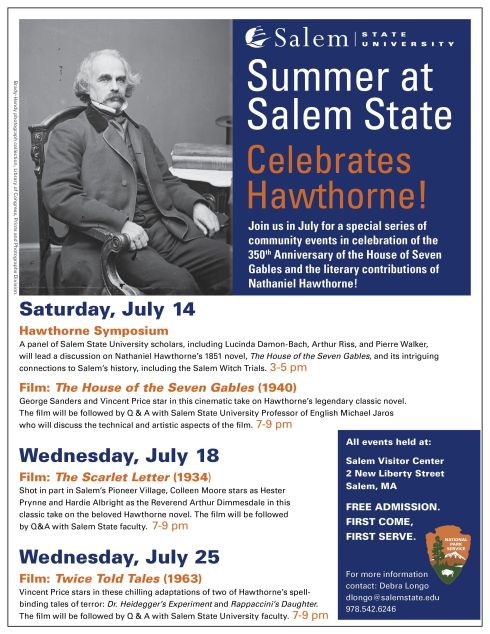
Not only does the House of the Seven Gables Settlement Association serve as a solicitous steward of this iconic house, it maintains a packed schedule of programming, continues to fulfill the social welfare mission of its founder, Caroline Emmerton, and partners with other regional institutions to interpret and present Salem’s history and culture. Even though its focus is limited necessarily, in many ways it is as close to a historical society as we have in this “historic” city. Both the organization and the House stand as authentic and educational antidotes to Salem’s more sensationalistic offerings. And again–given what has happened to Salem over this past year, it’s more important than ever that the city’s existing historical organizations work together to shore up—and celebrate–our heritage. So I’m particularly happy to see the first big Hawthorne event of the summer: an ambitious and aptly-titled public reading called “Enduring Hawthorne: A Marathon Reading of Nathaniel Hawthorne’s The Scarlet Letter”, a collaboration between the Gables, Salem Maritime National Historic Site, the Salem Athenaeum, and the Essex Heritage National Area on June 7 in front of the Custom House. The following weekend, Salem State University will screen the first film of a three-film series based on Hawthorne novels at Salem Maritime’s Regional Visitor Center, with a preceding symposium in which English faculty will discuss the historical context of The House of the Seven Gables. Then we will see the 1940 film, with The Scarlet Letter and Twice-Told Tales coming up on successive Wednesdays in July–with Q & A sessions after both. Scenes from The Scarlet Letter (1934) were apparently shot in then recently-constructed Pioneer Village, so I’m pretty excited to see that film in particular.

Summer at Salem State July 2018_Web Version

Scarlet Letter 3 Still from The Scarlet Letter, 1934. Pioneer Village?

With August comes Gables Fest: Celebrating 350 Years of Stories and Songs, a day-long event on the 4th which will take attendees on a musical “journey” through the history of the Gables (with food and drink) and a collaboration with another historic site celebrating a big anniversary this year: the Marblehead Museum’s Jeremiah Lee Mansion, built in 1768. Through “Architectural August” there will be architectural tours, visiting member events, and a comparative focus on these two structures built a century apart.

Interesting Houses collageFrom Burroughs & Company’s Interesting Houses of New England, 1915: with a photograph of the Gables before its restoration/recreation.

Remove not the ancient landmark, which thy fathers have set. (Proverbs 22:28)


The Golden Age of Pageantry

My title does not refer to the made-up medieval era but rather to the first decades of the twentieth century–when civic pageants reigned on both sides of the Atlantic! Datewise, we’re right in the midst of the anniversaries of Salem’s two great historical pageants: on this day in 1930 a replica of the seventeenth-century ship Arbella docked at the newly-constructed Pioneer Village with “Governor Winthrop” and his entourage on board, and seventeen years earlier tomorrow an equally elaborate pageant began its first performance at the gothic Kernwood estate in North Salem: the “Pageant of Salem” to benefit the House of the Seven Gables Settlement Association. Both events represent a significant investment of time, money, energy and resources by enthusiastic Salemites: while the 1930 event had the imprimatur of the Massachusetts Tercentenary Commission, the 1913 Pageant was organized by an executive board comprised of members of the relatively new Gables Board of Directors (including Gables founder Caroline Emmerton of course) which managed to draw in anyone and everyone: Sidney Perley served as “Historical Censor”, Jean Missud conducted the band, and well-known Salem artists Frank Benson, Philip Little and Ross Turner provided illustrations for the program.

Pageant 1930 collage

pag 3 collage

While the impact of the Tercentenary Pageant was more lasting, as its set, Pioneer Village, became the first “living history” museum in the United States and remains open today, the 1913 Pageant of Salem seems somehow more creative to me–or at least its program presents it as such. It certainly had a longer story to tell: from Naumkeag to “The Salem of the Present reviews the Past and looks forward to The Future”. Yet both extravaganzas shared many similar features, as the format for historical pageants seems to have been quite standardized by this time: a quick review of David Glassberg’s American Historical Pageantry opened up a world of comparative context for me in which professional associations, journals, and guidebooks devoted to pageantry literally set the stage. Pageants had elaborate staging and costumes, a succession of “episodes”  to move the story forward, attempts to personalize the “spirit” of the time and place and symbolize major themes and lessons, and audience participation–or at least the request thereof. Both Salem pageants featured all these general attributes, and more Salem-specific ones: the Native Americans are just waiting, waiting and waiting for the Europeans to come, gazing off into the water: all is well once the latter arrive, of course. For Salem, 1630 it’s all about the world in which Winthrop arrives with the Massachusetts Bay Charter in hand; while the 1913 Pageant of Salem has to transport its audience from the misty and superstitious days of the seventeenth century all the way up to the dawn of the twentieth—through the very romantic nineteenth. This must have been quite a performance (or four): I would especially have liked to have seen prominent businessmen “Knights” bearing inscriptions of the virtues of an ideal Salem, while the very peaceful personification of the City also took the stage.

American Historical Pageantry

Arbella

Tercentenary Cavalcade

Dress Up collage

Last collageLeslie Jones photograph of Arbella “arrivals” on June 12, 1930, Boston Public Library; with the Winthrop Charter in hand, a “Charter Cavalcade” en route from Salem to Boston in 1930, Dionne Collection, Salem State University Archives & Special Collections; Scenes from the 1913 Official Pageant of Salem Program.


Art+Science

The Salem Arts Festival was this past weekend in Salem: its tenth anniversary. Last year plastic-bag jellyfish were suspended above Derby Square and Front Street; this year it was all about bees. Salem’s art scene is very vibrant now, but this little city has always had a bustling community of artists (well, after the Puritans morphed into the Congregationalists) and craftsmen. I’ve written about quite a few individual artists, but I thought I would look for more collective precedents, and that quest took me directly to the fairs of the Salem Charitable Mechanic Association (1817-1932). The records for this association, like those of nearly every Salem institution and organization, are relatively inaccessible, as they are in the Peabody Essex Museum’s Phillips Library, which has been closed in Salem, removed to Rowley, and for which digitization plans are nonexistent at present. But fortunately the Association wanted to showcase the creations of all its exhibitors, and so compiled a wonderful program for its first fair in 1849 that has been digitized in several places. This was held in its very own Mechanic Hall, built a decade before.

Art + Science collage

Art + Science The_Salem_Charitable_Mechanic_Association

Art + Science Mechanic Hall SSUTwo copies of  Reports of the First Exhibition of the Salem Charitable Mechanic Association, 1849, a certificate from the exhibition (Boston Athenaeum), and Mechanic Hall at the corner of Essex and Crombie Streets in Salem, built in 1839 and destroyed by fire in 1905 (Dionne Collection, Salem State University Archives).

This program makes for very interesting reading for several reasons. First of all, the judges of each category are very detailed and opinionated about their criteria for awarding diplomas and silver medals–although it appears that everyone who showed up got the former. The sheer eclecticism of the entries is notable, as is the relatively small number of industrial entries–surprising as the exhibition was occuring in the midst of the Industrial Revolution in Massachusetts. The organizers address this deficiency in their introduction: it is to be regretted that there was not a greater display of the Manufactures of Old Essex, especially of Cotton and Woolen Goods. Andover and Newburyport, with their numerous and extensive Cotton and Woolen Manufacturing Establishments, did not exhibit a single article. Saugus with her Flannel and Yarn Factories—-none, and Danvers, with her Carpet and Tweed Factories, was also deficient. When we consider that Essex County produces more than the whole State of South Carolina—-that her products are more than twenty millions of dollars—and a fair share of it in the articles alluded to—the display was not what it should have been. But notwithstanding these adverse circumstances, the energy and the perseverance of the mechanics of Salem, essentially aided by the Ladies, produced one of the most beautiful exhibitions ever witness in this vicinity. I guess they just didn’t get the word out! And yes, “the Ladies” are very well-represented in this 1849 exhibition, which showcased every possible type of art: mechanical and utilitarian, “fine” and decorative.

PicMonkey Image

1849salemmechassoc_obvDiplomas and medals for “drab” clothing, an artificial leg, mineral teeth, a miniature steam engine and a Patent Cloth Folder used at the Naumkeag Steam Mills in Salem, among other exhibits; a rare medal from the 1849 exhibition, from John Kraljevich Americana.

Above all, the integration of art and science seems very apparent in this exhibition: perhaps it is highlighted by the paucity of industrial exhibits but there are still many categories that we would consign to an arts festival today rather than one celebrating “mechanics”. Besides “Fine Arts”, everything created with a needle was on display, along with everything for the house and the body. This exhibition was all about creation, pure and simple. I love this universality and lack of separation between the artistic and the scientific: it illustrates the continued influence of the culture of the Renaissance, the period in which I was trained, during which everything was an art. But the Charitable Mechanic Association had its categories too, some of which seem rather arbitrary: the sole Daguerreotype exhibitor, one of Salem’s three practitioners at the time, was D.S. Bowdoin, who won a silver medal in the Fine Arts category for “a very admirable collection of Specimens, showing great skill in the mechanical execution, good taste in the arrangement of subjects, and in the management of light and shade”.  To me, the daguerreotype seems a near-perfect combination of art and science.

Bowdoin collageI couldn’t find any D.S. Bowdoin daguerreotypes from 1849, but here are two cartes de visite from later: studio portraits portrait of Robert Daley (or Daily), a Salem “expressman”, c. 1855 (Historic New England) and John Lewis Russell, a well-known botanist and Unitarian minister (Wisconsin Historical Society). According to the later photograph, Bowdoin’s studio was in the Downing Block, Salem.

Back in the present and now that I think about it, this arts festival does indeed bridge the gap between art and science in its own way: what could be more technological than transforming commissioned plastic bees into building materials? I have never really understood the stem vs. steAm debate, and let’s throw an H for history in there somewhere!

bee collage 2

Arts Festival 1

Arts Festival 3

Arts Festival 2

Arts Festival 4

Arts Festival 8

Arts Festival 6

Arts Festival 7

Arts Festival 9Scenes from the Salem Arts Festival on Saturday: my neighbor Racket Shreve’s “Best in Show” painting in the gallery in Old Town Hall along with “Remembering Georgie” by Heather M. Morris; the Mural Slam—just loved this work-in-progress of “Salem from Above” by Casey Stanberry, especially in its partially finished state.


Centering History

This summer I’m teaching our department’s capstone course, a seminar in research and writing for which students write long papers on topics of their choosing, sourced by primary materials and grounded in the secondary literature. I do exclude some topics—World War II battles, the assassination of JFK, the Salem Witch Trials, anything too narrative, too big, or that has been done to death, but beyond those considerations, they pretty much have free rein. One of the first times I taught this seminar, more than a decade ago, I had to be much more restrictive, due to the circumstances we all found ourselves in: almost as soon as the semester began our university library was condemned and closed! Teaching a research seminar without a library demanded resourcefulness on my part, and my students: especially in this relatively “dark” time with few databases at our disposal (we obtained a lot more because of the library’s closure, but sadly Salem State cannot afford any of the Adam Matthew databases to which the Peabody Essex Museum has consigned Salem sources from the Phillips Library). I decided that they all had to do local history, and dig into the archives of their hometowns: they were at first resistant, but eventually they did dig in and the end result was a bunch of amazing papers—on trolleys, societies, movements, schools and hospitals, the local experience of the Civil War and World War I, and early efforts to draw tourists to enclaves all around Essex County.  I think my students got a lot out of that seminar, but it also taught me a lot: not being an American historian I wasn’t really aware as to what local historical sources were available and of what stories could be told and what stories could not or were not. Since that time, Salem State has opened a new library, the city of Salem has lost its major historical archive, the Phillips Library, first by severe restriction of access, then by closure and removal to temporary and then permanent locations well out of town, and I began writing this blog.

Local History

Local History MAssHenry Wilder, Map of the County of Essex, Massachusetts. Compiled from the Surveys made by order of the Legislature in 1831-1832, Boston Rare Maps; Ticknor map of Massachusetts, 1835, Leventhal Map Center, Boston Public Library.

I no longer insist that my seminar students engage in local historical research—they have many more resources available to them now–but I encourage it, and many of them choose to do so. As a consequence of their choices, and my own indulgence in this blog, I have become much more aware of the availability of local historical resources, both in Essex County and beyond. Years ago, even before the Phillips Library was removed from Salem, access was so restricted that those students interested in researching Salem’s history were disadvantaged comparatively to those focused on other locales; of course now this disadvantage is even more apparent. Students (and everyone) interested in researching Salem’s history can consult the sources (primarily secondary and genealogical but also historic newspapers) in the Salem Room of the Salem Public Library and there are more archival materials at Salem State’s Archives and Special Collections repository in the Berry Library at Salem State. But surrounding our storied (but relatively sourceless!) city are active historical museums, societies, and archives, including the the Marblehead Museum, the Local History Research Center at the Peabody Institute in Peabody, the Danvers Archival Center at the Peabody Institute in Danvers, and the Beverly Historical Society’s Research Library and Archives. A bit farther afield and all around, there are local history centers popping up, many revived and reconstituted historical societies: just this month the Andover Historical Society has become the Andover Center for History & Culture, the Framingham History Center continues to expand its mission and initiatives, the Sudbury Historical Society is creating a new Sudbury History Center & Museum in the town center, and the Lexington Historical Society is building a new Archives Center adjacent to its Munroe Tavern this very summer.

Local History Andover Market

WWI-image-with-exhibit-dateAn Andover Market from the archives of the Andover Center for History & Culture; the Framingham History Center’s current exhibition.

The grandfather of Massachusetts history centers must be the Lawrence History Center, the mission of which is to collect, preserve, share, and animate the history and heritage of Lawrence and its people. That is one great mission statement, and this very active organization clearly strives to fulfill it, offering a stream of symposia, educational programs, presentations, physical and digital exhibits and research services to provide access to and engagement with its archives. Their use of the word “animate” clearly does not refer to a diorama, wax figure, or haunted house!

Local History LawrenceLawrence textile industry strikers in 1912, Lawrence History Center Photographic Collection @Digital Commonwealth.

Appendix:  Three upcoming events for local historians—the first in Salem!

Finding & Sharing Local History workshopMay 31.

The Massachusetts History Conference:  June 4.

Cambridge Open Archives 2018: June 11-15 & June 18-21.


Rolling in Their Graves

I promise: this is the last Phillips Library post for quite some time. It’s been six months since the Peabody Essex Museum admitted, under duress and only because they needed approvals from the Salem Historical Commission, that the Library was moving to a former toy factory off Route One in Rowley, Massachusetts. Since then there has been a public forum, lots of meetings, a succession of newspaper articles in the Salem News and the Boston Globe, a stern letter to the PEM from the President of the American Historical Association, and countless posts by me appealing, edifying, and scolding the Museum’s leadership. All to no avail: the Library–constituting a great part of Salem’s documentary history–is now in Rowley, and from what I hear (from a friend who is desperately trying to finish her Ph.D. dissertation–they didn’t tell her the Phillips was going to close last September either), is set to open sometime in June. Even the Google address (sort of) has changed, so that must be that, right?

Phillips Location

The address of the Phillips has changed but everything else remains the same: photographs of the interior and exterior, and its description: in the Essex Institute Historic District of Salem. If past practices are any indication, this half-correct entry will be up for quite some time: when the Phillips was moved to a temporary location in 2011 for the restoration of the building you see above, the address was never changed. And so I must say that the two men who are referenced in this entry—one visually and the other by name—are likely rolling in their graves after all that has happened. The photograph on the left is of Dr. Henry Wheatland (1812-1893) in one of the Phillips’ smaller reading rooms, around 1885. Dr. Wheatland dedicated his life to the Essex Institute, helping to found it through a merger of the Essex County Natural History Society and the Essex Historical Society in 1848, and serving later as the Institute’s Secretary, Treasurer, and President. As the finding aid to his papers in the Phillips Library asserts, Dr. Wheatland “devoted much of his life to ensuring that the Institute became a ‘permanent centre of influence for the enlightenment and instruction of the community'” and even continued to serve as its President after he was struck with paralysis at age 80, until his death. Wheatland was born in Salem and he died in Salem, and his will, like the wills of many donors to the Essex Institute and its library, left bequests to a Salem institution. I know he was referencing his desire that the Essex Institute’s library should be reference only in his 1893 will, but still: no books [should/to] be taken from the building except in extraordinary circumstances.

Wheatland collage                                                                                  New York Times, 1893.

The prominent and prolific Boston architect, Gridley J.F. Bryant (1816-1899), is another grave-roller, as he was the architect of the Italianate Daland house which has served as part of the Phillips Library in Salem for over a century and would certainly not want to be associated with the suburban industrial building that now constitutes the Phillips Library in Rowley. His name should be removed at once.

Phillips Library Rowley

800px-Bigelow_Chapel_-_080167pv One of Bryant’s more notable commissions: the Bigelow Chapel at Mt. Auburn Cemetery. Library of Congress.

I can’t speak for all the people that put their trust in the predecessors of PEM, but fortunately it is a registered non-profit in Massachusetts and so its actions are subject to review by our Attorney General, Maura Healey. Several weeks ago a meticulous brief was delivered to her office formally requesting that the Public Charities Division review the actions of the PEM relative to the Phillips Library under Massachusetts General Laws, Chapter 12, Section 8H, regarding breaches of trust. The many “Friends of Salem’s Phillips Library” who have emerged over these past six months are sending letters in support of this brief and its request for review, and you can too if you like: Office of the Attorney General/Non-Profit Organizations/Public Charities Division/One Ashburton Place/ Boston, MA 02108.

Some other updates:

Contrary to what I reported here last week, the Working Group organized by Salem Mayor Kimberley Driscoll and PEM CEO Dan Monroe is still working: they will have more meetings. Their agenda still seems to be exclusively PEM-driven and they have a very odd understanding of what “collections” constitute, but they are still at work.

It looks like the votes are there for the Salem Historical Commission to approve the demolition of the 1966 “Stacks” building at the rear of Gridley Bryant’s Daland House. Everyone agrees that this space was insufficient to store the vast collections of the Phillips, and it is rather inelegant, as you can see below. When the library was moved in 2011 to a temporary location to accommodate the renovation and expansion of all of the Phillips buildings, it became apparent that this addition was essentially unworkable, given the integrated structure of its construction. The PEM leadership implied that they just learned this in 2017, and so were “forced” to abandon all of the Phillips buildings (and Salem) altogether, but we have learned of several mitigating plans from the intervening years, including those which specified the construction of a brand new “stacks” building. In any case, the present Phillips buildings are not ready to accept all the collections at this time, primarily due to the poor planning of PEM. Rowley can be yet another temporary facility for these materials, but we are continuing to work to bring them back to Salem.

Phillips Stacks The windowless “stacks” addition may soon be coming down. Salem News photograph.

And what about digitization? The fact that the PEM is at least a decade behind comparable institutions in the digitization of its holdings has become common knowledge: the institution itself has acknowledged its deficiency by including “digitization priorities” on the limited Working Group agenda. There is some progress: I noticed just the other day that several records of the Salem Witch Trials have been added to the limited digital collections of the Library. The bulk of Witch Trial records were digitized a decade ago by a team of scholars and have been available at a (much more contextual) site sponsored by the University of Virginia since that time, but there are hopes that the well-endowed PEM will someday provide a global scholarly community with more materials which will elucidate this often-told story, and so many more lesser-known ones.

I’m certainly moving on to other stories. After all, spring has finally arrived, the trillium are out, and there are places to go and more diverse and distant pasts to explore. If there are any new developments, I’ll post them here, but only if they are course-changing.

P.S. And thanks for your patience—especially those of you who are perhaps not quite so interested (obsessed) with this issue!


My Salem Museum

The Peabody Essex Museum has made an additional concession in the mitigation dialogue following their admission to the relocation of Salem’s historical archives to a “Collection Center” in Rowley: a presentation/exhibition on the “Salem (Historical?) Experience” to be permanently installed in Plummer Hall. This could be good news—-like everything else the devil will be in the details—but it in no way compensates for the removal of historical materials left in good faith to the care of the PEM’s predecessors by scores of Salem families. Still, Salem has always needed a proper Salem Museum, with texts, objects, and interpretations of key events and themes in its history presented in an installation that is both contextual and chronological. This could be an opportunity to have some semblance of that, as the PEM has wonderful curators and resources, but the institutional reluctance to actually showcase authentic Salem items—combined with the word “experience”—leaves me a bit worried that all we’re going to get is some sort of virtual presentation. Nevertheless I was inspired to put together my own Salem Museum, and here are its key components.

Salem Worlds: I would prefer a thematic presentation to a chronological one, but after teaching history for 20+ years I know that chronology is important—-people want to get the facts straight and in order. So I think I would use a “worlds” approach in which Salem expands from a tiny little settlement into one which is an important part of the entire world, and then create various other worlds which represent different aspects of Salem’s history. Worlds are a way to combine themes and chronology: we need to know about Salem’s experience as a colonial outpost of the expanding British Empire, its role in a world of Revolution, and its preeminence in a world of global exchange, but also about the worlds of ideas, work, and association which flourished within its borders. I’d like to flesh out the isolated world of seventeenth-century Salem and its environs that served as the setting for the witchcraft accusations of 1692 as much as possible, but also trace the legacy of the Trials through the evolution of the “world(s) of Witch City” from its first expressions until today. We need to peer into the worlds of Salem’s many activists—whether they were working for abolition, temperance, social reforms, or suffrage in the nineteenth century, or striking for more job security at Pequot Mills in 1933. I’d like to recreate Nathaniel Hawthorne’s Salem world with texts and images, and also that of one (or more) of the lesser-known diarists whose memorials are locked in the Phillips Library. Different worlds could be explored in keeping with the PEM’s programming (I guess I have to make that concession).

Virtual is fine, but we need objects and texts too: I’ve been to quite a few city history museums (but unfortunately none on this list) and it seems to me that the mix is best. There’s always some sort of “orienting” video, so that might be the best way to deal with the chronology: I love the Museum of the City of New York’s Timescapes in particular. The only way we can create some semblance of seventeenth-century Salem is through cgi, and I cannot watch Pudding lane Productions’ deep dive into seventeenth-century London enough (and my students love it).

My Museum Timescapes

In this era of immersive make-believe, people crave authenticity, so we need to see real stuff too: personally, I’d love to see the 1623 Sheffield Patent, which granted rights to Cape Ann to several members of the Plymouth Colony and was contested by a representative of the Dorchester Company. This is a connecting link between Plymouth and the North Shore, and between Plymouth and Salem: as Cape Ann didn’t quite work out at that time the old planters migrated down the shore. Later in the seventeenth century, let’s widen the circle of persecution a bit by showing items that illustrate the struggles of Thomas Maule and Philip English—what an Atlantic world the latter represents! The widening world of eighteenth-century Salem could be explored through periodicals, ephemera, and any and all expressions of “trade port culture”, which the PEM loves (as long as the port in question is not Salem). Craftsmanship (or simply work), consumption, and activism are themes and worlds that can take us (or Salem) from the eighteenth century through the nineteenth century and all the way up to today.

SHeffield Patent

My Museum Maule

My Museum Handkerchief PEMThe Sheffield Patent, 1623, Phillips Library, Peabody Essex Museum; Title page of Thomas Maule’s New England Pesecutors Mauld, 1697; The Poor Slave (Dedicated to the Friends of Humanity), ca. 1834, copperplate-printed cotton, Boston Chemical Printing Company, The Joseph Downs Collection of Manuscripts and Printed Ephemera, Henry Francis DuPont Winterthur Museum (Also in the Phillips Library). 

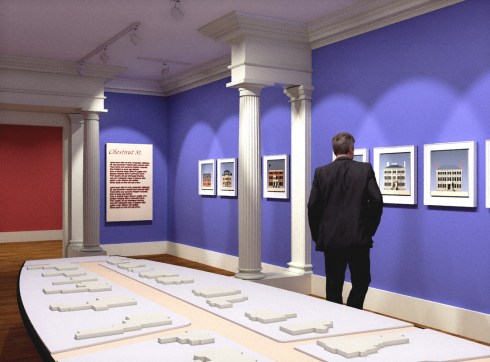
Art+History=Culture+Connections: The past five months—this entire semester!—has been like a Museum Studies course for me as I have been reading and exploring museums and historical societies around the world to see if I could come up with some compensation for the cultural deficit we have here in Salem, where the institution with most of the historical collections has withdrawn, leaving behind an infrastructure of largely commodified historical interpretation. There are many historical museums doing amazing things, but I’ve been particularly impressed by what I’ve seen (only online) at the Santa Cruz Museum of Art and History. I spent a summer in Santa Cruz years ago on an NEH grant, so I have a fondness for that place anyway, but I love how this particular museum merges art, history, and community engagement into a mission that stresses relevance and region. It is an institution that is governed by the same “connections” mission that PEM references all the time, but their much stronger emphasis on place (in part through history) must make the pursuit of those connections more attainable and meaningful. As I haven’t been there, I’m not sure exactly how SCMAH presents the past, but my Salem History Museum would not recognize divisions between art and history, or material and textual culture. I’d have both, together, and a very particular emphasis on architecture. Lots of McIntire drawings, a whole gallery wall of Frank Cousins photographs, and some modern representations of Salem buildings to illustrate their (ever-) lasting impact. I would certainly have some of John Willand’s houses on a wall of my museum as I already have one on a wall of my house: each one is amazing, and I know he prefers a collective display. I would also feature some of the wonderful photographs of Salem captured by Salem instagrammers: more posts than #pem, just count the hashtags.

My Museum Little collage

My Museum collage

My Museum 30 Chestnut

Willand Gallery

Two sides of Salem artist Philip Little (1857-1942) from the PEM’s own collection: “Submarine Baseball” and A Relic of History, Old Derby Wharf, Salem, c. 1915; A Frank Cousins (18501927) portfolio; John Willand’s 30 Chestnut Street and Chestnut Street “Gallery”.


Rescinding the Rump

The official response to the Peabody Essex Museum’s reluctant admission to the removal of Salem’s historical archives to a storage facility in Rowley was the formation of a “Working Group” by Mayor Kimberley Driscoll and PEM CEO Dan Monroe. In partnership, Ms. Driscoll and Mr. Monroe chose the members of this group, identified as “stakeholders”, from among Salem’s local officials and heritage and tourism organizations. I was wary from the very announcement of this group, because I believe that all of Salem’s residents are “stakeholders”, impacted equally by a short-sighted and disrespectful policy which removed the material heritage of a great city. (I also really, really, really dislike that divisive and disingenuous term). Nevertheless, I knew that there were well-intentioned and thoughtful people in this Working Group, so I hoped for the best. Now it appears that the work of the Group is complete: as the agenda for its third (and presumably last) meeting this week includes the item “Final Statement”, I assume it’s a wrap.

So what has been accomplished?  You don’t have to rely on my assessment: it’s all in the public statement issued on behalf of the Working Group on April 10. As a result of these “discussions” (one meeting was a meet-and-greet, the other a tour of the Rowley facility), the PEM has agreed to open Plummer Hall and the Saltstonall Reading Room of the former Phillips Library to the public as a “research facility” stocked with bound editions of the long-running Essex Institute journals the Essex Institute Historical Collections and American Neptune plus terminals that can be used to access “digital information from the Phillips Library”, very few items of which have been digitized!  In fact, one of the few things that the PEM has seen fit to digitize is the American Neptune, and the Essex Institute Historical Collections is available right down Essex Street at the Salem Public Library, so this concession (which was actually announced before the formation of the Working Group) is a joke, an insult, and an outrage.

WG Statement

After I heard that the Working Group was concluding its work, just yesterday, the first image that flew in my head was that of Oliver Cromwell marching into Parliament on April 20, 1653 and dissolving the powerless remnant (Rump) that was all that remained of the Long Parliament for which he had waged a revolution, and afterwards overtaken, with the famously paraphrased speech: You have sat too long here for any good you have been doing … Depart, I say; and let us have done with you. In the name of God, go! (It was likely a far more colorful dismissal ). An ineffectual body, but yet the only semblance of “representative” government, disbanded just like that. I’m sure I’m the only person in the world who could make such a connection: it must be the April dates—and my preparations for my summer graduate course on early modern English history. Or it might be my desire to find refuge in the past when the present is so bleak.

Rump 1790 BM

Rump West

Rump 1885 Cassells

Rump Cromwell Great MenFour very different Cromwells dissolving the Rump Parliament on April 20, 1653: British Museum, 1790; Benjamin West, 1782, Montclair Museum of Art; and Cassell’s Illustrated History of England.

So the leadership of the Peabody Essex Museum remains resolute in their decades-long campaign to bury Salem’s history, successfully (so far) employing strategies of restricted access, the redeployment of resources, and a confusing (and likely very, very costly) renovation, aided very ably by the accommodations of our elected officials. There may be some external pressures from this point on, but I am so very sorry that those in positions of power and influence in historic Salem have chosen not to safeguard, much less fight for, its history.


PEM: Praise and Public History

Ever since that fateful night in early December 2017 when a representative of the Peabody Essex Museum disclosed that the vast majority of the collections in its Phillips Library, the major repository for Salem’s history, would be moved to a storage facility in Rowley, I’ve been both very critical of this decision and very focused on the institutional leadership which made it. This admission is no surprise to regular (likely suffering in silence) readers: much more so will be the praise that I’m actually going to heap on the PEM in this post! Just this past week the museum announced two new positions: a manager of historic structures and landscapes for its historic houses in Salem and a head librarian for the Phillips Library. From my perspective, both positions signal a renewed commitment to the Salem resources which the PEM inherited from its founding institutions, particularly the Essex Institute. I’ve never questioned the PEM’s stewardship of its assets: my major concern has been mothballing, so investment in these important areas is very welcome. The architectural position seems focused on preservation issues, but the new librarian will be charged with some big organizational and outreach responsibilities, including increasing the Library’s responsiveness to the needs of local, regional, national and international researchers, integrating it more fully into the Museum, and transforming the Phillips into an innovative and active intellectual hub supporting the overall mission and global scope of the PEM. All this and the long-awaited digitization plan! This is a very responsible position and the PEM should be commended for seeking to fill it.

Librarian collage

Librarian Library of Congress 1966Challenges & Opportunities:  The Head Librarian in Sam Walter Foss’s Song of the Library Staff (1906); “To the rescue. Many librarians believe computers are the only means to effectively cope with their bulging bookshelves” (1966). New York World-Telegram and Sun Newspaper Photograph Collection, Library of Congress. 

That said, I’m just not sure how the PEM is going to create the “innovative and active intellectual hub” it is referencing in this job description in a storage facility off Route One in Rowley, much less foster the community engagement that is referenced continually in all of its messaging. My continuing preoccupation with the relocation of the Phillips Library stems from outrage at the removal of Salem’s historical archives, but also confusion about how such a move aligns with the PEM’s own goals. I understand the PEM’s arguments about the logistics of conservation and digitization, but what about integration? How can the Library be integrated more fully with the Museum when the Library is in Rowley and the curators of the Museum—as well as the physical Museum itself—are in Salem? Perhaps the goal is a virtual/digital integration, but we all know that that’s a long way off for the PEM. Discussion of LAM (Libraries, Archives & Museums) integration has been evolving for over a decade, and the Head Librarian job description indicates awareness of this dialogue, but the PEM seems oddly out of touch with other cultural trends, namely the evolution (and rejuvenation in many cases) of libraries as places not only of collections but also myriad connections and the growth of a dynamic field and practice of public history which emphasizes a wider and more multi-faceted engagement with the past. The PEM is investing a lot of money in the restoration of the physical buildings which constitute the (former?) Phillips Library in Salem but what purposes—and who— will this space serve once it is finished?

AAR collagePast & Present: the Library of the American Academy in Rome in 1933 and today, “a perfect blend of the past with the contemporary demands of modern scholarship.”

I understand that the h-word is anathema in the upper realms of the PEM but why ignore the demands of its host community, the interests of hundreds of thousands of visitors to Salem each year, as well as the strengths of its collections and its stated goals of “community engagement” by abandoning history? The answer can only lie in a very simplistic (and musty) understanding of what historical interpretation in the public realm constitutes these days: Colonial Williamsburg blinders if you will. Many of the PEM/PM Third Thursday events (now defunct), had historical aspects, as exemplified in its (also now defunct?) Phillips Library blog, Conversant. “History” is not all about the War of 1812 or even the Salem Witch Trials (I swear): it’s also about fashion, food, play, cross-cultural encounters, and golden ages, all of which the Peabody Essex Museum clearly embraces. History is about home, and housing: just imagine a PEM-initiated public history project about housing in Salem past, present and future similar to the 2016 symposium organized by the Cambridge Historical Society entitled “Housing for All?”. I can’t imagine anything more relevant, more engaging, and more reflective of the Museum + Library’s integrated resources.

Before_the_Fire__Salem_Neighborhood_North_Side_of_Broad_Street

Redevelopment__Completed_Reconstruction_The_PointBefore & After the Great Salem Fire of 1914: Housing on the northern side of Broad Street before the Fire and Mill Hill after, Phillips Library Digital Collections.