Tag Archives: Local Events

Locked Away

So many materials, locked away in the Phillips Library of the Peabody Essex Museum, undigitized, unheralded, unshared, undervalued and underutilized. Perhaps the digitized catalog will bring scholars to Rowley but they will have to be on the hunt: the Museum clearly does not have the inclination to blaze the trail. This was not always the case: a century and more ago, both of the PEM’s predecessors, the Essex Institute and the Peabody Museum, were determined to share the stories of their collections to as wide an audience as was then possible. This week, like many historically-minded people in Massachusetts, I’m thinking about the insurgent American Revolution: that’s what mid-April is all about here. We have the 382nd Annual Muster on Salem Common this weekend along with a Glover’s Regiment encampment over in Marblehead, and then all the events associated with Patriots Day in Lexington and Concord on Monday. As has become my habit, I looked through the catalog of the Phillips to see what I am missing–what all of us are missing— about the historical significance of this time. The diaries always catch my attention (the Phillips is particularly rich in diaries) and one looked really interesting: that of William Russell of Boston, a Tea Partier and later clerk to the dashing privateer Captain John Manley, commander of the Continental ship Jason, which was captured in 1779. He then became a prisoner of war and recorded conditions as such in the Old Mill Prison in Plymouth, England during the duration of the war. There is a list of his fellow prisoners as well as the ships from whence they came, and additional notes and annotations by his grandson James Kimball, a Salem resident who published the diary and presented his manuscript copy to the Essex Institute, where Ralph Paine mined it for several chapters in his 1908 book The Ships and Sailors of Old Salem; the Record of a Brilliant Era of American Achievement, calling it “by far the most complete and entertaining account of the experience of the Revolutionary privateersmen and naval seamen who suffered capture that has been preserved”. Here we have an example where (I think–I stand ready to be corrected by historians of the Revolution) an antiquarian and annotated copy has been more influential than the original source, which is part of the Boston Public Library’s collection of American Revolutionary War Manuscripts.

Locked Away Journal

Locked Away Russell Warrant 1779

Locked Away Captain_John_Manley,_wood_block,_Peabody_Essex_MuseumThe opening page of William Russell’s wartime diary & the warrant for his arrest in December of 1779, Boston Public Library; woodcut broadside illustration of the famous Captain Manley of Marblehead, Peabody Essex Museum.

If this is true, it will not be so for much longer: the Boston Public Library is committed to digitization, collective transcription and open access while the PEM clearly is not (yet, we have hopes), so the primary source will eclipse the copy if it has not already. I’m drawn to the PEM Russell diary because it speaks to the activities and inclinations of his grandson, James Kimball, almost as much as it does to William Russell himself, and also to the role played by the Essex Institute in later nineteenth-century Salem. Around the time of the Centennial, James Kimball, a former Salem shoemaker and current county commissioner, clearly devoted himself to the chronicling of the Revolutionary activities of his grandfather, giving public talks at both the Salem Lyceum and the Essex Institute and publishing several papers in the Historical Collections of the latter, and ultimately the annotated prison diary. The Essex Institute gave him a genealogical and historical forum, and created a far more lively public discourse of Salem’s past and the American past than seems possible now.

Locked Away EI Text

History is as much about the remembrance of things past as the past, but I don’t want the former to take precedence over the latter, especially as we approach Patriots Day and should be mindful of the heroism and the sacrifices of our Revolutionary forebears. Russell was clearly heroic, but his sacrifices were overwhelming–maybe that’s what motivated his grandson a century later. He was in captivity at the Old Mill Prison for two and a-half years, when he was exchanged, but only 20 days after his liberation he was imprisoned again, this time in the horrible, hulking British prisoner ship Jersey, anchored off New York. And there he remained until the end of the war, after which he returned to Boston (actually Cambridge) to resume his civilian and family life, but “with health shattered by reason of his years of hardship as a prisoner of war…consumption gripped him and he died in the following year on March 7, 1784 at the age of thirty-five. He had given the best years of his life to his country and he died for its cause with as much indomitable heroism and self-sacrificing devotion as though musket ball or boarding pike had slain him” in the 1908 words of Ralph Paine. And the story doesn’t even end there: Russell’s son and namesake (and Kimball’s uncle) grew up to be a master mariner, and was taken captive by the British during the War of 1812 and imprisoned in……Old Mill Prison! Russell Jr. suffered a much shorter confinement than his father, but still: think about the sacrifices of two generations of a family, and the devotion of a third.

Locked Away Mill Prison1812 Drawing of Mill Prison, Plymouth.


Salem Film Fest 2018

It is that time of year again: time for the annual Salem Film Fest, now in its eleventh year and very firmly established on the cultural calendar. Over the years, it has been very inspiring to see the festival’s growth: in terms of participation, attendance, offerings and impact. The care taken with curation is always very apparent to me: resulting in a nice balance of films with themes that are global and local, environmental and material, very serious and a bit more whimsical. One of the first films I saw at the festival was Grown in Detroit, way back in 2011: this was an interesting window into the urban crisis playing itself out in Detroit at the time and this year’s Beauty and Ruin offers another by focusing on the collections of the Detroit Institute of Art, which some thought might provide a solution to the city’s bankruptcy in 2013. I’m really looking forward to this film: as most of you know, the sanctity (and proximity) of a community’s treasures are important to me, and this film will be playing in PEM’s lovely Morse Auditorium!

FilmFest

FilmFest2 Stills and scenes of Detroit past and present in Beauty and Ruin.

I have a friend who oversaw the recent Skinner auction of items from Avis and Eugene Robinson’s collection of African American history (and also this beautiful–but troubling—catalog), so I’m also interested in seeing Black Memorabilia, which examines “the subculture around the collectibles and antiques that serve as reminders of America’s troubled racial past and present”. And speaking of subcultures, I might go for Mermaids, in which a select group of individuals idolize, identify and occasionally “become” sirens of the sea. In keeping (somewhat) with the marine theme, the South Korean film Old Marine Boy about a daring North Korean deep-sea diver in the South, looks amazing. On a very different note, I’m kind of interested in seeing Rodents of Unusual Sizeabout the enormous orange-toothed swamp rats (nutria) which have infested the waters of Louisiana post-Katrina and oil spills, but I’m not quite sure I want to spend so much time with these odious creatures on the big screen.

Mermaids Film

Old Marine Boy

Rodents2Scenes from Mermaids, the Old Marine Boy, and the poster for Rodents of Unusual Size.


Remember the Armory

The opposition to the Peabody Essex Museum’s removal of Salem’s historical archives to an industrial park in Rowley incorporates a range of perspectives: some people have never been in the Phillips Library but nevertheless have been waiting for its return; others have very concrete memories of childhood forays or later visits to research some specific aspect of their Salem past: their house, their neighborhood, their family. Everyone had great expectations: as the Museum leadership closed the Library in 2011 with promises to return in two years, only to disclose the Rowley move six years later, under duress. Expectations are a powerful motivating force, but so too is distrust: and for those of longer Salem residence the latter is clearly apparent. For them, the PEM’s latest move (literally and figuratively) falls into an established pattern of behavior that has broken trust with the Salem community. And the event that looms largest in this pattern is the demolition of the storied Salem Armory in 2000, under the auspices of the Peabody Essex Museum, which had previously signed a memorandum of agreement to preserve and incorporate the Armory’s headhouse into its expansion plans. Only the Armory entry arch remains on Essex Street, right next door to what used to be the Phillips Library, a constant reminder of what was and what was not preserved.

Armory 2

Salem Armory LOC

Armory Arch

The Salem Armory in 1992, ten years after a ravaging fire, and the year of the Memorandum of Agreement by which the “Museum Collaborative” promised to preserve its headhouse. This was also the same year that the Essex Institute and the Peabody Museum of Salem were merged to form the Peabody Essex Museum, which was still bound by that agreement. Library of Congress.

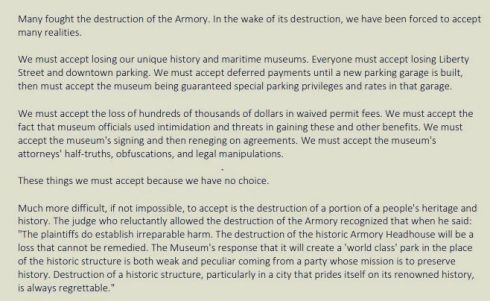
The Armory story–of its rise, role, and fall–has been written about many times, and well: the preservation report and narrative for the MOA is here, some colorful context is here, and the story in parts, right up to arrival of the wrecking ball, is here. But one of the most poignant accounts of the Armory (or of any building’s destruction, frankly) that I have ever read is a Letter to the Editor (of the Salem Evening News) written by Salem architect Staley McDermet in 2002, two years after its demolition. Mr. McDermet asks for an apology that I don’t think he–or we–every received, and goes on to document everything that happened. Indeed, the letter is historical in terms of both intent and subject, but it is also a very timely document, in light of the PEM’s recent actions and their explanations for actions in the past, so timely that I thought it should be “published” again.

Armory text 1

Armory text2

Armory text 3

Armory text 4


Salem Women’s Lives in the Phillips Library

As they are now, Salem women were really, really busy in the near and more-distant past, and the records in the Phillips Library are a testament to both the range and intensity of their activities. At this moment, the PEM is highlighting all of the powerful women whose work and lives are featured in their 2018 slate of exhibitions, including Georgia O’Keeffe, artist and facilitator Angela Washco, photographer Sally Mann, and a succession of Qing Dynasty empresses of China. In her post, Lydia Gordon writes about “multiple feminisms” and observes that to operate in feminist modes is not just advocating for women’s issues, but rather to take on the human issues within social, cultural, economic and political arenas of our lives. To be a feminist is to be human. I couldn’t agree more, and while it is wonderful to have all these exhibitions on view here in Salem, once again I am struck by the burying of the local past by an institution which is focused primarily on the more global present. For the collections of the PEM’s Phillips Library are full of women tak[ing]on the human issues within [the] social, cultural, economic, and political arenas of [their] lives, and I’m afraid we’re never going to hear their stories–or see their faces.

Woman Pierce PEMThe lovely Catherine Johnson Pierce, who we do get to see in Salem: anonymous American artist, c. 1828-29, Peabody Essex Museum.

So many activist “Republican Mothers” in nineteenth-century Salem! Here’s just a sampling of women’s association papers in the Phillips Library: the Salem Female Charitable Society Records (1801-2001; MSS 359—still active today!), the Dorcas Society of Salem (1811-1875; MSS 113), The Seamen’s Widow and Orphan Association (1833-1960; Acc. 2011.008); the Salem Female Anti-Slavery Records, 1834-1866; MSS 34—fortunately digitized by the Congregational Library and Archives), the Salem Female Employment Society (1861-1875; MSS 113) and the Salem Thought and Work Club (1891-1974), headed by the famed author and activist Kate Tannatt Woods, who deserves her own archive. In her 1977 article in the Essex Institute Historical Collections, then-curator Anne Farnam outlined the workings of the Salem Female Charitable Society early in the nineteenth century, and also reads between the lines to illustrate what can be gleaned from the more opaque entries, such as the vote of the SFCS on September 2, 1801 from the first published list of subscribers of the society. Mrs. West was in the process of a bitter divorce, and one would like to have heard that discussion. As the century progresses, Salem women’s organizations continue to serve as charity stewards, and widen their social scope to include abolition, temperance, education and immigration.

Women PEM SFCS

WOMEN PEM collage A published sermon for the Salem Female Charitable Society, 1815; and records of the Salem Female Anti-Slavery Society as digitized by the Congregational Library & Archives.

And then there are so many stories of individual women in the Phillips: far too many to include an exhaustive list here. One could: follow a Salem sea captain’s wife along as she accompanies her husband around the world in 1837-38 (Log 405), reconstruct several long-distance marriages by delving into the correspondence between captain’s wives who stayed in Salem and their roving husbands, perceive how several Salem women, from different stations in life, assessed the world around them and their own lives during short and long stretches of time in the nineteenth and early twentieth centuries through their diaries; appreciate the contributions of the extraordinary women of the Remond family (MSS 271), assess the interesting lives and careers of the “Misses Williams” of Salem, two spinster sisters who made, taught, collected and sold art in Salem, and traveled to Italy and elsewhere recording their observations and purchasing items for resale back in their Salem studio/gallery (MSS 253); read cookbooks annotated with notes and suggested variations (MSS 483); examine the unsuccessful restoration of the Qing Dynasty in China from the perspective of three missionaries present at the time (MSS 0.650), learn so much more about the lives and work of so many accomplished Salem women, including Sophia and Rose Hawthorne (MSS 69), educator Elizabeth Palmer Peabody (MSS 474), author, illustrator and educator Lydia Very (MSS 83), authors Kate Tannatt Woods and Mary Harrod Northend (Fam. Mss 1119 and MSS 0.016) and artist and entrepreneur Sarah Symonds (MSS 0.016).

Women PEM Collage 3

Photograph of Waters family members, undated, MSS 92 Volume 4

Women PEM Williams Sisters Studio

Women PEM Very


Women PEM Woods

Cookbook

Synchronicity Sarah Symonds

Studies of the intersection of maritime and gender histories have been trending for some time–but where do the rich collections of the Phillips Library fit in? Women of the Waters Family–all dressed up and ready to go where? (Phillips MH 12); The Studio of the Misses Williams of Salem (Phillips Library photograph from Jacqueline Marie Musacchio’s “The Misses Williams in Salem and Rome: Women Making and Marketing Art and Antiquities.” In The Art of the Deal: Dealers and the Art Market on Both Sides of the Atlantic, 18601940, ed. Lynn Catterson, 59-8 (2017)An illustration by Lydia Very, who bequeathed her Federal Street house to the Essex Institute (MSS 83); Kate Tannatt Woods, Out and About (1882); What Salem Dames Coked, the cookbook published by the Esther C. Mack (another amazing woman) Industrial School in 1910, 1920, and 1933 and reprinted by Applewood Books; The “Colonial Studio” of Sarah Symonds on Brown Street, in a building now owned by the Peabody Essex Museum.

As I think about these Salem women on this particular day, in the midst of this particular Women’s History Month, I am dismayed and disheartened when I should be inspired. The sources for women’s history in the Phillips Library are so rich that I have no doubt that they will be discovered and dispersed by a succession of scholars, as many have already (and the digitized catalog and finding aids will facilitate that process), but the prospects for public presentation and engagement seem bleak. As the Phillips collections take up residence in an inaccessible factory, with no obvious digitization plan in place or apparent institutional interest in historical interpretation, it is difficult to see how the people of Salem—or visitors to our “historic city”– will be able to face its history in any meaningful way, like the little girl below.

CurryPhotoTwo-year-old Parker Curry facing Michelle Obama’s portrait by Amy Sherald: a photograph taken by museum visitor Ben Hines which went viral last week, Washington Post.


Arthur Miller in Salem

So this is where we are with the Phillips Library relocation, for lack of a better term: the Peabody Essex Museum, having made the reluctant admission that the collections will not be returning to Salem in December (after informing several parties this fact in the late spring of 2017), has agreed to keep the historic reading room in Salem open, but that’s about it: what will actually be in there is unspecified, except perhaps for volumes of the Historical Collections of the Essex Institute, a venerable journal that the PEM did away with almost as soon as it had absorbed the latter. There have been two pieces in the Boston Globe, and several meetings of both the Salem Historical Commission and the Mayor’s “Working Group”, which are charged with dealing with both the exterior and interior aspects of this PEM problem. Meanwhile, the Phillips collections are en route to the 1980s toy factory off Route One in Rowley, far removed from the context of their creation, and inaccessible by public transportation.

Books-on-Shelves-870x490 I am assuming that these are Phillips materials, from the website of Smith +St. John, a “real estate and development management” company that has been fulfilling a variety of functions for the PEM, including: “Administrative leadership – when the director of the Phillips Library retired in October 2014, Smith + St. John principal Gregor Smith was asked to serve as interim director while the Museum conducted a national search to fill the position with the right rare book scholar”. Unusual to have a real estate developer serve as director of a research library, no?

Throughout these 2+ months, I have never heard one admission from a PEM representative that what they were doing was in any way detrimental to Salem, the very crucible of their collections, despite the fact that they are always lauding themselves as the country’s oldest continuously operating museum based on the 1799 founding of the East India Marine Society of Salem. They remain very publicly and exclusively focused on the priority of preservation, but I see no acknowledgement that the Phillips is both a library and an archive: with public records therein, as well as materials that people will come specifically to Salem to see. There’s no better way to illustrate the symbiotic relationship between place and exploration than the example of one of the Phillips’ Library’s most famous researchers, Arthur Miller, who wrote about his trip to Salem for Crucible material and inspiration in several essays as well as his 1987 autobiography Timebends. He was drawn to Salem in the spring of 1952, but found it to be “a sidetracked town…with abandoned factories and vacant stores” according to his 1996 recollections in the New Yorker. No one wanted to talk about the trials then; it was the archives that first made the story come alive for him, the trial transcripts which he read in the “gloomy courthouse” and then other texts in a repository he identifies alternatively as the “museum” or the “historical society”: the Phillips Library.

archival collage 2

Salem's Museum NYT 1953 Feb 8.JPG

In his 1953 New York Times article “Journey to the Crucible”, Miller recalls a “silent” library/museum, in which an old man, looking like a retired professor, is reading a document. Two middle-aged couples come in from their automobile outside and ask to see the pins: the pins the spirits stuck the children with. The pins are in the courthouse, they are told. They look about at the books, the faded fragments of paper that once meant Proctor must hang tomorrow, paper that came through the farmhouse door in the hands of a friend who had a half-determined, half-ashamed look in his eyes. The tourists pass the books, the exhibits and no hint of danger reaches them from the quaint relics. I have a desire to tell them the significance of those relics. It is the desire to write. That’s a pretty good description of intellectual/creative inspiration! And he goes on, taking it outside, into the streets of Salem: the stroll down Essex Street I remember, and the empty spaces between the parking meters, the dark storefronts…but further down a lighted store, and noise. I take a look: a candy store. A mob of girls and boys in their teens running in and out, ganging around on the vacant street, a jalopy pulls up with two wet-haired boys, and a whispered consultation with a girl on the running boards; she runs into the store, comes out with a friend, and off they go into the night, the proud raccoon tail straightening from the radiator cap. And suddenly, from around a corner, two girls hopping with a broomstick between their legs, and general laughter going up at the specific joke. A broomstick. And riding it. And I remember the girls of Salem, the only Salem there ever was for me—the 1692 Salem–and how they purged their sins by embracing God and pointing out His enemies in the town. Salem girls. No researcher is going to find such archival ambiance, and such an illuminating juxtaposition between past and present, in the midst of an industrial development in Rowley. Arthur Miller returned to Salem in late 1991 for the announcement of the planned memorial for the Tercentenary in the coming year, expressing concern about the commercialization of the Trials (which “trivializes the agony of the victims”) but also appreciation for its historical resources. And with the removal of the latter, we are increasingly defenseless against the former.


Anchor Away?

As if it is not enough to bury the archives of a historical seaport in an inland warehouse 45 minutes away, rumor has it that one of the prominent symbols of Salem’s maritime heritage will also be removed: the large anchor that stood sentinel in front of the East India Marine Hall for over a century. I don’t like to trade in rumor, but given the leadership of the Peabody Essex Museum’s propensity to avoid announcements until their intended actions have become faits accomplis, I think I should. We’re all scrambling to save as much of Salem’s historic fabric as we can. But I have a question mark in my title and am ready, indeed eager, to issue a retraction. Looking at the latest renderings for the addition that is rising on the western side of hall, however, I fear that that won’t be necessary.

Anchor 1912

Anchors First

Anchors 2

Anchors NS MAG EssexStreetLookingEastatNight-ba45be61East India Marine Hall and its milieu, 1912-the near future? As you can see, the anchor—clearly maritime kitsch that would spoil the sleek streetscape envisioned—is not there. Below we have a livelier, anchor-centric rendering from Rich Mather Architects: unfortunately Mather died and the PEM looked elsewhere, although his colleagues and successors at MICA Architects carried on with the rest of his commissions.

Anchors Aweigh Rich Mather Landscape Architect

To be fair, the anchor has not been in front of the East India Marine Hall from the date of its erection, but only since 1906. It was a gift from Theodore Roosevelt’s short-lived Secretary of the Navy Charles Bonaparte, of the “American Bonapartes” descended from the little Emperor’s younger brother Jerome. Secretary Bonaparte seems to have been a remarkably tone-deaf official, as almost immediately upon his appointment, in response to solicitations for funds to restore the venerable USS Constitution, he asserted that Old Ironsides should be towed out to sea and used as target practice! This caused an uproar in Boston, as you can imagine: the Boston Transcript opined that “to New England sailors, firing on the Constitution would be almost as offensive as bombarding Bunker Hill Monument or Plymouth Rock” and the national press ran stories under the headline “Secretary Bonaparte’s Collision with New England Patriotism”. There were Save the Constitution fairs and petitions, as the combined forces of the Daughters of the War of 1812 and the Massachusetts Historical Society shepherded a movement which forced Bonaparte to back down. He wisely did so, and in his second (and last) annual report he called for patriotic celebrations in Massachusetts’ seaport towns, in recognition of the Bay State’s maritime heritage. This was the compensatory initiative that brought a hand-forged c. 1820 anchor to rest before the East India Marine Hall in 1906. As long-time Peabody Museum treasurer and trustee John Robinson noted in his 1921 pamphlet The Marine Room at the Peabody Museum of Salem,“as an anchor is the emblem of the Salem East India Marine Society, for whom the building was erected in 1824, the placing of this large, old-time anchor at its front is very appropriate”. Apparently not now.


Curtain Lectures

It was Burns Night at Hamilton Hall last night, and my husband and I were charged with giving the Toast to the Lassies and Reply. After a week steeped in the Ploughman Poet, both of us were a bit uncomfortable with the very bawdy Burns in this year of #metoo, so he went with the more inspiring Rights of Woman as the basis of his toast, which meant I had to go for the uplifting too. But I kind of wish he had gone with one of my favorite Burns poems, The Henpecked Husband. I don’t like it for its overall sentiment, of course, but because of just one phrase, curtain lecture, an idiom which I’ve used in class time and time again, because it always provokes a conversation!

The Henpecked Husband

Curs’d be the man, the poorest wretch in life, The crouching vassal to a tyrant wife!  Who has no will but by her high permission, What has not sixpence but in her possession; Who must to he, his dear friend’s secrets tell, Who dreads a curtain lecture worse than hell. Were such the wife had fallen to my part, I’d break her spirit or I’d break her heart; I’d charm her with the magic of a switch. I’d kiss her maids, and kick the perverse bitch.

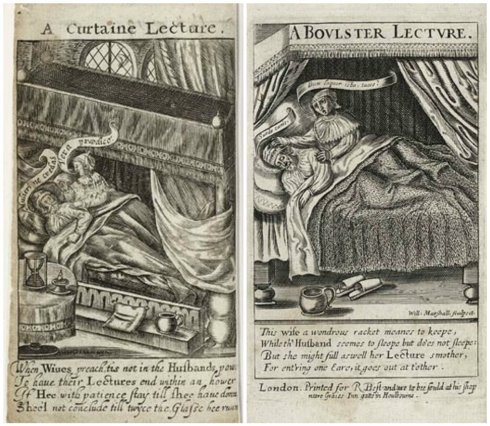
Burns certainly didn’t coin this phrase; it had been around for quite a while. In my courses, I use the frontispieces from Thomas Heywood’s Curtaine Lecture (1637) and Richard Brathwaite’s Art Asleep, Husband? (1640) but I think the expression predates these works as well. It seems very Shakespearian to me, but the heavily-curtained seventeenth-century bed provides the perfect “frame” for wifely “advice”.

Curtain Lecture collage

If you pop these images up before a class of 19-year-olds you are immediately rewarded with their focused engagement in the history of women, marriage, gender relationships, satirical discourse, and material culture (inevitably their attention strays to the “alarm clock” on the table in the Heywood illustration). Lots of comments, lots of questions, all of which can be contextualized and connected to other timely trends. Obviously the notion had a wide appeal—or recognition–in the seventeenth century and after, which is why it survived up until Burns’ time. In an earlier post, I showed the Richard Newton caricature that dates from around the time of The Henpecked Husband, and it is one of many variations on the theme published in this era, give or take a few decades. As the era of curtained-beds closed, the curtain lecture continued, and was revived quite dramatically by the publication of Mrs. Caudle’s Curtain Lectures by Douglas Jerrold in Punch in 1845. These 37 illustrated lectures were published in book form that same year, and reissued frequently thereafter, inspiring a wave of  variant visual expressions in all sorts of mediums: stereoviews, postcards, even a board game. Now it is a general rule of mine that once animals (or birds) take the place of people a concept has jumped the shark (with a few exceptions), and it’s hard to conceive the curtain lecture could have lasted through the twentieth century in any case, but nevertheless it survives as an effective teaching tool.

Curtain Lecture J. Lewis Marks 1824

Caudle2

Caudle 3 John Leech

mrs-caudle-s-curtain-lecture-victorian-card-from-punch-lecture-3-modelled-faces-and-real-hair_a-l-1585476-8880731

Curtain Lecture 1907 LOC

Curtain Lectures PC 1905

Curtain Lectures Chickens

Curtain DucksA Curtain Lecture pub. by J. Lewis Marks, 1824, British Museum; illustrations by John Leech for the first edition of Mrs. Caudle’s Curtain Lectures, 1845; Mrs. Caudle Card (with real hair!), Victoria & Albert Museum; 1907 stereoview from the Library of Congress; postcards, c. 1900-1910.


The Digitization Dilemma

From my perspective, there are two digitization dilemmas inherent in the Peabody Essex Museum’s plan to relocate the Phillips Library outside of Salem, where it was created over a period of 200+ years. The first is my own dilemma: if the PEM had actually made digitization an institutional priority, I certainly would have much less of a leg to stand on (or no leg at all) in my argument that the Library should remain in Salem. The second is theirs: if they had engaged in digitization equal to that of their peer institutions across the country and globe, or even comparable, their relocation–especially as it comes with promises of increased access– would be more palatable. One thing that the public debate over the relocation has made crystal clear is the fact that despite some confusing messaging, the PEM has actually only digitized the catalog of the Phillips collections, and a few additional items, pictured below.

Digital collageCompare the PEM’s online holdings to those of an institution with similar historical materials, the Massachusetts Historical Society, or another regional institution, the Boston Athenaeum.

This scant list is not completely representative of Phillips materials online: in partnership, the PEM has enabled more of its collection to be accessible, chiefly with the Congregational Library & Archives and Adam Matthew, a British-based digital publisher of primary source databases for teaching and research. Where there is a partner, there is a way. The materials at the Congregational Library site, including witch trial records digitized previously by the University of Virginia and other records digitized as part of a Digitizing Hidden Collections grant from the Council on Library and Information Resources, are open access, but the materials at Adam Matthew are solidly behind a paywall. This is really unfortunate, because these are truly important Salem sources which constitute part of Adam Matthew’s China, America, and the Pacific database and the entirety of its module on Meiji Japan. 

Digital database AM

Digital Japan

Both are wonderful thematic databases, expertly curated, and likely very dear—I wasn’t able to obtain exact pricing information. We don’t have these Adam Matthew products at Salem State, but I was able to get trial access to both databases for the month of January and I dove in. It’s wonderful to have so many Morse materials assembled in one place: Morse was an extraordinary intellectual and person, by all accounts: a naturalist, ethnologist, and director of one of the PEM’s foundation institutions, the Peabody Museum of Science, from 1880 until his death in Salem in 1925. (There’s a wonderful story of Morse’s young colleagues running through and around the Great Salem Fire of 1914 to their mentor’s house on Linden Street, only to find Morse ensconced in his living room, calmly playing a flute). Meiji Japan includes materials drawn from the Phillips’ 55 boxes of Morse papers, including Morse’s famous Japan diaries, correspondence (including letters to and from his colleague Ernest Fenollosa, the Salem-born Japanese Imperial Minister of Fine Arts, whose childhood home is right next door to ours), scrapbooks, and scholarly works. There is a note in the Phillips catalog that This digital resource is available to researchers on Phillips Library computers so I guess we can all troop up to Rowley to see the works of this long-time Salem resident, or perhaps there will be a desktop in Plummer Hall.

Digital Morse

Thomas PerkinsThe very interesting house of Edward Sylvester Morse on Linden Street in Salem; the Account Book of the Thomas Perkins of Salem (pictured above from the Essex Institute’s Old-Time Ships of Salem1922) is included in Adam Matthew’s China, America, and Pacific database.

Morse is amazing, but I found the China, America, and the Pacific collection captivating, as its sources have been even less accessible and are extremely relevant to, and illustrative of, historiographical trends in world history. My trial is rapidly coming to an end with this database, but we have one at the Salem State University Library for the next month or so, so you can go and see for yourself. Records of several major Salem merchants, including Benjamin Shreve, Samuel Barton, Joseph Peabody, Benjamin Crowninshield, Joseph Bowditch, and Nathaniel Kinsman, are included, encompassing account and log books for myriad Salem ships, including Minerva, the first Salem ship to circumnavigate the globe, Canton, New Hazard, China, Comet, Catherine, Bengal, Mount Vernon, and more. These materials don’t just record trade, they decipher relationships for us, as in the account book of the Minerva’s 1809 voyage to Canton, in which “the captain and his clerk have added detailed remarks about the Canton System and the Hong Kong merchants who they met”. This particular Adam Matthew “product” would be wonderful for my students, and I wish SSU could purchase it, but funds are limited and demands great for all library materials at my public university, just as they are at all public institutions. It seems more than a bit ironic then, that so many of the Phillips materials (including the Tucker, Kinsman, Barton, Shreve, Bowditch and Peabody papers) which are included in the China, America, and the Pacific database were, in fact, processed with public funds from either the National Endowment of the Humanities or the National Historical Publications and Records Commission.

I want to be very precise in my presentation of facts as PEM CEO Mr. Dan Monroe has recently complained that those of us who have “virulently criticized” the removal of the Phillips Library from Salem have been “constantly presenting false information to the public”: the PEM has licensed historical materials donated by Salem families and processed with Federal funds to a commercial academic database, and if I want my Salem students to be able to access these materials (after our trial run is over) we will have to pay for the privilege.


A Thin Veneer of Heritage

Six weeks into the struggle to convince the leadership of the Peabody Essex Museum to return its Phillips Library to Salem, I find myself with lost faith and many learned lessons. The phrase “broken trust” has been applied to the PEM’s actions many times over these past weeks, but that is too legal a concept for me: I prefer to think in terms of faith, encouraged by Victor Hugo’s lovely observation that A library implies an act of faith which generations, still in darkness hid, sign in their night in witness of the dawn. Under the guise of preservation and with a consistent disdain for accessibility and accountability, the PEM leadership broke faith with the community of Salem, and now I have lost faith in them. I’m trying to separate the leadership from everyone else who works at this large Museum, in effect the Museum itself from the policy regarding the Library and its collections, but that’s tough to do when such an all-encompassing feeling as faith is in play. Working on it.

PEM East India Room collageThe interior of the East India Marine Hall past and present, and before the installation of the PEM’s newest exhibition, Play Time.

I’ve learned many lessons over these past weeks but I think the most important one is about prejudging in general and my own prejudices in particular. I’ve been concerned about the commodification of history in Salem for quite some time (as regular readers are all too aware!) and assumed that this trend was driven exclusively by the many tour guides in town, who were presumably more concerned with #tourismmatters than heritage. Now I know that that predisposition is largely incorrect, as I have seen and heard tour guides take earnest and public stances in support of the return of the Phillips while established heritage institutions have stood silently on the sidelines, taking no position and choosing not to exercise their more considerable influence. I remain impressed, and heartened, by the power of history to unite a broad spectrum of people, although at the same time I realize that history, or the perception of one’s history, is also intensely personal.

Essex Institute 1980

Phillips RizviThe Collections of the Essex Institute in the Phillips Library Reading Room, 1980, and the library collections reinstalled, 2008, Rizvi Architects.

I’ve been having difficulty separating the personal from the professional in my reaction to the PEM’s policy towards the Phillips ever since the “announcement” was made—actually I don’t even think I can get past the “announcement”, or lack thereof! But I better try, because obviously no apologies will be forthcoming; instead PEM CEO Dan Monroe offered only the assertion that there was an expectation by a number of people that we had a responsibility to consult with them about what would be done with the Phillips collection…an expectation we didn’t particularly share or understand in last week’s Boston Globe article. I certainly wasn’t expecting a consultation, but an announcement might have been nice, especially as the PEM’s last official word on the Phillips was that it would be returning to Salem in……..2013.

Thank goodness, when confronted with such adversity, healthy instincts of self-preservation begin to take over, and so I’ve started to privilege the professional over the personal in my considerations. When I look at the situation from the former perspective it is clear to me that I don’t need the Phillips Library in Salem or even in Rowley. I have a car, a Ph.D., and a flexible schedule so I can probably gain access to the new warehouse library during one of the 12 hours a week or so that it will be open (well maybe not, after my running commentary over these past weeks) if I want to. In any case, I’m an English historian, fortunate to be equipped with academic databases and dependant on repositories that have made the accessibility of their collections a priority. Local history is just a lark for me, right?  Unfortunately, private priorities only work for a while: when I start thinking about all those records relating to Salem people, places and institutions, and all those Salem donors, I find myself right back in the realm of public history.

Actually, I do have three presentations coming up this year on the intersection of the Colonial Revival and historic preservation movements here in Salem—all of which were scheduled just before the temporary Phillips facility closed down on September 1, ostensibly so that materials could be readied for the big move to Rowley (which was not, of course, announced at that time). I was looking forward to using the library’s collections intensively for the first time in my career, an opportunity that will sadly not come to pass. I’ll have to make do, and I will make do, with the help of other institutions that have made their materials more accessible and lots of secondary sources, but I fear I will only be scratching the surface of this Salem story without the Phillips sources.

Colonial Stairway Wallis 1887

Colonial Frank Wallis Stairs 1887

Colonial Frank Wallis 1887

Colonial Seating collage

Colonial Tables Wallis 1887

Colonial Doorway Salem Wallis 1887

Colonial Gates Wallis 1887And I really fear I’ll be too reliant on the detailed-yet-romantic work of Maine-born architect Frank E. Wallis, whose reverence for Salem is all too apparent! Plates from Frank E. Wallis, Old Colonial Architecture and Furniture. Boston: George H. Polley & Co. Publishers, 1887. 


Hawthorne Hub

Considerations of both donor intent and the importance of place were brushed off pretty quickly by the leadership of the Peabody Essex Museum during the Q&A part of the public forum on the relocation of the Phillips Library last week, in contradiction to some of the museum’s own language on its website. Everything I have ever read about Nathaniel Hawthorne’s life and work stresses the importance of Salem in the latter, whether the dark secrets of his Hawthorne and Manning ancestors, the physical relics of the past all around him, or his daily perambulations all around town. His great-grandson Manning Hawthorne, who donated several boxes of family papers (MSS 69) to the Phillips Library in 1975, remarked that five generations of Salem ancestors and Salem itself were in his blood, nor could he ever rid himself of their influence. He was never particularly happy in Salem, but it was of Salem Hawthorne wrote and to Salem he returned in an article about the author’s early years published in the Essex Institute Historical Collections in 1938.

Hawthorne collageHawthorne provides a story for the 1860 fundraising effort on behalf of the indebted Essex Institute; “I should be very glad to write a story, as you request, for the benefit of the Essex Institute, or for any other purpose that might be deemed desirable by my native townspeople”. I wish he was still with us!

The PEM’s own words support the inextricable connection between Hawthorne and Salem: the messaging accompanying the PEM’s bicentennial Hawthorne exhibition in 2004 asserts that: With Salem as the birth and dwelling place of Nathaniel Hawthorne, it is understandable that the Phillips Library is a major hub of Hawthorne scholarship. In addition to the more than four feet of Hawthorne manuscripts, the library holdings include papers of the residents of Salem who were contemporaries and commenters on one of the leading 19th century American literary figures. The C. E. Fraser Clark* Collection of Hawthorniana augments the primary materials, and makes it possible to view all of the American editions and literary criticism of this premier writer. I feel the presence of Hawthorne pretty strongly still in Salem, primarily through extant buildings in which he lived and worked: a short walk around town can bring you to his birthplace, his childhood homes, houses belonging to his mother’s and wife’s families, and of course the House of the Seven Gables. It is difficult to see how an industrial warehouse is going to offer up the same ambiance for Hawthorne scholars, and consequently even more difficult to see the Phillips Library in Rowley continuing to serve as a hub of Hawthorne scholarship. And that’s another loss.

Salem-Custom-House-Hawthorne-stamp

Hawthorne 1

Hawthorne 2

Hawthorne 3 Hawthorne’s stencil from the Salem Maritime National Historic Site; just three Hawthorne houses in Salem: the Manning cottage (which happens to be my very favorite house in Salem)  and homestead on Dearborn and a short-term rental on Chestnut.

*It is C.E. Frazer Clark, not C.E. Fraser Clark.

P.S. And speaking of ambiance, here are the two Phillips Libraries, past and future, Salem and Rowley (thanks to Paul Jalbert for the latter!)

Phillips Collage