Tag Archives: holidays

Deerfield Thanksgiving

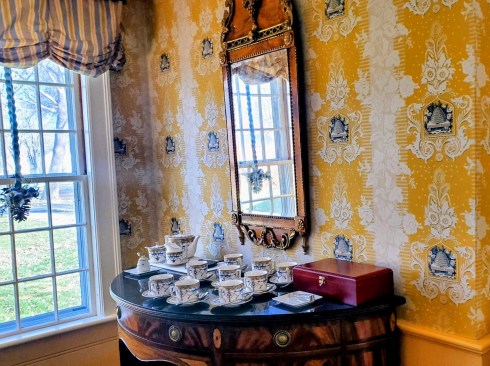
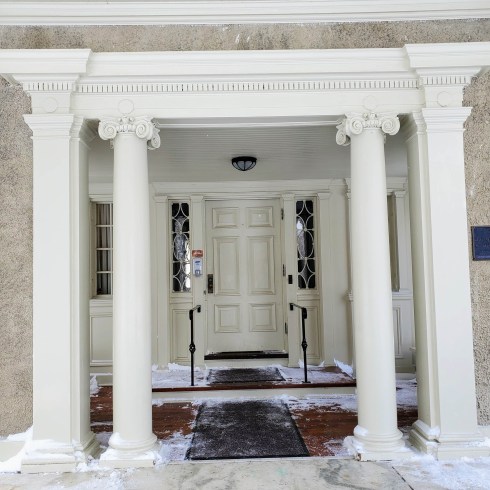
I know that it was a back-to-big-family-Thanksgiving for many people, but because of health and almost-conflicting family events my husband and I found ourselves alone this year. We made a last-minute decision to head to Historic Deerfield, where we stayed at the Inn for two nights and had a lovely Thanksgiving dinner at the Inn at Boltwood (previously the Lord Jeffrey Inn) in Amherst. We ran into old Salem friends and made new Pennsylvania friends at the Deerfield bar, walked around and in as many of those magnificent houses as we could, and “played” in the attic of the Flynt Center for Early American Life. I have under-appreciated this experience on past visits: there was something about this particular visit that made the “visible storage” of all sorts of items from Historic Deerfield’s collections—everything from ceramics to muskets to wrought iron, in multiples—so very engaging. Maybe it’s because we had this “attic” to ourselves. My husband and I have very different tastes, but he could be over there in the realm of metal-working tools while I was lingering in mocha ware, both of us content. We left the attic only because the weather was so beautiful: clear and sunny and bright, casting all those Connecticut River Valley doorways in stark relief.

Historic Deerfield has always been an exploration of maker/craft culture as much as architecture so a focus on objects on this particular visit seemed correct: I’ve always been too dazzled by the houses to take in the Deerfield-made baskets, famous blue-and-white embroidery pieces and pottery to take proper note of them in situ. Before there was Historic Deerfield, there was Arts and Crafts Deerfield, a haven and destination for traditional crafts and preservation at the turn of the last century, and before then there was of course colonial Deerfield: you can see and feel the layers as you walk down Old Main Street. We had the neighborhood to ourselves as we took a long walk on Thanksgiving morning, so we looked in a lot of windows and hung out in back amongst the barns.

A walk down Old Main Street from South to North and then back towards the Inn: village map with house names and dates.

A recent addition to Old Main Street are the Witness Stone markers laid before every house in which an enslaved person live and worked: these were installed just last month in partnership with the Connecticut-based Witness Stones Project. So there’s another layer uncovered and exposed. Museum neighborhoods can feel a bit static and fixed in time, but I’ve never felt that way about Historic Deerfield: rather it has always seems like an engaging mix of past and present or a cumulative work in progress to me. At the same time, time moves slower there: just turn off Route 5 for an hour or a day or two and catch your breath, take a walk, or rummage around in an attic.

Witness (to slavery) stones, a work in progress, and a signpost right in the midst of Deerfield Academy.


Remembering the Revolution: Two Caleb Footes

For this Veterans Day 2022 the stories of two Salem men named Caleb Foote: grandfather (1750-1787) and grandson (1803-1894). But there’s a shadow of another man in this post too, a young lieutenant named Benjamin West, the sole Salem casualty of the Battle of Bunker Hill. The younger Caleb Foote is the link between the other two men: a prominent newspaper editor and publisher, he also dedicated himself to the remembrance of both his grandfather, a privateer and prisoner of war who left behind quite a revolutionary record, as well as his great uncle, who did not. Their conjoined histories are a great reminder of both the sacrifices made by the first American veterans and the commitments that their descendants made to their memories.

Fortunately members of the Foote family were meticulous writers and archivists of their own family papers. Caleb Foote the Patriot was a wonderful letter writer and journal keeper, both on land and on sea. So we know his Revolutionary story well, and his grandson amplified it by compiling and publishing his records in the Historical Collections of the Essex Institute in 1889. Several of the original texts are preserved among the papers of Divinity Professor Henry Wilder Foote (grandson of Caleb Foote III) at Harvard. According to a letter to his wife Mary, Foote was with General Washington at Cambridge in the fall of 1775, but returned home to Salem after the new year. He then took to the sea as yet another of Salem’s many daring privateers: his vessel, the Massachusetts brigantine Gates, was captured by the British off Canada in July of 1778, after which he was taken to England and imprisoned in Forton Prison near Portsmouth for the next two years. In Spring of 1779, he wrote to Mary back in Salem: I am sorry to inform you that you need not look for me till December or March next altho it may be my good fortune to be at home sooner. Please to remember me to all friends….Capt. Smith, Mr. Hines, Mr. Campton, Mr. Foster, Jacob Tucker, John Shaw, and Jonathan Tarent are in the prison with myself (as Salem served as a major privateer port, so many of its sailors ended up in Forton or Mill Prisons as prisoners of war). Foote grew increasingly exasperated with his imprisonment over his next letters, and with Mary as well, who did not seem to be writing him return letters (oddly he refers to her as “most affectionate friend” in his early letters and “dear beloved wife” in the later ones!) In the summer of 1780 he sounds bereft: my welfare…is very poor at present for here we lie in prison, in a languishing condition and upon very short allowance, surrounded by tyrants, and with no expectation of being redeemed at present, for we seem to be cast out, and forsaken by our country, and no one to grant us any relief in our distress; and many of our noble countrymen are sick and languishing for the want of things to support nature in this low estate of health; and many of they have gave to the shades of darkness. Some others have entered on board His Majesty’s ships to get clothes to cover their nakedness, which is to the shame of America.” This was the low point, after which Foote and several of his fellow prisoners managed to escape and find their way to Amsterdam, where they signed on as crew of the recently-commissioned Privateer South Carolina, which eventually brought them home. Foote kept the log along the way, and was discharged from service in January of 1782, near the end of the Revolution. Five years later he was dead at the age of 37, having never really recovered from his long and difficult service, and leaving Mary and their children in rather desperate straits according to the successive applications for aid sent to various Federal offices on her behalf by august Salem dignitories like Timothy Pickering and Nathaniel Silsbee.

Mary Foote survived her husband by nearly 40 years, during which time she saw her eldest son, namesake Caleb, die at sea, several years after his wife, leaving their sole child, five-year-old Caleb III, an orphan in 1810. His mother belonged to the large West family in Salem, and he was raised by them, chiefly his grandmother, who was the widow of Samuel West, bother of the Benjamin West who was killed at Bunker Hill. The Wests must have discouraged a seaman’s career for young Caleb, because he began an apprenticeship at the Salem Gazette and essentially never left: rising to editor, co-owner, and publisher. He was also a civil servant and the model of nineteenth-century civic engagement, serving as postmaster, school committee member, state representative, and Whig party chairman, as well as on every single infrastructure committee I could find and on the boards of nearly every Salem insitution. He was a temperate Mason. Caleb Foote spoke about his grandfather and namesake at public events regularly, but it wasn’t until towards the end of his life that he began taking up the cause of his great uncle Benjamin, who was for some reason left off the list of names on the Bunker Hill Memorial. Joseph Felt asserted that Benjamin West died “in the trenches” in his 1827 Annals of Salem, but he was unheralded in Boston until the venerable Foote took up his cause in the 1880s, perhaps inspired by his compilation work on his grandfather’s papers. And so we have some charming remembrances, first from Foote himself, who testified that this great-uncle of mine had some taste and talent for portrait painting, and a life-sized bust portrait of him in his lieutenant’s uniform, painted by himself hung in the house [of his grandmother West] , and its history was often mentioned to visitors. A copy of it is now in the possession of the Essex Institute, in Salem, and another in the family…..Another reminiscence was entered into the record that is even more poignant: a column from the late Henry Derby of Salem, whose grandmother was nine years old in 1775 and a neighbor of the Wests. She told her grandson that she remembered that morning of June 17 very clearly, when the young lieutenant came through her mother’s door exhibiting his insignia of office (a feather in his hat) to bid her goodbye. To the question, “Are you going, Benjamin?” “Yes—right away,” was his quick reply and off he went, never to return. Mrs. Derby remembered his artistic skills too. He had a shop downtown with a beautiful and much-admired sign of himself in the process of painting a carriage: a perfect advertisement for his sign-painting business. After his death and the disposal of his effects, this very sign became the lining of an outside cellar door of his family house, his last earthly residence, and there gratified the eyes of children and passers-by whenever these doors were thrown open, till time and exposure erased the picture of this young patriot and martyr to liberty.”

Salem Printer Ezekiel Russell’s Elegiac Poem on the Bloody Battle at Bunker-Hill, Massachusetts Historical Society; West Reminiscences in William Whitmore Story’s A memorial of the American patriots who fell at the Battle of Bunker Hill, June 17, 1775 : with an account of the dedication of memorial tablets on Winthrop Square, Charlestown, June 17, 1889, and an appendix containing illustrative papers (Boston, 1889); Caleb Foote’s 1894 New York Times, obituary, also dated June 17!

A few notes on imagesafter I read about the self-portrait trade sign on the cellar door above, I spent hours trying to find some semblance. No luck: honestly, the close I could come is Norman Rockwell’s Colonial Sign Painter from 1936! As charming as Norman Rockwell can be, this is not what I was looking for. Much more interesting is the story of the West self-portrait at the Essex Institute, which turns out not to have been a self-portrait, but rather a portrait by his cousin Benjamin Blyth. All this is explained in an article on Benjamin Blyth by Professor Henry Wilder Foote, grandson of Caleb Foote III: what a coincidence! I couldn’t find an image anywhere, which is often the case with portraits which are referenced as deposited with the Essex Institute in nineteenth- and early twentieth-century catalogs and periodicals: I presume it’s up at the Peabody Essex Museum’s storage facility in Rowley. In any case, I love the inscription on the back as noted by Foote: The Gentleman The Patriot The Soldier The Hero.

Norman Rockwell, The New Tavern Sign (Colonial Sign Painter), 1936, Norman Rockwell Museum.


A Salem Ghost Story

Even though I recognize no connection between Halloween in general and the Salem Witch Trials (because #theywerenotwitches) and for that reason don’t particularly care for Salem Halloweens, I do like the holiday itself, especially its All Hallows Eve foundations. I like ghosts too, and ghost stories, especially if they are crafted elegantly and not just made up by Salem tour guides. For these reasons, I am always looking for a good Salem ghost story and last week I found one! It’s a humorous ghost story rather than a scary tale, written by Brander Matthews (1859-1929), the very prolific and pioneering professor of dramatic literature at Columbia University. “The Rival Ghosts” was first published in Harper’s Magazine in 1884 and then in Matthews’ Tales of Fantasy and Fact in 1896. Its plot features a Salem house haunted by two ghosts who duke it out before they enter into a spectral marriage, bringing peace to both the house and its owner, a Mr. Eliphalet Duncan, on the eve of his own marriage. Eliphalet Duncan is a young New York lawyer, of Scotch and Yankee stock, as his father had come over from Scotland and married a girl from an old Salem family, dating back to the days of the Witch Trials of course. Both his parents died when Eliphalet was quite young, leaving him two legacies: a haunted Salem house and (eventually) a Scottish title. The Salem house is described as “little” and dates back to the seventeenth century, so I’m picturing it as either the Narbonne House or the John Ward House, both of which I gothicized a bit. The Crowninshield-Bentley House might be a bit late but I’ll throw it in there too: “The Rival Ghosts” is not illustrated in either of its editions, but it seems to be calling out for some imagery!

The Narbonne House of the Salem Maritime National Historic Site; John Ward and Crowninshield-Bently Houses, Peabody Essex Museum.
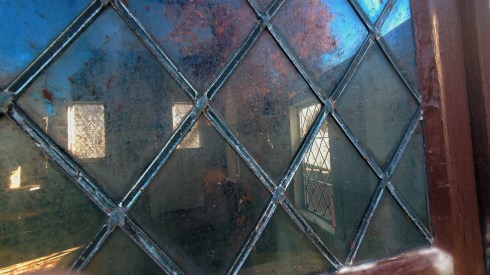
The Salem ghost never appears to the master of the house, but visitors would see and hear its presence on the second day of their stay, when it became determined to drive them away. So Eliphalet was a bit isolated in his little old Salem house, which became even more unwelcoming after he received word that his Scottish cousin had died, leaving him with the family title. Apparently the title came with a ghost, who was to attend his lord at all times and places, and so the Scottish Ghost was suddenly in Salem. Neither ghost was threatening to the new Lord Duncan, but they clearly hated each other, and caused quite a ruckus in his little house: wailing, rapping, throwing things, and playing a variety of musical instruments. He was determined to find out more about them in order to get rid of them, so that he might have peace and visitors in Salem. Towards that aim he invited an old friend to the house, a very brave friend with whom he had fought in the Civil War: his comrade left on day three of what was supposed to be a week’s stay, driven away by the the cacaphony of the rival ghosts. A very frustrated Eliphalet fled as well, to the White Mountains, accompanied by the personal Scottish Ghost and leaving the House Ghost in Salem: “spooks can’t quarrel when they are a hundred miles apart any more than men can,” our narrator observes.

Window of Quaker Meeting House, Salem, Peabody Essex Museum.

On the top of Mount Washington (I guess the cog railway had been built), Eliphalet met the love of his life, the sister of a former classmate who was he immediately determined to marry: Miss Kitty Sutton. A long courtship and engagement ensued, during which he told her about the ghosts. She expressed great interest in his family house, but wanted it cleared of spectres, so Eliphalet returned to Salem on a mission. He pleaded with the ghosts to vacate and managed to enter into a dialogue with them, during which it was revealed that the House Ghost was a woman! She had been murdered by her husband back in seventeenth-century Salem and had lingered ever since. Eliphalet suggested a spectral marriage to give them all some domestic peace, but the ghosts protested that there was too much of an age difference (the House Ghost was about 200 years old, while the Scottish Ghost claimed to be 450 years old) before finally consenting. There followed a double wedding, of ghosts and humans, and off the former went, leaving the little old Salem house to the new Mr. and Mrs. (Lord and Lady) Duncan. While it’s not entirely clear how their marriage led the ghosts to vacate, it’s a nice ending to a charming tale, full of spirited negotiations! Another discovery this past week: the old house interiors paintings of the Russian-American artist Morris Kantor (1896-1974), painted in 1930-31 after a summer tour of visiting historic houses. Maybe it was just the timing of these twin discoveries, but they seem like perfect atmostpheric illustrations for “The Rival Ghosts,” particularly this first one: The Haunted House. 

Morris Kantor, The Haunted House (1930), Art Institute of Chicago; Still Life (1931), Artemis Gallery; Interior (1931), Smithsonian American Art Museum.


A Juneteenth Tour of Salem

I like to craft my own walking tours for every major holiday just for myself, so that I can get in the proper celebratory or thoughtful frame of mind. This weekend, I put together my first Juneteenth tour and it really took some time: I wasn’t sure whether I wanted to focus strictly on Salem sites related to abolition or spaces which are connected to more general African-American history. But it was time well spent as I reconsidered some special people from the past who have always inspired me, and also learned some new stories. There might be two tours leading off into different directions (literally), but I managed to do both pretty easily in an afternoon. As always, I started at Hamilton Hall, the home of the justly-celebrated Remond family of Salem because 1) it is right next to my house; 2) they have served as my “guides” to the nineteenth-century struggles, opportunities, and achievements of free blacks in New England; and 3) As an institution, I think the Hall has made the most serious commitment to African-American History in Salem and there is lots to learn there. This is a subjective tour but objectively I think that Hamilton Hall is the logical starting place for any African-American history walking tour of Salem. The Remonds of Hamilton Hall are being honored this coming week with a marker from the Pomeroy Foundation and the Womens Suffrage Celebration Coalition of Massachusetts for their commitment to the Suffrage movement: more information is here. While I think the overwhelming focus of their advocacy efforts was on abolition rather than suffrage the entire family was focused on improving human rights above all, and the youngest Remond, Caroline R. Putnam, was a dedicated suffragist.

Stop #1: Hamilton Hall, 9 Chestnut Street & the “northern” branch of my tour.

From the Hall I walked down Cambridge Street to the Ropes Mansion on Essex, because I really think it might be a good idea to consider that before this lovely Georgian mansion was known as the “haunted” home of Alison from Hocus Pocus there were enslaved persons held here by Samuel Barnard during his occupancy. If we are going to appreciate and understand  Juneteenth, we must consider what came before. Then I walked over to another house which belongs to the Peabody Essex Museum, the Peirce-Nichols House on Federal Street, to consider the setting of the wonderful 1907 portrait of the Remonds’ successor at Hamilton Hall. Edward Cassell. It’s one of my very favorite photographs of anyone: such dignity of place and person! Cassell is connected to the Remonds through their eldest daughter, Nancy Remond Shearman, so there was really a catering dynasty at the Hall. From the Peirce-Nichols House, I walked all the way down Federal Street to Flint, and then towards North Salem and Oak Street, where Caroline Remond Putnam lived with her husband James and his family, who were also active and prominent abolitionists from Boston. Charlotte Forten, the first African-American graduate of theSalem Normal School and Salem’s first African-American teacher, lived with the Putnams for a while. It’s a short walk from Oak Street along Mason to Harmony Grove Cemetery, where most members of the Remond Family are buried, and according to her diary, a place where Charlotte walked often.

Stop #2: the Ropes Mansion, Essex Street; Stop #3: the Peirce-Nichols House, Federal Street (photograph of Mr. Cassell courtesy of Historic New England); Stop #4: Oak Street (the Putnams’ house at # 9 no longer exists, this woodworking business occupies its site); Stop #5 Harmony Grove Cemetery.

So back at my house on lower Chestnut, I ventured south into a neighborhood associated with Salem African-Americans in the early nineteenth century around High Street, which descended almost down to the water at that time. That’s the thing: the landscape of Salem is so different now that we can’t really envision neighborhoods from this time. There was the large Mill Pond right in the center of Salem, with several African-American families on either side: around High Street on the western shore and on Pond, Ropes, Porter, and Cedar Streets on the easten side. These streets off Lafayette all got wiped out by the 1914 Salem Fire so it’s impossible to see the structures in which they inhabited, but the Salem Directories from the mid-nineteenth century document their residency. The Remonds had a house on Pond Street; Edward Cassell lived on Cedar Street and I came across the most amazing story of another Cedar Street resident in the 1850s: Bacon Tait, a notorious Richmond slave trader who moved north with his common-law, African-American wife, Courtney Fountain and their four children in 1851! What is going on here? I found Courtney Fountain (Tait’s) brother living on Cedar so I suppose that was the draw, but how did Mr. Tait escape the watchful eyes of Salem’s prominent abolitionists? I need to know more! Then it was on to the Derby House,, Derby (and Higginson) Square, the site of much commercial and community activity in the past and the present, and home via Norman and Crombie Streets. This was by no means an exhaustive tour of African-American heritage sites in Salem, but it was a meaningful one for me.

Mill Pond on Henry McIntire’s beautiful 1851 map of Salem; Stop #6: High Street, where Clarissa Lawrence, schoolteacher and aboliltionist, lived in the 4th house down the street; #7 Cedar Street, rebuilt after the Fire but home to several African-American families before, including Edward Cassell, and the family of the notorious Bacon Tait. #8 is the Richard Derby House of the Salem Maritime National Historic Site: constructed by Derby for his son Elias Hasket Derby while he lived just up Derby Street in what is commonly called the Miles Ward House–another example of slavery’s co-existence with Georgian elegance. The Phillips Library of the Peabody Essex Museum has recently digitized a collection of broadsides, and one sheds a bright light on Derby’s slaveowning. Stop #9: Higginson and Derby Squares were very much the center of the Remond Family’s culinary enterprises outside of Hamilton Hall—and 5 Higginson Square was the residence for many Remonds at different stages of their lives. My last (#10) stop on the way back to Chestnut was at Crombie Street, where John Remond’s friend, fellow abolitionist, and culinary competitor Prince Farmer lived: such warriors were they!


Candy Land

In my sweetest dreams Salem is Candy Land rather than Witch City, and it certainly has the heritage to claim that title (although Candy Land was a Milton Bradley game rather than a Parker Brothers production.) There are of course the famous Gibralters and Black Jacks, still sold at the Ye Olde Pepper Candy Company on Derby Street, America’s oldest candy company. Mrs. Spencer sold her hard candy from a horse-driven carriage, and her primary competition seems to have been the stationary confectioner John Simon, whose shop was stocked with a variety of syrups and sweets, everything from anise drops to peppermint. He was always announcing his “removal” to Boston but somehow never made the move. Before the later nineteenth century, however, most confectionary item were not sold by single confectioners, but rather by grocers and apothecaries, and their lists of available sweets became longer and longer with every decade. Nourse’s Fruit Store on Washington Street sold “calves foot jelly candy, strawberry jelly candy, sherbet candy, gum jelly drops, and “East India Red Rock Candy” and all sorts of candies made with the New England’s favorite ingredient, molasses. Confections got a bit softer in the later nineteenth century, when cream candies became popular, and then comes Chocolate!

The Theodore Metcalf Company, one of Boston’s most successful apothecaries, published a beautiful pamphlet on gibralters and black jacks but these were SALEM candies; Nourse’s advertisement, Salem Observer 4 November 1865; Trade cards illustrate the softer trend in confectionary consumption.

The decline of hard candy and the rise of chocolate seems to be a major trend, but candy customers still loved variety. The most successful, and very long-running, confectionary business in twentieth-century Salem was the “Palace of Sweets” on Essex Street, from which the Moustakis Brothers sold their “mastermade” (a patented term) confections. This business was in operation from 1905 until 1968, and after the Taft Summer White House in Beverly placed a series of larger orders it received—and marketed—the presidential seal of approval.

Moustakis Brothers’ Menu from the digital archives of the Culinary Institute of Technology.

Salem is still candy central, in fact two confectionary shops opened up just this past year: Curly Girl Candy Shop on Washington Street and the Chocolate Pantry on Derby, not far from Ye Olde Pepper Candy Company further down the street. And then there is the venerable and amazing Harbor Sweets, the manufacturers of my very favorite candy, Sweet Sloops. I don’t even really have a sweet tooth, and if I am going to indulge I prefer jelly beans to chocolates, but bring a box of Sweet Sloops into the house and I will not rest until they are gone!

The House of the Seven Gables and Ye Olde Pepper Candy Company sponsored the ice sculpture of Mrs. Spencer’s horse and carriage for the Salem’s So Sweet festival this past weekend: its position made it difficult to photograph but it’s much bigger than it appears in this photo! My beloved Sweet Sloops, available at Harbor Sweets on Leavitt Street in Salem as well as lots of other retailers.


Christmas at Home and Away

Our Christmas was Covid-impacted like everyone else’s, but it ended up being just lovely, with most of our time spent with my brother and brother-in-law in Salem eating, drinking, playing bad board games and watching movies. We went up to York Harbor for Boxing Day with my parents, but we’re not going down to New Jersey to see my husband’s family, so this is a rare holiday season without long-distance travel for me (with the exception of last year, of course), and I’m enjoying lounging around. Because we knew we would be primarily stationary on Christmas weekend, we snuck in a quick trip down to Newport to see the decorated mansions (the Elms, Marble House, and the Breakers) as well as the streets and streets of colonial houses of every color. So all in all, a convivial, colorful, and (so-far) Covid-free holiday! I feel very fortunate.

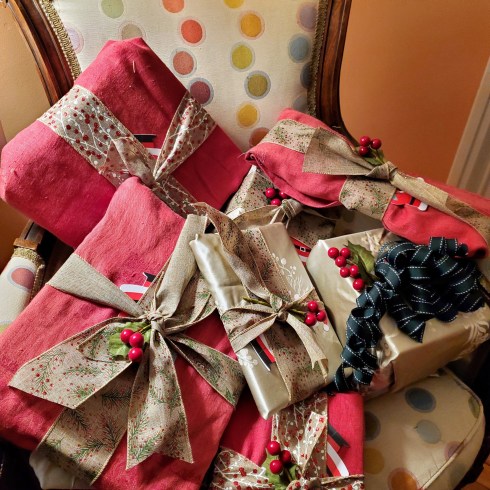
Christmas at Home (with swans this year—and lots of cats, our Trinity & Tuck, and my brother’s Clementine).

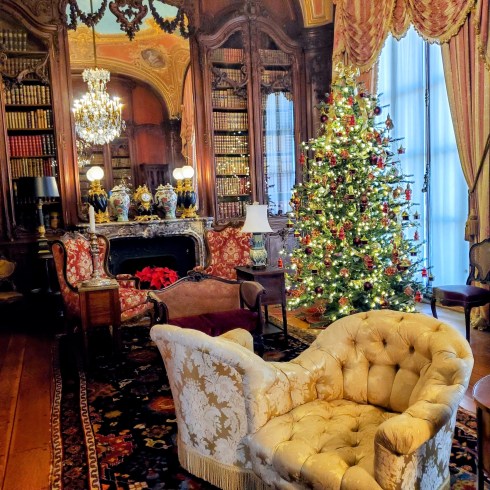
Newport! I really prefer the smaller colonial houses, but when you’re in Newport you’ve got to see some mansions, especially at Christmas time. We had a lovely dinner at the White Horse tavern, and just walked by and through so many houses. Perfect little break. I think I have the many, many Christmas trees and mantles in order of their location—-first The Elms, then Marble House, then the Breakers—but there were just so MANY I might have mixed some up.

The Elms, 1901.

Marble House, 1888-1892.

The Breakers, 1895.

As glittering as they are at this time of year in particular, these mansions are a bit over the top, so I’m ending with the simple themed trees in the basement kitchen of the Breakers (hedgehogs & mushrooms! I’ve been wanting to do those Christmas themes myself) above and my very favorite Newport house and the First Parish Church in my hometown of York, below. Happiest of holidays to everyone.


Thanksgiving Tradition and Transition

For many years my family spent the long Thanksgiving weekend at the grand old Equinox Hotel in Manchester Village, Vermont, the generous gift of my grandmother. We established several traditions there that ended with her death five years ago, after which none of us wanted to return, until this past Thanksgiving. So we came from Maine, Massachusetts and New York to Vermont, where the golden November weather shifted to white winter on Thanksgiving night. We woke up, and it was like a switch had been flipped! We’ve never been crazy about the Equinox restaurants, so we went to the Dorset Inn for a Thanksgiving dinner, as we had in the past. The night after Thanksgiving always began with a dram of Scotch at the tavern at the 1811 House across the way (where nothing else was served except popcorn) but that has been absorbed by the Equinox and I’m not entirely sure what they’re doing with it (although I looked in the window and the bar doesn’t seem to have been changed a bit, thank goodness). Manchester’s role as a center of outlet shopping seems a bit diminished by the pandemic, but we weren’t very interested in shopping anyway (except at the Vermont Country Store a half hour away in Weston). I trudged around in the snow quite a bit but certainly didn’t make it up, or even near, Mount Equinox, though others ascended.

Thanksgiving and the day after at the Equinox and vicinity, the Dorset Inn, and the Vermont Country Store.

On Saturday I trudged all the way to Hildene, the summer home of Robert Todd Lincoln and his family for many years. This is just a great site, encompassing a stately Georgian Revival house and several other adjacent structures, well-preserved and interpreted (and a very nice museum shop, which reinvigorated my shopping impulse). The house looks imposing from outside but seems intimate inside, especially as an organ was diffusing early twentieth-century music through pipes which seem to run throughout. After a spectacular sunset and a great schnitzel for Saturday dinner, we drove down south and home, out of the white and back to the brown (and all of our responsibilities!)

Exteriors and Interiors at Hildene.


The Spectre Ship of Salem

Despite the Salem marketing memo, Halloween is the time for ghosts, not witches, who already have their Walpurgis eve. I don’t think any ghost story could be more appropriate for a Salem Halloween than that of the legendary “Spectre Ship of Salem” which was supposedly reported by Cotton Mather in his Magnalia Christi Americana, according to all the internet “sources” and their sources. I can’t find the original reference, however, only one nineteenth-century gothic tale which asserts that it is embellishing Mather and indeed provides its readers with all sorts of romantic detail: a young couple bound for Old England set sail from Salem sometime in the later seventeenth century aboard the Noah’s Dove only to be presumably shipwrecked and perpetually cast adrift, their ship (and themselves) appearing periodically as an “apparition in the air” to the startled souls of Old Salem (always just before sunset, of course). The story of the “Spectre-Ship of Salem” first appears in print in Blackwoods Magazine in the spring of 1830, is transformed into one of the poetic Legends of New England by John Greenleaf Whittier, and then reappears in prose form in American periodicals over the next twenty years or so: with its repeated references to the elusive Mather, it is actually a ghost story about a ghost story! Mather does write about a ghost ship in his grand New England history, and cites a near-contemporary letter as evidence, but it is a ship out of New Haven rather than Salem, wrecked in 1647 and “perpetually sailing against the wind” thereafter.

Cotton Mather (including map embellished by me, 1702), John Greenleaf Whittier (1831) and Gleason’s Pictorial Drawing-Room Companion (1851).

Although his poem was penned early in his career, I suspect Whittier is responsible for the periodical popularity of the Salem spectre ship “legend” in the mid-nineteenth century, along with the fact that it could be linked to another spectral story increasing in appearances at the time, that of the Salem “witches”. It’s also so Hawthornesque. George Francis Dow commissioned the printing of a stand-alone edition of the Whittier poem in 1907, an act that was definitely in keeping with his other efforts to preserve/showcase/create colonial traditions. Ghost ships are the most global of eternal apparitions, so why shouldn’t Salem have one?

The Dow edition of the Spectre Ship of Salem, published in Salem in 1907; J. Flora illustration of a ghost ship from A Red Skelton in Your Closet: Ghost Stories Gay and Grim (1965).


A Vexillogical History of Salem

What am I writing about? Flags for the July 4th weekend of course: I had to look up that word and thus am using it, despite the fact that it is somewhat intimidating and I could easily have chosen something easy and alliterative like flags of our forefathers. But once I discover a new word, I want to use it, so here we are: vexillology is the study of flags, and like many other aspects of life (including food, drink, architecture, industry, and myriad forms of material and intellectual culture) Salem’s flag history is so notable that you can almost tell its history through flags: we have a famous colonial flag defacement, a Revolutionary symbol, many claims of “first flags” in foreign ports, a notable expression of Civil War resistance, and lots of other interesting flags which illustrate particular trends and times. Salem’s vexillogical history is a a variation on the device used by Nathaniel Hawthorne in his Grandfather’s Chair, which told the tale of the “Endicott Flag” in vivid detail.

A fanciful view of Endicott ordering the defacement of the English Ensign by cutting out its cross of St. George, Ballou’s Pictorial, 1855; Some flag illustrations from So proudly we hail : the history of the United States flag (1981) by William R. Furlong and Bryan McCandless.

Flag history is often “patriotic history” which of course is a contradiction in terms, so there is a lot of lore and legend that needs to be cut out, just like St. George’s cross. It’s best to stick to the primary sources. John Winthrop reported that on 5 November 1634, “At the court of assistants complaint was made by some of the country (Richard Brown of Watertown, in the name of the rest) that the ensign at Salem was defaced, viz. One part of the red cross taken out. Upon this, an attachment was awarded against Richard Davenport, ensign-bearer (who was ordered to cut out the cross by John Endicott), to appear at the next court to answer. Much matter was made of this, as fearing it would be taken as an act of rebellion, or of like high nature, in defacing the king’s colors; though the truth were, it was done upon this opinion, that the red cross was given to the King of England by the pope, as an ensign of victory, and so a superstitious thing, and a relique of antichrist.” Certainly Endicott was not alone in these sentiments: popery and the cult of the saints were right at the top of the “traditions” or relics which were the focus of intense Puritan opposition in both old England and New England. The “crossless flag” did not really take root, but symbols like the pine tree began to appear on banners in the next century, both within and without the cross, eventually inspiring the famous “Appeal to Heaven” flag of Washington’s Cruisers. There were so many interesting regimental flags used during the American Revolution, but the only one I would find with ties to Salem is that of Major Israel Forster of Manchester-by-the-Sea: there are several extant examples, one in the collection of the Peabody Essex Museum (see above) and the other which sold at auction in 2014. There are no references to the Forster flag in the PEM’s digitized catalog and collections, and I’m also curious about a flag with one star and many stripes which was long displayed in the Essex Institute’s Plummer Hall: I don’t know why it is often so difficult to find objects that were in the old Institute in the new PEM!

The Historic Forster Flag at Doyle’s auctions, 2014; 1915 postcard featuring the “mysterious” flag in the Essex Institute.

The history of the recognition of the American flag seems very intertwined with that of Salem’s maritime history: all the old-school maritime historians assert that the first time the US flag was spotted in many Asian and African ports was on a Salem ship. This would be a great topic for an academic paper, perhaps even a dissertation: you can certainly assess how important flying the flag was in all sorts of contemporary images, like George Ropes’ Launching of the Ship Fame (1802). The flag you see here, with its circle of stars, represents a common configuration in the nineteenth century up to the Centennial, but there was no standard, official design for the (expanding) stars and stripes until 1912 so there were all sorts of interesting arrangements up to that time. The Fame flag is very similar to that in a watercolor painting memorializing the American prisoners of the War of 1812 who died in the massacre at Dartmoor Prison in 1815, among them nine Salem sailors. About a decade later, a young Salem sea captain was gifted a flag by a group of Salem ladies for his first overseas voyage in command: this was William Driver, who made his Salem fortune and then retired early to Nashville, where his brothers operated a shop. He brought his flag with him, displayed it proudly until the onset of the Civil War, and then hid it in the attic until Union troops captured the city. His “Old Glory” became the symbol of resistance and triumph, both during and especially after the Civil War. What comes after is a bit more complicated, because there are actually two Old Glory flags: a large banner in the collection of the Smithsonian which is generally accepted as “official” and a smaller one in that of the Essex Institute/Peabody Essex Museum. It is quite clear, however, that a Salem-made flag was at the center of both storms at sea and on land.

George Ropes, The Launching of the Ship Fame, 1802, Peabody Essex Museum; Memorial to the victims of the Dartmoor Massacre, Dowst Family, Skinner Auctions; “Old Glory” at the National Museum of American History.

A few sought-after 13-star flags with Salem provenances have surfaced over the past few decades, including one which belonged to shipmaster Parker Brown and the so-called “Hancock & English” flag from the Mastai Collection, a period flag which was modified by the addition of the 1880 presidential candidates which once graced the cover of Time magazine (July 7, 1980: second from right in top row, below). There was a considerable expansion in the commercial use of the flag over the second half of the nineteenth century, and it was a favorite banner for Salem’s entrepreneurial merchant/photographer/author Frank Cousins, who featured flags and political souvenirs in his shop, and advertised his wares with flag posters and trade cards. From the Centennial on, it’s all about parades as well, which called for a variety of festive flags. Salem excelled at one particular form of July Fourth celebration in the twentieth century—bigger and bigger bonfires—and flags were always on top of these impressive constructions: this has always struck me as a bit problematic as presumably they would burn. A blaze of glory, perhaps.

13-star Salem flag, Heritage Auctions; Frank Cousins Bee-Hive flag, Bonsell Americana; 1896 parade flag, Cowan’s Auctions; July Fourth Bonfire, Boston Public Library, Leslie Jones Collection.


A Juneteenth Tour

I learned about Juneteenth ridiculously late, from a student! It was about five or six years ago (only!) and I was talking about Salem’s Black Picnic, an old tradition recently revived, with a brilliant African-American student and she said “that sounds like Juneteenth” and that was that. I don’t remember whether I feigned acknowledgement out of embarrassment or not but inwardly I was mortified by my ignorance. Yes, I was trained in European history, but I’m an American too! Since that time, I’ve used my focus on local history here to learn more about African-American history in Salem: I’m still lacking the big picture but fortunately I have wonderful colleagues at Salem State who help me with context and filling in the blanks. I started putting together my own African-American history tour of Salem about three years ago, and it began (and ended) with Hamilton Hall, where the Remond family lived and worked for decades. This was more familiar territory for me, and the Hall remains my main window/entry/initiation and orientation point for Salem’s African-American history; its centrality is particularly marked this year because of a special exhibition on view all summer long: Unmasking & Evolution of Negro Election Day and the Black Vote. The creation of Salem United, Inc., the organization that revived the Black Picnic at Salem Willows in 2014, the exhibition draws connections between the colonial traditions of Negro Election Day, nineteenth-century African-American parades and picnics, and the Civil Rights struggles of the twentieth century. Salem, United Inc. President Doreen Wade’s enthusiasm for this history is so infectious that her history is transformed into ours.

Scenes from the exhibition: our host and guide Doreen Wade, reproduction dress for Negro Election Day royalty & the jelly bean test for voting from the 1960s, the Brick Hearth Room, very much the center of the Remonds’ activity in the Hall.

For me, this exhibition was about the power of place: I was really moved by the exhibits in the Brick Hearth Room (last photo above), where the Remonds, who struggled for personal, professional, racial, and citizenship recognition for so long, worked, adjacent to where they first lived. The connection between past and present also felt appropriate to me: the distinguished historian of slavery Ira Berlin asserted that Negro Election Day “established a framework for the development of black politics” and who am I to argue with that? It was a special day at the end of May, recognized in twenty or more cities throughout the northeast from the mid-eighteenth century, on which resident African-Americans celebrated, made merry and wore dress clothes (sometimes belonging to their masters), elected notable “kings” or “governors” from among their own, and enjoyed a brief interlude of freedom and agency. To me, it looks like the medieval and early modern festivals of Europe, where everything was turned upside down for a day and peasants elected a “Lord of Misrule,” but it had African roots: I guess the drive for those on the bottom to live like those on the top for just a brief spell is universal. Negro Election Day is well-documented in Salem by most of its famous diarists. In 1741 Judge Benjamin Lynde identified May 27 as a day of “fair weather” and “Election: Negro’s hallowday here at Salem; gave Scip 5s. and Wm 2s. 6d.” indicating both recognition and a form of engagement, and William Pynchon seems to have had a similar attitude in 1788 when he went “to election at Primus’s flag,” indulged in the ale and pies offered at the festivities, and watched the dances. In 1817, the Reverend William Bentley noted “the still bewitching influence of what they call election” in his diary, but by the nineteenth century Election Day seems on the wane, replaced by more formal organizations like the Sons of the African Society in Salem with its dignified meetings and parades, and eventually by the Black Picnic at Salem Willows from 1880. While eighteenth-century white observers seem to be bemused by Negro Election Day, the nineteenth-century perspective seems more mocking, as you can see in the political commentary below: like a negro election King to-day but back again to-morrow. Besides the juxtaposition of objects in the Remond space, the most poignant exhibit in the Unmasking & Evolution exhibit for me was a photograph of a minstrel show at Salem Willows: apparently while the Black Picnic was happening, white Salem residents actually organized a performance with children in blackface to mock them. It’s quite an image on its own, but I think we need a bit more information about it. I can’t unsee it, and it reproduces badly here, so you should see it for yourself.

A minstrel show at Salem Willows—the exhibit caption says 1885 but it looks quite a bit later than that?

Obviously there is some rich history—American and African-American, both, together— encased in Hamilton Hall, in general and in particular this summer, so it’s the perfect place to start a Juneteenth tour. Some other suggestions: 8 High Street, where Clarissa Lawrence, fierce educator and abolitionist, lived among a small community of African-Americans, Aborn Street, where Salem’s first African-American teacher, Charlotte Forten, taught, at the former Epes School at number 21R, Oak Street, where Charlotte lived with Caroline Remond Putnam, daughter of John and Nancy Remond and an extremely active entrepreneur, abolitionist, and later suffragist, Higginson/Derby Squares, where the Remonds and other African-Americans had a succession of profitable businesses, and finally Harmony Grove Cemetery, where you can see the very striking and solitary grave of John Remond. And then to the Willows, of course.

Mrs. Nancy Remond was known for her Election Day cakes, which she offered not only during election week (last week of May) but all year long, Salem Gazette; John Remond’s grave stone in Harmony Grove Cemetery; more information about Salem United and the Black Picnic in Salem Willows is here.