Tag Archives: holidays

Heroes Uncovered

Salem has three historic downtown cemeteries and the one closest to my house is Broad Street, where I go weekly to wander around and learn something new from the gravestones. Its neighbors have been stewards for as long as I’ve lived in Salem, but over the past few years the cemetery has just looked better and better, acquiring a new permanent entrance sign featuring its notable occupants and seasonal flags for those who were veterans. Yesterday, there were more waving flags than ever, as the Friends of the Broad Street Cemetery held an event showcasing the efforts of their vice-president Kenneth Dike-Glover, who has uncovered many previously unknown graves of veterans, particularly those of the Revolutionary War. Ken was aided by a newly-discovered map, a local example of the Veterans Graves Registration project undertaken under the auspices of the WPA in the 1930s, and he told us in exuberant detail how he worked with this map to mark graves that he (we) didn’t even know were there. It was a lot of work, and it is ongoing: one particular mystery involves of the most famous graves in the cemetery, that of Timothy Pickering, Quartermaster- General of the Army during the Revolution and later Secretary of War and State, who just might not be buried under the perfectly preserved and DAR-marked Pickering family stone but rather under a derelict and unmarked one a few feet over! This is just one example of the often-perplexing process of correlating written documents with physicial spaces: it’s not as easy as it sounds. Maps do not always reveal all; sometimes they create more mysteries. But there were definitely revelations in terms of uncovered ground markers and veterans less conspicuous than Pickering whose graves were “hiding” under their family markers–now uncovered, and in plain sight. Ken had marked each grave with a flag and brief biographical and historical references, so after his talk, we all wandered around and got to know these uncovered heroes. I can’t imagine a more perfect Memorial Day activity.

A beautiful day in the Broad Street Cemetery. Ken Dike-Glover and the WPA Map; City of Salem Veterans Agent Kim Emerling, and some of the marked graves, including the two Pickering tombs. The Friends of the Cemetery are soliciting volunteers to help with their inititatives and advocacy, so if you’re interested in early American history (or just cemeteries), check out their facebook page here.

As I was meandering about digesting all of this new information, I was struck by how many privateers are interred in this cemetery. I knew about Jonathan Haraden, the superstar of Salem’s privateers (on whom we have a short chapter in Salem’s Centuries, featuring lots of new research!) but Captains David Smith and Francis Dennis (among others) were new to me and I look forward to reading more about their exploits and service. Captain James Barr (one of about a score of Revolutionary War veterans who lived long enough to be photographed) is also buried in Broad Street, along with approximately 70 of his contemporary brothers-in-arms, but the cemetery also features the recently-rededicated tomb of Brigadier General Frederick Lander and on an adjacent stone, the poignant epitaph of his Civil War comrade, Brevet Colonel Samuel Cook Oliver, who was wounded severely at Antietam: died after many years of suffering, cheerfully and bravely borne.

Salem heroes, long-known and recently-uncovered.


May Day Weather

May Day is a day with many associations and representations: an “olde” festival with attendant Green Man and maypoles, a cross-quarter celebration of spring and surviving the winter, a day to celebrate and demonstrate the power of workers everywhere, a signal of alarm. In between its folkloric and political roles, however, it appears to have taken on the more mundane role of annual weather check. I went through some Massachusetts newspapers published in the nineteenth century to see how May Day was celebrated, if at all, and while there were occasional references to May Queens and lots of bad poetry, I found many more assessments of what’s in bloom and how present May Days compared to the past in terms of flora. Actually it was often more about the climate than the weather. Here’s a great evaluation from the Newburyport Herald in 1837: On the whole, we may consider ourselves as gainers in regard to climate. We enjoy longer summers, milder autumns and shorter winters than our ancestors enjoyed. Spring is the only season in regard to which we are losers. The celebrated season of “ethereal mildness” seems to be entirely degenerated — it is nothing but a constant alternation of summer and winter weather. Spring losers!

Dwight William Tryon, Early Spring in New England, 1897. Smithsonian Institution, Freer Gallery of Art. Gift of Charles Lang Freer.

The Salem papers presented poetry for May Day in the earlier decades of the nineteenth century but then switched to more wary but still hopeful assessments of the day and the weather at mid-century. In their stories on the first heralds/flowers of spring, one is immediately struck by the lack of references to tulips and daffodils: bulbs must have been a later thing?  It’s all about woodland natives, found in the “Great Pasture” off Highland Avenue. The Salem Gazette heralded a “May Morning Bouquet” in 1849, noting that May comes to us this year out of the atmosphere of an iceberg, as it were, but it may prove as pleasant a month as the poets avow it to be in less fickle climes. Five plants made up this bouquet: hepatica (which was generally called liverwort), Sanguinaria canadensis (bloodroot), anemones, mayflowers (trailing arbutus), and violets. These hardly flowers “will amply reward a search on May morning amongst the thickets and rocks in the neighborhood. But then it may rain, or freeze, or snow!”

Liverwort and Bloodroot in Charles F. Millspaugh’s Medicinal plants : an illustrated and descriptive guide to plants indigenous to and naturalized in the United States which are used in medicine, their description, origin, history, preparation, chemistry and physiological effects fully described (1892).

Anemone from William B. Barton’s Flora of North America (Volume 2), 1821.

Arbutus (also called Epigaea repens or Mayflower) in Jacob Bigelow’s American medical botany :being a collection of the native medicinal plants of the United States, containing their botanical history and chemical analysis, and properties and uses in medicine, diet and the arts (1817).

Violet from Jacob Sturm’s Deutschlands Flora in Abbildungen nach der Natur mit Beschreibungen (1798).

These are lovely little wildflowers: I have bloodroot in my garden and (unfortunately) violets too, but a bouquet? I think not, we need more robust flora for that. And please, I would prefer to stroll in a sunny green pasture rather than among the “thickets and rocks.” Maybe we should not have abandoned our devotion to the Green Man over here in Puritan New England: we have consequently become spring losers! 


A Salem Walking Tour for Presidents Day

Sorry I’m a little late with this Presidents Day post, but I woke up this morning with an earnest desire to take a walk around Salem, an urge I haven’t felt for quite some time. And since it was Presidents Day, I had a walking theme, which is always nice. We had a lovely weekend in New Hampshire with old friends and a equally lovely dinner with my brother and brother-in-law when we returned last night, and I woke up feeling happy and finally rested from finishing THE BOOK. So off I went in search of presidential places on this sunny but chilly day. This is a little breezy, I certainly didn’t do any research, so feel free to make corrections and/or additions. I’ve plotted my tour on a 1915 “New Map of Salem for the for Motorists and Tourists” from the Library of Congress, and most of the tour stops (marked with stars) are standing today: one had yet to be built (the Hawthorne Hotel) and another (the Ruck House, marked by a special star) was torn down to make way for the new Post Office in the 1920s, along with 50+ other old structures in the vicinity.

I always start my walking tours at Hamilton Hall on lower Chestnut Street because I live right next door. So many things happened at the Hall, however, that it is not only a convenient place but also a logical place to start a Salem history tour. Quite a few presidents have visited the Hall, John Quincy Adams, Martin van Buren, and Theodore Roosevelt for certain. The latter came up to Salem from Harvard for debutante assemblies in the later 1870s, and I think he might have even met his first wife, Alice Lee, there, as several letters in the Pusey Library refer to their courtship amidst the assemblies. Then Vice-President Van Buren reportedly referred to Chestnut Street as “the most beautiful street I have ever seen” at an 1817 reception though this oft-quoted opinion has been attributed to others.

Keep walking up Chestnut and cross over to Essex on Flint, then walk eastward towards Grace Church, our second stop. President William Howard Taft, who maintained  “Summer White Houses” over in Beverly for several seasons, attended services here occasionally from 1909-1912. Like several other presidents, Taft also visited the Peabody Museum and the Essex Institute and spoke at the Salem Armory, and an endorsement from Mrs. Taft indicates that he was a big fan of the chocolates at the Moustakis Brothers’ “Palace of the Sweets” at 220 Essex Street (although I’m pretty sure he didn’t shop for them there himself.) Continue walking eastward on Essex and cross over to Federal Street at Monroe, after passing the Cabot-Low-Endicott house on the right: I really think President Grover Cleveland visited his first Secretary of War, William Crowninshield Endicottt, there but I can’t find the documentation.

On Federal, we’re just going to head west for a bit until we come to the Peabody Essex Museum’s Assembly House, where President George Washington was wined and dined at a reception during his big trip to Salem in October of 1789–he stayed at the Joshua Ward House on the street that would be renamed in his honor after this visit, now The Merchant Hotel. Then it’s a long walk towards downtown along Federal Street to Washington and the Tabernacle Church, where Calvin Coolidge attended services while maintaining his Summer White House in Swampscott in the 1920s. Then we walk down to Town House Square where several presidents traversed and campaigned, including Ulysses S. Grant, Chester Arthur, and Theodore Roosevelt.

President and Mrs. Coolidge attending services at the Tabernacle Church, Salem, on July 4, 1925, Special Collections and University Archives, University of Massachusetts Amherst Libraries.

Walk down Essex Street to the East India Marine Hall of the Peabody Essex Museum, which was visited by a succession of presidents from John Quincy Adams to Taft and Coolidge. The Salem Armory (or what’s left of it) also hosted several presidential receptions. It’s difficult to orient yourself historically on Essex Street as so much is new, but Thomas Jefferson (1784), James Monroe (1817), and Andrew Jackson (1833) all visited famous dwellings in this vicinity. Jackson was not popular, and he did not attend a special  “handsome and good dinner including mock turtle soup” for 150 attendees on June 26 prepared by famed Hamilton Hall caterer John Remond, pleading illness. His great opponent, the former president John Quincy Adams, later expressed his doubts about Jackson’s debility, which he called “politic,” at best.

Make your way over to Salem Common by the Hawthorne Hotel, from which President George H.W. Bush WALKED down Hawthorne Boulevard and Lafayette Streets for his speech at Salem State College (now University) in May of 1994. I’m not sure whether or not his fellow presidential speakers in the famed series, Presidents Ford, Carter, and Clinton, stayed or were “received” at the Hotel, but they were certainly in Salem!

On the Common, head for the northeast corner and the Washington Arch, recently restored by the Salem Common Neighborhood Association. (unfortunately the attendant sign is incorrect: while Salem’s privateering record is impressive, the port did not account for half of the estimated 1800 captured British vessels during the Revolution. This kind of sloppiness is unfortunately all too common with Salem’s historical signage). From the arch you can look at two “presidential” houses at either side of this corner, the former Silsbee house (now beautiful condos!) and the Joseph Story house, both of which served as venues for the reception of President James Monroe in the summer of 1817. From this vantage point, I can also imagine President James K. Polk’s entourage speeding down Winter Street towards Beverly in 1847.

Walk south towards Salem Harbor and Derby Street, where you will find the stately Brookhouse Home for Aged Women right next to the Custom House. It was built for Benjamin Crowninshield, who was a US representative and Secretary of the Navy under both Presidents Madison and Monroe, and the latter stayed her during his 1817 visit to Salem. From there its a pretty straight shot along Derby, Charter and Front Streets to the Joshua Ward House/Merchant, where President Washington stayed  in October of 1789. A friend of ours restored the building (very meticulously!) and so as soon as it was open for business, we booked the very room in which Washington slept, which was quite a thrill! From the Merchant you can look out to where the Ruck house once stood, now occupied by the Salem Post Office. This was the home of Abigail Adams’ sister and brother-in-law so often visited by the Adamses in his pre-presidential years. The two wonderful pastel portraits of Abigail and John by Salem artist Benjamin Blyth were no doubt a product of their familiarity with this house and Salem.

Abigail and John Adams by Benjamin Blyth, c. 1766, Massachusetts Historical Society.


St. Valentine’s Day Comes to Salem

So many Valentine’s Day posts! But I never wondered how this holiday was first observed in Salem until I came across an interesting newspaper article from the Salem Gazette in 1823. I just love the description of American “coolness of reason, devotion to secular business, and freedom from superstition” as contrasted with a more passionate England. This was nearly twenty years before the arrival of the uniform penny post in the UK, after which Charles Dickens and his editor W.H. Wills would write of the onslaught of “sacrifices” to St. Valentine, “consisting of hearts, darts, Cupid peeping out of paper-roses, Hymen embowered in hot-pressed embossing, swains in very blue coats and nymphs in very opaque muslin, coarse caricatures and tender verses” passing through the post offices of Great Britain on February 14 in Household Words (March 30, 1850).

Salem Gazette, February 14, 1823.

Several years before Dickens addressed these copious British valentines, one of them made its way to the Worcester, Massachusetts home of Esther Howland, who was inspired to make her own with her original designs and the materials sold in her father’s stationary store, thus beginning the commercial valentine industry in America. Worcester was the center of this industry for a century, aided by US postal reforms. The valentine story is really a Worcester story, not a Salem story, but it’s interesting to see how quickly Salem stationers picked up this trade. They were not innovators like Howland or her successors, but they jumped on board very quickly, offering a variety of valentines from various suppliers by the late 1840s, as well as materials for those who wanted to craft their own.

Salem Observer, January 29, 1848 and Salem Register, February 9, 1849.

If you search for the word “valentine” in databases of Salem newspapers you will get references to the names of various people, to the Saint, or to Sir Walter Scott’s novel The Fair Maid of Perth (or St. Valentine’s Day) before the 1840s and afterwards, almost exclusively to the holiday and its tokens. That “coolness of reason” observed in 1823 seems to have been abandoned relatively quickly, but Valentine’s Day was certainly not a religious holiday nor one based on “superstition”. And in antebellum Salem and elsewhere, it seems like an observance more than ready to burst out of Salem stationers’ shops.


Vintage valentines from c. 1890-1910 from the Mount Holyoke Valentines Collection ,assembled in memory of that famous Mount Holyoke graduate, Esther Howland.


Holiday Tables

If I’m hosting for Christmas or any other holiday, I spend more time thinking about the table than the menu: much more time. I love setting the table, and once I attain my “vision” we’re all relegated to eating in the kitchen, no matter how many days before the big meal. Here it is, December 22, and I am hosting Christmas dinner and the table is not set! I just finished my grading, however, so I’ll get it together. I have a different animal theme every year for Christmas decorating and some animals are easier than others. Obviously deer are super easy, and I’ve also done bears, foxes, sheep, swans, pheasants, mice and hedgehogs—and more. This year, I chose lions, and they have been challenging! But I do have these great lion placemats which are everything. I’m not quite ready, however, so here’s a succession of holiday tables from both sides of the Atlantic.  First we have some Scottish tables from my trip last month, and then a succession of tables from Strawbery Banke in Portsmouth, NH: every year they have a Candlelight Stroll among and within their historic houses, featuring a sweeping and colorful view of holidays past.

Scotland: first up are parlor, dining room, and kitchen tables in the Georgian House in Edinburgh’s New Town, owned and operated by the National Trust for Scotland, then a Georgian “everything” room in another National Trust House, Gladstone’s Land. You’re looking at a table, but a lot more is going on in this room–it reminded by of another Georgian room, just below, in the Concord Museum, which I just visited last week. Back in Edinburgh, nothing is more festive than a pub table, and the city is in the midst of major gin craze. The Jolly Botanist is a great gin bar that we really enjoyed.

Back Home (well in Portsmouuth): Strawbery Banke is a museum “neighborhood” of historic houses, some of which were located in the Puddle Dock area of Portsmouth, others which were moved there when the museum was founded in the 1960s. It’s always been a part of my life, as I grew up across the river in southern Maine. The annual Candlelight Stroll features decorated houses with reenactors, representing different periods and stratas of society. The opulent Goodwin Mansion, first up below, was built in 1811, but it is interpreted as an 1870s house. Below its dining room is that of the Chase House, a Georgian structure that is interpreted c. 1818, followed by that of the Rider-Wood House (1830s), the Shapiro House (1919) and the time-capsule 1950s kitchen of the Pridham House.

My table is not set yet but here are the lions, ready to go! Best wishes for a restorative and merry Christmas.


Colorways: a Parade of Portsmouth Doors

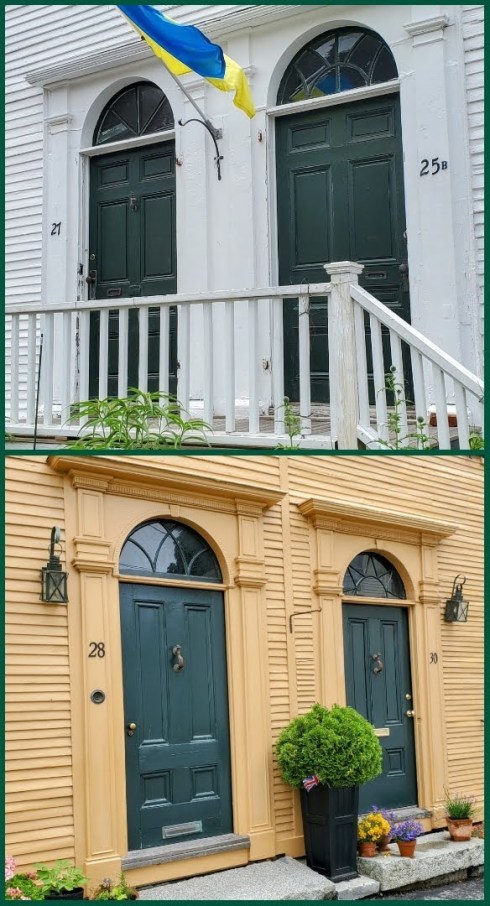
I’ve been in York Harbor all June and just returned to Salem. It was a very productive month removed from daily tasks and diversions, but I missed certain things and people: my husband (I brought the cats), my garden, my street. Certainly not the tour guides and groups though: they were in part what drove me away. Of course I found the usual Dunkin iced-coffee cup propped up on my stoop the moment I got home. Salem is busy and festive all year long now it seems; while the incessant witch tourism annoys me the other celebrations are great, and June is a particularly festive month with its mix of private and public celebrations: weddings and graduations, Juneteenth and Pride. Salem goes all out for Pride and  I missed that, and definitely craved some color amidst our rainy and foggy weather, so I took off for Portsmouth late last week seeking flags but finding doors. When I was growing up across river, Portsmouth was a much shabbier place: now you are hard-pressed to find an old house that is not in perfect condition. I expanded my usual downtown walk to include neighborhoods a bit more outlying like that bordering Christian Shore and the South End, and found so many lovely houses, all with very colorful entries. Red was an exotic front-door color before; now there is a veritable rainbow of Portsmouth doors. And I’ve got some flags here too.

Ok, I think I have the whole spectrum represented! It was surprisingly difficult to find white doors: as you see, one is hiding behind a tree. I wasn’t sure where to put taupe, so I paired it with brown. There are no painted brown doors, just various shades of natural woodwork. Not too many black doors either, but lots of green, and lots of yellow. Do not tell me that one of my purple doors is blue; it is purple. Portsmouth is the best walking city ever: beautiful neighborhoods, dynamic downtown, tons of historical markers, pocket parks, well-maintained sidewalks. More rainbows are there for the making!

Some singular Portsmouth doors: two-tone green and Happy Fourth!


Adorning Hearts

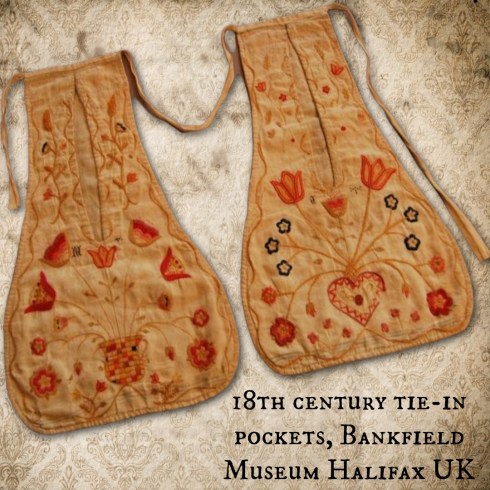
Something light and bright, fluffy and joyful and merely decorative for Valentine’s Day: I wanted to use the occasion to reaquaint myself with some decorative arts databases. Between my last book project and the two that I’m working on now, and teaching, and being frequently frustrated with Salem heritage and preservation issues (as you know all too well here) I don’t have much time for wandering about in digital image archives. But I gave myself permission to do so this weekend, and here are the results! If you have a universal symbol like ♥♥♥ as your keyword, you’re going to get thousands of results: I limited mine to textiles, and then just chose my favorites by purely aesthetic standards. Whether these fabrics were created for the table, or the wall, or a person, they are more about adornement than adoration.

Above: Furnishing Fabrics from Alsace, c. 1840, Metropolitan Museum of Art, A.C. Pugin, 1851, Victoria & Albert Museum, France, later 19th century, The Design Library, C.F.A. Voysey (who clearly loved hearts!), 1900-1929, Victoria & Albert Museum, and a heart handkerchief by Sylvia Chambers, 1940s, Glasgow School of Art Archives. Below: “Hearts & Flowers” from Folly Cove designer Peggy Hamilton, 1955, Cape Ann Museum.

Happy Valentine’s Day! Great sites for exploring decorative motifs (not just HEARTS) here.


A Big end-of-year Book Post

I always do a book post at this time of year for several reasons: it’s fun to go through the mental process of compiling “best of” lists, I like to offer gift suggestions, and the time between semesters is always one of intense reading for me. This year, I’m a little late for gift suggestions, but the two other inspirations apply: I read some great books over the past summer and I have my usual stack of unread books right by my bedside, all ready for December 26. This was the year that I published my own book, so I had more time for reading, but now I’ve just finished proposals for two new books, so the next year might not be so free (hopefully). I want to take advantage of the time that I have to read as much as I can, and I’m driven to learn more about: 1) Ukraine (because war); 2) commodities and trade in the pre-modern world (because saffron, the subject of one of my proposed books; 3) information dispersion, broadly defined (because academic+general interest); 4) the history of science (because academic+general interest); 5) early American history (because Salem, the subject of the other proposed book); and anything to do with design (just because). No fiction recommendations here, sorry: I  like fiction, I try to read fiction, but I just don’t seem to be able to finish novels at this point in my life. I put them down because I get curious about something: there are dog-eared spine-cracked books all over the house! So here goes: this is a “best of” list of what I’ve read or was on my radar in 2022 rather than what was published this year, and it’s pretty academic, but there are some fun and beautiful books here too.

Ukraine: I read Yale historian Marci Shore’s The Ukrainian Night: An Intimate History of the Revolution this past summer (and into September—it took me a while): I really learned a lot. My Ph.D. is in European comparative history, but boy, this book made me realize how little I know about Eastern Europe—and the twentieth century. The Ukrainian Night places the Crimean crisis of 2014 in historical context and thus also provides the context for the current crisis, and it is very much a personal, “intimate” history rather than an academic tome. I picked up Polish journalist Pawel Pieniazek’s Greetings from Novorossiya (2017) for more personal history of the ongoing conflict in eastern Ukraine and Timothy Snyder’s introduction: the latter (also at Yale) is my guide to everything Ukraine on Twitter (still). I imagine we’ll get “first-draft” histories of the Russian assault and Ukrainian response soon.

The demand, supply, consumption, and exchange of a range of commodities in the late medieval and early modern world are all academic and personal interests of mine, and 2022 was a banner year for books on all sorts of economic history. Any former student of mine will tell you that I believe that the Black Death was the most consequential event ever, for a variety of reasons, so I have been waiting for Belich’s book forever. It’s brilliant, and ties together all the trends and themes I have been teaching for years. I wanted to assign it to my undergrads this past semester, but I thought it would be a bit much for them. Future grad students, however, are duly “warned.” In terms of economic dominance in the world the plague made, it’s increasingly all about the Dutch, so Pioneers of Capitalism. The Netherlands 1000-1800 is a welcome book too. I like its long time span: too often the Dutch “Golden Age” seems to spring from a rather shallow pool. Anne Gerritsen’s The City of Blue and White has been by my bedside for a year or so, but I recently moved it to the top of the stack.

The City of Blue and White is definitely calling me, but it will probably have to wait until I have finished Pamela H. Smith’s latest book From Lived Experience to the Written Word. Reconstructing Practical Knowledge in the Early Modern World as I’m reviewing it for an academic journal. I wish I had read this book before I wrote my own, but Smith is a prolific and active scholar so I had the benefit of her prior publications. She teaches at Columbia, where she is also the Director of the Center for Science and Society and its Making and Knowing Project, which “explores the intersections between artistic making and scientific knowing.” There’s nothing new about “maker culture” and it was far more robust and fluid in the early modern era, when making became knowing. Jumping up a century or so and into the realm of visual information dissemination, I am obsessed with the new book series from San Francisco’s Visionary Press : Information Graphic Visionaries, edited by RJ Andrews, who told Print magazine’s Steven Heller that he is “obsessed with craft. To me, the most fascinating thing is to understand the story behind how something came to be.” That’s just how I feel, so I wish I had put these three books on my Christmas list. I’ll just have to buy them myself, beginning with volume on Emma Willard’s history maps (the “Temple of Time,” above, is just one) which are just fascinating in so many ways.

Speaking of ambitious and confident Victorians who believed in progress passionately, Iwan Rhys Morus’s How the Victorians Took Us to The Moon is a survey of nineteenth-century British innovators as well as the innovative “spirit” of their era. It’s a bit biographical for me but that approach definitely increases its accessibility. The other history of science, broadly and brilliantly focused, which I purchased this year is Lorraine Daston’s Rules: A Short History of What We Live By. I thought it would be a good aid for teaching, but I just devoured it, and find myself picking it up often: reference and readability: you can’t beat that!

My Salem State colleagues and I are collaborating on a book of essays for Salem’s 400th anniversary in 2026 and I’m going to have to do a deep dive into several periods of American history for my contributions. Since I’m not an American historian, I need some foundations, and I really like the “American Beginnings” series from the University of Chicago. Three series books are above: the first two explore a topic that my colleague Dane Morrison has been working on for a while: how trade to the East in particular and maritime history in general contributed to the formation of American identity. Dane has a book out this year too: Eastward of Good Hope. Early America in a Dangerous World. Salem was absolutely central to this expansive trade and thus to America’s emerging identify, and this is the broad context that we want for our book.

I’m just realizing that this is a very serious list so let’s lighten it up a bit! I’m not sure it’s an actual genre, but my favorite books to read for pleasure are “house stories” focused on houses and their evolution over time, along with, and because of, the people who lived in them. Here are three examples I picked up this year:

I absolutely hated the recent Netflix series on Anne Boleyn, Blood, Sex & Royality: it is that same weird hybrid documentary drama approach last seen in The Last Czars, which remains the most appalling historical “thing” I have ever seen. It’s so odd to see the main characters, actual historical people, engaging in intimacies followed by the commentary of a talking head. Anyway, one of the talking heads in Anne’s story, Owen Emerson, is one of the authors of The Boleyns of Hever Castle, which I absolutely love. I bought the book after I viewed the program, just to get all the horribly imagery of the latter out of my head, and it did. Clive Aslet’s The Story of the Country House is just wonderful, and I think Ruth Dalton’s Living in Houses. A Personal History of English Domestic Architecture (over four centuries) is going to be great too: I do hope I have time to read it. As you can see, I really need some stories of houses outside of Britain, so please send recommendations! Merry Christmas to all, and to all: try to reserve the week between Christmas and New Year’s for yourself: for reading (or whatever else you like to do).


Christmas Shopping in Salem: the Macabre and the Merry

I try to shop local whenever possible: compared to decades past, it’s not difficult as Salem seems to have become as much of a shopping destination as a dining one. But you’ve got to pick a side: goth or gleeful? dark or bright? macabre or merry? Krampus or Santa Claus? Because of the ever-increasing exploitation of the tragedy of 1692 and its contrived connection to Halloween, “witchy” shops, an aesthetic very broadly defined in Salem, have proliferated over the past few years, reaching the level of self-sustaining demand. This article asserts that Salem has become an “alt fashion hotspot” for those seeking gothic garb, and explains the supply and the demand far better than I can! Maybe you can have it both ways—there are certainly some Salem shops that manage to merge the macabre and the merry quite creatively—but with a list consisting of babies and mostly middle-aged people, I’m squarely in the Merry Christmas camp.

It’s difficult to take photographs of shop windows in the daytime, but Witch City Consignment’s windows represent Salem Christmas shopping well: all is bright but there are looming monsters!

So let’s take a walk down Essex Street from the Witch House to the Hawthorne Hotel and I’ll point out some of my favorite shops along the way and on the side streets. Remember my “merry” bias: this is not an all-inclusive tour! I’m so down on witch-kitschiness that I’ve sworn not to patronize businesses that even have “Witch City” in the name, but I have to make occasional exceptions. I can’t resist Witch City Consignment: there’s so much to see and buy there, though generally I end up buying more things for myself rather than friends or family. I can’t resist the Salem stuff and right now I’m into “apothecariana” or whatever you call it: I love these turn-of-century gold-lablel pharmacy bottles and they are on sale! Witch City Wicks across the way has great candles: I’ve been buying them from the pre-brick-and-mortar days. This section of Essex Street is pretty gothy with the looming Vampfangs and the new Blackcraft, a southern California company which transformed a Colonial Revival bank building into an all-black emporium with a red witch descending from the center ceiling medallion. I skipped the former and went into the latter, for a very brief spell. There’s a lot of black in the store, but very little craft: strictly made in China as far as I could tell. On to Town House Square past the Christmas Tree in Lappin Park.

Witch City Consignment wares; nice to see the cheery windows of the Gulu-Gulu Cafe after I left Blackcraft.

I craved more craft and more merry after Blackcraft, so I headed right for a trio of shops on the corner of Washington and Front Streets owned by a very creative and entrepreneurial couple: the brand new Spruce Home, Oak+Moss, and Roost & Company. Much shopping ensued: these shops have something for everyone, and their wares are unique yet usable, tactile and textural, both decorative and utilitarian. I scooped up napkin rings and onesies, managed to resist all manner of cocktail culture, but had to have my very own merry & bright banner!

Spruce Home and Oak+Moss.

There is great shopping on Front Street (particularly at J.Mode for women’s clothing) which runs paralell to Essex on either side of Derby Square, but I did so well at the Spruce/Oak/Roost triumvirate that I headed straight for Emporium 32 on Central, before getting back on Essex. Here we have the curation of yet another creative couple, who have packed their tin-ceilinged shop with more whimsical wares, including nostalgic Christmas decorations, jewelry, prints, very visual books, barware and outerware. It’s a great accessory shop, and also a wonderful place to shop for men with hats, gloves, and shaving stuff galore. Plus it’s just a merry place, which always cheers you up, no matter the season (and they always have the best windows, in every season). At this point, I have to admit that I had my husband with me and we had nearly reached his shopping capacity, so it was time to break for lunch at the tavern at the Hawthorne Hotel (and drinks, of course: I had this delicious blood orange & bourbon cocktail, below). 1925, the latest venture from the Emporium entrepreneurs, will be opening in the corner shop of the Hotel in the new year.

Shopping at Emporium 32 and drinks (+ food and a pointsettia Christmas tree) at the Hawthorne Hotel.

With sustenance, my husband declared he could do two more shops and no more, so we set off for the Peabody Essex Museum shop and DiehlMarcus & Company, a lovely store located in a Bulfinch building almost across from Emporium 32 on Central Street. Even when I was furious with the PEM for removing the Phillips Library to Rowley (five years ago!) I still shopped in its lovely shop: its buyers have always found the best things. This particular year, the PEM shop seems to have embraced all things Salem, commissioning little wooden replicas of all of its buildings from The Cat’s Meow. I want them all and I couldn’t possibly choose, so I “settled” for some Ropes Mansion placemats, among other items. There’s no question that more damage would have been done if my husband wasn’t with me, and I will have to return to do some actual shopping for others. It does seem a bit odd to me to be featuring all these buildings that are not presently open to the public, particularly the empty Plummer Hall, long home to the Phillips Library, and its adjoining and also-dark Daland House: maybe these little houses are a sign of future openings?

All the PEM houses! The Museum even installed a ye olde Salem Christmas neighborhood in the windows of one of its empty storefronts on Essex Street.

After DiehlMarcus, my husband dropped out and I was on my own in the shops of Church Street and at Pickering Wharf: the former is a sparkling street of signs while the latter is looking a bit shopworn, I must admit (no fault of the shopowners but rather of their landlord, of course). But I always like to buy a few things at the Marble Faun at the Wharf, a book and gift shop for anglophiles and Hawthorne-philes (more books at the PEM shop and Wicked Good Books on Essex Street), and I knew that Joe’s Fish Prints had some cute coffee cups which would work for everyone on my list except the babies.

Candles (+ great tea and soap and lots of other things) at Diehl-Marcus, fish impressions at Pickering Wharf, very pretty hand-crafted jewelry at Jenni Stuart Fine Jewelry and more apothecary bottles at Hive and Forge/Red Antler Pharmacy. This combined and eclectic shop also features a lot of taxidermy, so be forewarned if that’s not your thing, but also the crafts of 30+ makers.

I realize that my shopping guide is a bit late and long, but I’d like to mention a few online local makers and sellers as well: please add more in the comments!

Kamillascrochet for cute hats, made very speedily.

JandJGraphicsLLC for merry and bright calendars with local scenes.

EVArtandDesign for merry and bright “windows of Salem” digital illustrations.

Chloesgoodstuff for cat drawings.

WidowsWeedsAntiques for interesting ephemera.



Christmas Trim

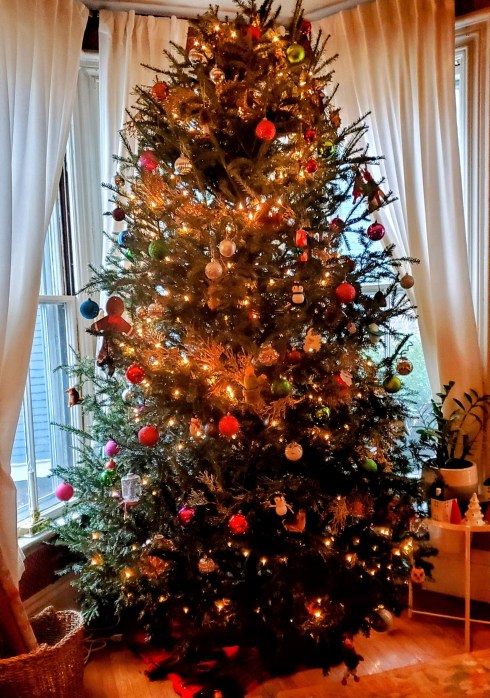
It’s going to be a super busy December, so I got a jump start on decorating my own house: we have eight fireplaces with mantles plus several other surfaces which “require” adornment so there’s a lot of sorting out and arranging to do. I have two rules, or should I say practices, which I observe for holiday decorating: I don’t bring greenery in until just before Christmas and I always choose a creature theme. Down in my basement, there’s a little room with shelves full of creatures of Christmases past: swans from last year, and then bears, foxes, sheep, hedgehogs, rabbits, mice, cats and lots of deer, of course. This year is all about pheasants, as I found some Royal Copley ones that I really liked this fall and wanted to keep them out: I’ve glitzed them up a bit and added some gilded companions. I love natural greenery but I can’t stand to see it fade, so usually I wait until the last possible moment to mix it in with my other decorations. This year I hedged on the rule, and added a few greens because I wanted some warmth and contrast, but more is coming! Someday I might go for simpler decorations but my holiday aesthetic is still pretty much all about abundance. The exception to the greenery rule has always been the Christmas Tree, but over the last few years we’ve had trees die on us before Christmas, so now we’re going to wait for that too. There’s nothing more depressing than a crispy Christmas tree, in my opinion.

Downstairs mantles, the “mantle” in the kitchen, measuring-cup creatures from Anthropologie and my pantry. The glittery squirrels always come out: they’re in the library. By the time I got to the second floor, I was running out of pheasants, so substituted a lowly duck. (There’s a few peacocks mixed in with the pheasants downstairs too, because peacocks). Last year’s swans on the shelf in the basement.

This past weekend was the Christmas in Salem tour, the major fundraiser for Salem’s historic preservation organization, Historic Salem Inc. It’s in a different neighborhood every year, and this year was all about North Salem, encompassing Buffum and Dearborn Streets, on either side of North Street, and a few homes off Dearborn. It was not at all a “colonial” tour, rather it had a bit of a retro feel to me despite the presence of many later nineteenth-century homes, including the gorgeous Queen Anne Ropes House. There was also a stunning 1915 bungalow on the tour, an unusual style for Salem. Gratitude and congratulations to all the homeowners: it’s quite an effort to open your home to 1000 people (believe me, I’ve done it twice). Christmas in Salem always puts me in the holiday mood: it’s such a lavish display of generosity and creativity and cheer: hopefully I’ve captures some semblance of these things in the pictures!

At the Ropes House: love, love, love the button garlands!!! Below: my friend Bradley guiding us through the kitchen in his Princess Diana black sheep sweater and everyone’s favorite “simple” decoration: red branches and floating candles.

Below: lots of textures and nooks and crannies on this tour! These are the details that gave me the retro feel.

What we want to see: table settings, a wreath, and a Christmas tree.

I hope all these homeowners are having a drink just about now (Sunday @5pm)!