Tag Archives: Historic New England

A Cape Full of Color

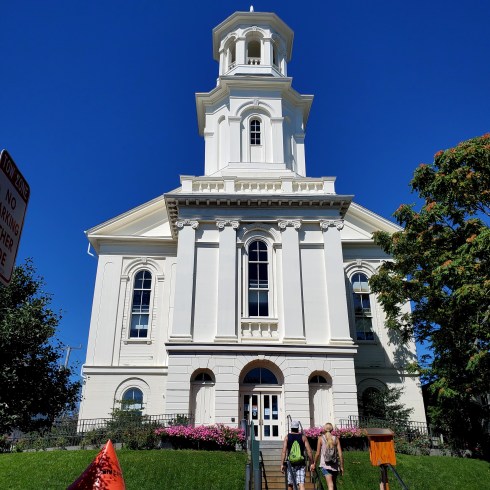
So every year in early September we journey to Cape Cod on the weekend after Labor Day for my husband’s birthday. It is an odd time, just after “summer” is over and we have established our fall routines, and I always complain, but off to the Cape we go because he has wonderful memories of fishing in Provincetown and that’s what he always wants to do for his birthday. As is generally the case with us, he will fish and I will walk or drive around looking for old houses, but this time we spent most of the weekend together. Provincetown is one of those towns that I don’t think I want to go to before I go but once I’m there I’m happy: actually everyone seems happy in Provincetown! It’s not that it isn’t a wonderful, dynamic and scenic town, it’s that I always feel that it is overbuilt and too crowded, with both houses and people. And it is, but if you stop and look at individual houses you’ll see some wonderful details and landscaping. I had not seen the Public Library before, and that was a special treat, and of course I had to make my yearly pilgrimage to John Derian’s summer house with its shop in back. Another highlight: the recently-restored eighteenth-century Mary Heaton Vorse House, on which interior designer Ken Fulk seems to have spared no expense.

Saturday in Provincetown: the Pilgrim monument, Public Library in the former Center Methodist Church, featuring a half-scale model of the Rose Dorothea schooner on its upper floors, John Derian & Mary Heaton Vorse Houses, and, of course, the beach.

I posted a few pictures and an Instagram friend informed me that there was an “All around the Common” event on Sunday way back in Yarmouth Port, during which several historic houses would be open, including Historic New England’s Winslow Crocker House, which I had never visited. So that was all I needed to hear: I had no problem driving back to get into that house. It was a very blustery day, so my husband decided to join me in lieu of fishing: a big surprise. We then commenced a long drive back to Salem via nearly every Cape town on Sunday, with stops in Harwich and Yarmouth. We both really wanted to visit the Atwood-Higgins House in Wellfleet, which is part of the Cape Cod National Seashore, but as soon as we got to the gates of the property a rather frantic park ranger drove up to us in his SUV and told us to proceed with extreme caution as there was a major mosquito infestation. We were still pretty gung-ho, but about ten steps in we were covered with mosquitos and ran back to our car: one Wellfleet mosquito rode all the way back to Salem with us! And then it was on to Yarmouth.

All we saw of the Atwood-Higgins property in Wellfleet.

I dashed through the Edward Gorey House and the Bangs Hallet across the Common, and then spent quite some time in the Winslow Crocker House: too much time for my husband. The house was built during the Revolution by privateer Crocker in West Barnstable, and moved by collector and descendant of an original land grant Cape family, Mary Thatcher, to Yarmouth Port in 1935-36. She had a new foundation laid, and removed all evidence of the division made by earlier owners. Miss Thatcher lived in the house all year long and filled it with antiques, all of which she donated to Historic New England. It’s a gorgeous Georgian house with warm wooden paneling throughout, lots of light, and some great William & Mary and Hepplewhite furnishings. I have added Miss Thatcher to my list of heroic female preservationists.

The Edward Gorey and Captain Bangs Hallet houses on Yarmouth Port Common and the Winslow Crocker House, built c. 1780. Miss Thatcher.

Our last visit was to the 1790s house of an old friend of my husband’s, also on architect, on the Herring River in West Harwich. Amazing setting and decoration, and some very striking mantles in particular (I hope you can pick up the detail in the pictures). A perfect end to our Cape dash, and then we dashed for home, with (miraculously) no traffic!

A beautiful end of our weekend in West Harwich.


Cogswell’s Grant

Like several summers in the past, this was supposed to be my “Historic New England Summer” in which I made a determined attempt to visit and write about as many HNE houses as possible. I started out very close to home at the Phillips House, and then was supposed to go on from there, but other plans and places interfered, and so I’m just now getting back to the “plan.” Yesterday I spent a delightful hour or so at Cogswell’s Grant, an expansive eighteenth-century farm which was long the summer house of two prominent collectors of Americana, Bertram and Nina Fletcher Little. The house is in the midst of glorious farmland surrounded by river and bays in Essex: a New England home in the midst of “Constable country” has always been my impression, reinforced by the golden early-September ambiance. I was so fortunate to have been given a tour by the site manager, Kristen Weiss, who knows the collections, and the family, so well. And that’s the key to Cogswell’s Grant: it is full to overflowing with the Littles’ collections, but also the stories of the things they collected as well as their own stories as collectors. The collections and the stories are inseparable and integral to the story of the house, from the 1930s until today.

A front parlor and Mrs. Little’s charming closet office.
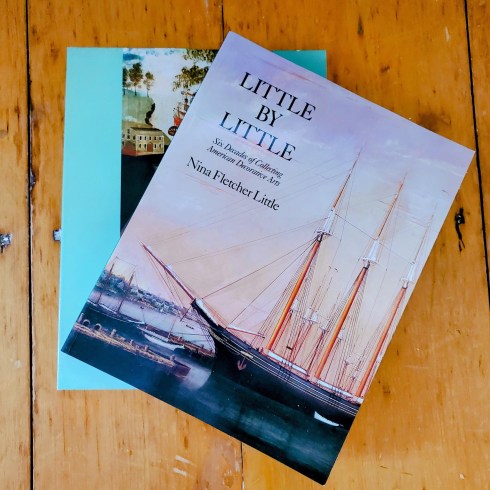
My perspective on the Littles was far too Salem-centric, as Bertram Little was the son of Salem Mayor (as well as naval architect, photographer, silversmith, military officer, bank director, and the last collector of the Custom House) David Mason Little and grew up on Chestnut Street in the midst of other Littles. But his purview, along with that of his wife and and collecting partner, Nina Fletcher of Brookline, was regional rather than parochial. They were New Englanders, who lived in Brookline during most of the year and at Cogswell’s Grant during the summers, from the late 1930s. I did not appreciate the professionalism of their collecting activities to the extent that I should have, or their partnership, or her scholarship: I returned home with just a few of her many books. Generally, when I visit a historic house I feel that I can sum it up in a somewhat representative way pretty quickly, but there’s just too many stories at Cogswell’s Grant: I’ve got to go back for more. It’s probably best to approach the vast collection through categories, which Mrs. Little does in her narrative of how their collection grew, Little by Little. Six Decades of Collecting American Decorative Arts (although as Kristen pointed out, this very accessible book employs a chronological framework as well). Again, so many stories: she was collecting stories as well as objects. Beginning with her first piece of blue and white Staffordshire she leads us through fireplace accessories, hooked rugs, clocks, “useful wares,” furniture, maritime art (the collection of which was tied to her husband’s Salem heritage), decoys, textiles, pictorial panels, all manner of portraits and paintings, and interesting miscellaneous items, like the engraved ostrich eggs the Littles purchased at a North Shore auction on the eve of World War II: they had to use a good amount of their precious gas ration to attend, but it was worth it! The portraits stand out in my photographs, just as they do in the house, but they are only part of a much larger story.

The open hearth kitchen/dining room and various halls of objects. An anonymous couple in their finery by Royall Brewster Smith, c. 1830.

With so much visual stimulation, you can either get overwhelmed or adopt a very personal perspective on what you are seeing: I always try to do the latter. Of all the portraits at Cogswell’s Grant, the one that I had the most immediate reaction to was of eighty-four-year-old Jacob Gould [Jacop Goold] by Benjamin Greenleaf, painted in 1803. He has an open book and a conspicuously-pointed finger, but all I could see was his red cap! I had just been proofing the copy edits to my forthcoming book the day before, and one chapter has a section on Renaissance suggestions for better sleep: wear a red cap!

Mr. Gould in his red cap; second-floor parlor and bedrooms; an amazing pictorial collage of the arrival of the first Oddfellows in America (there they are in the bottom left corner!); the BIG barn.


Summer Sunday Stroll in Salem

Sometimes I try to look at Salem as a tourist, a casual tourist taking a stroll, rather than with my historian/resident intensity. It doesn’t work for long, but I can pull it off for a few hours. I haven’t been home for very many weekends this summer, and I’m about to depart for two weeks in the Hudson River Valley, so I decided to take a long walk around Salem on a humid August afternoon, taking only pretty pictures (no new buildings). Two happenings inspired me: the annual antique car meet on Chestnut Street sponsored by Historic New England’s Phillips House (which did not happen last year and so I was REALLY looking forward to it) and the bountiful gardens around town, the products of our very rainy July.

I just love the juxtaposition of old cars and old houses at this car meet, which gets bigger and better every year.

More natural color: the Ropes Mansion and Derby House gardens are bursting with blooms at this time of year; the former is a formal annual garden, the latter a Colonial Revival garden of traditional plants: they are actually quite complementary. The Ropes is maintained by the Peabody Essex Museum (PEM) and the Derby garden by the Salem Maritime National Historic site: I appreciate these perpetual gifts to the community by both organizations.

Ropes and Derby Gardens.

It was definitely phlox time in both gardens, and Derby was abuzz with bees and butterflies. While I am grateful to the PEM for the Ropes Garden (as well as the open Ropes Mansion), even the casual tourist is going to notice their other properties around town and wonder what’s going on there? Can I get in? The grounds of Peirce-Nichols have always been wide open, now they are closed (but not locked) and I can’t remember the last time I was in there or Crowninshield-Bentley. Ok, stepping outside of my casual tourist mode (I told you it doesn’t work for long): every time I walk by the newly-restored Daland and Plummer buildings on Essex, right next to the Visitors Center, I can’t help but think: why can’t the Salem Museum go here? The buildings are so beautiful, so convenient, and apparently empty. Why can’t the PEM install their recent Witch Trial exhibit in there, along with the wonderful “Salem Stories” still on display across the way, and the Bowyer sundial, the Pickman codfish, James Emerton’s Paracelsus apothecary sign, various Derby items, the rooster weathervane from the former East Church, maps, photographs and paintings by Salem artists, among many other things and create a contextual introduction to Salem history for the those tourists who do not come dressed in Halloween costumes in the middle of August? And residents too! A girl can dream.

The PEM’s Peirce-Nichols, Crowninshield-Bentley, and Daland houses + Plummer Hall, the previous location of the Phillips Library.

Back on the tourist trail. I must say: Essex Street east and west on either side of the pedestrian mall is looking pretty good these days: some nice restorations, street gardens, and window boxes. One thing that the casual tourist might not notice, but I sure have, are some improvements in the hardscape downtown: there are several islands which have been neglected for years which are newly-planted and newly-mulched, like those across from the old Custom House, below. Central Street is further embellished by two beautiful shops, Emporium 32 and Diehl Marcus & Co. Back up on Essex and further down, I checked out the newly-restored First Period Daniels House, apparently the “Oldest Bed and Breakfast in the US,” and then walked down to Derby Street.

Shop window installation by Salem artist Meg Nichols of Mink Studio, reflecting the PEM’s summer exhibition, In American Waters: the Sea in American Painting. Central Street shops, Essex Street wreaths, and the Daniels House.

Derby Street feels like the realm of the House of the Seven Gables and the Salem Maritime National Historic Site, both of which I’ve written about many times, but in the midst of the latter is my favorite little street, Palfrey Court, lined by the Derby Garden, several Georgian buildings, and St. Joseph’s Hall as well as the former “Rum Shop” (another building that needs a purpose!). I just love this little street: when I stand in the middle of it looking down towards Derby and the water, I get a better sense of Salem’s maritime-mandated streetscape than anywhere else. It’s the mix of buildings, the narrowness of the street, the absence of cars. Up ahead is the (relatively) new location of the Salem Arts Association, a perfect spot with lots to see inside.

Palfrey Court and the Salem Arts Association.

And returning home for the golden/cocktail hour!


The Phillips House

I can’t believe that I’ve been blogging here for eleven+ years and have not featured 1) the only house museum; 2) the only house belonging to Historic New England; and 3) the only house which was (partially) moved to its site on the street where I live, Chestnut Street, before! There are two buildings which are open to the public on this famous street, Hamilton Hall and the Phillips House: the former is most definitely an assembly hall, while the latter is a home, and when you visit it, that will be one of your primary takeaways. Not only will you become familiar with multiple generations of the Phillips family, but also members of their staff (who were apparently never referred to as servants); not only will you see beautiful rooms “above,” but also working spaces “below.” The Phillips House has one of the best preserved historic working kitchens on the street (last used in 1962), which you will not see here, because I spent so much time and took so many pictures on my own personal tour with my former student Tom Miller that my camera was dead by the time I got there. So you must see it for yourself. The Phillips House opened for the season this past weekend: it is open every weekend through October but advance reservations are required.

The Phillips House on Chestnut Street is open! Great to see the flag flying. Tom Miller  opened the door for me on this past Friday, and we commenced a three-hour tour. Tom has been a associated with the house for 13 years, and knows everything about the Phillips house, its contents and inhabitants.

Because the house is a creation of many decades, families and styles, it has a lot to teach visitors, even though its interiors are presented as they were in 1919, several years after the Phillips family had taken possession and completed their renovations. Their fortune was based on Salem commerce, shrewd investments, and advantageous marriages, and they were well-traveled and engaged in society and civic affairs, so we can learn a lot from their stories as well. The story of the house begins with a maritime marriage and a messy divorce: between Elizabeth Derby, daughter of Salem’s wealthiest merchant, Elias Hasket Derby, and one of his ship captains, Nathaniel West. Mr. Derby did not approve of the marriage in 1783, but nevertheless he left his daughter an enormous inheritance in his 1799 will, which she used to to build a magnificent country estate just a few miles inland, commissioning the justly-famous Samuel McIntire to undertake much of the design and craftsmanship. After an important reform to Massachusetts divorce law in 1806 allowed women greater property rights in divorce cases involving infidelity on the part of the husband, Elizabeth Derby West sued for divorce and won, in a very public case involving a parade of prostitutes perhaps paid to give evidence against Captain West by her vengeful brothers, with whom he had engaged in fist-to-cuffs down on the docks. Elizabeth moved to Oak Hill permanently and continued to lavish material attention on it until her death in 1814, leaving it to her three daughters with the stipulation that they never let their father have a piece of it. The youngest West daughter, Sarah, died intestate five years later and consequently  her father did indeed inherit a third of the estate, despite his former wife’s wishes. He detached four rooms of the estate and had them moved to Chestnut Street: four miles in two days via teams of oxen and logs. After installing a central hall-connector with Palladian window and doors, he now had a slim but elegant (McIntire!) house. Over the nineteenth century the house doubled in size with a succession of owners, and the Phillips family acquired it in 1911. The cumulative composition is a bit Georgian, a bit Federal, a bit Victorian, and a lot of Colonial Revival, with just a pinch of Gothic.

The house in 1916, with lines marking the original McIntire rooms moved to Chestnut Street. An oxen team moving a structure along State Street in Newburyport for comparison, and the house in the later nineteenth century, all collections of Historic New England.

As you move through the house you are aware that you are entering another architectural era, especially as you move from McIntire front to Colonial Revival rear—somewhat of a pale imitation with an expanded scale. But you’re also busy looking at all the things that tie everything together, the personal belongings of a very grounded though worldly family.

Colonial Revival-ized houses always seem to have or side stairs: the front hall must be wide and open; I seem to recall that this side doorway (the “carriage entrance”) was once in front and is McIntire.

Dinner is set for a small party on the evening of July 30, 1919 in the expansive dining room: part of the extensive additions to the back of the house. No McIntire mantel, but lots of movable decorative detail in the form of serving ware, and one of my very favorite paintings which I somehow forgot was here: Joseph Badger’s Portrait of Thomas Mason (with a squirrel). It was a delight to see it: you can have your Copley boy and squirrel painting, I prefer this Badger.

As I am writing this it is very hot, so I want some ORANGE FAIRY FLUFF. The amazing pantry at the Phillips House, and the Badger!

Upstairs, things are a bit more intimate: bedrooms and bathrooms and Mrs. Phillips’ day room for keeping the household accounts. On the third floor there are guestrooms and staff rooms: a rear staircase descends from the latter to the kitchen. There are really wonderful windows throughout the house, in all shapes and sizes, with great views of Chestnut Street, and more McIntire detail in the front two rooms on the second floor.

Another major painting which “surprised” me in residence at the Phillips House was Marblehead folk artist J.O.J. Frost’s Massey’s Cove ( The Hardships and Sacrifice, Massey’s Cove, Salem 1626) depicting the first European settlement of Salem. It was just wonderful to see it there, hanging in Stevie Phillip’s light-filled, McIntire embellished bedroom with the best views of Chestnut Street in either direction. A less happy surprise, in this most Salem of houses, was a crumpled-up sign for the James Duncan Phillips Library, a library which is, of course, no longer in Salem.

I think I had professorial privilege as Tom showed me EVERYTHING and the standard tour can’t be quite as expansive due to time constraints, but the interpretation of the Phillips House definitely emphasizes the close personal connections between the generations that lived in the house and their staff and this is highlighted by one of the special tours at the house, “The Irish Experience at the Phillips House,” which will be offered on August 5. An annual must-attend event which we all missed last year is the antique car meet, which is on August 8. Vintage cars line the length of Chestnut Street, and the juxtaposition of cars and houses is more than instagram-worthy, believe me!


Tragedy amidst the Everyday

I LOVE Diaries: they offer such personal perspectives into the past, encompassing both “big” events and everyday occurrences. I read diaries, teach with diaries, and think about diaries often. I even like books about diaries, such as Kate O’Brien’s volume in my favorite Britain in Pictures series. So it is rather odd that I have omitted one of the most important diaries of a Salem woman in this year of #SalemSuffrageSaturdays until now: that of Mary Vial Holyoke (1737-1802), the second wife of Salem’s most eminent physician, Edward Augustus Holyoke (1728-1829). Mary’s diary was published in a compiled volume of Holyoke diaries published by the Essex Institute in 1911, after having been in the possession of several collectors, including the famed Salem numismatist Matthew Stickney.

Photograph of a Greenwood Portrait of Mary Simpson Vial before her Marriage.

1771 Portraits of Dr. Edward Augustus Holyoke and Mary Vial Holyoke by Salem artist Benjamin Blyth, referred to in Mary’s diary: Dr. Holyoke’s portrait, which descended in the Osgood family, is from the Northeast Auctions archive; Mary’s portrait, which descended in the Nichols family, appears to be lost at present.


Last week’s list of “notable Salem women” from the perspective of 1939 included Mary and drew me back to her diary, a record of 40 years of her rather enclosed life in Salem from 1760 to 1799. I had read it several times before but found it………….. unpleasant is the word I think I want to use. At first reading, the impression that I formed was of a superficial woman who gave birth to babies annually—most of which died within days—and resumed her social activities and household duties without missing a beat. None of this was unfamiliar to me as an early modernist: infant mortality hovered between 15 and 20% while 60% of all children born died before the age of 16 in the sixteenth and seventeenth centuries and childbirth was the leading cause of death for women, who were not especially introspective when they took pen to paper. But both Mary’s losses (8 of her 12 children) and her diary’s quickfire mix of the mundane and the sorrowful are comparatively extreme. Just one page of entries from the summer of 1767 contains entries about gardening, polishing or “scouring” furniture brasses, hanging bed curtains, attending “turtle” feasts and hosting the regular Monday assembly. Then on September 5 she was “brought to bed” at 2:00 in the morning, and gave birth to a daughter baptized Mary on the next day. On September 7 she reports that “The Baby very well till ten o’clock in the evening & then taken with fits.” Two days later, “It Died about 8:00 in the morning.” On the next day, we read simply “was buried” without even a pronoun.

A child’s shoe last from the first half of the nineteenth century, Historic New England

As I read the diary again over this past week more carefully, Mary emerged as a more thoughtful, caring, and substantive person. She was among a circle of women in Salem who were not just drinking tea and attending “turtles” (I love this name for social gatherings and think we should resume it) with great regularity, but also attending all those were brought to bed: for birth, for illness, for death: they were always “watching”. Mary was watched, her dying children were watched, and she herself watched. The entry above seems cold to be sure, but Mary generally referred to “my dear child” while noting the burials of her infants. And then there was the particularly poignant entry after the death of yet another of her newborns in 1770: the same as all the others. You almost can’t blame her for getting right back to the business of household work, which she does with great relish after she and the Dr. (this is how she refers to her husband) move into their permanent house on Essex Steet: this becomes “our house” and there’s a lot of work to do to maintain it: scouring, provisioning, ironing, soap-making, bottling, sewing, cooking, gardening, preserving (preserved damsons, a week too late! exclamation mine) and other tasks are all noted in detail. I think I dismissed the diary previously because Mary had little to say about the Revolution, but she does take note of the repeal of the Stamp Act and the “setting off” of a “feathered man” before the Revolution, and as it proceeds she gradually refers to the Americans as “our people”, perhaps reflecting her husband’s transition from Tory to Patriot. Dr. Holyoke was an early adopter of smallpox inoculation, and she records the constant outbreaks as well as the incremental inoculations. Earthquakes also appear with surprising regularity in the diary: I had no idea Salem was subject to so many tremors in the later eighteenth century. Extreme weather was also notable: Salem experienced some very hot summers and several “great” snows during Mary’s lifetime she elaborates on the former and is quite succinct about the latter. There’s more to learn about and from Mary Vial Holyoke, to be sure: you’ve just got to read carefully, between the lines and with careful attention to the personal pronouns, as she brings us into her world.

The Bowditch-Holyoke House at the corner of Essex & Central Streets in Salem, presently the site of the Naumkeag Block     


Break for Ice Cream

I was reading and writing about the 1563 plague in London—very deadly and very overshadowed by later Tudor and Stuart plagues—when I had to take a break for ice cream in the midst of a stifling afternoon. The break went on a bit longer than expected because I became diverted into the history of ice cream: I just opened up an old cookbook I had for a moment (really!) but the recipe looked similar to some that I had seen in the seventeenth-century cookbooks that I am going to be writing about later in this chapter that I’m working on so I indulged myself for a bit longer in the name of “research”……and before you I knew it I had abandoned early modern England and was looking into the history of ice cream in Salem. From the plague to ice cream in a half hour: the balance of book and blog will not work well if I continue to be so indulgent (but it was hot).

earliest-ice-cream-recipe

Take three pints of the best cream, boyle it with a blade of Mace or else perfume it with orang flower water or Ambergreece, sweeten the Cream, with sugar[,] let it stand till it is quite cold, then put it into Boxes, e[i]ther of Silver or tinn, then take, Ice chopped into small peeces and put it into a tub and set the Boxes in the Ice covering them all over, and let them stand in the Ice two hours, and the Cream Will come to be Ice in the Boxes, then turn them out into a salvar [salver = dish] with some of the same seasoned Cream, so sarve [serve] it up to the Table.

This is Lady Ann Fanshawe’s handwritten recipe for “icy cream” from the mid-seventeenth century and the Wellcome Library’s digitized recipe-book collection (MS.71113) . It is unusual when compared to the first published recipes for ice cream in the next century, which are more custard-style creams, made with egg yolks, and then frozen. But Lady Fanshawe’s ingredients–mace, orange-flower water, and even ambergris (well maybe I should exclude ambergris)–were not that unusual: early ices were made with a wide range of ingredients: all sorts of fruits and herbs, honey, tea and coffee, crumbled cakes and biscuits. Ice cream history in the nineteenth century is marked by two big developments, both in the US: the development of the portable ice cream “freezer” and “Philadelphia-style” ice creams, made without eggs. But nineteenth-century ice creams, sorbets and sherberts were still more exotic than we think they were, or at least thought they were: Mrs. Lincoln’s Frosty Fancies and Frozen Dainties, published in the late nineteenth century for best-selling freezer manufacturer White Mountain, feature lots of interesting ices, and ice creams made with arrowroot, cornstarch, and gelatin for their foundation, rather than eggs.

Ice Cream Frosty Fancies (3)

ice_cream_Fozen-removebg-preview (2)

And yes: I think this is yet another aspect of Salem’s history which seems notable, although I did not extend my break to make a city-by-city, town-by-town comparative analysis of ice-cream production and consumption. Salem had a very early ice cream “manufactory”, from at least 1856, as well as several antebellum retail shops or saloons. And these multiplied over the later nineteenth century and then of course opened up in the tourist destination that was (and remains) Salem Willows. Salem also had ice cream “peddlers” from the late nineteenth century on, and even a “millionaire milkman”: Gilbert H. Hood of the famous H.P. Hood Company, still very much with us, who spent the summer and fall of 1921 “learning the business from the ground up” while based at Hood’s Salem ice cream factory, now the site of luxury condominiums.

Salem Ice Cream

Cool-1881

Ice Cream Holly Tree

Ice Cream Shute (5)

Ice Cream NDN Aug 19 1989

Hood Collage

Notice of Salem’s first ice cream manufactory in the Salem Register, June 30, 1856; Salem Willows postcards from 1905; The manufactory at 271 Essex became a “saloon” in the 1870s and another popular ice cream parlor was the Holly Tree on Central Street (Collections of Historic New England); “Ira Moody Chute standing in front of his ice cream wagon, Salem, Mass., ca. 1898,” (Historic New England); The Newburyport Daily News, August 19, 1889; Gilbert H. Hood in the Boston Herald, October 9, 1921.

More! The SERVING of ice cream was serious business a century ago, and Historic New England has some great examples from the Phillips House: ice cream forks, scoops, molds, trays, etc….: check them out here.


Riverside Gardens

Sunny June continues, showcasing gardens all around me in the Seacoast region of southern Maine and coastal New Hampshire. I’m back to Salem today, and then off on other adventures, but first I wanted to share some photographs of gardens along (or not too far away from) the York and Piscataqua Rivers, including an absolutely stunning private garden which is cultivated by friends of my parents. It is behind a gate, which reveals nothing of the wonders within, so I feel very fortunate to have been granted access: the garden was in its last stage of late-spring bloom, but I’m sure you can discern its full-blown glory even with my amateur photographs. A bit further down (up?) the York River, the “old-fashioned” garden at the Elizabeth Perkins House, now the main office of the Old York Historical Society, has always been one of my favorite York gardens: this year it is untended due to the pandemic, but I have no doubt it will rise again.

20200618_094952

20200618_094921

20200618_094907

20200618_094819

IMG_20200621_120413_571

20200620_134748A spectacular private garden along the York River and the Elizabeth Perkins House and grounds.

Over in Portsmouth, I found refuge from a largely-maskless crowd on Juneteenth in the city’s pocket gardens and on the grounds of the Governor Langdon House, which belongs to Historic New England. So again, not a lot of garden-tending, but good bones!

20200619_151950_20200623070541775

20200619_135138

20200619_135041

20200619_135210Portsmouth gardens on Juneteenth.


Spring Break-Away

I’ve got a (virtual) stack of papers to correct but yesterday I gave myself the morning off to go visit the Patton Homestead in nearby Hamilton, the summer home of General George S. Patton Jr. and farm of his son Major General George S. Patton IV. We are in World War II week of our #SalemTogether project, and I had been reading about Beatrice Ayer Patton, a North Shore native who lived at the homestead during the war and after her husband’s death in Germany in December of 1945. Mrs. Patton was the guest of honor at Salem’s most spectacular war bond rally, held on the Common in September of 1943, and as all of the descriptions of her character and personality in the press accounts of this event were glowing, I wanted to see her house and garden. The Patton Homestead was donated to the town of Hamilton by the Patton family a few years ago: it’s a lovely late eighteenth-century house surrounded by outbuildings and fields named for heroes of the Vietnam War. The house was closed of course, but the grounds were open, and I spent a good bit of time wandering around, so much time that the morning was shot and I thought, well I might as well take the day. 

20200504_124358The Patton Homestead, Hamilton

Ipswich is right next to Hamilton, so I though I might as well drive up there and check out some of my favorite houses—there are so many. Once in Ipswich, I thought, why not drive up to Newbury and Newburyport along Route 1A and the marshes? Once in Newburyport, I thought, why don’t I drive along the Merrimack River for a while? Once in Haverhill, I thought, I’ll drive home along Route 97, which is such a pretty road. But I kept taking side roads, and stopping to look at houses, so it was dinnertime before I made it home to Salem. But I have no regrets: it was a warm spring day and I needed a getaway, mask in hand and on my face whenever I got out of the car.

An Essex County loop—some house “markers” along the way, Ipswich up and around to Topsfield:

20200504_132046

20200504_132659

20200504_133517

20200504_133639

20200504_135156

20200504_140333Ipswich: the Whipple & Heard houses and just a few beautifully preserved Colonials—there are so many more!

20200504_143221

20200504_144731

20200504_144752

20200504_145911Newbury and Newburyport: one of my favorite houses in the County, on Newbury’s Lower Green, plus the Spencer-Pierce-Little Farm (this is where you go if you really want to get away and pretend you are in England); just one house in Newburyport as I’ve featured so many in previous posts, but I couldn’t resist this little charmer!

20200504_160840

20200504_160910

Two houses in Georgetown, above: I’ve always loved this bottom house, so prominently situated with its Tory chimneys. Below: the Holyoke-French House and a nearby farmhouse in Boxford Village (Boxford is a lovely town but it has no sidewalks, which I find perplexing and unfriendly). Finishing up at the Parson Capen House in Topsfield.

20200504_161709

20200504_162447

20200504_170104


Whirlwind Weekend

I am pleasantly tired at the end of a busy weekend, which included: a sunset sail, several garden walks, a tour of the Coast Guard’s tall ship Eagle, long conversations into the night, the annual vintage car show on Chestnut Street, and a Red Sox game. Highlights of a New England summer all in one weekend! We have (for now) made it out of the muggy days of midsummer and are in the golden days of late summer: no humidity, just bright sun, warm days and cooler nights with just a whiff of Autumn in the evening breeze. The disappearance of humidity always recovers my will to live: I am not a summer person, but as long as there is a cool breeze mitigating the hot sun I’m fine—-everybody’s fine. I’m sure the humidity will return—and Fall will be here soon—which makes beautiful August days like these all the more precious.

20190809_194910

20190809_200341

20190810_121237

20190810_121143

20190810_131746

20190810_130914

20190810_130640

20190810_130449

20190810_130432

20190810_130426

20190810_130231

20190811_105355

20190811_105608

20190811_105142

20190811_110313

20190811_110138

20190811_105121

20190811_105416

20190811_105844

20190811_110435

20190811_122918

20190811_125522

20190811_151931Mid-August in Salem and Boston: a sunset sail on the Schooner Fame Friday night, Salem Story Walk in the Ropes Garden & a visit to the US Coast Guard’s Barque Eagle on Saturday, the Phillips House-sponsored annual vintage car meet on Sunday morning, at Fenway Sunday afternoon (the Red Sox lost in extra innings–I was so impressed with the score-keeping of the kid in front of me, who only took a break for an ice cream cone).


Sweeping through Beauport

Historic New England offers comprehensive “nooks and crannies” tours through several of its properties occasionally, and I was fortunate to go on one of these basement-to-attic-and-all-the-closets-in-between tours of Beauport, the rambling Queen Anne “cottage” on Eastern Point in Gloucester, the beneficiary of a generous friend’s conflict! Beauport was built and decorated in great detail by Henry Davis Sleeper, one of America’s first professional decorators, over several decades beginning in 1907: it is an incremental construction driven by Sleeper’s evolving vision and career. The former was preserved by Helena Woolworth McCann, who purchased Beauport after Sleeper’s death in 1934, following the advice of Henry Francis DuPont: “the minute you take things out of this house, or change them about, the value of the collection does not exist, as really the arrangement is 90%. I have no feeling whatsoever about the Chinese room, as I think it is distinctly bad; but the rest of the house really is a succession of fascinating pictures and color schemes.”  Mrs. McCann had Sleeper’s pagoda removed from the China Trade room and made it her own, and likely packed away some of Sleeper’s stuff while she and her family were inhabiting the house over successive summers, but seems to have understood DuPont’s assertion that the house was the sum of its parts–and her family donated the intact property to Historic New England (then the Society for the Preservation of New England Antiquities) in 1942. So when you go to Beauport today, you are stepping into Henry Davis Sleeper’s house, the way he wanted it, and you know that this is a man who admired arrangement above all, incorporating the contrast of light and dark, all color of glass, green, anything and everything that projected the spirit of idealized and romanticized pre-industrial American and English material culture, depictions of great men (George Washington above all, but also Benjamin Franklin, Lafayette, and Lords Nelson and Byron, among others), and a fair amount of whimsy. Beauport is a lot to take in, even on a standard tour much less this exhaustive one, so I’ve divided my photographs into room views and details—but they represent only a small measure of both! You’ve really got to see Beauport for yourself: several times.

The bigger picture: it’s really difficult to photograph the entirety of this house, except from above or the ocean! I focused on inside, but there’s some lovely photographs of both the interior and exterior taken by T.E. Marr & Son c. 1910-1915 here.  

Beauport HNE

20190628_131736

20190628_160752

20190628_161008

20190628_154925

20190628_154519

20190628_155946

20190628_155903

20190628_150118

20190628_145917

20190628_150237

20190628_145407

20190628_145259

20190628_144136-1

20190628_143917

20190628_142353The China Trade Room from Sleeper’s “Minstrel’s Gallery” above, within the Book Tower, the Octagon Room, where it’s all about eight, the Golden Step dining room, the South Gallery,  the Master Mariner’s Room, the “Red Indian” Room with its ships-cabin overlook of Gloucester Harbor, the Strawberry Hill room which became Sleeper’s bedroom, the Belfry Chamber—my favorite room in the house—-the Jacobean Room, the Chapel Chamber Room, and the Franklin Game Room.

Every salvaged discovery provoked an aesthetic reaction from Sleeper, and his design sense was so strong that it lives on well after his death in Beauport. Despite its size (it grew to 56 rooms by Sleeper’s “reactions”) the house remains very personal. It certainly reflects Sleeper’s personality, but as his collection of objects was so vast and varied it is possible to have a personal reaction to what you are seeing. That certainly happened for me, so my more detailed focus below reflects my own taste, in reaction to what I was seeing. And you will notice many other things that I missed.

20190628_162645

20190628_161438

20190628_160309

20190628_155403

20190628_154903

20190628_154055

20190628_150309


20190628_144304

20190628_143908

20190628_141858

20190628_141402

20190628_141355

20190628_135742Details, Details: marble mantle and 18th century hand-painted wallpaper from China in the China Trade room (it was purchased by Philadelphia financier Robert Morris in 1784 and discovered, still rolled up, in the attic of the Eldridge Gerry House in Marblehead in 1923), wooden “drapes” in the book tower room, a portrait by Matthew Prior (c. 1845) in the Blue Willow room, fishermen’s floats ( I think Sleeper was the original high-low decorator!), beehive pull, memorial to the death of a former slave, majolica hedgehog or porcupine (?) Nathaniel Hawthorne in the Belfry Chamber, Green glass urn in the Chapel Chamber, plate commemorating the visit of Hungarian nationalist Louis Kossuth to Boston in 1852 & window shade commemorating the American victory in the Spanish-American War in the Pine Kitchen or Pembroke Room, my favorite of Sleeper’s many hooked rugs, and the portrait of a dapper anonymous man.

♠ A more comprehensive history of both the house and the man can be found here.