Tag Archives: Historic New England

Weekend in Wiscasset

Just back from a long weekend in Wiscasset, Maine with family, lots of eating and drinking, house-hunting, and pumpkins. My stepson is working at an oyster farm in the region so we’re going to midcoast Maine pretty regularly, and this Columbus/Indigenous Peoples Day weekend was of course a good opportunity to escape Witch City. We stayed in a lovely house in Wiscasset, one of Maine’s prettiest towns, and made regular trips up Route One to Damariascotta, which was holding its annual Pumpkinfest, complete with Pumpkin Queen, Pumpkin Drop, Pumpkin Derby, Pumpkin Regatta, and a main street embellished with large embellished and carved Pumpkins.

Wiscasset houses & shopping & Damariascotta pumpkins.

I worked at Historic New England’s Phillips House in Salem on Saturday and visited Historic New England’s Nickels-Sortwell House in Wiscasset on Sunday. It certainly has been an HNE summer for me! We spent so much time with the pumpkin festivities in Damariascotta that I turned up at Nickels-Sortwell at 3:00 pm: the last tour of the day on the last day of their season! Bad form on my part, and I apologized profusely, but of course my guide was  completely gracious and welcoming and eager to show off the house. Historic New England has two houses in Wiscasset: the very dramatic Castle Tucker and the very……..strident Nickels-Sortwell, and I had never been to the latter so I was thrilled to be able to squeeze it in this weekend. I always look at history and houses through a comparative Salem prism, and this was not difficult to do regarding the Phillips and Nickels-Sortwell Houses: both are Federal constructions which evolved into a Victorianized rooming house/hotel and then were restored with Colonial Revival inspiration by wealthy Yankee families.

I learned a lot about the house and the families who lived in it on my tour, but after we said our goodbyes I was still puzzled by the assertion of my guide that in the year of the house’s construction, 1807, “Wiscasset was the busiest port north of Boston.” Of course I couldn’t stop myself from contesting that statement: I think Salem was? Certainly Portsmouth and Portland were busier? She responded that she wasn’t sure but that was a pretty standard Wiscasset claim. And she’s right: I looked at all the the Wiscasset tourist and historical information on the web and there it was, again and again: Wiscasset was the busiest port north of Boston, Wiscasset was the busiest port east of Boston in 1807, the year of the Jefferson Embargo Act. This is clearly not true in terms of tonnage or voyages, but I’m wondering if “busiest” means something else? Shipbuilding and other maritime industries AND customs revenues? HELP early American maritime historians!


The Bowman House

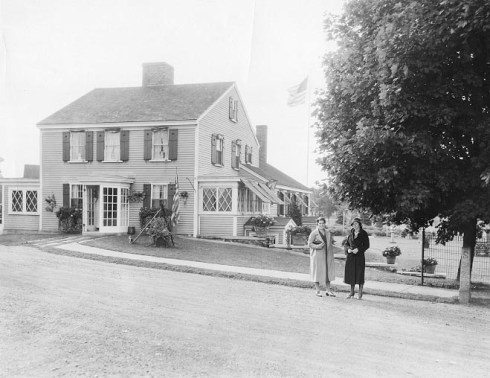
We were vacationing in midcoast Maine last week so I took the opportunity to visit Historic New England’s newest property, the Bowman House, with a few friends. We also saw the nearby Pownalborough Court House, which is one of the most extraordinary Colonial buildings I have ever encountered. The Bowman House is in Dresden, right on what was a very busy Kennebec River short at the time of its construction in the mid-eighteenth century. Now it sits amongst tranquil rolling lawn: this photograph is of the rear, of course; the front entrance looks upon the River.

The house is a very high-style Georgian construction, the type you see built in shipbuilding centers. It has a very charming air about it, partially provided by the architecture, but also by the restoration and decoration, which was the work of Bill Waters, who worked and lived in the house for decades. He died in 2016, after having donated the house to Historic New England with the qualification of lifetime tenure. So even though this house was built in 1762 for Joshua Bowman, a judge with Hancock connections, it really felt like Bill Water’s 21st century Georgian house: his personality shined through both his preservation efforts and his possessions. Since I’ve been working for Historic New England myself this summer, I’ve been thinking about the differences between the work of a tour guide and a professor, and one major one is that the work of the former is a lot more personal: you’re talking to and with smaller groups about more intimate stories rather than trends, causes and consequences. Historic New England’s interpretion focuses on the people who lived in its houses as much as their architectural history, and “Bill’s house” is a great example. (Although our guide did introduce us to local master builder Gershom Flagg, who built both the Bowman House and the Pownalborough Courthouses, and now I am obsessed!) Bill Waters came to the house through the Burrage sisters, Mildred and Madeleine, notable artists and world travelers who moved to Wiscasset in 1962 and became interested in the region’s historic architecture. In 1961 they purchased the Bowman House, and sold it to Waters several years later, and he and his life partner Cyrus Pinkham began their life’s (house) work. 

Bill Waters with Bowman descendant Florence Bixby and the Burrage Sisters in 1968 (Maine Historical Society), and more recently.

So let’s go into the house, shall we? You enter through a single-story sun room which was likely a nineteenth-century addition (the house served as the office for an ice-supply business in the later 19th century) and then into the kitchen and a series of first-floor parlors and dining room adjoining a spacious central hallway—wonderful reproduction wallpapers throughout, including the pillar-and-arch paper that I think is also in Hamilton House? Throughout his tenure, Waters worked to bring as many period-appropriate and/or Bowen furnishings into the house, and everything seems perfect and very colorful, but also very, very livable.

There are several spaces in which he seems like he just stepped away…….like the bar (above) and lots of whimsy, like the feathers on his canopy bed (below). Artful assembly throughout, and very special mirrors!

We exited through the sunroom, a very comfortable space which reveals Waters’ appreciation of trade signs (as well as his southern roots, represented by a small image of General Robert E. Lee) and then drove down the road to the Courthouse: wow! Photographs don’t quite represent the scale of this 1761 building.


Treasure House

Treasure House. That’s how the guide introduced the Codman Estate in Lincoln, Massachusetts, long known as “The Grange,” at the beginning of her tour the other day. It’s a term which has a specific meaning for Historic New England, which has been the owner and steward of the house since 1968: not only the house itself, but all of the treasures therein, encompassing the possessions and papers of the Codman family of Boston. The Grange was their summer house, expanded and decorated in successive eras by family members/design luminaries John Hubbard Sturgis and Ogden Codman Jr. My ears pricked up when I heard that term, because it’s how Salem was often described in the early and mid-twentieth century, as a treasure house of American material culture. That’s certainly not how Salem is thought of now, but in that heyday, proponents of the Colonial Revival like Ogden Codman Jr. thought and referred to it as such. When I was writing my chapter on Colonial Revival Salem for our forthcoming book this summer, I read quite widely (trying to make up for a disciplinary deficit) and reread Edith Wharton’s and Codman’s classic collaboration, The Decoration of Houses (1897). This book is so crystal clear in its articulation and presentation of interior design as a branch of architecture rather than “dressmaking” that I became more interested in Codman, who was both an architect and interior designer. I went off on a tangent, learning some very interesting design theories and practices as well as trivial details like the fact that he called Wharton (who was his client before his collaborator) “Pussy” and she called him “Coddy.”  And then it only seemed right to revisit the Grange, as the last time I went there, when I was in my 20s, I didn’t have a clue. I seem to remember being impressed with its Federal forthrightness, but not its interior, which I found “shabby.”

Well, its origins are not Federal: the models above show how the original Georgian house was transformed into the Federal Grange over the next century or so. But, it still strikes me as shabby, in an authentic rather than “chic” way: very layered and very waspy. This was really his father’s house, and there were things that Ogden Codman Jr. could change and things he could or would not. You can see his attempts to lighten things up, in his characteristic French-Colonial Revival fusion style, but the heavier hand of his uncle, John Hubbard Sturgis, is still much in evidence. So it’s quite a melange! Toile and Chintz in the sitting rooms and Tudor Revival in the dining room. I think I liked chintz back then, not a fan now, but will always love toile.

The very different stamps of Sturgis and Codman Jr. make for an interesting house. The Elizabethan dining room must have driven the latter crazy, but I love it. We went into only the front bedrooms, which seemed very Ogdenesque.

The other layering effect in the house is a result of the sheer number of Codman possessions therein: photographs, paintings, books, assorted personal items. There’s a time-capsule feeling, as if the family just went out the door, quite a while ago. That feeling is really resonant in the back of the house, where the servants lived and worked. I don’t remember seeing these spaces before: such a succession of rooms and staircases! How many staircases are there in this house? An impressive double staircase in front, and two or three in back? I lost track. Sturgis designed the rear addition, but I’m sure that neither he nor Codman ventured out back, so in a way (and except for the appliances and utilitarian elements) these ways feel even more timeless.

All the staircases and the way out back, eventually into the Italian Garden, which was being set up for a wedding on a VERY humid afternoon. I hope everything went well!


One Hero and 17 Rescinders

I am staying in my family’s house in York Harbor for the month of June, mostly writing with occasional breaks for gardening and sightseeing. But you know me: I can never really get away from Salem! On this past Saturday, a single word was uttered which provided me with a connecting link between my hometown and my principal place of residence: rescinders. This is not a word you come across often, but within a couple of days I did, quite by happenstance. I love it when that happens, so here’s the context and the connection, starting with yet another preservation challenge back in Massachusetts concerning a structure associated with Revolutionary War Brigadier General John Glover. Glover is associated with two standing structures, a landmark house not far from Marblehead Harbor and a “retirement” home located on the Marblehead/Swampscott/Salem line which had a long and varied history following his death in 1797. “Glover Farm” was most recently the “General Glover House,” a restaurant owned and operated by Anthony Athanas of Pier 4 fame, but the entire property, including the 1762 house in which John Glover lived and died, has been left to deteriorate following its closure in the 1990s. While various officials of the town of Swampscott have proclaimed the property “blighted,” the Swampscott Historical Commission (which seems to be 10x more proactive than its counterpart in Salem) voted to issue a demolition delay and is seeking ways and means to save it in collaboration with the Swampscott Historical Society and local preservationists and any- and everyone who is interested in material heritage.

Glover Farm as the General Glover Inn, part of Sunbeam Farm, 1920s-1930s, Swampscott Public Library. Anthony Athanas opened the General Glover House in 1957 and here are menu covers and ads from the 1950s, 1960s and 1970s from guidebooks of those eras. It looks like the perfect “ye olde” restaurant: I wish I had went!

General Glover was a true American hero, outfitting his own ships as privateers, ferrying General Washington across the Delaware on that fateful Christmas night in 1776 and serving at Saratoga, Newport, and the Hudson River highlands successively between bouts of ill health on his part and returns to Marblehead to attend to his ailing wife. He sought retirement at the close of the Revolution, and General Washington notified him of Congress’s approval in a letter dated July 30, 1782, closing with wishes for a restoration of health, attended with every happiness in your future walks of life. Apparently Glover found that happiness at the rural farm some distance from Marblehead’s busy docks, in a house that its still standing despite decades of active development all around it. I started digging into this particular Glover House when my friend and former colleague, Nancy Lusignan Schultz, brought it to my attention: as chair of the Swampscott Historical Commission, she is right at the center of the preservation efforts (which you can learn much more about in this podcast). But as soon as I realized who built the house, I was caught, or caught up: it was William Browne, Salem’s richest and most notorious Loyalist, whose considerable properties were confiscated after he fled to Britain in 1776, eventually ending up as the colonial Governor of Bermuda. Browne deserves much more scrutiny than I can give him here, but he was a powerful man in Salem and Massachusetts, whose fall from grace came when he became one of the 17 “Rescinders” who were described by John Adams as Wretches, without Sense or Sentiment after they voted to rescind the Massachusetts Circular Letter which had been drafted by the provincial Assembly in response to the Townshend Acts in 1768. The Letter called for resistance, and was sent to all of the other colonies, prompting the protest of Governor Francis Barnard on behalf of London. Bernard ordered the Assembly to rescind the letter, and the Assembly put the matter before a vote: 92 nays and 17 yeas, with Salem’s representatives Browne and Frye loudly voting YEA. This lead to one of the most important moments in Salem’s political history, a town meeting assembled to vote for replacements for Browne and Frye which exposed the deep divisions of the day, and about 30 Salem Loyalists. Browne and Frye and their 15 fellow wretches were “memorialized” by the ever-ready Paul Revere in his adaptation of a British broadside entitled The Scots Scourge issued under the title A Warm Place—[in]Hell and Boston merchant John Rowe noted the names in his diary, “for my own satisfaction.”

A Warm Place—Hell by Paul Revere, American Antiquarian Society.

How I love Rowe’s sentiment: I record the 17 yeas, that were so mean-spirited to vote away their Blessings as Englishmen, namely their Rights, Liberties and Properties and how lovely that one of Browne’s properties should go to such a self-sacrificing patriot as General John Glover. But this is not the end of my rescinder rap. I was so focused on Frye and Browne and Salem that I did not take note of all the names on Rowe’s list immediately. I drove up to York on Friday and went to an open house at our local Historic New England property on Saturday: the Jonathan Sayward House, where I interned in college. As soon as I stepped in the parlor, I remembered: he was a rescinder too, and there he is on Rowe’s list, just above Browne (Maine was of course part of Massachusetts until 1820). Sayward did not suffer as much loss as Browne, who I believe was a much bigger fish: no exile (just confinement to this very home), no confiscation, and reconciliation after it was all over. George Washington and King George III share wall space in the Sayward House today.

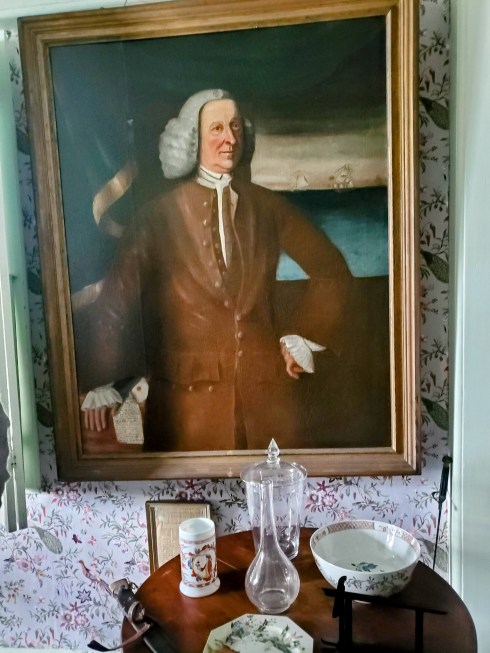
Portrait of Jonathan Sayward, Rescinder, in his family home, anonymous artist, and the right parlor, above. Below, our hero, Brigadier General John Glover: a study by John Trumbull drawn while Glover was living at his farm, 1794. Yale University Art Gallery.


Flight to Newbury

While I usually make plans to be as far away from Salem as possible on Columbus/Indigenous Day weekend to avoid the crowds and traffic, we had obligations this year so I was stuck in town. I can hide in my house or run over to the Salem Woods to escape the tourists, but not my feelings of anxiety at this time of year. It’s really hard for me to embrace the party as I can’t forget it is based on collective and individual tragedy so I’m just kind of seething in Salem. I wish I could lighten up, but I can’t so the best thing to do is get out of town: if not for a weekend at least for a day, or even a few hours. So as soon as I heard the laughter outside of my house I ran outside, jumped in the car, and drove north. The Newburys (Newbury, Newburyport, West Newbury) always calm me down with their seemingly endless inventory of perfectly restored old houses and litterless streets. Plus, this weekend the “Battle for Newbury” was on at Historic New England’s Spencer-Peirce-Little House: certainly a Revolutionary-war reenactment would distract me. And it did.

Two preserved early Colonial houses in very different places: Salem’s Witch or Corwin House and Historic New England’s Dole-Little House in Newbury. Heading north on Route 1A you come to another HNE property, the Spencer-Peirce-Little Farm, scene of the annual “Battle for Newbury.” Abbreviated tours of the house, which is dated 1690 with many later additions, were offered so I popped in with a bunch of soldiers (dining-room mantle, Federal parlor and back staircase above) but it was such a beautiful day to be outside!

So of course the real battles for Newbury occcurred across the pond during the English Civil Wars but it’s always fun to be with people who crave history, even in an idealized sense. That is certainly not the environment in Salem. And it was peaceful in Newbury, even with the mid-afternoon skirmish: clearly the reenactors, both soldiers and civilians, like to spend time together indulging in camp life. There were colonials from Rhode Island and Acton and Marblehead, Massachusetts, and the redcoats in His Majesty’s 10th Regiment of Foot are from Wrentham, I think (though they drill in Lexington). After a few hours at the Farm, I made a little tour of other seventeenth-century structures in Newbury and Newburyport and ended up at another Historic New England house, the Coffin House (1678), home to generations of the prolific Coffin family. I had a great tour and learned all about the evolution of the house, from its later seventeenth-century origins (oriented south), to its 1712 addition (what you see in “front” from Route 1A), and its 19th century division (so many interior windows!) and acquisition by Historic New England (then the Society for the Preservation of New England Antiquities) in that fateful year of 1929. So much history, so much texture! So calm.

The Coffin House in Newbury: exterior and original (back) house and newer (1712) addition in front: main room, bedroom, buttery, Georgian kitchen and parlors.


The Wentworth-Gardner House

We were in York Harbor all last week with family and friends, several of whom had never been to this region of New England before. So I was a bit of a tour guide, in my fashion. On a morning tour of Portsmouth, we passed by my favorite house in town, the Tobias Lear House, as well as its more famous neighbor, the Wentworth-Gardner House, one of the most famous Georgian structures in the country. I’m very familiar with this house, but for some reason I’ve never been inside, and the door was open with a flag out front, so in I went, forgetting all about my companions. They followed me, but I really gave them no choice in the matter! We had a lovely tour with a very knowledgeable guide, and the house was ever more stunning than I imagined. I’m kind of glad that I had never been in before, as this house is probably the best example of the entrepreneurial antiquarian Wallace Nutting’s material and cultural impact in New England and I’ve come to appreciate him only recently. Nutting purchased the house in 1915 and added it to his collection of “Colonial Pictorial Houses” after his restoration, and thus it became one of the more influential representatives of the “olden time” in his time and the Colonial Revival in ours. Images of Nutting’s wispy colonial ladies in its midst are scattered throughout and a room is devoted entirely to his work.

The Wentworth-Gardner House in Portsmouth, New Hampshire: present and before Wallace Nutting’s purchase in 1915; the amazing center hall with a stairway re-installed by Nutting, and one of his colonial ladies descending (from a large collection of Nutting images at Historic New England).

The houses was built by Mark Hunking and Elizabeth Rindge Wentworth in 1760 as a wedding gift for their son Thomas, who lived in it until his death in 1768. It was owned and occupied by Major William Gardner from 1793 to 1833, and thereafter by his widow. In the later nineteenth century the grand mansion became a rooming house as its South End neighborhood declined, and then Nutting came to its rescue! As you can see, his most extensive restoration was to its exterior, but the reinstallation of the stairway was a major undertaking as well. I know that the pineapple was a customary colonial symbol of hospitality, but I can’t help but wonder if Nutting was inspired by Salem’s “Pineapple House.”

Nutting’s restored doorway (Historic New England) and Salem doorheads from the 1895 Visitors’ Guide.

Nutting sold the house to the Metropolitan Museum of Art just after the close of World War I, initiating the threat of removal to New York City that was itself removed by the onset of the Depression. After a brief stint of stewardship by the Preservation of New England Antiquities, the Wentworth-Gardner (and adjoining Lear house) House was acquired by a group of local preservationists who eventually became known as the Wentworth-Gardner Historic House Associates in 1940. It’s just a great place to visit: so many wonderful structural and decorative details, including the wonderfully carved mantel in the front left parlor (another one of Nutting’s reinstallations), the newly-installed reproduction eighteenth-century flocked wallpaper, the very Colonial Revival kitchen with its steep steps leading to upstairs, several great bedchambers (I couldn’t call them simply bedrooms), the Wallace Nutting room, and a very nice exhibition on historic preservation in Portsmouth. I remain so impressed by this small city with all of its historic houses, in wonderful condition and all open to the public. It’s a great example of community commitment to material heritage and the importance of having several institutional stewards thereof, rather than just one or two.

Georgian and Colonial Revival styles/worlds merge in the Wentworth-Gardner House, Portsmouth, New Hampshire.


Roseland Cottage

In the last week of June I drove down to the “quiet” northeastern corner of Connecticut to see a house that was a major presidential July 4th destination in the later nineteenth century, Roseland Cottage, Historic New England’s sole property in the Nutmeg State. Home to several generations of the prosperous Bowen family from its construction in 1846 until its acquisition, fully furnished, by Historic New England in 1970, Roseland Cottage is a perfect Gothic Revival summer cottage located on one of the most picturesque roads in New England, Route 169 (the old Norwich-Worcester Turnpike), across from the Woodstock common which could accomodate the crowds that accompanied the first presidential visit of Ulysses S. Grant in 1870. Successive July 4 celebrations grew in size mandating their relocation to nearby Roseland Park, but three more presidents, Rutherford B. Hayes, Benjamin Harrison, and William McKinley, still stayed at the “cottage” and its outbuildings include both a presidential “two-seater” outhouse and a bowling alley built for Grant. When you read the accounts of these post-1870 Independence Day celebations you kind of get the feeling that this was a “July 4th is back” moment after the turmoil and division of the Civil War and its aftermath. I’d like to think that we are in a similar moment now, post-Covid, but I don’t think we are quite there (though it was nice to see the Pops last night). Roseland, however, is much more than a presidential pink palace: it feels very much like a family home, centered, but at the same time, out of time, as if it sprung from a fairy tale.

Roseland Cottage, built in 1846 for Mr. and Mrs. Henry C. Bowen: downstairs parlor, presidential bedroom, and outbuildings (including a carriage house bowling alley built for President Grant’s visit).

Because of its distinct style (even the furniture was custom-built for the house in Carpenter Gothic style, which foreshadowed Frank Lloyd Wright according to our guide), the house feels like a stage set in some ways, but also like we’ve just stepped in to a family home moments after its inhabitants have left as there are so many personal items remaining: Mr. Bowen’s commendations and commissions (he was a stalwart progressive Rebublican, which meant pro-abolition and suffrage in addition to pro-temperance, and also the founder and publisher of The Independent newspaper), Mrs. Bowen’s wedding dress and the Gothic Revival crib in which she rocked nine of their children (she died giving birth to their tenth and Mr. Bowen remarried a local girl), family photographs, books, prints, games, and decorative objects. I like to think that the pink china below was her preferred shade of her favorite color: Roseland has apparently been 13 shades of pink over its history and is now quite salmony-pink.

The other contradictory feeling is formality and SUMMER: Roseland Cottage is bordered by lush box-bordered gardens (which used to enclose roses but now mostly annuals, I believe), lawn, and Woodstock green so vivid green surrounds you inside, along with the bright colors of the stained-glass diamond-paned windows and the flowers outside. There are some fancy woolen carpets, but also thin matting under foot, and all of the soft furnishings are cotton florals and lace. Such a contradition, this house: dark and light, formal and fairytale-ish, solid and airy, sunshine and shadow.

My “HNE booties” and the grounds, displaying another contradiction: I wonder why there is a Greek Revival folly among all this GOTHIC Revival?


Salem Sustainability; or the Most Charming Memoir Ever

I came across a delightful short memoir quite by accident yesterday; it was so well-written and charming that I couldn’t stop thinking about it so I decided to write about it today to get it out of my head! It’s not about any BIG thing or event; in fact, it’s about a very little thing, what we might call an accessory today, and something we might not have thought much about at all before the pandemic: handkerchiefs in general, and “bundle handkerchiefs” in particular. “The Bundle Handkerchief ” was published in The New England Magazine in 1896 by Elisabeth Merritt Gosse, a Salem native and emerging newspaperwoman, who would go on to have a very successful career writing principally for the Boston Herald. It must have proved popular as it was issued as an illustrated pamphlet a few years later: I would love to get my hands on this! It’s such a simple story of how people wrapped up their purchases or possessions in the nineteenth-century, in handkerchief bundles of all cloths: gingham and calico sold at Mrs. Batchelder’s or Miss Ann Bray’s shops, the ‘finest white India silk” for ladies’ hats, lawn, linen or muslin for more intimate garments, Madras for new gowns as they made their way home from the dressmakers’, and “pale pink and blue gingham plaids” for shirts and spencers. Yet it is also revealing: of what people are doing and buying and wearing in very specific detail. l learned about all sorts of shops and customs of which I was previously completely unaware in its jam-packed three pages.

The bundle handkerchief as art: Alfred Denghausen, 1936, National Gallery of Art.

Apparently one could not even enter this world properly (or be introduced to it) without a bundle handkerchief! Is this where the stork with the bundled baby comes from? According to Elisabeth, No Salem infant, even without the requisite number of great-grandfathers and grandmothers, could be considered to have been properly introduced to society until it had dangled in a bundle handkerchief from a pair of steelyards, while its weight was recorded in the family Bible at the end of the family pedigree. She also included her own childhood memory of accompanying the family servants, armed with “two great bundle handkerchiefs of coarse blue and white checked gingham” to Mr. Hathaway’s bakery on Sunday mornings after church to retrieve the baked beans and brown bread which had been placed in his cavernous oven the day before. Salem women packed their soldiers’ trunks with prayer books from Mr. Wilde and medicine chests from Mr. (not Mrs.?) Pinkham, as well a selection of fine new bundle handkerchiefs, and three of these, of dark red silk, with the name embroidered in one corner, came home in one soldier’s trunk, brought by a guard of honor; for Salem gave the first of the Essex County heroes who laid down their lives for their country in the war of the Rebellion, as she did in the war of the Revolution. I wonder if she is referring to her own father here, Lt. Colonel Henry Merritt, who was killed at the Battle of New Bern in March of 1862.

Not blue and white, but the best I could do: a recipe card from the 1950s; Mr. Hathaway’s Bakery or the “Old Bakery” (now the Hooper Hathaway House on the campus of the House of the Seven Gables) in its original location at 21 Washington Street, Historic New England; Elisabeth Merritt Gosse in 1905, upon the occasion of the dedication of a boulder commemorating her father’s regiment near Salem Common.

Elisabeth Merritt Gosse recounts her last memory of a bundle handkerchief on the streets of Salem, wrapped around a book and carried by Mr. John Andrews in and out of the Salem Athenaeum, and observes that her title topic is as vivid a bit of color in Salem’s history as is Alice Flint’s silk hood, the frigate Essex, the North Bridge or even the House of the Seven Gables; and to speak of it calls up a long line of Salem’s sires and dames who took pride and pleasure and comfort in its use. [Another Salem memoirist, Harriet Bates or “Eleanor Putnam,” went even further: “The bundle handkerchief is as essential a figure in Salem history as the witches themselves.”] The bundle handkerchief’s time had passed in 1896, however, replaced by paper and string, prosaic, rustling, tearable, and to be quickly thrown aside and thrown away. This is not a good development in Elisabeth Merritt Gosse’s estimation, but as she died at the venerable age of 86 in 1936, we can at least be glad that she didn’t live long enough to see plastic.

Elisabeth Merritt Gosse was referencing the OLD Salem Athenaeum, now one of the Peabody Essex Museum’s empty buildings further up on Essex Street, but as I happened to be walking by the present one today, I snapped this photograph.


A Picky Guide to October in Salem

I think this might be the first time I’ve written up a “things to do” in Salem for Halloween, a holiday that lasts for at least two months here and seems to be on the way to becoming a year-long “celebration” with perhaps a month break for Christmas. I’m the ultimate Halloween Scrooge, I’ll never be able to get past the opportunistic exploitation of tragedy issue, and Salem has enough boosters already. BUT, this year is a bit different as I am teaching the Salem Witch Trials for the very first time, in a couple of seminars for freshmen designed not only the explore the historical event and its impact but also to introduce them to the requisite skills of critical thinking and effective discourse. None of my students are from Salem, so I want to introduce them to the city as well. They are excited to be here and the last thing they need is a Halloween Scrooge: every Thursday after our last class of the week they ask for weekend recommendations and it would terribly wrong for me to simply say LEAVE. They should form their own impressions about Salem in general and Salem in October, so here is my guide to helping them do that. It’s not just for students and those new to Salem: I get emails about October every year so I’m trying to address general queries as well.

Get the story straight and the lay of the land. Where to go for general orientation when there is no Salem Museum? The only option is the Salem Visitor Center on Essex Street, right in the midst of the sprawling Peabody Essex Museum campus. The Center is a collaboration between the National Park Service and Essex Heritage: at present there’s not much there besides flyers, books for sale, banners, and restrooms, but you can purchase tickets and view the best introduction to the trials: Salem Witch Hunt: Examine the Evidence. We’ve spent the last month in class doing just that, but I still recommend this documentary to my students and anyone visiting Salem with the goal of learning more about the trials.

The Salem Armory Visitor Center and the Peabody Essex Museum’s Plummer Hall and Daland House adjacent: empty in the midst of much activity!

Choose your tour carefully. Walking tours are the best way, and really the only means, for the student/visitor to get both the lay of the land and the Salem story, but it’s important to know which Salem story you want to hear. I have no idea how many walking tours are offered now: I was walking down Charter Street the other afternoon (a relatively short street) and I encountered six, encompassing amplified guides each surrounded by 30+ tourists. It felt like a gauntlet. It’s impossible not to hear what guides are saying as you walk down the street, and they are spinning very different tales. So this is an opportunity for consumer research. Use the crowd-sourced tourism review sites: they are very illuminating. I’m taking my seminar students on their own walking tour in November, but I’m sure many of them want to go on ghost tours now and are are too afraid to ask for recommendations from me: I have none, so I would just tell them (and any visitor so-inclined) to do their research. There are a few below-the-radar historical and architectural tours that I’d like to mention here, however. Dr. Donald Friary, the former executive director of Historic Deerfield who now lives in Salem, is giving two focused tours of the Salem Maritime National Historic Site sponsored by Essex Heritage, and you can also book tours with him (and other guides) here. Two other tour companies which seem to be offering more intimate and focused (cultural and architectural) experiences are here and here.

In addition to Dr. Friary’s tours, the Salem Maritime National Historic Site offers several audio and digital tours of their site; The tour group in Derby Square above is about the average Salem size in October: this particular guide was doing a great job explaining the changing coastline of Salem while keeping their rapt attention: I’m sure I couldn’t do that!

Salem museums are not created equal. Salem has only two museums which are accredited by the American Alliance of Museums, whose core standards are available here: the Peabody Essex Museum and Historic New England’s Phillips and Gedney Houses. Actually the small museum administered by Essex Heritage out at Bakers Island is also accredited, but I doubt that very many October visitors are going to make it out there and it is closed for the season. The word museum is used very loosely in Salem, so beware: this is another realm for which online reviews will be helpful. Last year, the Peabody Essex Museum decided to engage with the Witch Trials by offering its first exhibition on the events of 1692 in quite some time, and it was truly wonderful to see objects and texts which I had only read about for the first time. This year, the PEM is continuing its engagement with The Salem Witch Trials: Reckoning and Reclaiming. I’m a bit confused by this exhibition so I’m going to go back again myself as well as with my students, but I will say that, once again, the authenticity of the objects and texts is striking when contrasted with so much faux in Salem, and I know from reading all these reviews that authenticity is something that very many Salem visitors are seeking. Historic New England offers a bit of specialty programming for both of its Salem properties in October: just the other day I went to a stirring presentation of Poe poems at the Gedney House, and the Phillips House is presenting Wicked Wednesdays for children.

Poe at Gedney House by Theater in the Open: these performance are over but remember, remember for next year. They use the house really well.

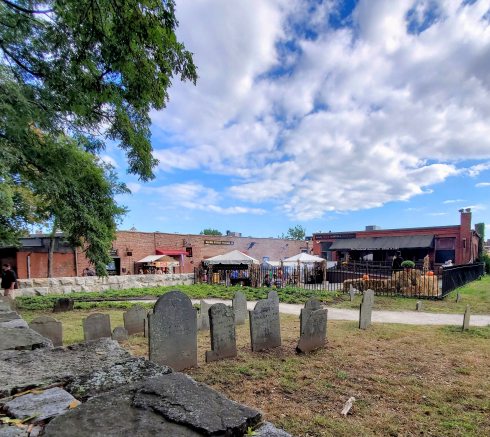
The Salem Witch Trials Memorial and Charter Street Cemetery. A big change here in terms of stewardship, so I can recommend a visit to these important, sacred sites. In past years, they were both overrun, but a partnership between the Peabody Essex Museum and the City of Salem has created a more protected and interpretive environment, based at the adjacent first-period Pickman House. The cemetery has been restored very carefully, and it’s really one of the most poignant places in Salem. Unfortunately the tackiest attractions in Salem are adjacent, literally blowing smoke into the cemetery, but that’s the reality of Salem in October: poignant and tacky.

FilmsThere are many opportunities to see timely films in Salem during October: on the Common, at the recently-revived Cinema Salem, on the patio of the East Regiment Beer Company. I’m looking forward to a screening of the animated House of the Seven Gables at Cinema Salem on the 28th in an evening sponsored by the Gables which will also feature a Q and A with the creator/director, Ben Wickey.

Just walk around: I suspect that my students just want to walk around in the midst of the packed Instagram crush that is downtown Salem, although a few of them did express concerns about the density of the crowds last weekend. So for them, and any visitor seeking a bit more space, I would recommend just walking around the neighborhoods: in the McIntire District, adjacent to the Common, along  and off Derby Street. There’s lots of beautiful houses to see, many decorated for the season, and lovely gardens behind the Ropes Mansion and Derby House. I’m hearing that the Haunted Happenings Marketplace, now on Salem Common, is a bit more carefully curated than in years past, so I might even venture over there today (a Saturday!) on foot, of course: opinions may differ about the character and impact of Salem’s Halloween, but the one thing everyone agrees on is the need to discourage driving dramatically: traffic and parking are just too scary.

Derby and Ropes Gardens, Federal Court, and WAY further afield on Lafayette Street.



A Cape Full of Color

So every year in early September we journey to Cape Cod on the weekend after Labor Day for my husband’s birthday. It is an odd time, just after “summer” is over and we have established our fall routines, and I always complain, but off to the Cape we go because he has wonderful memories of fishing in Provincetown and that’s what he always wants to do for his birthday. As is generally the case with us, he will fish and I will walk or drive around looking for old houses, but this time we spent most of the weekend together. Provincetown is one of those towns that I don’t think I want to go to before I go but once I’m there I’m happy: actually everyone seems happy in Provincetown! It’s not that it isn’t a wonderful, dynamic and scenic town, it’s that I always feel that it is overbuilt and too crowded, with both houses and people. And it is, but if you stop and look at individual houses you’ll see some wonderful details and landscaping. I had not seen the Public Library before, and that was a special treat, and of course I had to make my yearly pilgrimage to John Derian’s summer house with its shop in back. Another highlight: the recently-restored eighteenth-century Mary Heaton Vorse House, on which interior designer Ken Fulk seems to have spared no expense.

Saturday in Provincetown: the Pilgrim monument, Public Library in the former Center Methodist Church, featuring a half-scale model of the Rose Dorothea schooner on its upper floors, John Derian & Mary Heaton Vorse Houses, and, of course, the beach.

I posted a few pictures and an Instagram friend informed me that there was an “All around the Common” event on Sunday way back in Yarmouth Port, during which several historic houses would be open, including Historic New England’s Winslow Crocker House, which I had never visited. So that was all I needed to hear: I had no problem driving back to get into that house. It was a very blustery day, so my husband decided to join me in lieu of fishing: a big surprise. We then commenced a long drive back to Salem via nearly every Cape town on Sunday, with stops in Harwich and Yarmouth. We both really wanted to visit the Atwood-Higgins House in Wellfleet, which is part of the Cape Cod National Seashore, but as soon as we got to the gates of the property a rather frantic park ranger drove up to us in his SUV and told us to proceed with extreme caution as there was a major mosquito infestation. We were still pretty gung-ho, but about ten steps in we were covered with mosquitos and ran back to our car: one Wellfleet mosquito rode all the way back to Salem with us! And then it was on to Yarmouth.

All we saw of the Atwood-Higgins property in Wellfleet.

I dashed through the Edward Gorey House and the Bangs Hallet across the Common, and then spent quite some time in the Winslow Crocker House: too much time for my husband. The house was built during the Revolution by privateer Crocker in West Barnstable, and moved by collector and descendant of an original land grant Cape family, Mary Thatcher, to Yarmouth Port in 1935-36. She had a new foundation laid, and removed all evidence of the division made by earlier owners. Miss Thatcher lived in the house all year long and filled it with antiques, all of which she donated to Historic New England. It’s a gorgeous Georgian house with warm wooden paneling throughout, lots of light, and some great William & Mary and Hepplewhite furnishings. I have added Miss Thatcher to my list of heroic female preservationists.

The Edward Gorey and Captain Bangs Hallet houses on Yarmouth Port Common and the Winslow Crocker House, built c. 1780. Miss Thatcher.

Our last visit was to the 1790s house of an old friend of my husband’s, also on architect, on the Herring River in West Harwich. Amazing setting and decoration, and some very striking mantles in particular (I hope you can pick up the detail in the pictures). A perfect end to our Cape dash, and then we dashed for home, with (miraculously) no traffic!

A beautiful end of our weekend in West Harwich.