One of the chapters I’m working on for Salem’s Centuries this summer is about Colonial Revival Salem, or should I say, a group of antiquarians who lived and worked in Salem from about 1890-1930 who were dedicated to preserving and promoting any and everything about Colonial-era Salem in their time and for the future. Our book is a work of social history, so our focus in on Salem people. But when it comes to the various expressions of the Colonial Revival movement, if you can call it that, I’ve always found that individuals and their often-passionate attachments to the past are so important, and this is particularly true in the case of the Elizabeth Perkins House, one of the Old York Historical Society’s properties that has recently been reopened. For some reason, this is the one Old York house that I’ve never been inside, and I’d always heard that it was a perfect example of Colonial Revival influence in this region, so I was pretty eager when I showed up for my tour this past Friday.


The Elizabeth Perkins House of the Old York Historical Society, looking over the York River, Sewall’s Bridge and the Hancock Warehouse beyond. Its restorers, expanders and occupants: Mary Sowells Perkins and Elizabeth B. Perkins (photo on right from Old York Historical Society as featured in a very helpful Willaim & Mary 1988 thesis by Melisssa Mosher shows Elizabeth Perkins in front of the house).
This house is absolutely central to the preservation history of York as its early 20th century occupants, Mary Sowles Perkins (1845-1929) and her daughter Elizabeth B. Perkins (1869-1952) contributed it and several other structures (the Old Gaol, Jefferds Tavern, the old Schoolhouse, and the John Hancock warehouse) to what would eventually become the Old York Historical Society as well as encouraging other preservation efforts. So it seems right that Old York’s administrative offices have been relocated to this site as well. There was a whirlwind of restoration, expansion, embellishment and entertaining after the Perkins family purchased the house in 1898: they were from New York, and seem to have known everyone. Mark Twain came over from his summer rental across the river to use their telephone, the first one in York, and in 1905 they hosted the grandest party of the era: a Japenese-themed fête to celebrate the conclusion of the Portsmouth Peace Treaty ending the Russo-Japanese War of 1905 with over 700 guests in attendence. The tour really focused on their house, so much so that I’m not really sure of its pre-Perkins history. Old York is dating the house to around 1730 now, which seems about right to me, but I have postcards from my childhood (showing the house exactly as it looks now and at the time of Perkins’ death in 1952) bearing the date of 1680. The one below of the dining room shows the very “colonial” room that the Perkins created but also one of its most off-putting features for me—the electrified girondoles along the back wall.


Postcard of the dining room from 1960s or 1970s? I think it is a rule that every Colonial Revival house must have Hessians!
At first the house seemed to me like one of those sprawling recreations/creations which Mary Harrod Northend, one of the Colonial Revivalists in my Salem chapter, showcased in her Remodeled Farmhouses (1915) and I immediately wanted to know if Harrod knew either of the Perkins women–the two Marys were of the same generation. But inside, besides the dining room, it felt a little different to me than standard Colonial Revival: I guess there is no standard Colonial Revival because it is often an individual expression. The parlors of the Perkins house felt very traditional to me, but also more cosmopolitan, more worldly, more lavish, more of a mashup between past and present than a “period rooms”. A case in point would be this wonderful 20th century copy of an earlier portrait: this modern woman dressed in period costume just like Elizabeth Perkins above (well, a bit more elegantly). I love this portrait!

Hooked rugs abound of course, but the Perkins ladies were great travelers so that accounts for the worldliness of their rooms and all the interesting assemblages. Now I’m wondering about comparative Colonial Revival settings: if you’re trying to create and preserve a “colonial” home in the country it’s a different experience than in the city, where change is so much more apparent—and threatening. My Salem people, including Harrod, Frank Cousins, George Francis Dow, Caroline Emmerton and Daniel Low, are living and working in an environment of constant development, fire, pollution, and immigration: it seemed like things were being swept away. The Perkins ladies were facing none of that in York, so I’m thinking that they didn’t have to be quite so strident in their pusuit and preservation of the Colonial. Just a thought.


Front parlors and a very traditional entry; love the 17th century “open-back” ??? chairs.


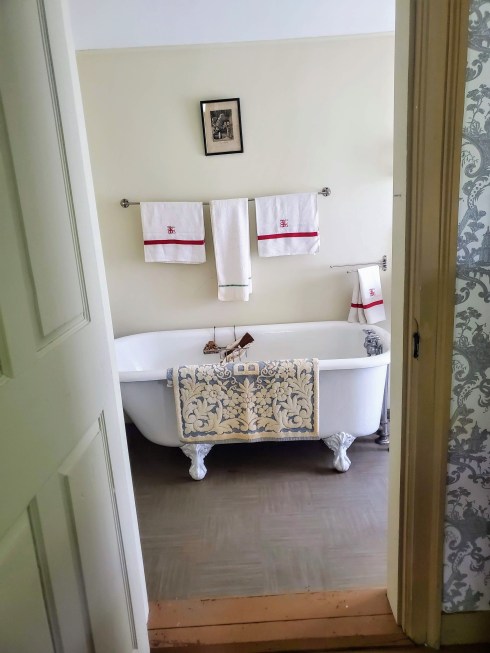


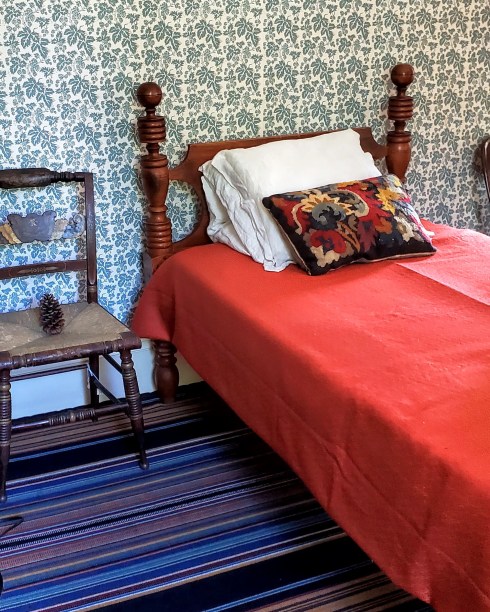
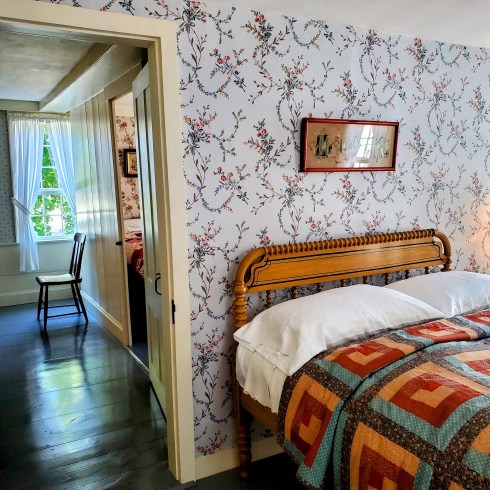
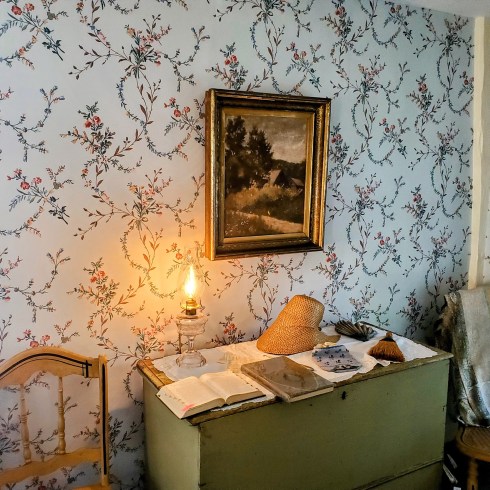
Loved the Currier & Ives presidential prints in the guest bedroom, which also has an en suite bathroom. The other bedrooms, including that of Mrs. Perkins above, have that “just left”/ I was just reading……. feeling, which is very Colonial Revival too: George Francis Dow pioneered the use of the folded-newspaper-by-the-gentleman’s chair motif in his period rooms in Salem, I believe.
Tours every Friday and Saturday available here.