Tag Archives: Historic Interiors

Reverential Restoration

I was browsing through the Flickr photographs of the Salem State Archives and Special Collections the other day, when I came across several photographs of crowds in and around the Gardner-Pingree House on Essex Street. This is one of the Peabody Essex Museum’s houses, and it is seldom open, so these crowds caught my eye. It’s also one of my very favorite houses in Salem, so every time I see it, in reality or in print, I stop and look. The photographs were from the Salem Evening News, which is my new favorite collection at Salem State, and they were part of the coverage of the reopening of the Gardner-Pingree after a substantive, source-based restoration in 1989. I didn’t live in Salem then, but I moved here not too long after, and one of the first things I did was go into this recently-restored house which I had heard, and read, so much about. It was absolutely stunning to me; I can still remember being shocked by the colors and patterns and detail. At that point in my life I was finishing my dissertation, then starting my teaching career, but at the same time I was increasingly obsessed with historic interiors. I had all the magazines and books, and they were like carrots that got me through all the work I had to do. My obsession is part of the reason I moved to Salem, and seeing this house just reinforced my instinct that it was the right place for me. After my first tour I bought a poster in the gift shop of the Essex Institute, and it still hangs on the wall: in my first Salem house it had pride of place, and now it dwells in a third-floor bathroom, but I still gaze upon it from time to time. I remember thinking when I bought it: this will be the inspiration for my own decoration–high standards indeed!

Unattainable standards obviously. If the colors above look blueish, be asssured they are not; there are layers of the most beautiful greens in that photograph. There must be 100 different shades of green in that house! I was impressed immediately, and my first instinct thereafter has always been to paint a room green. Our present house is north-facing, and green is not really the best choice, so I’ve used what I always think of as “Gardner-Pingree yellow” in several rooms. I tried to use what I think of as “Gardner-Pingree pink” in the double parlor but my husband objected so we have a compromise peachy salmon pink (although he would object to the label “pink”.)  It wasn’t only the colors–it was the slipcovers, the cream painted “fancy chairs,” the Brussels carpets, the fire buckets in the back hall: I could go on and on and I’m kind of ashamed to admit that whenever I’ve been in this house I notice the decoration more than McIntire’s woodwork. And I’m not the only one: this restoration certainly received acclaim from curatorial and preservation professionals but it was also featured in a cascade of shelter magazines and decorating books. Chalk paint pioneer Annie Sloan focused intently on one Gardner-Pingree green and that perfect pink, which is in the kitchen.

Just a few books which feature the Gardner-Pingree House.

It was a very important and influential restoration, and not just from my personal perspective. In several articles discussing its process and inspiration, then Essex Institute Research Curator and Project Director Dean Lahikainen (who later wrote the definitive book on Samuel McIntire, Carving an American Style) always seems slightly (though politely) appalled by the preceding restoration of the 1930s in which all the woodwork was painted white according to the dictates  of the Colonial Revival style which was so prevalent at the time. Fifty years later, Lahikainen and his team took their cues from historical sources rather than contemporary preferences, creating an interior that seemed both “refreshed” and restored. The house was  reopened this very week after a five-year restoration, and all the recorded visitors’ reactions run along these lines.

Stories from Lynn Daily Item and Boston Globe, June 1989 and 1990; photographs from the Salem Evening News, June 1989, Salem State Archives and Special Collections. The “formal English garden” photograph is of my garden! (Now not quite so formal) The last photograph above is of the small exhibit on the house which was in its carriage house, I believe.

You can see my photographs of the house from the last time I was inside, in 2017, in this post, and also here. Below are a few more, but I really don’t have very many good ones: every time I’m in this house I’m kind of overwhelmed and aware that I have this rare opportunity and I don’t focus on what I want to capture. On my past two spring break road trips, I thought that the Read House in New Castle, Delaware, and then Kenmore in Fredericksburg, Virginia might have supplanted the Gardner-Pingree as my very favorite house, but looking at these pictures again, I think not.


Salem’s Uber-Inglenook

A month or so ago, I was very fortunate to be able to tour Salem’s former Superior Court, a grand Victorian castle, complete with turret, built in 1861 and expanded in the 1880s. It’s been mothballed for quite some time, and is now part of big development/redevelopment project, in which it and its adjoining Greek Revival courthouse will be restored and a new multi-story residential building built alongside Salem’s train station. My husband’s firm, Seger Architects, is working on this project, and so after a big of nagging, I got to tag along on one of their site visits. I recall being in this building before, but I was not really present in the way I was on my recent visit: there were only a few people milling about and I had time to focus on every little detail. And there were so many: iron staircases with intricate designs, all manner of rounded and squared and arched windows, crafted courtrooms, with carved benches and siding and vaulted ceilings, small spaces for conferences delineated by smooth panelled doors and frosted windows, wooden phone booths, tiled floors with mosaic embellishments. But above and beyond all, there is the Essex County Law Library, with its magnificient “walk-in” fireplace. It’s impossible to describe the baronial beauty and presence of this particular room and feature, so I might as well just show you some photographs, of present and past.

My photos of the former Essex County Law Library and the Superior Court exterior from last month; Frank Cousins’ photographs from c. 1891, Cousins Collection, Phillips Library via Digital Commonwealth.

I posted a few photos on facebook, and one of my friends referred to this fireplace as an “inglenook,” which surprised me, as I think of inglenooks as small cozy places in pubs, where one gathers around the fire. This spacious enclosure does not strike me as particularly “nook-like”.  But the definition (according to Curl’s Dictionary of Architecture and Landscape Architecture) is more general: “corner of a large fireplace where the opening of the chimney was far larger than needed, and there was space where persons could sit” and “area off a room containing the fireplace, often with a small window, fitted with seats behind the chimney-breast and the wall.” So maybe it is an inglenook–it certainly could be fitted with myriad seats, though it was more purposely filled with bookcases. In the Cousins photographs above, you can see the windows on each side of the fireplace, long blocked-off. This area is more of an inglenook room, though, and its size and scale certainly impressed contemporaries when it was unveiled to the public upon its completion in 1889: “on entering it one is confronted by a fireplace so massive that, like one in the Castle of Chillon, it seems to dominate the whole room” wrote Thomas Franklin Hunt in the 1895 edition of Visitor’s Guide to Salem. I looked at all the Chillon fireplaces, and could not find one to rival Salem’s (imho) and none seem to be encased in inglenooks, so I think we have a very special space here, and also a relatively early example of the great inglenook revival ushered in by the Arts and Crafts movement on both sides of the Atlantic. The original architect of the Superior Court was Enoch Fuller of Boston; the 1880s addition was the commission of Wheeler & Northend of Lynn, the partnership of Holman King Wheeler and and William Wheelwright Northend. I’m not sure which partner designed the Library and its majestic fireplace, but I’d like to think it was Northend as he was from Salem and the younger brother of one of my favorite Salem authors, Mary Harrod Northend. In any case, it was was influenced by a burgeoning Tudor-esque revival of inglenooks, manifested in Britain most notably by the Richard Norman Shaw at Cragside in Northumberland in the 1870s and 1880s  and locally by Arthur Little’s renovation of Caroline Emmerton’s house on Essex Street in the latter decade.

Cragside Inglenook, Royal Academy of Arts; Sir William George Armstrong, 1st Baron Armstrong of Cragside (18101900), in the Inglenook at Cragside, by Henry Hetherington Emmerson, National Trust Collection; Arthur Little’s rendering of the dining room inglenook at 328 Essex Street, Salem, American Architect & Building News, November, 1890.

These inglenook fireplaces were the forerunners of more generic variants featured a few decades later in the pages of The Craftsman and on the cover of the Inglenook magazine. Like William Morris in Britain, Gustav Stickley loved these crafted “rooms within rooms”: for every bungalow an inglenook! It seems like this feature came to symbol craftsmanship in the early twentieth century, so it seems appropriate that the ultimate inglenook is right here in Salem, a very well-crafted city until recent decades. It’s not clear what new function the former library will serve in the future, but I’m hopeful that more people will be able to take (walk!) in this treasure in the years to come.

Gustav Stickley, Craftsman houses : a book for homemakers (1913). Cover of the weekly Inglenook magazine, 1906.


The Road to Mount Vernon

We have spring break this week, so I’m on one of my road trips, loosely following the footsteps of George Washington. I always feel like I need a theme beyond “interesting old houses” but often I find one along the way which replaces my original intention. Not this year though: George has been pretty present! I started out in northern New Jersey, where I visited a house that I’d long wanted to see because I love Gothic Revival architecture and it looked like the ultimate GR cottage, but it turned out to be much older with a Washington connection: the Hermitage in Ho-Ho-Kus. General Washington was headquartered here following the Battle of Monmouth and during the court martial of General Charles Lee in the summer of 1778, in the company of his aide Alexander Hamilton and the Marquis de Lafayette. Aaron Burr was there too, and a secret romance was initiated between the future Vice-President/duelist and the lady of the house, Theodosia Prevost, who happened to be married to a British officer. At the close of the war and after the death of Theodosia’s husband, the two were married. Decades later this very strategic house was “gothicized” and acquired its present appearance.

Not too far away is a house where Washington and his men spent much more time: the Dey Mansion in Wayne, New Jersey, which served as the General’s headquarters for several months in 1780. This is a beautiful property, maintained and interpreted by Passaic County, which acquired the house in 1934 after which it underwent an extensive restoration. A very knowledgeable guide took me all around the house, even into the atttic, which was absolutely necessary as I couldn’t understand how so many people could have lived in this house during the General’s residence: the Dey family did not vacate! You’re not going to see the house’s gambrel-esque roof that accomodates all this space because I didn’t have a drone with me, but check out the website. It’s a stately house for sure, but the spacious attic made everything clear. Washington, of course, was given the two best rooms, a large parlor/office on the first floor and a bedroom just above, by the master of the house, Colonel Theunis Dey.

The Dey Mansion: the first photos above—all the way down to the blue parlor—are rooms used by George Washington and his aides, including Alexander Hamilton. Then there’s the semi-detached restoration kitchen, and the spacious attic.

So at this point and place, if you really want to do the Washington tour, you should probably drive to Morristown, Trenton, Princeton, east to the Monmouth Battlefield, west to Valley Forge. But I’ve been to all those places several times, so I drove to the General’s last Jersey and last period headquarters in Franklin Township, a rather isolated farmhouse called Rockingham. No Pennsylvania for me; I headed south into Maryland to Annapolis, where Washington resigned his commission at the beautiful State House (obviously my chronology is all over the place, but these two stops did dovetail). I just really wanted to go to Annapolis in any case; George was just an excuse.

Rockingham: Washington’s last headquarters—and on to Annapolis.

A bronze George in the old Senate Chambers of the Maryland State House (Harriet Tubman and Frederick Douglass are just across the way); Hammond-Harwood, Shiplap and row houses in Annapolis.

On to Alexandria, where Washington touchstones abound, given its proximity to Mount Vernon. Like Annapolis, but MORE, Alexandria is full of beautiful townhouses: I started in the center of the Old Town and made my Washington stops—his church, his townhouse (actually a reproduction thereof) his pub—and then walked the streets taking photographs of doorways and wreaths, myriad details, spite and skinny houses. A bright sunshiney day: you almost can’t see this bronze Washington, sitting on a bench outside Duvall’s Tavern, where he was feted after his great victory.

From my parking place on North Washington Street, I drove straight out to Alexandria to Mount Vernon, mere miles away, along the George Washington Memorial Parkway. It definitely felt kind of like a pilgrimage at this point! I have been to Mount Vernon before, but have no vivid memories—an obligatory school trip, I think. It’s one of those houses that looks much bigger on the outside than the inside: it feels quite intimate within, especially as one side was closed off for renovations. I signed up for the “in-depth” tour so I could get some interpretation–and up into the third floor. While the mansion is a must-see, I think you can actually learn more about Washington from the many outbuildings on the estate: he was “Farmer George” and for all of his heroism he was also a slaveowner who seemed to have no regrets in that capacity. There are a lot of Washington contradictions, and there are a lot of Mount Vernon contradictions: while the subject of slavery is addressed up front the overall impression—reinforced especially at the museum adjacent to the orientation center—is of a “great man.” It was a bit too ra-ra for me, but I’m still headed to Yorktown for the last leg of my trip.

Mount Vernon: a house with 10 bedrooms and no bathrooms: the white-canopied bed is in the bedroom where Washington died. The presidential desk, parlor and dining room, key to the Bastille (a gift from Lafayette), greenhouse and garden, and view of the Potomac from the porch.


Holiday Tables

If I’m hosting for Christmas or any other holiday, I spend more time thinking about the table than the menu: much more time. I love setting the table, and once I attain my “vision” we’re all relegated to eating in the kitchen, no matter how many days before the big meal. Here it is, December 22, and I am hosting Christmas dinner and the table is not set! I just finished my grading, however, so I’ll get it together. I have a different animal theme every year for Christmas decorating and some animals are easier than others. Obviously deer are super easy, and I’ve also done bears, foxes, sheep, swans, pheasants, mice and hedgehogs—and more. This year, I chose lions, and they have been challenging! But I do have these great lion placemats which are everything. I’m not quite ready, however, so here’s a succession of holiday tables from both sides of the Atlantic.  First we have some Scottish tables from my trip last month, and then a succession of tables from Strawbery Banke in Portsmouth, NH: every year they have a Candlelight Stroll among and within their historic houses, featuring a sweeping and colorful view of holidays past.

Scotland: first up are parlor, dining room, and kitchen tables in the Georgian House in Edinburgh’s New Town, owned and operated by the National Trust for Scotland, then a Georgian “everything” room in another National Trust House, Gladstone’s Land. You’re looking at a table, but a lot more is going on in this room–it reminded by of another Georgian room, just below, in the Concord Museum, which I just visited last week. Back in Edinburgh, nothing is more festive than a pub table, and the city is in the midst of major gin craze. The Jolly Botanist is a great gin bar that we really enjoyed.

Back Home (well in Portsmouuth): Strawbery Banke is a museum “neighborhood” of historic houses, some of which were located in the Puddle Dock area of Portsmouth, others which were moved there when the museum was founded in the 1960s. It’s always been a part of my life, as I grew up across the river in southern Maine. The annual Candlelight Stroll features decorated houses with reenactors, representing different periods and stratas of society. The opulent Goodwin Mansion, first up below, was built in 1811, but it is interpreted as an 1870s house. Below its dining room is that of the Chase House, a Georgian structure that is interpreted c. 1818, followed by that of the Rider-Wood House (1830s), the Shapiro House (1919) and the time-capsule 1950s kitchen of the Pridham House.

My table is not set yet but here are the lions, ready to go! Best wishes for a restorative and merry Christmas.


Meeting Houses of Rockingham County

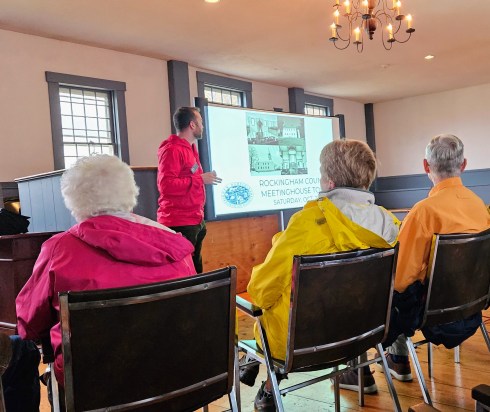
(Sorry—I have been reading and writing about meeeting houses for the past few months but still do not know if their identifier is one word or two). On this past Sunday, a rather dreary day, the New Hampshire Preservation Alliance sponsored a driving tour of meeting houses in southern Rockingham County, encompassing structures in Hampstead, Danville, Fremont, and Sandown. I drove over from York Harbor, fighting and defeating an inclination to just stay cozy at home. There was an orientation at Hampstead, the only colonial meeting house of the four that features a steeple addition (I envisioned Salem’s third meeting house, built in 1718), and then we were off to Danville, Fremont and Sandown. I have to tell you, I was in awe all day long: these structures are so well-preserved (cherished, really), simple yet elegant, crafted and composed. I remember thinking to myself when I was first set foot in the Danville meeting house: “I’d rather be here than in Europe’s grandest cathedral” (I think because I had just talked to my brother, on his way to Rome).  There’s just something about these places, and the people who care for them. Just to give you a summary of  the orientation that I received: they were built in the eighteenth century as both sacred and secular buildings, as close to the center of their settlements as possible and by very professional craftsmen. In the early nineteenth century, their religious and polical functions were seperated, so they became either churches or town halls or were abandoned altogether as other denominations built their own places of worship. It seems to me that they survived because of the preservation inclinations of their surrounding communities, and we were introduced to each meeting house by contemporary stewards who were clearly following in a long line of succession. Nice to encounter historical stewards rather than salesmen.

Hampstead:

The second floor of the meeting house, with its stage and original window frames propped up against the wall and all manner of remnants of civic celebrations, was really charming.

Danville: (which used to be called Hawke, so that’s the name of the meeting house. Hawke, New Hampshire–how cool a name is that!)

Incredible building—I had to catch my breath! I think it has the highest pulpit of these meeting houses, and there was just something about the contrast of that feature and the simplicity (though super-crafted) of the rest of the interior that was striking.

Fremont (which used to be called Poplin):

This meeting house is the only one remaining in NH with “twin porches” on each side, plus a hearse house (see more here–I have long been obsessed and have been to Fremont before but never inside the meeting house or the hearse house) with a horse-drawn hearse inside plus an extant town pound! Very simple inside, but note the sloping second-floor floors in picture #4 above. Took me a while to get used to those.

Sandown:

The most high-style of this set of meeting houses, particularly impressive from the back, I thought. Very light inside, even on this miserable day. Another high pulpit, and more marbleized pillars. Short steps to the second floor–I’m a size 7!

My photos are a bit grainy–not sure what my settings were, I was shifting them around to get more light, and too awestruck by the architecture to really focus, so in compensation I want to refer to you the wonderful work of photographer Paul Wainwright, who has photographed all of these meeting houses and more. Simply stunning!


Treasure House

Treasure House. That’s how the guide introduced the Codman Estate in Lincoln, Massachusetts, long known as “The Grange,” at the beginning of her tour the other day. It’s a term which has a specific meaning for Historic New England, which has been the owner and steward of the house since 1968: not only the house itself, but all of the treasures therein, encompassing the possessions and papers of the Codman family of Boston. The Grange was their summer house, expanded and decorated in successive eras by family members/design luminaries John Hubbard Sturgis and Ogden Codman Jr. My ears pricked up when I heard that term, because it’s how Salem was often described in the early and mid-twentieth century, as a treasure house of American material culture. That’s certainly not how Salem is thought of now, but in that heyday, proponents of the Colonial Revival like Ogden Codman Jr. thought and referred to it as such. When I was writing my chapter on Colonial Revival Salem for our forthcoming book this summer, I read quite widely (trying to make up for a disciplinary deficit) and reread Edith Wharton’s and Codman’s classic collaboration, The Decoration of Houses (1897). This book is so crystal clear in its articulation and presentation of interior design as a branch of architecture rather than “dressmaking” that I became more interested in Codman, who was both an architect and interior designer. I went off on a tangent, learning some very interesting design theories and practices as well as trivial details like the fact that he called Wharton (who was his client before his collaborator) “Pussy” and she called him “Coddy.”  And then it only seemed right to revisit the Grange, as the last time I went there, when I was in my 20s, I didn’t have a clue. I seem to remember being impressed with its Federal forthrightness, but not its interior, which I found “shabby.”

Well, its origins are not Federal: the models above show how the original Georgian house was transformed into the Federal Grange over the next century or so. But, it still strikes me as shabby, in an authentic rather than “chic” way: very layered and very waspy. This was really his father’s house, and there were things that Ogden Codman Jr. could change and things he could or would not. You can see his attempts to lighten things up, in his characteristic French-Colonial Revival fusion style, but the heavier hand of his uncle, John Hubbard Sturgis, is still much in evidence. So it’s quite a melange! Toile and Chintz in the sitting rooms and Tudor Revival in the dining room. I think I liked chintz back then, not a fan now, but will always love toile.

The very different stamps of Sturgis and Codman Jr. make for an interesting house. The Elizabethan dining room must have driven the latter crazy, but I love it. We went into only the front bedrooms, which seemed very Ogdenesque.

The other layering effect in the house is a result of the sheer number of Codman possessions therein: photographs, paintings, books, assorted personal items. There’s a time-capsule feeling, as if the family just went out the door, quite a while ago. That feeling is really resonant in the back of the house, where the servants lived and worked. I don’t remember seeing these spaces before: such a succession of rooms and staircases! How many staircases are there in this house? An impressive double staircase in front, and two or three in back? I lost track. Sturgis designed the rear addition, but I’m sure that neither he nor Codman ventured out back, so in a way (and except for the appliances and utilitarian elements) these ways feel even more timeless.

All the staircases and the way out back, eventually into the Italian Garden, which was being set up for a wedding on a VERY humid afternoon. I hope everything went well!


Sedgwick Sanctuary

Yesterday I learned a new word, drumlina long, flat-topped hill formed by glaciers, during my visit to the appropriately-named Long Hill in Beverly, one of the properties of the Trustees of Reservations. At the top of this drumlin, away from the “gold coast” where many of their Boston friends summered, Ellery and Mabel Cabot Sedgwick built a Federal Revival House with bricks harvested from an Ipswich mill and detailed woodwork crafted by enslaved workers from a Charleston mansion. They planted a copper beech tree to mark the spot of their new summer home, and after it was built, kept on clearing and planting, crafting a series of inter-connected gardens around it, designed to frame the home and also blend in with the 100+ acres of woodland and meadows beyond. It’s a spectacular site in so many ways: I’ve visited it many times and posted it about here too, but the Trustees have been engaged in a garden revitalization initiative for their properties, and so I wanted to give Long Hill another look. I took a proper tour rather than just wandering around (highly recommended: it was particularly important for me as I know quite a bit about plants but nothing about trees, and Long Hill has some very unsusual specimens) and now I have a whole new appreciation for this amazing space, and the amazing women who created it.

When Ellery and Mabel Cabot Sedgwick purchased the Long Hill property in 1916, he was in the first phase of his long and successful run as owner and editor of the Atlantic Monthly, which extended to 1938. But she was pretty famous too, having published a popular (and still very useful) gardening guide entitle The Garden MonthByMonth in 1907. The pull-out color chart from The Garden graces Long Hill’s library, framed by silhouettes of Mabel and the second Mrs. Sedgwick, the former Marjorie Russell, who was also an accomplished plantswoman. Together, in succession, they built the spectacular Long Hill gardens, Mabel establishing the integrated “garden rooms” format and Marjorie adding more exotic varieties of plant material—and also focusing on plant propagation and experimentation, often in collaboration with Harvard’s Arnold Arboretum. The property served as the summer retreat for the the entire Sedgwick family, including the four children of Mabel and Ellery and their children, until the death of Marjorie Sedgwick in 1978, after which Theodore Sedwick Bond, Henrietta Sedgwick Lockwood, S. Cabot Sedgwick, and Ellery Sedgwick, Jr. donated Long Hill to the Trustees. It still feels a bit like a family house, even with an event tent on site: accessible rather than stately.


One way the Trustees has enhanced the accessibility of the property is to emphasize the fact that it is a place of activity, still a work in progress as it was under the administration of the two Mrs. Sedgwicks. There’s a cutting garden, a greenhouse and horticultural center, cold frames, ongoing plant propagation, workshops, and for those that don’t want to get their hands dirty, the horticultural library in the house. There are also trails for those who want to explore the rest of the 114-acre property, the “world” beyond cultivation. The overall message is appreciate and act.

plant propagation in action for those who don’t recognize it—like me!

I’m going to conclude with some of the spectacular trees on the property, just a sampling for sure. I’m just starting to look at trees after a lifetime of being unblissfully unaware, and this is one of the reasons I wanted to revisit Long Hill and will continue to do so. There’s a lot to learn, but yesterday I was just kind of awestruck by some of the textures and colors of the bark, let along the flowers and leaves. It got increasingly humid as we made our way through the garden(s), and so a weeping hemlock was a welcome rest stop, as it was 10 degrees cooling under its dense branches.

These last two amber trees are a Tall Stewartia and a Paperbark Maple.

A few last photos: the house is beautiful, but it’s really just an orientation center for the garden now—-BUT I want you to see this beautiful wallpaper in the center hall, purchased by the Sedgwicks in London during their house furnishing tours in the 1920s, as well an example of “enslaved craftsmanship,” a mantle from the Isaac Ball House in Charleston.


A Big Move

No, not me: the Crowninshield-Bentley House! Visiting Louise DuPont Crowninshield’s former garden in Marblehead last week prompted me to reconsider her impact on Salem as a preservation advocate and philanthropist as it is considerable. At least two institutions in Salem, the Salem Maritime National Historic Site and the Peabody Essex Museum, reflect her commitment to the preservation of Salem’s material heritage which was manifested both by her direct involvement and her inspiration. The best example of the latter is one of the Peabody Essex Museum’s historic houses, the Crowninshield-Bentley House, which was moved by the Essex Institute from a rather precarious position on Essex Street to its current location in 1959. This early Georgian house, home to generations of the Crowninshield family as well as Salem’s pre-eminent diarist the Reverend William Bentley, was originally located at 108 Essex Street. In 1958 the Hawthorne Hotel donated the house to the Essex Institute with the condition that it be removed to make way for a parking lot. The move to its new site adjacent to the Gardner-Pingree House and across the street from the Hotel, was preceded by the demolition of a venerable commercial building and succeeded by a comprehensive restoration to its 18th century form under the direction of Abbot Lowell Cummings as a tribute to the “work and memory of preservationist Louise DuPont Crowninshield.” The Crowninshield-Bentley House became the cornerstone of the Essex Institute (now Peabody Essex Museum)’s main “campus” of historic structures, and to complete the vision, gardens also dedicated to the legacy of Mrs. Crowninshield were installed in its midst. Another reason I wanted to post on this big move today is the great visual documentation by Essex Institute President Albert Goodhue, Jr., who snapped photographs of the the entire process over what must have been several days (weeks???) in 1965. These are among some great sources at the Phillips Library in Rowley documenting Salem’s ever-evolving streetscape, one of the major topics we’ll be covering in our upcoming book Salem’s Centuries.

Washington Square West and Essex Street, Salem (Mass.) Photographs, MSS 0.1619. Courtesy of Phillips Library, Peabody Essex Museum, Rowley, MA.

Amazing!!! I love the nonchalance of the pedestrians, and not a police detail in sight. Everyone is just going about their business while the walls are tumbling down! The building being demolished was quite a storied commercial building, also an 18th century structure (I think) but altered and extended considerably. There were some very notable apothecary and stationary shops located within, and Salem architect/artist William Henry Emmerton made an iconic image of it in 1850 when it was his cousin’s apothecary shop (Emmerton was a great draftsman, and the Phillips Library has digitized the records of his architectural firm, Emmerton, Foster & Putnam, so you can see more of his work here). Those big storefront windows were apparently the second of their kind installed in Salem, and the Paracelsus bust trade sign was pretty conspicuous too. After the move and restoration was completed, the Crowninshield-Bentley House received a lot of attention in both academic and popular publications: there are both feature articles and cover stories throughout the 1960s into the 1970s and even the 1980s. The more scholarly pieces tend to focus on the detailed 1761 probate inventory of Capt. John Crowninshield as a primary source for the restoration (which includes references to “a Negro man” valued at £66.13.4 and a “Negro woman” valued at £40 about whom I’d like to know more)§ while trade periodicals seem to focus overwhelmingly on the kitchen. There’s a big spread on the interior of the house in the July 1987 Colonial Homes, part of feature on Salem as the “showcase of early America,” which it was, then.

William Henry Emmerton, Apothecary shop of James Emerton in Salem, c.1850 (pen & ink and sepia wash on paper), Peabody Essex Museum; the Crowninshield-Bentley House on the cover of Americana, September 1973; the kitchen as photographed by Samuel Chamberlain (1970, Phillips Library via Digital Commonwealth) and in House and Garden, January 1974; Frank Cousins photograph of the house in its original Essex Street location, 1890s, Phillips Library via Digital Commonwealth. The House today.

§ The Phillips Library has also digitized all of the booklets in the Essex Institute Historic House Booklet Series, including The CrowninshieldBentley House, Essex Institute historic house booklet series, no. 2, by Abbot Lowell Cummings, Dean A. Fales, Jr., & Gerald W.R. Ward, which you can access here. “An Inventory of the Estate of Capt. John Crowninshield Late of Salem and Apprized by Us the Subscribers at Salem November 10th 1761” is included as an Appendix.


The Elizabeth Perkins House

One of the chapters I’m working on for Salem’s Centuries this summer is about Colonial Revival Salem, or should I say, a group of antiquarians who lived and worked in Salem from about 1890-1930 who were dedicated to preserving and promoting any and everything about Colonial-era Salem in their time and for the future. Our book is a work of social history, so our focus in on Salem people. But when it comes to the various expressions of the Colonial Revival movement, if you can call it that, I’ve always found that individuals and their often-passionate attachments to the past are so important, and this is particularly true in the case of the Elizabeth Perkins House, one of the Old York Historical Society’s  properties that has recently been reopened. For some reason, this is the one Old York house that I’ve never been inside, and I’d always heard that it was a perfect example of Colonial Revival influence in this region, so I was pretty eager when I showed up for my tour this past Friday.

The Elizabeth Perkins House of the Old York Historical Society, looking over the York River, Sewall’s Bridge and the Hancock Warehouse beyond. Its restorers, expanders and occupants: Mary Sowells Perkins and Elizabeth B. Perkins (photo on right from Old York Historical Society as featured in a very helpful Willaim & Mary 1988 thesis by Melisssa Mosher shows Elizabeth Perkins in front of the house).

This house is absolutely central to the preservation history of York as its early 20th century occupants, Mary Sowles Perkins (1845-1929) and her daughter Elizabeth B. Perkins (1869-1952) contributed it and several other structures (the Old Gaol, Jefferds Tavern, the old Schoolhouse, and the John Hancock warehouse) to what would eventually become the Old York Historical Society as well as encouraging other preservation efforts. So it seems right that Old York’s administrative offices have been relocated to this site as well. There was a whirlwind of restoration, expansion, embellishment and entertaining after the Perkins family purchased the house in 1898: they were from New York, and seem to have known everyone. Mark Twain came over from his summer rental across the river to use their telephone, the first one in York, and in 1905 they hosted the grandest party of the era: a Japenese-themed fête to celebrate the conclusion of the Portsmouth Peace Treaty ending the Russo-Japanese War of 1905 with over 700 guests in attendence. The tour really focused on their house, so much so that I’m not really sure of its pre-Perkins history. Old York is dating the house to around 1730 now, which seems about right to me, but I have postcards from my childhood (showing the house exactly as it looks now and at the time of Perkins’ death in 1952) bearing the date of 1680. The one below of the dining room shows the very “colonial” room that the Perkins created but also one of its most off-putting features for me—the electrified girondoles along the back wall.

Postcard of the dining room from 1960s or 1970s? I think it is a rule that every Colonial Revival house must have Hessians!

At first the house seemed to me like one of those sprawling recreations/creations which Mary Harrod Northend, one of the Colonial Revivalists in my Salem chapter, showcased in her Remodeled Farmhouses (1915) and I immediately wanted to know if Harrod knew either of the Perkins women–the two Marys were of the same generation. But inside, besides the dining room, it felt a little different to me than standard Colonial Revival: I guess there is no standard Colonial Revival because it is often an individual expression. The parlors of the Perkins house felt very traditional to me, but also more cosmopolitan, more worldly, more lavish, more of a mashup between past and present than a “period rooms”. A case in point would be this wonderful 20th century copy of an earlier portrait: this modern woman dressed in period costume just like Elizabeth Perkins above (well, a bit more elegantly). I love this portrait!

Hooked rugs abound of course, but the Perkins ladies were great travelers so that accounts for the worldliness of their rooms and all the interesting assemblages. Now I’m wondering about comparative Colonial Revival settings: if you’re trying to create and preserve a “colonial” home in the country it’s a different experience than in the city, where change is so much more apparent—and threatening. My Salem people, including Harrod, Frank Cousins, George Francis Dow, Caroline Emmerton and Daniel Low, are living and working in an environment of constant development, fire, pollution, and immigration: it seemed like things were being swept away. The Perkins ladies were facing none of that in York, so I’m thinking that they didn’t have to be quite so strident in their pusuit and preservation of the Colonial. Just a thought.

Front parlors and a very traditional entry; love the 17th century “open-back” ??? chairs.

Loved the Currier & Ives presidential prints in the guest bedroom, which also has an en suite bathroom. The other bedrooms, including that of Mrs. Perkins above, have that “just left”/ I was just reading……. feeling, which is very Colonial Revival too: George Francis Dow pioneered the use of the folded-newspaper-by-the-gentleman’s chair motif in his period rooms in Salem, I believe.

Tours every Friday and Saturday available here.


A Visual History of Home

My mind is whirling these days: we’re at the end of the semester, and a teaching-free summer lies ahead of me, but so do three writing projects, maybe more. I’m always thinking, but I’m also really tired, so it’s not all constructive. Thankfully gardening season has begun, but I did not feel particularly re-energized after my first foray out back last weekend—just sore! Then I remembered this book that I picked up down in Connecticut during our stay at the Griswold Inn a few weeks ago. The Griswold has no televisions in their rooms, which pleased me, but not my husband, so I suggested we go to a rather elegant used bookstore next door. We browsed, he more intently than I, but I came across a beautiful book that I thought I could add to my bedside stack of books I never read because I seem to only read for information, and all my informational books are in my study. I bought it, threw it in my suitcase, brought it home and forgot all about it until this past Sunday, when I poured myself a glass of wine and opened it up………….and immediately began to relax, in the best possible, almost entranced way. This book is entitled At Home. The American Family 1750-1870, and it was written by Elisabeth Donaghy Garrett (now Widmer), then (1990) a vice-president at Sotheby’s, and author of several books on historic interiors. Apparently Ms. Garrett had published a series of articles on “the American Home” in The Magazine Antiques in 1983 that was so well-received that it prompted the publication of this book and boy, I can understand why. Peter Thornton, whose book Authentic Decor: the Domestic Interior 1620-1920 I am familiar with, notes in his Forward that the “outstanding quality” of At Home is “the sheer weight of evidence that has been marshaled and the manner in which it has all been presented.” I agree, but I think the manner is more important, at least for my personal purposes: I seldom read for pleasure, and this book offered both pure pleasure and tons of information, in well-crafted text and well-curated pictures. It really took me away, and that never happens.

I really wanted this book to be a picture book, a coffee table book, which I could just breeze through from time to time. And I suppose it is that, if you want it to be. The illustrations are amazing, representing a full-spectrum of deep-hued oils from well-known American artists of the eighteenth and nineteenth centuries, to seldom-seen (at least by me) watercolors of domestic scenes sourced from local historical societies. But once I started reading, I couldn’t stop: Garrett is a wonderful writer who favors narrative and literary sources, so her text is quite lively, and as Thornton observed, she manages to integrate a lot of information in a very accessible manner. I could take a lesson from her, but I’d rather just enjoy her book. The chapters begin with individual rooms in the house (their uses and all about their furnishings, in great detail) and then proceed to the myriad elements and tasks that go into making a home, all year round, and in the city and the country. So we have: parlors, the dining room, the kitchen, the bedchambers, lighting, “the daily dog-trot routine of domestic duties,” “the quest for comfort,” (probably my favorite chapter–a lot of heating and cooling advice, and bugs!), the tribulations of the early American housewife, and husband and wife as consumers. Here are some of my favorite images, and a few notes about how Garrett used them: I tend toward the vernacular, because so many of the paintings and prints in this book were new to me, but there are plenty of formal interior scenes as well. Since we’re in the beautiful month of May, I’m also going to focus primarily on summer homes: cozy parlors can come later.

The Children of Nathan Comfort Starr, Middletown, CT by Ambrose Andrews, 1855, Metropolitan Museum of Art. Garrett notes the elevation of the house, designed to promote healthy air inside. This looks like a happy scene of children playing shuttlecock, but Garrett believes that it is a memorial painting of the youngest son (in the dress, of course) who died when he was just over a year old.

York, Pennsylvania Family, 1828, anonymous artist, St. Louis Museum of Art. At Home is just as much about households as houses, including servants. Garrett discusses servants but she does not discuss race. This is a book of its time (1990), which is before the renewed historiographical focus on the roles of African-Americans in the northern US. She includes three images of African-Americans in the corners or the margins, but she does not digress on their identity or position beyond that of “trusted servants.” At Home is a study in material culture, not a social history, and so this painting is used to describe the vivid wallpaper and carpet (boy does this book have a lot to say about carpets!) contrasted with the simple painted furniture.

Rhode Island Interior by an anonymous artist, 1800-1810, collection of Fenton Brown. It’s really all about the carpets! They demanded so much time, and money. Women (or their servants) pulled them up in the spring, nailed them down in the fall, and spent a lot time worrying about moths. Garrett uses this particular image to present a European gaze on American interiors, which she does often throughout her book. An Italian observer noted that Americans “displayed few pictures, statues, or ornamented furniture, preferring instead mahogany furniture and fine carpets.”

Two paintings by Massachusetts artist Ellla Emory of Peter Cushing House in Hingham, MA: East Chamber and Old Laundry, c. 1878, both Private Collection. I love this artist! Back to the floors: this sisal-like straw matting was very popular in the summer for centuries—one of my favorite paintings of the Elizabethan court shows the same covering! Floors could be bare in the back of the house, and in hallways as well, and beach sand was spread around.

Garrett includes quite a few watercolors by new-to-me New Bedford artist Joseph Shoemaker Russell (1795–1860), all of which I found absolutely charming. Russell painted New England interiors, but spent some time in Philadelphia too, where he captured all the rooms of his boarding house: above are Mrs. A.W. Smith’s Parlor and Mrs. J.S. Russell’s Room at Mrs. A.W. Smith’s, both 1853 and in private collections. These are summer views, and present opportunities for Garrett to discuss shutters in detail, as well as the necessity of closing up the fireplace with fireboards or flowers during the warm months. The parlor view shows a gas-fed lamp of the 1850s, and also the American custom (noted by all of Garrett’s European sources) of placing all the furniture along the walls of the room. Silhouettes are everywhere in this book!

More summer images (and challenges): View from the House of Henry Briscoe Thomas, Baltimore, by an anomynous artist, c. 1841, Metropolitan Museum of Art; Tea, Alexandria by William Marshall Merrick, 1860, New York Public Library. Come Spring, the lady of the house (or her servants) had to change not only the carpet, but also the draperies. If she didn’t have shutters, she had to pull down the heavy drapes and replace with sheers. She (or her servants) also had to drag all the furniture outside for an airing: Spring cleaning was a really big deal. The battle against bugs intensified with the warm weather, but it was really fought all year long, the principal enemies being flies, mosquitoes, moths and bedbugs.

Ice Cart by Nicolino Calyo, c. 1840-44, New-York Historical Society. The provisioning of the household also varies with the seasons, and “the ice-cart was an integral part of the iconography of summer in the city” from May until October. The New England re-export ice trade was an Atlantic affair, and Garrett’s European observers frequently commented on the abundance of ice in American households.

Now refreshed: I can attack the (digital) pile of final papers and examinations before me!