Tag Archives: Gardens

Road Trip, Part Six: The Other Naumkeag

On the last day of my road trip, before I headed home to Salem, I visited a house named for Salem: Naumkeag, the Stockbridge summer cottage of Joseph Hodges Choate (1832-1917).  The native Americans called the land encompassing Salem Naumkeag, and the Salem-born Choate, a prominent New York attorney who took on Boss Tweed and served as Ambassador to Great Britain before World War I, named his country house for his native city.  I had never been to this western Naumkeag, but I had heard great things about it for many years, and I was not disappointed.

Naumkeag (1885), an early commission of Stanford White of McKim, Mead & White, Stockbridge, Massachusetts:  rear, front & detail views.

Actually, that’s putting it mildly:  I loved this property, which surprised me.  I grew up in a house in southern Maine not dissimilar from Naumkeag:  a shingle-style Victorian with dormers, porches, and a big hallway.  And while I love this house, when I moved away and grew up I always sought more straightforward houses for myself :  Federal and Greek Revival houses with clean lines and open facades in which squares are more important than curves.  Naumkeag is very curvy; it’s the antithesis of my beloved Federal style, but it is so perfectly placed in its setting that it cannot fail to charm.  I quickly realized that it was not just the house, but the house and its surrounding landscape, that was captivating me.  Mr. Choate and his wife Caroline had summered in the Berkshires for many years before they purchased the land on which they built their summer house, and they knew just where they wanted to build it–on a bluff overlooking a pastoral valley very close to the village of Stockbridge, where terraced and sloping gardens could surround the house and link it to that same valley below.

Naumkeag today, house and grounds tied together in a series of interior and exterior “rooms” which provide vistas that look both inward and outward, is not only the result of the collaboration of Mr. and Mrs. Choate and their consultants but also of another extraordinary partnership, between their daughter Mabel and the amazing landscape architect Fletcher Steele (1885-1971).  Mabel met Steele just before she inherited Naumkeag in 1929, and they embarked on a 30-year joint endeavor which made Naumkeag even more magical.  All the details–structural, horticultural, practical, were overwhelming!  I could write a separate post on just how water was moved from place to place.

Fletcher Steele’s work at Naumkeag: the “afternoon garden”, forged steps and “runnel” leading down to the famous, iconic Blue Steps.  My photograph is followed by one by Carol Highsmith (1980; Library of Congress), obviously a much better photographer.

Those blue steps: how amazing.  Art Deco in a “Victorian” garden (or is it?) and also an interesting juxtaposition of beauty and practicality; after all, they exist to channel water down to the lower perennial garden. The use of the azure blue, carefully chosen by Steele after much deliberation apparently, brings the sky down to the ground.  Here’s charming photograph of Steele and Mabel on the blue steps before they were blue:

Back to Salem, the first Naumkeag, where a statue dedicated to Joseph Hodges Choate marks one of the entrance corridors into the city.


Road Trip, Part Five: Two Sculptors in the Summer

Two very famous sculptors of the American Renaissance, a time when sculpture seems to have much more appreciated than now, maintained summer houses and studios in New England:  Augustus Saint-Gaudens (1848-1907), creator of the Robert Gould Shaw memorial on Boston Common among other masterpieces, and Daniel Chester French (1850-1931), who sculpted Abraham Lincoln and The Minute Man.  I visited both estates on the road trip:  Aspet House, in Cornish, New Hampshire, and Chesterwood, in West Stockbridge, Massachusetts.

After Saint-Gaudens rather reluctantly settled into circa 1800 former tavern that he renamed Aspet House about 1885 and built several studios and gardens, he inspired the foundation of the “Cornish Art Colony” in the border town and its surrounding area.  It’s a golden valley, encompassing towns in both New Hampshire and Vermont on both sides of the Connecticut River and framed by mountains beyond, particularly Mount Ascutney.  The train was the key factor here as well as down in Stockbridge:  artists and others could escape from sweltering New York City relatively easily and spend their summers in bucolic New England.  After Saint-Gaudens’ death in 1907, the estate declined; generations of preservation advocacy resulted in its acquisition by the federal government in the 1960s and the establishment of the Saint-Gaudens National Historic Park in 1977.  It is beautifully maintained and well-interpreted, well worth a visit from near or far, and there are over 100 examples of Saint-Gaudens’ work on view.

Augustus Saint-Gaudens: a photograph of the sculptor at work by Kenyon Cox (Library of Congress), Aspet House, grounds, and the Little Studio, details and sculpture.

About 140 miles to the southwest, Daniel Chester French bought a 122-acre farm in the western part of Stockbridge, Massachusetts (actually it might be in the little village of Glendale) in 1896 and commissioned architect Henry Bacon, with whom he had and would work on a number of memorial projects, to build first a studio (1897) and then a house on a bluff overlooking the Berkshire hills. While Saint-Gaudens remodeled his colonial dwelling (substantially), French opted to replace the existing colonial with a new Colonial Revival house.  Chesterwood is the only historic site that I have ever visited that is owned and operated by the National Trust for Historic Preservation, which received it from French’s daughter in 1969.  The Trust has not merely preserved the estate however; it is very much a living place, with modern sculptures placed artfully in the gardens (which are also beautiful, and designed by French himself, just as Saint-Gaudens designed the gardens at Cornish).

Daniel Chester French:  in his Chesterwood studio, 1907; the house and studio, tracks leading outside of the studio so French could work in natural light, and modern sculptures on the grounds.

French operated in the same milieu as Edith Wharton, whose Berkshire country house, The Mount, I visited in a previous post.  And as Edith, her house, and her circle (played by contemporary models, actors, writers and artists) are featured in this month’s Vogue, so too are French (played by artist Nate Lowman) and his Chesterwood studio.  Saint-Gaudens will have to wait for a later issue, but I can’t imagine a better setting for a photo shoot than Cornish.


Road Trip, Part Three: Pilgrimage to the Mount

The contrast between Edith Wharton’s aunt’s house, Wyndcliffe, and her own Berkshire “cottage”, The Mount, could not be more extreme:  decaying Victorian Gothic indulgence as opposed to restored (or in the process of being restored) and restrained American neo-Classicism.  Even before Wharton penned her fictional bestsellers she wrote a popular interior design manual with her friend and collaborator Ogden Codman, Jr., The Decoration of Houses (1898), and The Mount fulfilled her vision. There have been some obstacles and challenges in its ongoing restoration over the past 15 years, but on this beautiful August morning it looked bright and cheerful and orderly. By all accounts, Wharton considered The Mount to be her first real home, and it seems like such a shame that she only spend a decade in seasonal residence, from its construction in 1902 until the break-up of her marriage and departure for France in 1911.

Our vivacious guide kept referring to the house as English in inspiration and style, and I suppose it is:  Wharton always proclaimed her admiration for the Georgian style above all others.  But The Mount felt very American to me, in that assimilated, melting-pot way: Georgian house, Italian gardens, French courtyard.  None of the original furnishings are in the house, so contemporary designers have recreated an updated Edwardian ambiance inside, adhering to the original finishes and arrangements whenever possible.  I did like Bunny Williams’s dining room, but I was more drawn to the original features of the house no matter how mundane:  hardware, the “trunk lift”, the unrestored scullery in the basement.

Less decorative license was taken upstairs in the private rooms of The Mount, including in what is arguably the most important room in the entire house, Mrs. Wharton’s bedroom, where she did all of her writing, in bed.  She would write every morning, numbering her pages and casting them to the floor, where her maid would pick them up and send them off to her secretary to be typewritten.  She loved little yapping dogs, whose presence is felt by the placement of stuffed animals around the house and a pet cemetery out back.

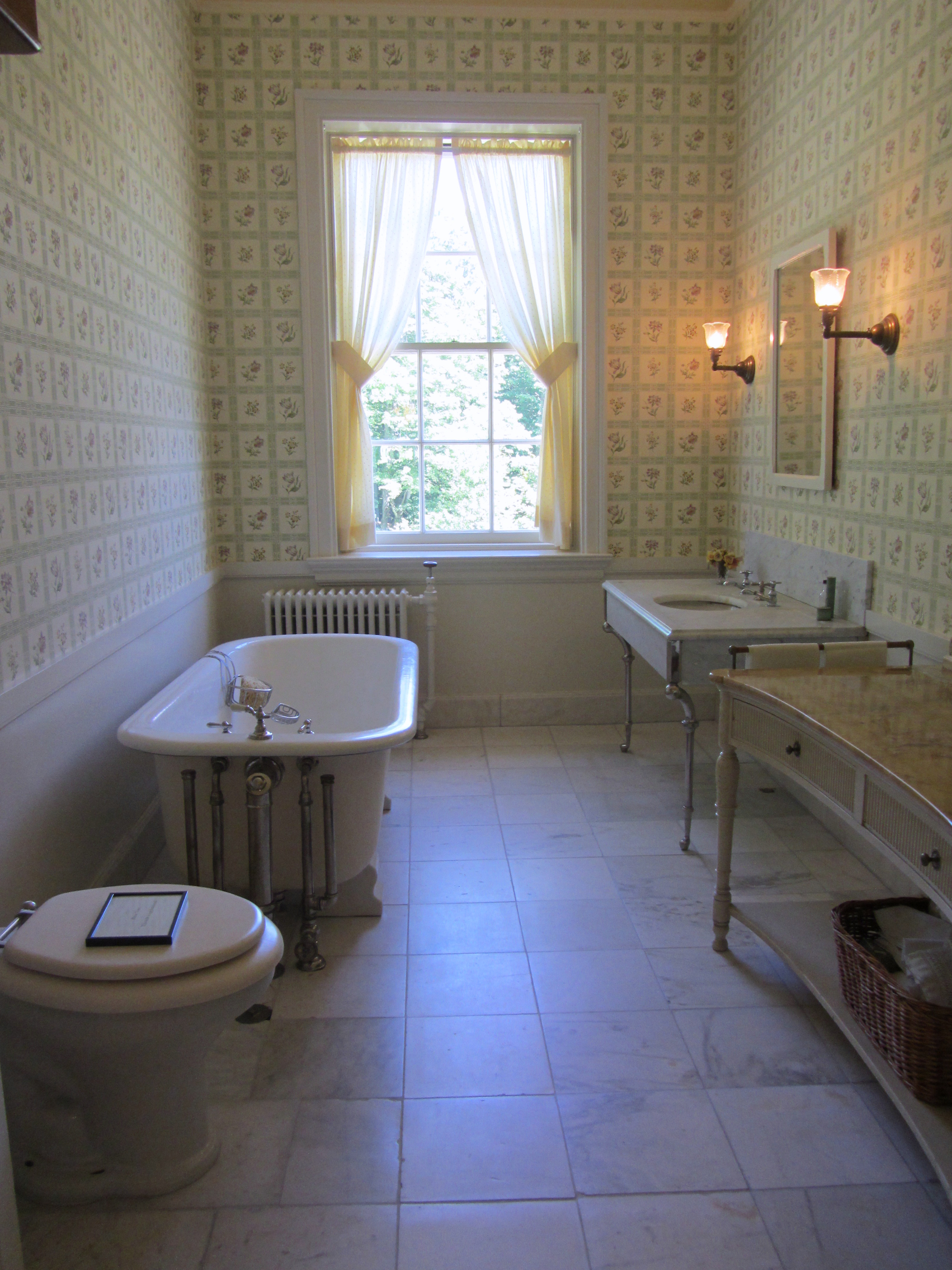
Private spaces made public:  Edith Wharton’s bedroom and adjacent bathroom.

The Mount, Plunkett Street (off Route 7), Lenox, Massachusetts.

Because I was having a completely indulgent day (one in a series), after my morning at The Mount, I stopped on the way back to my inn to pick up that must-have publication of the season, the September issue of Vogue Magazine.  I opened it up, and there she was:  Edith Wharton in Vogue!  Or model Natalia Vodianova playing Edith in residence, in an 18-page article and spread entitled “The Custom of the Country” by Colm Tóibín with photographs by Annie Leibovitz. There was Edith/Natalia ensconced where I just was, along with various actors, authors and models playing members of her inner circle who were regularly invited to the Mount (Henry James, Walter Berry, Theodore Roosevelt, her landscaper niece Beatrix Farrand, and sculptor Daniel Chester French–whose home I also visited yesterday).  A happy coincidence.


Globally-warmed Gardens

Unlike my students and nearly every one I run into, I’m not relishing this rare warm March weather.  I like warm (not hot) weather as much as the next person, but in season.  If there’s going to be a bright sun out there, I would prefer that there are leaves on the trees for shelter and shade.  Yesterday the temperature rose into the mid 80s which is just wrong for March in Massachusetts.  Last year was an amazing year for my garden, well-protected and -watered by a blanket of snow all winter long, but this year I am worried.  Looking around the web for some advice and reassurance, I instead became more alarmed when I came across the website for a campaign by the National Trust in Great Britain from 2010: A Plant in Time sought to raise environmental awareness by examining how climate change could end gardening as we know it.

The point, and the cause, is well-illustrated, literally, by three paintings by artist Rob Collins showing the effects of rising temperatures on the classic English garden—essentially it evolves into a Mediterranean one.

The end of the English garden is a dismal prospect indeed!  I look at my own (New) English garden, where blooms abound, and wonder if I’m going to see the same transformation:  the disappearance of the lawn, the roses, the delphiniums (actually, my delphiniums never come back anyway).  The National Wildlife Foundation’s Gardener’s Guide to Global Warming informs me that I’m still in my old 6B Plant Hardiness Zone, but also that at least one iconic Massachusetts plant, the mayflower, will disappear in the next few decades due to climate change.