Tag Archives: Flora and Fauna

Cicely & Alexander

It’s been raining for about a week and everyone I talk to is complaining, but not me:  everything is so lush and green.  I keep peeking out of my third-floor study window down at the garden below, a blissful escape from grading papers.  This is what I see: red, wet bricks and green, wet plants.

What you don’t see from this perspective are the shade borders that lead out to the street.  They are lined with two of my favorite stalwart spring plants: Sweet Cicely (myrrhis odorata) and Golden Alexander (zizea aurea).  These two plants never fail me, and provide fluffy little long-lasting flowers long before anything else has bloomed. Though Sweet Cicely is an herb with a long European heritage and Golden Alexander is a native wildflower, they actually have much in common:  both belong to the same Apiaceae family of  flowering plants, which used to be called the Umbelliferae family, for their hollow stems and umbel (umbrella-like) flowers.  This is a large group of plants that includes carrots, parsley, fennel, dill and other utilitarian potherb plants.  I think that the owners of my house and tenders of my garden from a century or more ago would probably be a little horrified by these lowly plants taking up so much prominent space, but I like them.

The path from street to garden; Sweet Cicely and Golden Alexander close-up.

Both plants are referenced in early modern herbals.  Even though my Alexander is an American native, it is related to a European genus called Smyrnium whose seeds were apparently sold by apothecaries’ shops throughout Europe.  Nicholas Culpepper, the seventeenth-century physician, astrologer, botanist, and author of The English Physician (1652) and The Complete Herbal (1653), describes Alexander as “an herb of Jupiter, and therefore friendly to nature, for it warms a cold stomach, and opens a stoppage of the liver and spleen; it is good to move women’s courses, to expel the afterbirth, to break wind, to provoke urine and helps the stranguary; and these things the seeds will do likewise.  If either of them be boiled in wine, or being bruised and taken in wine, is also effectual against the biting of serpents.”  Sweet Cicely, also an herb of Jupiter, has almost exactly the same virtues with the added benefit of  being a preservative against the plague (when drunk with wine, of course).

A century after Culpepper, Elizabeth Blackwell included both Cicely and Alexander in her Curious Herbal (1737-39), an ambitious enterprise she took on to pay her husband’s debts and get him out of debtor’s prison (she was successful, but he was later implicated in a treasonous conspiracy and executed).  The British Library has digitized King George III’s copy, so everyone can see Elizabeth’s hand-colored engravings drawn from specimens in the Chelsea Physic Garden.


Camellia Craze

One associates the camellia more with the South than the North (at least I always have), but in the early and middle part of the nineteenth century there was such intense interest in the flower among the elites of Boston, New York, and Philadelphia that the term craze seems apt. Camellias are far from hardy up here, so the camellia craze coincided with a flurry of greenhouse building.  All around Boston greenhouses popped up in the 1820s and 1830s, each one producing a profusion of hothouse flowers for Yankee homes.  At an exhibition sponsored by the fledgling Massachusetts Horticultural Society in 1836, Charles Mason Hovey, a local nurseryman and later a prominent horticultural publisher, showed 12 varieties of Camellia Japonica, one of which was named after him.

Herman Bourne, Flores Poetici, The Florist’s Manual (Boston, 1833); J.J. Grandville, Les fleurs animées (1847).

Another prominent Camellia enthusiast was Boston merchant Theodore Lyman, who commissioned Salem’s own Samuel McIntire to design a country house  for his property west of the city in 1793.  The Lyman Estate or “The Vale”, as it was called then and now, included not only the McIntire mansion (later considerably altered and expanded; you can see a great post on its later history and interiors here), surrounding grounds, and a beautiful carriage house, but also a chain of greenhouses.  The Vale remained the country seat of the Lyman family for over 150 years, and was conveyed to the Society for the Preservation of New England Antiquities (now Historic New England) in 1951.  Both the house and the carriage house are undergoing significant repairs at present but the greenhouses are open all year long, and I visited them last week, near the end of the annual “Camellia Days”.

The Vale in halcyon days, before its Victorian and Colonial Revival alterations (courtesy Historic New England) and last week, in the midst of roofing work.

There are four greenhouses at the Lyman Estate, the oldest one dating from 1804.  The “Camellia House” was built in 1820, right in the middle of the camellia craze in Boston.  I visit the greenhouses several times a year just to see the very established specimens within or for plant sales.  Even apart from the plants, the infrastructure is also very appealing, as is the juxtaposition of soft russet brick, Victorian steam fittings, and glass.  I have made it for the height of camellia season in the past, which is generally in February, but I was late in this busy year:  some of the camellias you see below are still blooming, but the general ambiance was one of faded glory.

The Camellia House is the last of the chain of greenhouses, so you go through glass rooms of tropical plants, fruit trees, succulents (!!!!), orchids, and then you’re there….


Green Men

A succession of green men for St. Patrick’s Day, beginning with several of the most celebrated medieval “foliate heads” in Britain from the parish churches of Sutton Benger, Wiltshire and Winchelsea, East Sussex.  As you can see, these grotesques are not green in color but they are definitely green in spirit:  representing nature, fertility, the life cycle, and memory.  A very common motif of medieval architecture across Europe, I have always felt that the presence of the Green Man in sacred spaces also represents the assimilation of Christianity and pre-Christian cultures.

Green Men from Wiltshire and Sussex, from a comprehensive gallery of images at “The Enigma of the Green Man” site.

The omnipresent Green Man has a few cousins in medieval culture, including the “wild man” or “wild woodman”, sometimes referred to as the “wodewose” as in this great scene from Jean Froissart’s Chroniques d’Angleterre, titled the “Dance of the Wodewoses”.  In the seventeenth century, the wild/green man appears playing with fireworks in John Bate’s Mysteries of Art and Nature (1635), which is a bit menacing, given that this is the century of the Gunpowder Plot.  And after that, he evolves into “Jack in the Green”, the central focus of May Day festivities across Britain. Below are some May Day, or Jack-in-the-Green Day celebrants in Bristol and from one of my very favorite blogs, terrain.  I wish we had this custom in the United States.

British Library MS Harley 4380, folio 1, 15th Century


There has to be a connection between the Green Man and the other famous green man of medieval English heritage, Robin Hood, but I’m not sure what it is (besides the pub sign below).  There are both outside of civilization, in the woods, but still moral guides.  And then of course there is the green knight of Sir Gawain fame:  how does he relate?  This is not my field; I can only speculate.  He’s beyond the realm of outlawry and in the realm of otherworldly–like the Green Man.

Robin Hood illustrations from the Robert Copland edition of 1550 and the Louis Rhead edition of 1912; the headless Green Knight in F.J.H. Darton’s Wonder Book of Old Romances (1912) and a Ken Orvidas illustration in the New York Times.

I am well into this post and I haven’t even mentioned the man whose day it is:  St. Patrick.  This is defensible because St. Patrick is not really a “green man”; he’s the antithesis of the green man really.  Before the early modern era, he is never depicted in green because that would make him too wild, I think.  He is a conqueror of the wild (the non-Christian) rather than a wearer of the green.  Green might be nearby (in the form of shamrocks or the snakes he supposedly drove out) but he is not green.

P. Gally print of St. Patrick the Apostle of the Irish, 1806, British Museum.


The only exception that I could find is this much earlier image of Patrick below, from John Mandeville’s Voyage d’outre mer (1451):  he is standing on a patch of green surrounded by devils and souls in purgatory, and underneath his bishop’s robe he is clearly wearing a green tunic.  Green has become Christian, it seems, and perhaps a little bit of early Irish nationalism.

British Library Royal MS 17B XLIII, folio 132v, Fifteenth Century.

Once you get into the modern era, there are a lot of directions in which to follow the green man.  The medieval motif gets revived in late nineteenth-century urban architecture, so that occasionally you will see him among the surface embellishment of neo-Romanesque multistory buildings:  modern skyscrapers.  There’s a whole book about The Green Man in New York City by Asher Derman. I tried to find some green men in Salem, but there are none:  perhaps in Boston where the Richardson Romanesque is more prevalent.  And then you can go into the popular culture fantasy direction, where there are the little green men of science fiction and the super-heroic Green Hornet and Green Lantern. Green men are everywhere, even telling us when to cross the street.

I think I’ll finish up close to where I began, with the woodsy green man. The work below, Hidden Green Men by Bryony Drew, is one of the entries in this year’s Victoria & Albert Illustration Awards.  There are supposedly eight green men in this picture (a mix of illustration, photography and photoshop), but I have yet to find them all. Green men are ever-elusive.


March Hares

The “frisky” behavior exhibited by European hares in March, the beginning of their mating season, has determined that the allusions “mad as a March hare” and “harebrained” have been with us for a while, far longer than Alice in Wonderland. In the sixteenth century, there are so many references to this seasonal disorder among rabbits, including John Skelton’s “as merry as a March hare”  in Magnyfycence (1520) and John Heywood’s “as mad as a March hare” in the first edition of his Proverbs (1546) that it seems well-established in the English language and culture.  So now it’s March, almost mid-March, and it’s definitely time for some March hares.

My search for some real long-legged European hares brought me to a beautiful book by Christine Gregory, Brown Hares in the Derbyshire Dales (2010), which contains some stunning photographs of hares in their element, in every season. Gregory seems to pursue her subjects with a singular intensity, with riveting results.

A Hare in March by Christine Gregory, from Brown Hares in the Derbyshire Dales.

In the past, visual depictions of hares came in a variety of forms: different types of cards issued over the centuries, fables and stories, the decorative arts. They also seem to be among the most anthropomorphic of animals (especially March Hares). There are of course many images of hares in hunting scenes in the medieval and early modern eras, but almost as many in “turning the tables”/ world-turned-upside-down scenes in which hares are the hunters rather than the prey.  I could focus an entire post on just this sub-genre, but I’ll just include one such scene today: The Hunter Caught by the Hares, a Georg Penz print from a Hans Sachs broadside (circa 1534-35) in the collection of the Museum of Fine Arts, Boston.

Cartophilic hares appear in both the early modern and modern eras, beginning with this “nine of hares” card, from a deck of 72 round cards engraved by the “Master PW’ of Cologne around 1500.  Rather than hearts and spades, the deck is organized into suites of roses, columbines, carnations, parrots and hares. A more dandified hare appears on a cigarette card from many centuries later.

The Nine of Hares, Master PW of Cologne, circa 1500, Collection of the Victoria & Albert Museum, London. Cigarette card, 1920s, New York Public Library Digital Gallery.

Nineteenth- and early twentieth-century hares take all forms: both straightforward and anthropomorphic representations, political caricatures, decorative motifs, and from the second half of the nineteenth century onwards, a steady succession of illustrations from children’s’ books. The most acclaimed graphic designers and illustrators all have their hares, including Christopher Dresser, Hugh M. Eaton, and Walter Crane.

A European hare from Samuel Griswold’s Pictorial Geography of the World (1849), A “grotesque dado-rail, being formed of the hare, which is especially suited to a dining room” by Christopher Dresser (1876),NYPL Digital Gallery, a Chelsea tile by William Frend De Morgan, c. 1873-76, Victoria & Albert Museum, London, and the March cover of Frank Leslie’s Popular-Monthly.

Crane’s March Hare, who first appeared in the 1865 edition of Alice’s Adventures in Wonderland, is my favorite, and more natural (and Arts & Craftsish) hares appear in his 1887 edition of Aesops Fables. Jessie Wilcox Smith’s March Hare and Mat Hatter appear in a domestic scene in her 1915 edition.

Illustrations from Walter Crane (1865 & 1887) and Jessie Wilcox Smith (1915), NYPL Digital Gallery.

There is a large trace (or drove, there seem to be quite a few applicable collective nouns) of contemporary hares from which to choose, but I finally settled on the two below:  Bruce Gernand’s 2004 etching, Hare in Transit, an updated version of the Tortoise and the Hare, and Julia Cassels’  very vertical Mad March Hare.


Patriotic Publishing: Britain in Pictures

I had very little time last weekend but still found myself rearranging bookshelves, a typical procrastination tactic.  Yet more time disappeared when I started opening up the slim volumes of the Britain in Pictures series, published by Collins (the forerunner of HarperCollins) in the 1940s when Great Britain was facing the imminent threat of German invasion.  Over 100 volumes were issued from 1941, each one covering a basic and essential aspect of British civilization, ostensibly in case it disappeared.  The volumes feature a colorful cover with standardized type, lots of illustrations to record the institutions, places and customs that were threatened with annihilation, and equally illustrious authors:  Cecil Beaton on English Photographers, Edith Sitwell on English Women, John Betjeman on English Cities & Small Towns, and (the most amazing pairing of all), George Orwell on The English People.


Much to my shame, I have to admit that I first bought a few of these books when I was looking for PINK and RED books to decorate the bookcases in my double parlor:  you will notice the preponderance of pink below.  This is a mortifying admission, as an English historian, as an Anglophile, as a reader.  I just loved the way these books looked, never mind the content.  But after they went on the shelf, I started (occasionally) pulling them off and reading them, and then I wanted more, never mind the cover color.  They are written in the most accessible way, almost blog-like, and definitely with the mission of capturing the essence of every single topic, whether it is British fashion, clubs or trade unions.  So now I have quite a few titles, most of which I bought from a used book store in Concord, Massachusetts owned by a woman who always seemed to be able to get more.  No longer; I notice they are fetching higher and higher prices on Ebay and AbeBooks, and there is even a book on collecting them:  Michael Carney’s Britain in Pictures:  A History and Bibliography (1995).

The categories of the series are on the back of each volume, encouraging collection in the 1940s and today:  Art and Craftsmanship, including both the visual and performing arts, History and Achievement (lots of military topics, like the book above, but also books on mountaineering and polar exploration), Social Life and Character (including my three favorite books, British Rebels and Reformers by Harry Roberts, Life among the English by Rose Macaulay, and The English at Table by John Hampson), Natural History, Education and Religion, Literature and Belles LettresTopographical History, Science, Medicine and Engineering, and Country Life and Sport (lots of lords and ladies made contributions here).  The back cover of one of the first books to be published also describes the rationale for the entire series:  The English have never been good at describing themselves or their ways, either for their own benefit or for the benefit of others.  It is, therefore, not surprising that no comprehensive series of books, at a popular price, illustrating, in print and picture, the life, art, institutions and achievements of the British people has ever been issued, either for British or for foreign readers.  At this time, when it has become essential for citizens throughout the Empire to take stock of themselves and their ideas and to express them to others, it is desirable to fill this gap.

A few observations about the series title:  Britain in Pictures.  You can tell from the quote above that while the goal was to capture British civilization, an English bias would emerge.  The majority of the titles focus on English life, although there are volumes on Wales, Scotland, Ireland and Commonwealth countries.  All of these books are illustrated histories in every sense of the word:  images were culled from libraries and museums but also commissioned from contemporary artists. The past and the present come together in these little British books, just in time.

Random illustrations from British Historians by E.L. Woodward, The English at Table by John Hampson, British Clubs by Bernard Darwin, and British Garden Flowers by George M. Taylor.


Stag Party

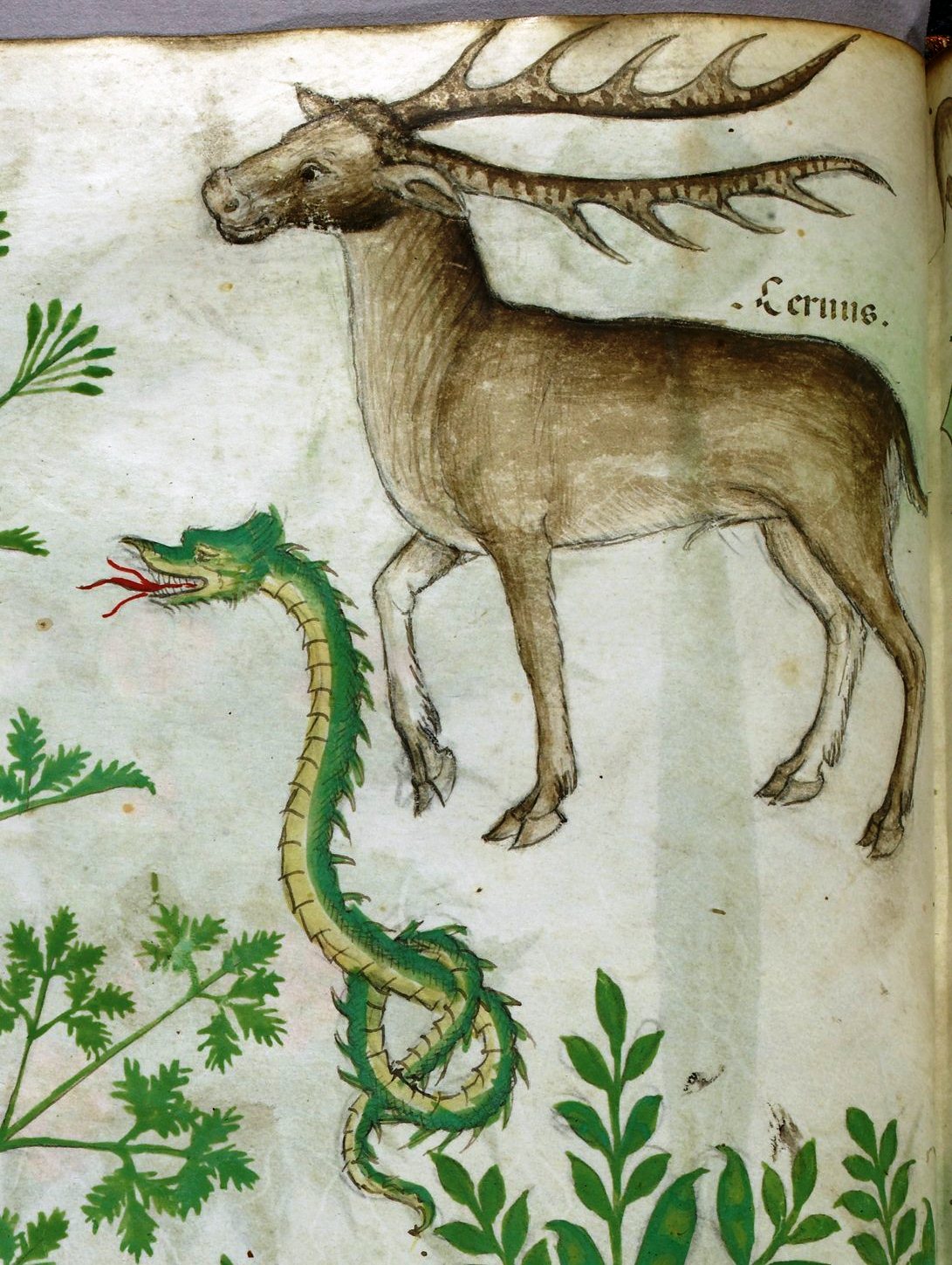
In addition to my chair duties, I am teaching one course this semester, a survey of English history from the Roman era through the Tudors.  This is a long period, and in order to add more depth to a course that is more characterized by breadth I’m going to bring quite a few illuminated manuscripts (digitally) into the classroom for my students to view and analyze.  While I was reacquainting myself with some of my favorites this past weekend (via the extraordinary resource that is the British Library’s digital catalog of illuminated manuscripts), I seemed to be seeing lots of deer in the margins, and stags in particular:  stags alone, stags as prey, stags with satyrs, stags with serpents (which they can apparently drive out of the ground) and stags parading with other animals. Stags appear not only in medieval bestiaries (encyclopedias of animals) but also in herbals (encyclopedias of plants) because the hardened cartilage of their hearts–os de cor de cervi–was used in medical preparations.

A selection of stags from the British Library Department of Manuscripts:  Arundel, Egerton, and Royal Mss., circa 1280-1490.

The image of the stag persists into the modern era in visual and material culture more as a symbol of majesty and the (receding) forest than a feature of everyday life.  There is the statuesque, noble stag, the leaping stag, and of course, the stag head–a hunting motif that has gained a more general popularity in the last decade or so.  I prefer my deer with their bodies attached, so here are a few favorite images from the collection of the Victoria & Albert Museum:  leaping deer on a  Meissen plate from the late 18th century, and Foxton furnishing fabric and a Susie Cooper figurine, both from the 1930s.  Cooper (1902-1995), the dominant ceramics designer of the twentieth century, loved the leaping deer motif so much that she used it as her company logo and trademark.

I use a lot of deer for my Christmas decorating, and as I’ve had neither the time or the inclination to do my typical January purge, there’s still quite a few stags around the house.  And I’ve had my eye on the Nico Masemula stag at Anthropologie for the last couple of months, now fortunately (for my wallet) sold out.


The other Ropes House

In my last post I showed pictures of the barren and brown (white this morning!) garden of the perfectly-preserved and well-protected Ropes Mansion in downtown Salem, but yesterday also brought sad news of another Ropes Mansion in Salem, presently in imminent danger of demolition.  This is the Ropes house in North Salem, which has belonged to another branch of that eminent Salem family (original seventeenth-century land grantees) since its construction in the later nineteenth century.

Here is the house and its outbuildings yesterday afternoon, before the dusting of snow that arrived last night.  The cupola-topped carriage house–also threatened–is particularly charming, so I took another photograph from the vantage point of a neighbor’s well-manicured lawn.

As many of the older houses in North Salem (Northfields) once were, the Ropes house is situated on a large lot with mature trees, including the magnificent copper beech you see above.  The wrap-around porch on the house evokes the earlier era of the “garden estate”, when prosperous Salem families established “rural” residences (both year-round and seasonal) across the North River from the busy city center.  The 1820 map below, drawn by Jonathan Saunders based on late eighteenth-century census materials, illustrates the relationship between North Salem and Salem proper in the nineteenth century–I placed a big star on the present location of the Ropes house.

Norman B. Leventhal Map Center at the Boston Public Library.

For as long as I’ve lived in Salem, everyone has had their eye on this house, coveting its graceful presence and large lot.  It remained in the Ropes family until this past fall, when it suddenly appeared on the market and sold relatively quickly despite the fact that the city of Salem had revoked an occupancy permit a while ago.  Now the present owners have put forward plans to demolish the buildings and build three houses on the lot, but perhaps save some of the trees.  These plans are now before the Historic Commission, so we’ll see what happens.


In Winter Gardens

Winters are great for assessing the “bones” of a garden, especially when you have no snow.  That’s certainly the case this year for New England:  lots of bones, no winter wonderland.  When I compare the glistening photographs from last year with those below, there’s obviously a stark difference, but there is also a certain kind of beauty in the stark brown landscape.

My garden looks pretty dreary except for a few bright spots captured on a 60-degree January day and the boxwood “balls” and germander border, which looks like it’s still alive (but is certainly not).  The brightest spot by far is the scarlet cardinal who spends a lot time back there, but I’ve given up trying to capture him on film.  The minute I pick up my camera, he flies away.

The Ropes Garden looks very bare, but if you’re not distracted by the flowers and colors you notice other things, like this amazing tree close to the house. I included a postcard from 1910 taken from the same vantage point, so you see the dramatic change, as well as a close-up of the texture of the tree.

A few more images of January gardens around Salem: on Warren, Beckford and Pickering Streets, in my general neighborhood, and across town at the historic herb garden behind the Derby House on Derby Street, on the grounds of the Salem Maritime National Historic Site.

Vincent van Gogh found beauty not only in sunflowers and blooming gardens but also in barren ones, as illustrated by his drawing from March, 1884:  Winter Garden (Van Gogh Museum, Amsterdam), one of several pen (black iron gall ink, now decayed–and decaying–into a sepia tone) drawings of the bleak landscape of Nuenen he made at that time.

For beautiful photographs of winter gardens–and gardens all year long and in many places–visit one of my favorite landscape (and travel!) blogs from across the Atlantic:  terrain.


Bits of Holly History

It occurred to me that holly–the traditional symbol of Christmas and Winter–is often paired with something and seldom presented on its own.  The “holly and the ivy” is the best example, but there are many others, like this stylized little image of holly and a lyre on the cover of a Christmas concert program from 1898.  I found the program in a dusty box of sheet music at a yard sale a couple of years ago, and opened it just the other day.

That same day I also checked in with the blog of the Met’s Cloisters Museum, The Medieval Garden Enclosed, to find the “holly girls” decorating the museum’s arches with holly.  So beautiful!  I have both interior and exterior arched doorways and several flourishing holly bushes–I wonder if I could do this next year?  Probably not, but at least I can think about it.

Holly is often pictured in the margins of medieval manuscripts (usually with ivy, its companion plant) and seems to have had many associations and virtues, all positive.  With its bright red berries blooming in December, it represents light, warmth and hope, joy and goodwill.  It has always been a protective plant:  against poisons and demons, even lightning.  With the coming of Christianity, it came to be associated both with the Virgin Mary and the blood (berries) of Christ.  In the early modern era, the holly tree was prominently linked with the ars nova of printing, notably on the title age of Leonhart Fuchs’ De historia stirpium commentarii insignes (“New Herbal”, 1542-43).  The title-page device of Basel printer Michael Isengrin features a holly tree with a printing-house platen amongst its branches,representing its increasing secular symbolism.

And here are two more holly herbal images from Elizabeth Blackwell’s Curious Herbal  (1739) and Francois Andre Michaux’s North American Sylva (1819).  Blackwell illustrated her own book, while Michaux called upon one of the most famous botanical illustrators of his day, Pierre Redoute.

In the nineteenth century, the holly becomes the stereotypical holiday plant through advances in lithography and the emergence of the dynamic greeting-card industry, which produced millions of holly-embellished holiday cards.  But there were other images of the plant out there too:  elaborate theatrical costumes, ceramics, cigarette cards.  The collection of the Victoria & Albert Museum encompasses a large collection of costumes from the London theater, including these two creations by “Wilhelm” (William Charles Pitcher) for productions in the 1890s:  Holly personified, with Mistletoe and alone.  From the same era and collection is the Minton “Four Season” tile, with holly representing winter.

And then there were so many cards: cigarette cards for advertising, Christmas and New Year’s cards for “greeting”.  The first card below, issued by the Duke’s cigarette company in the 1890s, is part of a “Language of Flowers” series, which associated holly with “foresight”.  The second and third are British and from the 1920s, illustrating the uses of the (hard) holly wood (chess sets and teapot handles, apparently) and the boy scout “holly patrol” badge.  How the holly has “evolved”:  from the blood of Christ to the boy scouts!

And finally two greeting cards, both from the vast collection at the New York Public Library Digital Gallery like the cigarette cards above:  a simple New Year’s Day card from the turn of the last century and a birthday card of similar vintage on which holly is paired with something I’ve never seen before:  turquoise?


Pine Cone Time

(Having spent more time than I have trying to determine whether “pinecone/ pine cone” is one word or two, I’m opting for two).  Along with the Christmas tree, there is no more omnipresent natural motif at Christmas time than the pine cone, which is rather ironic, given its decidedly pagan roots.  In classical mythology, the pine cone is most prominently featured on the thyrsus, the staff held by Dionysus and his bacchanalian cohorts.  The thyrsus is made from a stalk of fennel topped by a pine cone, representing the farm, the forest, and all sorts of fertility; in both classical and more modern imagery it is more representative of revelry than religion.

A.E. Becher, Bacchanal Scene (with pine cone-topped thyrsus leading the way, in left-hand corner),1903

With the coming of Christianity, the pine cone fades into the background as a natural motif and a way to bring some “life” indoors during the long winter.  I’ve seen pine cones in medieval manuscripts, but I think they become more apparent in early modern decorative arts.  Pine cone knobs are common features of eighteenth-century porcelain, like this beautiful coffee pot from the 1730s.  Fabrics and wallpapers also featured pine cones in the eighteenth and nineteenth century, as they do today.

Mulhouse Fabric, 1830s, Victoria and Albert Museum

Cotton Pine Cone fabric from the Whispering Pines Catalog.

Even if pedestrian pine cones don’t make it into the final product, they often served as objects of study for artists.  The two charming studies (made between 1950-75) by Samuel Chamberlain (also a brilliant photographer, whose Salem Interiors remains one of my favorite books) in the Smithsonian’s Archives of American Art illustrate his composition process.  The pine cone comes into its own in the recent drypoint by Jake Muirhead, from the Old Print Gallery.

Pine cones remain a popular element of seasonal decor because they’re so affordable (free!), accessible and flexible:  you can make ornaments, garlands, swags, topiaries, tablescapes, and wreaths out of pine cones, or just scatter them around.  And when the holidays are over and the glitter goes away, the pine cones can remain until the Spring, when more signs of life begin to appear.  Here are a few pine cone items that transcend holiday decor, and could (I think) be made at home (relatively) easily.

Pine cone garland from Anthropologie, map “pine cone” ornament from Turtles and Tails, and rustic pine cone mirror from Wisteria.