Tag Archives: Flora and Fauna

Church on Sunday; or, Lions and Tigers and Bears, oh my!

No, this is not a religious post, but rather a brief look at some of the works of the American artist and illustrator Frederick Stuart Church (1842-1924), not to be confused with his better-known, near-contemporary Frederic Edwin Church (1826-1900) of the Hudson River School and Olana fame.  During a brief dusting stint this weekend, I found myself admiring one of my F.S. Church etchings, bought in my early 20s, and it occurred to me that there are very few things I purchased over 20 years ago that I still like, must less admire.  This particular etching, entitled Hop-Frog, is not exactly representative of Church’s work as it is the accompanying illustration to a rather dark story by Edgar Allen Poe.  Nevertheless, it immediately charmed me then and continues to do so now.

Church was a Michigan-born artist who came to New York City in 1873 and seldom left afterwards. Over his long career he published more than a thousand illustrations in popular periodicals like Harper’s Weekly, Century Magazine, and Scribner’s, along with illustrations for several editions of classic children’s books like Aesop’s Fables  and Nathaniel Hawthorne’s Wonder Book for Boys and Girls.  From his Carnegie Hall studio, he ventured out to the Bronx Zoo, the Central Park Menagerie, and performances of Barnum and Bailey’s Circus, inspiration for the whimsical animals that adorn his etchings, prints, letters and notebooks.  My other two Church etchings are The Mermaid (with a seahorse) and Tiger and Bird (the former gazing longingly–but not hungrily–at the latter); these creatures appear often in his works, along with lions, bears (lots of polar bears), owls, and all manner of fauna—sometimes depicted anthropomorphically but always fancifully.


The Lion in Love, 1883. Harvard University Museums

Church’s whimsy is continued in the twentieth century, and in his paintings, including my favorite Tiger Having Eaten the Professor (1905) and the popular Rites of Spring (1908) with its dancing polar bears.

Animals appear in nearly all his works, and Church himself wrote a reflective piece in Scribner’s Magazine entitled “An Artist among Animals” (1893), but there is also a strong feminine presence in his art, though his romantic young women are generally interacting with members of the animal kingdom.  You can see Church’s sylphs above, and below, in print and painting versions of  The Witch’s Daughter (1881, Library of Congress and Smithsonian Institution of American Art), as well as in The Dreamers, Girl with Rabbits (etching and watercolor, both 1886, Smithsonian Institution), and another one of my favorites, The Mirror (1891).

The Mirror (1891, 1898 Print), New York Public Library Digital Gallery.

Over his lifetime, Church seems to have bridged the gap between the fine arts and the commercial arts quite gracefully.  He had his artist friends (including William Merritt Chase, who painted his portrait), and his prominent patrons (to whom he wrote illustrated letters) but also steady publishing work.  He was that rare creature:  a popular artist.  As I began with a Church illustration of a Poe composition, so I will end:  with The Devil in the Belfry, the title page to Volume IV of the collected Works of Edgar Allen Poe, published in 1884 by A.C. Armstrong & Sons.


Best Bats

Even though I don’t jump on the Halloween train here in Salem, I do decorate my house for the season.  I can’t help it; I am an habitual holiday decorator.  And I generally invite people over for Halloween night, not because I want to celebrate, but because I want them to hand out the bags of candy for the hours that it takes to appease the hordes of trick-or-treaters here in Salem while I hang out in the back.  So I like the house to look festive.  My fall decorating theme of the past few years—lots of owls everywhere—has become far too common so this year it’s all about bats.  Unlike most people, I don’t find bats even remotely scary or icky.  To me, they look cute and interesting and unique—a mammal that flies!  So I’m enjoying the various bats around the house; I may even keep them around until Christmas.

My decorating approach is both historically crafty  and acquisitive;  I look for historic images that I might be able do reproduce somehow—cards, garlands, decoupage–and I shop.  Since Etsy has been around I’ve done less and less crafting and more and more buying!  There are lots of digitized historic images of bats available, from the medieval bestiaries, early modern natural histories and nineteenth-century encyclopedias.  Here are some of my favorites, in chronological order.

Pierpont Morgan Library MSS 0081 (circa 1185) and 175 (circa 1500):  two hanging bats and a hybrid man (king?)-bat:

Seemingly very modern, but actually from the seventeenth century, is the Spanish artist Jusepe de Ribera’s Studies of Two Ears and a Bat from the collection of the Metropolitan Museum of Art.  Its motto:  Fulget Semper Virtus (Virtue Shines Forever).

But it’s in the next century that we get the best bats:  the bats of the Georges-Louis Leclerc, Comte de Buffon (1707-88.  Buffon’s pioneering and lavishly-illustrated (by French illustrator Jacques de Seve) 36-volume Natural History:  General and Particular (1749-88) contains illustrations of all sorts of bats, from long-eared to vampire (first named by Buffon), and as it was a reprinted frequently over the next century-and-a-half  it is a treasure trove for hunters of antique animal images.  Here are some of my favorite Buffon bats from the 1753-54 volumes of the Natural History, via the University of  Strasbourg:

A variety of bats from the 1799 edition of Buffon’s Natural History:


The Etsy seller antiqueprintstore has digitized images of bats from an 1831 edition of Buffon for sale; their postcard-sized prints can be used in a variety of ways.  I post them up on my parlor mirrors, along with the usual seasonal paraphernalia.

Tuesday Addendum:  I wanted to add this great 1919 Salem postcard, generously forwarded to me by the Salem native, author, collector, and researcher extraordinaire Nelson DionneI love it!


Ivy House

Just a quick post today: a stately brick house in the winter, on a street not far from Salem Common, becomes a lively ivy house in the summer.


White Hydrangeas

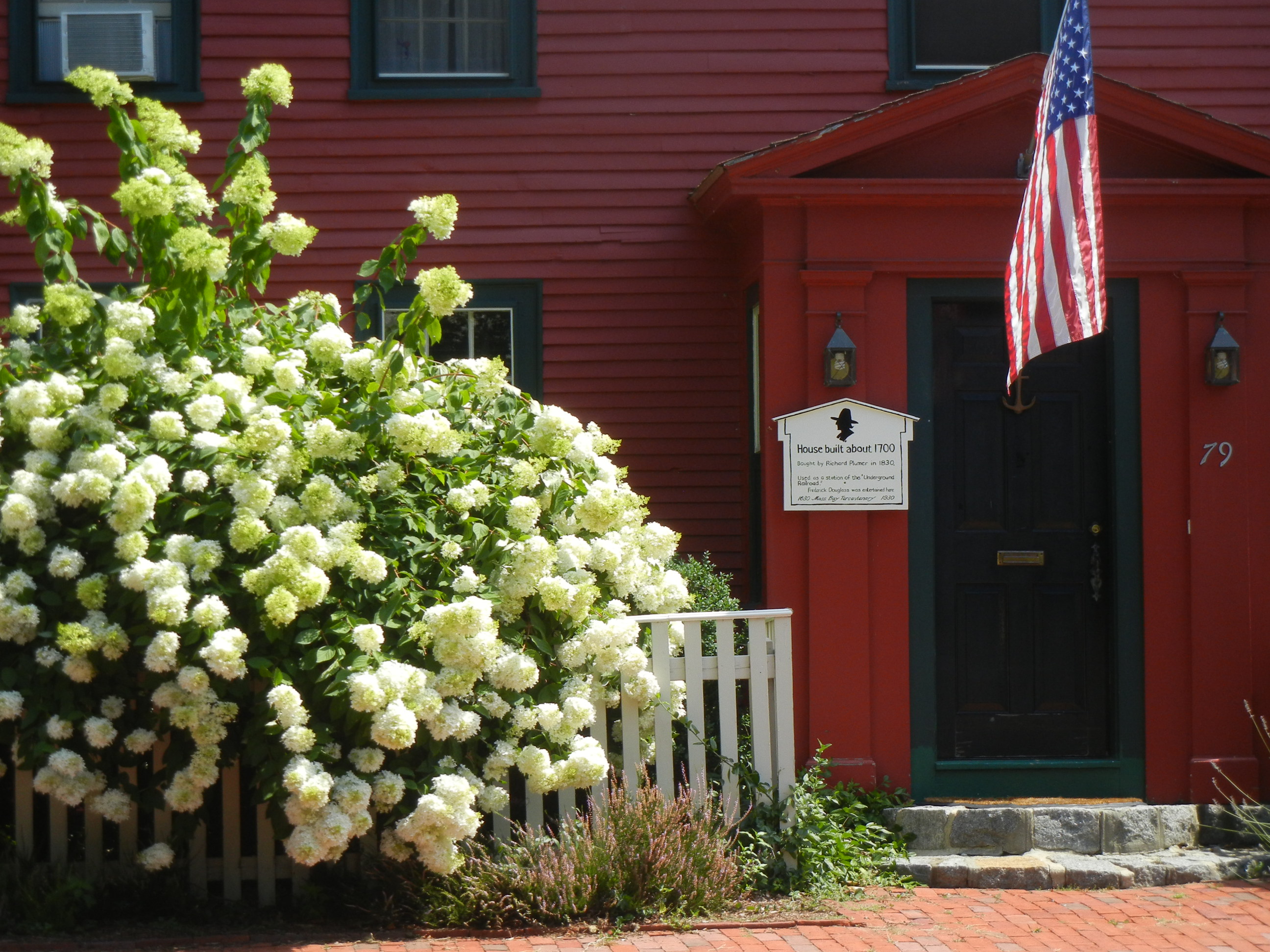
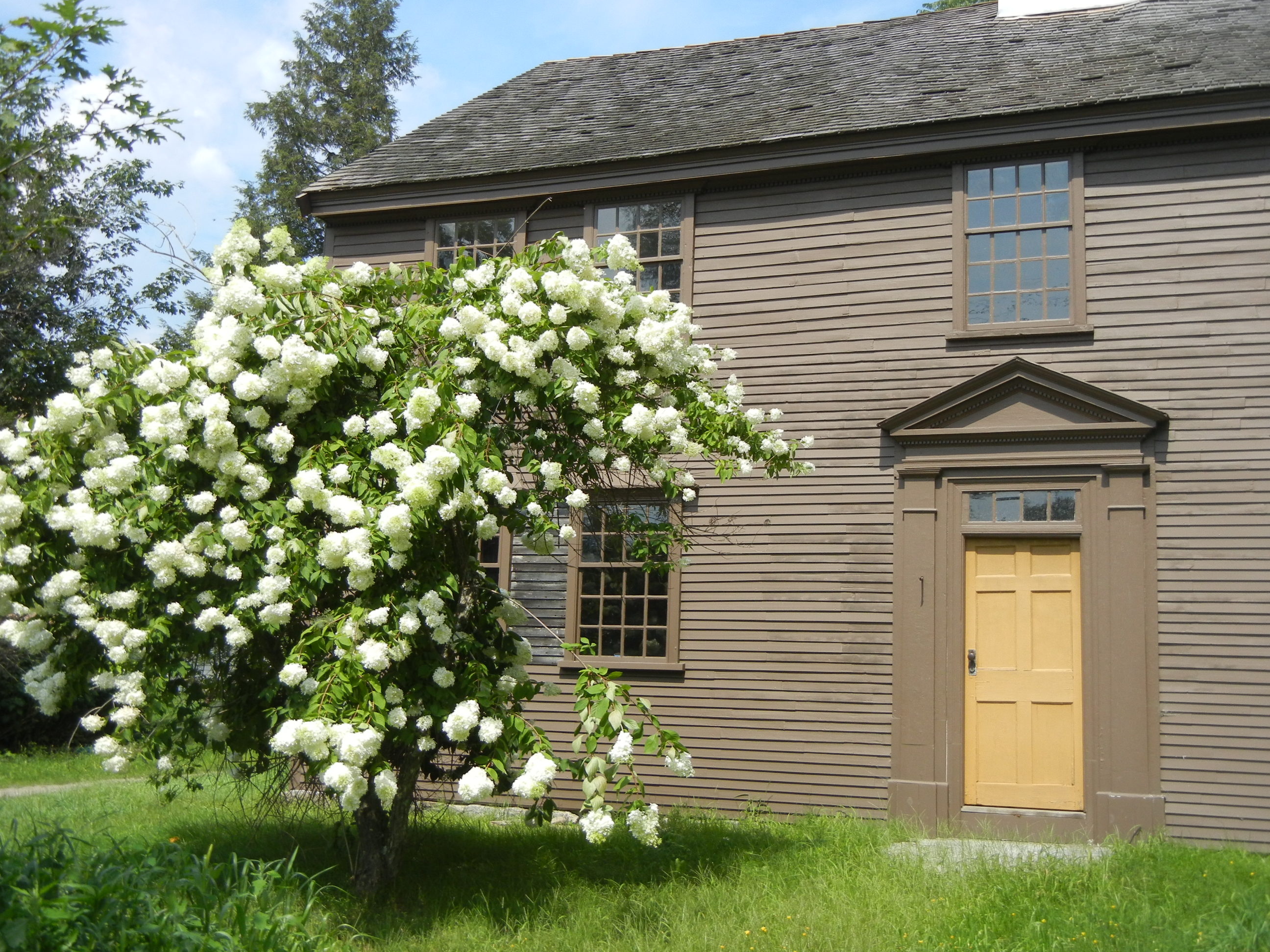
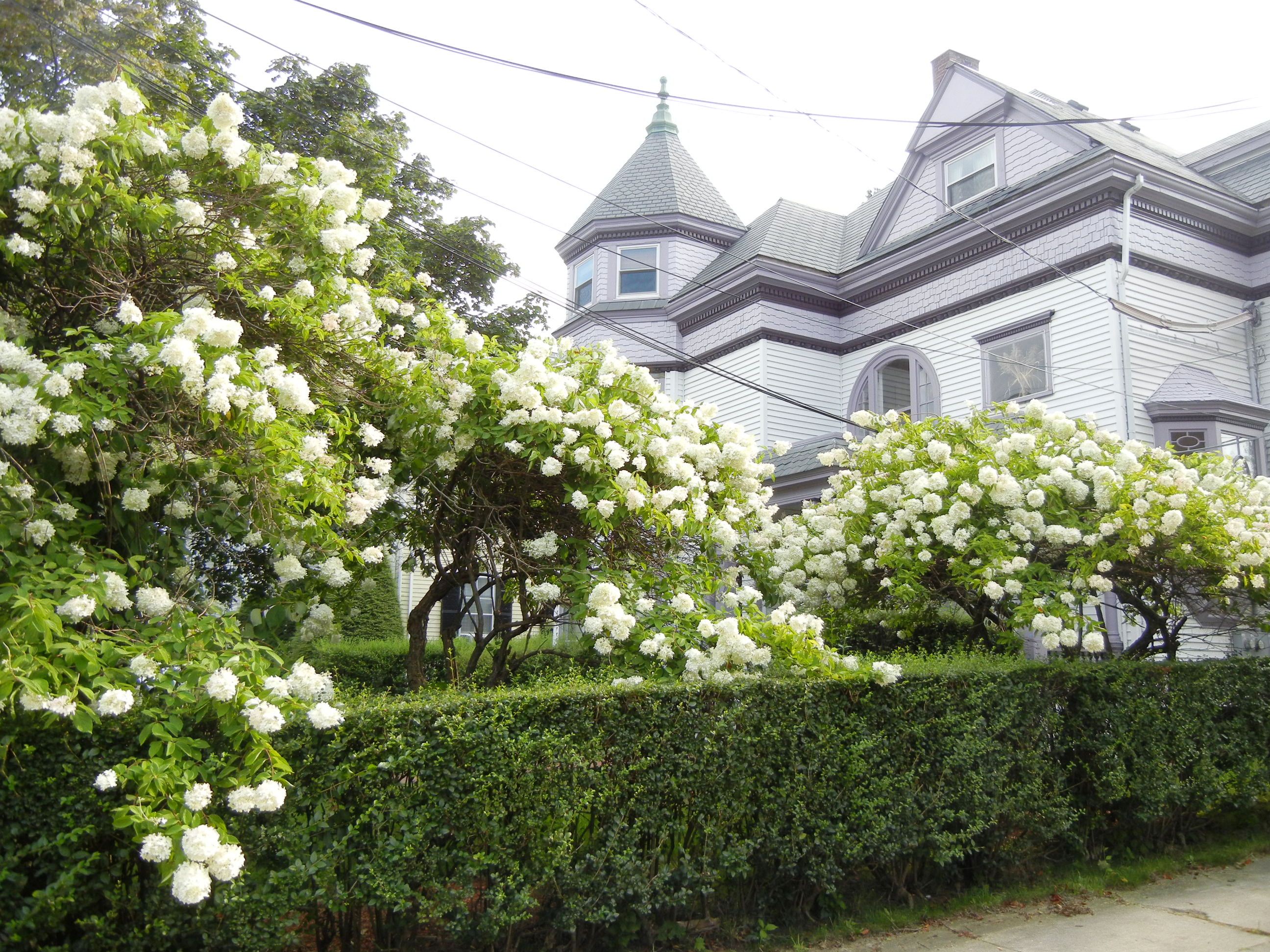
It’s been an endless summer of blue hydrangeas; I prefer white myself, although I’m not much of a hydrangea fan, I must admit. They’re a bit too ostentatious, conspicuous, fluffy, Victorian, much for me.  They don’t have a particularly interesting history, they’re not very practical, and they don’t really belong in colonial gardens. They seem to be much more of a colonial revival plant than a colonial one.  I have this silly rule in my head that hydrangeas, even blue hydrangeas, are fine for coastal shingle cottages (probably because I grew up in one) but that clapboard houses in old towns, large and small, must do without or at the very least have white hydrangeas.

Despite my disdain for the blue, I couldn’t help but be impressed by the blue hydrangeas at my parents’ house in York Harbor this summer; the bush below, which appears to be producing two varieties of blooms, is in fact (of course) two conjoined plants.  As you can see, the more violet of the two blooms are HUGE.

Impressive, but still blue.  Back in Massachusetts, I tried to capture some white hydrangea shrubs/trees that impressed me, many of them apparently quite old.  I do like hydrangeas that spill over fences, like the first two photographs below, the first taken in Newburyport, the second in Salem.

I also like the older shrubs that have turned into little trees, as illustrated by photographs of a Concord house along route 2A and Lafayette Street in Salem.

Two century-old photographs for some historical context:  the first is a Detroit Publishing Company postcard entitled California Hydrangea, the second, by the pioneering Canadian-American photographer Jessie Tarbox Beals, is a portrait of Kate Douglas Wiggin (author of Rebecca of Sunnybrook Farm and other children’s books) on the white hydrangea-bordered steps of her Maine house in the first decade of the twentieth century (Schlesinger Library, Harvard University).


Late July, Downtown Salem

For the last weekend in July, a few photographs taken during a leisurely stroll downtown on an absolutely beautiful day; the heat had broken and everyone was out and about, thankful to be out of their air-conditioner-enforced seclusion.  I started on Front Street, where there are so many great shops, and then made my way towards the House of the Seven Gables off Derby Street and then back to the McIntire Historic District along Essex Street.  It was not supposed to be an architectural excursion, it was supposed to be a day for flower boxes and streets scenes, but (as usual, in Salem) I couldn’t help myself.

Front Street window boxes, and fabric topiaries in the window of MarketPlace Quilts.

Work on one of the gables at the House of the Seven Gables, a much-photographed entrance with its summer louvered door, two window boxes on Turner Street (I like the nautical ropes supporting the second one), and one of my favorite houses, a Greek Revival cottage across from the Gables which looks like it has its own adjacent summer house.

Speaking of summer houses, the ultimate:  the Samuel McIntire-designed Derby-Beebe summer house in the center of the Peabody Essex Museum campus.  Amazing McIntire detail lavished on single-room seasonal  structure!  I was trying to be creative with the last shot and capture three windows, but I got a car and the house across the street as well.  The other McIntire/Derby summer house, larger and even more ornate, was originally situated at Elias Hasket Derby’s farm on Lafayette Street and moved to Glen Magna Farm in nearby Danvers in 1901.

Random scenes on and around Essex Street:  a very patriotic window and a very classical border, a Salem pedicab(by) takes a break, lunch in the Japanese garden of the Peabody Essex Museum. 


Midsummer Garden

Early to mid-July is about peak time in my garden, though over the years I’ve tried my best to make it as attractive as possible all summer long and into the Fall.  The garden has been shaped much more by my preference for individual plants rather than overall design, however, and several plants are pretty dominant right now.  Several cases in point:  the huge hosta which was here before me, and really thrives in its shady location in the back (sorry, I don’t know the varietal; if anyone does, I’d appreciate it), the double meadowsweet (filipendula ulmaria flora plena) that I purchased bareroot from Perennial Pleasures Nursery up in Vermont only three years ago, and the red baneberry (actaea rubra)  in the side garden along Hamilton Hall.  The last plant has a nice fluffy white flower in the spring, which turns into these bright red (poisonous!) berries that last all summer long.


There are so many plants–probably far too many plants–in my garden that I’m particularly grateful at this time of year for those that just exist looking lovely without any need of tending.  In my opinion, the best low maintenance plant of all time is this shiny European ginger (Asarum europaeum) groundcover that thrives in the shade.

The last of the June roses; they’re definitely on a midsummer break now but come back with a vengeance in August (IF I take care of them properly):


Lady’s Mantle, Roses and Rue

My garden is more plant-based than design-oriented, and I generally choose plants for their interesting historical associations rather than their appearance.  This doesn’t mean that if a plant is really ugly I won’t yank it out–despite its historical relevance (take that, horehound); I have some aesthetic sensibilities.  Three attractive plants that are in full flower now and have been used in all sorts of interesting ways in the past are Lady’s Mantle, roses, and rue.

Lady’s Mantle (alchemilla mollis or vulgaris) is a really common, self-seeding plant which some gardeners perceive as a weed, but I love everything about it:  its large and soft gray-green leaves and chartreuse flowers, its neat habit, and its history.  It forms a nice border in the shade garden pretty quickly, and blends in nicely with lots of other plants.  Here are some views of one of my shade borders, comprised of lots of Lady’s Mantle, sweet cicely,white baneberry, astilbe, and daylillies.

Like most herbs, Lady’s Mantle had lots of medicinal uses in the pre-modern past, but its Latin name, alchemilla, represents the role it played in alchemy, which moved out of the secretive laboratory and into the garden in the sixteenth century.  The water preserved on its velvety leaves was used for alchemical distillations, which amplified the healing powers of plants.  The common name denotes a multi-layered feminine association:  the “Lady” refers to the Virgin Mary (not just any lady!), the “mantle” to an women’s cloak, and (in the words of Nicholas Culpeper, a seventeenth-century physician and author of The Complete Herbal), “Venus claims the herb as her own”, meaning that it had long been perceived as a cure-all for the full range of “women’s problems”.

The Alchemical Garden. Theseaurus of Alchemy, 1734, Wellcome Library, London

Lady's Mantle illustration from Otto Brunfels' Herbarium, c. 1530

In addition to its aesthetic virtues, the rose was also used in both medicinal and cosmetic (as well as culinary) preparations in the medieval and early modern eras.  I can’t tell you how many rosewater recipes I’ve come across from the sixteenth and seventeenth centuries.  For some reason, I’ve never been able to find the rose variety that was prized the most for its medicinal properties in this era, the Rosa Gallica Officinalis (also called the “Apothecary’s Rose”).  Instead, I just have really pretty, dependable David Austin roses.  Though I generally refrain from showy plants in the garden, this orange rose bush (whose name I can’t remember), blooms all summer long.

Symphorien Champier, Rosa Gallica, Paris 1514. Wellcome Library, London

Rue (Ruta Graveolens or “Herb of Grace”) was perceived as an extremely important plant before 1800 largely because of its role as a “counter poison” against the plague.  To quote Nicholas Culpeper again, rue “causes all venomous things to become harmless”; it was pretty powerful stuff.  It’s neat to have in a plague cure in your garden, but I love rue because it’s so beautiful, with the same soft colors as Lady’s Mantle:  silvery gray leaves, yellow-chartreuse flowers.  It’s a willowy shrub, that can work in lots of (sunny) places.  Here’s rue, along with lots of other herbs (skullcap, avens, dill, flax, calamint) at the front of my sunny perennial border, and in a fourteenth-century herbal.  The attendant snake is meant to accentuate the plant’s anti-venomous virtues.

British Library MS Egerton 747

I wanted to sneak one more shot of the shade border here from the other perspective, but somehow how an orange kayak snuck in here!


Streets of St. George

We just returned from a quick visit to Bermuda, where we spent most of our time at the eastern end of the archipelago in the town of St. George and its environs.  The English first settled this part of Bermuda in the early seventeenth century, after a shipwreck in 1609 established its potential as a way station en route to Virginia.  Paradoxically, both Bermuda’s strategic location and its relative remoteness seem to be central factors in its history.

St. George is named after Sir George Somers (1554-1610) and the archipelago was briefly referred to as the Somers Isles.  Somers had been an admiral in the ongoing Anglo-Spanish wars and was working for the Virginia Company in charge of a fleet sent to aid the struggling and starving Jamestown Colony when his ship the Sea Venture  foundered on the rocks of Discovery Bay.  Somers and his fellow castaways, about 150 people (and a dog), remained onshore for 10 months, during which they built two ships and several buildings which established the town of St. George and the colony of Bermuda.  After proceeding to the mainland to complete his mission and replenish Jamestown, Somers returned to Bermuda where he promptly died, apparently leaving instructions to bury his heart on his island and return his (pickled) body to England.  The Somers saga might have been one of the inspirations for Shakespeare’s contemporary play The Tempest, in which the hypothetical island setting is called the “Bermoothes”.  Below is Somers’ portrait, from about 1605 by an anonymous Dutch painter, which I have always admired not so much for its technique but for its projection; Somers seems like such a forthright man of the moment, a real maritime adventurer with no aristocratic airs.


And now for some of my views of St. George:  a storm coming into the harbor, steps along Somers Wharf, some street scenes and St. Peter’s Church, the oldest Anglican church in North America.

Some fauna and flora:  cats on a scooter, a chameleon-like lizard, a chartreuse plant whose name I do not know, and rosemary in the seventeenth-century garden of the Bermuda Perfumery:

And finally, the “Unfinished Church” at twilight, Fort St. Catherine and its beach, and a “Bermuda sloop” in an 1831 painting by John Lynn and off the fort on Sunday.


Lady Slippers

It is an exciting week in the garden as the Lady Slippers have made their appearance.  About a decade ago my friend Rebecca, who was helping me set up my garden and teaching me how to garden at the same time, purchased a single slipper (Cypripedium calceolus) at the annual plant auction at Garden in the Woods in Framingham, Massachusetts for the princely sum of $90.00, if I remember correctly (which was about a third of my garden budget for the whole summer).  Now I have SEVEN lady slippers!  With apologies for my lackluster plant photography, here they are, in context and close-up.

As a bonus here is an illustration of a Cypripedium from James Sowerby’s 36-volume English Botany (1790).  While wildly plentiful in Sowerby’s time, yellow lady slippers have been endangered in Britain until just recently.


Cats Modern and Medieval

Since the weather has turned so dramatically summer-like over the past week, I’ve spent a lot of time in the garden, generally accompanied by a cat or two.  My own cats, Darcy and Moneypenny, are primarily indoor cats, but our garden is pretty sheltered so I let them out in the summer and they hang out there.  They have lots of company, as cats like our garden for the following reasons:  1) I have used catnip very liberally as a border plant; 2) our garden serves as a cat “highway” to the park across the street, and; 3) we are one of the few households on the street which doesn’t have a dog.  So there is generally a cat or two back there, particularly on sunny days.  Below is my big tabby Darcy lying on the deck, Moneypenny lying on the bricks, and my neighbors’ cat (Lord of the Garden and King of the Street) surveying his domain.

When I compare these modern cats to their medieval predecessors, it occurs to me that this is an animal that has drastically improved its standard of living over the centuries.  Medieval cats were clearly not pets, and they did not just lie around in the sun; they had working lives.  Looking at the images in medieval bestiaries from the 12th, 13th and 14th centuries in the manuscript collections of the British Library, the Bodliean Library, and the Getty and Morgan libraries, it is clear that while dogs served as companions (as well as hunters), cats existed solely to kill mice and rats.

A leashed companion and working cats, all from the British Library digital catalogue of illuminated manuscripts:

From the Northumberland Bestiary (mid-12th century) at the J. Paul Getty Museum:

A trio of cats from the Aberdeen Bestiary(c. 1200) at the University of Aberdeen is below, which is accompanied by this great caption:

The cat is called musio, mouse-catcher, because it is the enemy of mice. It is commonly called catus, cat, from captura, the act of catching. Others say it gets the name from capto, because it catches mice with its sharp eyes. For it has such piercing sight that it overcomes the dark of night with the gleam of light from its eyes. As a result, the Greek word catus means sharp, or cunning.

Only occasionally (generally in the marginalia of the manuscripts) are cats given a break from catching:  here we have two musical cats (one playing, one listening) and one (inexplicably) encased in a snail shell.