Tag Archives: Etsy

Streets of Boston

Like everyone else, I was thinking about Boston a lot yesterday and as it was a non-teaching day I was very vulnerable to the drip drip of media “updates” while at home. So I turned off everything and looked through some books about Boston:  its history, its architecture, its culture. Much better! Then I began assembling some of my favorite images and impressions of the city, and as that seemed like a somewhat productive enterprise I began to feel even better. So what I have today is a very random sample of my “collection”, including old favorites, new discoveries, and images of past and near-present. Boston is a dynamic city which has experienced a lot of change in the past few decades, but when I look at these images I still see a recognizable city, with the exception of the harbor views–visual reminders that Boston’s first and foremost identity for several centuries was that of a port. Paul Revere would draw on these prints a few decades later for his pre-revolutionary depiction of the occupation of Boston by British ships.

PicMonkey Collage with border

Two James Turner etchings of Boston’s wharves in the mid-eighteenth century from The American Magazine (Boston: Rogers and Fowle, 1743-46) and a hand-colored etching by John Carwitham of “A South East View of the Great Town of Boston in New England in America” (London: c. 1730-60), American Antiquarian Society, Worcester.

A century later, it’s more about the streets of Boston, the emerging “hub of the universe” and “Athens of America”. The mid- to late-nineteenth century were heady days for Boston, which of course had left Salem in the dust. During my hunt yesterday, I was particularly surprised to find that my favorite British pioneering photographer, Francis Frith, had included several images of Boston in his “Universal Series”. Artworks of varying mediums–watercolor, oil, another photograph–to depict other city scenes at around the same time.

Boston Francis Frith

Boston Frish State house

Boston Benjamin Champney 1851

Boston Railraod Jubilee on Boston Common William Sharp 1851

Boston Tremont Street 1860

Francis Frith photographs of Boston Common and the Massachusetts State House, 1850s, Victoria & Albert Museum, London; Benjamin Champney, Washington Street, Boston, 1850, Princeton University Graphic Arts Department; William Sharp, Railroad Jubilee on Boston Common, 1851, Museum of Fine Arts, Boston; Tremont Street, 1860, Halliday Historic Photograph Company, New York Public Library Digital Gallery.

And then there are the novel views of the city, created by creative and entrepreneurial publishers, cartographers, and balloonists! The nineteenth century loved the “big picture”.

Boston Balloon View 1860

Boston Birds Eye Triptych

James Black, Boston, as the Eagle and Wild Goose See It”, 1860, Metropolitan Museum of Art; a Birds Eye View of Boston Triptych, 1903, ArtHouseGraffiti.

Of the later nineteenth- and early twentieth-century “Boston painters’, I think Arthur Clifton Goodwin was particularly adept at capturing Boston streetscapes in his impressionistic way. There are lots of Goodwin paintings to choose from (in auction archives and the collection of the Museum of Fine Arts, Boston, which gave him his own posthumous show in the 1970s), but I went with Copley Square (1908). Of course I had to include a painting from his fellow Boston Impressionist, the more well-known Childe Hassam, so I went for Mount Vernon Street (1919) one of the most beautiful, and reproduced, streets of Boston. Jump forward thirty years, and you’re looking at “old” Beacon Hill with the financial district rising above it from across the Charles River in Cambridge in an amazing (oil!) painting by Thomas Adrian Fransioli. I love the “modern” look of this painting, although I believe that Fransioli is referencing the present, the past, and the future. Boston looks like the “shining city on the hill” that it has always been.

Boston Copley Square 1908 Arthur Clifton Goodwin MFA

Boston Mt Vernon Street Childe Hassam 1919 Christies

Boston Beadon Hill Fransioli 1947 MFA

Arthur Clifton Goodwin, Copley Square, London , 1908, Museum of Fine Arts, Boston; Childe Hassam, Mount Vernon Street, Christies; Thomas Adrian Fransioli, Beacon Hill, 1947, Museum of Fine Arts, Boston.


Fool’s Parsley

My scholarly, botanical and materialistic interests intersected the other day when I came across a beautiful Arts and Crafts wallpaper print by Charles Francis Annesley Voysey named “Fool’s Parsley”, first produced in 1907. Even though it’s not really appropriate for my 1820s house, I love art nouveau and Arts and Crafts wallpapers in general, and Voysey’s designs in particular. The more I looked at the design, the more it reminded me of Sweet Cicely, one of my favorite plants in the garden, and so it was no surprise to learn that these two plants are in the same family. Though they have a very similar appearance, these herbs have very different natures:  while Sweet Cicely “is so harmless you cannot use it amiss” according to the old herbalists, Fool’s Parsley is very, very poisonous. Beauty can be deceiving.

Fool's Parsely Voysey 1907 V and A

Fool's Parsley 1856 Herbal

L0013947 L. Fuchs, De historia stirpium commentarii

“Fool’s Parsley”, or Aethusa cynapium, in a 1907 wallpaper pattern by Charles Voysey, Victoria & Albert Museum, London and 1856 and 1542 herbals by Constantin von Ettingshausen and Leonhart Fuchs, respectively, Wellcome Library, London.

Fool’s Parsley is often called “Lesser Hemlock” in herbals from the Renaissance onwards, emphasizing its Socratic connection and toxic qualities rather than the evergreen tree. Along with Sweet Cicely, it belongs to the large Umbelliferae plant family, named for and distinguished by its lacy, umbrella-like flowers and including such beneficial vegetables and herbs as carrots, celery, dill, chervil, parsnips, and, of course, parsley. Besides the deprecating designation, there are many stories and anecdotes of poor fools who mistook the poisonous parsley for the passive one and ended up with severe nausea, headaches, and worse. But for CFA Voysey, this lethal plant was as beautiful as a rose, and by all accounts, his very best birds embellish the design.

PicMonkey Collage

Fools Parsley 1893

Trustworth Studios has reproduced Voysey’s design in light and dark colorways; Fool’s Parsley page from an 1893 German herbal, Etsy seller CabinetOfTreasures.


Tea with White Rabbits

For a little tea party I was giving, I decided to go with an Alice’s Adventures in Wonderland theme, as I have quite a few of the necessary characters, including many white rabbits, who could do double duty for Easter. I looked around the web for some inspiration, found some cute cards on Etsy, and bought lots of flowers in an attempt to bring Spring indoors (because it is still not outdoors). Every time I entertain, I spend far more time cleaning and decorating than I do cooking, which I imagine must be somewhat disappointing to my guests. But I don’t think the expectations are really that high for tea (at least my tea) and I did make some really delicious little sandwiches out of a cream cheese, hot pepper jelly, and pecan mixture (on Pepperidge Farm white bread, of course) if I do say so myself. No one was late!

Tea 8

Tea 2

Tea 4

Tea 5

I LOVE anemones, indoors and out.

Tea 7

Tea 10

Tea 051


Reynard the Fox

That fox pulling the papal tiara off Celestine V’s head in my last post reminded me of Reynard the Fox, a very popular medieval fable which developed in the later twelfth and thirteen centuries in France and Germany, from where it spread throughout western Europe:  the many “branches” of Reynard verse are generally grouped together as the Roman de Renart cycle. Reynard is an anthropomorphic fox who is always up to no good, a cunning trickster whose escapades are both entertaining and illuminating. He is the animal representative of the medieval outlaw, far less benevolent than Robin Hood, and utilized by medieval scribes (who were of course, monks) as a form of satirical and whimsical criticism.  But Reynard is also a fox, and like all sly foxes, quite capable of feigning vulnerability (and piety) in order to elude capture and capture his next meal. One of the most common images in medieval manuscripts is of Reynard preaching, to an audience of birds whom he intends to eat.

Royal 10 E.IV, f.49v

Fox Preaching Stowe

British Library MS  Royal 10 E IV, late 13th/early 14th century, and MS Stowe 17, “The Maastricht Hours”, early 14th century.

In every Reynard tale, the fox is summoned before a court of his animal peers, headed by a lion, of course, and called to task for his bad behavior. He always manages to outfox his judges by his cunning. He feigns remorse, confesses his sins, and sets off on a holy pilgrimage of atonement, only to get into more trouble. A death sentence leads to more displays of cunning, exploits and opportunities, and consequently he becomes the sympathetic “hero”, the one for whom we root.

Reynard the Fox Bod MS Douce 360

Reynard Bod Ms Douce Reynard Dead

Reynard as a “pious” pilgrim and on the cart of a fishmonger who has presumed him dead–meanwhile, the fox is working his way through the stock of fish:  Bodleian MS Douce 360, “The Romance of Reynard and Isengrin”, 1339.

I definitely think Reynard’s popularity increased in the late medieval era along with anticlericalism and lay piety, and he makes it into print relatively early. In England, William Caxton published his own translation in 1481, and the “history” was reprinted regularly in the sixteenth and seventeenth centuries. There followed all sorts of literary adaptations, as Reynard, like any outlaw, is readily adaptable. The most famous modern adaptation is Reneike Fuchs, an epic poem produced by Johann Wolfgang von Geothe in 1794, supposedly influenced by the events of the French Revolution. The editions of this text issued from the mid-nineteenth century, illustrated by Wilhelm von Kaulbach and Joseph Wolfe, must have been extremely popular as they were constantly in print. There were also a succession of children’s versions of the fable issued in the nineteenth century, and really beautiful artistic editions published by William Morris’s Kelmscott Press in 1892 (a reprint of Caxton) and the Insel Verlag Press in 1913.

V0023068EL A fox in a monk's habit is apparently deeply engrossed in pr

Reynard the Pilgrim

Reynard Kelmscott Press 1892

Reinke Voss 1913

Reynard posing as a monk in order to access the chicken coop of a monastery, and as a pilgrim being blessed by a ram-priest, Wolfe and von Klaubach illustrations from 1853 & 1846; first page of the Kelmscott Press Caxton edition, 1892; Cover of first edition of Reinke Voss, 1913.

Reynard lives on in a variety of forms and formats in the twentieth century, and today can be found on everything from pillows to china to chess sets. He seems to have shed a lot of the satirical and moralistic messages of his medieval origins, but he was never that moral a character to begin with so I guess it doesn’t matter!

Reynard the Fox Coffee Service

Reynard the Fox Etsy

Two Reynards that I covet:  a Royal Doulton coffee service from 1935, and pencil illustration of Reynard the Fox Detective.


Presidential Plates

Because I dislike Presidents Day so much (because of its ahistorical morphing of all the presidents together, thus denying their individual achievements, as well as the fact that it never seems to occur on the actual date of either Washington’s or Lincoln’s birthdays, the particular presidents it claims to commemorate), I’m going to downplay the historical and emphasize the material today with a very brief examination of Presidential china. The morphing of presidents is a very popular pastime today (see this viral video), but I prefer not to morph.

I spent (another) snowy afternoon looking through two books (Official White House China by Margaret Brown Klapthor and Susan Gray Detweiler’s American Presidential China. The Robert L. McNeil, Jr., Collection at the Philadelphia Museum of Art) and accessing two online sources (the White House Historical Association’s “Picturing the President’s House” digital series (so well done!) and the McNeil Americana Collection at the Philadelphia Museum of Art) and quickly formed an impression of presidential plates:  those from the first century of the presidency are far more aesthetically pleasing and interesting than those from the second.  Twentieth-century presidential china is, for the most part, boring.

Here are some of the early presidential plates, starting with that of the Washingtons, a gift to Martha from Dutch East India trader Andreas Everardus van Braam Houckgeest, who commissioned the design in Canton, China. I love the chain of 15 states, the state of the union in 1796. The service commissioned by James and Elizabeth Monroe from the French firm of Dagoty-Honoré is considered the first official White House china because of its patriotic motif:  surrounding the eagle are five vignettes depicting Strength, Agriculture, Commerce, Art, and Science, the foundations of the new nation. Successive presidents apparently used the large Monroe service (400+ pieces) for big state dinners but also brought their own china into the White House for daily use:  Mr. and Mrs. John Quincy Adams used this neoclassical service (with seahorse motifs), likely manufactured by the La Courtille Factory in Paris and purchased during Mr. Adams’ earlier diplomatic service in Europe, during their time in office.

Presidential China Plate

Presidential China Monroe

Presidential China Adams

Porcelain plates used during the Washington, Monroe, and Adams administrations, McNeil Americana Collection, Philadelphia Museum of Art.

There is no doubt that the star of early presidential china was the set purchased by James and Dolley Madison from the Nast Factory in Paris:  an absolutely stunning (and modern!) design featuring wheels, of all motifs. It seems to be very sought after; at first I thought this was because of its relative rarity, given the fact that the Madison White House was burned down by the British in 1814.  But it seems like most of the service survived (did Dolley sneak it out in the last hours, along with that great portrait of George Washington?), so I think its value must be based on the unusual design. I love it, and am even tempted to buy a copy–nearly every presidential library’s shop, including the JFK Library here in Massachusetts, seems to offer reproduction presidential china produced by Woodmere.

Presidential China Madison

Presidential China Madison 2

Presidential China Madison Nast Dessert Cooler 1804

The Madison China, purchased c. 1806 from the Nast Factory in Paris.  Plate and sauce boat, Philadelphia Museum of Art; dessert cooler, White House Historical Association.

The Lincoln “Royal Purple” china, pictured below on the cover of Detweiler’s book, was certainly expensive, like most of Mary Todd Lincoln’s White House “improvements”, but it seems to have stood the test of time and was supplemented and complemented by later sets. The scalloped shape set it apart from its predecessors, and like all White House china commissioned before 1918, it was made in France, by Haviland.

American Presidential China

In terms of their china choices, the two most innovative, or nationalistic (as well as naturalistic), first ladies were Lucy Webb Hayes and Caroline Harrison. Quite by chance, Mrs. Hayes met an artist and reporter for Harper’s Weekly named Theodore R. Davis who convinced her to use native American flora and fauna in the design of a new White House service in 1880; the end result, designed by Davis in collaboration with the Haviland Factory in Limoges, France, was a rather dramatic departure from the traditional styles of the mid-nineteenth century.  A decade later, Mrs. Harrison incorporated the naturalistic theme in her own design, but also paid tribute to tradition with the eagle and stars, and to Mrs. Lincoln’s plates with the  scalloped edge.

Presidential China Hayes Soup Plate 1880

Presidential China Rutherford B Hayes 1880 Haviland

Presidential China Harrison

Soup plate and serving platter from the administration of Rutherford B. Hayes, designed by Theodore R. Davis in collaboration with the Haviland Factory, Limoges France, 1880, Philadelphia Museum of Art and White House Historical Association; A soup plate designed by Mrs. Benjamin Harrison (Caroline Lavinia Scott) and manufactured by Tressemanes and Vogt, Limoges, France, 1891.

With the arrival of the twentieth century we come to the era of domestic production (mostly by Lenox) and rather boring bands: lots of gold, along with blue (Roosevelt), green (Truman and Bush), red (Reagan), and yellow (Clinton). The only departure from these restrained designs seems to be the Johnson wildflowers. I’m not sure what the Obama plans are regarding china, but in the mean time, we do have the “Abraham Obama” tea set by Ron English ( I suppose I am engaging in a little bit of presidential morphing after all) and you can also custom order your own flowered presidential plate here; I might go for Teddy Roosevelt myself.

Presidential China

President Plate Rothshank


Absinthe Accessories

Since its (re-) legalization a few years ago, I have somehow acquired three bottles of absinthe. I found them while I was cleaning out the liquor cabinet the other day, all largely untapped. I think I tried a few sips, and a few more cocktails, and then put all three bottles on the top shelf and forgot about them. Even though it comes in my favorite color green, is made of one of my favorite herbs (wormwood–which grows vigorously in my garden every summer), and I find its long history fascinating, I cannot seem to acquire a taste for la Fée Verte. Maybe it’s too strong for me, maybe I just haven’t found the right cocktail recipe (please forward if you have one), and maybe I just don’t have the right stuff: my tea strainer is clearly no substitute for an absinthe spoon, and my sherry glass can’t compete with the Pontarlier glass of the proper absinthe set-up. And then there are special fountains, decanters, seltzer bottles, sugar tongs, and saucers:  the Absinthe Ritual was quite a production.

Absinthe service

Absinthe Drinkers 1910

A contemporary absinthe service and the absinthe ritual in 1910:  photograph from the Virtual Absinthe Museum, a great site for all things absinthe.

I do like the slotted spoons:  they were made in many different designs and seem to be quite collectible. I’m sure most of them have been serving as pie knives for the last century or so. With the lifting of  the ban on absinthe and the diffusion of steampunk culture (which seems to give absinthe pride of place, right of there with gears and octopuses), new absinthe accessories are also being produced, including all manner of spoons.  The possibilities are endless.

Absinthe spoons

Green Fairy Absinthe Spoon Etsy

A selection of antique absinthe spoons from Absinthe Originals; Green Fairy Wing Absinthe Spoon by Etsy seller DangerAwesomeLasers.

The other type of absinthia (it is a word) that seems to be very collectible are images. Obviously the café paintings produced by nearly every French Belle Epoque artist are out of reach, but there was also a lot of more ephemeral absinthe art produced in the period as well:  posters, photographs, cards. I particularly like the posters produced around 1910, when a fierce debate was being waged over the Green Fairy. Advocates for and against the prohibition of absinthe put out very compelling images, like these posters below. In the first one, published by A.H. Gantner is Switzerland in 1910, a menacing man representing the coalition of religion and medicine (strange to have faith and science on one side!) is literally skewering the green fairy and Swiss freedom at the same time. That was the central pro-Absinthe argument at the time:  temperance is anti-freedom, not just freedom to drink absinthe, but civil liberties in general. Five years after absinthe was banned in Switzerland, France followed suit, and an Audino poster from 1915 presented the Green Fairy as Joan of Arc, burning at the stake while her ghostly Swiss sister looked on. In the last image, an advertisement for a 1913 film titled Absinthe produced by the Gem Motion Picture Company in New York, an absinthe addict stares at the evil substance, mesmerized.

L0030543 An evil man, representing medicine and religion (?), gloats

Absinthe Suppression in France 1915

L0038329 An absinthe addict eyeing three glasses on a table;

Wellcome Images, Wellcome Library, London.

Well I think I’ve gone off on a tangent:  the suppression of absinthe is another subject altogether, really, as is its early history, before the nineteenth century, when it was perceived as medicinally beneficial rather than addictive and destructive (as well as pleasurable).  I’m talking about stuff today. Though I haven’t acquired a taste for absinthe, I do like its smell (and color), especially as contained in my candle from Witch City Wicks.

Absinthe candle


Cranberry Picking

“…as why are Strawberries sweet and Cranberries sowre, there is no reason but the wonderfull worke of God that made them so…”.  John Eliot, the Puritan “Apostle to the Indians”, used the “American” name rather than the preferred English fenberry (variantly bear-berry and mosse-berry) in his 1647 treatise The Day-Breaking if not the Sun-Rising of the Gospell with the Indians in New-England, one of several seventeenth-century references to the sour little berry that was so common in Massachusetts. Along with corn, this was one native American crop that captured the attention of  the English early on–though most of their efforts seem to have been directed at transforming cranberries into something sweeter:  syrups, tarts, sauces.  They could not ignore a berry that ripened in the winter!

One last Thanksgiving weekend post on a fruit that remains one of Massachusetts’ few commercial crops, although we are no longer the country’s leading producer:  that title is now claimed by Wisconsin.  Still, there’s a major harvest every year starting in late September, and it’s a beautiful sight to see.  I just couldn’t make it down to the southeastern part of the state this busy semester, but here’s a great recent photograph of a bog at the A.D. Makepeace Company in Wareham, one of the state’s oldest producers.

Photo credit:  Charlie Mahoney for the Boston Globe; 1907 Makepeace Co. cranberry sign,Etsy.

The conditions of cranberry picking have changed a lot over the last century, for the better. Documentary photographers like Lewis Wickes Hine focused on the industrial exploitation of child and migrant labor in the early nineteenth century, and contemporary photographs of very small children, native Americans, and newly-arrived Europeans (in the case of southeastern Massachusetts, primarily Portuguese “bravas” from New Bedford, led by bog bosses called padrones) abound.

Portuguese cranberry pickers at the Eldridge Bog in Rochester, Massachusetts, and the “tenement” that housed them, September 1911, and a boy “scooper” at the Makepeace Bog. The caption of the last photograph reads: Gordon Peter, using scoop with metal teeth not covered. Said 10 years old. One of the smallest scoopers that we found. Usually scooping is done by adults. Been picking 3 years. Location: Makepeace near Wareham, Massachusetts. Lewis Wickes Hine, Library of Congress.

The pictures above contrast sharply with the recent photograph of the cranberry harvest at Makepeace, but also with artistic representations of cranberry picking in the nineteenth and twentieth centuries. Two paintings that fall on either side of Hine’s photographs are Eastman Johnson’s Cranberry Pickers, Island of Nantucket (1880) and Provincetown artist Ross Moffett’s circa 1930 Cranberry Pickers. Moffett’s modernistic representation of the workers in their spare Cape Cod context is a lot bleaker than Johnson’s more romantic image, but both artists seem to focus on the landscape at least as much as on the pickers.

Eastman Johnson, Cranberry Harvest, Island of Nantucket, 1880, Timken Museum of Art, San Diego; Ross Moffett, Cranberry Pickers, c. 1927-30, Smithsonian American Art Museum.


Etsy Harvest

I haven’t done an Etsy post for a while, and my basket is overflowing.  There’s too much creativity and diversity on display to restrict myself to Salem offerings (which tend to be dominated by kitschy witchy stuff and grotesque paintball helmets) so I have cast a wider net, although some Salem items landed in it. For some time, since I spotted some silver lustreware in Maine early last summer, I have been obsessed with silver-covered pottery, so I snapped up this “weeping” silver planter as soon as I saw it.  It was produced by the Swetye Pottery Company of SALEM, Ohio, which specialized in silver and gold glazed pieces–the gold looks a bit gaudy to me but I really like the silver.

And speaking of silver, there are several Daniel Low silver Witch Spoons on Etsy now, including the one below:  these little souvenir spoons almost singlehandedly transformed Salem into Witch City in the 1890s, and they remain very collectible.

More Salem stuff:  a Spode transferware jug, Greeff “China Trade” fabric yardage, and a May 1933 issue of Antiques with an article entitled “Salem Secretaries and their Makers”.

Decorating for Fall:  a few items that have the autumnal vibe that I’m craving right now:  a mixed media illustration (with real pressed leaves) entitled “The Hawthorne Sisters Endeavor to Grow their own Forest” by Fauna Finds Flora, a red squirrel watercolor by harebit, felted pumpkins by feltjar, a paper skull wreath by cardboard safari, and a red leather “green man” mask from MythicalDesigns. (Just click on the image to get to the listing).


Blue Lobsters

The rare discovery of a blue lobster by several Rockport lobstermen was all over the Boston news late last week, prompting a search to discover just how rare these crustaceans are.  I kept coming up with the odds of 1 in 2 million, which would indeed make them pretty rare, but I also found bright blue lobsters pulled out of the waters off Ocean City, Maryland last week, two from Canadian waters over the past year, and another off Scotland last year.  Before that, not much news; in fact, the last mention of a blue lobster in Boston was in 1926!  So I am wondering if something is up in the lobster world? Here is the very bright blue–quite aptly referred to as cobalt–Scottish lobster, and an even more rare (1 in 30 million) mutant calico lobster, in the New England Aquarium.

Natural History Museum/Solent

I wish I could blow up this little negative of the 1926 lobster on exhibit in a Boston hotel from the Smithsonian, because it looks like a great picture.  The caption reads:  Boston, Mass.: Rare lobster exhibited at hotel exposition. Ann Donnelly, an attendant at the exposition in the Mechanics Building, holds a blue lobster, one of the very few which has been taken out of New England waters in many years. 5/20/26.

Out of the water, there are lots of blue lobsters, on pottery and paper, fabric and canvas (besides lots of restaurants and Nike sneakers). I particularly liked this platter from Apartment 48, a repurposed nineteenth-century image from Etsy seller Ephemera Press, and an original watercolor called A Lobster Tale by Sarah Storm.


Maypoles

When I was a very little girl my family lived in a small village in central Vermont which had no preschool program, so my parents sent me to a private school the next town over.  My memories of this school are positively idyllic:  reading Peter Rabbit, singing, games, toast.  A singular memory, reinforced by a photograph of me looking like a little dark-haired Swiss girl in a dirndl, is of a Maypole, and going round and round it holding my ribbon.  Because of the Maypole, May Day was the most special holiday to me as a child, and I’ve tried to keep it up as an adult, with wreaths and May wine (made with sweet woodruff, a great spring plant) and a general spirit of merriment.  But I’ve yet to erect a Maypole in my backyard.

It is interesting to me that my experience with the Maypole happened in Vermont, the least puritanical of all the New England states. The Puritans hated Maypoles, and any ceremony or ritual or image that detracted from the word of God.  So dancing around the Maypole, a very popular custom in the medieval and Tudor eras, was prohibited during much of the very Puritan seventeenth century, both in old and New England.  There was definitely a revival in the eighteenth century, but it might have been too late for Massachusetts.  Thank goodness I had my Vermont childhood!

It’s hard to separate survival and revival in the history of the Maypole, but the custom seems to have been alive and well in the Elizabethan era, as illustrated by these amazing painted glass panels from the later sixteenth century depicting a Maypole and the various “Morris Dancers” who danced around it on May Day.  They are from Betley Hall in Staffordshire, and were somehow saved from Puritan iconoclasm and incorporated into a later house.  May Day celebrations seem to be part of every romantic history of the Elizabethan era, if only because the first Elizabeth makes a perfect May Queen.

Betley Hall glass panels, later sixteenth century, Victoria & Albert Museum, London; “May Day in the Reign of Queen Elizabeth”, Hodgson & Graves print, c. 1836, British Museum, London.

After the English Revolution, the maypoles of England reappeared, including a famously tall one in the Strand in London (to which, according to Walter Thornbury’s “St Mary-le-Strand and the Maypole” , Old and New London, Volume 3 (1878), Sir Isaac Newton attached his telescope) and in the center of the weeks-long “May Fair” in the Mayfair neighborhood.  The Great Fire and the great rebuilding of the later seventeenth and and eighteenth centuries removed maypoles from the streets of London but the custom apparently continued, as they appear in print and paintings as symbols of “Merry Old England”.  This particular symbolism seems to intensify in the nineteenth century, an age of dynamic change which threatened to sweep everything away that was both merry and old.  There is a definite revival of the Maypole motif in the later nineteenth and early twentieth century by the Arts and Crafts movement; as the old merrymaking custom endures, so too will traditional craftsmanship in the midst of mass production.

Country Dances Round a Maypole, Francis Hayman, c. 1741-42 (Supper Box Decoration at Vauxhall Gardens), Victoria & Albert Museum, London.

Edward Henry Corbould, May Day, 1873, British Museum, London; Kate Elinor Lambert, Woodcut device for the Stanton Press, 1921-22.

Another later nineteenth-century trend–the politicization of everything–also affected the maypole, which was appropriated primarily by the left side of the political spectrum, coincidentally with the association of May Day with workers’ movements.  Below are two illustrations of  a more modern Maypole:  around which monopolists and workers dance.

Frederick Barr Opper, the Monopolists’ May-pole (including lots of Vanderbilts), Puck Magazine, 1885 and Walter Crane, The Workers’ May-pole”, 1894, Library of Congress.

Back to basics:  of course, the survival (or revival) of the Maypole, in the nineteenth century and today, might simply be due to the fact that it provides entertainment for children, who probably see no greater meaning in its form than the focus of a simple dance in celebration of spring!  That’s my memory.

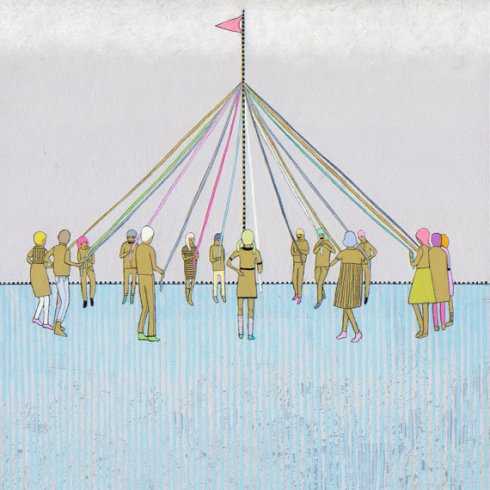
May Day in Central Park, c. 1905, Detroit Publishing Company, Library of Congress; May Pole by Jennifer Davis, Etsy.